Dynamic control and indirect absorption detection for high-speed
capillary electrophoretic separation of organic acids
*
Huan-Tsung Chang , Hsuan-Shen Chen, Richard Lee
Department of Chemistry, National Taiwan University, Taipei, Taipei, Taiwan Received 10 April 1997; received in revised form 3 October 1997; accepted 14 October 1997
Abstract
Dynamic control and indirect absorption detection have been combined for the separation of eight small aliphatic organic acids in less than 4 min. Electroosmotic flow (EOF) coefficients in 5 mM 8-hydroxyquinoline-5-sulfonic acid (8-HQSA) (pH
24 2
3.00) and 3 mM 1,2,4,5-benzenetetracarboxylic acid (BTA) solutions are 4.35 and 1.65?10 cm / V s, respectively. In the BTA system, relatively large amounts of sodium ions adsorbed into the capillary wall are the most probable reason for the small EOF, in turn causing problems for the separation of all acids. In contrast to BTA, 8-HQSA could be used for the separation of all eight organic acids. Limits of detection of analytes are at the level of several tens of mM at pH 3.00 in the 8-HQSA system. This new technique provides several features such as high speed, reasonable resolution and sensitivity, and ease of operation. 1998 Elsevier Science B.V.
Keywords: Detection; Electrophoresis; Buffer composition; Organic acids; Benzenetetracarboxylic acid; Hydroxy-quinolinesulfonic acid
1. Introduction detection [2]. Alternatively, dynamic modification of
the electrolyte pH at the inlet of the capillary by Aliphatic organic acids are difficult to separate and steady addition of a modifying electrolyte was useful detect due to their diverse dissociation constants (K )a for better separation of anions [3]. Changes in and the lack of suitable detection modes. The effective mobilities of analytes by formation of development of suitable analytical methods for these complexes with divalent metal ions have also been compounds is important because of their functions in employed to improve the separation performance of biological system and their presence in foods, bever- organic acids [4]. Simply controlling system tem-ages and medicines. For example, the increase in the perature [5] and performing voltage programming [6] level of some organic acids, so called acidaemia, can have been applied to generating significant changes lead to acidotic coma and even to death [1]. in buffer viscosity and pH for better separations of Reversal of electroosmotic flow (EOF) by adding anions. Recently, we developed a simple method cetyltrimethylammonium bromide (CTAB) to the using dynamic control to improve the separation running buffer has been used to separate six aliphatic performance of organic acids [7]. High-speed and acids in weaker acidic conditions with conductivity high-resolution capillary electrophoretic separations of organic acids were achieved resulting from high *Corresponding author. EOF and pH changes in weak acidic conditions. 0021-9673 / 98 / $19.00 1998 Elsevier Science B.V. All rights reserved.
for 10 s. Analytes were introduced into the capillary for better separation results is the use of binary
by applying a high voltage at 1 kV for 2 s. The buffers [12].
separation was performed at 20 kV. In this study, we further investigated dynamic
control for the separation of aliphatic acids in indirect absorption detection. The possibility to
simultaneously perform indirect absorption detection 3. Results and discussion and dynamic control in CZE was tested with two
different chromophores for the separation of eight Since the molar absorptivities of the aliphatic 3
aliphatic acids. The effects of EOF and chromo- organic acids are very small (e ,10 ) in low-UV phores on the separation performance of organic range (around 210 nm), UV measurement is not acids were compared. High-speed separation and suitable for the detection of diluted acids. Thus, the sensitive indirect absorption detection for acids were use of indirect absorbance for universal and rela-also emphasized. tively sensitive detection of acids is essential. 8-HQSA has been widely used for sensitive detection of metal ions. Maximal absorption of 8-HQSA is
4 21 21
2. Experimental found at 380 nm (e is close to 1.5?10 cm mol l)
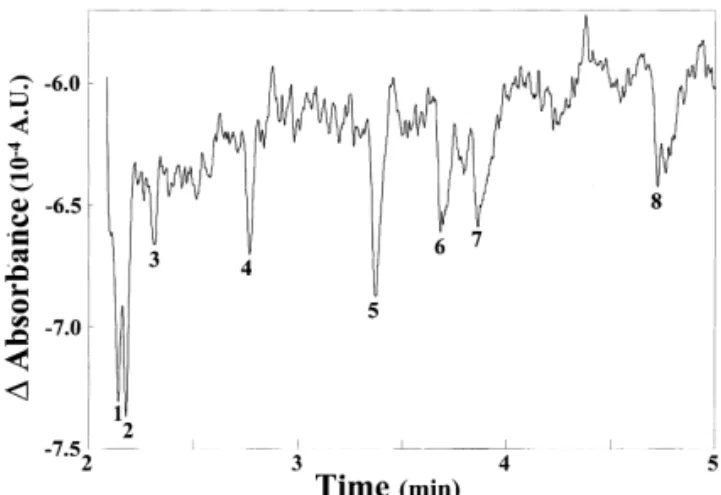
in weaker acidic solutions. In addition, good solu-2.1. Instrument bility in water and strong acidic characteristics make it a suitable candidate for the analysis of organic A commercial electrophoretic instrument from acids. In this study, we chose a detection wavelength Bio-Rad (BioFocus CE 2000, Hercules, CA, USA) of 290 nm for two reasons: better base line and the was used. The fused-silica capillary (Polymicro lack of visible light in our system. Fig. 1 shows the Technologies, Phoenix, AZ, USA) was 35 cm375 separation of eight organic acids in 5 mM 8-HQSA
mm I.D. At 30 cm from the injection end, the at pH 3.00. All eight organic acids were separated in polyimide coating was burned off to form the less than 4 min because of the very high EOF and detection window. The detection wavelength was set relatively small electrophoretic mobilities (EPM) of
at 290 nm. the analytes. The migration order agrees with the
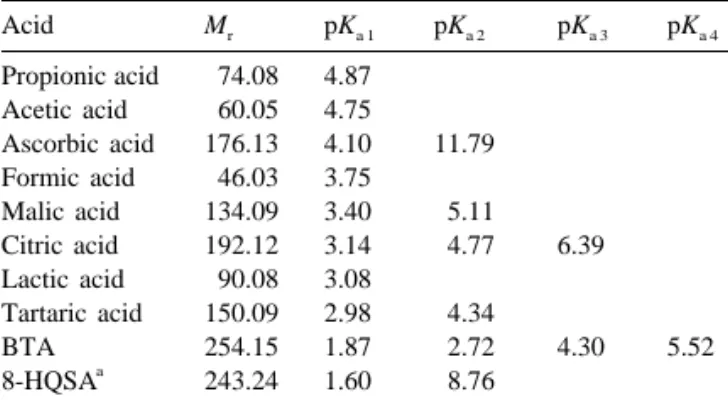
dissociation constants of eight organic acids shown 2.2. Chemicals in Table 1. For citric acid, malic acid and tartaric acid better separation was achieved at pH 3.00 than All chemicals were of reagent grade and were at pH 3.35 (not shown here) in the 8-HQSA system. obtained from Sigma (St. Louis, MO, USA), except On the other hand, worse results were obtained for sodium hydroxide, 8-HQSA and BTA which were acetic acid and propionic acid at pH 3.00. In addition from Fisher (Fair Lawn, NJ, USA). Buffer solutions to better control of dissociation of acids in weak were 5 mM 8-HQSA or 3 mM BTA and slightly acidic conditions, the reversed direction of EOF and
Fig. 1. Separation of eight analytes in 5 mM 8-hydroxy-quinoline-5-sulfonic acid (pH 3.00) buffer solution, with indirect absorption detection and dynamic control in CZE. Column: 35 cm (30 cm effective length) 75 mm I.D.3365 mm O.D. Detection wavelength was set at 290 nm. Peak identities: 1, propionic acid; 2, acetic acid; 3, ascorbic acid; 4, lactic acid; 5, formic acid; 6, citric acid; 7, malic acid and 8, tartaric acid. The inset shows the whole scale.
EPM of analytes is also credited for the high acids could be detected. Table 2 shows the EOF and
resolution. EPM of analytes obtained from the 8-HQSA and
Another chromophore, 1,2,4,5-benzenetetracarbox- BTA systems. EOF coefficients were 4.35 and ylic acid (BTA) was used for the evaluation of the
effects of electrolytes on the separation results in our new method. Fig. 2 shows that only four weaker Table 1
Dissociation constants (pK ) and molecular masses (M ) ofa r organic acids used in this study
Acid Mr pKa 1 pKa 2 pKa 3 pKa 4 Propionic acid 74.08 4.87 Acetic acid 60.05 4.75 Ascorbic acid 176.13 4.10 11.79 Formic acid 46.03 3.75 Malic acid 134.09 3.40 5.11 Citric acid 192.12 3.14 4.77 6.39 Lactic acid 90.08 3.08 Tartaric acid 150.09 2.98 4.34
Fig. 2. Separation of eight analytes in 3 mM
1,2,4,5-benzene-BTA 254.15 1.87 2.72 4.30 5.52
tetracarboxylic acid (pH 3.00) buffer solution with indirect a
8-HQSA 243.24 1.60 8.76
absorption detection and dynamic control in CZE. Conditions are a
EOF coefficients were 4.35?10 cm / V s in 5 mM 8-HQSA and
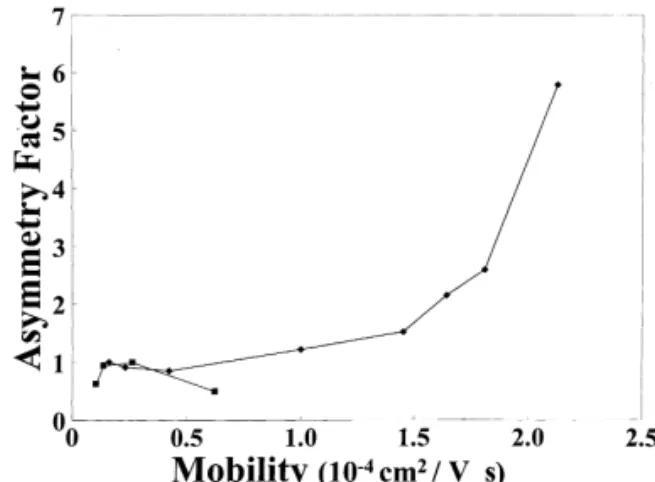
Fig. 3. Asymmetry factors of acids from the results shown in Figs. 24 2
1.65?10 cm / V s in 3 mM BTA. Positive value means flow is
1 and 2. Symbol identities: ♦ from Fig. 1 and j from Fig. 2. toward cathode end.
24 2
1.65?10 cm / V s in the 8-HQSA and BTA solu- performance should be different if analytes with a tions, respectively. One of the possible reasons for wide range of mobilities are separated in these two the smaller EPM of all analytes obtained in the BTA electrolytes. Fig. 3 shows the asymmetry factors system is the smaller z potential in the BTA system (B /A) of analytes in two different electrolytes [16]. because of the addition of larger amounts of sodium Among these eight analytes, B /A ratios of citric acid, ions [13]. It is surprising that two electrolytes, 8- malic acid and tartaric acid are higher than 1 at pH HQSA (zwitterion) and BTA (polyprotic acid), had 3.00, while for weaker monoprotic acids, the ratios such significantly different effects on the change of are slightly smaller than 1. The mobility of 8-HQSA EOF at pH 3.00. In BTA, adsorption of positively at pH 3.00 ranges between those of lactic acid and charged sodium ions (¯3 mM in solution) into the formic acid from B /A ratios. The result shows that capillary wall causes the reduction of the z potential, 8-HQSA is a zwitterion at pH 3.00. It is noted that in turn decreasing EOF [14]. It agrees with the result BTA carries more than one negative charge at pH shown by Salmon et al. that EOF is proportional to 3.00, its mobility is much higher than those of the reciprocal of the square root of the concentrations 8-HQSA and weak acids. The deviations of B /A of NaOH [15]. In addition, competitive adsorption ratios from 1 are reasonably different from those into capillary wall between positively charged obtained in 8-HQSA.
species, such as sodium ions and zwitterionic 8- Fig. 4 shows the separation efficiencies of the HQSA in solution (pH 3.00) is possible for higher organic acids in 8-HQSA and BTA systems. For EOF in the 8-HQSA system. The adsorption of weak monoprotic acids, better efficiencies, as high as 8-HQSA onto the capillary wall through Coulombic one hundred twenty thousand theoretical plates (N ), attractions by its cationic amine, or through hydro- were obtained by using BTA. Comparable efficien-phobic interactions by its heterogeneous ring, may cies were also available for weak acids in 8-HQSA. leave its negatively charged sulfonate group out- Worse efficiencies were observed for polyprotic wards the capillary wall. Hence, EOF remains high- acids in 8-HQSA system. Since migration times of er. On the other hand, in BTA solution, sodium ions all analytes are close, the irregular and significant are dominant in the capillary wall because BTA is decreases in efficiency are abnormal as migration relatively hydrophilic and carries more negative times increase. The trend of the changes in sepa-charges. In other words, it is more difficult for BTA ration efficiencies relating to migration times for all to be adsorbed into capillary wall than 8-HQSA via acids in 8-HQSA can not be predicted from theory. Coulombic interactions or Van der Waals forces. Several possible factors may account for this ob-8-HQSA is a zwitterion, while BTA is a strong servation. First, mobilities of analytes and carrier tetraprotic acid. It is predictable that separation electrolytes are significantly different. This results in
Fig. 5. Separation of eight analytes in 5 mM 8-hydroxyquinoline-Fig. 4. Efficiencies of acids from the results shown in Figs. 1 and 5-sulfonic acid (pH 3.00) buffer solution with indirect absorption 2,5. Symbol identities as in Fig. 3. detection and dynamic control in CZE. Conditions as in Fig. 1
25 except that the concentrations of analytes injected are 3?10 M.
significant peak tailing and fronting for some
ana-lytes. Second, EOF decreases gradually because of serious fluctuation on the signal and shift of the dissociation of negatively charged species of capil- baseline was expected. The other possible problem lary wall. At longer migration time, retardation on sensitivity is low displacement ratio when low pH occurs because the EPM of these acids are higher buffer solution is used. To overcome these short-than small local EOF. This causes irregularly large comings the use of low concentration of a chromo-band broadening on strong polyprotic acids in the phore with pK slightly lower than pH for optimuma 8-HQSA system. The significant decreases in ef- separation conditions is suggested. It is acceptable in ficiencies of ascorbic acid and lactic acid in BTA our system since carrier electrolytes with low buffer reflected the existence of dynamic flow. No detection capacity are better for dynamic control. The merits of polyprotic acids in BTA system also supports the of the use of carrier electrolyte with very low ionic existence of dynamic flow. The agreements rule out strength on sensitivity are reflected in the limit of that the efficiency is dominated by the differences in detection (S /N53) for all analytes estimated from mobilities. In other words, they strongly support the Fig. 5 are in several tens of (mM ranges. It is view that dynamic flow is an important factor on the especially sensitive to citric acid because of its determination of efficiency in this study. Third, the charge capacity and similarity of mobility to that of changes in the composition of the anodic inlet vial the chromophore.
resulting from electrolysis [17,18]. Changes in dis-sociation of acids and electrolytes at higher pH may
generate larger differences in mobilities between 4. Conclusion analytes and carrier electrolytes. The occurrence of a
significant increase in band broadening for tartaric To our knowledge, this is the first paper demon-acid supports this point. Fourth, disturbance of the strated the use of indirect absorption detection and peak of propionic acid from system peak is one dynamic flow for the analysis of organic acids in possible explanation for slightly smaller efficiency of weaker acidic conditions. This new technique is very propionic acid than that of acetic acid. Finally, useful for the analysis of small analytes, which have irregular fluctuation in absorbance, possibly, because wide ranges of dissociation constants and a lack of of dynamic flow and generation of pH gradient, strong optical characteristics. Aliphatic organic acids, should be considered. amino acids, peptides and amines are most suitable At first glance, the high sensitivity is not predicted candidates to be analyzed by this new technique. by the use of our new dynamic technique, since more Overall, it is important to point out some features of
damentals and Applications, John Wiley, New York, 1980, Ch. 12.
[15] K. Salmon, D.S. Burgie, J.C. Helmer, J. Chromatogr. 559 (1991) 69.
References
[16] J.J. Kirkland, W.W. Yau, H.J. Stoklosa, C.H. Dilks Jr., J. Chromatogr. Sci. 17 (1977) 303.
[1] P.W. Felts, Med. Clin. N. Am. 67 (1983) 831. [17] M.S. Bello, J. Chromatogr. A. 744 (1996) 81.
[2] X. Huan, J.A. Luckey, M.J. Gordon, R.N. Zare, Anal. Chem. [18] M.K. Strege, A.L. Lagu, J. Liq. Chromatogr. 16 (1993) 51. 61 (1989) 766.
[3] V. Sustacek, F. Foret, P. Bocek, J. Chromatogr. 545 (1991) 331.