Observation of transverse patterns in an isotropic microchip laser
Y. F. ChenDepartment of Electrophysics, National Chiao Tung University, Hsinchu, Taiwan, Republic of China Y. P. Lan
Institute of Electro-Optical Engineering, National Chiao Tung University, Hsinchu, Taiwan, Republic of China 共Received 20 August 2002; published 22 April 2003兲
An isotropic microchip laser is used to study the characteristics of high-order wave functions in a two-dimensional共2D兲 quantum harmonic oscillator based on the identical functional forms. With a doughnut pump profile, the spontaneous transverse modes are found to, generally, be elliptic and hyperbolic transverse modes. Theoretical analyses reveal that the elliptic transverse modes are analogous to the coherent states of a 2D harmonic oscillator; the formation of hyperbolic transverse modes is a spontaneous mode locking between two identical Hermite-Gaussian modes.
DOI: 10.1103/PhysRevA.67.043814 PACS number共s兲: 42.60.Jf, 42.55.Xi
I. INTRODUCTION
The quantum harmonic oscillator is an excellent peda-gogical system to understand the basic properties of quantum mechanics. The eigenfunction of the two-dimensional 共2D兲 quantum harmonic oscillator can be analytically expressed as Hermite-Gaussian 共HG兲 function with Cartesian symmetry 共x,y兲 or Laguerre-Gaussian 共LG兲 function with cylindrical symmetry (r,) 关1兴. It is well known that the paraxial wave equation for the spherical laser resonators has the identical form with the Schro¨dinger equation for the 2D harmonic oscillator关2–4兴. Since the functional forms of the 2D quan-tum oscillator and the spherical resonators are similar, the higher transverse modes of the spherical resonators can be in terms of HG modes or LG modes. Recently, the pure high-order HG modes and LG modes have been successfully gen-erated from a microchip laser 关5–7兴.
An usually elusive question in quantum mechanics is that of building high-order wave functions that mimics the famil-iar classical periodic orbits for two-dimensional共2D兲 and 3D quantum systems. Modern interest in this topic can, in part, be attributed to the continuous desire to attain a more thor-ough understanding of the quantum-classical connection in mesoscopic systems. For example, some striking phenomena in quantum ballistic cavities are found to be associated with the wave functions in terms of classical periodic orbits 关8–10兴. On the other hand, the semiclassical periodic orbit theory has been used to explain the scarred wave function in the quantum chaos关11–13兴.
Recently, it has been proposed to use optical devices with identical functional form to extract the information of wave functions in mesoscopic systems 关14,15兴. In this work, we use an isotropic microchip laser to study the properties of the high-order wave functions in a 2D isotropic harmonic oscil-lator. Experimental results show that the spontaneous high-order patterns are generally the elliptic or hyperbolic modes corresponding to the classical trajectories. The elliptic modes are found to be analogous to the SU共2兲 coherent states of the 2D quantum harmonic oscillator. The hyperbolic modes are found to be the interference of two identical HG modes with a particular angle p. Theoretical analyses indicate that the
anglep corresponds to the local minimum of the transverse
mode area.
II. EXPERIMENTAL RESULTS
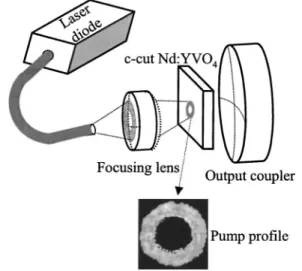
Figure 1 shows the schematic and the pump profile for the present laser system. The experimental laser cavity consists of one planar Nd:YVO4 surface, high-reflection coated at 1064 nm and high-transmission coated at 809 nm for the pump light to enter the laser crystal, and a spherical output mirror. The gain medium in the experiment is a c cut 2.0 at. % 1 mm length Nd:YVO4 microchip crystal. It is worthwhile to note that a c-cut Nd:YVO4 crystal is used to realize an isotropic spherical cavity. The YVO4 crystal be-longs to the group of oxide compounds crystallizing in a Zircon structure with tetragonal space group. The fourfold symmetry axis is the crystallographic c axis. Perpendicular to this axis are the two indistinguishable a and b axes. The uniaxial Nd:YVO4 crystal shows strong polarization-dependent fluorescence emission due to the anisotropic
crys-FIG. 1. Schematic of a fiber-coupled diode end-pumped isotro-pic microchip laser; a tyisotro-pical pump profile of a fiber-coupled laser diode away from the focal plane.
tal field. In a Nd:YVO4 crystal, for example, the stimulated emission cross section parallel to the c axis, 储⫽25 ⫻10⫺19cm2, is four times higher than that orthogonal to the c axis,⬜⫽6.5⫻10⫺19cm2, for the emission wavelength at 1064 nm关16兴. A larger stimulated emission cross section, as usual, results in a lower pumping threshold for laser opera-tion. Therefore, the conventional Nd:YVO4 crystals are cut along the a axis, i.e., the so-called a cut, to use the stimulated emission cross section of储to dominate the laser oscillation. To obtain an isotropic stimulated emission cross section in the transverse plane, however, the Nd:YVO4 crystal should be cut along the c axis, i.e., the so-called c cut.
We setup the resonator length to be as short as possible for reaching single-longitudinal mode operation. The total length in the present resonator is ⬃2.5 mm. The frequency spacing between consecutive longitudinal modes ⌬L is
about 60 GHz. On the other hand, the transverse mode spac-ing for the present cavity is given by
⌬T⫽⌬L
冋
1
cos⫺1
冉
冑
1⫺L
R
冊册
, 共1兲 where R is the radius of curvature of the output coupler. A large⌬T is beneficial to a lasing transverse mode within afrequency-degenerate family. Therefore, we use an output coupler of R⫽10 mm, corresponding to ⌬T⫽10 GHz, to ensure the lasing transverse modes belonging to a frequency-degenerate family. The pump source is a 1.0-W fiber-coupled laser diode共coherent, F-81-800C-100兲 with a 0.1 mm of core diameter. Note that the output intensity profile from an ordi-nary fiber-coupled laser diode is a top-hat distribution. With the special coupling condition, a fiber-coupled laser diode can have a doughnut output profile. It is extremely important to use a doughnut pump profile for controlling the pump region as well as for keeping the cavity isotropic.
First we use an output coupler with the reflectivity of 98% in the laser resonator. The pump spot size is controlled to be nearly 0.2 mm; the intensity of the pump power is approxi-mately 15 W/mm2; the incident angle of the pump beam is within⫾5
⬙
with respect to the longitudinal axis. The size of the observed patterns is in the range of 0.15–0.2 mm. Near lasing threshold, the laser emits elliptic modes with the standing waves in the azimuthal direction. The order of the elliptic mode can be easily varied by controlling the pump size. The eccentricity of the lasing elliptical mode mainly depends on the spot size and incident angle of the pump beam. The measurement of the optical spectrum reveals that the elliptical mode is a single frequency emission. Figure 2 shows two typical experimental results for the near-field transverse pattern on the concave mirror.Increasing the reflectivity of the output coupler to 99%, we generally observe the transverse pattern near lasing threshold to be localized on the hyperbolic trajectories. With the center of the pump beam at the longitudinal axis, the persistent patterns are usually the hyperbolic modes. How-ever, the lasing mode may change to the elliptic patterns when the pump beam is off-axis by 20– 40m. Although the eccentricity of the elliptic modes can be slightly varied by controlling the pump condition, the lasing mode never
be-comes a circle pattern; that is, the eccentricity cannot go to zero. Similar to the elliptic modes, the order and the shape of the hyperbolic modes mainly depend on the spot size and incident angle of the pump beam. Figures 3共a兲 and 共b兲 show two typical experimental results for the near-field transverse patterns on the concave mirror. The hyperbolic mode is also measured to be a single frequency emission. Slightly increas-ing the pump power, the transverse mode displays a coexist-ing pattern that consists of an elliptic mode and an inscribed hyperbolic mode, as shown in Fig. 3共c兲. It is found that the coexisting pattern is also a single frequency emission. More-over, both the elliptic and hyperbolic patterns are linearly polarized and are preserved in free-space propagation. It is well known that only HG modes remain HG field patterns as they propagate. Therefore, the formation of the elliptic and hyperbolic patterns can be interpreted as a spontaneous pro-cess of transverse mode locking of degenerate HG modes. To our knowledge, the elliptic and hyperbolic modes are experi-mentally observed in laser systems.
The power intensity spectra reveal that both the elliptic and hyperbolic modes display self-sustained relaxation oscil-lation. In class-B lasers, relaxation oscillations arise from the energy coupling between field and inversion because of the slowness of population inversion. Therefore, the self-sustained relaxation oscillation is the dynamic characteristics of the class-B laser in a single-mode operation; the present results confirm this property.
III. THEORETICAL ANALYSIS
It is well recognized that the classical Hamiltonian of 2D isotropic harmonic oscillator can be simply expressed in FIG. 2. Typical experimental results for the elliptic transverse patterns near lasing threshold.
terms of the generators of its dynamical group SU共2兲 关17兴. Pollet et al. 关18兴 demonstrated that the geometric discussion of the classical meaning of these quantities leads, in the quantum counterpart, to the construction of the SU共2兲 coher-ent states, which are well localized on the corresponding classical elliptical trajectories. Results concerning the con-struction and properties can be essentially found from Ref. 关19兴. Based on the numerical calculations, it is found that the elliptic modes shown in Fig. 2 are analogous to the SU共2兲 wave packet of a 2D harmonic oscillator. As in the Schwinger representation of the SU共2兲 algebra, the wave function for the elliptic mode is given by关20,21兴
⌿N共x,y;兲⫽ 1 2N/2K
兺
⫽0 N冉
N K冊
1/2 eiKK,N⫺K共x,y兲, 共2兲wherem,n(x, y ) is the HG eigenmode for the spherical
reso-nator关2兴: m,n共x,y兲⫽ 1
冑
2m⫹n⫺1m!n! 1 o Hm冉
&x o冊
Hn冉
&y o冊
⫻exp冋
⫺共x 2⫹y2兲 o 2册
, 共3兲whereois the laser beam waist. The HG transverse mode is
equivalent to the eigenfunction of the 2D quantum harmonic oscillator using the relationship o2⫽2ប/(m), where m is the oscillator mass andis the angular frequency. For high-order modes, the parameterin Eq.共2兲 can be related to the eccentricity of the trajectory e by e⫽2
冑
cos/(1⫹cos), where 0⭐⭐/2. The wave function given in Eq.共2兲 rep-resents a traveling-wave property. The standing-wave repre-sentations can be obtained by replacing the factor eik with sin(K) or cos(K). Including the normalization constant, the standing-wave form for cos(K) can be written as⌿N c共x,y;兲⫽ 1
冋
兺K⫽0 N冉
N K冊
cos 2共K兲册
1/2 ⫻兺
K⫽0 N冉
N K冊
1/2 cos共K兲K,N⫺K共x,y兲. 共4兲Using Eq.共4兲, the patterns shown in Fig. 2 were numerically reconstructed, as depicted in Fig. 4. The good agreement between experimental and reconstructed patterns confirms that the observed elliptic modes are analogous to the SU共2兲 wave packet of a 2D harmonic oscillator.
To interpret the hyperbolic mode, we consider the super-position of two identical HG modes with an arbitrary angle. Due to the isotropic property of the 2D harmonic oscillator, a HG mode under an arbitrary rotation by an angleis still an eigenfunction. Namely, the wave function m,n(x
⬘
, y⬘
) isstill the eigenfunction of the 2D harmonic oscillator, where x
⬘
⫽x cos⫹y sin and y⬘
⫽⫺x sin⫹y cos. The com-pleteness of the eigenfunctions of an Hermitian operator war-rant that the wave function m,n(x⬘
,y⬘
) can be in terms ofthe degenerate eigenstates K,N⫺K(x, y ), where N⫽m⫹n
and K⫽0,1,2,...N. Using the creation and annihilation opera-tors and various identities known from the angular-momentum theory 关22兴, after tedious algebra, m,n(x
⬘
, y⬘
)can be analytically expressed as
m,n共x
⬘
,y⬘
兲⫽兺
K⫽0N
BK共兲K,N⫺K共x,y兲, 共5兲
where BK() can be in terms of the Wigner d function关22兴: FIG. 3. Typical experimental results for the hyperbolic and
co-existing patterns.共a兲 and 共b兲 Pump power near lasing threshold; 共c兲 pump power at 1.2 times lasing threshold.
BK共兲⫽d共N/2兲⫺m,共N/2兲⫺K N/2 共2兲 ⫽
冑
m!共N⫺m兲!K!共N⫺K兲!兺
共⫺1兲 ⫻ 共cos兲 N⫺2⫹K⫺m共sin兲2⫹m⫺K !共N⫺m⫺兲!共K⫺兲!共m⫺K⫹兲!, 共6兲 where the summation over is taken whenever none of the arguments of factorials in the denominator are negative.Using Eqs.共5兲 and 共6兲, the wave packet for the superpo-sition of two identical HG modes of m,n(x, y ) and
m,n(x
⬘
, y⬘
) can be written as ⌽m,N⫺m共x,y;兲⫽m,N⫺m共x,y兲⫹m,N⫺m共x⬘
,y⬘
兲 ⫽兺
K⫽0 N 关BK共兲⫹␦m,K兴K,N⫺K共x,y兲. 共7兲 Here we replace the subscript index n by N⫺m for conve-nient presentation. For stable stationary wave patterns, the angle of the wave function ⌽m,N⫺m(x,y ;) is governedby the criterion of the minimum threshold pump power. The threshold pump power for the transverse mode ⌽m,N⫺m(x,y ;) can be given by关23兴
Pth共兲⫽ ␥Isat p 1 兰兰S共x,y;兲Rp共x,y兲dxdy , 共8兲
where ␥ is the total logarithmic loss per pass, Isat is the
saturation intensity, and P is the pump efficiency, Rp(x, y )
is the normalized pumping distribution, and the normalized intensity distribution S(x,y ;) is given by
S共x,y;兲⫽ 兩⌽m,N⫺m共x,y;兲兩 2 兰⫺⬁⬁ dy兰 ⫺⬁ ⬁ dx兩⌽ m,N⫺m共x,y;兲兩2 . 共9兲
Substituting Eq. 共9兲 into Eq. 共8兲, the threshold pump power for ⌽m,N⫺m(x,y ;) can be written as
Pth共兲⫽ ␥Isat p V共兲
冋
1 兰兰兩⌽m,N⫺m共x,y;兲兩2Rp共x,y兲dxdy册
, 共10兲 where the mode-area function V() is defined asV共兲⫽
冕
⫺⬁ ⬁ d y冕
⫺⬁ ⬁ dx兩⌽m,N⫺m共x,y;兲兩2. 共11兲Numerical calculations confirm that the value of the integra-tion in the square bracket of Eq. 共10兲 is nearly independent of because the present pump profile is cylindrically sym-metric. Therefore, the minimum mode area corresponds to the minimum pump threshold. Substituting Eq. 共7兲 into Eq. 共11兲 and using the orthonormal property, the functional V() becomes
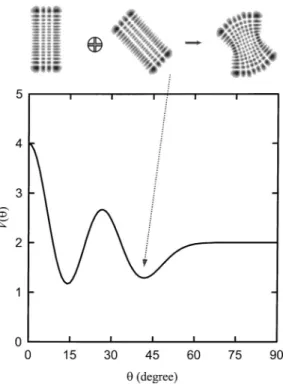
FIG. 5. The mode-area functional V() as a function of for the state⌽17,3(x,y ;). The numerically reconstructed pattern at the
lo-cal minimum pointed to by the arrow corresponds to the experimen-tal result shown in Fig. 3共a兲.
FIG. 4. The theoretically SU共2兲 elliptic standing waves corre-sponding to the results shown in Fig. 2. 共a兲 ⌿35
c
(x,y ;50°); 共b兲 ⌿53
c
V共兲⫽
兺
K⫽0N
兩BK共兲⫹␦m,K兩2. 共12兲
The local minima of V() correspond to the transverse pat-terns near lasing threshold. It is interesting to note that the local minima of the functional V() for high-order mode physically coincide with the local minima of mode area, compatible with the uncertainty relations for the coherent state.
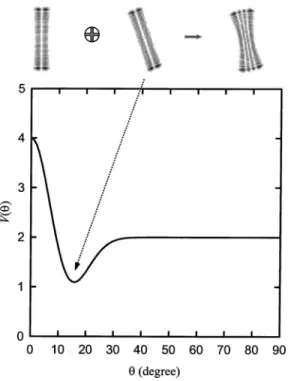
Figure 5 shows the mode-area functional V() as a func-tion offor the state⌽17,3(x,y ;). One of two local minima is found to correspond to the wave pattern localized on
hy-perbolic trajectory. It can be seen that the theoretical wave pattern agrees very well with the experimental pattern shown in Fig. 3共b兲. Note that the wave pattern corresponding to the other local minimum was not excited due to higher lasing threshold. The lasing threshold essentially depends on the pump profile. For a doughnut-shaped pump profile, the ellip-tic and hyperbolic wave patterns usually have lower lasing threshold than the patterns corresponding to other local minima of the mode area. This is the reason why the high-order transverse patterns observed here are usually localized on classical trajectories. Figure 6 shows the mode-area func-tional V() as a function of for the state ⌽39,1(x,y ;). Once again, the wave corresponding to the local minimum is in good agreement with the experimental pattern shown in Fig. 3共a兲.
IV. CONCLUSION
A new type of laser transverse modes has been observed in an isotropic microchip laser pumped by using a doughnut pump profile. The observed transverse modes include elliptic and hyperbolic wave patterns that are analogous to the quan-tum states of classical trajectories of a 2D harmonic oscilla-tor. The elliptic mode is found to be analogous to the SU共2兲 wave packet of a 2D harmonic oscillator. The hyperbolic mode is found to be a spontaneous mode locking between two identical Hermite-Gaussian modes with a particular angle governed by the minimum mode area. The present re-sults support the idea that the optical devices can be deliber-ately designed to simulate the quantum phenomenon in me-soscopic physics关14,15兴. Recently, Doya et al. 关24,25兴 have also introduced the paraxial approximation to establish an analogy between light propagation along a multimode fiber and quantum confined systems. We believe that these analo-gies will continue to be exploited for understanding the phys-ics of mesoscopic systems.
ACKNOWLEDGMENT
The authors thank the National Science Council for their financial support of this research under Contract No. NSC-91-2112-M-009-030.
关1兴 S. Flu¨gge, Practical Quantum Mechanics 共Springer-Verlag, New York, 1971兲, p. 107.
关2兴 H. Kogelnik and T. Li, Proc. IEEE 54, 1312 共1966兲.
关3兴 H. A. Haus, Waves and Fields in Optoelectronics 共Prentice-Hall, Englewood Cliffs, NJ, 1984兲.
关4兴 A. E. Siegman, Lasers 共University Science Books, Mill Valley, CA, 1986兲.
关5兴 Y. F. Chen, T. M. Huang, C. F. Kao, C. L. Wang, and S. C. Wang, IEEE J. Quantum Electron. 33, 1025共1997兲.
关6兴 H. Laabs and B. Ozygus, Opt. Laser Technol. 28, 213 共1996兲. 关7兴 Y. F. Chen and Y. P. Lan, Phys. Rev. A 63, 063807 共2001兲. 关8兴 J. P. Bird, R. Akis, D. K. Ferry, D. Vasileska, J. Cooper, Y.
Aoyagi, and T. Sugano, Phys. Rev. Lett. 82, 4691共1999兲. 关9兴 Y. H. Kim, M. Barth, H. J. Sto¨ckmann, and J. P. Bird, Phys.
Rev. B 65, 165317共2002兲.
关10兴 I. V. Zozoulenko and K. F. Berggren, Phys. Rev. B 56, 6931 共1997兲.
关11兴 M. V. Berry, Proc. R. Soc. London, Ser. A 423, 219 共1989兲. 关12兴 E. B. Bogomolny, Physica D 31, 169 共1988兲.
关13兴 O. Agam and S. Fishman, Phys. Rev. Lett. 73, 806 共1994兲. 关14兴 D. Dragoman and M. Dragoman, Prog. Quantum Electron. 23,
131共1999兲.
关15兴 D. Dragoman, J. Appl. Phys. 88, 1 共2000兲.
关16兴 H. Nagamoto, M. Nakatsuka, K. Naito, M. Yamanaka, K. Yoshida, T. Sasaki, T. Kanabe, A. Nakai, S. Saito, and Y. Ku-wano, Laser Res. 18, 87共1990兲.
关17兴 H. Goldstein, Classical Mechanics, 2nd ed. 共Addison-Wesley, Reading, MA, 1980兲.
FIG. 6. The mode-area functional V() as a function of for the state⌽39,1(x,y ;). The numerically reconstructed pattern at the
lo-cal minimum pointed by the arrow corresponds to the experimental result shown in Fig. 3共b兲.
关18兴 J. Pollet, O. Me´plan, and C. Gignoux, J. Phys. A 28, 7282 共1995兲.
关19兴 A. Perelomov, Generalized Coherent States and Their Appli-cations共Springer-Verlag, Berlin, 1986兲.
关20兴 V. Buzˇek and T. Quang, J. Opt. Soc. Am. B 6, 2447 共1989兲. 关21兴 J. Banerji and G. S. Agarwal, Opt. Express 5, 220 共1999兲. 关22兴 D. A. Varshalovich, A. N. Moskalev, and V. K. Khersonskil,
Quantum Theory of Angular Momentum 共World Scientific, Singapore, 1988兲.
关23兴 K. Kubodera and K. Otsuka, J. Appl. Phys. 50, 653 共1979兲. 关24兴 V. Doya, O. Legrand, F. Mortessagne, and C. Miniatura, Phys.
Rev. Lett. 88, 014102共2002兲.
关25兴 V. Doya, O. Legrand, F. Mortessagne, and C. Miniatura, Phys. Rev. E 65, 056223共2002兲.