系統程式
系統程式
朱浩華教授
朱浩華教授
/
/
施吉昇教
施吉昇教
授
授
Tei-Wei Kuo, Chi-Sheng Shih and Hao-Hua Chu©2006 Department of Computer Science and Information Engineering
Contents
Contents
1.
1.
Preface/Introduction
Preface/Introduction
2.
2.
Standardization and Implementation
Standardization and Implementation
3.
3.
File I/O
File I/O
4.
4.
Standard I/O Library
Standard I/O Library
5.
5.
Files and Directories
Files and Directories
6.
6.
System Data Files and Information
System Data Files and Information
7.
7.
Environment of a Unix Process
Environment of a Unix Process
8.
8.
Process Control
Process Control
9.
9.
Signals
Signals
10.
Multi-processes in modern
Multi-processes in modern
systems
systems
Image that you are now a system architect to
Image that you are now a system architect to
design a new multi-process systems.
design a new multi-process systems.
Q1: How does the systems create a new process and
Q1: How does the systems create a new process and
terminate a process?
terminate a process?
Q2: What processes you need when the system
Q2: What processes you need when the system
starts?
starts?
Q2: Should you impose a communist or democratic
Q2: Should you impose a communist or democratic
system on your system?
Tei-Wei Kuo, Chi-Sheng Shih and Hao-Hua Chu©2006 Department of Computer Science and Information Engineering
Process Control
Process Control
Special Processes
Special Processes
PID 0 –
PID 0 –
Swapper
Swapper
(I.e., the scheduler)
(I.e., the scheduler)
Kernel process
Kernel process
No program on disks correspond to this proce
No program on disks correspond to this proce
ss
ss
PID 1 –
PID 1 –
init
init
responsible for bringing up a Unix sy
responsible for bringing up a Unix sy
stem after the kernel has been bootstrapped. (/et
stem after the kernel has been bootstrapped. (/et
c/rc* & init or /sbin/rc* & init)
c/rc* & init or /sbin/rc* & init)
User process with superuser privileges
User process with superuser privileges
PID 2 - pagedaemon responsible for paging
PID 2 - pagedaemon responsible for paging
Kernel process
Memory Management
Memory Management
Virtual Memory – Demand paging
Virtual Memory – Demand paging
File System
Swap Space
Run
Swap-Out/In
Logical Memory
Memory Map
(Page Table)
Physical Memory
Tei-Wei Kuo, Chi-Sheng Shih and Hao-Hua Chu©2006 Department of Computer Science and Information Engineering
Memory Management
Memory Management
Virtual Memory – Demand paging
Virtual Memory – Demand paging
File System
Swap Space
Run
Swap-Out
Swap-In
CPU
MMU
Page
Table
TLB
Logical
Address
Memory
Physical
Address
Memory Management
Memory Management
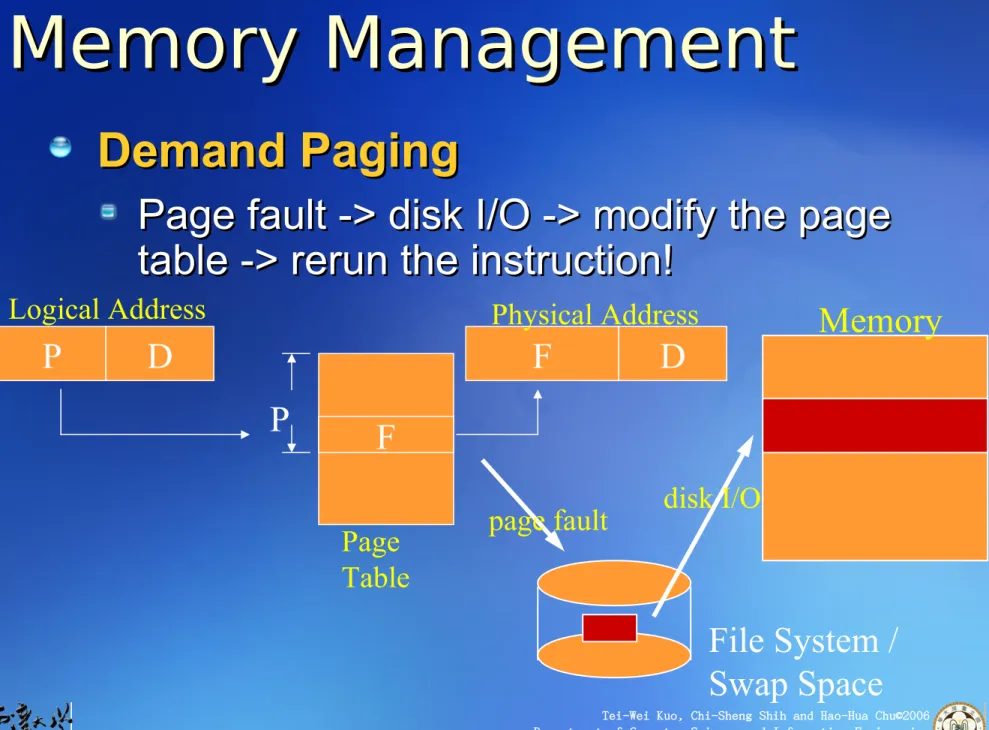
Demand Paging
Demand Paging
Page fault -> disk I/O -> modify the page
Page fault -> disk I/O -> modify the page
table -> rerun the instruction!
table -> rerun the instruction!
F
P
D
P
F
D
page fault
disk I/O
File System /
Memory
Logical Address
Physical Address
Page
Table
Tei-Wei Kuo, Chi-Sheng Shih and Hao-Hua Chu©2006 Department of Computer Science and Information Engineering
Process Control
Process Control
#include <sys/types.h>
#include <sys/types.h>
#include <unistd.h>
#include <unistd.h>
pid_t getpid(void);
pid_t getpid(void);
pid_t getppid(void);
pid_t getppid(void);
uid_t getuid(void);
uid_t getuid(void);
uid_t geteuid(void);
uid_t geteuid(void);
gid_t getgid(void);
gid_t getgid(void);
gid_t getegid(void);
gid_t getegid(void);
None of them has an error return.
Discussion
Discussion
How can your systems have multiple
How can your systems have multiple
processes?
processes?
Tei-Wei Kuo, Chi-Sheng Shih and Hao-Hua Chu©2006 Department of Computer Science and Information Engineering
If ((pid=fork()) == 0){
{
…
}
else {
}
exit(0);
if ((pid=fork() == 0){
{
…
}
else {
}
exit(0);
Parent
Child
fork()
What’s a
What’s a
Fork()
Fork()
Child is an exact copy of the parent process.
Child is an exact copy of the parent process.
They have their own memory space.
fork
fork
#include <sys/types.h>
#include <sys/types.h>
#include <unistd.h>
#include <unistd.h>
pid_t fork(void);
pid_t fork(void);
The only way beside the bootstrap process to
The only way beside the bootstrap process to
create a new process.
create a new process.
Call once but return twice
Call once but return twice
0 for the child process (getppid)
0 for the child process (getppid)
Child pid for the parent (1:n)
Child pid for the parent (1:n)
Copies of almost everything but no sharing of
Copies of almost everything but no sharing of
memory, except text
memory, except text
Copy-on-write (fork() – exec())
Tei-Wei Kuo, Chi-Sheng Shih and Hao-Hua Chu©2006 Department of Computer Science and Information Engineering
fork
fork
Program 8.1 – Page 212
Program 8.1 – Page 212
fork(), race conditions, write vs standard I/O
fork(), race conditions, write vs standard I/O
functions
functions
File sharing
File sharing
Sharing of file offesets (including stdin, stdo
Sharing of file offesets (including stdin, stdo
ut, stderr)
ut, stderr)
Tables of
Opened Files
(per process)
System
Open File
Table
In-core
i-node
list
fork
fork
Normal cases in fork:
Normal cases in fork:
The parent waits for the child to complete.
The parent waits for the child to complete.
The parent and child each go their own way (e.g., ne
The parent and child each go their own way (e.g., ne
twork servers).
twork servers).
Inherited properties:
Inherited properties:
Real/effective [ug]id, supplementary gid, process group ID, ses
Real/effective [ug]id, supplementary gid, process group ID, ses
sion ID, controlling terminal, set[ug]id flag, current working dir, r
sion ID, controlling terminal, set[ug]id flag, current working dir, r
oot dir, file-mode creation mask, signal mask & dispositions, FD
oot dir, file-mode creation mask, signal mask & dispositions, FD
_CLOEXEC flags, environment, attached shared memory segm
_CLOEXEC flags, environment, attached shared memory segm
ents, resource limits
ents, resource limits
Differences on properties:
Differences on properties:
Returned value from fork, process ID, parent pid, tms_[us]time,
Returned value from fork, process ID, parent pid, tms_[us]time,
tms_c[us]time, file locks, pending alarms, pending signals
Tei-Wei Kuo, Chi-Sheng Shih and Hao-Hua Chu©2006 Department of Computer Science and Information Engineering
fork
fork
Reasons for fork to fail
Reasons for fork to fail
Too many processes in the system
Too many processes in the system
The total number of processes for the real uid exceed
The total number of processes for the real uid exceed
s the limit
s the limit
CHILD_MAX
CHILD_MAX
Usages of fork
Usages of fork
Duplicate a process to run different sections of code
Duplicate a process to run different sections of code
Network servers
Network servers
Want to run a different program
Want to run a different program
shells (spawn = fork+exec)
vfork
vfork
Design Objective
Design Objective
An optimization on performance
An optimization on performance
Execute exec right after returns from fork.
Execute exec right after returns from fork.
Mechanism – SVR4 & 4.3+BSD
Mechanism – SVR4 & 4.3+BSD
Since 4BSD
Since 4BSD
<vfork.h> in some systems
<vfork.h> in some systems
No fully copying of the parent’s address space i
No fully copying of the parent’s address space i
nto the child.
nto the child.
Sharing of address space
Tei-Wei Kuo, Chi-Sheng Shih and Hao-Hua Chu©2006 Department of Computer Science and Information Engineering
vfork
vfork
vfork() is as the same as fork() except
vfork() is as the same as fork() except
The child runs in the address space of its parent.
The child runs in the address space of its parent.
The parent waits until the child calls exit or exec.
The parent waits until the child calls exit or exec.
Child process always executes first.
Child process always executes first.
A possibility of deadlock if the child waits for the par
A possibility of deadlock if the child waits for the par
ent to do something before calling exec().
ent to do something before calling exec().
Program 8.2 – Page 217
Program 8.2 – Page 217
vfork,
vfork,
_exit vs exit (flushing/closing of stdout)
_exit vs exit (flushing/closing of stdout)
exit() may close the file descriptors, causing printf() to f
exit() may close the file descriptors, causing printf() to f
ail.
Deadlock – One Example
Tei-Wei Kuo, Chi-Sheng Shih and Hao-Hua Chu©2006 Department of Computer Science and Information Engineering
Process Termination
Process Termination
Eight ways to terminate:
Eight ways to terminate:
Normal termination
Normal termination
Return from main()
Return from main()
exit(main(argc, argv));
exit(main(argc, argv));
Call
Call exit()
Call
Call _exit()
or _Exit()
or
Return of the last thread from its start routine
Return of the last thread from its start routine
Calling
Calling
pthread_exit
pthread_exit
from the last thread.
from the last thread.
Abnormal termination (Chapter 10)
Abnormal termination (Chapter 10)
Call abort()
Call abort()
Be terminated by a signal
Be terminated by a signal
Response of the last thread to a cancellation request.
exit
exit
Termination
Termination
The same code in the kernel is finally execute
The same code in the kernel is finally execute
d.
d.
Close all open descriptors, release memory
Close all open descriptors, release memory
, and the like.
, and the like.
Exit status vs. termination status
Exit status vs. termination status
Exit status (arg from exit, _exit, or return)
Exit status (arg from exit, _exit, or return)
termination status
termination status
In abnormal case, the kernel generates it.
In abnormal case, the kernel generates it.
wait & waitpid to retrieve the termination sta
wait & waitpid to retrieve the termination sta
tus.
Tei-Wei Kuo, Chi-Sheng Shih, and Hao-Hua Chu©2006 Department of Computer Science and Information Engineering
Annoucements
Annoucements
Midterm exam scores are out
Midterm exam scores are out
Average: 68.1
Average: 68.1
Std. Dev: 20.35
Std. Dev: 20.35
MP3 is out today
MP3 is out today
Tei-Wei Kuo, Chi-Sheng Shih and Hao-Hua Chu©2006 Department of Computer Science and Information Engineering
Fun project #1
Fun project #1
Hyperdragging (1999)
Hyperdragging (1999)
Dragging into the physical space
Dragging into the physical space
Fun project #2
Fun project #2
Diamond touch (2005)
Diamond touch (2005)
Lay display flat on the table, and interactions g
Lay display flat on the table, and interactions g
et interesting …
et interesting …
Tei-Wei Kuo, Chi-Sheng Shih and Hao-Hua Chu©2006 Department of Computer Science and Information Engineering
Discussion
Discussion
wait() and waitpid() are called by the par
wait() and waitpid() are called by the par
ent process to retrieve the termination s
ent process to retrieve the termination s
tatus of its child process.
tatus of its child process.
Questions:
Questions:
How to use these functions?
How to use these functions?
What if the child processes terminate before w
What if the child processes terminate before w
ait() and waitpid() are called?
ait() and waitpid() are called?
wait & waitpid
wait & waitpid
#include <sys/types.h>
#include <sys/types.h>
#include <sys/wait.h>
#include <sys/wait.h>
pid_t wait(int *statloc);
pid_t wait(int *statloc);
pid_t waitpid(pid_t pid, int *statloc, int op);
pid_t waitpid(pid_t pid, int *statloc, int op);
wait will block until one child terminates or an error c
wait will block until one child terminates or an error c
ould be returned.
ould be returned.
waitpid could wait for a specific one and has an optio
waitpid could wait for a specific one and has an optio
n not to be blocked.
n not to be blocked.
SIGCHILD from the kernel if a child terminat
SIGCHILD from the kernel if a child terminat
es
es
Default action is ignoring.
Tei-Wei Kuo, Chi-Sheng Shih and Hao-Hua Chu©2006 Department of Computer Science and Information Engineering
wait & waitpid
wait & waitpid
Three situations in calling wait/waitpid
Three situations in calling wait/waitpid
Block
Block
Return with the termination status of a child
Return with the termination status of a child
Return with an error.
Return with an error.
Termination Status <sys/wait.h> – Figure 8.4
Termination Status <sys/wait.h> – Figure 8.4
Access termination status through the following MACROs
Access termination status through the following MACROs
Exit status (WIFEXITED, WEXITSTATUS)
Exit status (WIFEXITED, WEXITSTATUS)
WIFEXITED(status): if successfully exited (true/false)
WIFEXITED(status): if successfully exited (true/false)
WEXITSTATUS(status): exit code
WEXITSTATUS(status): exit code
Signal # (WIFSIGNALED, WTERMSIG)
Signal # (WIFSIGNALED, WTERMSIG)
Core dump (WCOREDUMP)
Core dump (WCOREDUMP)
Others (WIFSTOPPED, WSTOPSIG)
Program 8.5 – Page 222
Program 8.5 – Page 222
void
pr_exit(int status)
{
if (WIFEXITED(status))
printf("normal termination, exit status = %d\n",
WEXITSTATUS(status));
else if (WIFSIGNALED(status))
printf("abnormal termination, signal number = %
d%s\n",
WTERMSIG(status),
#ifdef WCOREDUMP
WCOREDUMP(status) ? " (core file g
enerated)" : "");
#else
"");
#endif
else if (WIFSTOPPED(status))
printf("child stopped, signal number = %d\n",
WSTOPSIG(status));
}
linux1:~/sys_prog_06/test> fig.8.6.exe
normal termination, exit status = 7
abnormal termination, signal number = 6
abnormal termination, signal number = 8
if ((pid = fork()) < 0)
if ((pid = fork()) < 0)
err_sys("fork error");
err_sys("fork error");
else if (pid == 0) /* child */
else if (pid == 0) /* child */
exit(7);
exit(7);
if (wait(&status) != pid) /* wait for child */
if (wait(&status) != pid) /* wait for child */
err_sys("wait error");
err_sys("wait error");
pr_exit(status); /* and print its status */
pr_exit(status); /* and print its status */
if ((pid = fork()) < 0)
if ((pid = fork()) < 0)
err_sys("fork error");
err_sys("fork error");
else if (pid == 0) /* child */
else if (pid == 0) /* child */
abort(); /* generates SIGABRT *
abort(); /* generates SIGABRT *
/
/
if (wait(&status) != pid) /* wait for child */
if (wait(&status) != pid) /* wait for child */
err_sys("wait error");
err_sys("wait error");
pr_exit(status); /* and print its status */
pr_exit(status); /* and print its status */
if ((pid = fork()) < 0)
if ((pid = fork()) < 0)
err_sys("fork error");
err_sys("fork error");
else if (pid == 0) /* child */
else if (pid == 0) /* child */
status /= 0; /* divide by 0 generates SI
status /= 0; /* divide by 0 generates SI
GFPE */
GFPE */
if (wait(&status) != pid) /* wait for child */
if (wait(&status) != pid) /* wait for child */
Tei-Wei Kuo, Chi-Sheng Shih and Hao-Hua Chu©2006 Department of Computer Science and Information Engineering
Zombie process
Zombie process
zombie
zombie
The process has terminated, but its parent
The process has terminated, but its parent
has not yet waited for it.
has not yet waited for it.
It keeps the minimal information for the
It keeps the minimal information for the
parent process.
parent process.
If (pid=fork() == 0){
{
…
exit(0);
}
else {
// parent’s code
}
Parent
Child
fork()
How is a Zombie process created?
How is a Zombie process created?
If (pid=fork() == 0){
{
…
exit(0);
}
else {
// parent’s code
}
Tei-Wei Kuo, Chi-Sheng Shih and Hao-Hua Chu©2006 Department of Computer Science and Information Engineering
Cleaning up Zombies
Cleaning up Zombies
What if the parent process terminates
What if the parent process terminates
before the child process?
before the child process?
Inherited by init
Inherited by init
When a parent terminates, it is done by
When a parent terminates, it is done by
the kernel.
the kernel.
Clean up of the zombies by the init – wait
Clean up of the zombies by the init – wait
whenever needed!
whenever needed!
Discussion: why do we
Discussion: why do we
need zombie?
need zombie?
A parent process can end up with two
A parent process can end up with two
different children that share the same PID.
different children that share the same PID.
A parent process can end up trying to wait
A parent process can end up trying to wait
for the return code of another process’s
for the return code of another process’s
child.
child.
If child process completely disappear, its parent
If child process completely disappear, its parent
process won’t be able to wait on & fetch its
process won’t be able to wait on & fetch its
termination status.
termination status.
Tei-Wei Kuo, Chi-Sheng Shih and Hao-Hua Chu©2006 Department of Computer Science and Information Engineering
wait & waitpid
wait & waitpid
pid_t waitpid(pid_t pid, int *statloc, int op);
pid_t waitpid(pid_t pid, int *statloc, int op);
pid
pid
pid == -1
pid == -1
wait for any child
wait for any child
pid > 0
pid > 0
wait for the child with pid
wait for the child with pid
pid == 0
pid == 0
wait for any child with the same group id
wait for any child with the same group id
pid < -1
pid < -1
wait for any child with the group ID = |pid|
wait for any child with the group ID = |pid|
return
return
pid of the child
pid of the child
0 if WNOHANG flag is set & the specified pid does not
0 if WNOHANG flag is set & the specified pid does not
exit
exit
-1 an error is returned -> how can an error occur?
wait & waitpid
wait & waitpid
Errors
Errors
No such child or wrong parent
No such child or wrong parent
Option for waitpid
Option for waitpid
WNOHANG, WUNTRACED
WNOHANG, WUNTRACED
WNOWAIT, WCONTINUED (SVR4)
WNOWAIT, WCONTINUED (SVR4)
Tei-Wei Kuo, Chi-Sheng Shih and Hao-Hua Chu©2006 Department of Computer Science and Information Engineering
Troubles from Zombie
Troubles from Zombie
Although Zombie processes do not occupy
Although Zombie processes do not occupy
any memory space in the system, it consumes
any memory space in the system, it consumes
process IDs
process IDs
, which are limited resources too.
, which are limited resources too.
You may not be able to fork new child
You may not be able to fork new child
processes when there are too many zombie
processes when there are too many zombie
processes in the systems.
processes in the systems.
CHILD_MAX: max number of simultaneous processes
CHILD_MAX: max number of simultaneous processes
per real user ID
per real user ID
How to fork a new child process but
How to fork a new child process but
not asking the parent process to wait for the child AND
not asking the parent process to wait for the child AND
not generating zombie process?
if (pid1=fork() == 0){
{
if (pid2=fork() == 0) {
}
else
exit(0);
}
else
waitpid(pid1, NULL, 0)
exit(0);
Parent
How to create a background process
How to create a background process
without making a zombie?
without making a zombie?
Child
if (pid1=fork() == 0){
{
if (pid2=fork() == 0) {
}
else
exit(0);
}
else
exit(0);
Grandchild
if (pid1=fork() == 0){
{
if (pid2=fork() == 0) {
sleep(2);
// grandchild exec
}
else
exit(0);
}
else
exit(0);
Tei-Wei Kuo, Chi-Sheng Shih and Hao-Hua Chu©2006 Department of Computer Science and Information Engineering
waitid
waitid
#include <sys/wait.h>
#include <sys/wait.h>
pid_t waitid(idtype_t idtype, id_t id, siginfo_t *infop, int options);
pid_t waitid(idtype_t idtype, id_t id, siginfo_t *infop, int options);
Defined in XSI extension
Defined in XSI extension
Similar to waitpid() but provide extra info.
Similar to waitpid() but provide extra info.
idtype:
idtype:
P_PID: wait for a particular process
P_PID: wait for a particular process
P_PGID: wait for a group of process
P_PGID: wait for a group of process
P_ALL: wait for any child process
P_ALL: wait for any child process
options:
options:
WCONTINUED
WCONTINUED
WNOHANG
WNOHANG
WSTOPPED
WSTOPPED
WNOWAIT: the exit status will be kept for other wait() functions.
WNOWAIT: the exit status will be kept for other wait() functions.
WEXITED
wait3 & wait4 – resource
wait3 & wait4 – resource
usage info
usage info
#include <sys/types.h>
#include <sys/types.h>
#include <sys/wait.h>
#include <sys/wait.h>
#include <sys/time.h>
#include <sys/time.h>
#include <sys/resource.h>
#include <sys/resource.h>
pid_t wait3(int *statloc, int op, struct rusage *rusage);
pid_t wait3(int *statloc, int op, struct rusage *rusage);
pid_t wait4(pid_t pid, int *statloc, int op, struct rusage
pid_t wait4(pid_t pid, int *statloc, int op, struct rusage
*rusage);
*rusage);
4.3+BSD – Figure 8.4, Page 203
4.3+BSD – Figure 8.4, Page 203
User/system CPU time, # of page faults, # of signal
User/system CPU time, # of page faults, # of signal
s received, the like.
Tei-Wei Kuo, Chi-Sheng Shih and Hao-Hua Chu©2006 Department of Computer Science and Information Engineering
Race Conditions
Race Conditions
Def: When multiple processes are
Def: When multiple processes are
trying to do something with shared
trying to do something with shared
data, the final outcome depends on the
data, the final outcome depends on the
order in which the processes run.
order in which the processes run.
Race condition example
Race condition example
A is the number of available copies
A is the number of available copies
of a book = 1.
of a book = 1.
Two processes (transactions)
Two processes (transactions)
running concurrently.
running concurrently.
Race between T1 & T2!
Race between T1 & T2!
T1 wants to buy one copy.
T1 wants to buy one copy.
T2 wants to buy one copy.
T2 wants to buy one copy.
T1 gets an error.
T1 gets an error.
The result is different from any serial
The result is different from any serial
schedule T1,T2 or T2,T1
schedule T1,T2 or T2,T1
How to solve this?
How to solve this?
Locking mechanism
Locking mechanism
T1
T1
T2
T2
R(A=1)
R(A=1)
Check if
Check if
(A>0)
(A>0)
R(A=1)
R(A=1)
Check if
Check if
(A>0)
(A>0)
W(A=0)
W(A=0)
W(A=0)
W(A=0)
Error!
Error!
Tei-Wei Kuo, Chi-Sheng Shih and Hao-Hua Chu©2006 Department of Computer Science and Information Engineering
Another race condition
Another race condition
example
example
Situation: T2 reads an object that has b
Situation: T2 reads an object that has b
een modified by T1, but T1 has not com
een modified by T1, but T1 has not com
mitted.
mitted.
T1 transfers $100 from A to B. T2 adds
T1 transfers $100 from A to B. T2 adds
6% interests to A and B. A non-serializ
6% interests to A and B. A non-serializ
able schedule is:
able schedule is:
Step 1: deduct $100 from A.
Step 1: deduct $100 from A.
Step 2: add 6% interest to A & B.
Step 2: add 6% interest to A & B.
Step 3: credit $100 in B.
Step 3: credit $100 in B.
Why is the problem?
Why is the problem?
The result differs based on different order of
The result differs based on different order of
execution
execution
The result differs from any serial schedule
The result differs from any serial schedule
-> Bank adds $6 less interest.
> Bank adds $6 less interest.
T1
T1
T2
T2
R(A)
R(A)
W(A-100)
W(A-100)
R(A)
R(A)
W(A+6%)
W(A+6%)
R(B)
R(B)
W(B+6%)
W(B+6%)
Commit
Commit
R(B)
R(B)
W(B+100
W(B+100
)
)
Commit
Commit
Race Conditions
Race Conditions
Example: Program 8.8 – Page 225
Example: Program 8.8 – Page 225
Who is the parent of the 2
Who is the parent of the 2
nd
nd
child?
child?
Program 8.12 – Page 229
Program 8.12 – Page 229
Mixture of output by putc + setting of unbuffer
Mixture of output by putc + setting of unbuffer
ing for stdout
ing for stdout
Tei-Wei Kuo, Chi-Sheng Shih and Hao-Hua Chu©2006 Department of Computer Science and Information Engineering
Can you spot the potential race
Can you spot the potential race
condition?
condition?
(avoid zombie processes by calling fork
(avoid zombie processes by calling fork
twice)
twice)
int
int
main(void)
main(void)
{
{
pid_t pid;
pid_t pid;
if ((pid = fork()) < 0) {
if ((pid = fork()) < 0) {
err_sys("fork error");
err_sys("fork error");
} else if (pid == 0) { /* first child */
} else if (pid == 0) { /* first child */
if ((pid = fork()) < 0)
if ((pid = fork()) < 0)
err_sys("fork error");
err_sys("fork error");
else if (pid > 0)
else if (pid > 0)
exit(0); /* parent from second fork == first child */
exit(0); /* parent from second fork == first child */
/*
/*
* We're the second child; our parent becomes init as soon
* We're the second child; our parent becomes init as soon
* as our real parent calls exit() in the statement above.
* as our real parent calls exit() in the statement above.
* Here's where we'd continue executing, knowing that when
* Here's where we'd continue executing, knowing that when
* we're done, init will reap our status.
* we're done, init will reap our status.
*/
*/
sleep(2);
sleep(2);
printf("second child, parent pid = %d\n", getppid());
printf("second child, parent pid = %d\n", getppid());
exit(0);
exit(0);
}
}
if (waitpid(pid, NULL, 0) != pid)
if (waitpid(pid, NULL, 0) != pid)
/* wait for first child */
/* wait for first child */
err_sys("waitpid error");
err_sys("waitpid error");
/*
/*
* We're the parent (the original pr
* We're the parent (the original pr
ocess); we continue executing,
ocess); we continue executing,
* knowing that we're not the pare
* knowing that we're not the pare
nt of the second child.
nt of the second child.
*/
*/
exit(0);
exit(0);
}
}
What if the 2nd child exit
What if the 2nd child exit
before the 1st child calle
before the 1st child calle
d exit(0)?
d exit(0)?
- parent of 2nd child is n
- parent of 2nd child is n
ot init by the 1st child.
ot init by the 1st child.
What if the 2nd child exit
What if the 2nd child exit
before the 1st child calle
before the 1st child calle
d exit(0)?
d exit(0)?
- parent of 2nd child is n
- parent of 2nd child is n
ot init by the 1st child.
Race Conditions
Race Conditions
How to synchronize parent and child proce
How to synchronize parent and child proce
sses?
sses?
Busy wait?
Busy wait?
Waste CPU time, other means possible: Inter-Proce
Waste CPU time, other means possible: Inter-Proce
ss Communication facility, such as pipe fifo, semaph
ss Communication facility, such as pipe fifo, semaph
ore, shared memory, etc.
ore, shared memory, etc.
Program 8.13 on Page 206
Program 8.13 on Page 206
WAIT_PARENT(), TELL_CHILD(), WAIT_CHILD(),
WAIT_PARENT(), TELL_CHILD(), WAIT_CHILD(),
TELL_PARENT()
TELL_PARENT()
while (getppid() != 1)
sleep(1);
Tei-Wei Kuo, Chi-Sheng Shih and Hao-Hua Chu©2006 Department of Computer Science and Information Engineering
Can you spot the potential race
Can you spot the potential race
condition?
condition?
(avoid zombie processes by calling fork
(avoid zombie processes by calling fork
twice)
twice)
int
int
main(void)
main(void)
{
{
pid_t pid;
pid_t pid;
if ((pid = fork()) < 0) {
if ((pid = fork()) < 0) {
err_sys("fork error");
err_sys("fork error");
} else if (pid == 0) { /* first child */
} else if (pid == 0) { /* first child */
if ((pid = fork()) < 0)
if ((pid = fork()) < 0)
err_sys("fork error");
err_sys("fork error");
else if (pid > 0)
else if (pid > 0)
exit(0); /* parent from second fork == first child */
exit(0); /* parent from second fork == first child */
/*
/*
* We're the second child; our parent becomes init as soon
* We're the second child; our parent becomes init as soon
* as our real parent calls exit() in the statement above.
* as our real parent calls exit() in the statement above.
* Here's where we'd continue executing, knowing that when
* Here's where we'd continue executing, knowing that when
* we're done, init will reap our status.
* we're done, init will reap our status.
*/
*/
sleep(2);
sleep(2);
printf("second child, parent pid = %d\n", getppid());
printf("second child, parent pid = %d\n", getppid());
while (getppid() != 1)
sleep(1);
exit(0);
exit(0);
}
}
if (waitpid(pid, NULL, 0) != pid)
if (waitpid(pid, NULL, 0) != pid)
/* wait for first child */
/* wait for first child */
err_sys("waitpid error");
err_sys("waitpid error");
/*
/*
* We're the parent (the original pr
* We're the parent (the original pr
ocess); we continue executing,
ocess); we continue executing,
* knowing that we're not the pare
* knowing that we're not the pare
nt of the second child.
nt of the second child.
*/
*/
exit(0);
exit(0);
}
}
What if the 2nd child exit
What if the 2nd child exit
before the 1st child calle
before the 1st child calle
d exit(0)?
d exit(0)?
- parent of 2nd child is n
- parent of 2nd child is n
ot init by the 1st child.
ot init by the 1st child.
What if the 2nd child exit
What if the 2nd child exit
before the 1st child calle
before the 1st child calle
d exit(0)?
d exit(0)?
- parent of 2nd child is n
- parent of 2nd child is n
ot init by the 1st child.
Can you spot the potential race
Can you spot the potential race
condition?
condition?
Program 8.12 on page 229
Program 8.12 on page 229
static void charatatime(char *);
static void charatatime(char *);
int main(void)
int main(void)
{
{
pid_t pid;
pid_t pid;
if ((pid = fork()) < 0) {
if ((pid = fork()) < 0) {
err_sys("fork error");
err_sys("fork error");
} else if (pid == 0) {
} else if (pid == 0) {
charatatime("output from child\n");
charatatime("output from child\n");
} else {
} else {
charatatime("output from parent\n");
charatatime("output from parent\n");
}
}
exit(0);
exit(0);
}
}
static void charatatime(char *str)
static void charatatime(char *str)
{
{
char *ptr;
char *ptr;
int c;
int c;
setbuf(stdout, NULL); /* set unbuffered */
setbuf(stdout, NULL); /* set unbuffered */
for (ptr = str; (c = *ptr++) != 0; )
for (ptr = str; (c = *ptr++) != 0; )
$ ./a.out
$ ./a.out
ooutput from child
ooutput from child
utput from parent
utput from parent
$ ./a.out
$ ./a.out
output from child
output from child
output from parent
output from parent
Tei-Wei Kuo, Chi-Sheng Shih and Hao-Hua Chu©2006 Department of Computer Science and Information Engineering
Avoid race condition
Avoid race condition
#include <sys/types.h>
#include <sys/types.h>
#include "ourhdr.h"
#include "ourhdr.h"
static
static
void
void
charatatime(
charatatime(
char
char
*);
*);
int
int
main(
main(
void
void
)
)
{
{
pid_t pid;
pid_t pid;
if
if
( (pid = fork()) < 0)
( (pid = fork()) < 0)
err_sys("fork error");
err_sys("fork error");
else
else
if
if
(pid == 0)
(pid == 0)
{
{
charatatime("output from child\n");
charatatime("output from child\n");
}
}
else
else
{
{
charatatime("output from parent\n");
charatatime("output from parent\n");
}
}
exit(0);
exit(0);
}
}
static
static
void
void
charatatime(
charatatime(
char
char
*str)
*str)
{
{
… …
… …
}
}
TELL_WAIT();
TELL_WAIT();
WAIT_PARENT(); // parent goes first
WAIT_PARENT(); // parent goes first
TELL_CHILD(pid);
exec (6 variations)
exec (6 variations)
Replace the text, data, heap, and stack segments of a proc
Replace the text, data, heap, and stack segments of a proc
ess with a program!
ess with a program!
Specify: new program, command line args, environment
Specify: new program, command line args, environment
#include <unistd.h>
#include <unistd.h>
int execl(const char *pathname, const char *arg0, … /* (char *)
int execl(const char *pathname, const char *arg0, … /* (char *)
0 */);
0 */);
int execv(const char *pathname, char *const argv[]);
int execv(const char *pathname, char *const argv[]);
int execle(const char *pathname, const char *arg0, … /* (char
int execle(const char *pathname, const char *arg0, … /* (char
*) 0, char *const envp[] */);
*) 0, char *const envp[] */);
int execve(const char *pathname, char *const argv[], char *co
int execve(const char *pathname, char *const argv[], char *co
nst envp[]);
nst envp[]);
int execlp(const char *filename, const char *arg0, … /* (char *)
int execlp(const char *filename, const char *arg0, … /* (char *)
0 */);
0 */);
int execvp(const char *filename, char *const argv[]);
Tei-Wei Kuo, Chi-Sheng Shih and Hao-Hua Chu©2006 Department of Computer Science and Information Engineering
exec
exec
l
l
,
,
v
v
, and
, and
e
e
stands for list, vector, and environment, r
stands for list, vector, and environment, r
espectively.
espectively.
command-line arg must end with null pointer
command-line arg must end with null pointer
Limit on # of command line args: ARG_MAX
Limit on # of command line args: ARG_MAX
With
With
p
p
, a filename is specified unless it contains ‘/’.
, a filename is specified unless it contains ‘/’.
PATH=/bin:/usr/bin:.
PATH=/bin:/usr/bin:.
/bin/sh is invoked with “filename” if the file is not
/bin/sh is invoked with “filename” if the file is not
a machine executable.
a machine executable.
When do you want to change environ parameters?
When do you want to change environ parameters?
login process
login process
exec
exec
Inherited from the calling process:
Inherited from the calling process:
pid, ppid, real [ug]id, supplementary gid, proc gid, se
pid, ppid, real [ug]id, supplementary gid, proc gid, se
ssion id, controlling terminal, time left until alarm clo
ssion id, controlling terminal, time left until alarm clo
ck, current working dir, root dir, file mode creation m
ck, current working dir, root dir, file mode creation m
ask, file locks, proc signal mask, pending signals, re
ask, file locks, proc signal mask, pending signals, re
source limits, tms_[us]time, tms_cutime, tms_ustime
source limits, tms_[us]time, tms_cutime, tms_ustime
FD_CLOEXEC flag
FD_CLOEXEC flag
Requirement
Requirement
Closing of open dir streams
Closing of open dir streams
May change:
May change:
effective user/group ID if new program has set-uid-I
effective user/group ID if new program has set-uid-I
D bit set
Tei-Wei Kuo, Chi-Sheng Shih and Hao-Hua Chu©2006 Department of Computer Science and Information Engineering
exec
exec
In many Unix implementations, execve() is a
In many Unix implementations, execve() is a
system call, other exec are library functions
system call, other exec are library functions
calling execve().
calling execve().
Program 8.8 – Page 235
Program 8.8 – Page 235
Program 8.9 – Page 236
Program 8.9 – Page 236
The prompt bet the printing of argv[0] and argv[1].
The prompt bet the printing of argv[0] and argv[1].
execvp
execlp
execv
execl
execve
execle
build argv
build argv
build argv
try each
PATH prefix
use
environ
exec example
exec example
char *env_init[] = { "USER=unknown", "PATH=/t
char *env_init[] = { "USER=unknown", "PATH=/t
mp", NULL };
mp", NULL };
int int main(void) main(void) { {pid_t pid;pid_t pid;
if ((pid = fork()) < 0) {if ((pid = fork()) < 0) {
err_sys("fork error");err_sys("fork error");
} else if (pid == 0) { /* specify pathname, specify environment */} else if (pid == 0) { /* specify pathname, specify environment */
if if
(execle("/mnt/professor/hchu/sys_pro
(execle("/mnt/professor/hchu/sys_pro
g_06/test/fig8.17.exe", "echoall", "myar
g_06/test/fig8.17.exe", "echoall", "myar
g1", "MY ARG2", (char *)0, env_init) < 0)
g1", "MY ARG2", (char *)0, env_init) < 0)
err_sys("execle error");
err_sys("execle error");
}
}
if (waitpid(pid, NULL, 0) < 0)if (waitpid(pid, NULL, 0) < 0)
err_sys("wait error");err_sys("wait error");
if ((pid = fork()) < 0) {if ((pid = fork()) < 0) {
err_sys("fork error");err_sys("fork error");
} else if (pid == 0) { /* specify filename, inherit environment */} else if (pid == 0) { /* specify filename, inherit environment */
if (execlp("fig8.17.exe", "echoall",
if (execlp("fig8.17.exe", "echoall",
"only 1 arg", (char *)0) < 0)
"only 1 arg", (char *)0) < 0)
err_sys("execlp error");
err_sys("execlp error");
}
}
exit(0);
exit(0);
linux1:~/sys_prog_06/test> fig8.16.exe
linux1:~/sys_prog_06/test> fig8.16.exe
argv[0]: echoall
argv[0]: echoall
argv[1]: myarg1
argv[1]: myarg1
argv[2]: MY ARG2
argv[2]: MY ARG2
USER=unknown
USER=unknown
PATH=/tmp
PATH=/tmp
linux1:~/sys_prog_06/test> argv[0]: echoall
linux1:~/sys_prog_06/test> argv[0]: echoall
argv[1]: only 1 arg
argv[1]: only 1 arg
USER=hchu
USER=hchu
LOGNAME=hchu
LOGNAME=hchu
HOME=/home/professor/hchu
HOME=/home/professor/hchu
PATH=/usr/bin:/bin:/usr/X11R6/bin:/opt/kde/bin:.
PATH=/usr/bin:/bin:/usr/X11R6/bin:/opt/kde/bin:.
MAIL=/var/mail/hchu
MAIL=/var/mail/hchu
SHELL=/bin/tcsh
SHELL=/bin/tcsh
SSH_CLIENT=140.112.30.82 46314 22
SSH_CLIENT=140.112.30.82 46314 22
SSH_CONNECTION=140.112.30.82 46314 140.112
SSH_CONNECTION=140.112.30.82 46314 140.112
.30.32 22
.30.32 22
SSH_TTY=/dev/pts/5
SSH_TTY=/dev/pts/5
TERM=xterm
TERM=xterm
DISPLAY=localhost:10.0
DISPLAY=localhost:10.0
LANG=zh_TW.Big5
LANG=zh_TW.Big5
HOSTTYPE=i486-linux
HOSTTYPE=i486-linux
VENDOR=intel
VENDOR=intel
OSTYPE=linux
OSTYPE=linux
MACHTYPE=i486
MACHTYPE=i486
SHLVL=1
SHLVL=1
PWD=/home/professor/hchu/sys_prog_06/test
PWD=/home/professor/hchu/sys_prog_06/test
GROUP=users
GROUP=users
HOST=linux1
HOST=linux1
Tei-Wei Kuo, Chi-Sheng Shih and Hao-Hua Chu©2006 Department of Computer Science and Information Engineering
program 8.17
program 8.17
#include "apue.h"
#include "apue.h"
int
int
main(int argc, char *argv[])
main(int argc, char *argv[])
{
{
int i;
int i;
char **ptr;
char **ptr;
extern char **environ;
extern char **environ;
for (i = 0; i < argc; i++) /* echo all command-line args */
for (i = 0; i < argc; i++) /* echo all command-line args */
printf("argv[%d]: %s\n", i, argv[i]);
printf("argv[%d]: %s\n", i, argv[i]);
for (ptr = environ; *ptr != 0; ptr++) /* and all env strings */
for (ptr = environ; *ptr != 0; ptr++) /* and all env strings */
printf("%s\n", *ptr);
printf("%s\n", *ptr);
exit(0);
exit(0);
}
}
Changing User/Group ID’s
Changing User/Group ID’s
This part is confusing … (when I read it)
This part is confusing … (when I read it)
Why changes user id in the middle of a
Why changes user id in the middle of a
program execution?
program execution?
Least-privilege model: a program should use the least
Least-privilege model: a program should use the least
privilege necessary to accomplish any task.
privilege necessary to accomplish any task.
Reduce window of security vulnerability
Reduce window of security vulnerability
Example: a process needs to gain a privilege to
Example: a process needs to gain a privilege to
access a privileged file
Tei-Wei Kuo, Chi-Sheng Shih and Hao-Hua Chu©2006 Department of Computer Science and Information Engineering
Recall …
Recall …
A
A
process
process
can have more than one ID.
can have more than one ID.
Real user/group ID: who you really are
Real user/group ID: who you really are
Effective user/group ID: determine file access
Effective user/group ID: determine file access
permission
permission
Supplementary group IDs
Supplementary group IDs
Saved set-user/group-ID = owner of the
Saved set-user/group-ID = owner of the
program with set-user-id bit set
program with set-user-id bit set
Why do you need saved set-user-id?
Why do you need saved set-user-id?
cannot give up privilege temporarily (and get it back)
Recall …
Recall …
#include <sys/types.h>
#include <sys/types.h>
#include <unistd.h>
#include <unistd.h>
int setuid(uid_t uid);
int setuid(uid_t uid);
The process == superuser
The process == superuser
set real/effective/saved-suid =
set real/effective/saved-suid =
uid
uid
Otherwise, euid=
Otherwise, euid=
uid
uid
if
if
uid
uid
== ruid or
== ruid or
uid
uid
== saved-suid (suid = se
== saved-suid (suid = se
t-uid)
t-uid)
Return 0 upon success
Return 0 upon success
Return -1 otherwise, errno=EPERM (_POSIX_SAVED_IDS)
Return -1 otherwise, errno=EPERM (_POSIX_SAVED_IDS)
int setgid(gid_t gid);
int setgid(gid_t gid);
The same as setuid
Tei-Wei Kuo, Chi-Sheng Shih and Hao-Hua Chu©2006 Department of Computer Science and Information Engineering