A
Codeword
Weight
Lower Bound
for a Class of
Tail-Biting Turbo
Codes
Zheng Yan-Xiu and Yu T. Su Department of Communications Engineering National Chiao Tung University, Hsinchu, TAIWAN [email protected] [email protected] Abstract- Thispaper presents anachievablecodewordweight
lower bound associated with weight-2 input sequences of a class
ofturbo codes. The classofcodes has aninterleaverstructurethat encompasses most practical interleavers usedbyturbo codes. It
partitions the incoming information sequenceinto blocks ofthe same size and the interleaver performs intra-block and inter-block permutations. Both pre- and post-permuted blocks are
individually tail-biting encoded. Following [4], we refer to the codewordassociated withaweight-2 inputsequence as a
weight-2 error event. We apply a special permutation function that
incorporates the separate encoding concept to derive a lower bound of the weight-2 error event. This lower bound reveals that(i)alargercomponent codeperiod givesbetterdistancefor the weight-2 error events, and (ii) separate encoding results in
improved distance if the block length issuitably chosen andis
large enough.
I. INTRODUCTION
Considerareasonablegood interleaver of size N. Partition-ing an N-bitgroup into L = FN
W]
or LN Wj-bitblocks,wefind theinterleaving rule rendersaninter-blockpermutation
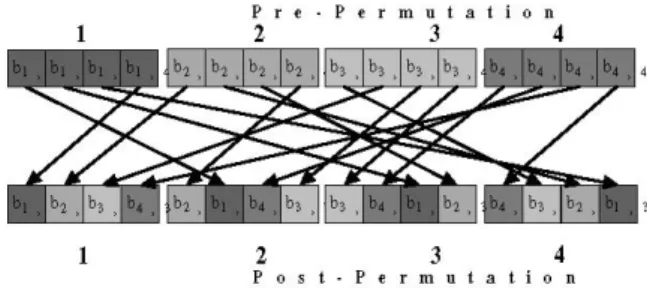
structure like that shown in Fig. 1. Such a structure can be foundinother codes suchasproduct codes (block turbo codes, BTCs). Hence both classic convolutional turbo codes (CTCs) and BTCs can be considered as subclasses of the recently proposed inter-block permuted (IBP) turbo codes (IBPTCs) [3] whose interleaver performs consecutive intra- and then inter-block permutations.
However, an interleaver used in a classic CTC, after the above virtual partition, usually yields a non-regular local interleaving structure, i.e., the interleaving relation between a
block and other blocks inthesamegroupdoes notfollow the
same permutation rule. In contrast, product codes and some
IBPTCs have muchmoreregular local interleaving structures. An appropriate regular local interleaving (and deinterleaving)
structure makes implementation easier and offers properties that are useful for parallel decoding, e.g., (memory access) contention-free andsimpler routing requirement.
Another distinction between classic CTCs and other sub-classes of IBPTCs is that, for a classic CTC with an
in-terleaving size of N bits (in L virtual blocks), encoding of consecutive blocks is often continuous. On the otherhand, a
product codearrangesNinformation bitsin a twodimensional
array and encodes each row and column separately (discon-tinuously). The class of IBP turbo codes (IBPTCs) can also encodes each blockseparately.
Betweenthetwo separate(discontinuous) encoding options, thetail-biting encoding scheme, since it can do without
tail-bits, givesahigher spectral efficiency. Moreover, itwasshown that [1], [2], as a tail-biting CTC can eliminate some error events acrossneighboring blocks, improved distanceproperties
can be obtained. Weiss et al. [2] proposed a product code (without the check-on-check part) whose column and row vectors are tail-biting encoded convolutional codewords and
derived somedistance properties.
1 P2r e - P e r m u t a t3 i o n4
1 2 3 4
P o s t - P e r m u t a t i o n
Fig.1. The inherent inter-blockinterleavingstructure canbe foundin most
practical interleavers.
The codeword associated with a weight-2 input sequence was called a weight-2 error event by Breiling [4] for an
obvious reason. Most CTC interleaver designs [6], [3] take this class of errorevents into account,trying tomaximize the minimumweight of theseerror events.Breiling [4] suggesteda
novelpartitionstrategy toderiveupperbounds for the
weight-2 error events. Although the upper bound is not as tight as moregeneralupperbounds [4], [5] which consider othererror events as well, weight-2 error event remains an important
design concern.
As mentionedbefore, ageneralIBPinterleaver [3] encom-passes many existing interleavers as special subclasses. It is built on smaller interleavers and uses some re-permutation
across these interleavers to construct a larger interleaver. By usingasuitableIBPrule,anIBPTCcanpossessgood distance properties.Itis therefore reasonableto conjecture that the
dis-tancespectrumofaCTCusinganIBPinterleaver andseparate
encoding would offersomedesiredproperties. Thepurposeof thispaperisto validateapartof this conjecture. Wederivea
general lower bound for the weight-2 error events associated withgeneral IBP-interleaved CTCs. By analyzing the effects
ISIT2007, Nice, France,June 24-June29,2007
of selectedparticularsystem parameters onthisgeneralbound
we obtain someusefuldesign guidelines. Weuse a
simplified
partition rule presentedin[4] andapplyaregularpermutation function to derive the bound. We also examine some
special
casesand evaluate distance lower bounds of the
weight-2
errorevents for different block lengths.
The rest paper is organized as follows. The next section
presents our derivation of the achievable weight-2 lower bound.InsectionIII,weexaminesomespecial
codes,
evaluate the corresponding distance bounds and discuss theresulting
design constraints. The last section contains some
concluding
remarks.
II. THE ACHIEVABLEWEIGHT-2 INPUT LOWER BOUND
Forconvenience ofsubsequentdiscourse, weneedtodefine
somenotations tobeginwith. Definition 1:
lxly
X modY.(1)
Definition 2:
IIXIIY
= { Xlx
XX0
=(2)
Definition 3:
scrbjLb(u)
is the weight of alength-L
tail-biting convolutional code outputfor ainput
sequence u.Definition 4:
W21(L)
= min scrbL(u
J),
i,j,ji-jjT,AO,|L-i+jlT,- tU
The simplified partition rule for the (k = 0) and post-permutation (k = 1) is givenby
F(k)
j
{+ C: °<ji
<FTL
'i +
Tcj
:
°
<
j
<
LT }7
ith pre-permutation setsF(
, k = 0,1 0 <i
<
LI
T
ILIT,
<i<Tc(5)
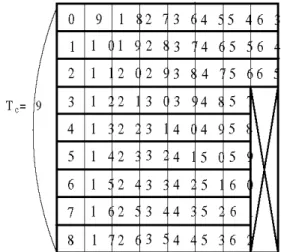
An exemplary partition of (5) is shown in Fig. 2 where the integersrepresentthe coordinates of eitheranpre-permutationorpost-permutation sequence. Each row represents an index
set
Fk)
and is of size 8 or7.Tc=
(3)
where
u'j
isaweight-2inputsequencewithnonzeroelementsat coordinatesi andj. Definition 5: 9 1 )2 i3 64 j5 11
41
2 3 456
211 2 O2 345
" 6 31i22
3 O3 i4 15 ; 4 1i2 i3 4 4 G5 / 51 42 i3 44 15 O5 4132
3445
6 7 426 j3 44 5 ;6 1 1 23
45
5 W1(L)
=minscrb (u'),
(4)
where
u'
is a weight-I input sequence with the nonzeroelement located atcoordinate i.
scrbfL
(uij)
islower-boundedbya i+H13
ora(L
Tij)
+13
[4], whereT,
is the period of the convolutional code used. MoreoverscrbjLj(uij)
>W2(L)
if i-j
Ir,
0and L i -i
jT,
:y7
0; otherwise scrbfL(uij)
= amin
},
(L -) +13.
Furthermore,
if nopuncturing
is applied, the linearity of the convolutional code
implies
a
(L-TC)
+ 3<W2(L)
<(L+T+)
+1. A. Partition ruleSystematic recursive convolutional code used in a CTC is equivalentto anIIR scrambler whose
period
hasagreatimpact
onthe distancepropertyof the associated CTC.Afinite
weight
codeword can be generated
by
aweight-k input
sequence,k > 2. Ifk= 2,the distance of thesetwo nonzerocoordinates
must be divisible by the period.
Breiling
[4]
applies
thisproperty to partition the coordinates of
input
sequences intosome equivalence classes in which any two coordinates is associated with afinite
weight
codeword. He concluded thata larger component period
implies
a smallerprobability
in generating low weightcodewords.Fig. 2. Partition ofequivalenceclasses; L=66, T,=9.
B. Main Theorem
In this section we establish our main result whose
proof
needs thefollowing two lemmas.
Lemma 1: Foreach integer set
Sx
={f0,
1,2, ..., X-1},
there existsapermutation ruleHx such that
minj#AjESx
(iS
-jix+w1-x(i)
-wx(j)Ix,
li
-jX
+x-1FX(i)
w-X(j)lX,X-xi-
Ix
+FX(i)
-Fx(j)
x,2X -ji -jlx
-I7FX(i)
-x(j)|x)
> r +1,
where r =Xa
-1. Apermutation
satisfying these constraints is
qilq
gcd(X, r)
x(6)
Proof: Itis obvious that the
inequality
holdsif i-jIx
> r andX -i-jlx
> r. Hence weconsider i-jlx
< r or X -i-jlx
<r only.When i > j and 0 < i-j < r,
gcd(X,
r)
< r and r =X-]
1< Ximplies
that q =X/gcd(X, r)
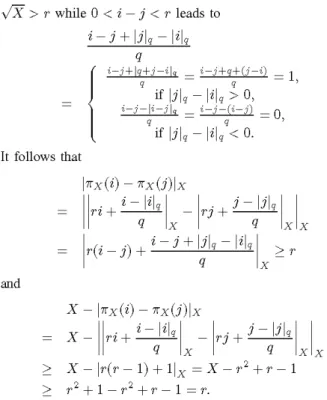
> x >X > rwhile 0 <i-j < rleads to i
-j+
jlq
-lilq
q{
i-j+lq+j-ilq q ifljlq
i-j-li-jl q ifljlq
i-j+q+(j -i) q -lilq
>0, 1-j-(i-j) q -lilq
< 0-Itfollows that7iX(t)
-lx(i)lx
q x qr(i
-j)+i
-ij
+ljlq -liq
qan
and
Proof: We place the elements in the jth n-element set in a cycle by j + i(NI+ N2 -L2
2]),
where 0 < i < n and 0 < j < N1. The elements of the jth (n- 1)-element set are placed at positions indexed(
[iN2+±j-N] (N1+Al)+N1+
iN2N1+jl,1,
0
~(7)
by
NlN2n+Al-+LNN2+JMN
iN2+-i
<Al3,
N|N|2
In
+ 13+ - 3(N Al+) +N+
iN2
+j-N1
- 3A3M2, otherwise,
whereO<i<n-1,N <j<Ni+N2,Ml =N2
L-N2],
M2 = N2N2]
and M3 = Ml N2n It is easy to seethat such an arrangement achieve the bounds and no larger
minimumseparationcanbe found. U
lxIx >r X 7Fj-(i) wx(ji)x X- ri+ q rj+ V x x q -x = q X r(r )+lIX X r2+r > r2+1- r2+r- =r.
Therefore,
minj,j,s.(i
j+ 7FX(i)-wx(j)
Ix
i1FX(i) -wx(j)lx)
>r+ 1.Thispermutation function is q-invariantinthat
7Fx(li
-qlx)
-wx(Ij
-qlx)lx
N9+=
9
j+X (i q)+(i-q)-i-qlq
q-r(j
q)
+(ji-q)-
Ij-
qlq
q = ri + tiq
rj
.+xl
x q x q x 7Fx(i) -wx(j)Ix
Wenow show that both the remaining cases canbe converted
into the above case.
(A) For thecasei <j andO <j-i < r, wehave
li-jlx
i+X
-jlx
= i +X-mq-(j-mq)lx
= i'-j'l
andw-Fx(Ii+X-mqIx)--wx(jr-mqIx)Ix
= 7FX(i)- wx(j)|x,X >i' = i +X
-mqlx
>j' =Ij-mqlx
>O for somem >0.
(B)Ifi>j,X -i
-jlx
= X+j-ilx
=X+j-mq-(i-mq)l
=lj'-i'l
and7-Fx(1i-mqIx)--wx(IX+j-mqlx)Ix
= 17x(i)- wrx(j)Ix, x >V =Ii
+X >mqx>j' =
Ij-mqlx
>Ofor somem>0.Lemma 2: GivenN1 distinct n-elementsetsandN2 distinct
(n -)-element sets, where n> 1.Ifwearrange all elements
in these N1 +N2 setsinto acycle, the minimum separation
among elements in the same set is lower-bounded by N1 + N2-FN21 for the n-element sets, and N1+ N2-L]N2 for
the (n-1)-element sets. Moreover,there areat most
IN2 In
element pairs with separation N1 +N2-F N2] for thesen-element sets. n= 8 /0 9 1 82 63 44 25 0 \ 1 1 0 1 92 73 54 35-5 1'. 2 1 12 02 83 64 45 2> -G1
5N2=
6111z=-==~~~~~~~~~~~~~~~~~~~~~~~~~~~~~~~~~~~~~~~~1
\8
4 '41=N2=Fig.3. Setmapping; N1 =3, N2=6andn 8.
Fig. 3 shows a exemplary placementfor N1 3, N2 = 6
andn=8. The minimumseptationintheseN1 8-element and
N2 7-element setsis atleast 7 and 8,
respectively.
Moreover,there are only
IN2
8 = 6 element pair withseparation
7 forthese 8 elementsets.
Since the scrambler output weight of the weight-2 error
events is lower-boundedbythe difference ofan
(i,
j)
coordi-nate pair, the weight ofa tail-biting encoded CTC is lower-bounded by
min(2+W(i,j,L)+
W(w(i),
w(j), L))
l,jwherewFis alengthL permutation function and
{
W(iL+
othei-rT
=0W(i,
j,
L)
= aLc
-ii
+13
IL|-Ii-jIIT,
W2
(L)
, otherwise(8)
O
(9)
Basedonthe aboveresults, we canprove
Theorem 1: There existsaseparatetail-bitingencoded CTC of blocklength L whose minimum codeword
weight
W2,minI+N I
1 2
ISIT2007, Nice, France, June 24-June29, 2007
for weight-2 inputsequences is lower-boundedby W2,min > 2 +2p3+ min(W2(L) +
aDmin
13,aTDmin
min ( Nmax ]2N2IN,,,)
+oDmax max ( Nmax]
-2IN22
IN
))), (10)where 2W14(L) > 2+
CTDmin
+W2(L)+/3, DmindT,-UN 1
NDmax
=
dTs
dax
-
LN
Nil'ax
N2
=
dTs
l Ld dT,'d
Nmax
=d2T%
1,d=gcd(|
LT,7Tc)
and T, is the number of blocks involvedin encoding.Proof: Tail-biting encoding results in low-weight code-words whose nonzero coordinates are confined to the tail and the head parts of two consecutive sets. This hap-pens if one nonzero coordinate of a weight-2 input
se-quence belongs to
Fk)
and the other one belongs to(li+T-ILITk)
IT,
One can then place the set F(k)-(k)
right
after the set Fi so thatthey
form acycle.
Ifgcd(ILIT,
Tc)= d,wehave dcycles with the mthcycle being(k)
_
I{(k)
F(k)
(k)F~m - lFm7
lrlm+T,-ILITJIT,'
|m+2(T,-ILIT9)IT,'
|(k
-1)(TC LT)},where 0<m <d.(k)
Mapping the coordinatesin
FmV
sequentiallytotheintegers in the interval [0 m 1 = i], we obtain the setSlF(k)l
={0,1,2,.
- 1}. We further partitionSjF(k)
into dT, sets
{Si},
whereISi
Nmax[d2ii
1 for0< i < N dT and
I,Si
Nmin
LdiTJ
for dT -N2
= dT < i < dT,.According
to Lemma2,
we can maximize the minimum separation of
Si
toDmin
=dT _ [N>] and Dmax=
dTi,
NL
] for 0 < i < NanddlS N2 <i < dT, respectively.
We can construct anIBPrule such thatp C
Si
and q CSi
are permuted to the same block iff
Ii -jIT
= 0. Since allblocks canapply thesamepartitionrule forpermutation, such
an IBPrule does exist.
Incorporating separateencoding results inthattwo indexes
in twodifferent blocksproduceacodewordweight largerthan the bound, either the pre-permuted orthepost-permuted pair
makes the codeword weight
2W1(L).
Therefore we consider the case two indexes are permutedto the sameblock.There are d sets
Si
and d sets SI (2) AllSi
C SF(1)l canbepermutedtodifferentSIF(2)
Iftwo indexes areintwodifferent
Si's,
either the pre-permuted or the post-permutedpair makes the codeword weight >
W2(L),
which is largerthan the bound. Therefore we onlyhave to consider the case
whenacoordinatepairbelongstothesame
Si
before and after permutation.According to Lemma 1, the separation sum of pre-permutationandpost-permutationfor
Si
withNmaxandNmin
elements can be F Nmax] and
F/Nmin]
respectively.Ac-cording toLemma2,the minimumseparationoftwoadjacent
indexes is
Dmin
and there are at mostIN21Nmax
pairs with such a separation. The minimum codeword weight is thuslower-bounded by 2 +avDminmin(2 N2
N,,
FNmax])
+avDmax
max(FNm-ax]
-2 N2Nm,as
x 0) +2/3.
Finally,wenotice that smallweighterror event occurswhen thetwocoordinate pair (i,j) CFm is such that i-j #4 0
and
IL
-i-jI
T7y
0and the separation of thepermuted pair (w-F l(i), (jFl(j))
is greater thanTcDmin.
The correspond-ing codewordweight will beatleast2+W2 (L)+aDmmi
+/3. Therefore, wehavewt(X'j)
> 2+2/3
+min(W2(L) +CaDmin
-3, ovDminmin (2N2Nmas,,
oaDmaxmax( Nmax
[1
-2Nf2NI,])+
ma7)) (1 1)U
If L> (TC+2d)M, wehave
TlcDmin
min(2 N2
NNm,,+TcDmax
max(V_Nmax
2 N2Nmasc
7,
U)
< Tc
dTJs
dJ < Md( dlT
+1+1) < lsL +d2M2 + dM <+ (L-2dlili)L+d2M2+dM <V'L_
2dML+d2M2+dM=L, (12) whereM =TlT,. ThenaDmin
min (2N21N|,
Nmax])+ oDmaxmax
VNmax
2N21N,
°) +13
< aL +1 < W2(L)+a,
Tc
c (13)if nopuncturing is applied for the scrambler.
Corollary 1: If the block length L is greater than
(TC
+2d)Mandnopuncturing isapplied,then there existsaseparate
encoding tail-biting turbo code whose minimum codeword weightW2,min forweight-2inputsequencesis lower-bounded by
W2,min
>2 +aDDmin
min(2N2
IN,,
[ Nmax+ozDmax
max ( Nmax- 2N2
N ,0) +2/3,
(14)
where 2W1(L) > 2 +
avDmin
+W2(L)
+13,
M TcTs,Dmin
=
dTS
-
[N2]
Dmax
=dT
[JN2
=
dsl,
dlldT 'Nmax
=dTJ
d=gcd(LIT,lTc)
and Ti isthe number of blocks involvedinencoding.
III. NUMERICAL EXAMPLES
Weevaluates lower bounds for the scramblers
given
inTable I.Figs. 4-6plot the lower bounds for various interleaverlengthISIT2007, Nice, France, June 24 - June 29, 2007
TABLE I
(a, B) FOR SOME SCRAMBLERS.
Scramblers
TT
(a, B)1+D2
1+D+D2 3 (2, 2)
1
+D+D2
7 (4,2)1+D
+D4+D
15 (8,2)T, L. Larger component code periods generally give better
bounds, asindicatedby these curves.
Separate encoding improves the lower bounds for some
interleaver lengths but also imposes constraints on interleaver lengths. These figures shows 10-50 weight improvements on
the lower bound for long interleaver lengths but W2(L) is small for short interleaver lengths. Fig. 6 indicates that, the lower bound is a decreasing function of
T,
for short block length. Corollary] saysthat W2(L) is not a dominant factor of the lower boundifthe blocklength constraintL >(TC+2d)M
is satisfied.
Fig. 4 compares theupperbound [4] and the lower bound
we derived. The large "gap" between the upper and lower bounds is duetothe fact that[4] doesnotconsider theweight-2
error eventsresulted fromadjacent partitions butourderivation does. The gap would be much reduced if these events were
taken into account.
co N 140 - 120- 100-80 -60 -40 -L *Ts-T=1
--T=2
---&---T =4 ---T=6 ---T=8 Upperbound[4] 150 -120 -m aT) o 90- 60- s-_Tr=a ---T=2 ---T =3 ---4---T=4 Fill=5 400 800 1200 Interleaver Length i+D+D3Fig.5. Theweight2lower bound for theScrambling function 1D2 DT3
360 -200 0) 120-40 co Fig. 6. The 1 D2+D3 +D4 1+D+D4 800 InterleaverLength 1600
weight 2 lower bound for the Scrambling function
201
-200 400
InterleaverLength
600
Fig.4. Theweight2lower boundforthe Scramblingfunction 1++DD2
IV. CONCLUSION
This paper derives a general achievable codeword weight lower bound for theweight-2erroreventswhenaseparate tail-biting encoded CTCuses twoidentical scramblers (component codes) and an IBP interleaver. The bound implies separate
encoding stands a better chance to obtain a weight-2 lower boundlarger than that of the conventional continuous encoding scheme ifthe block length is not too small and is properly chosen. The relationships between these two parameters and
the lower bound provide useful design guideline for the
800 separate tail-biting encoded CTCs.
REFERENCES
[1] C.Weiss,C. Bettstetter, S.Riedel,D. J.Costello, "Turbo decoding with tail-biting trellis,"in Proc. ISSSE'98, Pisa,Italy,pp. 343-348, 1998.
[2] C.Weiss,C. Bettstetter, S.Riedel, "Codeconstructionanddecodingof
parallel concatenated tail-biting codes,"IEEE Trans. Inform., vol. 47,
no. 1,pp.366-386 Jan.2001.
[3] Y-X.Zheng,Y T.Su,"Onthe inter-block permutation and turbocodes,"
in Proc.3ndInter Sympo. Turbocodes, Brest, France,pp.107-110, Sep.
2003.
[4] M. Breiling, J. B. Huber, "Combinatorial analysis ofthe minimum
distanceofturbo codes," IEEE Trans. Inform. Theory, vol. 47, no7,
pp.2737-2750, Nov.2001.
[5] A.Perotti,S.Benedetto,"A newupperboundontheminimumdistance
ofturbocodes,"IEEETrans.Inform. Theory,vol.50,no.12,pp. 2985-2997,Dec.2004.
[6] C.Fragouli, R. D.Wesel,"Semi-random interleaver design criteria,"in Proc. Globecom'99,RiodeJaneiro, Brazil,pp.2352-2356, 1999.