Property Evaluation of PET Fiber and Metal Fiber Composite Woven
Fabric
Yuan-Jen Chang
1, Bing-Chiuan Shiu
2, Jia-Horng Lin
2, 3, 4, aand
Ching-Wen Lou
1,b1Institute of Biomedical Engineering and Material Science, Central Taiwan University of Science
and Technology, Taichung 406, Taiwan, R.O.C.
2Laboratory of Fiber Application and Manufacturing, Department of Fiber and Composite Materials,
Feng Chia University, Taichung City 407, Taiwan, R.O.C.
3School of Chinese Medicine, China Medical University, Taichung 40402, Taiwan, R.O.C. 4Department of Biotechnology, Asia University, Taichung 41354, Taiwan, R.O.C.
Corresponding email: a[email protected]b[email protected]
Keywords: electrical conduction , woven fabric, stainless steel monofilament, function fabric. Abstract: This study aims to fabricate strong mechanical properties and electrical conduction woven fabric, which provides flexible and strength for application. Polyethylene Terephthalate fiber (PET fiber) having fine mechanical properties are widely used in industry, as well as metal fiber are often used on electromagnetic shielding and static electricity protection. This study took both advantages of PET fiber and metal fiber for water sensitive functional textile. The result showed that warp yarns has a tensile strength of 1363.3N/mm and weft yarns has a tensile strength of 1483.3N/mm. In addition, both textiles with 20 wt% water absorption can be electrical conduction. Various metal yarns have different electrical resistivity and conductivity with various water absorption percentage.
Introduction
Recently new functional textiles have been emerging in wearable technology. Especially, electronic textiles with wearable sensors have a significant potential in healthcare application [1]. Electronic textiles can provide electrical conduction for sensors to transmit signals. These products integrating textiles and electronic sensors are so called “smart textiles”. The potential market is wide in sports, healthcare or military [2]. Woven fabric, which has very fine detail and subtle directional effects, has planar structure pliable enough to be made into three-dimensional products. In woven fabric fabricating process, it can easily control warp yarn and filling yarn. For wearable sensors it must have enough mechanical properties and electrical conduction. Therefore, it is important to know the way their dielectrical properties change with the changes of resistance and electric current in electric field [3]. In addition, high strength of polyethylene terephthalate fiber and stainless steel monofilament were used through fabricating process to increase tensile strength of polyester fiber yarns by inserting stainless steel monofilament. The dense structure with enough mechanical properties can enhance water absorption for textiles. Various materials were reported
for flexible textiles sensor fabrication. The first one is to print silver nanoparticles on non-woven fabric for humidity sensing [2]. The second is to use humidity sensitive polymer for woven sensors [4]. In this study,commercial woven fabric, i.e. high strength polyethylene terephthalate fiber and stainless steel monofilament were used to constitute textile through fabricating process. The mechanical properties and electric characteristics of the woven fabric were tested after manufacturing.
Experimental
Preparation of Samples
The commercial woven fabrics made from PET(fineness: 500 D, Universal Textile CO., LTD ), PET and stainless steel monofilament with diameter 0.01 mm/cm2 (King's Metal Fiber Technology
Co., Ltd) were used in this study. The woven fabrics are generally composed of two sets of yarns and interlaced at right angles. The system of yarn extending along the woven fabric makes the warp, while the system of yarn over the width makes the woven yarn weft. The tested samples were in blain weave with yarns made from filament fibers, and the warp density is 20 pick/inch,weft is 36 pick/inch, every 10 cm insert stainless steel monofilament for electrical conduction.
Air permeability
The air permeability test of the warp knits was evaluated using air permeability tester (FX3300, Switzerland) as specified in ASTM D737. Ten pieces of samples measuring 25 cm×25 cm were used for each specification of textile.
Tensile Strength
The tensile strength along the warp and weft directions of the warp knits was evaluated by Instron5566 (Instron, U.S.A.) as specified in CNS-12915. The settings are as follows: Sample size is 200×50 mm2; the number of the samples is 5 of each specification; the distance between fixtures
is 20cm; and the tensile speed is 300 mm/min. Stiffness
A Flexometer (Kuoeh Tsuan Scientific Company, Taiwan, ROC) is employed to measure the stiffness of the samples according to cantilever method specified in CNS 12915. The woven fabric was cut into 150×25 mm2 along the warp and weft direction, respectively and then mounted on the
platform of the instrument. The length (cm) of the sample protruding the platform horizontally before starting bending downward represents the stiffness, the longer the protruding length, the greater the stiffness.
Burst strength
The burst strength was tested by Instron5566 (Instron, U.S.A.) as specified in CNS-129150. The number of samples is 5 pieces with diameter 8 cm for each specification, and the burst strength speed is 10 cm/min.
Electrical and structural properties
The PET woven fabric sample is 30 cm × 15 cm and contain stainless steel monofilament. The stainless steel monofilament distance is 10 cm. The sample water absorbs over 100% weight
percent (wt%) through dense structure. The electrical conduction of smart textiles was measured using Agilent 34401A multimeter with DC 15V.
Results and discussion
Figure 1 shows that the stainless steel monofilament single-core and four-core resistance with water weight percent. It shows that there is about 1.5 MΩ difference between single-core and four-core PET woven fabric at 20 wt% water weight percentage. The water absorption of PET woven fabric depends on various dense structure. The single-core and four-core textiles have difference contact area with water and proportional inversely to the resistance of water in the range of 20 wt% to 80 wt%. It is near equivalent to the water saturation in the range of 80 wt% to 100 wt%.
20% 40% 60% 80% 100% 0 0.5 1 1.5 2 2.5 3 3.5 4 4.5 5 Single-core Four-core
Water weight percent
R es is ta n ce (M Ω )
Figure1. Water weight percent of single-core and four-core and stainless steel monofilament for resistance
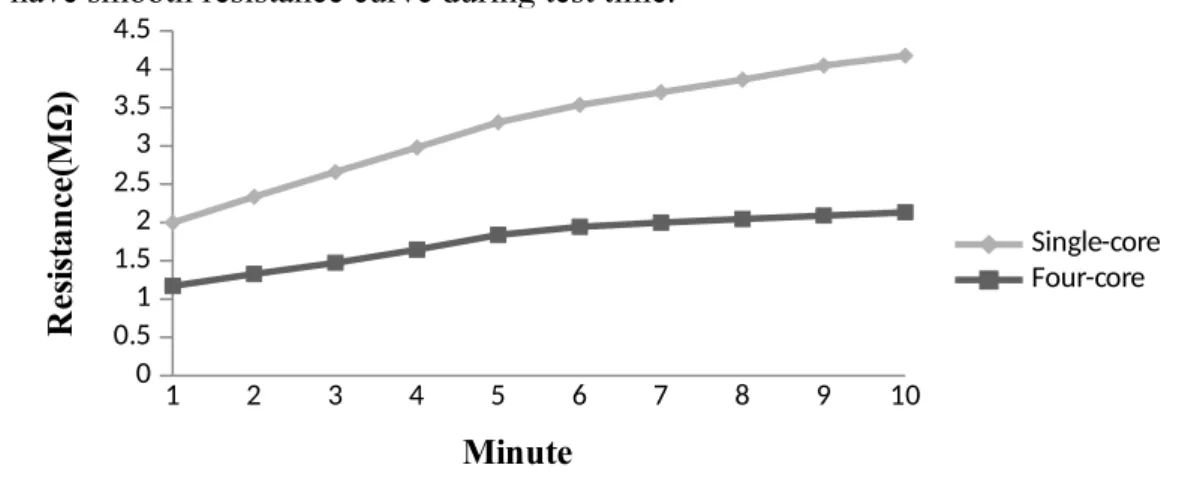
Figure 2 shows the time of water weight percentage loss for PET woven fabric with single-core and four-core of stainless steel monofilament at 70 % relative humidity (RH) and 25 C environment. The resistance from the time 1 minute to 10 minute was observed. The single-core stainless steel monofilament shows higher loss rate of water weight percentage than four-core. The four-core have smooth resistance curve during test time.
1 2 3 4 5 6 7 8 9 10 0 0.5 1 1.5 2 2.5 3 3.5 4 4.5 Single-core Four-core Minute R es is ta n ce (M Ω )
Figure 2. Time of water weight percent loss of single-core and four-core and stainless steel monofilament for resistance
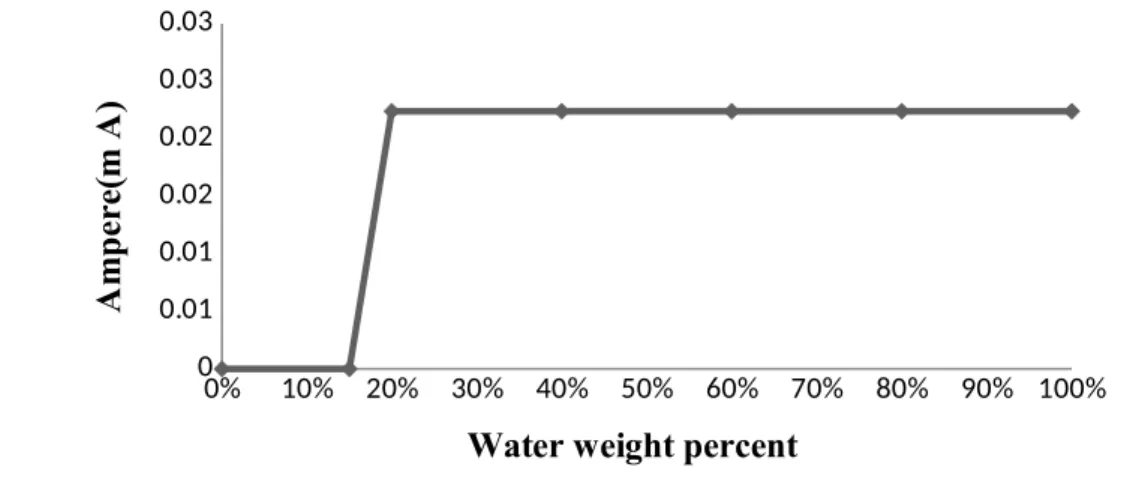
Figure 3 shows the electrical characteristics of woven fabric with input of DC 15V on stainless steel monofilament. It indicates an interesting result of electrical evaluation. The sample with 20wt
% shows electric current 0.024 mA and has electrical conduction. It can be utilized for woven sensors to sense water weight percent of textiles.
0% 10% 20% 30% 40% 50% 60% 70% 80% 90% 100% 0 0.01 0.01 0.02 0.02 0.03 0.03
Water weight percent
A m p er e( m A )
Figure3.The electrical characteristics of woven fabric
Table 1 shows the PET woven fabric prerogative. There is no significant difference in stiffness because the warp and weft density caused little drapability. The warp and weft of the tensile strength were 1363.3 N/mm and 1483.3 N/mm, respectively. The tensile strength of weft is greater than the weft because the unit area is higher for the weft yarns than warp yarns. Although dense structure reduces air permeation, in this study, the selection of materials for high-strength PET to obtain higher burst strength.
Table 1.PET woven fabric prerogative
Stiffness Tensile Strength Air permeability Burst strength
Warp 7.3 cm 1363.3 N/mm 16.7±0.7
cm3/cm2/s
1036.8±195 N /cm2
Weft 6.4 cm 1483.3 N/mm
Conclusion
This research successfully produces the electrical conduction woven fabric with dense structure
for advancement water absorption applied in water sensibility textiles. The single-core has good resistance response of the time, 20 wt % to 100 % has about 1.5MΩ difference, and the four-core only about 0.2 MΩ difference. But four-core has smooth resistance curve and low resistance. The electrical characteristics of woven fabric shows electrical conduction 20 %wt water weight percentage.
References
[1] M.Z. Poh, N.C. Swenson, and R. W. Picard, Ming-Zher Poh, Student Member, IEEE, Nicholas C. Swenson, and Rosalind W. Picard, IEEE T. Bio-Med. Eng. 57 (2010) 1243-1252.
[2] J. Weremczuka, G. Tarapata, R. Jachowicz, Humidity sensor printed on textile with use of ink-jet technology, Procedia Engineering, 47 (2012) 1366-1369.
[3] D.D. Cerovic, K. A. Asanovic, S. B. Maletic, J.R. Dojcilovic, Comparative study of the electrical and structural properties of woven fabrics, Compos. Part B-Eng. 49 (2013) 65-70.
[4] C. Atamana, T. Kinkeldei, A. Vasquez Quinteroa, F. Molina Lopez, J. Courbat, K. Cherenack, D. Briand, G. Tröster, N. F. de Rooij, Humidity and Temperature Sensors on Plastic Foil for Textile Integration, Procedia Engineering, 25 (2011) 136-139.