ABSTRACT: A new silicon-containing oxirane triglycidyl phenyl silane oxide (TGPSO) and its corresponding silicon-containing epoxy resins are synthesized and character-ized. The activation energies of TGPSO curing reaction with various curing agents, including 4,4-diaminodiphenylmethane, 4,4-diaminodiphenylsulfone, and dicyanodi-aminde, are found to be 180, 196.5, and 154 kJ/mol. The curing reaction of TGPSO with diamines is determined to be a first-order reaction through means of Arrhenius plots. The introduction of the silicon-containing group results in higher curing reactivity. This silicon-containing resin possesses higher char yield as well as higher limiting oxygen index (LOI5 35) than the commercial epoxy resins, confirming the usefulness of these silicon-containing epoxy resins as flame retardants. Char yields and LOI measure-ments demonstrate that incorporating silicon into epoxy resins is able to improve their flame retardancy.© 1999 John Wiley & Sons, Inc. J Appl Polym Sci 73: 1231–1238, 1999
Keywords: silicon; epoxy; char yield; limiting oxygen index
INTRODUCTION
Epoxy resins are widely used in casting, coating, adhesion, and composite applications. In some applications, epoxy resins require versatile and special functions, such as high adhesion to the substrates, low shrinkage, and low thermal stress after cure, good toughness, low flammability, and good chemical resistance. To meet some applica-tion requirement, several approaches have been utilized to enhance the thermal properties of ep-oxy.1,2Apart from that, the flammability of epoxy resins is a major disadvantage in their applica-tion. Recently, some organosilicon compounds have been found highly effective as epoxy flame retardant. Organofunctional alkoxysilanes or poly-siloxane are frequently used as epoxy
modifi-ers,3–5polymer composites,6 and in polymeric or-ganic–inorganic hybrids.7 Organosilicon
com-pounds exhibit higher flame retardancy, without generating toxic gas and smoke, than the halo-gen-containing compounds. Silicon-containing compounds have been known to possess many excellent properties, such as high resistance to thermal oxidation, imparting nonflammability, low glass transition temperature, and low surface energy to the resin.8The conventional practice of
introducing siloxane compounds into polymers has been achieved by blending those polymers with polydimethylsiloxanes.9 Most epoxy resins,
such as the diglycidyl ether of bisphenol A (DGEBA), are carbon based, whereas the silicon-containing epoxies are inorganic based; therefore they are usually immiscible and phase separation limits incorporation of a large amount of silicon compound. Such limitation leads to a more seri-ous problem of bleeding of silicon components. Therefore, in order to reduce the above limitation,
Correspondence to: G.-H. Hsiue.
Journal of Applied Polymer Science, Vol. 73, 1231–1238 (1999)
© 1999 John Wiley & Sons, Inc. CCC 0021-8995/99/071231-08
silicones with reactive groups are utilized to pre-pare polymers that possess siloxane bond in the backbones or on side chains. Several approaches for reaching the above goal have been reported.10 –14
Making these compounds for flame-retardant ep-oxy resin involves complicated schemes in organic synthesis, and they have lower curing reactivity with commercial curing agents and are immisci-ble with the organic system. These characteristics limit the application of these compounds as flame retardants.
In this study, phenyltrimethoxyl silane was used to react with epichlorohydrin in order to prepare the trifunctional epoxy monomer contain-ing silane linkages. Therefore, these silicon-con-taining oxiranes, made by simple synthesis pro-cesses with high silicon contents, are of great interest as flame retardants for epoxy resins. A new silicon-containing oxirane, phenyltri(3-glyci-dyloxy) silane oxide (TGPSO, Fig.1), was previ-ously synthesized and characterized. The curing reactivity and kinetics of this silicon-containing monomer are investigated. This silicon containing oxirane with high silicon content of 9% by weight exhibits high efficiency in enhancing the flame retardance of the epoxy resin.
EXPERIMENTAL
Reagents
Phenyltrimethoxyl silane and p-toluene sulfonic acid monohydrate were purchased from Tokyo Chemical Industry Co. Epichlorohydrin, sodium hydroxide, and toulene were from Merck and used as received. The 4,4-diaminodiphenylmethane
(DDM), 4,4-diaminodiphenylsulfone (DDS), and dicyanodiaminde (DICY) were acquired from Al-drich and used as received. The DER 331, a low molecular weight liquid diglycidyl ether of DGEBA with an epoxide equivalent weight of 186 –192, Eponex 1015, and DER 732, were pur-chased from Dow Chemical Co.
Synthesis of TGPSO
Twenty grams (0.1 mol) phenyltrimethoxyl silane with 5.4 g (0.3 mol) water, and 0.1 g p-toluene sulfonic acid monohydrate were added to a 1000 mL three-necked flask equipped with a stirrer, thermometer, condenser, and dropping funnel. The reaction time was 30 min and the tempera-ture was controlled at 20°C; epichlorohydrin and 0.1 g benzyl trimethylammonium chloride were subsequently added. The mixture was heated to 60°C with stirring. The amount of 0.3 mole NaOH was added and the system was maintained at 60°C for 1.5 h. After completion of the reaction, the excess of epichlorohydrin was distilled off at 60°C under vacuum. The residue was cooled to room temperature and then dissolved in 100 mL dichloromethane. The undissolved salt was re-moved by vacuum filtration. After distilling off the dichloromethane, a viscous liquid silicon-con-taining epoxy resin TGPSO was obtained.
Preparation of Polymers
Silicon-containing epoxy resins were obtained via thermal curing of the TGPSO with various curing agents. The reactant compositions were mixed homogeneously with stoichiometric equivalents of the epoxy and curing agents, such as the
Kinetic Studies
The kinetic studies of the TGPSO curing reaction were performed by a differential scanning calo-rimetry (DSC) technique with two analytical methods presented as Dynamic Method I and Dy-namic Method II.
Dynamic Method I15,16
In this method only one reaction curve is ana-lyzed. As the temperature of the system is in-creased continuously, a series of rate constants at different temperatures can be obtained by
k5 ~dH/dT!/DH (1) whereDH 5 DHo2 DHT.DHTis the enthalpy at temperature T andDHois the total reaction en-thalpy of cure reaction. The activation energy can be determined from these rate constants at vari-ous temperatures. This formula is based on the assumption that the curing reaction is first order.
Dynamic Method II
A simple but accurate relationship among activa-tion energy (Ea), heating rate (f), and tempera-ture of exothermic peak (Tp) as
Ea< 2R 1.052 D lnf D~1/Tp! (2) This method provides an easy calculation for the activation energy.
Characterizations
IR spectra were obtained by using a Bio-Red FTS-155 infrared spectrophotometer.1H-NMR spectra
were recorded with a Bruker MSL-300 (300Mhz) NMR spectrometer using CDCl3as a solvent.
Dif-atmosphere. In the epoxy curing kinetic analysis, experiments were carried out at heating rates of 5, 10, and 20°C/min, respectively. Thermogravi-metric analysis (TGA) was performed by a Seiko TG/DT 6200 Thermogravimetric analyzer at a heating rate of 10°C/min under nitrogen or air atmosphere. Limiting oxygen index (LOI) values were measured on a Stanton Redcroft flame meter by a modified method as reported in the literature.19
RESULTS AND DISCUSSION
Synthesis of TGPSO
The synthesis scheme of the silicon-containing epoxy (TGPSO) was obtained by reacting phenyl-trihydroxyl silanol with epichlorohydrin (Fig. 1). The product was purified by column chromatog-raphy with a yield of 40 and then was character-ized by Fourier transform IR and 1H-NMR. The IR spectrum of TGPSO is shown in Figure 2. The peak at 922 cm21 indicates the formation of ep-oxide ring. The peak at 1085 cm21is from the SiO stretching vibration, 2950 cm21 arises from the
CH stretching vibration of SiCH, and 1594 cm21 is associated with the vibration of the phenyl group. These characteristic absorption peaks are consistent with the proposed TGPSO chemical structure. Further characterization of TGPSO was performed by NMR analysis (Fig. 3). Assign-ments of the chemical shifts from1H-NMR
anal-ysis are as follows: d 5 2.60–3.21 ppm (oxirane ring protons),d 5 3.28–3.92 ppm (Si—O—CH2), and d 5 7.07–7.48 ppm (aromatic protons). The epoxy equivalent weight of TGPSO was deter-mined to be 108 by titration.
Curing Reactivity and Kinetics
The curing reactions of TGPSO with various cur-ing agents were studied by DSC (Fig. 4). Dynamic DSC studies provided information for choosing cure cycles (Table I) to be used in making cured castings. Figure 5 shows typical DSC thermo-grams of TGPSO and other commercial epoxies cured with DDM. The reactivities of the epoxies were directly read from the starting temperatures of the exothermic peaks.21Therefore, as shown in
the DSC thermograms, TGPSO is more reactive with amine curing agents than the other epoxies. The observed higher reactivity of TGPSO is prob-ably due to the electronic effect. The silane,
serv-ing as an electron-withdrawserv-ing group in the ep-oxy, reduces the electron density of the oxirane rings. This effect makes TGPSO more electro-philic in the reaction between oxirane ring and amine, i.e., more reactive toward amine curing agents.
In addition to the reactivity of TGPSO, the kinetics of TGPSO curing reactions were further
Figure 3 1H-NMR spectrum of TGPSO.
Figure 4 DSC thermograms of curing reaction of TGPSO/DDM (—), Epon828/DDM (–––––), and DER 732/DDM (–z –).
studied. The enthalpy of complete curing reaction was first obtained from the DSC dynamic scan. Values of the enthalpies were obtained at several heating rates. Variation in heating rate did not have a significant effect on the value of the com-plete curing enthalpy (Table II). The reaction en-thalpies were found to be 180, 196.5, and 154 J/g for TGPSO/DDM, TGPSO/DICY, and TGPSO/ DDS, respectively.
To calculate the activation energy by eq. (1), the reaction is assumed to be a first-order reac-tion in the first place. The dH/dT and DH were obtained at various temperatures from the DSC thermograms. Table III summarizes the values of rate constant k of the curing reactions of TGPSO with DDM at various heating rates. The maxi-mum value of dH/dT increased with increasing
heating rates. On the other hand, the value of rate constant k at a constant temperature de-creased with increasing heating rates. The begin-ning temperature of the curing reaction reveals that DDM is the most reactive toward TGPSO among the curing agents employed. This is also confirmed by the rate constants obtained for these curing reactions at a certain temperature.
The activation energy was obtained from the Arrhenius plots (Figs. 6 and 7). It is important to notice that the Arrhenius plots for all curing re-actions are linear. This verifies that the assump-tion of first-order reacassump-tion is correct. The observed activation energy varies with heating rates, How-ever, the variation is not very significant (Table
Figure 5 Arrhenius plot from dynamic method I of TGPSO/DICY curing reaction.
Table II Enthalpies of the Curing Reaction of TGPSO with Various Curing Agents
Curing Agent Heating Rate (°C/min) Enthalpy (J/g) DDS 5 154 DDS 10 141 DDS 20 133 DDM 5 180 DDM 10 161.64 DDM 20 140.72 DICY 5 196.5 DICY 10 136.88 DICY 20 102.45 DICY 125 10.51 DICY 130 20.94 DICY 135 40.58
Figure 6 Arrhenius plot from dynamic method I at 10°C/min.
V). For examples, the values of 128.5–134.24 kJ/ mol and 204.8 –212.5 kJ/mol for TGPSO/DDM and TGPSO/DICY, were obtained. More values of activation energy are summarized in Table IV.
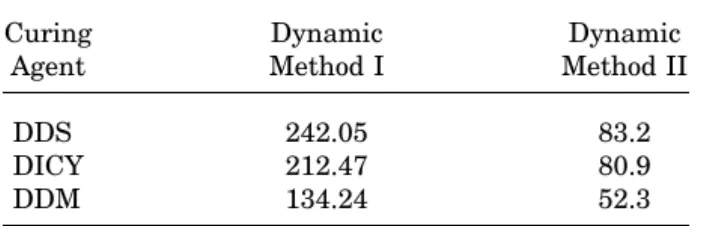
Dynamic method II provides another conve-nient way to obtain the activation energy of a curing reaction without resorting to the evalua-tion of the reacevalua-tion order and reacevalua-tion rate con-stant. The plot based on eq. (2) for determining the activation energy is shown in Figure 8. The activation energies determined by this method are also listed in Table IV. The activation ener-gies of the curing reactions for TGPSO with var-ious curing agents were found to be in the order of DDM, DDS , DICY. However, the values ob-tained from this method were smaller than those from the Dynamic Method I. This difference has been described in literature. Activation energy based on the variation of peak position with dif-ferent heating rates (Dynamic Method II) gener-ally gives smaller values than the dynamic method I.
Thermal and Flame-Retardant Properties
The glass transition temperatures (Tgs) of the cured epoxy resins are listed in Table V.
TGPSO-based epoxy resins show lower Tgs than the com-mercial system of Epon 828/DDM. This can be understood from the TGPSO structures that tain no aromatic moiety in the backbones. A con-ventional additive-type flame retardant usually behaves as a plasticizer in the epoxy resin sys-tems to reduce the resins’ Tgs as well as to affect their mechanical properties.23,24 The reactive-type flame retardants presented here show ad-vantages of better physical properties than the additive type.1
Figure 9 shows the TGA thermograms of the cured Epon 828/DDM and TGPSO/DDM resins in nitrogen. The corresponding weight loss data based on TGA analysis are listed in Table V. Epon 828/DDM resin (Fig. 9b) exhibited 5% weight loss at around 360°C and then a rapid weight loss at 390°C. This dramatic weight loss was due to the decomposition of the resin matrix, which resulted in a constant char weight at temperatures higher than 550°C. Therefore, the Epon 828/DDM resin gives a one-stage weight loss behavior. However, the weight loss behavior of the silicon-containing resins is somewhat different. TGPSO/DDM resin (Fig.9a) shows 5% weight loss at about 215°C and additional weight loss at 260°C. Unlike the sili-con-free Epon 828/DDM resin, which showed a one-stage weight loss behavior, a second stage of weight loss was found at 450°C for this silicon-containing TGPSO/DDM resin. It is noteworthy that the percentage of the first weight loss of the silicon-containing TGPSO/DDM resin is less than 10%. This small percentage of weight loss proba-bly comes from the decomposition of the silane
Figure 8 TGA thermograms of TGPSO/DDM (a) and Epon 828/DDM (b) in nitrogen.
Figure 7 Determination of the activation energy by dynamic method II.
Table IV Activation Energies (kJ/mol) of TGPSO Curing Reaction with Various Curing Agents Curing Agent Dynamic Method I Dynamic Method II DDS 242.05 83.2 DICY 212.47 80.9 DDM 134.24 52.3
cated decomposition of silane groups in TGPSO and the resin matrix. The decomposition of silane groups is able to form a silicon-rich residue after the initial stage of weight loss to slow down further decomposi-tion of the resins. This phenomenon plays an impor-tant role in improving the flame-retardant properties of the resins and will be discussed later. Thus, the thermal stability at high temperatures of the resins is improved as the silicon is covalently incorporated in the resin. While in fire, the silane groups first decom-pose and then SiO2is formed.
24
This silicon-rich resi-due is able to prevent further decomposition of the polymer, raise the decomposition temperature of the polymer, and result in a high char yield. This specu-lation is confirmed by the char yield study. At 700°C, Epon 828/DDM resin exhibited a char yield of 18, whereas TGPSO/DDM gave 40%.
The thermogravimetric analyses of the epoxy resins were also carried out in air (Fig. 10). The weight loss behavior of these epoxy resins in air was found to be similar to that in nitrogen at
tempera-based epoxy resins. While in air, Epon 828/DDM also showed a two-stage weight loss. Other weight losses at higher temperature were observed for Epon 828/DDM and TGPSO/DDM, respectively. These weight losses were brought about by the ox-idation of the polymers at high temperatures. As a result of this oxidation process, the char yield is decreased. Char yields of Epon 828/DDM and TG-PSO/DDM in air were found to be 0 and 31.1%, respectively. Furthermore, the silicon-free resin, Epon 828/DDM, was less thermally stable in air than in nitrogen. The temperature of the first rapid weight loss decreases from 390°C in nitrogen to 296°C in air. On the other hand, the thermal sta-bility of the silicon containing epoxy resin TGPSO/ DDM show little difference between nitrogen and air as shown in Figures 9 and 10.
The TGA thermograms of TGPSO based resins cured by diamine curing agents are shown in Fig-ure 8. Polymers of TGPSO, reacted with diamine curing agents, showed similar weight loss behav-ior (Table V). The pyrolysis temperatures of the resins were raised when the silicon-containing TGPSO epoxy was incorporated. The rapid weight loss temperature of TGPSO-based resin, as men-tioned, is about 130°C higher than that of Epon 828-based resin. The temperature of oxidation py-rolysis of TGPSO-based resin in air is at about 645°C. On the other hand, the silicon-free Epon 828-based resins showed their oxidation pyrolysis temperature at 540°C. Moreover, the TGPSO based resin does not show the notable reduction in thermal stability in air.
The flame-retardant properties of these epoxy resins were further examined by measuring their LOI. TGPSO-based resins exhibit LOI values of about 35 while the silicon-free Epon 828/DDM epoxy resin exhibit an LOI value of 24, as shown in Table V. The LOI values of these cured epoxy
Figure 9 TGA thermograms of TGPSO/DDM (a) and Epon 828/DDM (b) in nitrogen.
resins are high enough to be considered flame-retardant systems.
Conclusions
A new silicon-containing oxirane compound was synthesized and used in preparing silicon-contain-ing epoxy resins. The resultsilicon-contain-ing epoxy resins showed high char yields and high LOI values. Furthermore, combination of the silicon-containing epoxy and di-amine curing agent provided epoxy resin systems with a silicon content higher than 9%. This high silicon content thus led to epoxy resin with excellent flame-retardant properties with high char yield of 42% and high LOI value of 39. These silicon-con-taining compounds have been shown to be effective flame-retarding epoxy resins.
REFERENCES
1. Liu, Y. L.; Hsiue, G. H.; Chiu, Y. S.; Jeng, R. J. J Appl Polym Sci 1996, 61, 1789.
2. Mantecon, A.; Cadiz, V.; Serra, A.; Martinez, P. A. Eur Polym J .1987, 23, 481.
3. Bajaj, P.; Jha, N. K.; Ananda Kumar, R. J Appl Polym Sci 1992, 44, 1921.
4. Landon, G.; Lewis, G.; Boden, G. F. J Mater Sci 1977, 12, 1605.
5. Vu-Kanh, T.; Decharentenay, F. X. Polym Eng Sci 1985, 25, 841.
6. Bramuzzo, M.; Savadori, A.; Bacci, D. Polym Com-posites 1985, 6, 1.
7. Serier, A.; Pascault, J. P.; Lam, T. M. J Polym Sci Polym Chem 1991, 29, 1125.
8. Kasemura, T.; Takahashi, S.; Nishisara, K.; Komatu, C. Polymer 1993, 34, 3416.
9. Hedrick, J. L.; Yilgor, I.; Jurek, M.; Wilke, G. L.; McGrath, E. Polymer 1991, 32, 2020.
10. Zheng, S.; Wang, H.; Dai, Q.; Kuo, X.; Ma , D.; Wang, K. Macromol Chem Phys 1995, 196, 269. 11. Crivello, J. V.; Narayan, R. Macromolecules 1996,
29, 433.
12. Crivello, J. V.; Lee, J. J. Polym Sci Polym Chem 1990, 28, 479.
13. Crivello, J. V.; Bi, D. J Polym Sci Polym Chem 1993, 31, 3121.
14. Crivello, J. V. Polym Eng Sci 1992, 32, 1463. 15. Keenan, M. A. J Appl Polym Sci 1987, 33, 1725. 16. Campa, J. G.; Abajo, J.; Mantecon, A.; Cadiz, V.
Eur Polym J 1987, 23, 961.
17. Ozawa, T. J Therm Anal 1970, 2, 301.
18. Barret, K. E. J. J Appl Polym Sci 1967, 11, 1617. 19. Foun, C. C.; Moroni, A.; Pearce, E. M.; Mijovic, J.
Polym Mater Sci Eng 1984, 51, 411. 20. Jay, R. R. J Anal Chem 1964, 36, 667.
21. Chin, W. K.; Hsau, M. D.; Tsai, W. C. J Polym Sci Polym Chem 1995, 33, 373.
22. Acitelli, M. A.; Prime, R. B.; Sacher, E. Polymer 1971, 12, 333.
23. Mikroyannidis, J. A.; Kourtides, D. A. J Appl Polym Sci 1984, 29,