
臺灣與美國流行音樂錄影帶中的性內容與愛情表現之比 較研究 (2000 與 2010) - 政大學術集成
94
0
0
全文
(2) Love Relationship and Sexual Content in Popular Music Videos of Taiwan and the U.S.A.: A Comparative Study (2000 and 2010) 臺灣與美國流行音樂錄影帶中的性內容與愛情表現之 比較研究 (2000 與 2010). 研究生:吳怡馨. Student: Yi-Hsin Wu. 指導教授:郭貞教授. 國立政治大學. 學. 國際傳播英語碩士學位學程. ‧. ‧ 國. 立. Advisor: Dr. Cheng Kuo 治 政 大. 碩士論文. n. er. io. sit. y. Nat. al. i n U. v. C h A Thesis e n g c h i Master’s Program in Submitted to the Faculty of International International Communication Studies National Chengchi University In partial fulfillment of the Requirement For the degree of Master of Arts. 中華民國 101 年 6 月 June 2012.
(3) Acknowledgement 終於完成這本論文,結束無憂無慮的學生生活,內心五味雜陳。終於邁 向人生的下一階段,除了緊張、雀躍、更多的是不捨。「天下無不散的宴席」, 該來的還是會來,該走的還是要走。這本論文的完成要感謝的人太多太多;帶 我到這世界上的人,啟蒙教導我的人,陪伴我的人,幫助我的人,擊敗我的人; 所有出現以及尚未出現在我生命中的人都值得我說一聲謝謝。我會試著一一點 名但可惜的是我以暫發性失憶症出名,所以若我忘了提到而您也看到這文,並 且知道您應該要出現在文章中的人們,請大可厚臉皮的將您的大名楷寫或草寫 或亂寫在空白處。我想這應該是我這一生唯一一次寫謝辭的機會,所以我盡量 將您們都提到。 Here goes. 首先,感謝我的家人們,尤其是我的父母親,您們將我帶到這 個世界上,每天的辛苦只為了讓我跟弟弟能夠吃得飽穿得暖並且有好的教育; 我也感謝您們在我學習的路上給我很大的自由,讓我開心地去接觸我有興趣的 學科,讓我無畏地去挑戰未知的領域,即便您們猜到或猜不到結果不盡人意。 同時,感謝從小到大教過我的老師們,若不是您們有教無類的教導,讓我的學 習興趣一再的被挑起,我也不會一路走到研究所。其中,教我英語的千馨美語 的老師,高中的洪滿江老師,補習班的 Albert 老師,感謝您們為我的英文基礎 種下強韌的種子。高中的曾珍老師,您所給我們的不只是國文知識更是人生道 理,因為您,我也開始相信「信任」的力量。還有其他老師們,您們帶給我非 常開心的高中生活。大學的老師們,Jo, Ankuo, Spencer, David Barton, Prof. Dave Stewart, Wenchi, KC, Lili, Steve Bradbury and all the other excellent professors; you gave me the best time of my life. What I have learned from you is what I bring with me for the rest of my life. 研究所的老師們,我的指導教授郭貞老師,口試委員施 琮仁老師及劉文英老師,感謝您們所給我的指導及意見,若不是您們,這本論 文不會誕生,我的學生生涯將不會圓滿地完成。 再來,要感謝的是這一路上所有陪伴過我的朋友們。Saxon, 姐姐 officially 畢業了啦,你可以帶著五十嵐去冰半糖珍奶來恭喜我了。陳 Danny 小 感謝你和雞 critical 的賤嘴,讓我在無聊的生活中得以解憂。呆娜,大餅,金貝, 歡仙子 Olivia,百八,你們也是我大學生活是我一生顛峰的理由之一,那些歡淫 的日子啊~Mandy, Conny, Singing, Jenny, Astrid,若不是你們三不五時的鼓勵跟 意見,我應該無法撐到最後。Oscar, I don’t know if you’ll see this, but I still want to thank you for the advice, company, laughter, food, drum lessons and fun. We had such a good time, and I do hope we’ll meet again. 當然,還有楊基,怎麼可能忘了 你呢,你如此忍受我三天兩頭就發作一次的羊癲風發神經憂鬱症躁鬱症失憶症 等等奇奇怪怪的老症頭,連我本人都覺得太不可思議,將來更多隱藏版的老症 頭還請你多照顧。 最後的最後,不免俗的,感謝陳之藩,寫出「謝天」這篇世世代代流傳 的好文章。「因為需要感謝的人太多了,所以就感謝天吧」。. 立. 政 治 大. ‧. ‧ 國. 學. n. er. io. sit. y. Nat. al. Ch. engchi. i n U. v.
(4) Abstract This study examines 200 music videos from Taiwan the USA for their sexual content lyrical and visual presentation. The second focus is the illustration of themes in songs. Results of a content analysis shows that in terms of sexual content in music videos, the USA is still more sexual than Taiwan as a whole; however, the increase of sexual imagery in music videos is greater in Taiwan in 2010 compared to in 2000 than that from USA in 2010 compared to 2000. Within-country comparisons show that the increase in images is greater than that in lyrics from 2000 to 2010 in both countries. For themes in songs, in both years, over 80% of the songs analyzed from Taiwan are love theme songs. Songs from the USA are more varied, and from 2000 to 2010, there are 20% less love theme songs.. 政 治 大. On the whole, this study agrees with previous studies, which found that love. 立. manifested in lyrics is often an asexual kind of love in Taiwan, while in the USA physical. ‧ 國. 學. desires are often outright portrayed, regardless of the song themes. Although the sexual level in music videos images have not yet reached an alarming level, researchers should, however,. ‧. keep track of the sexual content because music videos do take up a part in forming a. io. sit. y. Nat. socializing environment, especially for the young people.. n. al. er. Key words: Sexual content, theme, music video, lyrics, Taiwan, USA.. Ch. engchi. i. i n U. v.
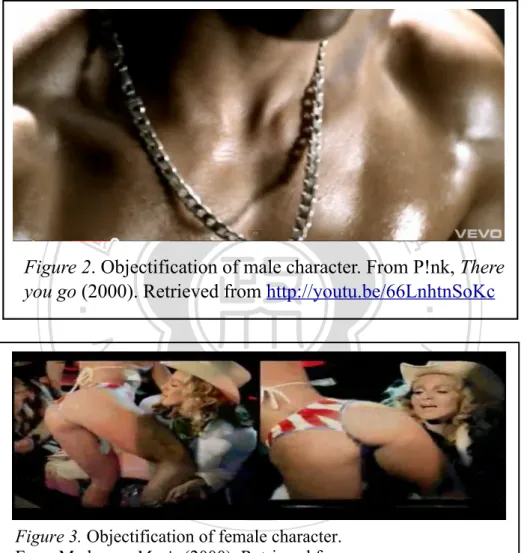
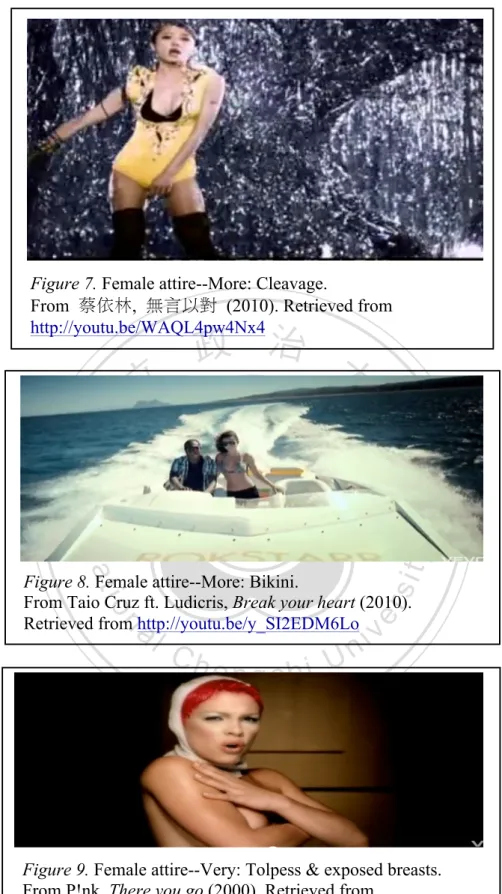
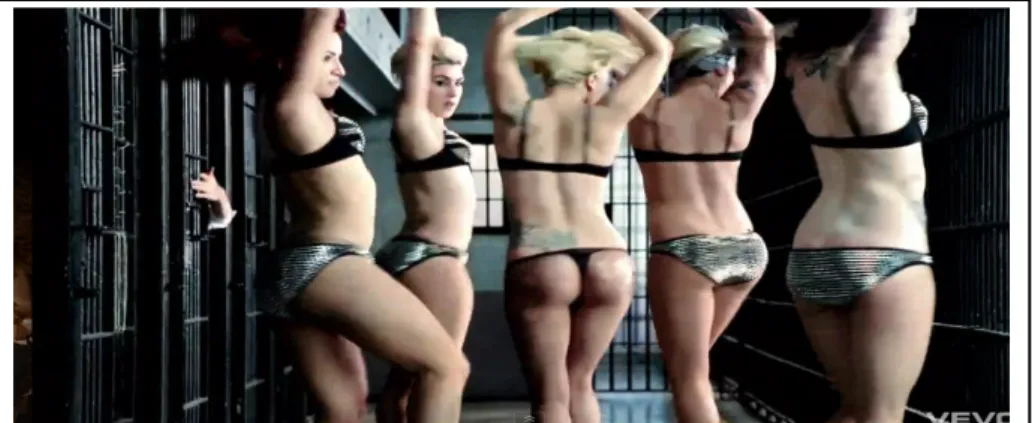
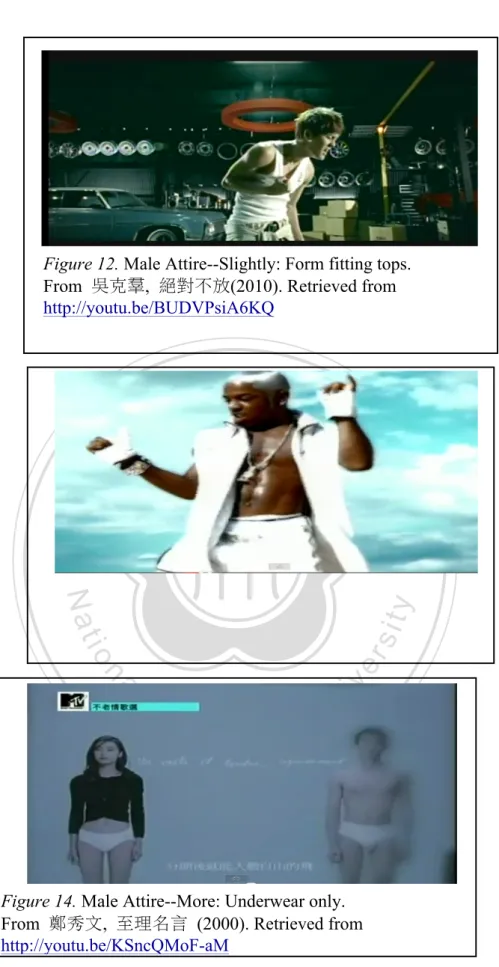
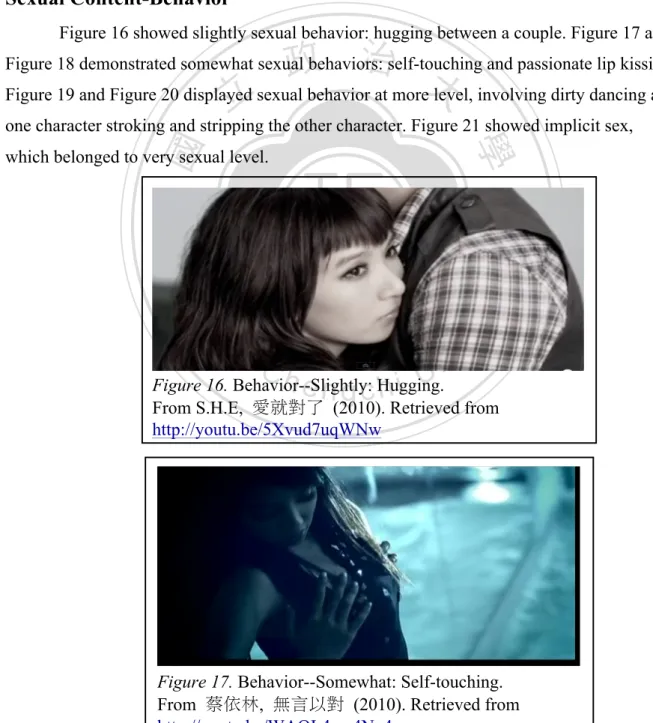
(5) TABLE OF CONTENTS Chapter 1. Introduction ..................................................................................................... 1 Research Motives ................................................................................................................... 1 Research Background ............................................................................................................ 3 Chapter 2. Literature Review............................................................................................ 4 Music Videos ......................................................................................................................... 4 Music Videos and MTV......................................................................................................... 5 • MTV ............................................................................................................................. 5 Music Videos and the Internet ............................................................................................... 6 Sexuality and Cultural Differences ........................................................................................ 7 Sexual Content in Popular Music Videos .............................................................................. 9 • Lyrical Presentation .................................................................................................... 10 • Visual Presentation ..................................................................................................... 12 Themes in Song Lyrics ........................................................................................................ 14 Summary .............................................................................................................................. 15. 政 治 大 Chapter 3. Research Framework and Hypotheses ...................................................... 17 立 Research Framework ........................................................................................................... 17. ‧ 國. 學. Figure 1. Research Framework of Present Study .................................................... 17 Hypotheses ........................................................................................................................... 18. ‧. Chapter 4. Research Method......................................................................................... 20 Sample Selection.................................................................................................................. 21 Analytical Unit ..................................................................................................................... 23 Coding Scheme .................................................................................................................... 24 Pretest................................................................................................................................... 26. sit. y. Nat. n. al. er. io. Chapter 5. Results ............................................................................................................ 29 Results for Basic Information .............................................................................................. 29 Results for Lyrical Presentation ........................................................................................... 31 • Theme of the Song ...................................................................................................... 31 1. Not concerning any relationships............................................................................. 31 2. Establishment of love relationship--Celebration ..................................................... 33 3. Establishment of love relationship--Ambivalence ................................................... 33 4. Establishment of love relationship--Difficulties ...................................................... 34 5. Disintegration of love relationship--Mourning ........................................................ 35 6. Disintegration of love relationship--Reversibility of decision/Bargaining.............. 36 7. Disintegration of love relationship--Ex-lover’s mistake.......................................... 37 8. Disintegration of love relationship--Cheating/Triangle love ................................... 38 9. Disintegration of love relationship--Rationalization of break-up ............................ 38 10. Disintegration of love relationship--Getting over/Moving on ............................... 39 11. Anticipation of love relationship ........................................................................... 40 12. Social commentary on love relationship ................................................................ 41 13. Other relationships--Friendship/Family ................................................................. 42 • Sexual Content in Lyrics ............................................................................................ 42 Results for Visual Presentation ............................................................................................ 43 • Music Video Style ...................................................................................................... 43 • Characters of MV ....................................................................................................... 44 • Sexual Content-Objectification .................................................................................. 45. Ch. engchi. ii. i n U. v.
(6) • Sexual Content-Female Attire .................................................................................... 46 • Sexual Content-Male Attire ........................................................................................ 47 • Sexual Content-Behavior ............................................................................................ 48 Hypotheses ........................................................................................................................... 49 Chapter 6. Discussion ....................................................................................................... 52 Sexual Content and Cultural Differences ............................................................................ 52 Sexual Content and the Young ............................................................................................ 54 Love Songs in the USA and Taiwan .................................................................................... 55 Limitations and Direction for Future Research ................................................................... 56 Chapter 7.. Conclusion ...................................................................................................... 58. References ............................................................................................................................... 61 Appendix A ............................................................................................................................. 66 Sample List .......................................................................................................................... 66 Appendix B ............................................................................................................................. 74 Codebook ............................................................................................................................. 74. 治 政 Appendix C ............................................................................................................................. 79 大 Music Video Screenshots..................................................................................................... 79 立 Sexual Content-Objectification............................................................................................ 79 ‧. ‧ 國. 學. Sexual Content-Female Attire.............................................................................................. 79 Sexual Content-Male Attire ................................................................................................. 82 Sexual Content-Behavior ..................................................................................................... 84. n. er. io. sit. y. Nat. al. Ch. engchi. iii. i n U. v.
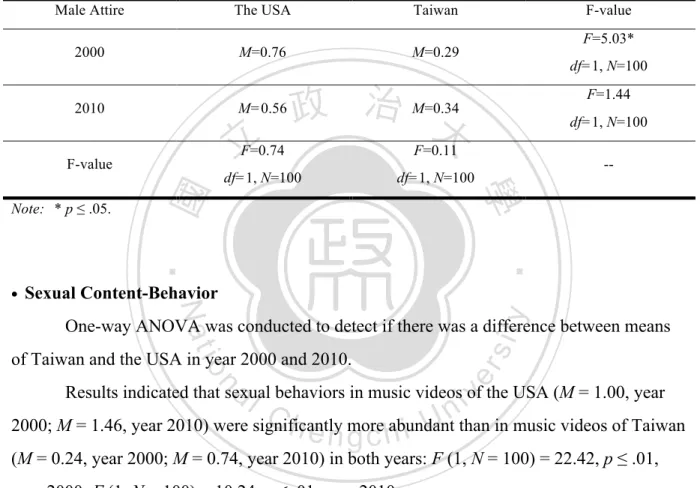
(7) LIST OF TABLES Table 1. Categorization of love relationship in lyrics of present study ................................... 25 Table 2. Pretest Sample of American Songs............................................................................ 27 Table 3. Pretest Sample of Chinese Songs............................................................................... 27 Table 4. Descriptives of Gender of Artist(s)/Group ................................................................ 30 Table5. Frequency and Chi-Square Test of Theme of the Song – Not concerning any relationship............................................................................................................................... 32 Table 6. Frequency and Chi-Square Test of Theme of the Song – Establishment of love relationship – Celebration ........................................................................................................ 33 Table 7. Frequency and Chi-Square Test of Theme of the Song – Establishment of love relationship –Ambivalence ...................................................................................................... 34. 政 治 大 Table 9. Frequency and Chi-Square 立 Test of Theme of the Song – Disintegration of love relationship – Mourning........................................................................................................... 36 Table 8. Frequency and Chi-Square Test of Theme of the Song – Establishment of love relationship –Difficulties ......................................................................................................... 35. ‧ 國. 學. Table 10. Frequency and Chi-Square Test of Theme of the Song – Disintegration of love relationship – Reversibility of decision/Bargaining ................................................................ 37. ‧. Table 11. Frequency and Chi-Square Test of Theme of the Song – Disintegration of love relationship – Ex-lover’s mistake ............................................................................................ 37. sit. y. Nat. Table 12. Frequency and Chi-Square Test of Theme of the Song – Disintegration of love relationship – Cheating/Triangle love...................................................................................... 38. n. al. er. io. Table 13. Frequency and Chi-Square Test of Theme of the Song – Disintegration of love relationship – Rationalization of break-up............................................................................... 39. i n U. v. Table 14. Frequency and Chi-Square Test of Theme of the Song – Disintegration of love relationship – Getting over/Moving on .................................................................................... 40. Ch. engchi. Table 15. Frequency and Chi-Square Test of Theme of the Song – Anticipation of love relationship............................................................................................................................... 41 Able 16. Frequency and Chi-Square Test of Theme of the Song – Social commentary on love relationship............................................................................................................................... 41 Table 17. Frequency and Chi-Square Test of Theme of the Song – Other relationshipsFriendship/Family .................................................................................................................... 42 Table 18. ANOVA of Sexual Content in Lyrics ...................................................................... 43 Table 19. Descriptives of Music Video Style .......................................................................... 44 Table 20. Descriptives of Characters of MV ........................................................................... 45 Table 21. Frequency and Chi-Square Tests of Sexual Content – Objectification ................... 46 Table 22. ANOVA of Sexual Content – Female Attire ........................................................... 47 Table 23. ANOVA of Sexual Content – Male Attire............................................................... 48 Table 24. ANOVA of Sexual Content – Behavior .................................................................. 49 iv.
(8) LIST OF FIGURES Figure 1. Research Framework of Present Study .................................................................... 17 Figure 2. Objectification of male character ............................................................................. 79 Figure 3. Objectification of female character .......................................................................... 79 Figure 4. Female attire--Slightly: Form fitting clothing.......................................................... 80 Figure 5. Female attire--Somewhat: Exposed stomach. .......................................................... 80 Figure 6. Female attire--Somewhat: Short skirts..................................................................... 80 Figure 7. Female attire--More: Cleavage. ............................................................................... 81 Figure 8. Female attire--More: Bikini. .................................................................................... 81 Figure 9. Female attire--Very: Tolpess & exposed breasts. .................................................... 81 Figure 10. Female attire--Very: Exposed thong underwear. ................................................... 82. 政 治 大. Figure 11. Male Attire--Slightly: Form fitting tops................................................................. 82. 立. Figure 12. Male Attire--Slightly: Form fitting tops................................................................. 83. ‧ 國. 學. Figure 13. Male Attire--Somewhat: Exposed chest. ............................................................... 83 Figure 14. Male Attire--More: Underwear only. ..................................................................... 83 Figure 15. Male Attire--More: Swim suit................................................................................ 84. ‧. Figure 16. Behavior--Slightly: Hugging.................................................................................. 84. y. Nat. Figure 17. Behavior--Somewhat: Self-touching...................................................................... 84. sit. Figure 18. Behavior--Somewhat: passionate lip kissing. ........................................................ 85. er. io. Figure 19. Behavior--More: Dirty dancing. ............................................................................ 85. al. v i n C sexuality. Figure 21. Behavior -- Very: Implicit 86 U h e n g..................................................................... i h c n. Figure 20. Behavior--More: Stripping and stoking the other person. ..................................... 85. v.
(9) Chapter 1.. Introduction. Research Motives Music Industry has always been fascinating to both ordinary people and academic people. Music soothes people, expresses for people, and it also influences people in many ways. What influence and how great the influence are two major questions that interest many researchers in communication studies, cultural studies and sociology discipline. As a member of the pop culture generation who happens to be in the communication studies, the idea of looking into the relationship between music industry and its social/cultural meaning naturally occurs. Among numerous aspects that could be chosen to examine popular music culture,. 政 治 大 Music Videos are a unique 立 combination of vocal, lyrical and visual presentation.. music videos are decided to be the window from which I look into this fascinating world.. ‧ 國. 學. Quandt distinguished between watching music videos in two ways: as foreground activity (without other activity) and as background activity (while engaged in other activities) (as. ‧. cited in Nikorowitsch & Sligo, 2008). While the audiences watch videos as foreground activity, it was almost impossible to multitask, unlike watching as background activity, which. sit. y. Nat. made it assemble to listening to a song from the radio or CD. When the audiences paid more. io. er. attention to the music video, it was naturally for the audiences to remember the song, the singer(s), even the lyrics to the song.. n. al. Ch. i n U. v. Music videos, for that reason, not only served as the best promotion tool, but also the. engchi. most influential music product on the audience, in terms of social values and sex values. What we usually called common sense could be viewed as a type of values reinforced by mass media repeatedly for a long time, and in the long run, the common senses would turn into stereotypes and ideologies. Music, both in its lyrical and visual aspect, served as one of the popular couriers for the stereotypes and ideologies to form. For that reason, to understand how popular music influenced a society or even a culture, music videos were one of the best aspects to be examined. The study of music videos has been paid considerable attentions in Western communication studies. Music videos have become an important means for the music industry to successfully catch the audience’s attention and make the music popular. After Music Television’s (MTV) launching in August 1981, in the U.S.A., music videos have since 1.
(10) then turned into a crucial commercial weapon for record companies. With the more sophisticated music videos produced and played on MTV later on, MTV has then been a popular outlet of audio-visual entertainment for the young people (Hansen & Hansen, 2000). Since the introduction of MTV Mandarin in the 90s, with the help of KTV (Karaoke) culture, Chinese music industry has changed its face--with music videos becoming an indispensable product in Chinese popular music industry, artists’ appearance and other elements (e.g., make-up, costume, choreography, etc.) in addition to their vocal performance started to come into play in promoting singers. Despite that, researches of music videos were often hard to come by in Taiwan’s communication studies. Among many different aspect of music videos that could be researched, sexual content in music videos was one of the most studied aspects in Western communication. 政 治 大. studies because it was believed to have a great impact on people’s, especially the teenagers’,. 立. sexual perception, values and behaviors (Arnett, 2002; Bogt et al., 2010; Hansen, 1989;. ‧ 國. 學. Hansen & Hansen, 1990; Kalof, 1999; Zhang et al., 2008).. Many studies focused on the sexualization in lyrics. Richard et al. (2003) examined. ‧. the expressions of love, sex, and hurt themes in 100 popular songs from 1958 to 1998. Another content analysis examined popular songs from 1959 to 2009 (Cougar Hall et al.,. y. Nat. sit. 2011), while even more studies put emphasis on sexual imagery in music videos and its effect. er. al. v i n C hin the Western society, In spite of the numerous studies e n g c h i U there have been few n. 2010).. io. on the audience (Gow, 1990; Hansen & Hansen, 1990; Kistler & Lee, 2010; Zhang et al.,. researches on the sexual content in either the lyrics or video images in Taiwan. The reason might be the traditional view of sex being an unspeakable private matter, and therefore sexual content was naturally rare in publications. When there has not been any sexual content, there would be no need to inspect. However, as the international communication happened more and more often, it was possible that the music industry was influenced by the Western music industry, and therefore sexual content in music might increase, and so did the need for researches to catch up with the Western studies.. 2.
(11) Research Background Music videos came into prominence almost at the same time MTV made its debut in 1981 in the U.S.A. As early as 1985, Baxter and colleagues had published a content analysis on music videos. In Taiwan, even though research on music videos had appeared as early as 1994 (Wu, 1994), even a year before MTV’s launching in Taiwan, follow-up studies were not as abundant and thorough as in the Western countries. Surprisingly, there had been no content analyses of sexual content in music videos in Taiwan while many had been done in the U.S.A. (Arnett, 2002; Aubrey & Frisby, 2011; Baxter et al., 1985; Bornales, 2007; Cooper, 1985; Gow, 1990; Hansen & Hansen, 1990; Turner, 2011; Turner, 2005; Wallis, 2011; Zhang et al., 2010).. 治 政 examining music videos produced in Taiwan in 2000 and 2010, 大 comparing to music videos of 立 U.S.A. from the same period of time to see what differences existed between the two This study tried to start catching up with the Western sexual content studies by. ‧ 國. 學. counties/cultures; in addition to between-county comparison, music videos during the two different time periods were also compared to see the changes within the countries.. ‧. n. er. io. sit. y. Nat. al. Ch. engchi. 3. i n U. v.
(12) Chapter 2.. Literature Review. This study aimed to compare the love relationship and sexuality portrayal in popular music videos of Taiwan and U.S.A. Two cross-sectional comparisons would be applied: between countries and within countries. Music videos would be broken down in lyrical and visual aspects. The following sections give background knowledge of music videos, and its relationships with MTV and the Internet; relevant literature would be reviewed on sexual content and theme in pop songs.. 政 治 大 Music videos in today’s culture were more than just a means of publicizing singers’ 立. Music Videos. names and singles; they communicated values and changed a culture. Music videos, as Rubin. ‧ 國. 學. et al. suggested (as cited in Hansen & Hansen, 2000), were frequently liked more than music alone, because music videos added visual dimension to music; as such, they increased the. ‧. potential for excitation and provided more social information for audience to learn. The. sit. y. Nat. visual content gave meanings, or even incorporated different meanings to the original music. Music videos initially were film clips created as a type of promotion of artists’ latest. io. n. al. er. music release by the record companies. The original idea was to hold the viewers’ attention. i n U. v. long enough to catch and remember the artist’s name and record/song name (Bornales, 2007).. Ch. engchi. Today, music videos were more than simply that: they were a type of advertising; however, they sold not only the artist and record, but the director, the cinematographer, the choreographer, the stylist, (Reiss & Feineman, 2000) and more importantly, the ideology, i.e., through the characters’ performance in the videos, they were telling the viewers how and what they should think and act. The earlier music videos, or more precisely, prototype of music videos, were a kind of one-song film called “promotional clips” made for Panoram visual jukebox in the 1940s. They were then short films of musical selections, displaying usually a band playing on a movie-set bandstand (Music Video, n.d.). Throughout the decades until 1980s when MTV was introduced, music videos had developed various visual techniques and styles, but they. 4.
(13) remained a commercial-like clips which were played when singers could not perform live (Music Video, n.d.). Taiwan saw its very first music video in 1981, i.e., Everyone, come together (大家一 起來) by Zhang, Ai-Jia (張艾嘉) (Chen, 1999). The blooming of music videos in Taiwan was when MTV Taiwan set foot in 1995, resembling the development pattern of music videos in the U.S.A. As music videos grew more important both in the music industry and everyday life, Golden Melody Awards (金曲奬) starting from 2000 officially put The Best Music Video Directer into its award categories (Li, 2009).. Music Videos and MTV. 政 治 大 until MTV’s appearance in 1981 in the United States that music videos began to be 立. Music videos, however, did not have the current influence from day one. It was not. appreciated by record companies. When mentioning music videos, one would think of MTV,. ‧ 國. 學. the television channel that became the first television channel in history that made music videos its sole content. MTV not only helped creating the modern music videos we see today. ‧. but also became the mainstream medium, which popularized teen culture in the 1980s and. sit. y. Nat. 1990s (Li, 2009).. MTV and Music videos then became two inseparable elements in the making of. io. n. al. er. popular music business. By producing popular music, they also created a new consumer. i n U. v. culture which the popular culture that influenced people, especially the teenagers’ values and behaviors.. Ch. engchi. • MTV Music videos came into prominence in 1980s when MTV based its content on them, played 24 hours a day. MTV has then changed the largely held opinion of music videos clips and created a nationwide music network in the United States. MTV also brought underground music into distinction, such as new wave of the 80’s and grunge of the 90’s. Artists’ gained exposure on MTV was reflected on the ranks on Billboard charts (Bornales, 2007). MTV’s success was not only limited in the U.S.A., it has later become a worldwide phenomenon. It was launched in Taiwan in 1995, originally as MTV Mandarin, later changed to Taiwan (MTV Taiwan, n.d.), and was also known as MTV Chinese. However, long before that, MTV Asia had already been launched in 1987 Channel [V], a more Asia-specific MTV5.
(14) like music channel, launched in 1994 thanks to MTV Asia’s temporary disappearance due to MTV’s higher charges. MTV Taiwan, according to a report issued by Consumer’s Foundation in 2000, was the most popular music television channel, and was also the first music television channel that popped into mind among 15-year-old to 34-year-old teenagers (As cited in Li, 2009).. Music Videos and the Internet Digital media grew so rapidly at the moment that almost everything had gone digital and online; music videos were no exception. Thanks to the fast growth of video-sharing Websites such as Youtube, the Internet has become an important new venue for music video. 治 政 & Nichols, 2008; Li, 2009; Nikorowitsch & Sligo, 2008). 大 立 In addition to the fact that music videos were changing distribution venue, another. viewing. Several studies have started to pay attention to this Web phenomenon (Cunningham. ‧ 國. 學. reason for old television viewers to transfer from television to the Web was the fact that roughly after 2000 music television channels like MTV and VH-1 played more reality shows. ‧. instead of music videos (Nikorowitsch & Sligo, 2008; Turner, 2005). According to Zettel,. y. Nat. 70% of Internet users in the U.S.A. watched online videos (As cited in Nikorowitsch & Sligo,. sit. 2008). Nikorowitsch and Sligo’s (2008) survey of 44 random online participants indicated. er. io. that most participants (76%) consumed music videos on the Internet as foreground activity. al. n. v i n C h of watching U Another distinguishing characteristic e n g c h i music videos online was the user. and watched music videos on television as background activity (65%).. control: the audiences searched for what they wanted to watch online instead of waiting for it to be played on TV. Although at times the audiences did not have specific clues and just browsed, yet they still had the control over whether to click on a video or not. The result of Nikorowitsch and Sligo’s (2008) study provided some evidence of this user-driven quality of these video-sharing websites. As a result, in the digital age, the influence of what were conveyed through music videos may be more influential than the television age because as users watched them more as foreground activity instead of background activity, they paid more attention on the videos and would remember and be affected more by them. If music videos nowadays carried more misleading information, it certainly would cause a greater effect than before. Sexual content. 6.
(15) was the type of information that may be misleading given the often unrealistic and biased depictions in music videos. The representation of sexuality in music videos has been an attraction and staple in the Western music industry and a popular topic of various researches, too; on the contrary, sex in Chinese music videos was not as common as in English music videos, which might be one of the reasons that no study has been conducted to examine sexual content in music videos in Taiwan. The answer to why the difference between music videos of the two countries might lie in the ingrained cultural values toward sex. The following section explains the different sexual values. Past research results regarding sexuality in music and music videos will be reviewed afterwards.. 政 治 大. 立. Sexuality and Cultural Differences. ‧ 國. 學. According to Weeks (1989), sex was not a kind of universal or unanimous experience, but was the result of cultural and historical construction (As cited in Hwu, 2003). Sex, both in. ‧. the West and East world, had gone from a depressed and conservative period of time to the. y. Nat. liberal and open status now.. sit. In both the ancient Europe and China, sex was in fact treated as normal and discussed. n. al. er. io. about, but after the Enlightenment, sex was depressed and treated as something not proper for. v. public discussion; in China, it was until Sung Dynasty that began the almost eight hundred. Ch. years of sex depression (Hwu, 2003).. engchi. i n U. Sex liberation started in the second half of twenty century in the United States and came to its peak in the sixties and seventies (Hwu, 2003). With the rise of Capitalism and consumerism, sex had become a usual theme in all media to not only attract people’s attention but to sell products. “Sex sells” became one of the golden rules in media world. There was also a liberation time for Chinese sex values; however, the biggest difference between that and the Western one was: the Chinese sex liberation was brought on to the Chinese as Western culture started to influence the traditional Chinese values at the end of Chinese monarchy, instead of a revolution ignited from within the culture. The jump from conservative traditional values to science and rationality was too quick for most Chinese people to handle. Those who received Western education were only. 7.
(16) the few wealthy people while most of the common people had not yet understood the concept of “rational thinking.” The so-called rational and open thinking was forced onto these Chinese people instead of stemmed from these people. As a result, contradiction within and between people’s attitude and action towards sex was manifested many unique phenomena in Taiwan. In addition, the sex education given from elementary to high school was insufficient, and results of a survey of high school students’ sex knowledge were unsatisfactory, yet sex attitude of these teenagers showed that during this period, over 50% of the participants said they had dating experience and 10% of them had sexual experience (Yen et al., 2009b). The aftermath of the insufficient sexual knowledge combined with the high interests in sexuality might lead the teenagers to seek for sexual information else where, oftentimes incorrect, like. 政 治 大. online pornography sites. The incorrect information in the end might do harm to these young. 立. adults.. ‧ 國. 學. Lo et al. (2005) in their study inspected effects of Internet pornography on adolescents’ sexual attitudes and behaviors from randomly sampled 1688 high school. ‧. students in Taipei. They found that about 42.1% admitted watching Internet pornography in recent one or two years, among which 66.4% were males, and females accounted for 17.8%.. y. Nat. sit. Further analysis indicated that the more Internet pornography watched, the more acceptances. er. io. for casual sex, extramarital sex, and rape myth that held female victims should be responsible. al. n. v i n Another study traced trends C of h dating and sex behavior e n g c h i U among junior college students. for being raped.. in Taipei City from 1979 to 2007 and discovered an increase in dating experiences, with 80% of males and 70% of females having dating experiences, and also a decrease in fist dating age, with most students admitting having fist date at age of fifteen (Yen et al., 2009a). What should be the worrying matter was that the sex knowledge did not increase along with the dating and sex behavior. Tsai et al. (2002) showed in their study that about 51.6% teenagers had poor knowledge about condom use and 61.5% admitted not using condoms at first sexual encounter. The results of these studies pointed out the paradoxical quality of attitude toward sexuality in Chinese society. While the younger generation was becoming more open regarding sexuality, the general social norms were still conservative, and the insufficient sex. 8.
(17) education served as a proof. These young people with fresh interests in sexuality were forced to obtain information else where, which was from the media: ads, magazines, dramas, music videos, or even porn sites. Public commercials, ads and television shows were generally lack of sex appeal mainly because of the strict censorship, and the fact that people deemed sex a private and inappropriate topic in public, but in the more private online forum where one’s true identity was kept unknown, sex could be discussed in the most detailed and even nasty ways. Usually, safe sex information as basic as condom usage was left out in the popular media. This could be the possible explanation for the worrying results of the previous studies. But as the younger generation grew up to be the main social group, the general sex. 治 政 served as one apparent example. She first appeared in 1999大 as a cute and innocent singer and as she grew, her style changed立 to a more mature and sexy one. Another equally popular male values changed too. One of the most popular female singers in Taiwan Jolin Tsai (蔡依林). ‧ 國. 學. singer David Tao (陶喆) who was raised in Western education in his earlier years (he published first album in 1997) also sang about the normal love songs without much touch on. ‧. sexuality, but about five years later he started to produced song regarding sexuality, i.e. 討厭. sit. y. Nat. 紅樓夢 (Hate Dream of the Red Chamber).. These examples showed that the conservative attitude towards sex was changing,. io. n. al. er. although might be a little slow compared to the Western countries. Since popular music took. i n U. v. up a great deal of people’s life and participated a great deal in cultural change. It was. Ch. engchi. worthwhile looking into music videos across years and countries to understand the changes going on.. Sexual Content in Popular Music Videos Popular music was an important product of popular culture, and was one of the key routes to understand a culture and its residents. For music to be popular, it took not only good melody but also catchy and appealing words, or in music’s term, lyrics. With the introduction of image clips accompanying music, it took more than mere melody and lyrics to attract the audience’s attention. Images became equally important as melody and lyrics to keep music popular.. 9.
(18) Popular music not only served as a product of the business system, but also a tool to convey information and to entertain the consumers/audiences, and at the same time created and consolidated a set of cultural values and ideology. The study of sexual content in popular music videos had three dimensions because a music video combined melody, lyrics, and images. However, most of the past researches focused more on the lyrical and visual presentation because they were the main carrier of meanings; sounds were more abstract for researchers to come up with objective conclusions. This study for that reason would only include lyrical and visual presentations.. • Lyrical Presentation. 治 政 when Ronald Warren conducted a study on Nazi chorus songs 大 (as cited in Su, 1999). Carey’s (1969) analysis of the changing立 of courtship, which had been an overwhelming topic in Western analyses on song lyrics had been abundant, dating back as early as 1943,. ‧ 國. 學. popular love songs, was based on a content analysis done by Horton in the 1955. The results showed that, compared to songs in the 50s, song lyrics from 1966 put more emphasis on. ‧. physical relationship and love were more often than before simplified as physical desires. Other than that, Carey further found that more new values appeared in love songs from 1966,. y. Nat. sit. including the separation of love from sex, actively seeking love instead of passively waiting. n. al. er. io. for love, relationship could be ended if one or both parties thought it as “unhealthy,” etc.. v. These new values appeared in 83% of the songs in 1966, which has increased from 1955’s. Ch. 68% in Horton’s study (Carey, 1969).. engchi. i n U. Cole (1971) later conducted similar research. In that research, Cole analyzed Top 10 popular singles during each year of the sixties based on Billboard magazine. With a total of 100 songs, love-sex theme was the predominant theme (71%) among the five themes, throughout the ten years (other 4 themes were: religion, violence, social protest). As for values concerning sexual content in lyrics, result showed that among the 71% love-sex songs, only 13% dealt with physical desire. This showed that during the sixties, sexual content was not yet the predominant theme in lyrics. Social changes in the sexual scene was rapid in the 1970s, Lance and Berry (1981) thus conducted a study to examine whether there had been a sexual revolution. They chose 100 top hit rock and roll singles from Billboard magazine during 1968 to 1977 for analysis.. 10.
(19) They did found that during those ten years, attitudes toward human sexuality had changed; it was more openly discussed and a wider variety of sexual behavior was recognized or endorsed. Dukes et al. (2003) examined the expressions of love, sex, and hurt themes in 100 popular songs from 1958 to 1998. The time period was further broken down to three shorter periods: 1958-1972, 1976-1984, and 1991-1998. They found references to sex in lyrics reached its heights during 1976-1984 when women used sexual references five times more than men perhaps due to sex liberation, but during 1991-1998, black men used more sexual references, because of the rising of hip hop and rap genre in the 90s. Another across-time analysis examined sexualization in lyrics of popular songs in the final year of six decades; a total of 600 songs of Billboard Hot 100 year-end from 1959 1969,. 政 治 大. 1979, 1989, 1999, and 2009 (Cougar Hall et al., 2011). Results showed that male artists. 立. accounted fro 66.6% of songs during that six-decade period, which involved higher. ‧ 國. 學. percentage of the first two decades (80%). Male artists’ lyrics, non-White artists’ lyrics in 1999 and 2009, and overall 2009 lyrics were more likely to contain sexualization. As for. ‧. female artists, since in 1959 and 1969, they only accounted respectively for 10% and 5% of produced songs, sexualization in lyrics of female artists was 0%. In 1979, the percentage was. y. Nat. er. io. sexualization by female artists again peaked in 2009 at 14.3%.. sit. the highest of all, with 20.8%, and then dropped in 1989 and 1999, the percentage of. al. v i n C h although at this U lyrics started to increase from the sixties, e n g c h i period, love description was still n. Combining the results from above studies, sexual content in the US popular song. dominating, new ideas and thoughts were stemming. In the seventies, there appeared to be a small climax in sexual lyrics due to, as researchers speculated, sexual liberation; female artists were starting to voice during this period. Coming on to the eighties and nineties, past the sexual liberation hype, percentage of sexuality in lyrics lightly decreased, yet during this period, hip hop and rap genre were taking on the charts and sexuality in the lyrics was more explicit than in other genres After the new millennium, percentage of sex in lyrics reached another height again, and with the developing of hip hop, R&B, rap and more cross-overs, lyrics were also more explicit than before (Cougar Hall et al., 2011). Domestic analyses of song lyrics focused more on gender rather then sexual content; however, in analytic studies of love songs from 1989 to 1998, Ping and Su (2001) discovered. 11.
(20) that love as manifested in popular song lyrics was an asexual kind of love, only 0.4% of sample songs mentioned sexual activity and 2.1% described kiss. This, as they pointed out, was very different from Western popular music studies, in which physical desire was paid constant attention, and the unanimous conclusion was that popular music in the United States tended to simplify love as description of sexual desire. Lance and Berry’s study further pointed out that the U.S. popular music between 1968 and 1977 included various sexual desire related contents (as cited in Ping & Su, 2001).. • Visual Presentation In one of United States’ earliest content analyses of music videos, Baxter and. 政 治 大. colleagues (1985) analyzed 62 random sampled music videos aired on MTV during April 28 to May 4, 1984, using 23 categories including sex, dance, violence and/or crime, etc. Results. 立. indicated that sex (portrayal of sexual feelings or impulses) had 59.7%, which was ranked. ‧ 國. 學. second in all 23 categories. However, they also pointed out that the sexual content was understated, relying on innuendo through clothing, suggestiveness, and light physical contact. ‧. instead of overt behaviors.. Later on, more and more researchers found sexual content in music videos of various. y. Nat. sit. genres. Carey (1969) pointed out that sex has long been a focus of rock and popular music,. er. io. Singletary also named soul and country music as affected by sexual content (as cited in. al. v i n Cclothing, mostly through innuendo, suggesting and subtle body contact. Pardun and h e n gimplicit chi U n. Andsager & Roe, 2003). Yet the representation of sexuality was just like Carey (1969) stated,. McKee in 1995 conducted a study following the similar definition of sexual references and analyzed MTV videos in 1992, and they found that 63% of the videos contained sexual imagery (as cited in Andsager & Roe, 2003). Anther analysis also located 89% of 40. analyzed MTV videos in 1990 with implicit sex, while only 4% with explicit sex (SommersFlanagan et al., 1993). Laake (2005) in her thesis sampled 411 music videos aired on MTV, MTV2, BET and GAC from August 2, 2004 to August 15, 2004 and found 52, 393 depictions of sexual behavior and sexually explicit attire. Among these depictions, no occurrences of explicit sexual activity; rather, occurrences relied on innuendo through attire, suggestiveness, and behaviors.. 12.
(21) Another thorough study published that same year, Turner (2005) based his study on four previous content analyses from the 1980s and 1990s which yielded an average of 47% of videos contained some form of sexual content. Similar methods and measures were used to conduct this study and results showed that 73% of music videos contained some form of sexual content. A total of 120 videos were sampled from MTV, MTV2, VH-1, BET, and CMT during a five-week period in December and January 2004-05. Despite the increased sexual content, results also revealed that “sexual content has not gotten more overt or explicit but instead, remained innuendo-laden and based on sexual suggestion” instead of moving to explicit as other researchers (Brown & Newcomer, 1991; Lampman et al., 2002; Truglio, 1998) previously predicted based on the results that sexual content in television content increased both in frequency and explicitness (Turner, 2005).. 政 治 大. A general conclusion could be drawn from these studies was that sexual content in. 立. music videos was increasing yet it still remained implicit rather than going explicit like that. ‧ 國. 學. in advertising or television programs was.. In addition to content analyses, other researchers focused on examining the effect of. ‧. sexual imagery in music videos on sexual attitudes, Kistler and Lee (2010) found that male college students who were exposed to hip-hop music videos of highly sexual content. y. Nat. sit. expressed the higher levels of objectification of women, stereotyped gender attitudes, and. er. io. acceptance of rape myths. Zhang and colleagues (2008) also found similar results: regardless. al. v i n C hsex and stronger endorsement permissive attitudes toward premarital of gender-specific engchi U sexual stereotypes. n. of gender, exposure to more sexually explicit music videos was associated with more. As for domestic studies, like the studies of lyrical presentation of music, there had been several studies of popular music videos, but only on gender presentation, none of which was on sexual content. The slight lacking of analyses on music video sexual imagery was understandable due to the development of music videos only began in the early 1980s compared to the 1940s of the Western origin. Another possible explanation of the lacking of such studies was stated in Ping and Su’s study (2001). They revealed in their analysis on lyrics that the love represented in lyrics was asexual romantic love, and the reason they provided was that it was probably due to the traditional Chinese culture where sex was a. 13.
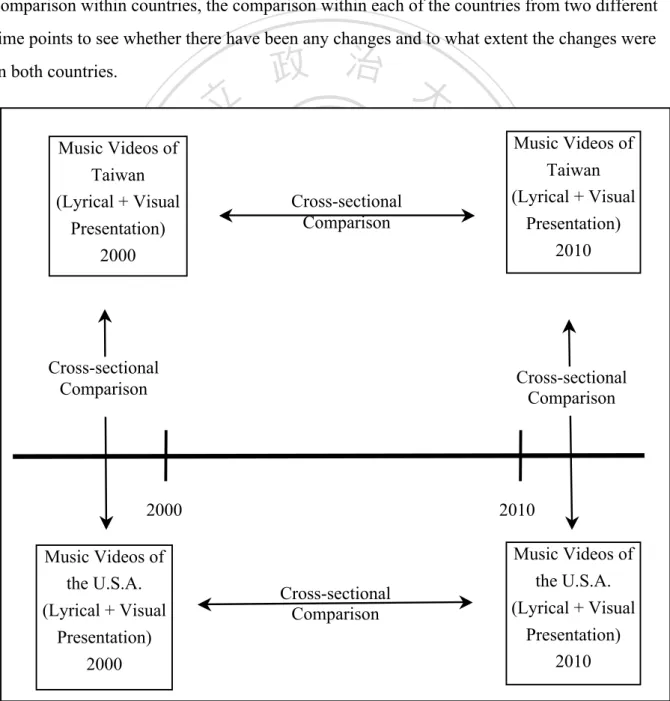
(22) taboo. If then, it was again understandable that there wouldn’t be too much sexual content in music videos and thus the lack of interests in academia.. Themes in Song Lyrics The themes of song lyrics were diverse, and were very well connected to our everyday life. Although content analyses of music content started later in Taiwan, some of the studies did cover songs from the 1940s, so we could still have a general knowledge of the lyrical contents of earlier songs in Taiwan. Among the various themes, the most popular and most common one in Taiwan was “love,” while only a few song lyrics were about friendship, family, or others (Chang, 2008).. 治 政 not about love, while 48.2% of the songs was about the enthusiasm 大 and establishment of love 立 relationships, and 46.8% was about the heartbroken feeling and the lost of love relationships. Ke (1994) analyzed 220 songs from 1993 to 1994 and found only 1 song (0.5%) was. ‧ 國. 學. Su (1999) found in 278 songs from 1989 to 1998 in Taiwan, that 83.5% were description of love relationships while the second most common theme, emotion expressing,. ‧. was only 6.1%, and third, inspirational songs, took up only 5% of the 278 songs.. y. Nat. A recent study compared Mandarin Chinese songs with Taiwanese songs from 1946. sit. to 2009 in aspects of the difference between “theme,” “melody,” and “lyrics.” Songs with. er. io. love theme in 1946 to 1987 were 119 out of 179 (66.5%), and in 1987 to 2009 were 201 out. al. n. v i n C h of theme was period in this study (1987-2009), the diversity e n g c h i U increased even within love. of 303 songs (66.3%). Although love still was the number one theme in lyrics, in the second. songs. Besides the most common joy and sadness in love topic, there were topics like triangle love, proposing, death and love, etc. (Hung, 2010). In the United States, there were also a great deal of depiction of love relationships and the happy or unhappy emotions caused by love, which in Peatman’s (1944) study were categorized as “novelty types,” “happy-in-love ballads,” and “songs of frustration-in-love,” although there were still other themes appearing in American song lyrics such as education, death, food and drink, etc. (Cooper, 1991). As mentioned, the study of music content in the United States started earlier than in Taiwan, Horton (1957) analyzed 235 songs picked from four music magazine, Hit Parader,. 14.
(23) Song Hits Magazine, Country Song Roundup and Rhythm and Blues, and found that 87% lyrics of popular songs were about love. In 1969, Carey compared the 235 samples in Horton’s study to 227 songs of 1966 to see the changing pattern and discovered that there was less songs than in found in Horton’s study were about love, which were 64.7% (Carey, 1969). Later, Cole (1971) did another similar study, in which 4 categories were developed for 100 top 10 songs from Billboard magazine: Love-sex, religion, violence, and social protest. Love-sex was still the predominant theme with 71% of the lyrics, but in second half of the sixties (1965-1969), there were 12% fewer songs belonging in this category than the first half of the sixties (1961-1964). In 1994, another study analyzed 200 top 20 songs from 1980 to 1989 on Billboard. 政 治 大. magazine and also concluded that love and sex were still the dominance theme in American. 立. pop music, with 85.5% of songs in the category. Among the love-themed songs, negative. ‧ 國. 學. attitude towards love appeared more than positive attitude (Edwards, 1994). Another more recent study examined 100 most popular songs from 1958 to 1998 or. ‧. artist characteristics and expression of love, and the results indicated that the percentage of love songs did not change significantly over the three time periods framed in that study,. y. Nat. sit. which were 1958-1972, 1976-1984, and 1991-1998. There were in total 96% love songs in. er. io. R&B songs, 82% love songs in rock and roll songs, and 59% love songs in rap/hip-hop songs. al. n. v i n Love theme apparently was C thehmost dominant theme e n g c h i U in song lyrics across cultures. (Dukes et al., 2003).. and time, but results of the researches showed that there were a little more love songs in. Chinese songs than in English songs, and the diversity of other themes in English songs was also slightly wider.. Summary The study of music and music video contents has long been a popular branch in communication studies. Music videos were popularized when MTV was launched in the United States in 1981, and therefore MTV and other similar music television channels were where the audience watched music videos. However, after MTV and the other channels started to air music videos less to play more shows, and with the now easy accessibility of the. 15.
(24) Internet, Youtube.com and similar video-sharing sites have become the first place people looking for any videos, including music videos. Sexual content in lyrics and music video images was among the most studied aspects in the branch of music and music video studies in the United States. From the results of previous studies, sexual content in lyrics started to increase in the 1960s and in the 1970s reached to a climax because of the sexual liberation movements during that time. After the 70s, sexual content in lyrics decreased in the 1980s and 90s and started to increase again after the new millennium. The explicitness of sexual content in lyrics became more explicit in the 90s because of popularization of the rap/hip-hop genre. As for sexual content in music videos, researches of music videos started later than the study of lyrics, roughly in 1985 (Baxter et al.), after MTV’s launching. Researches. 政 治 大. generally agreed that more images contained sexual messages, but in terms of the explicitness. 立. of the messages, they remained mostly implicit rather than explicit, unlike those expressed in. ‧ 國. 學. lyrics.. Compared to the United States, researches of sexual content were insufficient in. ‧. Taiwan, both in song lyrics or music video images. Nonetheless, there were still some general conclusions to be drawn from the existed studies. Sexual content was very rare in song lyrics. y. Nat. sit. even though most of the popular songs in Taiwan were love songs. Ping and Su (2001). er. io. concluded that the love expressed in most of the Chinese songs was asexual love.. al. v i n C himages because first, videos of Taiwan examining the sexual e n g c h i U the even later appearance of music video, roughly in the 1980s; second, MTV Taiwan was only launched in 1995, and n. For music video studies, there has yet to be a thorough content analysis on music. third, the conservativeness of Chinese culture’s view of sex: as the unspeakable private matter. If sexual content in lyrics was already rare, it was even rare for music video images to contain sexual messages because, as mentioned, the regulation for music videos was stricter than for lyrics. Besides sexual content, themes in songs were another focus of music studies. Love theme had been found, not matter in which country, to be the most dominant theme of all time. Yet, another conclusion drawn from the results of the researches was that the themes were more diverse in the USA than in Taiwan, and were more diverse in songs from more recent time.. 16.
(25) Chapter 3.. Research Framework and Hypotheses. Research Framework This study proposed the following framework in order to compare romantic love relationship portrayal and sexual content inner-culturally and inter-culturally. Figure 1. showed the research framework design. Two types of comparison were the main research focus of this study--a cross-sectional comparison between countries, the comparison between music videos of Taiwan and those of the United States; a cross-sectional comparison within countries, the comparison within each of the countries from two different time points to see whether there have been any changes and to what extent the changes were in both countries.. 立. 政 治 大. ‧ 國. ‧. Cross-sectional Comparison. n. al. er. io. sit. y. Nat. Cross-sectional Comparison. Ch. engchi. 2000 Music Videos of the U.S.A. (Lyrical + Visual Presentation) 2000. Music Videos of Taiwan (Lyrical + Visual Presentation) 2010. 學. Music Videos of Taiwan (Lyrical + Visual Presentation) 2000. i n U. v. Cross-sectional Comparison. 2010 Music Videos of the U.S.A. Cross-sectional (Lyrical + VisualFrom Lady Figure 10. Female Comparison attire--Very: Exposed thong underwear. Exposed thong underwear. From Lady Gaga ft. Beyoncé, Telephone Presentation) Lady Gaga ft. Beyoncé, Telephone (2010). Retrieved 2010from (2010). Retrieved from http://youtu.be/EVBsypHzF3U http://youtu.be/EVBsypHzF3U. Figure 1. Research Framework of Present Study. 17.
(26) Hypotheses The purpose of this study was to compare popular music videos of both Taiwan and the U.S.A. by ways of breaking each music video down to two different analytical elements-lyrical presentation and visual presentation because when the audience watched a music video, both lyrical and visual presentations were causing effects. Vocal presentation was not included in the analysis in this study because vocal presentation did not carry as much sexual content as lyrical and visual presentations did. Sample music videos were chosen using a ten-year period as a threshold; 50 videos from 2000 of both Taiwan and U.S.A., and 50 from 2010 of both countries, generating a total of 200 sample videos.. 治 政 the sexual content in song lyrics and music video images: 大 立 H1: Sexual Content in song lyrics and music video images in the U.S.A. will. This study proposed the following hypotheses; the first 4 hypotheses were regarding. ‧ 國. 學. increase from year 2000 to year 2010.. H2: Sexual content in song lyrics and music video images in Taiwan will increase. ‧. from year 2000 to year 2010.. y. Nat. H3: There is more sexual content in song lyrics and music video images in. sit. music videos of the U.S.A. than in music videos of Taiwan in year 2000.. er. io. H4: There is more sexual content in song lyrics and music video images in. al. n. v i n C h whether the popular The last four hypotheses were about e n g c h i U topics of songs were also music videos of the U.S.A. than in music videos of Taiwan in year 2010.. changing in different time, i.e., whether there were more heart-broken love songs, sweet love songs, or more songs not about any relationships in certain period of time. H5: Representation of themes in song lyrics of the U.S.A. is different in year 2000 and year 2010. That is, love relationship themes in English song lyrics will be more or less common in year 2010 than in year 2000. H6: Representation of themes in song lyrics of Taiwan is different in year 2000 and year 2010. That is, love relationship themes in Chinese song lyrics will be more or less common in year 2010 than in year 2000. H7: Representation of themes in song lyrics from the U.S.A. is different from that in song lyrics from Taiwan in year 2000. That is, love relationship. 18.
(27) themes in song lyrics are more or less common in the U.S.A. than in Taiwan in year 2000. H8: Representation of themes in song lyrics from the U.S.A. is different from that in song lyrics from Taiwan in year 2010. That is, themes of love relationship songs are more or less common in the U.S.A. than in Taiwan in year 2010.. 立. 政 治 大. ‧. ‧ 國. 學. n. er. io. sit. y. Nat. al. Ch. engchi. 19. i n U. v.
(28) Chapter 4.. Research Method. A content analysis was conducted as a means to examine the prevalence of sexual imagery and themes in popular music videos. Almost all of the past studies of Western music video used music televisions as the sampling frame for data collecting (Andsager & Roe, 2003; Andsager & Roe, 1999; Baxter et al., 1985; Seidman, 1992; Sherman & Dominick, 1986; Sommers-Flanagan et al., 1993; Turner, 2011; Vincent et al., 1987; Wallis, 2011; Zhang et al., 2010). However, MTV, MTV2 and VH-1 rarely showed music videos any longer (Turner, 2005) and carried shows regularly, if researchers still wished to obtain music video content from music televisions, they might. 政 治 大 Soul). However, lesser-known music channels meant less audience and less influence among 立 audience. Most of the lesser-known channels did not air to as many countries as MTV did. need to look to lesser-known or newer versions of MTV and VH-1, (i.e., MTV HITS, VH-1. ‧ 國. 學. Thus, the results might have problem generalizing.. When music televisions started to air music videos less more often, the Internet. ‧. appeared. By distributing music videos online, the Internet has completed what MTV and. y. Nat. other music television channels couldn’t anymore, which was to ensure that music videos. sit. have the potential influence (Aikat, 2004; Shao et al., 2006). With the online version of these. n. al. er. io. music televisions (i.e., MTV.com) and video-sharing websites such as Youtube and Vimeo,. i n U. v. people started to migrate to various video sites to watch music videos.. Ch. engchi. Consequently, sexual content was no longer limited to be seen in one medium only, in this case, television. As Partun et al. (2005) stated, “This single media perspective is insufficient for understanding the range and quantity of sexual messages in the media.” Thus, studying solely the television content; that is, MTV and other similar music television channels, could not apply to the reality of the society now. A better way to study sexual content in music videos now was therefore to look at popular music videos per se; most audiences today would look for music videos actively, rather than waiting for MTV to play them. Video sharing sites such as Youtube therefore was the best way to acquire the desired music videos. To use video websites for collecting analysis sample required a different tactic than the one for sampling televisions because it was almost impossible to random sample music. 20.
(29) videos with the video sites. Videos were played when users selected a link or when they chose or searched an artist or a genre. It was sensible that the higher a song’s popularity, the greater chance for its music video to be clicked on a video site; and in turn, the more a music video link was accessed, the more popular it would get. Accordingly, popular song charts were chosen as the sampling frame to select music videos for analysis. Music charts were the reflection and combination of the majority of the audience’s taste; airing of a song in the radio, playing of a song’s music video, or other ways of exposure of a song would all popularize a song and be reflected in chart results. According to Denisoff (1988), music videos made a song popular by aiding its position on Billboard, the official music chart in the U.S.A. Again, with a song’s better result on a chart might not only encourage greater airing time of its music video on television but also provoke greater. 政 治 大. interest of the audience to seek out its music video on the Internet.. 立. ‧ 國. 學. Sample Selection. Samples were selected from Billboard Year-End Hot 100 Chart and HitFM Yearly. ‧. One Hundred Single Chart (HitFM 年度百首單曲), respectively for English songs and. y. Nat. Chinese songs. All of the songs were selected from 2000 and 2010. Top 50 songs from both. sit. charts of the two years were selected. There were 200 songs in total, with half (100) English. n. al. er. io. songs and half (100) Chinese songs.. i n U. v. The HitFM One Hundred Single Chart contained not only Chinese songs but also. Ch. engchi. English, Japanese, and Korean songs because it was an integrated audience-voted chart; nonChinese songs were eliminated until there were 50 Chinese songs, separately from chart of 2000 and 2010. Among the various charts of the world, different numbers of songs were used for the charts. Most of the charts used number top 10, 20, 40, 50 and 100. A country as big as the United States issued many singles and albums each month; in addition, the audience fragmentation of each genre of music was large enough to have individual chart of its own. The combination charts thus would use forty to one hundred songs to be more representative (e.g., Billboard, America’s Music Charts, American Top 40, etc.). However, small countries like Taiwan produced less singles and albums each month, and the genre fragmentations were. 21.
(30) not as clearly and diverse, usually 10 to 50 songs were on one music chart (e.g., G-Music, KKBOX, Holiday KTV, Cashbox KTV, etc.). For this study, top 50 songs were chosen to be most representative of both countries. Since a year-end chart was a chart where only 100 songs were selected out of hundreds of songs published in one year, selecting half out of the 100 songs would be the acceptable number to generate a sample set representative enough. Billboard charts had undoubtedly always been the most substantial and credible song charts in the music industry of the United States. The choice of using its year-end chart was because it would be more difficult to obtain samples due to the fact that Billboard issues top charts weekly. Also, the year-end charts served as a wrap up of the most popular songs and albums of that year, and this met the requirements of this study’s time frame, a yearly frame.. 政 治 大. Billboard Year-End Hot 100 Chart was the result of the most popular songs of a year. 立. across all genres, “ranked by radio airplay audience impressions as measured by Nielsen. ‧ 國. online music sources” (Best of 2010--Hot 100 songs, n.d.).. 學. BDS, ales data as compiled by Nielsen SoundScan and streaming activity data provided by. ‧. On the domestic side, it was rather difficult to find the counterpart of a chart like the Billboard. There were various kinds of charts: from single charts, album chars to KTV charts.. y. Nat. sit. KTV charts were considered to be the most representative song charts in Taiwan because of. er. io. the KTV culture’s dominance and prevalence. However, the problem of obtaining samples. al. v i n C h they both generated Cashbox KTV (錢櫃) despite the fact that e n g c h i U year-end charts. No data was n. from these charts was the lack of archived database, either of Holiday KTV (好樂迪) or. found on the two years intended for this study.. HitFM One Hundred Single Chart was chosen because first, of its archived database, from 1998 to 2011 so far; second, its chart type, namely, yearly chart; third, the fact that the songs were voted by the audiences, which would reflect their liking (Yearly One Hundred Singles, n.d.). The biggest advantage of using year-end charts was that it rid the genre problem because they were usually combination charts, as now to clearly put a song into solely one genre was more difficult than it was before with all the crossover collaboration happening in the music industry. A song might be simultaneously pop and rock (e.g., P!nk, Maroon 5, Jonathan Brothers, etc.), hip-hop and pop (e.g., Rihanna featuring Eminem, B.o.B. Featuring. 22.
(31) Bruno Mars, etc.), or country and rap (e.g., Jason Aldean featuring Ludacris). Destiny’s Child and Beyoncé might be categorized as R&B, but they were also on pop charts a lot; Eminem was also a good example of a non-African American doing traditionally black genre music (Rap). His songs were listened by many of non-black people and ended up in pop charts often. On the domestic side, there were less ethnic problems in music genre, although there are Mandarin songs, Taiwanese songs, Hakka songs, and aboriginal songs, most of the mainstream songs and most of the top songs on popular chart were Mandarin songs. The fact that there were only 1 to 2 songs of the aforementioned types of songs appearing in the HitFM Yearly One Hundred Single Chart showed Mandarin songs were still the mainstream songs.. 政 治 大. All the music lyrics were retrieved from Mojim.com, a website containing almost all. 立. of the song lyrics of various language. None of the lyrics needed were missing on this site.. ‧ 國. 學. Online video sharing websites Youtube.com and Youku.com were the sources for getting access to the music videos. There were, however, non-official clips to the songs,. ‧. which were mostly fan-made videos and lyrics videos. These were excluded from analysis. Because only promoted singles were possible to make it to chart lists, the problem of not. y. Nat. sit. finding official music videos was not affecting this study. Nonetheless, the unique KTV. er. io. culture of Taiwan has generated various KTV version of music videos; usually, these videos. al. v i n C h videos. These were marquee-styled subtitles in KTV version e n g c h i U treated the same as official music videos and were included in this study. Although there were still some non-official n. were the same with the official ones, the only variation was that there was larger and. KTV version music videos, they were generally pirated ones and most of them were of earlier songs when the making of music videos had not become a staple tactic of promoting hit singles. In the time period chosen in this study, music videos had already become a staple of song promotion; unofficial KTV version music videos did not affect the sample collection.. Analytical Unit The analytical unit was the official music video of each selected song on the chart lists. Each music video would be analyzed text-wise (lyrics) and image-wise (images of music videos) but not sound-wise (the melody, tone of the singer(s), background sounds,. 23.
(32) beat, etc.). It would be too broad and too complex to include sounds because not only the melody, and the singing tone, but also interspersing background sounds such as a moan, a laugh, a sigh, etc. This study chose to focus on texts and images, which were the song lyrics and video images.. Coding Scheme Coding scheme included three parts: 1) Basic information; 2) Lyrical Presentation; 3) Visual Presentation. Basic information included 6 items: 1) Coder number; 2) MV number; 3) Country of music video; 4) Length of music video; 5) Year of music video, and 6) Gender of artist(s) or. 治 政 Lyrical presentation included 1) Theme of the song, 大and 2) Sexual content in lyrics. 立 In “theme of the song,” there were 13 sub-categories. Categories in “Theme of the. group. For detailed illustration of each item, please refer to Appendix B.. ‧ 國. 學. song” were adapted from Saucier’s (1986) categories of love relationships and Ke’s (1994) later categorization of love relationship themes in Taiwan’s popular music. Table 1 showed. n. al. er. io. sit. y. Nat. Appendix B.. ‧. all the 13 items in “Theme of the song.” For illustrations and definitions, please refer to. Ch. engchi. 24. i n U. v.
數據

+7


相關文件
6 《中論·觀因緣品》,《佛藏要籍選刊》第 9 冊,上海古籍出版社 1994 年版,第 1
The first row shows the eyespot with white inner ring, black middle ring, and yellow outer ring in Bicyclus anynana.. The second row provides the eyespot with black inner ring
• Give the chemical symbol, including superscript indicating mass number, for (a) the ion with 22 protons, 26 neutrons, and 19
substance) is matter that has distinct properties and a composition that does not vary from sample
The observed small neutrino masses strongly suggest the presence of super heavy Majorana neutrinos N. Out-of-thermal equilibrium processes may be easily realized around the
Attractions, no matter physical or cultural, are the main pull factor of tourist flow. Without these attractions, there would be no need for other tourist
Microphone and 600 ohm line conduits shall be mechanically and electrically connected to receptacle boxes and electrically grounded to the audio system ground point.. Lines in
(2000), Valuation: measuring and managing the value of companies, Third Edition, John Wiley and Sons, New York. (2000), “The Dark Side Valuation: Firm with no Earning, no History,
