Fabrication and Characteristics of Self-Aligned ZnO Nanotube
and Nanorod Arrays on Si Substrates by Atomic Layer
Deposition
Yung-Huang Chang, Shun-Min Wang, Chien-Min Liu, and Chih Chenz
Department of Materials Science and Engineering, National Chiao-Tung University, Hsinchu 30010, Taiwan
Vertically self-aligned ZnO nanorods and nanotubes are fabricated on Si substrates by atomic layer deposition with the assistance of anodic aluminum oxide at 250°C. These nanostructures are equal in height, isolated, and vertical to the Si substrate. With 550 deposition cycles, we can fabricate regular arrays of ZnO nanorods with an average diameter of 70 nm and with a height of 470 nm. In particular, the wall thickness of the nanotubes can be controlled precisely by using the atomic layer deposition approach. The measured wall thickness is 18.5⫾ 1 nm after 250 deposition cycles, which yields a growth rate of 0.075 nm/cycle. A polycrystalline structure for both ZnO nanorods and nanotubes was confirmed by a transmission electron microscope and selected area diffraction pattern. Compared with the ZnO films and nanorods, the fabricated ZnO nanotubes exhibit an excellent perfor-mance on photoluminescence characteristics due to their larger surface area.
© 2010 The Electrochemical Society. 关DOI: 10.1149/1.3489953兴 All rights reserved.
Manuscript submitted June 22, 2010; revised manuscript received August 13, 2010. Published September 28, 2010.
Due to the unique physical and chemical properties, one-dimensional共1D兲 semiconductor nanostructures have attracted con-siderable interests in recent years.1-10Among them, with various growth methods, a high melting point of 1975°C, thermal and chemical stability at high temperatures, and a wide and direct band-gap semiconductor possessing high excited binding energy of 60 meV, 1D ZnO nanostructures have become one of the most potential materials for optoelectronic devices. Therefore, ZnO can be devel-oped as field emitters,11field effect transistors,12dye-sensitized solar cells,13photodetectors,14gas sensors,15-17 and other optoelectronic devices.18-21
In literatures, various techniques have been reported to produce ordered ZnO nanorod or nanotube arrays on substrates, such as met-allorganic chemical vapor deposition,14,19IR irradiation,22 thermal evaporation through vapor–liquid–solid2,3,20,23,24 and vapor–solid mechanisms,25electrochemical deposition,26hydrothermal chemical method,27 and template technology.28,29 Although various growth methods were provided to fabricate nanorod or nanotube arrays, vertically arrayed and wall-thickness controllable 1D ZnO nano-structure on Si substrate is rarely reported. In template-grown tech-nology, anodic aluminum oxide共AAO兲 has been widely used as a template to prepare 1D self-aligned nanostructure because of a simple fabrication process, low cost, and a high aspect ratio in nano-scale. Furthermore, atomic layer deposition共ALD兲 is a promising technique possessing a superb capability in precisely controlling the film thickness and in filling pores with high aspect ratios, excellent uniformity, and⬃100% step coverage. Therefore, 1D Ru, Al2O3, ZnO, and TiO2 nanostructures can also be prepared by utilizing ALD technology and AAO templates.30-34ALD technology has been employed to prepare ZnO nanorod and nanotube arrays.35,36
In this paper, we report on a fabrication technique of ZnO nano-rod and nanotube arrays using ALD at 250°C and AAO nanoporous templates. Highly ordered ZnO nanorod arrays can be obtained. In particular, self-aligned ZnO nanotube arrays can be fabricated, and their wall thickness is ⬃18 nm. Their photoluminescence 共PL兲 characteristics were investigated. This approach provides low tem-perature growth for ZnO nanorod and nanotube arrays with equal height, both vertical to the substrate.
Experimental
To fabricate AAO on a Si substrate, a 20 nm Ti film was depos-ited on p-type 共100兲 silicon substrates by a sputtering system as adhesion layer. Subsequently, a 1.5 m thick Al film was deposited by a thermal evaporation coater. A two-step anodization process was
fulfilled on the Al film to form a highly ordered nanoporous structure.37,38The first anodization was carried out in a 0.3 M oxalic acid 共H2C2O4兲 electrolyte at 40 V bias under room temperature. After the first anodization, the AAO film was removed by wet chemical etching at 60°C in a mixed solution of 6 wt % phosphoric acid共H3PO4兲 and 1.8 wt % chromic acid 共H2Cr2O4兲 for 40 min. An ordered hexagonal pattern of hemispherical nanoindents was pro-duced on the surface of the aluminum film. The second anodization was performed under the same anodization condition as the first step. Then the AAO layer on the Si substrate was annealed at 400°C for 2 h to improve its quality. A pore widening procedure was ac-complished in a 6 wt % H3PO4solution for 30 min. The schematic structure for the sample is shown in Fig.1a. The as-prepared AAO possessed an average diameter of ⬃70 nm, a pore distance of ⬃95 nm, and a height of ⬃720 nm, and the nanopores have an aspect ratio of 10:2.
Then ALD technique was employed to deposit ZnO into the AAO nanopores. Diethylzinc关DEZ, Zn共C2H5兲2兴 and deionized wa-ter were used as the precursors for ZnO deposition. Pure N2 gas 共99.999%兲 was used to carry and purge gas. The reaction is
Zn共C2H5兲2+ H2O→ ZnO + 2C2H6 关1兴 The reaction chamber was pumped down to 1–2 Torr before depo-sition. The operating environment of ZnO deposition was main-tained at 5 Torr and 250°C. Each deposition cycle consisted of four steps, which included DEZ reactant, N2purge, H2O reactant, and N2 purge. The typical pulse time for introducing DEZ and H2O precur-sors was 1 s, and the N2purge time was 1.5 s. The deposition cycles of 180, 250, and 550 cycles were chosen to produce various ZnO nanostructures. The deposition rate at the above condition ap-proaches 0.075 nm/cycle. To fill an AAO pore with 75 nm diameter, at least 500 cycles were needed. Therefore, deposition cycles of 550 was chosen for the growth of ZnO nanorods. We chose 250 and 180 cycles for the fabrication of ZnO nanotubes. A shorter deposition cycle gives a thinner tube wall. After deposition, ZnO film was deposited on the surface of AAO nanopores, as shown in Fig.1b
schematically. With mechanical or sputtering polishing, the ZnO film on the top surface of the AAO can be removed, as shown in Fig.
1c schematically. Finally, the AAO template was selectively re-moved by a 0.4 wt % sodium hydroxide关NaOH共aq兲兴 solution, and the ZnO nanorod or nanotube arrays can be fabricated on the Si substrate, as shown in Fig. 1d. This approach can produce self-aligned, equal-height, and almost equal-spaced ZnO nanorods and nanotubes on a Si substrate.
The nanostructures of the ZnO arrays were examined by a field-emission-scanning electron microscope 共JSM-6500F兲 and a trans-mission electron microscope 共TEM, JEM-2100F兲. The PL of the
z
ZnO nanostructures was measured at room temperature using a con-tinuous wave He–Cd laser of 325 nm wavelength as the excitation source.
Results and Discussion
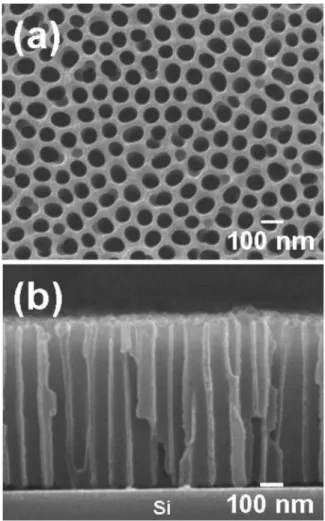
Figure 2a shows the plan-view scanning electron microscopy 共SEM兲 image of the fabricated AAO. The diameters of the AAO pores range from 65 to 75 nm. Figure2bshows the cross-sectional
SEM image of the AAO template on a Si substrate. Almost all the pores align vertically to the Si substrate. In particular, the AAO barrier has been removed after the pore widening treatment so that the deposited ZnO nanostructure can stick to the substrate after the removal of the AAO template.
Figure3a-cshows the plan-view SEM images after the ALD for 180, 250, and 550 cycles, respectively. At 180 cycles, the nanopore structure of the AAO pores could still be clearly observed. Because this growing process belongs to surface reaction control mechanism during the ALD process, the ZnO film can be deposited on the walls, the bottoms, and the top surface of the AAO template uniformly. Figure 1. 共Color online兲 Schematic diagram of the fabrication process for
ZnO nanorods and nanotubes:共a兲 AAO template on a Si substrate, 共b兲 after the deposition of ZnO by ALD,共c兲 after the procedure of mechanical pol-ishing or sputtering, and 共d兲 after the removal of the AAO template by selective chemical etching.
Figure 2. SEM images of the fabricated AAO template:共a兲 Plan-view, and
共b兲 cross-sectional view.
Figure 3. Plan-view SEM images after the ZnO deposition on AAO template
for共a兲 180, 共b兲 250, and 共c兲 550 cycles.
K237
When the deposition cycle increases, the diameters of the AAO pores decrease, as illustrated in Fig.3b. The AAO pores can be filled completely after 550 cycles, as depicted in Fig.3c. The AAO pores are no longer visible from the plan-view image after the deposition with 550 cycles.
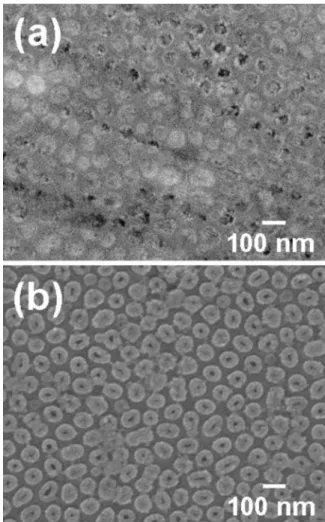
With mechanical polishing and selective etching, freestanding ZnO nanorods can be fabricated using the sample with 550 cycles. Figure 4a shows the plan-view SEM image after the mechanical polishing on the top surface of the 550 cycle sample in which the lighter area represents the ZnO nanorods and the darker area
illus-trates the AAO template. After the selective etching of the AAO template by a 0.4 wt % sodium hydroxide关NaOH共aq兲兴 solution, the details of the ZnO nanorods becomes very clear, which is shown in Fig.4b. All of the nanorods are able to stand firmly and are isolated from each other. To observe their cross-sectional structure, the speci-men was cleft and then analyzed by SEM, as shown in Fig. 4c. Because of the cleavage process, some nanorods near the interface were damaged. However, it is quite unique that all the nanorods stand vertically to the Si substrate, and they have the same height of ⬃470 nm and a uniform diameter of 70 nm.
To fabricate ZnO nanotubes, sputtering etching is required before the selective etching. Otherwise, the open ends of the nanotubes would not be revealed. Figure5ashows the plan-view SEM image for the 250 cycle sample after the mechanical polishing. Compared with Fig.3b, the open ends of the nanotubes were blocked by some polishing residues. Thus, no pores were visible after the polishing procedure. With the selective etching, some of the pores may be visible because the etchant also etched away some of the polishing residues, as seen in Fig. 5b. However, compared with Fig. 3b, clearly most of the open ends of the nanotubes were still blocked by the polishing residues. To overcome this difficulty, sputtering etch-ing is employed to etch away the top surface instead of usetch-ing me-chanical polishing. Figure6adepicts the plan-view SEM image after the sputtering etching by using Ar gas at 150 W for 3 min. Most of the pores of the nanotubes at the upper surface can be observed clearly after the sputtering etching. Figure6bshows the plan-view Figure 4.共a兲 Plan-view SEM image showing the surface morphology of the
ZnO nanorods with 550 cycles after mechanical polishing,共b兲 plan-view SEM image after removing the AAO template, and共c兲 cross-sectional view of the equal-height ZnO nanorods standing vertically to the Si substrate.
Figure 5. 共a兲 Plan-view SEM images showing the surface morphology of
ZnO nanotubes with 250 cycles after mechanical polishing. The open ends of the ZnO nanotubes are filled with the polishing residues.共b兲 After the selec-tive etching of the AAO template, some of the ZnO nanotubes become vis-ible.
morphology of the nanotubes after the selective etching of the AAO template. The AAO template did not etch away completely. Almost equal-spaced ZnO nanotubes can be fabricated by using this ap-proach. The thickness of the tube wall appears quite uniform. Figure
6cshows an enlarged image of the nanotubes. The measured wall thickness is 18.5⫾ 1 nm under this condition, which yields a growth rate of 0.075 nm/cycle. It is quite unique that the wall thick-ness is very uniform regardless of the shape of the AAO pores 共circles or ovals兲. Therefore, this approach is quite suitable to fab-ricate ZnO nanotubes with well-controlled wall thickness.
The ZnO nanotubes can stand firmly even after the complete removal of the AAO template. Figure 6d illustrates the cross-sectional SEM image of the nanotubes. Similar to the ZnO nanorods in Fig.4c, the nanotubes are of equal height and are almost vertical to the Si substrate. The aspect ratio of the nanotubes reaches 7:4. In particular, the bottoms of the nanotubes remain tubular in structure, as shown in the dotted square in Fig.6d. The measured thickness of the tube at the bottom is⬃18.4 nm, which is very close to the mean value of 18.5⫾ 1 nm measured from the top of the nanotubes. For the 180 cycle sample, some of the nanotubes were destroyed after the removal of the AAO template. The mechanical strength of the ZnO nanotubes is not strong when the tube wall is too thin; there-fore, they may be destroyed during the removal process of the AAO template.
The nanostructures of the nanorods and nanotubes are further investigated by TEM. Figure7aandbillustrates the cross-sectional TEM images for the ZnO nanotubes共250 cycles兲 and nanorods 共550 cycles兲 in the AAO template, respectively. For the ZnO nanotubes in Fig.7a, the tube structure can be observed very clearly in the TEM image and the wall thickness is measured to be⬃17.4 nm, which corresponds to the measured results from the SEM images. The wall thickness near the top surface is slightly higher than that of the Si substrate. Furthermore, the ALD is capable of filling the AAO pores fully to form ZnO nanorods, as shown in Fig.7b. The diameter of the nanorods is⬃70 nm, consistent with the observation from the SEM images. However, some of the nanorods may have tiny voids or seams near the bottom of the nanorods. Yet, in general, the pores were nicely filled, and thus, the ZnO nanorods can be fabricated by using this approach. The ZnO nanorods and nanotubes are polycrys-talline. The image contrast in the TEM images represents the differ-ent grain oridiffer-entations. The selected area diffraction patterns are ex-amined in the dotted circles, as shown in Fig.7candd. By indexing the diffraction patterns, both the nanorods and nanotubes are identi-fied to be ZnO wurtzite structure. For the ZnO nanotubes, ring pat-terns with scattered diffraction spots are observed, which are gener-ated from the共100兲, 共101兲, 共102兲, 共110兲, 共103兲, and 共201兲 planes, as shown in Fig.7c. The diffraction pattern in Fig.7dshows clear ring patterns with more diffraction patterns. This may be attributed to the fact that ZnO nanorods comprise more grains than nanotubes in a fixed volume. The polycrystalline characteristics in the ZnO nano-structures are revealed by the ring patterns.
This approach provides an excellent way to fabricate ZnO nano-tubes. No other approaches have been reported to fabricate ZnO nanotubes with well-controlled wall thickness, as mentioned in the Introduction. However, when the tube wall is too thin, nanotubes may not be able to stand firmly on the Si substrate. Some possible approaches may be adopted to solve this problem. First, a thinner AAO template could be used. Thus, the aspect ratio of the AAO pores is smaller. The nanotubes may have more chances to remain on the Si substrate after the removal of AAO. The other approach is by not etching away the AAO template completely, so that the re-maining AAO template could support the thin nanotubes. The above approaches are also feasible on a glass substrate. This part deserves more study.
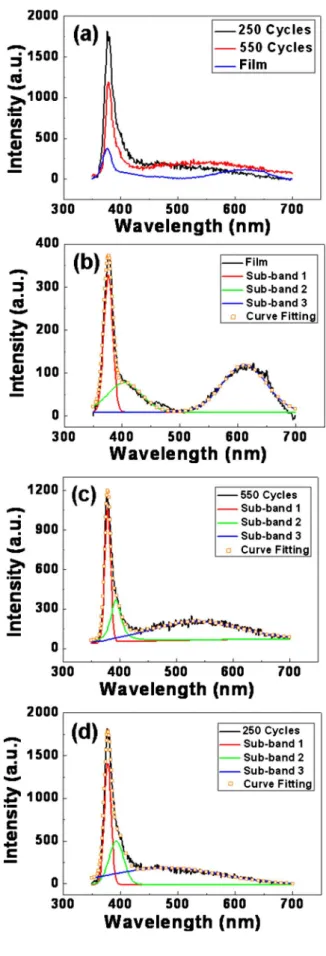
Compared with the ZnO films and nanorods, the ZnO nanotubes possess a better PL performance. Figure8ashows the PL spectrum for a 180 nm thick ZnO film, nanorod, and nanotube arrays. The ZnO film and nanorods were prepared under the same deposition condition of 550 cycles at 250°C, whereas the ZnO nanotubes were Figure 6.共a兲 Plan-view SEM image for the ZnO nanotube arrays with 250
cycles after the sputtering etching.共b兲 After the selective etching of the AAO template for the sample in共a兲. All the open ends of the nanotubes are re-vealed using this approach.共c兲 Enlarged SEM images for the nanotubes in 共b兲. 共d兲 Cross-sectional SEM image after the removal of the AAO template. The dotted square in共d兲 shows the tube structure clearly.
K239
fabricated at 250 deposition cycles. For the three structures, a strong excitation emission and broad defect-level emission are observed in the UV and visible regions. After Gauss fitting, the PL spectrum can be fitted to three sub-bands共sub-band 1, sub-band 2, and sub-band 3兲, as shown in Fig.8b-d. The sub-band 1 was located at 376, 379, and 377 nm, the sub-band 2 was situated at 404, 394, and 392 nm, and the sub-band 3 was observed at 612, 534, and 479 nm for the ZnO film, nanorods, and nanotubes, respectively. The sub-band 1 located at⬃380 nm is attributed to the radiation recombination of free exciton transition from the conduction band to the valance band.39,40The sub-bands 2 and 3 located at⬃400 to 700 nm may be caused by the defect-level transition of the oxygen vacancies and zinc interstitials, common impurities, and defects in the crystal.39-46 A strong excitation emission of PL共sub-band 1兲 is observed for the ZnO nanotubes. Shen et al. reported that both photon-to-electron conversion efficiency and photonic performance were enhanced in Figure 7.共Color online兲 Cross-sectional TEM images for 共a兲 ZnO nanotubes
with 250 cycles and共b兲 ZnO nanorods with 550 cycles. Figures 共c兲 and 共d兲 are selected area diffraction patterns for共a兲 and 共b兲, respectively.
Figure 8.共Color online兲 共a兲 PL spectrum of the ZnO thin film 共550 cycles兲,
ZnO nanorods共550 cycles兲, and ZnO nanotubes 共250 cycles兲. Gauss fitting was used to fit the three spectrums in共a兲. 共b兲 Thin film with 550 cycles, 共c兲 nanorods with 550 cycles, and共d兲 nanotubes with 250 cycles.
the studies of ZnO nanorod arrays on PL spectrum due to the de-crease in diameters and the inde-crease in surface areas for nanorod configuration.45In addition, Wu et al. investigated the PL spectra of ZnO nanorods and nanotubes,40 and they found that the tubular structure is advantageous to the optical characteristic because of the higher porosity and larger surface area. In particular, for ZnO rods and nanotubes in this study, the surface area ratio of the nano-tube to the nanorod is 1:57, which appears to fairly agree with the 1:63 ratio obtained from their area of sub-band 1 in Fig.8candd. Consequently, the higher excitation emission of the nanotubes could be attributed to their larger surface area. Therefore, the ZnO nano-tubes exhibited better performance in excitation emission than those of the ZnO film and nanorods. In addition, a blueshift of visible emission 共sub-band 3兲 located at ⬃479 to 612 nm was obtained from the ZnO nanotubes, compared with the ZnO film and nanorods, in the PL spectrum. According to the literatures,39-46the visible band located at 479–612 nm results from the deep-level emission caused by oxygen vacancies, including VO• and VO••. VO• is the oxygen va-cancy with one electron lost at ⬃2.0 eV below the conduction band, whereas VO••is the oxygen vacancy with two electrons lost at ⬃2.2 eV below the conduction band.39,43Because the depletion re-gion at the ZnO surface contains VO••rather than VO•, this implies that the ZnO nanotubes have a larger surface area and therefore would have a large amount of VO••. On the contrary, the ZnO film would have a higher concentration of VO• instead of VO••. Therefore, the PL results of sub-band 3 indicate that the ZnO nanotubes would prefer to perform blue/green luminescence, whereas the ZnO film would radiate green/yellow lights. In addition, the ratio of visible emission 共sub-band 3兲 to excitation emission 共sub-band 1兲 is 1:73, 2:13, and 2:16 for the ZnO film, nanorods, and nanotubes, respectively. These results suggest that the ZnO nanotubes have a great amount of deep-level vacancies due to their larger surface area, which agrees well with those mentioned above. The sub-band 2 located at⬃400 nm may be a result of the radiation of zinc interstitials.39,43 Neverthe-less, further studies are required to clarify these results.
Conclusions
In summary, self-aligned ZnO nanotubes and nanorods have been fabricated by using ALD technique and AAO templates on Si substrates. The as-prepared AAO nanopores have a 70 nm diameter, a 95 nm pore distance, a 720 nm height, and an aspect ratio of 10:2. From the SEM and TEM images, the wall thickness of the nano-tubes at 250 cycles is⬃18 nm and the diameter of the nanorods at 550 cycles is⬃70 nm. In particular, by controlling the amount of deposition cycles, the wall thickness of the nanotubes can be con-trolled precisely. Because of their larger surface area, the ZnO nano-tubes exhibit excellent PL performances compared with the ZnO films and nanorods on the excitation emission, the blueshift of vis-ible emission, and the ratio of visvis-ible emission to excitation emis-sion.
Acknowledgments
The authors thank the National Science Council of Taiwan for their financial support in this research under contract no. NSC-96-2628-E-009-010-MY3.
National Chiao-Tung University assisted in meeting the publication costs of this article.
References
1. Y. Xia, P. Yang, Y. Sun, Y. Wu, B. Mayers, B. Gates, Y. Yin, F. Kim, and H. Yan, Adv. Mater., 15, 353共2003兲.
2. M. H. Huang, Y. Wu, H. Feick, N. Tran, E. Weber, and P. Yang, Adv. Mater., 13, 113共2001兲.
3. Z. W. Pan, Z. R. Dai, and Z. L. Wang, Science, 291, 1947共2001兲. 4. Z. L. Wang, J. Mater. Chem., 15, 1021共2005兲.
5. B. P. Zhang, N. T. Binh, K. Wakatsuki, Y. Segawa, Y. Yamada, N. Usami, M. Kawasaki, and H. Koinuma, Appl. Phys. Lett., 84, 4098共2004兲.
6. Z. Y. Yuan and B. L. Su, Colloids Surf., A, 241, 173共2004兲.
7. Y. Lei, L. D. Zhang, G. W. Meng, G. H. Li, X. Y. Zhang, C. H. Liang, W. Chen, and S. X. Wang, Appl. Phys. Lett., 78, 1125共2001兲.
8. Y. Wu, R. Fan, and P. Yang, Nano Lett., 2, 83共2002兲.
9. J. Goldberger, R. R. He, Y. F. Zhang, S. Lee, H. Q. Yan, H. J. Choi, and P. Yang, Nature (London), 422, 599共2003兲.
10. Z. Tang, N. A. Kotov, and M. Giersig, Science, 297, 237共2002兲.
11. Y. K. Tseng, C. J. Huang, H. M. Cheng, I. N. Lin, K. S. Liu, and I. C. Chen, Adv. Funct. Mater., 13, 811共2003兲.
12. M. S. Arnold, P. Avouris, Z. W. Pan, and Z. L. Wang, J. Phys. Chem. B, 107, 659 共2003兲.
13. M. Law, L. E. Greene, J. C. Johnson, R. Saykally, and P. D. Yang, Nature Mater., 4, 455共2005兲.
14. S. Liang, H. Sheng, Y. Liu, Z. Huo, Y. Lu, and H. Shen, J. Cryst. Growth, 225, 110 共2001兲.
15. Q. Wan, Q. H. Li, Y. J. Chen, T. H. Wang, X. L. He, J. P. Li, and C. L. Lin, Appl. Phys. Lett., 84, 3654共2004兲.
16. S. Pizzini, N. Buttd, D. Narducci, and M. Palladino, J. Electrochem. Soc., 136, 1945共1989兲.
17. N. Golego, S. A. Studenikin, and M. Cocivera, J. Electrochem. Soc., 147, 1592 共2000兲.
18. S. C. Minne, S. R. Manalis, and C. F. Quates, Appl. Phys. Lett., 67, 3918共1995兲. 19. C. R. Gorla, N. W. Emanetoglu, S. Liang, W. E. Mayo, Y. Lu, M. Wraback, and H.
Shen, J. Appl. Phys., 85, 2595共1999兲.
20. M. H. Huang, S. Mao, H. Feick, H. Yan, Y. Wu, H. Kind, E. Weber, R. Russo, and P. Yang, Science, 292, 1897共2001兲.
21. B. Lin, Z. Fu, Y. Jia, and G. Liao, J. Electrochem. Soc., 148, G110共2001兲. 22. Y. B. Li, Y. Bando, T. Sato, and K. Kurashima, Appl. Phys. Lett., 81, 144共2002兲. 23. V. Craciun, R. K. Singh, J. Perriere, J. Spear, and D. Craciun, J. Electrochem. Soc.,
147, 1077共2000兲.
24. J. J. Robbins, J. Esteban, C. Fry, and C. A. Wolden, J. Electrochem. Soc., 150, C693共2003兲.
25. J. F. Conley, Jr., L. Stecker, and Y. Ono, Nanotechnology, 16, 292共2005兲. 26. M. J. Zheng, L. D. Zhang, G. H. Li, and W. Z. Shen, Chem. Phys. Lett., 363, 123
共2002兲.
27. T. L. Sounart, J. Liu, J. A. Voigt, J. W. P. Hsu, E. D. Spoerke, Z. Tian, and Y. Jian, Adv. Funct. Mater., 16, 335共2006兲.
28. H. Chik, J. Liang, S. G. Cloutier, N. Kouklin, and J. M. Xu, Appl. Phys. Lett., 84, 3376共2004兲.
29. M. Scharrer, X. Wu, A. Yamilov, H. Cao, and R. P. H. Chang, Appl. Phys. Lett., 86, 151113共2005兲.
30. W. H. Kim, S. J. Park, J. Y. Son, and H. Kim, Nanotechnology, 19, 045302共2008兲. 31. J. W. Elam, D. Routkevitch, P. P. Mardilovich, and S. M. George, Chem. Mater.,
15, 3507共2003兲.
32. G. Xiong, J. W. Elam, H. Feng, C. Y. Han, H. H. Wang, L. E. Iton, L. A. Curtiss, M. J. Pellin, M. Kung, H. Kung, et al., J. Phys. Chem. B, 109, 14059共2005兲. 33. M. S. Sander, M. J. Côté, W. Gu, B. M. Kile, and C. P. Tripp, Adv. Mater., 16, 2052
共2004兲.
34. D. Losic, G. Triani, P. Evans, A. Atanacio, J. Mitcheli, and N. H. Voelcker, J. Mater. Chem., 16, 4029共2006兲.
35. C. J. Yang, S. M. Wang, S. W. Liang, Y. H. Chang, C. Chen, and J. M. Shieh, Appl. Phys. Lett., 90, 033104共2007兲.
36. T. M. Abdel-Fattah, D. Gu, H. Baumgart, and G. Namkoong, ECS Trans., 25共4兲, 315共2009兲.
37. F. Li, L. Zhang, and R. M. Metzger, Chem. Mater., 10, 2470共1998兲. 38. O. Jessensky, F. Müller, and U. Gösele, Appl. Phys. Lett., 72, 1173共1998兲. 39. Y. Y. Peng, T. E. Hsieh, and C. H. Hsu, Nanotechnology, 17, 174共2006兲. 40. C. C. Wu, D. S. Wuu, P. R. Lin, T. N. Chen, and R. H. Horng, Cryst. Growth Des.,
9, 4555共2009兲.
41. K. Vanheusden, W. L. Warren, C. H. Seager, D. R. Tallant, J. A. Voigt, and B. E. Gnade, J. Appl. Phys., 79, 7983共1996兲.
42. A. van Dijken, E. A. Meulenkamp, D. Vanmaekelbergh, and A. Meijerink, J. Lu-min., 90, 123共2000兲.
43. S. A. M. Lima, F. A. Sigoli, M. Jafelicci, Jr., and M. R. Davolos, Int. J. Inorg. Mater., 3, 749共2001兲.
44. X. L. Wu, G. G. Siu, C. L. Fu, and H. C. Ong, Appl. Phys. Lett., 78, 2285共2001兲. 45. X. P. Shen, A. H. Yuan, Y. M. Hu, Y. Jiang, Z. Xu, and Z. Hu, Nanotechnology, 16,
2039共2005兲.
46. M. Q. Israr, J. R. Sadaf, L. L. Yang, O. Nur, M. Willander, J. Palisaitis, and P. O. Å. Persson, Appl. Phys. Lett., 95, 073114共2009兲.
K241