研究報告
台灣昆蟲 29: 37-50 (2009) Formosan Entomol. 29: 37-50 (2009)前 言
岡 崎 釉 小 蜂 (Closterocerus okazakii (Kamijo)) 分 布 於 臺 灣 (Lin and Wang,
1992; Chien and Ku, 1998)、中國之褔建省 (Chen and Ye, 2002) 與廣東省 (Zeng et al., 1999) 及日本 (Arakaki and Kinjo, 1998) 等地。在臺灣,該蜂為蔬菜斑潛蠅 (Liriomyza
溫度對岡崎釉小蜂
(
Closterocerus okazakii (Kamijo))
(膜翅目:釉小蜂科) 生命表與致死寄主能力之影響
錢景秦
1*、張淑貞
11 行政院農業委員會農業試驗所應用動物組 41362 臺中縣霧峰鄉中正路 189 號
摘 要
岡 崎 釉 小 蜂 (Closterocerus okazakii (Kamijo)) 為 臺 灣 地 區 蔬 菜 斑 潛 蠅 (Liriomyza sativae Blanchard) 之優勢寄生蜂。為瞭解該蜂對蔬菜斑潛蠅生物防治 之利用,本文探討溫度 (10~35℃) 對岡崎釉小蜂生命表與致死寄主能力之影響。結 果得知,該蜂發育適溫帶為 15 至 35℃,其間卵至蛹期之存活率為 92.4~100%, 發育日數為 8.8~56.8 日,而 10℃ 時卵期與幼蟲期之存活率僅各為 7.5 與 0%。 卵至蛹期之發育臨界低溫為 11.3℃,卵、幼蟲、前蛹、蛹及卵至蛹期之發育有效積 溫各為 21、51、16、109 及 192 日度。於定溫情況,每日供應 40~50 隻蔬菜斑 潛蠅第三齡寄主幼蟲時,該蜂致死寄主總數在 20 與 25℃ 時,各為 245 與 372 隻,15、30 及 35℃ 時各為 94、64 及 32 隻。該蜂在 25℃ 下繁殖,並於初羽化 時移至 30 與 35℃,則致死寄主總數各為 189 和 141 隻。該蜂餵食純蜂蜜,25℃ 時 族 群 增 長 最 快 , 雌 蜂 每 日 產 雌 性 有 活 力 卵 數 (蛹數) 之內在增殖率 (rm) 為 0.2421,淨增殖率 (R0) 為 139.7 粒。在 15~35℃ 定溫,每日僅以純蜂蜜餵食時, 雌、雄蜂壽命最長各為 20℃ 時之 55.9 日,與 15、20℃ 時之 39.5~40.3 日;同 時供應寄主與純蜂蜜時,雌、雄蜂壽命最長各為 15℃ 時之 45.5 與 32.5 日。 關鍵詞:岡崎釉小蜂、蔬菜斑潛蠅、溫度、生命表、致死寄主能力。
sativae Blanchard) 之 本 地 種 優 勢 寄 生 蜂
(Chien and Chang, unpublished data)。寄 生方式屬幼蟲單員內寄生 (larval solitary endoparasitoid)。致死寄主方式有寄生與取食 寄主 (host-feeding) 兩種,不論在非洲菊斑潛 蠅 (Liriomyza trifolii (Burgess)) 與蔬菜斑 潛蠅上,雌蜂偏好在第三齡寄主幼蟲上產卵, 在第二齡與第三齡寄主幼蟲上取食 (Chien and Ku, 2001; Chien and Chang, 2009)。於
25 ℃ 下,雌蜂一生致死寄主蔬菜斑潛蠅幼蟲
數高達 372 隻,同時寄主幼蟲被產卵或取食 後,各經 2.8~102 與 0 分鐘即不再活動、 取食 (Chien and Chang, 2009)。為深入瞭解 在蔬菜斑潛蠅上,溫度對岡崎釉小蜂之發育、 齡別生命表、致死寄主能力及壽命等之影響, 乃進行本試驗,冀能提供該蜂繁殖技術與應用 之參考。
材料與方法
寄主植物、寄主昆蟲及寄生蜂之飼育 本試驗所用之寄主蔬菜斑潛蠅蟲源、寄主 植物菜豆 (Phaseolus vulgaris var. communis Aeschers) 苗 及 寄 主 蔬 菜 斑 潛 蠅 之 繁 殖 方 法,如 Chien and Ku (1996)所述。岡崎釉 小蜂之蟲源與繁殖方法,則如 Chien and Ku (2001)所述。即以帶有寄主蔬菜斑潛蠅第三齡 幼蟲潛食之罐插菜豆苗,繁殖岡崎釉小蜂。 寄生蜂寄生致死寄主與取食致死寄主之區分 本試驗中,區分寄主幼蟲被岡崎釉小蜂寄 生或取食後之致死徵狀,係依 Chien and Chang (2009) 所述。被寄生者體黃色、外形 鬆馳拉長但仍保持原來之飽滿、消化管內無暗 綠色之內容物、呈深度麻痺狀態,被取食者體 黃褐色、外形伸長體扁且萎縮、消化管內仍殘 留有暗綠色之內容物、傷口處留有乾涸之體 液。 一、溫度對釉小蜂發育之影響 由於岡崎釉小蜂前蛹期在 15~35 ℃ 下 低於 1 日;而該蜂生命表中卵至蛹期之發 育,必須採用 24 小時同齡蜂卵為試材。因此 為達精確記錄該蜂發育期與齡別生命表之目 的,分別將帶有 2 小時或 24 小時同齡蜂卵 (24~51 粒) 之罐插菜豆苗,各放入 10、15、 20、25、30 及 35 ℃ 之定溫箱內。2 小時同 齡蜂卵之處理組,每日觀察溫度對該蜂各蟲期 存活率與發育日數之影響,並在近各蟲期變化 或齡期蛻皮之際,每小時記錄該蜂之發育情 形。24 小時同齡蜂卵之處理組,則觀察在不 同溫度處理下,卵發育至蛹期之發育日數與存 活率。其中存活率試驗,以 25~35 粒卵為一 組,各做 3 重複;發育期試驗各觀察 23~51 隻不等。並依 Campbell et al. (1974)之方 法,估算該蜂之發育臨界低溫與發育有效積 溫。 二、溫度對釉小蜂生命表與致死寄主能力之影 響 利用前項中,岡崎釉小蜂卵在 15、20、 25、30 及 35 ℃ 五種不同定溫下,正常發育 交尾後 0 日齡之成蜂,各取 1 對釋入直徑 12 cm、高 21 cm 之玻璃筒,並供應 1 株內 有 40~50 隻第三齡寄主幼蟲潛食之罐插菜 豆苗,然後再放回原定溫箱內。每日早上 7 點,將已被寄生或取食寄主之菜豆苗移出,更 換 1 株新鮮帶有寄主之菜豆苗,並以細毛筆 將純蜂蜜塗於玻璃筒內壁,直至雌蜂死亡為 止。試驗期間,每日將各處理所更換下內有被 寄生、或取食寄主之菜豆苗,移至 25 ℃ 下飼 育,直至子代羽化。記錄各處理 1 對成蜂之壽命,並依 Chien and Ku (2001) 之方法, 於接蜂後次晨,利用透光法,計數雌蜂對寄主 幼 蟲 之 致 死 總 數 (寄生致死數+取食致死 數),7 日後,再分別記錄雌蜂對寄主幼蟲之寄 生數 (寄生蜂蛹數) 與取食寄主數 (致死寄主 總數-寄生蜂蛹數),待寄生蜂羽化後,再記錄 雌蜂與雄蜂數及雌性比。每處理各進行 8~18 重複。然後將前項岡崎釉小蜂於 24 小時內之 同齡蜂卵,在各不同溫度處理中之發育期與存 活 率 資 料 及 本 項 試 驗 所 得 之 資 料 , 利 用 Lotka-Euler formula 之 方 法 (Goodman, 1982),估算該蜂在各不同定溫下之族群介 量 , 如 內 在 增 殖 率 (intrinsic rate of increase, rm)、終極增殖率 (finite rate of increase, λ)、淨增殖率 (net reproductive rate, R0) 及平均世代時間 (mean generation,
T) 等。 三、高溫對 25℃ 下繁殖之釉小蜂生育力與致 死寄主能力之影響 岡 崎 釉 小 蜂 在 30 與 35 ℃ 定 溫 下 繁 殖,雖不利其生育力與致死寄主能力。但為測 試室內 25 ℃ 下繁殖之雌蜂,在田間高溫下之 應用,於是將在 25 ℃ 下繁殖之 0 日齡 1 對 成蜂,分別釋入直徑 12 cm、高 21 cm 之玻 璃筒,移至 30 與 35 ℃ 下,然後測試高溫對 岡崎釉小蜂壽命、生育力及致死寄主能力之影 響,期間供試寄主與檢視試驗結果之方法,與 前第二項相同。各進行 8 與 4 重複。 四、溫度與食物對成蜂壽命之影響 探討溫度 (15~35 ) ℃ 與食物 (純蜂蜜、 寄主與純蜂蜜、水) 對岡崎釉小蜂壽命之影 響。純蜂蜜與水之處理組,係將於 25 ℃ 下初 羽化之 10 對成蜂,釋入直徑 3 cm、高 10 cm 之玻璃管,每日以細毛筆塗畫於玻璃管內 壁之方式,餵以純蜂蜜或水,另設一不餵食任 何食物之對照組。其中餵食純蜂蜜之處理組, 係將成蜂各放入 15、20、25、30 及 35 ℃ 等 不同溫度之定溫箱,而餵食水、或不餵食任何 食物之對照組,則將成蜂放入 25 ℃ 定溫箱, 每日記錄成蜂之壽命,每處理各進行 5 重 複。餵食寄主與純蜂蜜之處理組,則利用前第 二項之資料,測試在上述五種不同溫度下,每 日同時供應寄主與純蜂蜜情況時,記錄成蜂之 壽命。 五、統計分析 各 項 試 驗 資 料 利 用 SPSS (Statistical Products and Services Solutions) 軟體先進 行變方分析,再以最小顯著差 (LSD) 法,或 t 值測試法檢測,採 p < 0.05 顯著水準比較處 理間之差異。
結 果
一、溫度對釉小蜂發育之影響 在 10~35 ℃ 定溫下,岡崎釉小蜂卵發育 至蛹期之存活率受溫度之影響 (表一)。該蜂發 育之適溫帶為 15 至 35℃,各溫度下卵、幼 蟲及蛹期之存活率均高於 92.4%。至於 10 ℃ 時,其卵期與幼蟲期之存活率卻僅為 7.5 與 0%。在 15~35 ℃ 間,岡崎釉小蜂未成熟期 之發育日數,均隨溫度之升高而縮短 (表二), 該蜂各生長期之發育速率與溫度呈極顯著之 線性迴歸關係 (表三)。卵、幼蟲、前蛹、蛹及 卵至蛹等蟲期之發育臨界低溫,各為 10.7、 12.9、4.7、10.3 及 11.3℃;發育有效積溫各 為 21、51、16、109 及 192 日度 (表三)。 二、溫度對釉小蜂生命表與致死寄主之影響 壽命:雌蜂壽命在 15 ℃ 時為 45.5 日,20 與 25 ℃ 時各為 21.9 與 18.7 日,30 與 35 ℃ 時各為 9.6 與 8.2 日,處理間呈顯著 差異 (表四)。雄蜂壽命在 15 ℃ 時為 32.5 日,20 與 25 ℃ 時均為 16.3 日,30 與 35 ℃ 時各為 8.0 與 7.3 日,處理組間呈顯著差異 (表四)。雌、雄蜂二者在相同溫度下,各處理 組壽命均無顯著差異 (表四)。 產卵:每雌一生產有活力卵數 (蛹數),在 25 ℃ 時為 243 粒,20 ℃ 時為 135 粒,15、 30 及 35 ℃ 時僅為 14~41 粒,處理間呈顯 著差異 (表四)。日產卵型式受溫度影響 (圖 一)。在 15 ℃ 下,雌蜂之產卵前期為 2 日, 表一 不同定溫下岡崎釉小蜂未成熟期之存活率1)
Table 1. Survival rate (
x
± SEM) of each immature stage of Closterocerus okazakii at various constant temperatures1) Temp. (oC) Egg Larva Prepupa Pupa Egg-pupa10 7.5 ± 4.6 0 - - 0 15 100 100 100 94.1 ± 2.2 94.1 ± 2.2 20 100 100 100 100 100 25 100 100 100 95.9 ± 1.7 95.9 ± 1.7 30 100 100 99.5 ± 0.5 93.9 ± 1.6 93.4 ± 1.1 35 100 100 100 92.4 ± 1.4 92.4 ± 1.4
1) With 25-35 eggs per treatment, three replicates.
表二 不同定溫下岡崎釉小蜂未成熟期之發育日數
Table 2. Duration (days) of each immature stage of Closterocerus okazakii at various constant temperatures Temp. (oC) Egg n
x
± SEM Larva nx
± SEM Prepupa nx
± SEM Pupa nx
± SEM Egg-pupa nx
± SEM 10 30 10.0 ± 0.0 - - - - 15 25 5.7 ± 0.0 25 21.6 ± 0.6 25 2.5 ± 0.6 23 27.0 ± 0.8 23 56.8 ± 0.8 20 28 3.6 ± 0.0 28 8.8 ± 0.2 28 0.9 ± 0.1 28 13.2 ± 0.2 28 25.5 ± 0.2 25 51 1.5 ± 0.0 51 4.2 ± 0.1 51 0.7 ± 0.1 49 6.2 ± 0.1 49 12.6 ± 0.1 30 24 1.1 ± 0.0 24 2.6 ± 0.1 24 0.6 ± 0.1 23 4.9 ± 0.1 23 9.2 ± 0.1 35 29 0.8 ± 0.0 28 2.5 ± 0.2 28 0.6 ± 0.1 27 4.9 ± 0.1 27 8.8 ± 0.1 表三 岡崎釉小蜂各發育期之發育速率對溫度之線性迴歸方程式、發育臨界低溫及有效積溫Table 3. Linear regression equations (y = developmental rate, x = temperature), Lower developmental thresholds (oC), and thermal summation (degree-day) for the different life stages of Closterocerus okazakii
Stage Temp. range (oC) Regression equation1) R2 T
o (
x
± SEM)2) DD(x
± SEM)2) Egg 10-35 y = 0.0477x - 0.5091 0.9477 10.7 ± 1.0 21 ± 2 Larva 15-35 y = 0.0196x - 0.2527 0.9578 12.9 ± 0.9 51 ± 6 Prepupa 15-35 y = 0.0618x - 0.2898 0.9110 4.7 ± 1.8 16 ± 4 Pupa 15-35 y = 0.0092x - 0.0948 0.9520 10.3 ± 1.3 109 ± 20 Egg to pupa 15-35 y = 0.0052x - 0.0591 0.9610 11.3 ± 0.9 192 ± 261) Regression equation for relationships where p < 0.01.
2) Estimated according to Campbell et al. (1974). R2: coefficient of determination. T
o: the lower developmental
產卵期雖長達 52 日,但每日產有活力卵數僅 0~2.2 粒,且無產卵後期;在 20 與 25 ℃ 下,雌蜂之產卵前期各為 1 與 0 日,產卵期 各長達 28 與 35 日,每日產有活力卵數各為 0.3~16.1 與 1.0~21.3 粒,產卵後期各為 6 與 0 日;在 30 與 35 ℃ 時,雌蜂均無產卵 前期,產卵期各縮短為 15 與 13 日,前者每 日產有活力卵數雖仍維持 0.3~11.1 粒,但後 者卻僅為 1.0~2.6 粒,產卵後期各為 2 與 1 日。 取食:每雌一生取食寄主數,在 20 與 25 ℃ 時各為 110 與 129 隻,15 ℃ 時為 75 隻,30 與 35 ℃ 時各為 22 與 17 隻,其中 20 與 25 ℃ 處理組,與其餘處理組間呈顯著 差異 (表四)。日取食型式受溫度影響 (圖一)。 在 15 ℃ 下,雌蜂之取食前期為 2 日,取食 期雖長達 52 日,但每日取食寄主數僅 0~ 5.0 隻,無取食後期;20 與 25 ℃ 下,雌蜂 無取食前期,取食期相近各為 32 與 35 日, 每 日 取 食 寄 主 數 各 為 0.9~10.1 與 2.2~ 14.0 隻,取食後期各為 3 與 0 日;在 30 與 35 ℃ 時,雌蜂無取食前期,取食期各縮短為 15 與 13 日,每日取食寄主數亦各銳減為 0.9~5.0 與 0.4~3.3 隻,取食後期各為 2 與 1 日。 寄生致死寄主數與取食致死寄主數之比 值:雌蜂寄生致死寄主數與取食致死寄主數之 比值,在 25 與 30 ℃ 時均為 2.0,而 15、 20 及 35 ℃ 時各達 0.3、1.2 及 0.8,其中 25 與 30 ℃ 處理組,與其餘處理組間呈顯著 差異 (表四)。 致死寄主能力:每雌一生致死寄主數,在 25 ℃ 時為 372 隻,20 ℃ 時為 245 隻,15、 30 及 35 ℃ 時僅為 32~94 隻,處理間呈顯 著差異 (表四)。 子蜂數:每雌一生產子蜂數,在 25 ℃ 時 為 231 隻,20 ℃ 時為 123 隻,15、30 及 35 ℃ 時僅為 11~39 隻,處理間呈顯著差異 (表四)。 子代雌性比:子代雌性比在 20、25 及 30 ℃ 時為 0.52~0.60,處理間無顯著差異, 而 15 ℃ 時為 0.48、35 ℃ 時僅為 0.01,兩 表四 不同溫度下岡崎釉小蜂之壽命、生育力及致死寄主能力1)
Table 4. Longevity, fertility and host-killing capability of Closterocerus okazakii at various temperatures1) Longevity (d) Fertility No. hosts killed/female Temp.
(oC) n Female Male No. adults Female
proportion
Parasitized Host-
feeding Total host-feedingParasitized/ 15 10 45.5 ± 5.1Aa2) 32.5 ± 4.1Aa 11 ± 2 d 0.48 ± 0.05b 19 ± 3d 75 ± 14bc 94 ± 14de 0.3 ± 0.1d
20 8 21.9 ± 3.4Ab 16.3 ± 1.8Ab 123 ± 23b 0.53 ± 0.06ab 135 ± 26b 110 ± 19ab 245 ± 43b 1.2 ± 0.2bc 25 9 18.7 ± 2.8Ab 16.3 ± 1.4Ab 231 ± 24a 0.60 ± 0.03a 243 ± 25a 129 ± 21a 372 ± 42a 2.0 ± 0.2a 30 18 9.6 ± 1.0Ac 8.0 ± 0.9Ac 39 ± 9cd 0.52 ± 0.04ab 41 ± 10cd 22 ± 7d 64 ± 15de 2.0 ± 0.4a 35 11 8.2 ± 1.1Ac 7.3 ± 1.0Ac 14 ± 5d 0.01 ± 0.01c 14 ± 6d 17 ± 6d 32 ± 11e 0.8 ± 0.3cd 25 30→ 3) 8 10.3 ± 0.8Ac 7.9 ± 0.8Ac 116 ± 18b 0.60 ± 0.03a 121 ± 20b 68 ± 15c 189 ± 24bc 2.0 ± 0.3ab 25 35→ 3) 4 9.8 ± 0.7Ac 9.0 ± 0.7Ac 84 ± 6bc 0.55 ± 0.01ab 85 ± 7bc 56 ± 9cd 141 ± 16cd 1.7 ± 0.2ab
1) One pair of adults was provided daily with 40-50 third instars of Liriomyza sativae and honey and reared at a
given temperature with a photoperiod of 14:10 (L:D) and 65-85% RH.
2) Means (
x
± SEM) of longevity followed by the same uppercase letter denote that there are no significantdifferences between sexes (p < 0.05, t-test). Means (
x
± SEM) within each column followed by the same lowercase letter are not significantly different (p < 0.05, LSD).0 5 10 15 20 25 30 35 40 45 50 55 60 0 5 10 Parasitized 0 Feeding 15oC 0 5 10 15 20 25 30 35 40 0 5 10 15 20 25 30 20oC 0 5 10 15 20 25 30 35 40 No. h o st s kil le d p e r f e mal e 0 5 10 15 20 25 30 25oC 30oC 0 5 10 15 20 25 30 35 40 0 5 10 15 20 25 30 35oC Adult age (d) 25-35oC 25-30oC 0 5 10 15 20 25 30 35 40 0 5 10 15 20 25 30 30oC 0 5 10 15 20 25 30 35 40 0 5 10 15 20 25 30 Adult age (d) 25-30oC 0 5 10 15 20 25 30 35 40 0 5 10 15 20 25 30 25-35oC
圖一 岡崎釉小蜂在不同溫度下各日齡之寄生與取食寄主型式。
Fig. 1. Daily parasitization and host-feeding patterns of female Closterocerus okazakii at various temperatures (25-30oC and 25-35oC: wasps reared and emerged at 25oC, then transferred to 30 or 35oC for oviposition and feeding).
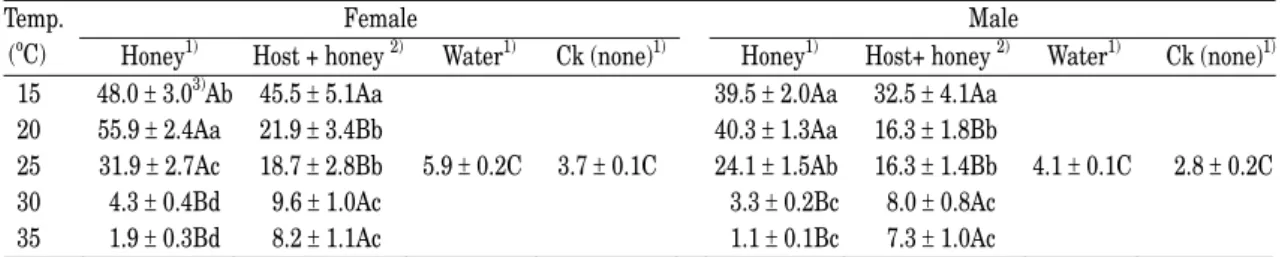
者與 25 ℃ 處理組間呈顯著差異 (表四)。 齡別生命表:在 15~25 ℃ 定溫時,族群 增長隨溫度之上升而增加,因此若就其每日雌 性有活力卵數之內在增殖率觀之,25 ℃ 為該 蜂族群增長最快之溫度,30 ℃ 時內在增殖率 略下降,至 35 ℃ 時更呈負成長 (表五)。該蜂 齡別存活率 (lx) 之曲線型式,在 15~35 ℃ 各處理組間均相似,而齡別淨增殖值 (vx) 與 齡別繁殖率 (mx) 之曲線型式,在 20~35 ℃ 處理組間雖皆相似,卻與 15 ℃ 處理組不同 (圖二)。 三、高溫對 25℃ 下繁殖之釉小蜂壽命、生育 力及致死寄主能力之影響 岡崎釉小蜂在 25 ℃ 下繁殖之初羽化成蜂, 若移至 30 與 35 ℃ 高溫下、每日供應 40~ 50 隻第三齡寄主幼蟲時,兩處理組間,不論 壽命、致死寄主能力及子代雌性比等均無顯著 差異。與前第二項試驗結果比較時,該兩處理 組雌蜂之一生產子蜂數、致死寄主總數、寄生 致死寄主數及取食致死寄主數等,雖均顯著較 25 ℃ 定溫者低,但前三項卻各顯著較 30 與 35 ℃ 定溫者高;子代雌性比方面,兩處理組 與 25 ℃ 定 溫 者 間 無 顯 著 差 異 , 卻 顯 著 較 35 ℃ 定溫者高 (表四)。另兩處理組之日產卵 與取食型式,亦與 25 ℃ 定溫者不一,兩處理 組每日產有活力卵數與取食寄主數,雖仍各維 持為 1.3~21.6 粒與 0.6~9.8 隻,但兩處理 組之產卵期與取食期卻均明顯縮短為 11~13 日 (圖一)。 四、溫度與食物對成蜂壽命之影響 溫度與食物對成蜂壽命影響甚大。就溫度 而言,每日僅以純蜂蜜餵食,雌蜂壽命在 20 ℃ 時最長,15 ℃ 時次之,25 ℃ 時再次,30、 35 ℃ 時最短,處理間呈顯著差異,雄蜂壽命 則在 15、20 ℃ 時最長,25 ℃ 時次之,30、 35 ℃ 時最短,處理間呈顯著差異 (表六);每 日同時供應寄主與純蜂蜜時,雌、雄蜂壽命均 在 15 ℃ 時最長,20、25 ℃ 時次之,30、35 ℃ 時最短,處理間呈顯著差異 (表六)。就食物而 言,在相同溫度下,僅供應純蜂蜜,或同時供 應寄主與純蜂蜜,15 ℃ 時,雌、雄蜂壽命在 兩種食物處理組間皆無顯著差異;而 20、25 ℃ 時,不論雌、雄蜂,僅供應純蜂蜜者之壽命, 均 顯 著 較 同 時 供 應 寄 主 與 純 蜂 蜜 者 長 ; 但 30、35 ℃ 時,不論雌、雄蜂,僅供應純蜂蜜 者之壽命,卻均顯著較同時供應寄主與純蜂蜜 者短 (表六);另在 25 ℃ 下,雌、雄蜂壽命, 均以餵食純蜂蜜者最長,供應寄主與純蜂蜜者 表五 不同定溫下岡崎釉小蜂之族群介量1,2)
Table 5. Population parameters1,2) of Closterocerus okazakii at various constant temperatures Temp. (oC) rm λ R0 T 15 0.0299 1.030 8.4 71.2 20 0.1179 1.125 65.5 35.5 25 0.2421 1.274 139.7 20.4 30 0.2154 1.240 19.1 13.7 35 - 0.1381 0.871 0.1 14.6 1) r
m: intrinsic rate of increase (d-1). λ: finite rate of increase (d-1). Ro: net reproduction rate (viable female
eggs/female). T: mean generation time (d).
2) For the calculation of the population parameters, the number of eggs that survived to pupae was used as the
其次,僅餵食水或不餵食者最短,處理間呈顯 著差異 (表六)。 在 15~35 ℃ 定溫、每日僅以純蜂蜜餵 食,成蜂各日齡之存活率,隨溫度之上升而降 低。雌蜂在 15、20 及 25 ℃ 時,其 37、49 及 27 日齡時之存活率,仍各高達 80.7~ 85.8%,但在 30 與 35 ℃ 時,其 4 與 2 日 齡時之存活率,卻僅各達 35.0 與 20.0%;雄 蜂在 15、20 及 25 ℃ 時,其 29、31 及 16 日齡時之存活率,仍各高達 80.0~83.3%,但 在 30 與 35 ℃ 時,其 3 與 1 日齡時之存活 率,卻僅各達 35.7 與 13.3%(圖三)。 0.0 0.5 1.0 1.5 2.0 0 10 20 30 40 50 60 70 80 90 100110120 0.0 0.2 0.4 0.6 0.8 1.0 15oC 0 5 10 15 20 25 30 35 40 45 50 55 60 65 70 0 5 10 15 20 25 30 0.0 0.2 0.4 0.6 0.8 1.0 20oC 0 5 10 15 20 25 30 35 40 45 50 55 60 65 70 0 5 10 15 20 25 30 0.0 0.2 0.4 0.6 0.8 1.0 25oC 0 5 10 15 20 25 30 35 40 45 50 55 60 65 70 0 5 10 15 20 25 30 30oC lx mx vx 0.00 0.02 0.04 0.06 0.08 0.10 0.0 0.2 0.4 0.6 0.8 1.0 35oC Age (d) 0.0 0.2 0.4 0.6 0.8 1.0 Age (d) 0 5 10 15 20 25 30 35 40 45 50 55 60 65 70 Age-specif ic fecundity ( mx ) and net maternity value ( vx )
Age-specific survival rate (
lx
)
圖二 岡崎釉小蜂在不同定溫下之齡別存活率 (lx)、齡別繁殖率 (mx) 及齡別淨增殖值 (vx = lxmx)。
Fig. 2. Age-specific survival rate (lx), fecundity (mx) and net maternity value (vx = lxmx) of Closterocerus okazakii at
討論與結綸
一、溫度對岡崎釉小蜂發生之影響 Campbell et al. (1974) 曾就蚜蟲與其寄 生蜂兩者之發育臨界低溫加以比較,認為寄生 蜂為適應生存,其發育臨界低溫較寄主高,但 這種現象亦影響寄生蜂與寄主之同律性。在臺 灣,不論自中央氣象局 1897~1997 年間發 佈之臺北、新竹及臺中地區 12 月至 2 月冬 季之月平均最低溫 (11.7~14.3 )℃ 、臺南與高 雄 6 至 8 月夏季之月平均最高溫 (32.0~ 32.6 ℃ 與 31.3~37.6 )℃ ;或本試驗結果 (表 三) 與蔬菜斑潛蠅卵至蛹期之發育臨界低溫 (11.1 )℃ 、發育有效積溫 (236 日度) 及發育之適溫帶 (15~30 ) (Chien and Chang, ℃
2007) 比較後,岡崎釉小蜂卵至蛹期之發育臨
表六 溫度與食物對岡崎釉小蜂壽命之影響
Table 6. The influence of temperature and food on the longevity of Closterocerus okazakii
Female Male Temp.
(oC) Honey1) Host + honey 2) Water1) Ck (none)1) Honey1) Host+ honey 2) Water1) Ck (none)1)
15 48.0 ± 3.03)Ab 45.5 ± 5.1Aa 39.5 ± 2.0Aa 32.5 ± 4.1Aa
20 55.9 ± 2.4Aa 21.9 ± 3.4Bb 40.3 ± 1.3Aa 16.3 ± 1.8Bb
25 31.9 ± 2.7Ac 18.7 ± 2.8Bb 5.9 ± 0.2C 3.7 ± 0.1C 24.1 ± 1.5Ab 16.3 ± 1.4Bb 4.1 ± 0.1C 2.8 ± 0.2C 30 4.3 ± 0.4Bd 9.6 ± 1.0Ac 3.3 ± 0.2Bc 8.0 ± 0.8Ac
35 1.9 ± 0.3Bd 8.2 ± 1.1Ac 1.1 ± 0.1Bc 7.3 ± 1.0Ac
1) With ten pair of adults per treatment reared at a given temperature with a photoperiod of 14:10 (L:D) and
65-85% RH. Four to five replicates.
2) One pair of adults was provided daily with 40-50 third instars of Liriomyza sativae and honey and reared at a
given temperature with a photoperiod of 14:10 (L:D) and 65-85% RH. Five to eleven replicates.
3) Means (
x
± SEM) within each row in female test and male test followed by the same uppercase letter denotethat there are no significant differences (p < 0.05, LSD or t test). Means (
x
± SEM) within each column followed by the same lowercase letter are not significantly different (p < 0.05, LSD).Male 0 5 10 15 20 25 30 35 40 45 50 55 60 65 70 0 10 20 30 40 50 60 70 80 90 100 15oC 20oC 25oC 30oC 35oC Female 0 5 10 15 20 25 30 35 40 45 50 55 60 65 70 75 80 Percent survival 0 10 20 30 40 50 60 70 80 90 100 150C 200C 250C 300C 350C Female Adult age (d) 圖三 不同溫度下供應純蜂蜜時岡崎釉小蜂成蜂之日存活率。
界低溫不僅與寄主近似,其發育有效積溫較寄 主低,同時其發育適溫帶亦較寄主寬。顯示蔬 菜斑潛蠅與岡崎釉小蜂,不但均可在臺灣地區 終年發生,且兩者間之同律性亦不受當地溫度 之影響。 二、岡崎釉小蜂致死寄主能力之估算 岡崎釉小蜂致死寄主之方式,有寄生與取 食寄主兩種,為確保試驗值之正確性與操作之 方便性,Chien and Ku (2001) 曾建議在 25 ℃ 下,以寄生蜂蛹數,代表雌蜂對寄主之 寄生數;取食寄主數則由雌蜂對寄主幼蟲之總 致死數減去寄生蜂蛹數得知。本試驗結果顯 示,岡崎釉小蜂在 15~35 ℃ 下,其卵期或幼 蟲期之存活率均高達 100% (表一),因此更證 實在此溫度範圍內,可利用上述兩種方法,簡 易並確實地估計岡崎釉小蜂對寄主之致死能 力。同時由於該雌蜂一生寄生致死寄主數與取 食致死寄主數之比值與溫度有關 (表四),15 ℃ 時取食數偏高,20 與 35 ℃ 時寄生與取食量 近似,25 與 30 ℃ 時則寄生量較取食量高 2 倍。顯示該值於蔬菜斑潛蠅生物防治時,不論 對岡崎釉小蜂繁殖或釋放量之決定,均具參考 價值。例如該蜂於室內 25 ℃ 下大量繁殖時, 須依其寄生與取食之能力,供應足夠量之寄主 數,否則將因寄主數量之不足,導致雌蜂過寄 生 (superparasitism) 現象,進而影響寄生蜂 之量產。田間進行該蜂生物防治時,需同時考 量該蜂在不同溫度下對寄主之致死能力及其 寄生與取食寄主之比值,進而決定寄生蜂與寄 主之釋放比例,如逢寒流低溫,此時決定寄生 蜂之釋放量,要偏重其對寄主之取食抑制力; 其餘溫度時,因寄生蜂對寄主寄生之抑制力與 取食力相當、或更高,此時寄生蜂之釋放量即 不可過多,以免不利寄生蜂下一代族群之發 生。 三、溫度對岡崎釉小蜂致死寄主能力之影響 在定溫情況下,25 ℃ 為岡崎釉小蜂致死 蔬菜斑潛蠅之最適溫度,20 ℃ 次之,而 15、 30 及 35 ℃ 則不利該蜂對寄主之致死能力 (表四)。但在非定溫情況下,若將 25 ℃ 下繁 殖之岡崎釉小蜂移至 30 與 35 ℃ 時,其對寄 主之致死力卻可較 30 與 35℃ 定溫時,各提 高 3.0 與 4.4 倍 (表四)。其間之差異,或可 推論 30 與 35 ℃ 高溫對岡崎釉小蜂致死寄 主能力之影響,並非在雌蜂之寄生或取食寄主 行為,但是否影響該蜂未成熟期卵巢之發育, 尚待進一步試驗。不過此項特質,對於岡崎釉 小蜂在溫、網室高溫下,以生物藥劑釋放方 式,防治蔬菜斑潛蠅時,仍有利用之處。至於 畫夜變溫,對岡崎釉小蜂活動、生殖及致死寄 主能力之影響,仍待觀察。 四、溫度對岡崎釉小蜂生命表與抑制寄主族群 能力之影響 一般生物防治時,寄生蜂之內在增殖率常 被要求需較寄主高或相當,可是當寄生蜂之內 在增殖率雖較寄主低,但其具取食寄主或殘害 寄主 (host mutilation) 之能力時,仍可視為 好的生物防治因子 (Huffaker et al., 1977)。 經比較岡崎釉小蜂 (表五) 與寄主蔬菜斑潛蠅 (Chien and Chang, 2007) 在 15~30 ℃ 下 之族群介量,得知該蜂每日產雌性有活力卵之 內在增殖率,除在 30 ℃ 外,其值均較寄主 高;同時該蜂致死寄主方式除寄生外,尚有取 食寄主一項 (表五)。因此不論,自害蟲與寄生 蜂間之齡別生命表、或寄生蜂抑制寄主能力, 均顯示岡崎釉小蜂在 15~30 ℃ 時,確對寄主 族群具強勢之抑制力,且為蔬菜斑潛蠅之有效 寄生蜂。
五、溫度與食物對岡崎釉小蜂壽命之影響 寄生性膜翅目成蜂之食物,可分寄主性食 物 (host food) 與非寄主性食物 (non-host food) 兩大類;前者主要係寄主體液,為寄生 蜂卵形成時所必需之營養 (Leius, 1961a, b; Wylie, 1962; Clark, 1963);而後者則多屬醣 類食物,為寄生蜂活動、維生所必需之養分 (Jervis and Kidd, 1986)。岡崎釉小蜂壽命除 受溫度影響外,亦受其寄主體液與蜂蜜之影響 (表六)。在 25 ℃ 定溫、不餵食或餵水時,岡 崎釉小蜂雌、雄蜂壽命甚短;在 20~25 ℃ 時,該蜂確可因純蜂蜜之供食與無產卵活動能 量之消耗,使得雌、雄蜂壽命,較有寄主與純 蜂蜜存在時,各延長 1.7~2.6 與 1.5~2.5 倍,但在 30 與 35 ℃ 高温時,雖同時供應純 蜂蜜,岡崎釉小蜂卻可因豆株之存在與雌蜂取 食寄主體液獲得之營養,使得雌、雄蜂壽命, 較無豆株與寄主存在時,各延長 2.2~4.3 與 2.4~6.6 倍。因此建議當岡崎釉小蜂成蜂貯 存、繁殖及田間應用時,均可考慮以純蜂蜜供 食,除可直接延長成蜂壽命外,間接亦促進其 族群增長與致死寄主能力之增強。 六、岡崎釉小蜂大量繁殖時之條件 進行害蟲生物防治時,為提供適時、適量 之寄生蜂,因而寄生蜂之大量繁殖與貯存技 術,即成為害蟲生物防治中必備之條件。有關 岡崎釉小蜂之接蜂方法、寄主植物、對寄主齡 期偏好性及生活史等已有報導 (Chien and Ku, 2001; Chien and Chang, 2009)。今由本
試驗結果得知,25 ℃ 為岡崎釉小蜂繁殖之最 適溫度。至於岡崎釉小蜂貯存技術之開發,本 試驗初步結果僅知雌蜂在 15 與 20 ℃ 下餵 食純蜂蜜,其壽命可顯著延長達 48~55.9 日,至於該蜂最適之貯存蟲期、溫度、期限及 該蜂在貯存時是否具有控制卵巢發育之機制 等,仍待探討。 七、岡崎釉小蜂與底比斯釉小蜂對溫度之偏好 在 臺 灣 , 岡 崎 釉 小 蜂 與 底 比 斯 釉 小 蜂 (Chrysocharis pentheus (Walker)) 同為田 間蔬菜斑潛蠅本地種之優勢寄生蜂 (Chien and Chang, unpublished data)。Chien and Chang (2008a) 曾深入了解底比斯釉小蜂之 形態與生活史,Chien and Chang (2009) 亦 曾就兩種寄生蜂之分布與寄主種類、形態與蛹 便上之區辨、發育與習性、及對寄主之抑制力 等不同特性進行比較。至於溫度對兩種寄生蜂 之影響,經比對本試驗結果與溫度對底比斯釉 小蜂發育、致死寄主能力及生命表等 (Chien and Chang, 2008b) 資料後,發現二蜂發育 時,對 10 ℃ 低溫之適應,岡崎釉小蜂幼蟲無 法存活,而底比斯釉小蜂卵至蛹期之存活率則 可達 46.1%;致死寄主之適溫範圍,岡崎釉小 蜂 (15~35 ) ℃ 較底比斯釉小蜂 (15~25 ) ℃ 廣;繁殖之適溫範圍,岡崎釉小蜂較適於中至 高溫 (20~30 )℃ ,而底比斯釉小蜂則較適於 低至中溫 (15~25 )℃ 。筆者認為此二蜂對溫 度之不同偏好,或有益於減少彼此之競爭,但 此說法仍待田間調查資料之證實。
引用文獻
Arakaki, N., and K. Kinjo. 1998. Notes on
the parasitoid fauna of the serpentine leafminer Liriomyza trifolii (Burgess) (Diptera: Agromyzidae) in Okinawa, southern Japan. Appl. Entomol. Zool. 33: 577-581.
Campbell, A., B. D. Frazer, N. Gilbert, A. P. Gutierrez, and M. Mackauer. 1974.
aphids and their parasites. J. Appl. Ecol. 11: 431-438.
Chen, Y., and Q. Ye. 2002. Studies on
the biological characteristics of
Neochrysocharis okazakii Kamijo
(Hymenoptera: Braconidae). Acta Entomol. Sin. 45 (Supplement): 128- 131.
Chien, C. C., and S. C. Chang. 2007.
Morphology, life history and life table of Liriomyza sativae (Diptera:
Agromyzidae). Formosan Entomol. 27: 205-225. (in Chinese)
Chien, C. C., and S. C. Chang. 2008a.
Morphology and life history of
Chrysocharis pentheus (Walker)
(Hymenoptera: Eulophidae). Formosan Entomol. 28: 159-183. (in Chinese)
Chien, C. C., and S. C. Chang. 2008b.
Influence of temperature on the population increase and host-killing capability of Chrysocharis pentheus (Walker) (Hymenoptera: Eulophidae). Formosan Entomol. 28: 277-291. (in Chinese)
Chien, C. C., and S. C. Chang. 2009.
Morphology and life history of
Closterocerus okazakii (Kamijo)
(Eulophidae). Formosan Entomol. 29: 25-36. (in Chinese)
Chien, C. C., and S. C. Ku. 1996.
Morphology, life history and reproductive ability of Liriomyza
trifolii. J. Agric. Res. China 45: 69-
88. (in Chinese)
Chien, C. C., and S. C. Ku. 1998. The
occurrence of Liriomyza trifolii (Diptera: Agromyzidae) and its parasitoids on fields of Gerbera
jamesonii. Chinese J. Entomol. 18:
187-197. (in Chinese)
Chien, C. C., and S. C. Ku. 2001. Instar
preference of five species of parasitoids of Liriomyza trifolii (Hymenoptera: Eulophidae, Braconidae). Formosan Entomol. 21: 89-97. (in Chinese)
Clark, A. M. 1963. The influence of diet
upon the adult life span of two species of Bracon. Ann. Entomol. Soc. Am. 56: 616-619.
Goodman, D. 1982. Optimal life histories,
optimal notation, and the value of reproductive value. Am. Nat. 119: 803-823.
Huffaker, C. B., R. F. Luck, and P. S. Messenger. 1977. The ecological basis
of biological control. pp. 560-586. In: D. White, ed. Proceedings of XV International Congress of Entomology. Entomological Society of America, College Park, Maryland.
Jervis, M. A., and N. A. C. Kidd. 1986.
Host-feeding strategies in Hymenoptera parasitoids. Biol. Rev. 61: 395-434.
Leius, K. 1961a. Influence of food on
fecundity and longevity of adults of
Itoplectis conquisitor (Say) (Hymenoptera:
Ichneumonidae). Can. Entomol. 93: 771-780.
Leius, K. 1961b. Influence of various foods
Scambus buolicnce (Htg.) (Hymenoptera:
Ichneumonidae). Can. Entomol. 93: 1079-1084.
Lin, F. C., and C. L. Wang. 1992. The
occurrence of parasitoids of Liriomyza
trifolii (Burgess) in Taiwan. Chinese J.
Entomol. 12: 247-257. (in Chinese)
Wylie, H. G. 1962. An effect of host age on
female longevity and fecundity in
Nasonia vitripennis (Walker) (Hymenoptera:
Pteromalidae). Can. Entomol. 94: 990- 993.
Zeng, L., J. J. Wu, and W. Q. Zhang. 1999.
Preliminary studies on the parasitoids of Liriomyza sativae (Blanchard) (Diptera: Agromyzidae) in Guangdong. Natural Enemies of Insects 21: 113-116. (in Chinese)
收件日期:2009 年 2 月 3 日 接受日期:2009 年 4 月 8 日
Influence of Temperature on the Life Table and Host-killing
Capability of Closterocerus okazakii (Kamijo) (Hymenoptera:
Eulophidae)
Ching-Chin Chien1* and Shu-Chen Chang1
1 Applied Zoology Division, Agricultural Research Institute, Council of Agriculture, Wufeng, Taichung, Taiwan
ABSTRACT
Closterocerus okazakii (Kamijo) is one of the dominant species in the
parasitoid complex of the vegetable leaf miner Liriomyza sativae Blanchard in Taiwan. To understand the biological control availability of this wasp, we investigated the influence of temperature (10-35oC at 5oC intervals) on both
their life table and their host-killing capability. The suitable temperature range for the development of this wasp was from 15 to 35oC. Within this range, the
survival rate and development period from egg to pupal stage was 92.4-100% and 8.8-56.8 days, respectively. However, the survival rates of egg and larval stages were 7.5 and 0% at 10oC. The lower developmental threshold was 11.3oC
from egg to pupal stage. The thermal requirements of egg, larval, prepupal, pupal, and egg to pupal stages were 21, 51, 16, 109, and 192 degree-days, respectively. The total number of hosts killed by the wasp was 94, 245, 372, 64 and 32 at 15, 20, 25, 30 and 35oC, respectively when 40-50 third instars of L.
sativae were provided daily for a pair of C. okazakii. However, the total
numbers of hosts killed by parasitism and feeding were 189 and 141, respectively when the wasps were reared at 25oC during the immature stages
and later transferred to 30 and 35oC after emergence. At 25oC, the intrinsic
rate of increase (rm) and the net reproductive rate (Ro) were 0.2421/day and
139.7 viable female eggs (pupae) per female, respectively. The maximum longevity of the female and male wasps was 55.9 days at 20oC and 39.5-40.3
days at 15 and 20oC, respectively when adults were provided daily with honey
only at between 15 to 35oC. For those wasps provided daily with both hosts and
honey, the maximum longevity of both female and male wasps was 45.5 and 32.5 days at 15oC, respectively.
Key words: Closterocerus okazakii, Liriomyza sativae, temperature, life table,