Laser Trapping-Induced Reconfiguration of Individual Smectic Liquid
Crystal Micro-Droplet Showing Size-Dependent Dynamics
Anwar Usman,* Wei-Yi Chiang, Takayuki Uwada,* Hiroshi Masuhara*
Department of Applied Chemistry and Institute of Molecular Science,
National Chiao Tung University, Hsinchu 30010, Taiwan
ABSTRACTWe present laser trapping behavior of individual smectic 4'-n-pentyl-4-cyanobiphenyl liquid crystalline micro-droplet dispersed in heavy water; in particular, laser trapping-induced molecular reconfiguration of the optically trapped droplet when the laser trapping power is above a definite threshold. The reconfiguration undergoes throughout the inside of the droplets even though their size is larger than the focal spot, and the threshold laser power depends on the droplet size. We propose that the reconfiguration mechanism involves optical reorientation at the focal volume competing with the droplet-liquid interfacial anchoring effect, leading to symmetry breaking throughout the inside of the optically confined droplet. With this mechanism, we qualitatively described the existence of the threshold power and the dependence of the threshold upon the droplet size.
Keywords: liquid crystal droplets, 4'-n-pentyl-4-cyanobiphenyl, laser trapping, polarization optical microscopy,
wide-field illumination
1. INTRODUCTION
A continuous-wave (cw) laser beam highly focused on micron- to submicron-sized target materials allows one to trap and manipulate the target materials with a high precision.1,2 With its potential ability as a non-invasive tool, this
technique has become indispensable and has been widely employed in various research purposes.3,4 In recent years, there
have been more research efforts on optical trapping of particles,5 polymers,6,7 micelles,8 J-aggregates,9 and amino
acids.10-14 In the latter case, the optical trapping has been demonstrated to control the nucleation, growth, and polymorph
of single crystals of the amino acids,13,14 realizing three-dimensional alignment driven by the highly focused laser beam.
This finding is therefore attractive for both fundamental sciences and applications. Soft materials such as liquid-crystal (LC) droplets with their high refractive index, large birefringence, and various kinds of self-organization depending on boundary conditions have also been the target materials, aiming to explore mainly reconfiguration inside the droplets induced by the optical trapping beam.15-17
For radial or bipolar nematic LC droplets dispersed in water, linearly, elliptically, or circularly polarized laser trapping beams not only confine the birefringent droplets, but also induce molecular reconfigurations leading to conoscopic structures or rotations of the droplets.15,18-20 In contrary, at the similar level of laser powers, molecular
reconfiguration inside smectic LC droplets has never been observed, although the laser trapping beams can also confine the droplets or induce wobbing rotation.17 Lamellar organization of LC molecules inside the smectic droplets has been
considered to induce large elastic rigidity, preventing the light-induced molecular reconfiguration inside the droplet.21,22
In all the cases, an equilibrium configuration inside the LC droplets in the presence of applied fields is considered, and the optical transfer of torque to the droplets is understood to occur through wave plate behavior,15,19,23 light scattering,24
______________________________________________________________________________________ Emails: [email protected] (AU); [email protected] (TU); [email protected] (HM); Phone +886-3-571 2121 ext. 56595; Fax +886-3-571 2121 ext. 56593
Complex Light and Optical Forces VI, edited by Enrique J. Galvez, David L. Andrews, Jesper Glückstad, Marat S. Soskin, Proc. of SPIE Vol. 8274, 82740L · © 2012 SPIE · CCC code: 0277-786X/12/$18 · doi: 10.1117/12.906305
Proc. of SPIE Vol. 8274 82740L-1
absorption processes,19,25 or the optical realignment.16,18
Here, we report laser trapping behavior of smectic 4'-pentyl-4-cyanobiphenyl (5CB) liquid crystalline micro-droplets dispersed in heavy water (D2O) under highly focused cw laser beam. In particular, we show that the optically trapped
smectic LC droplet indeed undergoes a molecular reconfiguration. The reconfiguration occurs only when laser power intensity of the linearly polarized beam is above a definite threshold level, which is dependent on the droplet size. We propose that the likely mechanism of the molecular reconfiguration inside the smectic LC droplet involves local optical reorientation at focal volume when the free energy by the light field exceeds Frank distortional energy, followed by symmetry breaking throughout the inside of the confined droplet. The definite threshold power can be explained by the total free energies of two coexisting processes, considering that the optical reorientation at the focal volume is competing with the geometric alignment governed by the droplet-liquid interfacial anchoring effect.
2. EXPERIMENTAL
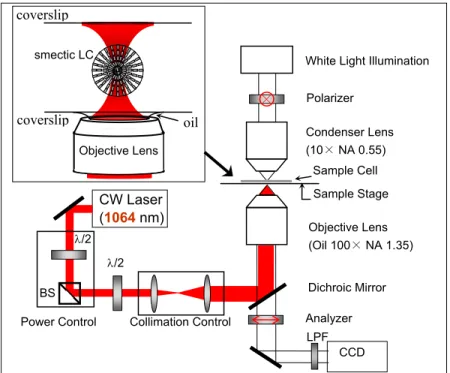
The experimental setup is schematically shown in Fig. 1. A continuous wave 1064 nm Nd:YVO4 laser beam
(Spectra Physics; J20I-BL-106C) was expanded and collimated to ~7 mm in diameter and sent into an UPlanApo oil immersing objective lens (100×, NA=1.35) in an inverted microscope (Olympus IX71). By using numerical analysis of Airy pattern of the objective, the beam waist for 1064 nm was calculated to be 0.390 μm. The laser power was varied in the range of 0.1−1.0 W after the objective, and the laser polarization was controlled properly using a half-wave plate. The beam was focused at normal incidence into a sample cell, which was placed on the microscope stage between two orthogonal polarizers. The molecular configuration inside the LC droplet was conventionally analyzed by polarization optical microscopy (POM), which was performed by passing visible probe light from a halogen lamp (λ=400−750 nm) through the pair of polarizers sandwiching the sample cell. The transmittance of the probe light was continuously detected by using a charge-coupled device (CCD) camera (JAI; CV-A55IR E) running at 30 interlaced frames per second. The elastic light scattering originated from the near infrared laser beam was completely eliminated by putting a low pass filter before the CCD camera. All experiments were carried out at room temperature (23−24 °C).
Figure 1. A schematic diagram of the experimental setup; BS = beam splitter, λ/2=half-wave plate, LPF = low pass filter with transmission edge at 900 nm. Inset: the cell containing an individually trapped smectic LC droplet by focused laser beam. Objective Lens smectic LC coverslip coverslip oil λ/2 Collimation Control CW Laser (1064 nm) Sample Cell Polarizer Analyzer Objective Lens (Oil 100× NA 1.35) White Light Illumination
CCD Sample Stage LPF Dichroic Mirror × Power Control BS Condenser Lens (10× NA 0.55) λ/2
Proc. of SPIE Vol. 8274 82740L-2
The sample cell was assembled from two cover-glass plates (Matsunami). The cell chamber with a thickness of 15−25 μm was obtained by using strips of parafilms along the glass edges, and the chamber was filled with 5CB (Tokyo Kasei Co.) suspended in D2O without the addition of any surfactants. In such a condition, laser-induced temperature
elevation in the surroundings of the droplets can be suppressed, as the temperature elevation of D2O by 1064 nm laser
has been reported to be 2.6 °C/W, which is an order of magnitude lower than that of H2O (24 °C/W).26,27 In the absence
of surfactants, the LC was obtained in the forms of spherical droplets of smectic phase (schematically shown in Fig. 1) due to droplet-liquid interfacial tension of immiscible 5CB in D2O. The LC droplet spheres were in the range of
submicron to several microns in diameter, which was determined directly from image processing of their optical transmission.
3. RESULTS AND DISCUSSION
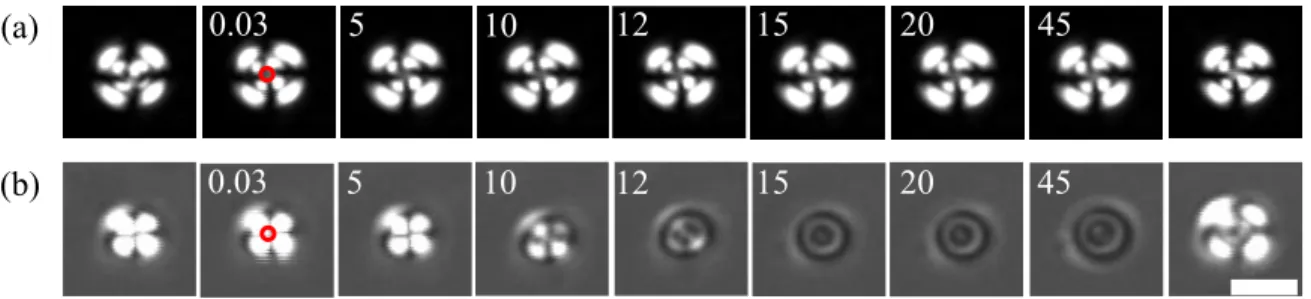
The self-organized smectic droplets consist of concentric layered LC molecules with a radially symmetric configuration. The smectic phase of the micro-droplets was confirmed from their POM images. Upon introducing the highly focused laser beam, the large refractive index mismatch between the LC droplets (the average refractive index = 1.61) with respect to surrounding heavy water (refractive index = 1.33) rendered them to be polarizable and easily trapped by the steep gradient of the optical field. Therefore, in principle, an individual droplet with the radius being smaller or larger than the beam waist can be optically trapped. As for a representative example, in Fig. 2(a) are shown POM images for a smectic droplet of 2.5-μm-diameter before laser irradiation and for the droplet optically trapped by the focused laser beam at laser power intensity of few tens of MW/cm2. The POM imaging suggests that the droplet center is
located at the focal area, and the intrinsic lamellar configuration inside the droplet apparently remains intact. However, we consider that optically controlling LC reorientation should occur initially at the focal spot inside the droplet, although such local reorientation is too small to be detected by the POM imaging. The location of the trapping center being at the center of mass of the droplet is supported by the absence of angular momentum transfer to the smectic LC droplet. This so-called on-center optical trapping is commonly observed in optical trapping experiments of smectic droplets smaller than 4 μm in diameter irrespective of laser power.17
When we increased the laser power to few hundreds of MW/cm2, we observed that POM images of the optically
trapped droplet show the time evolution as shown in Fig. 2(b). The POM images showed clearly that the radially symmetric configuration of the smectic droplet disappears, followed by transient ring patterns of transmitted probe light passing through the trapped droplet. Typically, the ring patterns which consisted of a small ring near the center and one or two larger concentric rings appeared on the time scales of seconds to a few tens of seconds depending on the laser power. The time evolution of the POM images indicates unambiguously that molecular orientation inside the smectic droplet is reconfigured under the high power of laser trapping beam. When the laser beam was switched off, the transient
Figure 2. Sequences of time evolution POM images of an individual smectic 5CB droplet optically trapped by a highly focused trapping beam; (a) at 130 mW (or 60 MW/cm2), and (b) at 850 mW (or 360 MW/cm2). The trapping time in second is indicated in each snapshot; while the most left and most right snapshot is the image just before laser trapping beam is switched on and just after the beam is switched off, respectively. The red circle denoting the focal spot area and the scale bar of 3 μm are applied for all images.
0.03
5 10
12
15
20 45
0.03
5
10
12 20
15
45
(b)
(a)
Proc. of SPIE Vol. 8274 82740L-3
ring patterns vanish immediately on the time scale of tens of milliseconds, restoring the initial radially symmetric pattern of a smectic droplet. The immediate restoration of the initial pattern is evidence for the existence of droplet-liquid interfacial anchoring effect as well as for the absences of optical memory, hysteresis, or storage effects.
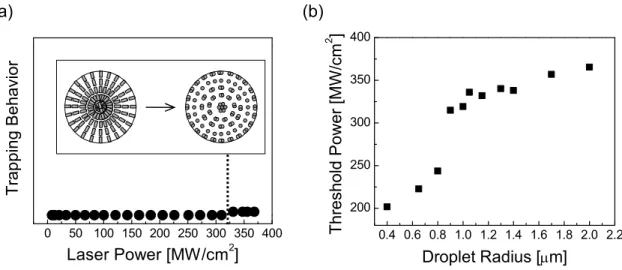
By varying the laser power to trap an individual smectic LC droplet, we found that there are two distinctive optical trapping properties with a clear threshold power; (i) below which an individual droplet is optically trapped and its intrinsic lamellar configuration remains intact, and (ii) above which the optical trapping is followed by molecular reconfiguration throughout the inside of the droplet, as shown in Fig. 3(a). This finding suggests that optical trapping-induced molecular reconfiguration does exist in the smectic droplet similarly to radial or bipolar nematic LC droplets,18,28,29 although such reconfiguration in the smectic droplet takes place under the high laser powers. The
reconfiguration is always started at the beam center and once the reconfiguration starts it expands to outside focal area throughout the inside of the trapped droplet, even though the droplet radius is a few times larger than the beam waist of the focal spot. As the result, reconfiguration partially inside the droplet was never observed, even though the reconfiguration can take several seconds to a few tens of seconds depending on the laser power and droplet size. As a consequence of the reconfiguration, and hence a jump of the ordinary or extraordinary refractive index of the LC molecules, the transmittance of probe light passing through the droplet in the POM images changes dramatically (as shown in Fig. 2b). The transient ring patterns of the optical transmission indicate the temporal dependence in the molecular reconfiguration inside the droplet, but no preferred LC reorientation along the laser polarization. The latter may imply that reconfiguration is not solely due to the laser polarization, but also due to cooperative motions throughout the LC molecules inside of the droplet. Thus, based on the POM images, we qualitatively interpreted the possible structure of the reconfigured droplet, as shown in Fig. 3(a). In order to evaluate the droplet size dependence in the molecular reconfiguration, we repeated the same experiments for different droplet sizes and we found that a higher laser power threshold is required for a larger droplet, as shown in Fig. 3(b).
To interpret the optically induced reconfiguration in the smectic LC droplet, we first consider optical reorientation of LCs, analogous to optical Fréederickscz transition (OFT) in nematic LCs. The optical reorientation should take place when the free-energy by the light field exceeds intermolecular interaction energy, which is represented by Frank distortional energy. In this case, one can also consider that the diameter of the droplet is equal with the thickness of a corresponding LC thin slab analog,18 in which optical reorientation in relation with Frank distortional energy has been
accurately described.30 Thus, by adopting the values of ordinary and extraordinary refractive index (1.54 and 1.74) and
Frank elastic constant (10 pN) of 5CB,28 with the conventional approximation we calculated the critical light intensity for
a droplet of 2.5-μm-diameter to be approximately 2 MW/cm2, about two orders of magnitude lower than the threshold
Figure 3. (a) Trapping behavior of a 2.5-μm sized smectic droplet as a function of laser power showing two distinctive regimes (with and without molecular reconfiguration). The threshold power is denoted by the dotted line. Inset: proposed molecular reconfiguration under the laser trapping above the threshold. (b) Plot of threshold laser power intensity to induce the molecular reconfiguration as a function of droplet radius.
(a) (b)
0.4 0.6 0.8 1.0 1.2 1.4 1.6 1.8 2.0 2.2 200 250 300 350 400 Thr eshol d Power [M W/ cm 2 ] Droplet Radius [μm] 0 50 100 150 200 250 300 350 400 Tr ap pin g Be ha vio r Laser Power [MW/cm2]Proc. of SPIE Vol. 8274 82740L-4
for the reconfiguration throughout the inside of the droplet (~320 MW/cm2). The low OFT threshold supports that the
optically controlled LC reorientation should take place locally at the focal spot when the laser power ranges from 2 up to 320 MW/cm2.
Thus, we should consider a focused beam with laser intensity steeply distributed around the diffraction limited size. The beam intensity above a definite threshold should not only generate the gradient force confining stably the birefringent droplet, but it can also locally induce optical reorientation by adopting the preferred dipolar orientation. The light-induced reorientation should be limited within the focal volume, not throughout the inside of the smectic droplet. Considering that the center of a smectic droplet is the area with largest local directional anisotropy and birefringence, and that the molecular density of 5CB is almost the same to D2O, the droplet must be optically trapped in such a
condition that its center is lying on the focal volume. This means that the local reorientation first takes place at the droplet center directly by the polarized trapping beam. The local reorientations are strongly affected by the neighboring dipoles leading to cooperative motions. However, as a self-organized structure, droplet-liquid interface energetic will also control the molecular orientation inside the droplet through the interfacial anchoring effect. In this sense, the LC droplet-liquid interface acts as the anchoring layer. Under the optical trapping at laser powers between the OFT and the reconfiguration thresholds, the droplet may adopt a kind of intermediate configuration. Ultimately, at high laser powers, an equilibrium configuration throughout the inside of the droplet is formed, though one can consider that the interfacial layer should remain intact.
Since the light-induced reconfiguration always competes with LC droplet-liquid interfacial anchoring effect, just like a system consisting of an optically controlled lattice site surrounded by the interface-controlled self-aligned configuration, we evaluate qualitatively the threshold of light-induced reconfiguration based on the mean-field theory. Here, we consider the trapping potential of the droplet by the focused Gaussian beam, as U(r,z)∝−21αQI(r,z), where α is polarizability, I(r,z) is the light field intensity as a function of the lateral (r) and axial (z) distance from the center of the focal spot, and Q is dimensionless factor for the target materials in the geometrical optics regime.31 We also take into
account the surface free energy of the droplet-liquid interfacial anchoring effect, which is defined as the multiplication of surface free energy per unit area (β) and the phase boundary area. Thus, the total energy to induce the molecular reconfiguration is given by,
(1) where I0 is the laser intensity at the beam center, k is wavenumber in the surrounding medium, ω0 is beam waist, and R is
the radius of the droplet.
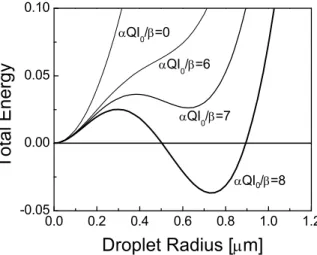
From the solution of Eqn. (1), we show the total energy as a function of the radius of the droplet at different level of laser power in Fig. 4. When αQI0/β is larger than 7.5 the total energy shows a local minimum, indicating clearly that at
0.0 0.2 0.4 0.6 0.8 1.0 1.2 -0.05 0.00 0.05 0.10
Total Energy
Droplet Radius [
μm]
αQI0/β=8 αQI0/β=7 αQI0/β=6 αQI0/β=0Figure 4. The total energy as a function of the radius of the droplet at different level of laser power.
0 R ) 4z kω 2k exp(-) 4z (kω kω β αQI R 2 0 20 2 2 2 2 0 2 0 2 0 + < + + −
∫
r r drProc. of SPIE Vol. 8274 82740L-5
such the laser powers above the threshold condition, the trapping energy overcomes the surface free energy of the droplet-liquid interface. The higher laser trapping intensity induces a deeper and larger local minimum, indicating clearly that the larger droplet size undergoes the light-induced reconfiguration at higher threshold power. The qualitative agreement between the calculated tendency and the experimental observation (Fig. 3b) reveals the relevance of our proposed model.
Finally, we should also consider that once laser light is focused on the LC droplet, local heating is inevitable and will result in the generation of lattice defects which could lead to a phase transition. However, under the 1064-nm laser irradiation, at which 5CB is transparent,32 the temperature elevation is less than 2.5 °C/W at the center of focal spot.33
With this level of temperature elevation, we can rule out the possible smectic→isotropic transition or an effect of local heating directly on the laser trapping-induced molecular reconfiguration. Moreover, the discrete dependence of the molecular reconfiguration on the laser power with a sharp threshold is in contrast to the local heating effect, which is linearly correlated to laser power intensity. Despite such negligible direct effect, the current level of temperature elevation can affect several other subtle physical properties of the droplets such as molecular density34 or interfacial
tension,35,36 which may involve indirectly in the laser-induced molecular reconfiguration process.
4. CONCLUSION
We have presented the laser trapping behavior of micrometer-sized 5CB liquid crystalline smectic droplets dispersed in D2O. The highly focused laser beams traps an individual droplet at the focal spot and shows two distinctive power
regimes of optical trapping behavior with a definite threshold; (i) below which the intrinsic lamellar configuration of the trapped smectic droplet remains intact, and (ii) above which the molecular reconfiguration undergoes throughout the inside of the trapped droplet. Considering that the LC droplet is a self-organized structure with droplet-liquid interface energetic controlling the molecular orientation inside the droplet, we proposed that the likely mechanism of the molecular reconfiguration involves the optical reorientation (OFT effect) at the focal volume, competing with the droplet-liquid interfacial anchoring effect, leading ultimately to symmetry breaking throughout the inside of the confined droplet. With the proposed mechanism, we show qualitatively that the dependence of the threshold power on the droplet size is in agreement with the theoretical prediction. Future experiments should also provide insights into the dynamics molecular reconfiguration in three dimensional pictures for both further analyses and possible photonic applications.
ACKNOWLEDGEMENT
The present work has been supported by the MOE-ATU Project (National Chiao Tung University) from the Ministry of Education of Taiwan, the National Science Council of Taiwan to T. U. (NSC 100-2113-M-009-001) and to H. M. (NSC 98-211-M-009-001), a KAKENHI grant (a Grant-in-Aid for Scientific Research) in the Priority Area “Molecular Science for Supra Functional Systems” to T. U., and a KAKENHI (S) grant (18106002) to H. M. from the Japan Society for the Promotion of Science (JSPS).
REFERENCES
[1] Ashkin, A. "Acceleration and Trapping of Particle by Radiation Pressure", Phys. Rev. Lett., 24, 156-159 (1970). [2] Ashkin, A. "Optical Trapping and Manipulation of Neutral Particles Using Lasers", Proc. Natl. Acad. Sci. USA,
94, 4853-4960 (1997).
[3] Ashkin, A., Dziedzic, J. M., and Yamane, T., "Optical Trapping and Manipulation of Single Cells Using Infrared Laser Beams", Nature, 330, 769-771 (1987).
[4] Sasaki, K., Koshioka, M., Misawa, H., Kitamura, N., and Masuhara, H., "Laser-Scanning Micromanipulation and Spatial Patterning of Fine Particles", Jpn. J. Appl. Phys., 30, L907-L909 (1991).
Proc. of SPIE Vol. 8274 82740L-6
[5] Uwada, T., Sugiyama, T., and Masuhara, H., "Wide-Feld Rayleigh Scattering Imaging and Spectroscopy of Gold nanoparticles in heavy water under laser trapping", J. Photochem. Photobiol. A: Chemistry, 221, 187-193 (2011).
[6] Hofkens, J., Hotta, J., Sasaki, K., Masuhara, H., Taniguchi, T., and Miyashita, T., "Molecular Association by the Radiation Pressure of a Focused Laser Beam: Fluorescence Characterization of Pyrene-Labelled PNIPAM", J. Am. Chem. Soc., 119, 2741-2742 (1997).
[7] Ito, S., Tanaka, Y., Yoshikawa, H., Ishibashi, Y., Miyasaka, H., and Masuhara, H., "Confinement of Photopolymerization and Solidification with Radiation Pressure", J. Am. Chem. Soc., 113, 14472-14475 (2011).
[8] Hotta, J., Sasaki, K., and Masuhara, H., "A Single Droplet Formation from Swelled Micelles by Radiation Pressure of a Focused Infrared Laser Beam", J. Am. Chem. Soc., 118, 11968-11969 (1996).
[9] Tanaka, Y., Yoshikawa, H., and Masuhara, H., "Two-Photon Fluorescence Spectroscopy of Individually Trapped Pseudoisocyanine J-Aggregates in Aqueous Solution", J. Phys. Chem. B, 110, 17906-17911 (2006). [10] Sugiyama, T., Adachi, T., and Masuhara, H., "Crystallization of Glycine by Photon Pressure of a Focused CW
Laser Beam", Chem. Lett., 36, 1480-1481 (2007).
[11] Tsuboi, Y., Shoji, T., and Kitamura, N., "Optical Trapping of Amino Acids in Aqueous Solutions", J. Phys. Chem. C, 114, 5589-5593 (2010).
[12] Yuyama, K., Sugiyama, T., and Masuhara, H., "Millimeter-Scale Dense Liquid Droplet Formation and Crystallization in Glycine Solution Induced by Photon Pressure", J. Phys. Chem. Lett., 1, 1321-1325 (2010). [13] Rungsimanon, T., Yuyama, K., Sugiyama, T., Masuhara, H., Tohnai, N., and Miyata, M., "Control of Crystal
Polymorph of Glycine by Photon Pressure of a Focused Continuous Wave Near-Infrared Laser Beam", J. Phys. Chem. Lett., 1, 599-603 (2010).
[14] Rungsimanon, T., Yuyama, K., Sugiyama, T., and Masuhara, H., "Crystallization in Unsaturated Glycine/D2O
Solution Achieved by Irradiating a Focused Continuous Wave Near Infrared Laser", Cryst. Growth Des., 10, 4686-4688 (2010).
[15] Joudkazis, S., Matsuo, S., Murazawa, N., Hasegawa, I., and Misawa, H., "High-Efficiency Optical Transfer of Torque to a Nematic Liquid Crystal Droplet", Appl. Phys. Lett., 82, 4657-4659 (2003).
[16] Murazawa, N., Joudkazis, S., and Misawa, H., "Characterization of Bipolar and Radial Nematic Liquid Crystal Droplets Using Laser-Tweezer", J. Phys. D, 38, 2923-2927 (2005).
[17] Murazawa, N., Joudkazis, S., and Misawa, H., "Laser Manipulation of a Smectic Liquid-Crystal Droplet", Eur. Phys. J. E, 20, 435-439 (2006).
[18] Brasselet, E., Murazawa, N., Joudkazis, S., and Misawa, H., "Statics and Dynamics of Radial Nematic Liquid-Crystal Droplets Manipulated by Laser Tweezers", Phys. Rev. E, 77, 0417041-7 (2008).
[19] Wood, T. A., Gleeson, H. F., Dickinson, M. R., and Wright, A. J., "Mechanisms of Optical Angular Momentum Transfer to Nematic Liquid Crystalline Droplets", Appl. Phys. Lett., 84, 4292-4294 (2004).
[20] Joudkazis, S., Shikata, M., Takahashi, T., Matsuo, S., and Misawa, H., "Fast Optical Switching by a Laser-Manipulated Microdroplet of Liquid Crystal", Appl. Phys. Lett., 74, 3627-3629 (1999).
[21] de Gennes, P. G., and Prost, J., [The Physics of Liquid Crystals], 2nd ed., Clarendon Press, Oxford, (1993). [22] Brasselet, E., and Joudkazis, S., "Optical Angular Manipulation of Liquid Crystal Droplets in Laser Tweezer",
J. Nonlinear Opt. Phys. Mater., 18, 167-194 (2009).
[23] Friese, M. E. J., Nieminen, T. A., Heckenberg, N. R., and Rubinsztein-Dunlop, H., "Optical Alignment and Spinning of Laser-Trapped Microscopic Particles", Nature, 394, 348-350 (1998).
[24] Tabiryan, N. V., Sukhov, A. V., and Zel’dovich, B. Ya., "High-Efficiency Energy Transfer due to Stimulated Orientational Scattering of Light in Nematic Liquid Crystals", J. Opt. Soc. Am. B, 18, 1203-1205 (2001). [25] Savchenko, A. Y., Tabiryan, N. V., and Zel’dovich, B. Ya., "Transfer of Momentum and Torque From a Light
Beam to a Liquid", Phys. Rev. E, 56, 4773-4779 (1997).
[26] Joudkazis, S., Mukai, N., Wakaki, R., Yamaguchi, A., Matsuo, S., and Misawa, H., "Reversible Phase Transitions in Polymer Gels Induced by Radiation Forces", Nature, 408, 178-181 (2000).
[27] Ito, S., Sugiyama, T., Toitani, N., Katayama, G., and Miyasaka, H., "Application of Fluorescence Correlation Spectroscopy to the Measurement of Local Temperature in Solutions under Optical Trapping Condition", J. Phys. Chem. B, 111, 2365-2371 (2007).
[28] Murazawa, N., Joudkazis, S., Matsuo, S., and Misawa, H., "Control of the Molecular Alignment Inside Liquid-Crystal Droplets by Use of Laser Tweezers", Small, 1, 656-661 (2005).
Proc. of SPIE Vol. 8274 82740L-7
[29] Murazawa, N., Joudkazis, S., and Misawa, H., "Laser Manipulation Based on a Light-Induced Molecular Reordering", Opt. Express, 14, 2481-2486 (2006).
[30] Khoo, I. C., and Wu, S. T., [Optics and Nonlinear Optics of Liquid Crystals], Vol. I, World Scientific, Singapore, (1993).
[31] Ashkin, A., "Forces of a Single-Beam Gradient Laser Trap on a Dielectric Sphere in the Ray Optics Regime", Biophys. J., 61, 569-582 (1992).
[32] Hotta, J., Sasaki, K., and Masuhara, H.,"Manipulation of Liquid Crystal Textures with a Focused Near Infrared Laser Beam", Appl. Phys. Lett., 71, 2085-2087 (1997).
[33] Usman, A., Uwada, T., and Masuhara, H., "Optical Reoreintation and Trapping of Nematic Liquid Crystals Leading to the Formation of Micrometer-Sized Domain", J. Phys. Chem. C, 115, 11906-11913 (2011). [34] Zgura, I., Moldovan, R., Beica, T., and Frunza, S.,"Temperature Dependence of the Density of Some Liquid
Crystals in the Alkyl Cyanobiphenyl Series", Cryst. Res. Tech., 44, 883-888 (2009).
[35] Tintaru, M., Moldovan, R., Beica, T., and Frunza, S.,"Surface Tension of Some Liquid Crystals in the Cyanobiphenyl Series", Liq. Cryst., 28, 793-797 (2001).
[36] Kralj, S., Žumer, S., and Allender, D. W., "Nematic-Isotropic Phase Transition in a Liquid-Crystal Droplet", Phys. Rev. A, 43, 2943-2952 (1991).
Proc. of SPIE Vol. 8274 82740L-8