
中國醫藥大學機構典藏 China Medical University Repository, Taiwan:Item 310903500/23811
7
0
0
全文
(2) Hsien-Wen Kuo, et al.. produced in three ways: (1) by the oxidation of styrene, (2) by the reaction of styrene with volatile organic peroxides, and (3) by the reaction of styrene with ozone or other highly oxidative compounds. In a previous study [7], we simultaneously measured levels of styrene and SO in a plastics manufacturing plant and found that SO levels were very low. This finding was consistent with findings reported by YeowellO’Conell et al [8] and Pfaffli et al [9]. However, few studies have focused on the photochemical reactivity of styrene. The purpose of this study is to investigate the mechanism of SO formation, and to measure the concentrations of other byproducts of styrene when it is exposed to NO2 and UV. MATERIALS AND METHODS. Three concentrations of styrene (low: 2.07 ppm (equivalent to 50.75 nmole), moderate: 6.22 ppm (equivalent to 152.5 nmole), high: 12.44 ppm (equivalent to 305.02 nmole)) were injected into one-liter Teldar bags containing pure air (SKC, serial NO. 232-01). The bags were exposed to a UV light source at an intensity of 3.91 W/m2 for six different time periods (10 min, 30 min, 1 hour, 2 hours, 3 hours, 4 hours). UV intensity (wavelength, 302 nm) was measured by a UVX digital radiometer. All six periods were measured in triplicate and airborne compounds generated in the bag were pumped into a tube containing Carbopack B using a personal pump (SKC AirChek, model 224-52). Thermal desorption (Perkin Elmer ATD 400) and gas chromatography-mass spectrometry (GC-MS, Perkin Elmer Q-mass 910) with a column (J & W DB-1, 60 m 0.25 mm ID 1 µm) were used for the analysis. The temperatures started at 85 C for 2 min and increased by 35 C/min to 160 C for 3 min, and then increased by 35 C/min to 240 C for 7 min. The ionization mode was EI (70 eV) and ionization temperature was 185 C. The electron multiple voltage was 1180 volts, and the scan mass range was 10 to 250 amu. To measure the compounds produced by the reaction of styrene with NO2, 100 ppm of NO2 was injected into the air bags. Three concentrations of styrene. 185. (as stated above) were then injected into each air bag and the by-products in each bag were sucked into a tube containing Carbopack B after six different time periods. Finally, the aforementioned procedures were combined to measure the photoreactive effects of styrene after exposure to NO2 and/or UV light. In the pilot study, GC-MS was used to detect the by-products of styrene after exposure to NO2 and UV. The three main products were benzene, benzaldehyde and styrene. SO was present in very small amounts. In this study, these four products were the target compounds. Several collecting media were tested before the study. Carbopack B (60/80 Mesh, Supelco Co.) was found to be the optimum medium for collecting the target compounds. For each measurement, 200 mg of Carbopack B was placed in a stainless steel tube (89 mm 5 mm ID). Several quality control tests were conducted. Seven different concentrations of the four target compounds were used to set up a calibration curve. The correlation coefficients (r) of the curves exceeded 0.9986. Relative predictive deviations (RPD) were < 5%. Stability of all the target compounds using Carbopack B was good overall. Recovery efficiencies were over 90% at 14 days for all target compounds except for SO (88%). Detection limits of GC-MS for benzene, styrene, benzaldehyde, and SO were 0.199 ng, 0.206 ng, 0.184 ng and 1.147 ng, respectively. Desorption efficiencies of the four target compounds in the Carbopack B-filled tube were over 99%. The areas and retention times of reproducibility in GC-MS for the four compounds were less than 7% (C.V.). All glassware was cleaned with a detergent, and then sterilized using ultrasonic waves for 90 min before rinsing with distilled water. This procedure was repeated and then the glassware was placed in an oven at 40 C overnight. Clean He gas was introduced into the Carbopack Bfilled tube for 2 hours to remove stale air and contaminants. Thermal conditions (300 C) were then applied to the tube overnight to ensure consistent baseline data. The thermal desorption instrument was cleaned before analyses to remove any contaminants. Perfluorotributylamine (PFTBA) was used to tune the GC-MS machine..
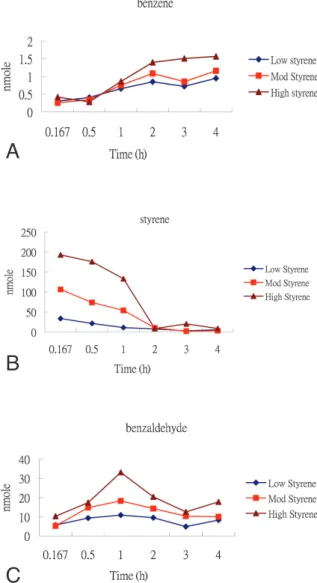
(3) 186. We used the criteria developed by the U.S. Environmental Protection Agency to assure the acuracy of the GC-MS. Statistical analyses were performed using SAS 6.12 (1986). The trends for levels of the three compounds produced over time when styrene was exposed to the three conditions (UV irradiation, NO2 exposure, and NO2 with UV) are shown in Figs. 1-3. Multiple regression analysis was used to show which factors affected the levels of the three compounds when styrene was exposed to the three conditions (Table). SO levels were negligible and, therefore, were not included in the data.. Photochemical Reactivity of Styrene. Levels of the three compounds produced over time when styrene was exposed to UV and NO2. Figure 3 shows the levels of the three compounds produced over time when styrene was simultaneously exposed to UV irradiation and NO 2. Benzene levels gradually increased over time (Fig. 3A) for each concentration of styrene. Medium and low levels of styrene remained constant, but high levels of styrene decreased gradually over time (Fig. 3B). Benzaldehyde levels (Fig. 3C) showed a similar trend to styrene levels, remaining constant at medium and low levels and showing gradual decreases at high. RESULTS Levels of the three compounds produced over time when styrene was exposed to UV. Figure 1 shows the levels of the three compounds produced over time when styrene was exposed to UV irradiation. Fig. 1A shows that benzene levels increased gradually over time for each concentration of styrene. After two hours of exposure, styrene levels (Fig.1B) at each concentration decreased to a constant level of 2 10–9 mole . Benzaldehyde levels were higher than benzene levels, peaking at one hour and decreasing gradually (Fig.1B). There was a similar trend for each concentration of styrene. There was an inverse relationship between benzene and styrene levels, but no direct relationship between benzaldehyde and styrene levels. Levels of the three compounds produced over time when styrene was exposed to NO2. Figure 2 shows the levels of the three compounds produced over time when styrene was exposed to NO2. Benzene levels peaked at one hour and decreased gradually for each concentration of styrene (Fig. 2A). Styrene levels decreased to very low levels after one hour for each concentration of styrene (Fig. 2B). Benzaldehyde levels peaked at one hour for high and medium concentrations of styrene; however, at low concentrations of styrene, benzaldehyde levels decreased gradually over time.. A. B. C Fig. 1. Levels of target compounds (A: benzene, B: styrene, C: benzaldhyde) produced over six time periods when three levels of styrene were exposed to UV..
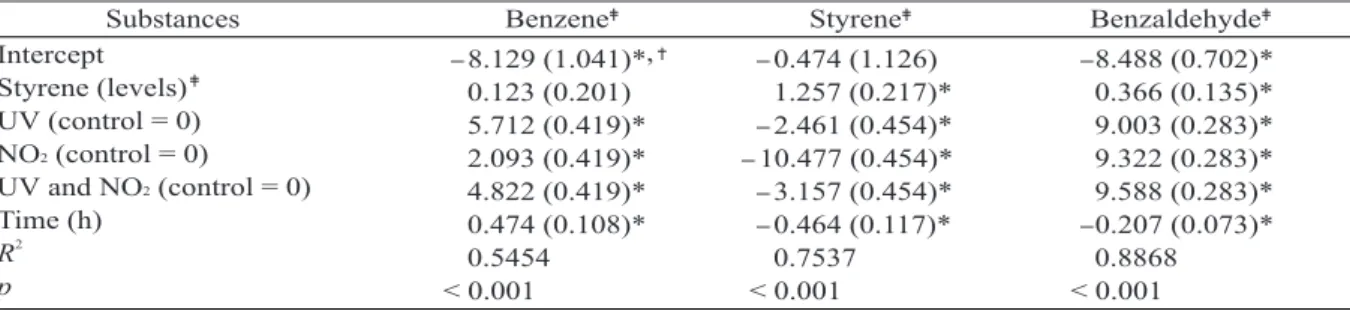
(4) Hsien-Wen Kuo, et al.. 187. Table. Factors affecting levels of the three target compounds using multiple linear regression models Substances Benzene Styrene Benzaldehyde Intercept 8.129 (1.041)*, 0.474 (1.126) 8.488 (0.702)* Styrene (levels) 0.123 (0.201) 1.257 (0.217)* 0.366 (0.135)* UV (control = 0) 2.461 (0.454)* 5.712 (0.419)* 9.003 (0.283)* NO2 (control = 0) 10.477 (0.454)* 2.093 (0.419)* 9.322 (0.283)* UV and NO2 (control = 0) 3.157 (0.454)* 4.822 (0.419)* 9.588 (0.283)* Time (h) 0.464 (0.117)* 0.207 (0.073)* 0.474 (0.108)* 2 R 0.7537 0.8868 0.5454 p < 0.001 < 0.001 < 0.001. *p < 0.01. β (SE). Values were log transferred.. A. A. B. B. C. C. Fig. 2. Levels of target compounds (A: benzene, B: styrene, C: benzaldhyde) produced over six time periods when three levels of styrene were exposed to NO2.. Fig. 3. Levels of target compounds (A: benzene, B: styrene, C: benzaldhyde) produced over six time periods when three concentrations of styrene were exposed to UV and NO2.. levels. Overall, for high concentrations of styrene, there was an inverse relationship between benzene and benzaldehyde levels.. The Table shows the factors that affected the levels of benzene, styrene and benzaldehyde using multiple regression models. Log.
(5) 188. Photochemical Reactivity of Styrene. transformations were performed for the concentrations of the three compounds before analyses. The independent variables were styrene concentration, UV irradiation, NO2, UV NO2, and exposure time (hours). All factors significantly affected concentrations of the three compounds, except for benzene levels, which did not correlate significantly with styrene levels. There was a significant positive correlation between benzaldehyde and styrene concentrations. Benzene and benzaldehyde concentrations were significantly higher under UV, NO 2 and UV NO 2 conditions, compared with control conditions. However, styrene levels were inversely related to UV, NO2 and UV NO2 conditions. Benzene levels positively correlated with the number of hours of exposure to styrene. However, there was an inverse relationship between styrene and benzaldehyde levels in the different durations of styrene exposure. DISCUSSION. There are few data in the literature regarding exposure of styrene to NO 2 and UV irradiation. It is also unclear what compounds these reactions produce. In our preliminary study, three target compounds were identified: benzene, benzaldehyde and SO. Photoreaction of styrene at high concentrations does not occur in ambient air. However, we were able to simulate photoreaction under unexpectedly explosive emissions such as those found in the petrochemcal industry. Carter et al [1] reported that many compounds are produced when VOCs react with NO2. Alkanes, for example, are produced by the removal of peroxy radicals by reactions with NO2 to form alkyl nitrates, whereas acetaldehyde and ethanol are produced by the removal of acetyl peroxy radicals by reactions with NO 2 to form PAN. Based on GC-MS analysis, the four major compounds produced by styrene on exposure to UV and NO 2 were styrene, benzene, benzaldehyde and SO. However, SO levels were negligible. While other compounds may have been produced during the photoreaction of styrene, they were undetectable by GC-MS because of their low levels.. When UV light reacts with styrene, the bond between -CH2CH2 and the aromatic ring is broken, producing benzene. An aromatic ring reacts with an aldehyde group to produce benzaldehyde. The chromatograms indicate that, in addition to the three target compounds, other compounds, such as SO and octyl benzene were produced. However, SO levels were negligible and octy benzene, because of its large size and instability, was excluded from the results. These data show that styrene is unstable when exposed to UV irradiation. Previous studies [3,10,11] have shown that VOCs produce ozone on exposure to NO due to reaction with hydroxy radicals. Gas-phase reactions involved in NOx tropospheric chemistry include the reactions of OH radical with NO and NO2. The OH radical reaction with NO to form nitric acid was produced in photo-equilibrium with the photolysis of HONO. A similar reaction of high-level styrene with hydroxy or other radicals may produce benzene and benzaldehyde, although further research is needed to establish the exact mechanism at work under low levels of styrene in ambient air. There were no direct relationships between styrene levels and the two compounds benzene and benzaldehyde, except that the peaks of the two compounds coincided at one hour with the sudden drop in levels of styrene. The sharp decrease in styrene levels may have been due to reaction of styrene with other compounds. The chromatograms showed that benzene, octyl and aldehyde compounds were produced but SO was not detected. Atkinson [12] demonstrated that styrene reacts with hydroxy radicals and NO 3 radicals to produce ozone and aldehyde compounds, which is consistent with the results of the current study. NO2 is an unstable molecule due to its photoreactivity, causing it to become electronically excited (NO Oxygen radical). Oxygen radicals then react with oxygen and other compounds to produce ozone. VOC compounds react with hydroxy radicals to produce ozone, aldehydes and ketones, which are known to be primary air pollutants. In the current study, styrene levels were.
(6) Hsien-Wen Kuo, et al.. inversely related to UV, NO 2 and UV NO 2 conditions. Benzene levels positively correlated with the number of hours of exposure to styrene. However, there were inverse relationships between styrene and benzaldehyde levels and duration of styrene exposure. The addition of ozone apparently improved the removal of VOCs by the UV/O3 process, and promoted excessive O3 reduction in the treatment efficiency of VOCs. The enhancement of UV light intensity promotes the decomposition of VOCs more effectively than the supplement of O3 [13]. VOCs were degraded by photoreaction and OH radicals to generate organic intermediates. The organic intermediates were then mineralized to form CO 2 and other byproducts mainly produced by OH radical rather than UV photolysis [14]. The one liter Tedlar bag, which was used to assess the photochemical reactivity of high-level styrene, had many advantages, including ease of operation and observation, and rapid photoreaction. However, the limitations in the study included trying to accurately measure the levels of the target compounds in the consecutive periods, and the fact that the dynamic conditions within the small Tedlar bags do not accurately reflect the conditions that exist in ambient air. Furthermore, our study did not evaluate the mass balance of carbon element in the bag to assure the quality of the experimental process. The Table shows a high coefficient of determination, which explains the levels of target compounds by the styrene exposure to NO2 and UV. In conclusion, exposure of styrene to NO2 and UV produced benzaldehyde and benzene. SO was also detected but in very small concentrations. Concentrations of styrene and benzaldehyde decreased with duration of exposure, but benzene levels increased over time. These results indicate that styrene is a photoreactive compound, producing benzaldehyde and benzene during photolysis. ACKNOWLEDGMENT. This study was supported by a grant (CMC 90-EM-01) from the China Medical University.. 189. REFERENCES 1. Carter WPL, Pierce JA, Luo D, et al. Environment chamber study of maximum in incremental reactivities of volatile organic compounds. Atom Environ 1995; 29:2499-511. 2. Jiang W, Singleton DL, Hedley M, et al. Sensitivity of ozone concentration to VOC and NOx emissions in the Canadian lower fraser valley. Atom Environ 1997;31:627-38. 3. Atkinson R. Atmospheric chemistry of VOCs and NOx. Atom Environ 2000;34:2063-101. 4. Browman FM, Seinfeld JH. Ozone productivity of atmospheric organics. J Geophys Res 1994;99:5309. 5. Carter WPL. Development of ozone reactivity scales for volatile organic compounds. J Air Waste Man Ass 1994;33:881-99. 6. Nylander LA, Kupper LL, Rappaport SM. An investigation of factors contributing to styrene and styrene-7-8-oxide exposures in the reinforced-plastics industry. Ann Occup Hyg 1999;43:99-109. 7. Kuo HW, Chung JL, Wang WS, et al. Biological monitoring of styrene metabolites and relationship with low-level airborne styrene and styrene oxide. Report of China Medical College, Taichung, Taiwan, 2000. 8. Yeowell-O’Connell K, Jin Z, Rappaport SM. Determination of albumin and hemoglobin adducts in workers exposed to styrene and styrene oxide. Cancer Epidemiol Biomarkers Prev 1996;5:205-15. 9. Pfaffli P, Vainio H, Hesso A. Styrene and styrene oxide concentration in the air during the lamination process in the reinforced plastics industry. Scand J Work Environ Health 1979;5:158-61. 10. Logan JA. Tropospheric ozone: seasonal behavior, trend and anthropogenic influence. J Geophy Res 1985;90:10463-82. 11. Ehhalt DH, Dorn HP, Poppe D. The chemistry of hydroxy radical in the troposphere. Proc R Soc Edinb B 1991;97:17-34. 12. Atkinson R, Aschmann SM. Products of the gas-phase reactions of aromatic hydrocarbon: effect of NO 2 concentration. Int J Chem Kinetic 1994;26:929-44. 13. Shen YS, Ku Y. Treatment of gas-phase volatile organic compounds (VOCs) by the UV/O3 process. Chemosphere 1999;38:1855-66. 14. Beltran F, Garcia-Araya F, Acedo B. Advanced oxidation of atrazine in water. II ozonation combined with ultraviolet radiation. Water Res 1994;28:2165-74..
(7) 190. 2.07 ppm. 6.22 ppm. 12.44 ppm. 1 L. 10 1. 2. 3. 4. Carbopack B. (GC-MS) (styrene oxide). 2007;12:184-90. 404. 91. 2006. 12. 4. 2007. 9. 19. 2007. 2. 7. 30.
(8)
數據
相關文件
CASE (Center of Advanced Medical Simulation and Education) is a multidisciplinary medical simulation center aims to give high quality education with new training methodologies by
臺大機構典藏NTUR (National Taiwan University 二 Repository, http://ntur.lib.ntu.edu.tw) 經驗與協助推 動臺灣學術機構典藏TAIR (Taiwan Academic Institutional Repository,
國際學術機構 QS 世界大學排名(QS World University Rankings)或泰晤士高等教育世界 大學排名(Times Higher Education World
MR CLEAN: A Randomized Trial of Intra-arterial Treatment for Acute Ischemic Stroke. • Multicenter Randomized Clinical trial of Endovascular treatment for Acute ischemic stroke in
【There was trash/garbage everywhere】 【on/in the playground one/an hour ago.】【However, everything】 【is different now.】.. 【There was trash/garbage all over/around】
• When light is refracted into two rays each polarized with the vibration directions.. oriented at right angles to one another, and traveling at
† Institute of Applied Mathematical Sciences, NCTS, National Taiwan University, Taipei 106, Taiwan.. It is also important to note that we obtain an inequality with exactly the
However, due to the multi-disciplinary nature of this subject, schools may consider assigning teachers with different expertise to teach this subject at different levels (S4, 5
