Multiple Teacher Transfer Optimization using Genetic Algorithms
– Case Study on Kindergarten Teacher Transfer
Hsiu Wang
Graduate Institute of
Information and
Computer Education,
National Kaohsiung
Normal University
[email protected]
Tung-Kuan Liu
Mechanical and
Automation Engineering
Department,
National Kaohsiung
First University
[email protected]
Chung-Huang Yang
Graduate Institute of
Information and
Computer Education,
National Kaohsiung
Normal University
[email protected]
Abstract
-This paper proposes an approach using Genetic Algorithm (GA) which has been proved an optimal searching approach for global solution to solve the Multiple Teacher Transfer problem. The current Multiple Teacher Transfer Operation (MTO) in Taiwan follows a matching procedure that he/she of the highest scores initiates operations of 2-sided, 3-sided, 4-sided and 5-4-sided Transfer between/among schools. The solution space is N!(NM)!, where N is the number of people in MTO, M is the number of transfer sides. Since MTO is a NP-Hard problem when M and N getting large it is difficult to solve by traditional determinative approach or by mathematical inference. In this paper, we propose a GA-based method by using maneuvers of string encoding, one-point crossover, neighbor search mutation, repairing, local search and diversity maintenance. Furthermore, conducting GA parameter design in accordance with Taguchi Method, the proposed method has proved to be able to break through restrictions of solution space of current operation and to pursue optimal solution, the improvement of successful cases increase up to 45%, after conducting experiments on public kindergarten teachers who failed in Single TeacherPosting Operation (SPO) from 2007 to 2008 in Taiwan, in accordance with “Operation of Application for Inter-City/County Transfer for Teachers of Public Junior High Schools, Elementary Schools and Kindergartens in Taiwan Area” (AITTOS).Keywords: Teacher Transfer, Multiple Transfer,
Genetic Algorithm, Evolutionary Computation, Diversity Maintenance
1. Introduction
The “Operation of Application for Inter-City/County Transfer for Teachers of Public Junior High Schools, Elementary Schools and
Kindergartens in Taiwan Area” (AITTOS) is a major routine for education administration in Taiwan. The main purpose of AITTOS is to allow teachers to transfer to their ideal schools in concern of transportation or family considerations [3].
Current AITTOS is performed in 2 phases: Single Teacher Posting Operation (SPO) and Multiple TeacherTransfer Operation (MTO) [1]. The details are stated as follows separately:
SPO is a comparing operation based on available vacancies; the operation focuses on one’s scores and priority in selection of schools. Vacancy is the necessity for teacher requisite of a school. One who has highest scores has top priority in SPO of the chosen school.
MTO is a matching operation for those who failed in SPO. MTO based on the corresponding relations of each teacher’s choices among original schools and the target schools that one wishes to transfer to, is initiated by highest scorer to conduct 2-sided, 3-sided, 4-sided and 5-sided Transfer Operations sequentially.
Currently, traditional determinative approach is adapted in the MTO, due to consideration of time efficiency, the operation is done unto 5-sided Transfer. This way saves computing time but restricts solution space tremendously, thus makes pursuing global solution impossible.
This research applies GAs to MTO by using maneuvers of string encoding, one-point crossover, neighbor search mutation, repairing, local search and diversity maintenance. Furthermore, conducting GA parameter design in accordance with Taguchi Method, the proposed method has proved to be able to break through restrictions of solution space of current operation. Unsuccessful cases of SPO for kindergarten in AITTOS from 2007 to 2008 are used to evaluate the proposed method.
This paper is organized as follows: in the second Section we discuss AITTOS and related GA literatures; problems that this research deals
with are detailed in Section 3; Section 4 reveals approach proposed in this paper; experiments and results are stated in Section 5; Section 6 offers some conclusions; future works and researches are addressed in Section 7. Literatures and documents conferred are listed at the end of this paper.
2. Literature Review
2.1. Teacher Transfer in Taiwan Area
Taiwan government issued and performed “Teacher Transfer Act for Reserved Educational Personnel of Taiwan Province” in 1965 because the stability of personnel matters played a key role in development of compulsory education. Teacher Transfer operation was held the following year [3]. From 1969, in order to increase opportunities for transfer, teachers were granted target schools for transferring in two adjacent cities/counties as their first and second choice [3].
In 1982, Taiwan Ministry of Education established another regulation act for the purpose of promoting personnel exchange among cities and counties called “Teacher Training Program and Transfer Act for Elementary and Junior High School” for Taipei and Kaohsiung City when both cities became the state governed cities. This regulation not only played the mother regulation for provincial government to set up operational details for teacher transfer, but also roughly dissected the whole transfer operation of public kindergartens, elementary and junior high schools into two categories: within city/county administration, and inter-city/county administration in Taiwan area [3]. In 1987, AITTOS became computerized and had processed cases of SPO and MTO, which have been the major operational approaches regularly [3].
In order to solve unfair problems ,e.g., an applicant with lower scores transfers successfully while others with higher scores fails, limitations for first and second city/county schools of choice has been cancelled since 2003. After that teachers can still apply schools in two ideal counties/cities but not limited by them. This procedure is used to identify his/her favorable schools in two desired counties/cities. AITTOS can be performed by: 1) Single Teacher Posting, 2) 2-sided Transfer, 3) 3-sided Transfer, 4) 4-sided Transfer and 5) 5-sided Transfer [1] sequentially. Furthermore, a new regulation added to AITTOS in 2007. Based to it, teaches have to fill in more than 10 or half number of candidate schools, if the total schools are less than 20. On the other hand, the maximal number of candidate schools relaxes until 120 from the
original 100 [1].
Computerized AITTOS is charged by Department of Elementary Education of Ministry of Education. For years Yang-Ming Junior High School of Zhanghua County had authorized handle this affair. But, from 2001 to 2008, Computer Center of Ministry of Education took charge and has been authorizing Education Network Center of Kaohsiung County for total operational affairs.
2.1.1. Transfer Criteria. For teachers, the
factors that influence a successful transfer case are: schools of one’s choices, geographical restrictions (GR) for teaching, subject needed (SN) and scores. GR is the footnote put in the “Remark” on teaching certificate. This footnote indicates the geographical type (GT) allowed for teacher to teach. It means one is allowed to teach in any location if the “Remark” is blank, as shown in table 1 [1]. SN is corresponding subject stated in one’s teaching certificate. One can apply for a maximum of three teaching subjects, which are needed in other schools, in accordance with his service of teaching at present stage. The first of these subjects must be taught by one in his/her original school.
For schools, the criteria that influence a successful transfer case are: Vacancy for certain subject and GT. For example, a vacancy for Mathematics is offered in some school of normal GT, one who wishes to transfer to that school must meet the following conditions:
1. That school has to be of his choice 2. Mathematics must be stated in his
teaching certificate 3. No GR note is remarked
Table 1. Connections between GR and GT
School
Remark Normal Particular Remote Particularly remote
No remark O O O O
Particular area X O O O
Remote area X X O O
Part. remote area X X X O
2.1.2. Single Teacher Posting Operation (SPO).
The premise for SPO is there is a vacancy. SPO will not be operable if there is no vacancy or school that offers this vacancy is not of any applicant’s choice.
In short, when a school offers a vacancy for SPO, system will filter out matching teachers meeting conditions required, then begins transfer procedures in the order starting from teachers of highest scores until all vacancies are filled. Teachers who meet the conditions required include ones of unsuccessful transfer cases, and ones of the successful cases but the schools are not of their favorable.
successful applications to transfer are obliged to release the original vacancies. The vacancies will be included in the next SPO. Teachers, who has been transferred successfully but the school is not of their first choices, may continue to participate in every SPO. The procedures circle on until all vacancies left are not from any of the participants’ choice of schools. This transfer operation is “Single Teacher Posting Operation”.
2.1.3. Multiple Teacher Transfer Operation (MTO). All unsuccessful participants from SPO,
after which has ended, who are eligible for MTO, will be able to initiate 2-sided Transfer in accordance with, also in the sequence of, their scores and their ideal choices of schools. For example, highest scorer A finds that B’s school is of A’s choice and the fits the GR and SN criteria, then both ways of A→B and B→A are available. Consequently, A and B are able to initiate switching schools. This transfer operation is “2-sided Transfer”.
All unsuccessful participants from 2-sided Transfer will be able to initiate 3-sided Transfer, in accordance with, also in the sequence of, their scores and their ideal choices of schools. Suppose highest scorer A finds B and confirms that B’s school is of A’s choice, A also find C’s school is of B’s choice while A’s school is of C’s choice, and they all match the conditions of GT as well as SN in ways of A→B, B→C, and C→A. Then A can initiate transfer operation so that they all can be switched to their ideal schools. This transfer operation is “3-sided Transfer”. Modes of 4-sided Transfer and 5-sided Transfer are derived from this operation.
MTO, a time consuming computing operation, is categorized as NP-Hard problem. In practical use, consideration of time efficiency, MTO is maneuvered in phases unto 5-sided Transfer completed. Since the operation time is shortened due to this maneuvering, it closes the door to other multi-sided Transfer. If the number of teachers is N, the number of transfer sides is M, the solution space isN!(NM)!.
2.2. Genetic Algorithm
Genetic Algorithm was first introduced in 1970 by Professor John Holland and his students of University of Michigan. It is inspired by Charles Darwin’s evolutionary theory of “Natural Selection”, simulating the concept of competition among species, to which the cycle of genetic evolution is similar [5]. It includes five basic components listed below [2]:
1. Genetic presentation of problem solution 2. Method of generating the initial
population
3. Fitness function for calculating fitness 4. Genetic manipulation of reproduction of
offspring
5. Parametric value of Genetic Algorithm To put Genetic Algorithm in simple words is that it is a computing program based on the principles of genetic heredity [4]. Since genes possess abilities of reproduction, crossover and mutation, hence, nature tends to keep good genes by eliminating bad genes. When finding solutions using GA, one important matter is how the approaches to solutions are coded into chromosomes [2], because the manipulation of genetic reproduction, crossover and mutation conducted in GA targets on chromosomes, which represent solution approaches. Another issue is to define appropriate objective function, focusing on the unique aspects of the problem, so the system is able to filter and keep better offspring genes.
GA has been improved over years and has completed achievements in application in many fields [4]. It is widely used in research which concerns job shop scheduling [6, 7, 8], e.g.: mold production [5], course scheduling. It has been proved that GA is the optimal searching approach for global solution since ways to improve efficiency of GA are proposed, like ITGA (Intelligent Taguchi-Genetic Algorithm) that integrates Traditional GA (TGA) and Taguchi Method [6]; HTGA (Hybrid Taguchi-Genetic Algorithm) [7].
3. Problem Description
Assume a group of N teachers, who are in MTO. It is regarded as that there are N schools offer vacancies with original SN for transfer for N teachers. Solution space is N!. There will be 3 results among teachers (T) and schools (S):
A. Success, a result which is correct, optimal and meets all the conditions listed below:
(1) S is one of T’s ideal schools (2) S’s vacancies of SN are among the
subjects that T’s qualified to teach (3) T’s GR matches S’s GT
B. Fail, if S is the school that T teaches at present, it is considered a fail. The result is not preferable but correct.
C. Error, if conditions of S and T do not fit results A or B, it is considered a false operation, which is an error result. Results A and B, despite the differences between, are correct and acceptable in a transfer operation. But, in order to achieve the optimal result, scores, order of one’s ideal schools and SN have to be taken in to further consideration in A. C is an unacceptable error result. To sum up, the result of relations of each teacher and school has to be either A or B to be a success, otherwise an error.
In this research we proposed a GA-Based Transfer Operation shown as follows:
4.1. Design of Chromosome
The chromosomal structure which indicates solutions to problems is shown as Figure 1. There are N genes in a chromosome, which represents N teachers are involved in MTO and each gene represents each teacher who participates in the operation. The position of each gene represents a school that offers vacancy. Each chromosome indicates one possible result.
Teacher 1 Teacher 2 …… Teacher N
School 1 School 2 …… School N
Figure 1. Design of chromosome
4.2. Objective Function
To this research, the unique position (school) of each gene (teacher) in a chromosome produces different result and evaluation value. The value of objective function is the sum of all evaluation values. This research expects the smaller the value of objective function the better. Definitions of each evaluation value, on the three different results mentioned above, are as the followings:
1. “Success” is a correct and feasible result. The evaluation value is the better. To make it evolve, under such result, the evaluation is considered on how high a teacher’s scores ya is, the order of one’s preferred schools yb and the sequence of SN yc. The evaluation value will be
ys=1/ya+yb+ yc.
2. “Fail” is a result that is correct but not preferable. The evaluation value is a constant yf which is a bit higher than ys. 3. “Error” is a wrong result. The evaluation
value is the infeasible. The value, which is a constant ye that is far bigger than ys, will be eliminated naturally by adding up penalty value.
Therefore, the objective function value of a chromosome is as followed: 1 ( ) N i( ) i Y y
x x , Error if y Fail if y Success if y y e f s i,
(1)where, x denoted the input data shown in Figure 1. The objective of MTO can be formatted as,
minimize ( ),
subject to x all participants.
Y
x
(2)
4.3. Genetic Manipulations
The genetic operations used in the proposed method are shown as follows:
4.3.1. Reproduction. The research takes
Roulette Wheel Selection to conduct reproduction. The approach determines the area measurements on the wheel according to the fitness of each chromosome. The better the fitness is, the greater the area measurements. The area measurements are smaller, on the other hand, if the fitness is worse. The ratio of area measurements reflects the probability of that if a chromosome is selected for next generation.
4.3.2. Crossover. The research adapts one-point
crossover. A crossover point is randomly selected between two chosen chromosomes. Genes of each chromosome that are on the right end of crossover point are mutually swapped and fixed to generate new feasible chromosome. Approach of crossover is shown as Figure 2.
Figure 2. One-point crossover 4.3.3. Mutation. k
m
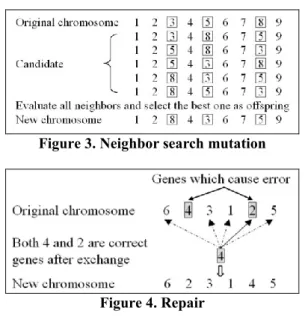
P kinds of combinations of Neighbor Search Mutation (NSM) [3, 5, 8] is conducted in the research for mutation implementations. This is an approach to randomly select k genes from m chromosomes for permutation and combination process to generate candidate chromosomes to filter out the best chromosome after calculating fitness of all candidate chromosomes. Figure 3 is an example of NSM when k=3.
Figure 3. Neighbor search mutation
Figure 4. Repair
4.3.4. Repair Operation. To accelerate
evolution convergence, genes, which cause error, of a chromosome after mutation will be repaired.
It targets on the error genes and determines each result when the individual genes are switched. If the result is correct, the genes will be exchanged. Figure 4 shows the repair pattern.
4.3.5. Local Search Procedure. This procedure
proceeded after Repair Operation aims to enhance GA search. It targets on improving the feasible solution to optimal one by switching genes in a success chromosome. If the fitness of the switched individual is better than the old one then the genes will be exchanged, as shown in Figure 5.
Figure 5. Local search
4.3.6. Diversity Maintenance Operation. To
keep GA searching space, as well as maintaining differences of populations, a thorough inspection of each individual chromosome in the new generation is executed from upstream to downstream. If fitness of a chromosome is the same as that of the former one, one of the chromosomes of worse fitness is randomly selected and replaced.
4.4.
Experiment Design
Firstly, a list of information of public kindergarten teachers, who were eligible for MTO but failed SPO, is screened from 2007 to 2008 from the database of AITTOS computer system to proceed chromosome coding, after excluding information of that schools one serviced were not of any other teacher’s choice, and build initialized information files below:
1. Of schools: serial numbers, GT and SN 2. Of teachers: present schools, qualified
subjects, GR, one’s choices of schools and scores
Secondly, load the above-mentioned initialized information files into the system to generate initial population randomly and to calculate the fitness. The procedure runs in a cycle following the sequence of reproduction, crossover, mutation, repair, local search and diversity maintenance to generate a newer population and to calculate the fitness. The termination condition this research sets up is the max generation number. If the condition is met by the operation, the whole evolution procedures will terminate.
4.5. GA Parameter Setup
For GA, it is very important to discover and select efficient parametric values, including those of population size, generation number, crossover rate and mutation rate [2]. This research takes on Taguchi Method and use L9(34) orthogonal array (Table 2) to conduct a total number of 9 experiments of 3 levels with 4 control factors (Table 3). After attaining contribution levels of all parameters through ANOVA and adjusting parametric values, 3 confirmation experiments are conducted to achieve parametric values which are efficient and functional [5].
Table 2. L9(34) Orthogonal array [5]
No. 1 2 3 4 5 6 7 8 9
A 1 1 1 2 2 2 3 3 3
B 1 2 3 1 2 3 1 2 3
C 1 2 3 2 3 1 3 1 2
D 1 2 3 3 1 2 2 3 1
Table 3. Definitions of parameter levels
Factors Level 1 Level 2 Level 3
A Population size 100 200 300
B Crossover rate 0.1 0.5 0.9
C Mutation rate 0.1 0.5 0.9
D Generation number 500 1000 1500
5. Experiment Results
Web-base structure is adapted in this research. Operation takes Apache as web server, PHP server-side script language to compile application system, and is executed through web browser.
5.1. Parameter Analysis
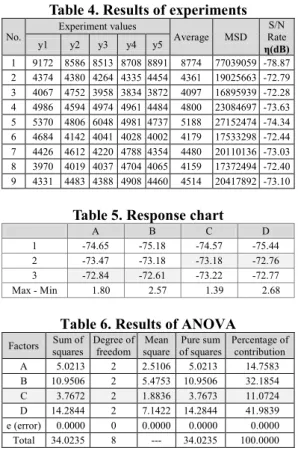
In this research, information of 2007 is retrieved to conduct parameter analysis. Table 4 is the list of experiment statistics of L9(34), a response chart, shown as Table 5, is produced based on S/N rate of the statistics. From the response chart it is agreed that A3, B3, C2 and D2 are the best parameters and the S/N rate calculated is -71.71 dB.
After conducting ANOVA (Table 6) that focused on the S/N rate on Table 4, it is discovered that the lowest contribution level falls on mutation rate, which is determined as non-primary control factor. To shorten evolution time laps, mutation rate is adjusted to C1 (0.1), then conduct 3 confirmation experiments using parameters A3, B3, C1 and D2. The S/N rate of experiment results (as of Table 7) is -72.16 dB, which is within tolerance range, which also shows good reappearance character. Therefore, A3, B3, C1 and D2 are adapted as parametric values.
5.2. Results and Comparisons
Information of from 2007 to 2008 is processed for MTO using the above-mentioned
parameters of A3, B3, C1 and D2. The comparisons among calculation results and the original results are shown as Table 8, which shows success rate increases 45%. Figure 6 show the convergence chart of 2007 and 2008, in which the generation is as of X axis, the error case is as of Y axis.
Table 4. Results of experiments
No. Experiment values Average MSD Rate S/N
η(dB) y1 y2 y3 y4 y5 1 9172 8586 8513 8708 8891 8774 77039059 -78.87 2 4374 4380 4264 4335 4454 4361 19025663 -72.79 3 4067 4752 3958 3834 3872 4097 16895939 -72.28 4 4986 4594 4974 4961 4484 4800 23084697 -73.63 5 5370 4806 6048 4981 4737 5188 27152474 -74.34 6 4684 4142 4041 4028 4002 4179 17533298 -72.44 7 4426 4612 4220 4788 4354 4480 20110136 -73.03 8 3970 4019 4037 4704 4065 4159 17372494 -72.40 9 4331 4483 4388 4908 4460 4514 20417892 -73.10
Table 5. Response chart
A B C D
1 -74.65 -75.18 -74.57 -75.44 2 -73.47 -73.18 -73.18 -72.76 3 -72.84 -72.61 -73.22 -72.77 Max - Min 1.80 2.57 1.39 2.68
Table 6. Results of ANOVA
Factors squares Sum of Degree of freedom square Mean of squares Pure sum Percentage of contribution A 5.0213 2 2.5106 5.0213 14.7583 B 10.9506 2 5.4753 10.9506 32.1854 C 3.7672 2 1.8836 3.7673 11.0724 D 14.2844 2 7.1422 14.2844 41.9839 e (error) 0.0000 0 0.0000 0.0000 0.0000 Total 34.0235 8 --- 34.0235 100.0000
Table 7. Results of confirmation experiments
Experiment values
Average MSD S/N Rate
η(dB)
y1 y2 y3
4090 4038 4035 4054 16438256 -72.16
Table 8. Results and comparisons
Year Participants Number of successful cases Original GA Profit
2007 145 20 29 45%
2008 163 34 43 26%
Figure 6. Convergence process of error cases
6. Conclusions
This research studies the application of GA on MTO, and provides a practical approach which is not bound to the limitations of current operation. It shows that, by applying the approach which is proved to be able to break the restrictions of solution space of the original operation, the improvement of successful cases
will increase up to 45%, after conducting experiments on public kindergarten teachers who failed SPO from 2007 to 2008, in accordance with AITTOS.
7. Future Works and Researches
The authors are now attempting to extend the current results to more complicated cases. The real data of elementary and junior high school teachers who failed SPO from 2004 to 2008 are under researching. The primary results show that the proposed method can solve the MTO problem effectively and efficiently. The further studies on transfer operation of elementary and junior high school teachers will show a wilder application of MTO with GAs.References
[1] Education Network Center of Kaohsiung County, Web of “Operation of Application for Inter-City/County Transfer for Teachers of Public Junior High Schools, Elementary Schools and Kindergartens in Taiwan Area” of 2008, http://exc.ks.edu.tw/.
[2] M. Gen and R. Cheng, Genetic algorithms and engineering design, Wiley, 1997, New York.
[3] Miao-Ni Guo, “A Comparative Study on Elementary School Teacher Transfer System among Taiwan, Australia and U. S. A.”, M.D. Thesis, Department of Comparative Education, National Chi Nan University, 2002.
[4] Peng-Cheng Chou, Theories and applications of genetic algorithms – Using Matlab, Chuan-Hua, 2001, Taipei.
[5] Tsung-Yi Wu, “A Study on the Application of Genetic Algorithm and Taguchi Methods for Mold Production Scheduling System”, M.D. Thesis, Department of Mechanical and Automation Engineering, National Kaohsiung First University of Science and Technology, 2002.
[6] Tung-Kuan Liu, Jinn-Tsong Tsai, Jyh-Horng Chou and C.-H. Lai, “Job-shop scheduling problems by using an improved genetic algorithm,” Proc. of the 2005 SICE Annual Conference, Okayama, Japan, August 2005, pp.944-949.
[7] Tung-Kuan Liu, Jinn-Tsong Tsai and Jyh-Horng Chou, “Improved genetic algorithm for the job-shop scheduling problem,” The International Journal of Advanced Manufacturing Technology, Vol. 27, No. 9-10, February 2006, pp. 1021-1029. [8] Y. Tsujimura, Y. Mafune and M. Gen,
“Effects of Symbiotic Evolution in Genetic Algorithms for Job-shop Scheduling,” Proc. of the IEEE 34th International Conference on System Sciences, Hawaii, 2001, pp. 1-7.