Impacts of the self-Raman effect and
third-order dispersion on pulse-squeezed
state generation using optical fibers
Shinn-Sheng Yu and Yinchieh Lai
Institute of Electro-Optical Engineering, National Chiao-Tung University, Hsinchu, Taiwan
Received January 19, 1995; revised manuscript received May 15, 1995
Based on a newly developed general quantum theory of nonlinear optical pulse propagation, the influences of the self-Raman effect and third-order dispersion on the achievable squeezing ratio in squeezing experiments with optical fibers at both the 1.3- and 1.55-mm wavelengths are studied. In the presence of these effects, squeezing still survives, but the achievable squeezing will reach a limit as the propagation distance increases. Temperature dependence of the squeezing ratio is also examined. 1995 Optical Society of America
1.
INTRODUCTION
Pulse-squeezed state generation by the use of optical fibers has attracted a lot of attention recently. By the use of a fiber-loop interferometer, a pulse-squeezed vac-uum has been successfully generated at the 1.3-mm wave-length with more than 5-dB squeezing observed1 – 3 and
at 1.55 mm with 1.1-dB squeezing observed.4 In
experi-ments at the 1.3-mm wavelength, pulses from mode-locked Nd:YAG or Nd:YLF lasers with a pulse duration of,20 ps were used. In the squeezing experiment at the 1.55-mm wavelength, pulses from mode-locked color-center lasers with a pulse duration of ,200 fs were used. In going from longer pulses to shorter ones, the self-Raman effect and third-order dispersion start to affect pulse propaga-tion. Physically, both effects cause additional perturba-tions to the optical field, and thus they are expected to reduce or even destroy squeezing. The objective of this paper is to study how serious the reduction or the de-struction is in the experiments at both the 1.3- and the 1.55-mm wavelengths.
In the experiments at the 1.3-mm wavelength, the group-velocity dispersion of the fiber is close to 0. In the literature, quantum effects of pulse propagation inside dispersionless Kerr media have been studied by many authors.5 – 9 It has also been pointed out that if
non-square pulses are used, the achievable squeezing will reach a limit as the propagation distance increases.6
This is because when the group-velocity dispersion is 0, nonsquare pulses get chirped because of self-phase modu-lation. The squeezing directions with respect to the phases of the light field at different time slots are differ-ent because the intensities across the pulse are differdiffer-ent. In squeezing experiments in which a fiber loop is used, the same pulse, after propagating through the fiber, is used as the local oscillator of the homodyne detection, with a possible adjustment of a constant phase to minimize the noise. The local oscillator cannot match the squeezing directions at every time slot when the chirp that is due to self-phase modulation increases as the propagation distance increases. Thus the detected squeezing
eventu-ally gets saturated because of such a mismatch. As we see below, for sech pulses, the magnitude of squeezing saturates at,7.5 dB. The status of recent experiments (5-dB squeezing observed) is actually not very far from the above limit. Therefore, to obtain as much squeezing as possible, it should be helpful if one can find some way to overcome such saturation behavior. One possibility is to use square pulses as the input. Because a square pulse has a constant intensity, there is no chirping that is due to self-phase modulation, and thus the saturation of squeezing can be avoided. However, inside optical fibers, there are always other linear and nonlinear effects, such as the third-order dispersion and the self-Raman effect. In the presence of the self-Raman effect and third-order dispersion, a square pulse cannot remain square during propagation. Moreover, because square pulses contain larger higher-frequency components, they are more sen-sitive to the self-Raman effect and third-order dispersion than Gaussian or sech pulses are. As we see below, in the presence of these two effects, squeezing still survives, but the achievable magnitude is reduced and will reach a limit as the propagation distance increases.
In the experiments at the 1.55-mm wavelength, the group-velocity dispersion of the fiber is negative, and the pulses inside the fiber are actually solitons or solitary pulses. In the literature, the squeezing ratio for ideal solitons in optical fibers has been calculated by direct nu-merical simulation based on positive-P representation10,11
and by the linearization approximation.12,13 The
quan-tum effects of the third-order dispersion have been studied by the use of the time-dependent Hartree approxi-mation.14 However, the squeezing ratio calculation is
not performed. Quantum theories of the self-Raman effect have been developed by the use of Hamiltonian approaches.15,16 The calculation of an achieveable
squeezing ratio was performed by direct numerical simu-lation based on a truncated Wigner representation17
and by analytical derivation based on the soliton perturbation theory.16 From their numerical results,
Drummond and Hardman17 found that squeezing still
survives for FWHM 176-fs solitons in the presence of 0740-3224/95/122340-07$06.00 1995 Optical Society of America
the self-Raman effect. However, their calculation was performed only for FWHM 176-fs solitons at 77 K and the propagation distance was only up to five normalized distance units. The dependence of the squeezing ratio on temperature and pulse duration was not shown. The combined effects of the self-Raman effect and third-order dispersion were also not considered. K ¨artner et al.16
studied the temperature and the pulse-duration depen-dence of the achievable squeezing ratio. They concluded that it is more advantageous to use longer pulses in squeezing experiments if the self-Raman noise is to be reduced. Their calculation is based on the soliton per-turbation theory,12 which ignores the coupling between
the soliton parts and the continuum. Such an approach is rigorously correct for ideal solitons but may not be accurate enough in the presence of the self-Raman ef-fect when the propagation distance is long and when the squeezing is big. Also, the squeezing ratio they calcu-lated corresponds to the use of a special local oscillator, which is not the case in actual experiments. They did not consider the third-order dispersion, either.
In this paper, from a newly developed general quan-tum theory of nonlinear optical pulse propagation,18 we
study the influences of both the self-Raman effect and the third-order dispersion on the achievable squeezing ratio in squeezing experiments by using optical fibers at both the 1.3- and the 1.55-mm wavelengths. Be-sides finding that squeezing still survives but is de-graded in the presence of the two effects, we also find that there is a limit on the achievable squeezing ra-tio as the propagara-tion distance increases. Tempera-ture and pulse-duration dependence of the squeezing ratio are also examined. Compared with direct simula-tion, the computational efficiency of our backpropagation method enables us to obtain more results under different temperatures, pulse durations, and longer propagation distances. Compared with the soliton perturbation the-ory, our backpropagation method is more accurate be-cause it does not ignore the coupling between the soliton parts and the continuum.
This paper is organized as follows. In Section 2, we develop the formulation for the squeezing ratio calcula-tion. By utilizing the linearization approximation and the conservation of commutation relations, we can suc-cessfully quantize the propagation equations and derive the correlation functions of the noise operator in a sys-tematic way. The calculation of quantum uncertainties is based on the concept of adjoint systems and the back-propagation method. The results for the 1.3-mm wave-length are presented in Section 3, and the results for the 1.55-mm wavelength are presented in Section 4. Finally, in Section 5, we conclude the paper.
2.
FORMULATION
The classical pulse-evolution equation in the presence of the self-Raman effect and third-order dispersion is
≠ ≠zUsz, td id2 ≠2 ≠t2Usz, td 1 d3 ≠3 ≠t3Usz, td 1 ikijUsz, tdj2Usz, td 1 i" Z t 2`hst 2 tdjUsz, tdj 2 dt # Usz, td . (1)
Here Usz, td is the normalized optical-field envelope func-tion, z is the propagation distance, t is the time de-viation from the pulse center, d2 2k000y2 represents
the group-velocity dispersion, d3 k 000
0y6 represents the
third-order dispersion, ki represents the instantaneous Kerr nonlinearity that is due to electronic transition, and hstd is the response function of the noninstanta-neous Kerr nonlinearity that is due to photon – phonon interaction.19,20 The optical field is normalized in such a
way thatRjUsz, tdj2dtis the photon number in the
opti-cal pulse at the propagation distance z.
In the literature, the Raman gain (in real units) is de-fined as twice the imaginary part of the Fourier transform of hstd19,20: ARsVd ; 2 Im " Z hstdexpsiVtddt # . (2) Therefore hstd is related to ARsVd by hstd 1 p Z ` 0 ARsVdsinsVtddV if t $ 0 , 0 if t , 0 . (3)
The Raman gain spectra of silica fibers has been mea-sured experimentally19 – 21 and can be used in the
calcu-lation of hstd. This is of course the right approach if one wants to make a careful comparison with experimental results. Nevertheless, it is also interesting to note that if one assumes a Lorentzian distribution of Raman gain,
ARsVd kR " g g21sV 2 V 0d2 2 g g21sV 1 V 0d2 # , (4) and then a simple expression for hstd can be derived:
hstd kR Imhexpfs2g 1 iV0dtgj if t $ 0 ,
0 if t , 0 . (5)
Here V0is the center resonance frequency of the phonon
field, g is the decay rate of the Raman response, and kR represents the interaction strength between the pho-ton and the phonon field. The values of V0 and g can
be determined from the experimental curve of Raman gain spectra. The numbers used in our calculation are g 20 THz and V0 2p 3 12 THz. The interaction
strength kR is determined as follows. For pulses with a duration of much longer than the decay rate of the Raman response, the net Kerr nonlinearity coefficient is
ki1 Z ` 0 hstddt k i1 kR V0 g21 V2 0 . (6)
This has to be equal to "v0k0n2yAeff, where Aeff 50 mm2
is the effective cross section of the fiber and n2 3.2 3
10220m2yW is the nonlinear index coefficient. The value
of kR can be determined from the fact that,82% of the Kerr nonlinearity is instantaneous (because of electronic transition) whereas the other 18% is noninstantaneous (because of photon – phonon interaction).20 Thus one has
ki 0.82s"v0k0n2dyAeff, (7)
kRV0ysg21 V02d 0.18s"v0k0n2dyAeff. (8)
The magnitudes of second-order and third-order disper-sion used in our calculation are estimated from the
Sellmeier equation for fused silica. At the 1.55-mm wavelength, the second-order dispersion is k000 22.79 3
10226s2ym and the third-order dispersion is k000
0
1.51 3 10240 s3ym. At the 1.3-mm wavelength, the
second-order dispersion is 0 and the third-order disper-sion is k0000 7.46 3 10241 s3ym.
After quantization based on the linearization approxi-mation and the conservation of commutation relations is performed,18 the evolution equation for the perturbed
optical-field operator ˆu (which represents the quantum noise) is ≠ ≠zusz, td idˆ i ≠2 ≠t2usz, td 1 dˆ 3 ≠3 ≠t3usz, tdˆ
1 2ikijU0sz, tdj2usz, td 1 ikˆ iU02sz, td ˆu ysz, td 1 iZ t 2`hst 2 tdjU 0sz, tdj2dt ˆusz, td 1 iU0sz, td Z t 2` hst 2 tdUp0sz, td ˆusz, tddt 1 iU0sz, td Z t 2`hst 2 tdU 0sz, td ˆuysz, tddt 1 i ˆGsz, tdU0sz, td . (9)
Here U0sz, td is the exact solution of classical equation (1).
It is obtained numerically in our calculation. Gˆsz, td is a Hermitian noise operator that represents the additional quantum noise introduced by the self-Raman effect. The third-order dispersion does not introduce additional noise. For a purely inhomogeneously broadened phonon field, the correlation function of ˆGsz, td is given by18
k ˆGsz, t1d ˆGsz0, t2dl Nnst12 t2ddsz 2 z0d , (10) with Nnstd 1 2p Z ` 0 ARsVd hfnVsTd 1 1gexps2iVtd 1 nVsTdexpsiVtdjdV . (11)
Here nVsTd fexps"VykTd 2 1g21 is the mean
num-ber of phonons (with a resonance frequency V) at tem-perature T. Our expression for the correlation function agrees exactly with that given in Ref. 17, except that normalized units were used and the correlation function was expressed in the Fourier domain in Ref. 17. Our quantization approach thus offers an alterative and more straightforward way to determine noise statistics.
In squeezing experiments, homodyne detection is usu-ally used for detecting quadrature-squeezed states. It has been shown that the output of the homodyne detec-tion is simply the inner product of the input-field operator and the local-oscillator pulse.12 The quantum
uncertain-ties of the inner product between a given weighting func-tion fstd and the perturbed field operator ˆusL, td can be written down explicitly18:
Varfkfstd j ˆusL, tdlg VarfkuAs0, td j ˆus0, tdlg 1Z L 0 ZZ Qst1, t2, zdNnst12 t2d 3 dt1dt2dz . (12)
The first term on the right-hand side represents the
trans-formed original quantum uncertainties, whereas the sec-ond term is the contribution of the noises introduced mid-way. The function Q is given by
Qst1, t2, zd 1/2RefuAsz, t1duApsz, t2dUp0sz, t1dU0sz, t2d
2 uApsz, t1duApsz, t2dU0sz, t1dU0sz, t2dg .
(13) The function Nn is given in Eq. (11), and the function uAsz, td is obtained by the backpropagation of the follow-ing adjoint equation from z L to z 0 with the initial condition uAsL, td fstd: ≠ ≠zu Asz, td id i ≠2 ≠t2u Asz, td 1 d 3 ≠3 ≠t3u Asz, td 1 2ikijU0sz, tdj2uAsz, td 2 ikiU02sz, tdu Apsz, td 1 iZ t 2`hst 2 tdjU 0sz, tdj2dtuAsz, td 1 iU0sz, td Z` t hst 2 tdUp0sz, tdu Asz, tddt 2 iU0sz, td Z` t hst 2 tdU 0sz, tduApsz, tddt . (14) This above procedure is the backpropagation method we developed to calculate quantum uncertainties for general nonlinear optical pulse-propagation problems.18
The squeezing ratio in squeezing experiments is given by
RsLd ; minfQgVarfkfLstd j ˆusL, tdlgyVarfkfLstd j ˆus0, tdlg . (15) Here fLstd is the local-oscillator pulse-envelope function. In usual squeezing experiments, one uses the same pulse after it propagates through the fiber as the local oscillator, with a possible adjustment of a constant phase. There-fore, the appropriate expression for fLstd is
fLstd U0sL, tdexpsiQd . (16)
Here Q is an adjustable phase and can be adjusted to minimize the detected squeezing ratio. The computa-tional procedure to minimize over Q has been presented elsewhere18 and is not repeated here.
3.
RESULTS AT THE 1.3-mm WAVELENGTH
In our calculation at the 1.3-mm wavelength, the phonon field is assumed to be purely inhomogeneously broadened with a Lorentzian – Raman gain spectra. The param-eters for the self-Raman effect and third-order dispersion have been given in Section 2. The input pulse is either a sech pulse or a square pulse with a given pulse duration. The output pulse is used as the local oscillator. Because the second-order dispersion is 0, the conventional way to normalize the pulse-propagation equation in soliton the-ories is not suitable for the cases considered here. We choose our normalization units and the initial conditions according to the following rules:(1) The normalization unit of the propagation distance is 10 m.
(2) The normalization unit of the intensity is chosen in such a way that, if there is no third-order dispersion and no self-Raman effect and if the intensity is one unit, the nonlinear phase shift is 1 rad after the pulse propagates one unit distance (10 m).
(3) The peak intensity of the input pulse is always one unit intensity. Such peak intensity is of the same order of magnitude as the actual value in experiments.
We have calculated the squeezing ratio of 20-ps (FWHM) sech pulses. The squeezing ratios at five dif-ferent temperatures (0, 77, 273, 298, and 373 K) are plotted in Fig. 1. It can be seen that the squeezing ratio reaches a limit of ,7.5 dB. As has been explained in Section 1, this is due to the chirping caused by the self-phase modulation. The small variation (,0.3 dB from 0 to 373 K) of the achievable squeezing with respect to different temperatures indicates that the contribution of the self-Raman effect is only a minor one. We find that the contribution of the third-order dispersion can be neglected because the pulse duration is relatively long. The squeezing ratio is mainly limited by the saturation effect because of chirping.
The squeezing ratios for 20-ps (FWHM) square pulses at the same five temperatures are plotted in Fig. 2. The achievable squeezing is much higher. We find that the contribution of the third-order dispersion still can be ig-nored. However, the self-Raman effect now plays a more important role. The squeezing is ,19 dB at 0 K and 16.2 dB at 373 K when the normalized propagation dis-tance is 10 m. Because the curves are still going down slowly, the achievable squeezing should be somewhat larger.
We have also calculated the squeezing ratio for 2-ps (FWHM) square pulses at 77 K. The results are plotted in Fig. 3. To see the relative contributions of the two effects, we plot the squeezing ratios with only the self-Raman effect, with only the third-order dispersion, and with both. It is clear that the third-order dispersion ef-fect becomes more important because the pulse duration is relatively short. The achievable squeezing is limited to 10.3 dB. When the propagation distance is too large, the squeezing can be totally destroyed. This is because the 2-ps square pulse is disturbed a lot because of the third-order dispersion during propagation. Such an impact is 1000 times smaller for 20-ps square pulses and thus can be ignored. From the above results, it is clear that it is harmful to use a shorter pulse duration in squeezing experiments at the 1.3-mm wavelength.
It is interesting to note that at the 1.3-mm wavelength, at which the second-order dispersion is 0, it is the third-order dispersion effect that prevents us from using a shorter pulse duration. This is in contrast to the situ-ation at the 1.55-mm wavelength, which we examine in Section 4. At the 1.55-mm wavelength, solitons are used and the third-order dispersion has only a minor effect. The relative importance of the self-Raman ef-fect and third-order dispersion also depends on the in-tensity of the pulse. Because the self-Raman effect is a third-order nonlinear effect, whereas the third-order dispersion is a linear effect, the contribution from the
Fig. 1. Squeezing ratio versus normalized propagation distance for 20-ps (FWHM) sech pulses at five temperatures at the 1.3-mm wavelength. The curves at 273 and 298 K are too close to be resolved. Without the Raman effect and third-order dispersion, one normalized propagation distance unit 1.0 rad nonlinear phase shift.
Fig. 2. Squeezing ratio versus normalized propagation distance for 20-ps (FWHM) square pulses at five temperatures at the 1.3-mm wavelength. Without the Raman effect and third-order dispersion, one normalized propagation distance unit 1.0 rad nonlinear phase shift.
Fig. 3. Squeezing ratio versus normalized propagation distance for 2-ps (FWHM) square pulses at 77 K at the 1.3-mm wavelength. KR, Raman only; D3, third-order dispersion only; KR 1 D3, both; dotted curve, neither. The dotted curve and the curve labeled KR are too close to be resolved. Without the Raman effect and third-order dispersion, one normalized propagation distance unit 1.0 rad nonlinear phase shift.
Fig. 4. Squeezing ratio versus normalized propagation distance for 50-fs (FWHM) pulses at 77 K at the 1.55-mm wavelength. KR, Raman only; D3, third-order dispersion only; KR 1 D3, both; dotted curve, neither. Without the Raman effect and third-order dispersion, one normalized propagation distance unit 0.5 rad nonlinear phase shift.
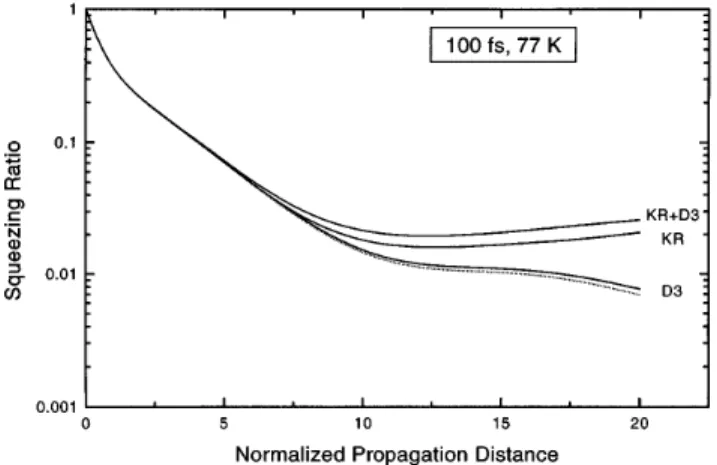
Fig. 5. Squeezing ratio versus normalized propagation distance for 100-fs (FWHM) pulses at 77 K at the 1.55-mm wavelength. KR, Raman only; D3, third-order dispersion only; KR 1 D3, both; dotted curve, neither. Without the Raman effect and third-order dispersion, one normalized propagation distance unit 0.5 rad nonlinear phase shift.
self-Raman effect increases as the intensity of the pulse increases.
4.
RESULTS AT THE 1.55-mm
WAVELENGTH
In our calculation at the 1.55-mm wavelength, the phonon field is again assumed to be purely inhomogeneously broadened with a Lorentzian – Raman gain spectra. The parameters for the self-Raman effect and third-order dis-persion have been given in Section 2. The input pulse is the soliton solution in the ideal soliton case [d3 0, ki "vk0n2yAeff and hstd 0]; it is a sech pulse A0sechstyt0d
with A20t02 2diAeffy"v0k0n2. Again the output pulse is
used as the local oscillator. We did not attempt to op-timize the input pulse shape or the local-oscillator pulse shape in the present calculation.
We have calculated the squeezing ratios for 50- and 100-fs (FWHM) solitary pulses at 77 K. The results are shown in Figs. 4 and 5, respectively. To investigate the temperature dependence, in Fig. 6 we plot the squeezing
ratio for 100-fs (FWHM) solitary pulses at five tempera-tures. In all the figures, the transverse coordinate is the normalized propagation distance in conventional soliton theories (i.e., z zyz0, z0 t02yjk000j, t0 FWHMy1.763).
For ideal solitons, the nonlinear phase shift is 1 rad after the pulse propagates two normalized distance units.
From the figures, it is clear that, in the presence of the self-Raman effect and third-order dispersion, squeez-ing still survives but will reach a limit as the propagation distance increases. At 77 K, for 50-fs pulses the achiev-able squeezing is,10.5 dB, whereas for 100-fs pulses it is ,17 dB. In going from 77 to 298 K, the achievable squeezing is degraded by,2.1 dB.
From the figures, it is also clear that the influences of the self-Raman effect and third-order dispersion are not additive. For the cases considered here, the impacts from the third-order dispersion are much less than those from the self-Raman effect. This is because of the pres-ence of the second-order dispersion.
At this stage, it may be advantageous to compare our results briefly with other published calculations. Drum-mond and Hardman17 calculated the squeezing ratio for
t0 100 fs or FWHM 176 fs solitary pulses at 77 K up
to five normalized distance units. Only the self-Raman effect was considered. They found that the squeezing ra-tio decreases monotonically as the propagara-tion distance increases and that the squeezing ratio at five normalized distance units is,0.08 m. This agrees reasonably with our Fig. 5, given that Drummond and Hardman17 used
the full measured Raman gain spectra20 whereas we
as-sume a Lorentzian – Raman gain shape. In their calcula-tion the error bar at five normalized distance units is 0.04, and they did not show their results for larger propagation distances, different temperatures, or pulse widths. Be-cause in their calculation the propagation distance is not long enough (only up to 5 units), they did not observe the saturation behavior, as we did in Fig. 5. K ¨artner et al.16
obtained a series of curves of the squeezing ratio for dif-ferent temperature and pulse durations. Again only the self-Raman effect was considered. The squeezing ratio also decreases monotonically as the propagation distance increases. Extracted from Fig. 3 of Ref. 16, the squeez-ing at five normalized distance units (2.5-rad
nonlin-Fig. 6. Squeezing ratio versus normalized propagation distance for 100-fs (FWHM) pulses at five temperatures at the 1.55-mm wavelength. Without the Raman effect and third-order disper-sion, one normalized propagation distance unit 0.5 rad non-linear phase shift.
ear phase shift) for 100-fs solitary pulses at 300 K is ,10.5 dB. This again agrees reasonably with our Fig. 5, given that K ¨artner et al.16 used the soliton perturbation
theory and the new Raman gain data21whereas we used
the backpropagation method and the Lorentzian – Raman gain model based on the old Raman gain data.20
How-ever, the temperature dependence predicted by K ¨artner et al. is larger than that in our Fig. 5. Especially at 0 K the soliton perturbation theory predicts that the squeez-ing ratio can monotonically go beyond 20 dB, whereas our curve reaches its minimum near 18 dB. We believe that this is an indication that the soliton perturbation the-ory is no longer accurate enough when the propagation distance is long and when the squeezing is large. The coupling between the soliton parts and the continuum must be taken into account in order to get correct re-sults. Another point to be noted is that the squeezing ratio calculated by K ¨artner et al.16is the squeezing ratio
that corresponds to a special optimum local oscillator.12
On the other hand, we use the same pulse after it propa-gates through the fiber as the local oscillator. Because of such a difference, one should be careful in comparing the results. To have a more commensurate comparison, we have used the special optimum local oscillator in one calculation for 100-fs solitons at 77 K with only the self-Raman effect (see Fig. 4 in Ref. 18). We found that the squeezing ratio indeed is smaller for a shorter propaga-tion distance (,8 distance units) but becomes larger after-wards. The maximum squeezing is ,16 dB. In other words, in the presence of self-Raman effect, the use of the special optimum local oscillator derived for ideal soli-tons does not increase the achievable squeezing when the propagation distance is long.
It should also be noted that the parameters used in our or other groups’ calculations may have some uncer-tainties. For example, the usual value for n2 3.2 3
10220m2yW was taken from the literature based on the
measurements in the visible wavelength.24 Recent
mea-surements for which two-photon nonlinear effects were used indicates that the nonlinearity in the infrared may be smaller. Values as low as n2 2.4 3 10220m2yW
have been reported for wavelengths of ,1.06 mm. The magnitudes of second- and third-order dispersions and the percentages of instantaneous and noninstantaneous non-linearities may also have their uncertainties. Neverthe-less, such uncertainties and differences should cause only small quantitative differences.
5.
DISCUSSION
In this paper we have examined the influence of the self-Raman effect and third-order dispersion on the achiev-able squeezing ratio in squeezing experiments in which optical fibers are used. Calculations were performed up to a longer propagation distance at several pulse dura-tions and temperatures. We find that in the presence of the two effects, squeezing still survives but will reach a limit as the propagation distance increases. Physically, the reduction or the destruction of observed squeezing can be attributed to three factors. First, the statistics of quantum noises are changed because of the transfor-mation of the self-Raman effect and third-order disper-sion. Second, additional noises are introduced midway.
Finally, the local-oscillator pulse shape is also changed and may become more unmatched with the statistics of quantum noises. To investigate more carefully the rela-tive importance of the three factors and the possibility of increasing observed squeezing with an optimized input pulse and a local oscillator, we have also tried to use the sech oscillator pulse shape and the optimum local-oscillator pulse shape given in Ref. 12 for ideal solitons (i.e., without the self-Raman effect and third-order disper-sion). We find that, even though the detected squeezing is larger for short propagation distances, if the optimum local-oscillator pulse shape given in Ref. 12 for ideal soli-tons is used, eventually the use of the output pulse as the local oscillator gives the largest achievable squeezing. This clearly shows that the optimum local-oscillator pulse shape for ideal solitons is no longer optimum in the pres-ence of the self-Raman effect. A more accurate deter-mination of the optimum input pulse shape and optimum local-oscillator pulse shape is an interesting research topic to be addressed in the future.
In our calculation, other noise sources like guided-acoustic-wave Brillouin scattering22,23 (GAWBS) is not
considered. Physically, GAWBS can be modeled in the same way as in the inhomogeneously broadened case, ex-cept that GAWBS has different resonance frequencies, dif-ferent coupling strengths, and difdif-ferent relaxation rates. As long as these characteristics are determined, they can be easily incorporated into the calculation. In practice, the effects of GAWBS can be eliminated or reduced by the proper selection of a good fiber,1by high-frequency phase
modulation of the pump,2 or by the use of a high
pulse-repetition rate.3 Nevertheless, because we do not include
GAWBS and other minor noise sources in the present calculation, the results given in this paper represent the ideal lower limit of squeezing ratio for squeezing experi-ments with optical fibers.
The present status of squeezing experiments with op-tical fibers is ,5-dB squeezing observed at the 1.3-mm wavelength. To observe experimentally or check the pre-dictions of our calculation, the observed squeezing ratio has to be pushed down further. It will be interesting to see whether one can experimentally approach the limits predicted here.
ACKNOWLEDGMENTS
The work was supported by the National Science Coun-cil of Taiwan under contract NSC 84-2221-E-009-033. The authors also thank the National Center for High-Performance Computing in Taiwan for offering us their computational power.
REFERENCES
1. K. Bergman and H. A. Haus, “Squeezing in fibers with op-tical pulses,” Opt. Lett. 16, 663 (1991).
2. K. Bergman, C. R. Doerr, H. A. Haus, and M. Shirasaki, “Sub-shot-noise measurement with fiber-squeezed optical pulses,” Opt. Lett. 18, 643 (1993).
3. K. Bergman, H. A. Haus, E. P. Ippen, and M. Shirasaki, “Squeezing in a fiber interferometer with a gigahertz pump,” Opt. Lett. 19, 290 (1994).
4. M. Rosenbluh and R. M. Shelby, “Squeezed optical solitons,” Phys. Rev. Lett. 66, 153 (1991).
5. M. Shirasaki and H. A. Haus, “Squeezing of pulses in a nonlinear interferometer,” J. Opt. Soc. Am. B 7, 30 (1990). 6. K. Bergman, H. A. Haus, and Y. Lai, “Fiber gyros using
squeezed pulses,” J. Opt. Soc. Am. B 8, 1952 (1991). 7. K. J. Blow, R. Loudon, and S. J. D. Phoenix, “Quantum
theory of nonlinear loop mirrors,” Phys. Rev. A 45, 8064 (1992).
8. F. X. K ¨artner, L. G. Jonechis, and H. A. Haus, “Classical and quantum dynamics of a pulse in a dispersionless nonlinear fiber,” Quantum Opt. 4, 379 (1992).
9. L. G. Jonechis and J. H. Shapiro, “Quantum propagation in a Kerr medium: lossless, dispersionless fiber,” J. Opt. Soc. Am. B 10, 1102 (1993).
10. P. D. Drummond and S. J. Carter, “Quantum field theory of squeezing in solitons,” J. Opt. Soc. Am. B 4, 1565 (1987). 11. P. D. Drummond, S. J. Carter, and R. M. Shelby, “Time
dependence of quantum fluctuations in solitons,” Opt. Lett.
14, 373 (1989).
12. H. A. Haus and Y. Lai, “Quantum theory of soliton squeez-ing — a linearized approach,” J. Opt. Soc. Am. B 7, 386 (1990).
13. Y. Lai, “Quantum theory of soliton propagation — a unified approach,” J. Opt. Soc. Am. B 10, 475 (1993).
14. F. Singer, M. J. Potasek, J. M. Fang, and M. C. Teich, “Femtosecond solitons in nonlinear optical fibers: classical and quantum effects,” Phys. Rev. A 46, 4192 (1992).
15. S. J. Carter and P. D. Drummond, “Squeezed quantum soli-tons and Raman noise,” Phys. Rev. Lett. 67, 3757 (1991). 16. F. X. K ¨artner, D. J. Dougherty, H. A. Haus, and E. P. Ippen,
“Raman noise and soliton squeezing,” J. Opt. Soc. Am. B 11, 1267 (1994).
17. P. D. Drummond and A. D. Hardman, “Simulation of quan-tum effects in Raman-active waveguides,” Europhys. Lett.
21, 279 (1993).
18. Y. Lai and S.-S. Yu, “General quantum theory of nonlinear optical pulse propagation,” Phys. Rev. A 51, 817 (1995). 19. J. P. Gordon, “Theory of the soliton self-frequency shift,” Opt.
Lett. 11, 662 (1986).
20. R. H. Stolen, J. P. Gordon, W. J. Tomlinson, and H. A. Haus, “Raman response function of silica-core fibers,” J. Opt. Soc. Am. B 6, 1159 (1989).
21. D. Dougherty, F. X. K ¨artner, I. P. Ippen, and H. A. Haus, “Low-frequency Raman gain measurements,” Opt. Lett. 20, 31 (1995).
22. R. M. Shelby, M. D. Levenson, and P. W. Bayer, “Guided acoustic-wave Brillouin scattering,” Phys. Rev. B 31, 5244 (1985).
23. R. M. Shelby, P. D. Drummond, and S. J. Carter, “Phase-noise scaling in quantum soliton propagation,” Phys. Rev. A
42, 2966 (1990).
24. R. H. Stolen and C. Lin, “Self-phase-modulation in silica optical fibers,” Phys. Rev. A 17, 1448 (1978).