科技部補助專題研究計畫成果報告
期末報告
基於腦波發展之注意力感知系統及其支援提升網路同步與非同
步學習注意力與成效之應用研究(第2年)
計 畫 類 別 : 個別型計畫 計 畫 編 號 : MOST 104-2511-S-004-003-MY2 執 行 期 間 : 105年08月01日至106年07月31日 執 行 單 位 : 國立政治大學圖書資訊與檔案學研究所 計 畫 主 持 人 : 陳志銘 計畫參與人員: 碩士班研究生-兼任助理:許筑婷 碩士班研究生-兼任助理:黃儀甄 碩士班研究生-兼任助理:陳俊逸 碩士班研究生-兼任助理:黃雅翎 碩士班研究生-兼任助理:連英佑 博士班研究生-兼任助理:陳勇汀中 華 民 國 106 年 09 月 11 日
中 文 摘 要 : 英語是目前全世界非英語國家最受歡迎的第二語言,如何利用科技 發展可以有效輔助學生學習英語的機制是非英語國家的一個重要課 題。隨著數位筆技術的發展,發展結合紙本教科書和數位筆支援英 語課堂學習的互動學習環境已經變得可行。本研究提出了基於腦波 檢測注意力的診斷和複習機制(attention-based diagnosing and review mechanism, ADRM),可以幫助學習者記錄透過結合紙本與 數位筆輔助英語學習過程中注意力低落的段落,以作為複習的主要 依據,希望據此提高學生的英語學習成效。基於真實驗設計,本研 究所提出的ADRM,是否有助於提高了學習者利用紙本教科書和數位 筆支援英語課堂學習的複習成效與持續注意力。研究對象為台灣台 北市某一所工業職業學校共108名學生,研究對象為17至18歲的男性 。實驗組學習者在使用數位筆支援閱讀紙本英文文本進行學習時 ,同時使用ADRM輔以複習,而對照組在使用數位筆支援閱讀紙本英 文文本的同時,則使用自主複習。實驗結果顯示,實驗組的複習成 效顯著優於對照組,證明ADRM輔以複習比自主複習更有效。此外 ,實驗組中場地相依型學習者比場地獨立學習者有更好的複習成效 ,此一結果顯示ADRM較有助於場地相依型學習者。實驗組中採用 ADRM的低能力學習者的複習成效顯著優於採用自主學習的對照組低 能力學習者。實驗組中採用ADRM的高注意力學習者的複習成效及複 習注意力顯著優於採用自主學習的對照組高注意力學習者。本研究 證實基於腦波檢測發展的ADRM輔助學習者進行更精確的複習是可行 的。然而,在資訊社會中應該進一步考慮使用ADRM取代人類自主複 習是否具有可用性和可接受性。 中 文 關 鍵 詞 : 腦波、數位筆、英語學習、注意力識別、注意力為基礎之診斷與複 習機制
英 文 摘 要 : Since English is probably the most popular second language, helping students learn English through technology is a critical issue in non-English speaking countries. With the growth of digital pen technologies, developing an
interactive learning environment that combines printed textbooks and a digital pen to support English-language classroom learning has become feasible. This work presents an attention-based diagnosing and review mechanism (ADRM) based on brainwave detection to help learners identify the passages with low attention level in a lesson as review targets in order to perform efficiently and accurately review processes while reading paper-based English texts with digital pen support in autonomous learning
environments. Based on the true-experimental design, this work aims to confirm whether the ADRM improves the review performance and sustained attention of learners while
reading paper-based English texts with digital pen support. The research participants were a total of 108 students at an industrial vocational high school in Taipei City,
Taiwan. All research participants were males and aged from 17 to 18 years old. The experimental group used the ADRM
while reading paper-based English texts with digital pen support, whereas the control group used the autonomous review while reading paper-based English texts with digital pen support. Experimental results reveal that the review performance of the experimental group was significantly better than that of the control group, proving that the ADRM improved review performance. The results also show that the field-dependent learners in the experimental group exhibited a great improvement in review performance in comparison to the field-independent learners. Additionally, the low-ability learners in the experimental group
exhibited better review performance compared to those in the control group.
英 文 關 鍵 詞 : brainwave signals, digital pen, English learning, attention recognition, attention-based diagnosing and review
科技部專題研究計畫成果報告
基於腦波發展之注意力感知系統及其支援提升網路同步與非
同步學習注意力與成效之應用研究(2/2)
計畫主持人:陳志銘 教授 計畫執行單位:國立政治大學圖書資訊與檔案學研究所 計畫編號:MOST104-2511-S-004 -003 -MY2
計畫執行期間:105 年 8 月 1 日~106 年 7 月 31 日中文摘要
英語是目前全世界非英語國家最受歡迎的第二語言,如何利用科技發展可以有效輔助學 生學習英語的機制是非英語國家的一個重要課題。隨著數位筆技術的發展,發展結合紙本教 科書和數位筆支援英語課堂學習的互動學習環境已經變得可行。本研究提出了基於腦波檢測 注意力的診斷和複習機制(attention-based diagnosing and review mechanism, ADRM),可以幫 助學習者記錄透過結合紙本與數位筆輔助英語學習過程中注意力低落的段落,以作為複習的 主要依據,希望據此提高學生的英語學習成效。基於真實驗設計,本研究所提出的ADRM, 是否有助於提高了學習者利用紙本教科書和數位筆支援英語課堂學習的複習成效與持續注意 力。研究對象為台灣台北市某一所工業職業學校共108名學生,研究對象為17至18歲的男性。 實驗組學習者在使用數位筆支援閱讀紙本英文文本進行學習時,同時使用ADRM輔以複習, 而對照組在使用數位筆支援閱讀紙本英文文本的同時,則使用自主複習。實驗結果顯示,實 驗組的複習成效顯著優於對照組,證明ADRM輔以複習比自主複習更有效。此外,實驗組中 場地相依型學習者比場地獨立學習者有更好的複習成效,此一結果顯示ADRM較有助於場地 相依型學習者。實驗組中採用ADRM的低能力學習者的複習成效顯著優於採用自主學習的對 照組低能力學習者。實驗組中採用ADRM的高注意力學習者的複習成效及複習注意力顯著優 於採用自主學習的對照組高注意力學習者。本研究證實基於腦波檢測發展的ADRM輔助學習 者進行更精確的複習是可行的。然而,在資訊社會中應該進一步考慮使用ADRM取代人類自 主複習是否具有可用性和可接受性。 關鍵字:腦波、數位筆、英語學習、注意力識別、注意力為基礎之診斷與複習機制Abstract
Since English is probably the most popular second language, helping students learn English through technology is a critical issue in non-English speaking countries. With the growth of digital pen technologies, developing an interactive learning environment that combines printed textbooks and a digital pen to support English-language classroom learning has become feasible. This work presents an attention-based diagnosing and review mechanism (ADRM) based on brainwave detection to help learners identify the passages with low attention level in a lessonas review targets in order to perform efficiently and accurately review processes while reading paper-based English texts with digital pen support in autonomous learning environments. Based on the true-experimental design, this work aims to confirm whether the ADRM improves the review performance and sustained attention of learners while reading paper-based English texts with digital pen support. The
research participants were a total of 108 students at an industrial vocational high school in Taipei City, Taiwan. All research participants were males and aged from 17 to 18 years old. The experimental group used the ADRM while reading paper-based English texts with digital pen support, whereas the control group used the autonomous review while reading paper-based English texts with digital pen support. Experimental results reveal that the review performance of the experimental group was significantly better than that of the control group, proving that the ADRM improved review performance. The results also show that the field-dependent learners in the experimental group exhibited a great improvement in review performance in comparison to the field-independent learners. Additionally, the low-ability learners in the experimental group exhibited better review performance compared to those in the control group. Furthermore, learners with high-attention level in the experimental group have exhibited better review performance and the sustained attention than the learners in the control group. This work confirms that developing an ADRM based on brainwave detection to assist learners’ review processes is practicable. However, the usability and acceptability of using ADRM instead of human autonomous review should be further considered in the information society.
Keywords: brainwave signals, digital pen, English learning, attention recognition, attention-based
diagnosing and review mechanism
1. Introduction
English is probably the most popular second language in many non-English-speaking countries (Chen & Hsu, 2008; Chen & Chung, 2008). Many studies (Day & Bamford, 1998; Pikulski & Chard, 2005; Chen, Tan & Lo, 2016) have pointed out that developing novel and effective learning environments can promote the effectiveness of students’ language learning and increase their interest therein. Therefore, many Computer Assisted Language Learning (CALL) (Levy & Hubbard, 2005) systems have been designed to help learners learn English using suitable technology. For example, Hu et al. (2007) developed an interactive multimedia web site as a technology-assisted learning platform to support the learning of English and compared technology-assisted learning with face-to-face learning. Their study confirmed that technology-assisted learning supported greater learning effectiveness than conventional face-to-face learning. Hui et al. (2008) used the same technology-assisted learning platform (Hu et al., 2007) to support English language learning for university students, including reading, speaking, listening, vocabulary, and writing. Their results demonstrated that CALL better supports vocabulary acquisition than face-to-face learning. Chen, Wang and Chen (2013) proposed a self-regulated learning (SRL) mechanism that was combined with a digital reading annotation system (DRAS) to help Grade 7 students to generate rich and high-quality annotations to improve their performance in reading English. Their study revealed that the reading comprehension of the learners was significantly improved by using the proposed DRAS with the SRL mechanisms to read English texts online.
Most CALL systems for English learning offer interactive functions that rely mainly on computer screens. A study of the computer-screen reading habits of university students showed that 74% of participants prefer paper-based over computer-screen reading (Vandenhoek, 2013). Allen (2010) also found that 75% of students prefer printed textbooks over digital textbooks. Mangen et al. (2013) found that reading texts on paper led to significantly better comprehension performance than reading the texts on a computer screen. Therefore, most students prefer, or are used to, paper-based reading and learning activities (Bromley, 2010; Woody, Daniel, & Baker, 2010). Moreover, many empirical studies have found that reading and working using printed paper results in a lower cognitive load than working with a computer (Wastlund et al., 2005; Oviatt, Arthur, & Cohen, 2006). These studies imply that the use of screen-based technologies for learning English may not be effective or acceptable for learners. Accordingly, an interactive paper-based CALL system to
support the learning of English is required. Therefore, this work proposes an integrated interactive digital pen technology for use with printed textbooks to support paper-based learning of the English language. Many studies have verified that this technology is very effective in improving learning performance (Lai, Chao & Chen, 2007; Alvarez et al., 2013; Chen, Tan & Lo, 2016). For example, Chen, Tan and Lo (2016) developed an interactive learning environment that combines printed textbooks with digital pen technology to support English-language learning. This digital pen and paper interaction platform (DPPIP) enables teachers to develop paper-based activities that involve the digital pen for English-language learning and enables students to use digital pens to interact with printed reading tags to obtain immediate assistance, including oral reading demonstrations, and to record oral readings and rehearse independent reading aloud.
Students may easily lose attention during learning in the absence of supervision by a teacher (Zhang, Zhou, Briggs & Nunamaker, 2006). However, attention is the key determinant of learning performance (Steinmayr, Ziegler & Träuble, 2010). In recent years, developments in human physiological signal measurement technology have been considerable and this technology has been successfully applied to the evaluation of emotion (Chen & Sun, 2012; Chen & Wang, 2011) and attention (Chen & Wu, 2015; Chen & Huang, 2014; Rebolledo-Mendez et al., 2009). Therefore, many recent studies have focused on developing e-learning systems using an attention model to improve the performance of learners by continuously measuring their physiological signals and by using wireless communication technology to monitor their attention (Hsu et al., 2012; Chen & Wu, 2015; Chen & Huang, 2014).
Generally, learners adopt an autonomous review method that performs the review process based on self-judgment to review the lessons that they have not learnt well while performing English learning. However, it is difficult to memorize correctly those lessons that need to be reviewed by themselves during the reading of English texts with a digital pen support due to the limited working memory. To improve review performance during the reading of English texts with a digital pen support, brainwave detection technology is used herein to develop an ADRM which can diagnose and record the printed reading tags with corresponding English texts that the digital pen can click for individual learners who are paying little attention on the printed reading tags. The system then provides reviews of those texts to which learners were paying little attention, providing an opportunity for the student to consolidate everything that should have been learned. The research questions of the study address whether any significant differences exist in the review performance and review attention of learners using the ADRM and that of those using the autonomous review while reading paper-based English texts with digital pen support, and whether significant differences exist in review performance and review attention of learners with distinct cognitive styles, distinct learning abilities, and distinct attention levels using the ADRM and of the corresponding groups of learners using the autonomous review while reading paper-based English texts with digital pen support.
2. Literature Review
2.1 Digital pen technology-supported learning
In recent years, digital pen technology has been studied as an assistive educational technology. For example, Huang, Wang and Young (2012) used a digital pen to support English learning for primary school students. They confirmed that using a digital pen as a tool to learn English can effectively reduce anxiety and increase learners’ interest. Higgins and Raskind (2005) examined the compensatory effectiveness of the digital pen in the reading comprehension of students with learning disabilities. In their experiment, students with reading disabilities aged between 10 to 18 were given two weeks of training in using the digital pen as a learning tool. Their results demonstrated that the digital pen had a positive impact on reading comprehension. In addition, Chang (2009) developed a collaborative English as a foreign language (EFL) reading platform that
integrated a digital pen and Wiki. This system provided a learning environment that supported EFL reading. Piper, Weibel and Hollan (2011) studied the practices of speech therapy, and demonstrated that the digital pen and paper interface has potential for speech-language therapy.
Alvarez et al. (2013) utilized digital pens and interactive whiteboards in support of individual work and found that these increased the motivation of students to work with the teacher to solve problems. Lai, Chao and Chen (2007) developed an interactive multimedia textbook for computer programming with a digital pen to support learning. Their research results demonstrated a positive effect on understanding programming concepts. Chen, Tan and Lo (2016) proposed a digital pen and paper interaction platform (DPPIP) that integrated digital pen technologies, printed textbooks and a course management system, to support the repetitive reading strategy for improving fluency in the oral reading of English. Their results revealed that using the DPPIP to support an English-language course had significantly positive effects on fluency, motivation to learn, and satisfaction with learning for junior high school students. The DPPIP helped students with field-independent and field-dependent cognitive styles (Witkin, 1977) accelerate improvement in oral reading fluency. Therefore, this work proposes an ADRM based on brainwave detection to help learners review lessons with low attention level while reading paper-based English texts with digital pen support and examined the potential of this proposed system to improve English-language learning performance.
2.2 Effects of attention awareness on learning performance
Sustained attention has been considered to be a critical issue in cognitive psychology because of its strong relationship with learning performance (Steinmayr, Ziegler, & Träuble, 2010; Chen & Wu, 2015). Keller and Suzuki (2004) indicated that an e-learning lesson must gain and sustain learners’ attention because learners’ attention spans are typically 20 to 30 minutes. Therefore, many recent studies have focused on the development of e-learning systems based on a model of attention awareness to promote learning performance of learners or alert teaching statuses of teachers in a digital learning environment by monitoring their states of attention. Developing an attention aware system to identify a learner’s attention level based on human physiological signals for promoting digital learning performance has been confirmed as an applicable approach. For example, Hsu, Chen, Su and Huang (2012) developed a reading concentration monitoring system for use with e-books in an intelligent classroom. The system captured the learning behaviors of students using three kinds of sensor - webcams, heartbeat sensors, and blood oxygen sensors. Various physiological signals are collected and used to evaluate the concentration of students on reading. The researchers found that their developed system helped instructors to understand the students’ reading concentration rates in a classroom learning environment. Chen, Wang and Yu (2017) developed a novel attention aware system (AAS) capable of recognizing students’ attention levels accurately based on EEG signals, thus having high potential to be applied in providing timely alert for conveying low-attention level feedback to online instructors in an e-learning environment. Chen and Huang (2014) proposed a web-based reading annotation system with an attention-based self-regulated learning mechanism (ASRLM), which is based on brainwave detection, to enhance the sustained attention of learners while reading annotated English texts online, and thereby promote online reading performance. Also, Raca and Dillenbourg (2013) developed a system for monitoring the attention paid by teachers in a classroom and giving feedback to the teacher when it drops. It is obvious that the effects of attention awareness on promoting e-learning performance are significant.
However, to the best of our knowledge, few studies have focused on developing attention awareness system based on human physiological signals to diagnose learners’ learning problems in digital learning environments. Therefore, a novel ADRM, which dynamically monitors individual attention levels and provides a lesson review list based on diagnosing periods of low attention, was designed herein to support the paper-based reading of English texts with digital pen. This study
logically supposed that reviewing the passages with low attention level can perform efficiently and accurately review processes while reading paper-based English texts with digital pen support in autonomous learning environments. Based on this assumption, this study examines the effects of English learning with ADRM support on the attention of learners and review performance determined by the score of posttest after performing the review process.
2.3 Effects of cognitive style on learning performance
Among a variety of individual characteristics, cognitive style significantly affects learning performance. Cognitive style has also been identified as significantly influencing learners’ preferred learning materials. Mampadi et al. (2011) proposed an adaptive hypermedia learning system to examine the relationships between learners’ cognitive style and their learning perceptions and learning performance, based on their responses to the proposed system. Their results indicated that adaptation to cognitive style improves learning, and an adaptive hypermedia learning strategy has a greater effect on learners’ learning perceptions than on their learning performance. Two of the most important kinds of learning styles are Witkin’s field-dependent and field-independent cognitive styles (Witkin, 1977). Nozari and Siamian (2015) examined how the field-dependent and field-independent cognitive styles affect the reading comprehension while reading an English text. Their results revealed a significant linear relationship between field dependence/independence and learning performance. Greater field-independent is associated with higher reading comprehension. Sabet and Mohammadi (2013) studied the relationship between the field-dependent and field-independent cognitive styles and the reading comprehension abilities of EFL readers. Their results demonstrated a relationship between the two cognitive styles and reading comprehension. Chen (2010) proposed a Web-based learning system that uses Web-based learning programs to identify how learners’ field-dependent and field-independent cognitive styles and learning behavior are related to each other. They thus confirmed that participants with different cognitive learning styles have different learning strategies, and favor different navigation tools for the purposes of learning.
Chen, Tan and Lo (2016) proposed a digital pen and paper interaction platform (DPPIP) in which digital pen technologies were integrated with printed textbooks and a course management system to support the repetitive reading strategy for improving oral reading fluency in English. Analytical results demonstrated that using the DPPIP to support an English-language course helped students with field-independent or field-dependent cognitive styles improve their oral reading fluency. Therefore, this study focuses on finding whether significant differences exist in review performance and review attention of learners with distinct cognitive styles while performing the ADRM and the autonomous review in the context of reading paper-based English texts with digital pen support.
3. Methodology
3.1 Research architecture
In this work, the independent variable is the use of the ADRM or autonomous review to assist the learning of English-language texts in a paper-based learning context with digital-pen support. The experimental group used the ADRM to learn English-language texts in paper-based learning context with digital-pen support, whereas the control group used the autonomous review. Dependent variables are review performance and review attention paid during performing the review of English-language texts. Several previous studies have argued that e-learning may generate different effects to learners who have distinct learner characteristics such as cognitive styles (Chen, Tan, & Lo, 2016), sustained attention levels (Chen & Huang, 2014), and learning abilities (Nakayama, Yamamoto & Santiago, 2007). This work thus considered the three learner
characteristics as the background variables to explore whether the use of the ADRM or autonomous review generated different effects on review performance and review attention to learners with distinct cognitive styles, sustained attention levels, and learning abilities. Both groups were taught the same English texts for the same period in an autonomous learning environment.
3.2 Experimental design
This work applies the true-experimental design (Salkind, 2010) to perform the instructional experiment. The participants of the study were randomly recruited from Grade 10 (42 students) and Grade 11 (66 students) at an industrial vocational high school in Taipei City, Taiwan. All participants were male, aged 17 to 18 years old. According to the true-experimental design, participants were randomly assigned to the experimental group and the control group. Those in the experimental group learned selected English-language texts with the ADRM support in paper-based learning context with digital-pen support, whereas those in the control group learned the same texts as with the experimental group using the autonomous review. Of the 108 participants, the experimental group comprised 53 and the control group comprised 55 participants.
3.3 Experimental procedure
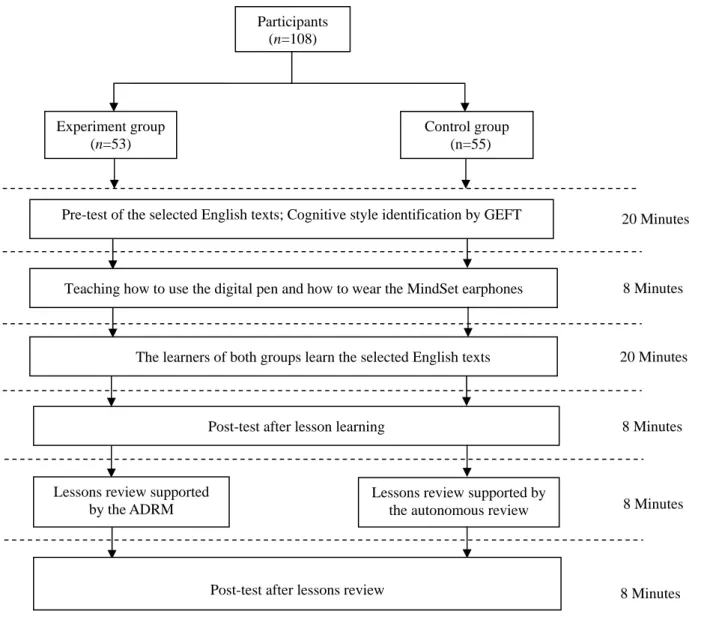
Figure 1 shows the learning procedure in the instructional experiment. The experimental procedure can be divided into three stages, as follows.
(1) First stage
Before the instructional experiment was performed, students took a pretest that involved the selected English texts to evaluate the English-language proficiency of both groups. The Group Embedded Figures Test (GEFT) (Witkin, 1977) was used to identify the cognitive styles of learners in both groups. Then, all participants in both groups were taught how to use a digital pen to interact with printed reading tags to obtain immediate assistance in reading and learning English. The wearing of MindSet earphones, which were used to record the level of sustained attention in the learning process, was also demonstrated.
(2) Second stage
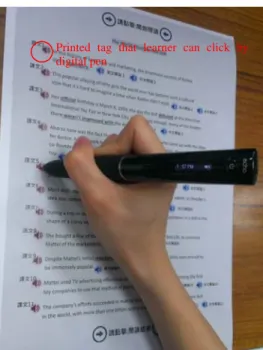
In the instructional experiment, all participants in both groups learned the same English texts with the assistance of the digital pen for 20 minutes. Figure 2 shows the English texts with printed tags that can be clicked with the for learning. First, participants started by clicking the printed tag “begin reading” (step 1 of Fig. 2). Then, the learners could click the English text with the printed tag to play the corresponding oral reading of the English text (step 2 of Fig. 2), to reveal an explanation in English (step 3 of Fig. 2), to reveal an explanation in Chinese (step 4 of Fig. 2), orto learn vocabulary (step 5 of Fig. 2). In addition to step 1, the other learning steps are optional, not fixed and mandatory steps respectively. The learners could determine the order and combination of learning steps 2 to 5 by themselves. At the same time, the learners wore the MindSet earphones, which assessed the level of sustained attention during the learning process as they read the selected English-language texts. After 20 minutes of learning, the students were given a post-test to assess their learning performance.
(3) Third stage
Following the above, learners of the experimental group were treated with a learning review that was supported by the ADRM, which was based on attention detection. Learners in the control group reviewed their own learning in an autonomous review. Learners in the experimental group needed to follow the guide of the ADRM to perform their review processes. This work supposed that the
use of ADRM has potential benefits in enhancing learners’ long-term knowledge retention so that their learning performance can be significantly improved because the ADRM can accurately and efficiently guide them to perform the review process. On the other hand, the autonomous review means that learners in the control group could perform review processes based on their self-judgment. For example, they could click the printed tag “legendary” that appears in Figure 2 by using the digital pen to learn the vocabulary again if they felt the vocabulary needs to be reviewed based on their self-judgment. In this case, the learners’ decision may be due to paying little attention to learning the vocabulary or still being unfamiliar with the vocabulary even if the vocabulary has been learned.
To assess the effects of the lesson review mechanisms – the ADRM and autonomous review – on the review performance of both groups, the learners of both groups had to take a post-test immediately after the end of the lesson review. The review performance was determined by evaluating the score of the post-test after performing the review process. This study designed the pre-test performed before lesson learning, post-test performed after lesson learning, and post-test performed after lesson review that contain the same questions with different sequences of selecting items in a multiple-choice design. The aim is to control that the three test sheets have the same difficulty and to reduce the probability of giving correct answer based on guessing. Based on the results of the post-tests of both groups following their lesson review, this work examined whether the review performance and review attention in the experimental group were better than those in the control group.
Figure 1. The learning procedures of the designed instructional experiment
Figure 2. English text with printed tags that can be clicked with the digital pen for learning
3.4 Research participants
Participants (n=108)
Teaching how to use the digital pen and how to wear the MindSet earphones
Lessons review supported by the ADRM
Control group (n=55)
Pre-test of the selected English texts; Cognitive style identification by GEFT
The learners of both groups learn the selected English texts
Post-test after lesson learning
Lessons review supported by the autonomous review
Post-test after lessons review
20 Minutes Experiment group (n=53) 8 Minutes 20 Minutes 8 Minutes 8 Minutes 8 Minutes
A 108 total of students who speak Chinese as their first language were recruited to participate in the instructional experiment. Their English language skills are basic level of General English Proficiency Test (GEPT), which is a test of English language proficiency commissioned by Taiwan’s Ministry of Education. The students were from four classes at an industrial vocational high school in Taipei City, Taiwan. All participants were male, aged between 17 and 18 years old. Of the 108 participants, 53 were randomly assigned to the experimental group, reviewing their lessons with ADRM support, while the remainders were randomly assigned to the control group, reviewing their lessons autonomously.
3.5 Research instruments
3.5.1 Paper-based reading with digital pen support
The study used the Livescribe™ smartpen to support paper-based classroom English learning. This kind of digital pen is an advanced paper-based computer in the form of a pen that can synchronously record everything one hears and writes as well as provide both audio and visual feedback, powerful processing capabilities, and substantial built-in storage (Livescribe™ Smartpen User Guide, 2010). Moreover, to perform paper-based operations, the Livescribe smartpen uses Livescribe™ dot paper, which is standard paper with printed microdots on its surface. These dots are nearly invisible to the human eye, however the smartpen can easily see and use them to know which page one is writing on and the exact location on that page. The Livescribe smartpen is composed of nine components including replaceable ink tip, soft rubber grip, anti-roll design, built-in speaker, built-in microphone, organic light-emitting diode (OLED) display, power button, micro-USB connector, and headset/audio jack. Figure 3 shows the components of the Livescribe smartpen.
Articles in the “Ivy League Analytical English” magazine for senior high school students were selected as the English learning materials. Paper-based reading, integrating with Livescribe™ smartpen, printed tags made of Livescribe™ dot paper, and printed textbooks, were used to assist English learning. Students could use their digital pens to click printed tags to interact with the texts in printed textbooks (Fig. 4).
Figure 4. An example of using the digital pen in paper-based English learning
3.5.2 Proposed ADRM for promoting review performance
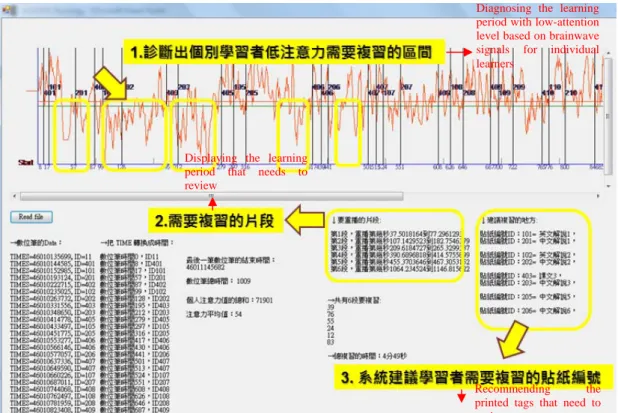
Electrical EEG brainwave monitoring equipment, NeuroSky’s MindSet earphones (NeuroSky, 2015), was used herein to measure the sustained attention of learners. The device comprises a headset, an ear-clip, and a sensor arm. Attention values in the range 0–100 were calculated form collected real-time EEG signals that were wirelessly transmitted to a computer with a brainwave receiver, using a patented algorithm developed by NeuroSky. Chen and Huang (2014) applied Pearson product-moment correlation analysis to confirm the scores of all participants in the Birdwatching game, an attention training game developed by Lumosity (http://www.lumosity.com/) and the attention values measured by the NeuroSky’s Mindset earphones to verify the correlations. The result shows that the two were strongly correlated (r=0.730, p=.000<.05), thus proving that the Mindset earphone was a valid measurement tool to identify learner attention. Therefore, the proposed ADRM integrated the paper-based reading with digital pen support and the measurement of sustained attention using NeuroSky’s MindSet earphones to diagnose whether learners generated low attention while clicking the printed tags by digital pen for learning English-language texts. Figure 5 presents the integrated user interface.
The proposed ADRM can record the learning processes of an individual learner, including the timestamps associated with clicking on printed reading tags and the attention values for every second for the individual learners. An attention graph with time as the X-coordinate and attention value upon clicking a labeled tag as the Y-coordinate is plotted. An attention threshold value is set based on a pilot study to divide the learners into low- and high-attention groups. Then, based on a sorted list of printed tags that were clicked when attention was low, the ADRM recommends review content to the students in the experimental group.
Several pilot experiments were performed to set the threshold between low- and high-attention groups. The procedure for determining the threshold value is as follows. First, the NeuroSky’s MindSet earphone set is used to record the attention values during the learning of the selected English-language texts. Then, the average value of attention is calculated from the collected data. Based on the trial-and-error pilot experiments, when the attention value of a learner is less than the average for 8s on a printed tag that the digital pen can click, then the printed tag is recorded as the printed tag that the learner needs to review. Since EEG signals may oscillate during the recording, when the attention value of learner remains above average for 5s, the recording ends.
Printed tag that learner can click by digital pen
Figure 5. The integrated user interface of paper-based reading with digital pen and ADRS support
3.5.3 Group Embedded Figures Test (GEFT)
All participants were classified by cognitive style into field-dependent (FD) and field-independent (FI) learners, using the modified Chinese version of the Group Embedded Figures Test (GEFT) (Witkin, 1977). The aim was to determine whether different lesson review methods cause differences in the effectiveness for students with field-independent and field-dependent cognitive styles. The scale’s reliability by the Sperman–Brown prophecy formula is 0.82. This work applied the GEFT to identify students whose GEFT scores were higher and lower than the average score as field-independent and field-dependent styles, respectively.
4. Experimental Results
4.1 Analysis of initial English abilities of learners in both groups
The initial English abilities of learners in the two learning groups were assessed before the instructional experiment was performed. The independent samples t-test was conducted to identify differences between the initial English abilities of learners in both groups. The results reveal that the difference between the pre-test results of both groups was not statistically significant (t = .858, p = 0.393 > 0.05), indicating that learners in both groups had equivalent English abilities.
4.2 Analysis of difference in review performance and attention of both groups
The analysis of difference in review performance aimed to assess whether the review performance and review attention paid by both groups differ significantly with the use of the ADRM or autonomous review to support English-language texts learning based on the independent samples t-test. Table 1 shows the results, demonstrating that the review performance of the two groups differed significantly (t = 2.00, p = .048 < .05) and the experimental group had better review performance compared to the control group. Therefore, the review performance of learners was significantly improved by the proposed ADRM. However, the review attention paid by learners in both groups did not differ significantly (t = .84, p = .401 > .05).
Diagnosing the learning period with low-attention level based on brainwave signals for individual learners
Displaying the learning period that needs to review
Recommending the printed tags that need to review
Table 1: Independent samples t-test of review performance and attention for both groups
Test item Learning group Number of
learners Mean
Standard
deviation t
Significance (two tailed)
Review performance Experimental group 53 5.38 1.86 2.00 .048*
Control group 55 4.60 2.16
Review attention Experimental group 53 65.01 12.36 .84 .401
Control group 55 62.85 14.13 * indicates p < 0.05
4.3 Analysis of difference in review performance and attention of learners with
different cognitive styles between both groups
This analysis aimed to assess whether the review performance and attention of learners with either the field-independent (FI) or the field-dependent (FD) cognitive style differs significantly between both groups, using the independent samples t-test. Table 2 shows the results, which reveal that the review performance of FD learners differed significantly between both groups (t = 2.25, p = .028 < .05), although the review performance of FI learners did not differ significantly between both groups (t = .46, p = .0647 > .05). The review attention paid did not differ significantly between both groups for FD learners (t = .34, p = .746 > .05) and FI learners (t = 1.00, p = .325 > .05). As shown in Table 2, the mean review scores of FD learners in the experimental group was higher than that of FD learners in the control group (M = 5.44 > 4.15), indicating that FD learners in the experimental group had a better review performance than FD learners in the control group. Restated, the use of the ADRM as a review mechanism rather than autonomous review, greatly improved the review performance of learners with the FD cognitive style.
Table 2: Independent samples t-test of the review performance and attention of the field-dependent and field-independent learners for both groups
Test item Learning group Cognitive style Number of
learners Mean Standard deviation t Significance (two tailed) Review performance Experimental group FD 36 5.44 1.86 2.25 .028* Control group 26 4.15 2.66 Experimental group FI 17 5.24 1.92 .46 .647 Control group 29 5.00 1.51 Review attention Experimental group FD 36 64.14 12.51 .34 .746 Control group 26 63.04 14.00 Experimental group FI 17 66.86 12.20 1.00 .325 Control group 29 62.69 14.49 * indicates p < 0.05
4.4 Analysis of difference in review performance and attention of learners with
different learning abilities between both groups
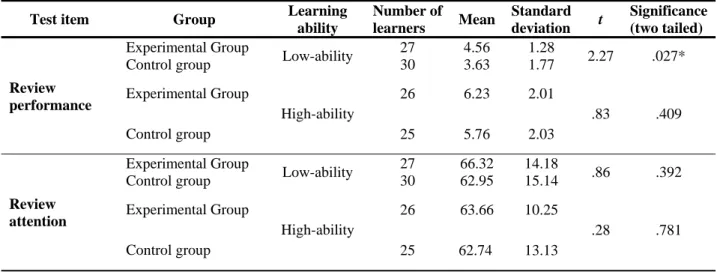
The post-test scores after performing the 20 minute - learning activities were applied to identify students whose post-test scores were higher or lower than the average score as high-ability learners and low-ability learners, respectively. Whether the review performance and attention of learners with low ability and high ability differed significantly was also determined. Table 3 shows the results, which reveal that the review performance of low-ability learners differed significantly between both groups (t = 2.27, p = .027 < .05), although that of high-ability learners did not (t = .83, p = .409 > .05). However, sustained attention did not differ significantly between both groups
for either low-ability learners (t = .86, p = .392 > .05) or high-ability learners (t = .28, p = .781 > .05). Restated, the low-ability learners in the experimental group had better review performance than the control group. This result verifies that the review performance of low-ability learners was significantly improved by the proposed ADRM. However, the high-ability learners did not differ significantly in review performance or review attention between the two groups.
Table 3: Independent samples t-test of the review performance and sustained attention of both group learners with low- and high-ability
Test item Group Learning
ability Number of learners Mean Standard deviation t Significance (two tailed) Review performance Experimental Group Low-ability 27 4.56 1.28 2.27 .027* Control group 30 3.63 1.77 Experimental Group High-ability 26 6.23 2.01 .83 .409 Control group 25 5.76 2.03 Review attention Experimental Group Low-ability 27 66.32 14.18 .86 .392 Control group 30 62.95 15.14 Experimental Group High-ability 26 63.66 10.25 .28 .781 Control group 25 62.74 13.13 * indicates p < 0.05
4.5 Analysis of difference in review performance and attention of learners with
different attention levels in experimental group
During the 20 minute learning activities, sustained attention values assessed by the MindSet earphone set were applied to identify students whose sustained attention values were higher or lower than the average score as high-attention learners and low-attention learners, respectively. To assess how attention levels of learners in the experimental group affected review performance and sustained attention, the difference in the review performance and sustained attention of learners with low- or high-attention levels in the experimental group was evaluated using an independent samples t-test. Table 4 presents the results, which show that the low- and high-attention learners of the experimental group differed significantly in the review performance (t = 2.07, p = .044 < .05) and review attention (t = 2.63, p = .011 < .05), indicating that high-attention learners in the experimental group who used the ADRM support had better review performance and review attention compared to the low-attention learners in the experimental group.
Table 4: Independent samples t-test of review performance and attention for the learners with low- and high-attention level in the experimental group
Test item Attention
group Number of learners Mean Standard deviation t Significance (two tailed) Review performance High attention level 25 5.92 2.040 2.07 .044* Low attention level 28 4.89 1.571 Review attention High attention level 25 69.49 11.214 2.63 .011* Low attention level 28 61.01 12.132 * indicates p < 0.05
4.6 Analysis of difference in review performance and attention of learners with
different learning abilities in experimental group
To assess how the learning ability of learners in the experimental group affects review performance and attention, the difference in the review performance and attention of learners with low- and high-ability in the experimental group was evaluated using the independent samples t-test. Table 5 shows the results, which indicate that the difference in review performance between the low- and high-ability learners in the experimental group was statistically significant (t = 3.61, p = .001 < .05) in favor of the high-ability learners. However, the difference in the review attention between the low- and high-ability learners of the experimental group was not statistically significant (t = -.78, p = .439 > .05). Therefore, the use of ADRM support significantly improved the review learning performance of high ability learners.
Table 5: Independent samples t-test of review performance and sustained attention of the learners with low- and high-ability in the experimental group
Test item Learning ability
group Number of learners Mean Standard deviation t Significance (two tailed)
Review performance High-ability 26 6.23 2.01 3.61 .001*
Low-ability 27 4.56 1.28
Sustained attention High-ability 26 63.66 10.25 -.78 .439
Low-ability 27 66.32 14.18
* indicates p < 0.05
5. Discussion
Although the digital pen technology is relatively new, many studies have confirmed its benefits in terms of improving language learning (Lai, Chao & Chen, 2007; Alvarez et al., 2013; Chen, Tan & Lo, 2016). Lam and Beale (1991) demonstrated that attention factor ratings were strongly correlated with reading comprehension scores for normally developing children. Briefly, solving problems associated with sustained attention may be the best way to improve learning performance. In that respect, the work presented in this paper has proposed an ADRM combined with paper-based reading with digital pen support to automatically provide an order in which lesson contents should be reviewed by monitoring periods of low attention of learners. Its potential in improving English-language learning performance was examined. Experimental results reveal that the experimental group with ADRM support exhibited significantly better review performance than the control group with autonomous review, proving that the ADRM improved review performance. Clearly, the proposed ADRM accurately identified the printed tags with low-attention periods of learners based on the EEG attention scores to enable them to effectively review their lessons with review outcomes that are better than would be achieved by self-review. This finding confirmed that diagnosing the lesson that the learners needed to review by using the EEG attention scores is an applicable approach. This is consistent with the results of Chen and Huang (2013), who found that sustained attention paid and learning performance were significantly –positively- correlated with each other. Therefore, reviewing the printed tags with low-attention level for individual learners provides benefit in terms of improving review performance. Restated, learning performance can be improved by reviewing the lesson contents with low-attention level.
A number of previous studies of field-dependence and independence (Liu & Reed, 1994; Paolucci, 1998) have yielded inconsistent results in various learning scenarios. The present study has found that using ADRM as a review mechanism for English-language learning improved the review performance of field-dependent learners though not of field-independent learners. One possible reason is that field-dependent learners are more easily affected by their environment than field-independent learners and field-dependent learners tend to rely on information that is provided by the outer world (Cunningham-Atkins et al., 2004; Witkin & Goodenough, 1977). However,
Chen, Tan, and Lo (2016) developed a digital pen and paper interaction platform (DPPIP) that comprised a student learning tier, a course management tier, and a teacher tutoring tier, in which digital pen technologies were integrated with printed textbooks and a Moodle course management system to support the repetitive reading strategy for improving English-language oral reading fluency. They confirmed that the DPPIP helped students with field-independent and field-dependent cognitive styles improve oral reading fluency. Many studies have found that field-independent students do better in L2 learning situations (Abraham, 1985; Tinajero & Páramo, 1997; Nozari, & Siamian, 2015). Abraham (1985) also indicated that field-independent students performed better than field-dependent students in learning English. Nozari and Siamian (2015) claimed that greater field-independence is associated with greater reading comprehension skills and greater academic achievement. Tinajero and Páramo (1997) showed that field-independent students consistently achieve higher academic results than field-dependent students. It is encouraged that the proposed ADRM provided good benefits to field-dependent learners with low attention to review English learning materials effectively.
Low-ability learners who use the ADRM to review lessons exhibited better review performance than those who reviewed lessons autonomously, indicating that low-ability learners gain the most from ADRM support for review when the paper-based reading with digital pen is used to study English, perhaps because it is difficult for low-ability learners to perform autonomous review. Thus, CALL systems, such as the ADRM, provide more help to low-ability learners of English than to others.
Some limitations of this work warrant consideration. First, the proposed ADRM was used for review purposes to support the use of paper-based learning with digital pen support by male students at an industrial vocational high school in Taiwan for studying English-language texts. Research results cannot be transferred readily tofemale students or to research subjects of different academic levels. Second, articles in the “Ivy League Analytical English” magazine were used as English learning materials for high school students. Whether the research results hold for learning materials related to different subjects needs to be examined further.
6. Conclusions and future work
In this work, an ADRM, which is based on brainwave detection, is designed to help learners review lessons that involve the reading of paper-based English texts with digital pen support. Analytical results reveal that providing lessons for review to which learners originally paid little attention improves review performance. The monitoring of learners for periods of low as they read English texts on paper feasibly improves review performance. Analytical results demonstrate that the ADRM provides a greater benefit to field-dependent as compared to field-independent learners in this respect. Low-ability learners with ADRM support for reading English texts exhibited a greater improvement in review performance than high-ability learners. Also, high-attention learners in the experimental group exhibited better review performance and attention than low-attention learners. High-ability learners who reviewed with either ADRM support or autonomously significantly outperformed low-ability learners in review performance. The research findings generate impacts on using an attention awareness system (Rapp, 2006) to successfully develop an effective learning diagnosis mechanism based on human EEG physiological signals in an autonomous and interactive learning environment that combines printed textbooks and a digital pen to support English-language classroom learning.
Additional studies are required. First, participants should include primary school students, junior high school students or college students to confirm whether learners with various levels of academic achievement attain different outcomes when they using ADRM support and that without in the learning of English texts. Second, future studies can use reading materials other than English-language reading texts from a textbook. Third, the proposed ADRM was developed based
on a small sample of male vocational high school students. A future study should enlarge the pool of participants and consider the balance of genders to get more reliable research results.
References
Abraham, R. G. (1985). Field independence-dependence and the teaching of grammar. TESOL
Quarterly, 19(4), 689–702.
Allen, N. (2010). A cover to cover solution: How open textbooks are the path to textbook affordability. Chicago, IL: The Student PIRGs. Retrieved from http://www.studentpirgs.org/sites/student/files/reports/A-Cover-To-Cover-Solution_4.pdf
Alvarez, C., Salavati, S., Nussbaum, M. & Milrad, M. (2013). Collboard: Fostering new media literacies in the classroom through collaborative problem solving supported by digital pens and interactive whiteboards. Computers & Education, 63, 368-379.
Bromley, K. (2010). Picture a world without pens, pencils, and paper: The unanticipated future of reading and writing. Journal of College Reading and Learning, 41(1), 97-108.
Chang, C. K. (2009). Augmenting Wiki system for collaborative EFL reading by digital pen annotations. International Symposium on Ubiquitous Virtual Reality ISUVR’09, pp. 43-46. Cunningham-Atkins, H., Powell, N., Moore, D., Hobbs, D., & Sharpe, S. (2004). The role of
cognitive style in educational computer conferencing. British Journal of Educational
Technology, 35(1), 69–80.
Chen, C. M., Wang, J. Y., & Yu, C. M. (2017). Assessing the attention levels of students by using a novel attention aware system based on brainwave signals. British Journal of Educational
Technology, 48(2), 348-369.
Chen, C. M. & Chung, C. J. (2008). Personalized mobile English vocabulary learning system based on Item Response Theory and learning memory cycle. Computers & Education, 51(2), 624-645. Chen, C. M. & Hsu, S. H. (2008). Personalized intelligent mobile learning system for supporting
effective English learning. Educational Technology & Society, 11, 153 – 180.
Chen, C. M. & Huang, S. H. (2014). Web-based reading annotation system with an attention-based self-regulated learning mechanism for promoting reading performance. British Journal of
Educational Technology, 45(5), 959-980.
Chen, C. M. & Sun, Y. C. (2012). Assessing the effects of different multimedia materials on emotions and learning performance for visual and verbal style learners. Computers & Education,
599(4), 1273–1285.
Chen, C. M., Tan, C. C. & Lo, B. J. (2016). Facilitating English-language learners’ oral reading fluency with digital pen technology. Interactive Learning Environments, 24(1), 96-118.
Chen, C. M. & Wang, H. P. (2011). Using emotion recognition technology to assess the effects of different multimedia materials on learning emotion and performance. Library & Information
Science Research, 33, 244–255.
Chen, C. M., Wang, J. Y. & Chen, Y. C. (2014). Facilitating English-language reading performance by a digital reading annotation system with self-regulated learning mechanisms. Educational
Chen, C. M. & Wu, C. H. (2015). Effects of different video lecture types on sustained attention, emotion, cognitive load and learning performance. Computers & Education, 80, 108-121.
Chen, L. H. (2010). Web-based learning programs: Use by learners with various cognitive styles.
Computers & Education, 54(4), 1028-1035.
Day, R. R. & Bamford, J. (1998). Extensive reading in the second language classroom: Cambridge Univ. Press.
Higgins, L. H. & Raskind, H. M. (2005). The compensatory effectiveness of the quicktionary reading pen II on the reading comprehension of students with learning disabilities. Journal of
Special Education Technology, 20(1), 29-38.
Hsu, C. C., Chen, H. C., Su, Y. N. & Huang, K. K. (2012). Developing a reading concentration monitoring system by applying an artificial bee colony algorithm to e-books in an intelligent classroom. Sensors, 12(10), 14158–14178.
Hu, P. J. -H., Hui, W., Clark, T. H. K. & Tam, K. Y., (2007). Technology-assisted learning and learning style: A longitudinal field experiment. IEEE Transactions on Systems, Man and
Cybernetics, Part A: Systems and Humans, 37(6), 1099–1112.
Huang, H. Y., Wang, Y. H. & Young, S. C. (2012). Exploring elementary school students’ perceptions of applying the talking pen into English learning. International Journal of Science
and Engineering, 2(3), 19-28.
Hui, W., Hu, P. J. -H., Clark, T. H. K., Tam, K. Y. & Milton, J. (2008). Technology-assisted learning: A longitudinal field study of knowledge category, learning effectiveness and satisfaction in language learning. Journal of Computer Assisted Learning, 24, 245–259.
Keller, J. M. & Suzuki, K. (2004). Learner motivation and e-learning design: A multi-nationally.
Journal of Educational Media, 29, 3, 229-239.
Lai, W. C., Chao, P. Y. & Chen, G. D. (2007). The interactive multimedia textbook: Using a digital pen to support learning for computer programming. In Advanced Learning Technologies of the
ICALT 2007 on Seventh IEEE International Conference, 742-746.
Levy, M. & Hubbard, P. (2005). Why call CALL “CALL”?. Computer Assisted Language Learning,
18, 3, 143-149.
Livescribe™ Smartpen User Guide (2010). Web available at https://www.livescribe.com/en-us/media/pdf/support/SmartpenUserManual.pdf
Lam, C. M. & Beale, I. L. (1991). Relations among sustained attention, reading performance, and teachers’ ratings of behavior problems. Remedial and Special Education, 12, 40–47.
Liu, M., & Reed, M.W. (1994). The relationship between the learning strategies and learning styles in a hypermedia environment. Computers in Human Behavior, 10, 419–434.
Mampadi, F., Chen, S. Y. H., Ghinea, G. & Chen, M. P. (2011), Design of adaptive hypermedia learning systems: A cognitive style approach. Computers & Education, 56(4), 1003-1011
Mangen, A., Walgermo, B. R. & Brønnick, K. (2013). Reading linear texts on paper versus computer screen: Effects on reading comprehension, International Journal of Educational
Research, 58, 61-68.
cognitive style and understanding of English text reading and academic success. Mater
Sociomed, 27(1), 39-41.
Nakayama, M., Yamamoto, H., & Santiago, R. (2007). The impact of learner characteristics on learning performance in hybrid courses among Japanese students. The Electronic Journal of
e-Learning, 5(3), 195-206.
NeuroSky. (2015). NeuroSky MindWave, Retrieved January 15, 2016, from http://press.neurosky.com/MindWave.html
Oviatt, S., Arthur, A. & Cohen, J. (2006). Quiet interfaces that help students think. The 19th annual
ACM symposium on User interface software and technology, 191-200.
Pikulski, J. J. & Chard, D. J. (2005). Fluency: Bridge between decoding and reading comprehension.
The Reading Teacher, 58, 510-519.
Paolucci, R. (1998). The effects of cognitive style and knowledge structure on performance using a hypermedia learning system. Journal of Educational Multimedia and Hypermedia, 7, 123–150. Piper, A. M., Weibel, N. & Hollan, J. D. (2011). Write-N-Speak: Authoring multimodal
digital-paper materials for speech-language therapy. ACM Transactions on Accessible
Computing (TACCESS), 4(1), 1-20.
Raca, M. & Dillenbourg, P. (2013). System for assessing classroom attention. The 3rd International
Learning Analytics & Knowledge Conference.
Rebolledo-Mendez, G., Dunwell, I., Martínez-Mirón, E., Vargas-Cerdán, M., de Freitas, S., Liarokapis, F. et al (2009). Assessing NeuroSky’s usability to detect attention levels in an assessment exercise. In: HCI, New Trends, 149–158.
Rapp, D. N. (2006). The value of attention aware systems in educational settings. Computers in
Human Behavior, 22, 603–614.
Sabet, M. K. & Mohammadi, S. (2013). The eelationship between field independence/dependence styles and reading comprehension abilities of EFL readers. Theory and Practice in Language
Studies, 3(11), 2141-2150.
Salkind, N. J. (2010). Encyclopedia of research design. Thousand Oaks, Calif: SAGE Publications. Steinmayr, R., Ziegler, M. & Trauble, B. (2010). Do intelligence and sustained attention interact in
predicting academic achievement? Learning and Individual Differences, 20(1), 14-18.
Tinajero, C. & Páramo, M.F. (1997). Field dependence-independence and academic achievement: A re-examination of their relationship. British Journal of Educational Psychology, 67, 199-212. Vandenhoek, T. (2013). Screen reading habits among university students. Information and
Communication Technology,19(2), 37-47.
Wastlund, E., Reinikka, H., Norlander, T. & Archer, T. (2005). Effects of VDT and paper presentation on consumption and production of information: Psychological and physiological factors. Computers in Human Behavior, 21, 377–394.
Witkin, H. A., Moore, C. A., Goodenough, D. R. & Cox, P. W. (1977). Field dependent and field independent cognitive styles and their educational implications. Review of Educational
Woody, W. D., Daniel, D. B. & Baker, C. A. (2010). E-books or textbooks: Students prefer textbooks. Computers & Education, 55(3), 945-948.
Zhang, D., Zhou, L., Briggs, R. O. & Nunamaker, J. F. (2006). Instructional video in e-learning: Assessing the impact of interactive video on learning effectiveness. Information & Management,
104年度專題研究計畫成果彙整表
計畫主持人:陳志銘 計畫編號:104-2511-S-004-003-MY2 計畫名稱:基於腦波發展之注意力感知系統及其支援提升網路同步與非同步學習注意力與成效之應用 研究 成果項目 量化 單位 質化 (說明:各成果項目請附佐證資料或細 項說明,如期刊名稱、年份、卷期、起 訖頁數、證號...等) 國 內 學術性論文 期刊論文 0 篇 研討會論文 0 專書 0 本 專書論文 0 章 技術報告 0 篇 其他 0 篇 智慧財產權 及成果 專利權 發明專利 申請中 0 件 已獲得 0 新型/設計專利 0 商標權 0 營業秘密 0 積體電路電路布局權 0 著作權 0 品種權 0 其他 0 技術移轉 件數 0 件 收入 0 千元 國 外 學術性論文 期刊論文 1 篇Chih-Ming Chen and Jung-Ying Wang, and Mi Lin “Enhancement of English Learning Performance by Using an Attention-based Diagnosing and Review Mechanism in Paper-based Learning Context with Digital-Pen Support”, Universal Access in the Information Society, 2017.
(Accepted) [SSCI收錄]
研討會論文 1
Ya-Ling, Huang, Chih-Ming Chen, Mi Lin “An English Diagnosis and Review System based on Brainwave Attention Recognition Technology for the Paper-based Learning
Context with Digital-Pen Support,” The 6th International Conference on Learning Technologies and Learning Environments, 2017. (accepted)
專書 0 本 專書論文 0 章 技術報告 1 篇 陳志銘,基於腦波發展之注意力感知系 統及其支援提升網路同步與非同步學習 注意力與成效之應用研究(2/2),科技部 結案報告,計畫編號MOST 104-2511-S-004 -003 -MY2 。 其他 0 篇 智慧財產權 及成果 專利權 發明專利 申請中 0 件 已獲得 0 新型/設計專利 0 商標權 0 營業秘密 0 積體電路電路布局權 0 著作權 0 品種權 0 其他 0 技術移轉 件數 0 件 收入 0 千元 參 與 計 畫 人 力 本國籍 大專生 0 人次 碩士生 5 計畫有5位碩士生參與,其中4個學生的 研究獲得科技部補助出席國際研討會發 表論文。 博士生 1 計畫有1位博士生參與,協助博士生養成 更好的學術研究及論文發表能力。 博士後研究員 0 專任助理 0 非本國籍 大專生 0 碩士生 0 博士生 0 博士後研究員 0 專任助理 0 其他成果 (無法以量化表達之成果如辦理學術活動 、獲得獎項、重要國際合作、研究成果國 際影響力及其他協助產業技術發展之具體 效益事項等,請以文字敘述填列。) 成果項目 量化 名稱或內容性質簡述 科 教 國 合 測驗工具(含質性與量性) 0 課程/模組 0 電腦及網路系統或工具 0
司 計 畫 加 填 項 目 教材 0 舉辦之活動/競賽 0 研討會/工作坊 0 電子報、網站 0 計畫成果推廣之參與(閱聽)人數 0