Spatial dichotomy of quasiparticle dynamics in underdoped thin-film YBa
2Cu
3O
7−␦superconductors
C. W. Luo,1 C. C. Hsieh,1Y.-J. Chen,1 P. T. Shih,1M. H. Chen,1K. H. Wu,1J. Y. Juang,1,3J.-Y. Lin,2T. M. Uen,1 and Y. S. Gou3
1Department of Electrophysics, National Chiao Tung University, Hsinchu, Taiwan, Republic of China 2Institute of Physics, National Chiao Tung University, Hsinchu, Taiwan, Republic of China 3Department of Physics, National Taiwan Normal University, Taipei, Taiwan, Republic of China
共Received 18 September 2006; revised manuscript received 28 April 2006; published 22 November 2006兲 By the spatial-temporal-resolved femtosecond spectroscopy on well-textured共110兲- and 共100兲-YBCO thin films, two distinctly temperature-dependent characteristics of quasiparticle relaxation in the nodal and antin-odal directions are clearly identified. One temperature dependence associated with a high-energy gap has been observed along the ab diagonal for the whole hole-doping region and along the b axis except near optimal doping, while the other temperature dependence related to the opening of the superconducting gap appears along b axis regardless of the hole concentration. This spatial dichotomy between the nodal and antinodal quasiparticle dynamics and the evolution of gap symmetry with hole doping are discussed for enlightenment on the nature of the phase diagram of hole-doped cuprates. These strongly suggest that the two characteristics may have different physical origins and compete with each other.
DOI:10.1103/PhysRevB.74.184525 PACS number共s兲: 74.25.Gz, 74.78.Bz, 74.81.Bd, 78.47.⫹p
I. INTRODUCTION
Elucidation of the phase diagram of high-Tc
superconduc-tivity has been one of the most demanding intellectual chal-lenges. Usually different theoretical models of high-Tc
super-conductivity propose different phase diagrams.1,2Therefore, experimental investigation of the phase diagram is the key to distinguishing the appropriate theory of high-Tc
supercon-ductivity, which is considered by many to remain elusive. Very recently, angle-resolved photoemission spectroscopy 共ARPES兲 indicated a dichotomy between nodal and antin-odal excitations.3–5However, the spatial anisotropy of quasi-particle共QP兲 relaxation dynamics and how the evolution of the gap symmetry with doping have remained to be revealed. The time-domain spectroscopy,6–10which probes the dynam-ics of the electronic states intimate to superconductivity, has proven to be a powerful tool to provide new insights into the fundamental nature of both the pseudogap and the supercon-ducting gap.7–10 Suggested by the previous time-resolved spectroscopy experiments,11–19the amplitude and picosecond scale relaxation time of the transient reflectivity change 共⌬R/R兲 observed below Tc are directly associated with the
opening of the superconducting gap. For example, Kabanov
et al.17 have calculated the temperature dependence of the photoexcited QP density and concluded that⌬R/R is deter-mined by two gaps with different energy scales and tempera-ture dependences. Recently, it has been demonstrated that the polarized time-resolved spectroscopy on well-oriented samples provides prominent information about the symmetry of the superconducting gap9 and the QP relaxation along various crystalline orientations.10 Following these ideas, the experiments carried out here, directly reveals the spatial di-chotomy between the nodal共ab diagonal兲 and antinodal 共a or
b axis兲 QP relaxation dynamics as well as the respective
evolution of the gap symmetry with hole doped YBCO. The analysis does not involve any specific theoretical model and consequently the results are model independent.
II. EXPERIMENTAL SETUP AND RESULTS
The共001兲-, 共100兲-, and 共110兲-oriented YBCO films used in this study were prepared by pulsed laser deposition. The characterization and manipulation of the oxygen content on the films were discussed in detail elsewhere.20–23Briefly, the orientation alignment of each set of films is better than 97%. The orientation- and time-resolved femtosecond spectros-copy was carried out by the pump-probe scheme with 20 fs pulses at a central wavelength of 800 nm, as described in Ref.9.
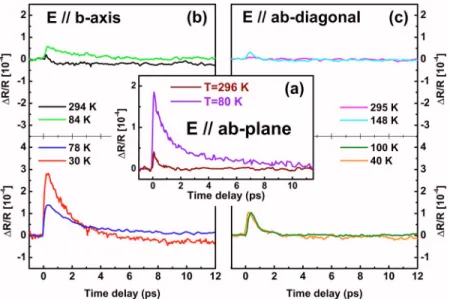
Figure 1共a兲 shows the typical ⌬R/R curves on the ab plane of 共001兲 YBCO films with Tc= 90.4 K in the normal
and superconducting states, respectively. The significant dis-tinction between these two states could be easily interpreted by the following context, which is generally accepted as the protocols in the pump-probe experiments. Namely, the pump pulse excites the electron-hole pairs that relax to the states in the vicinity of the Fermi energy 共EF兲 by various scattering mechanisms共e.g., electron-electron or electron-phonon scat-tering兲. This process occurs in the normal state 共T⬎Tc兲
within a subpicosecond time scale.17,24The presence of a gap near EFleads to the carrier accumulation in the quasiparticle states above the gap in the superconducting state 共T⬍Tc兲.
This, in turn, gives rise to a transient change in reflectivity 共⌬R/R兲 to be detected by a second laser 共probe兲 pulse as a function of the time delay共t兲 between the pump and probe pulses. The amplitude and characteristic relaxation time of the measured ⌬R/R thus give important information of the number of the accumulated QPs and the amplitude of the gap.9,11,12,17 Since the ab plane results from 共001兲 YBCO films are the averaged result of those from the a axis, b axis, and ab diagonal, the spatial resolution of the QP dynamics is largely missing. In order to separate the ultrafast responses along the b axis and the ab diagonal, we have used 共100兲-and 共110兲-YBCO films, respectively, with polarized pump and probe beams for the measurements. The typical results
are shown in Figs.1共b兲and1共c兲. There are quite significant distinctions, similar to Fig.1共a兲, between the normal and the superconducting states共not only in the magnitude, but also in the characteristics of the relaxation兲 for the ⌬R/R along the b axis near optimal doping共Tc= 89.7 K兲. For the ab
di-agonal, however, the magnitude of⌬R/R starts to change at
T⬃150 K 共well above Tc= 90.2 K兲 and reaches a constant
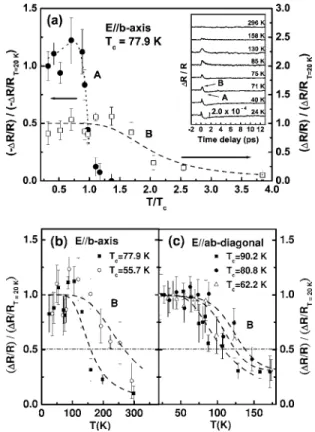
value below T⬃100 K, and the characteristics of relaxation are almost independent of T for the whole temperature range where the transient behavior occurs. Especially, ⌬R/R is quantitatively illustrated in Fig. 2 where the normalized ⌬R/R as a function of the reduced temperature 共T/Tc兲 is
shown.
Near optimal doping, the data along the b axis关Fig.2共b兲兴 are dramatically different from those along the ab diagonal 关Fig. 2共c兲兴. The anomaly just near Tc, called “A-type
tem-perature dependence,” is suggestive of the opening of the superconducting gap that is absent along the ab diagonal. On the other hand, the amplitude of⌬R/R measured along the
ab diagonal is persistent to temperatures well above Tc关Fig. 2共c兲兴 and this behavior, called “B-type temperature
depen-dence,” may be governed by another order parameter, e.g., high-energy gap. Unlike the two cases just mentioned above, the data of the ab plane of共001兲 YBCO 关Fig.2共a兲兴 cannot be described by either the behavior of A or B temperature de-pendence alone. Nonetheless, it can be explained by the combination of both types of the temperature dependence. The present study, thus for the first time, distinguishes two kinds of QP relaxation dynamics in CuO2planes of YBCO to display their respective orientation characteristics in real space.
As the YBCO sample becomes further underdoped 关Tc
= 77.9 K and 55.7 K, this was achieved on one single (100)
YBCO film by the method described in Ref.23兴, ⌬R/R
ap-pears to have two distinct components along the b axis关Fig.
3共a兲for Tc= 77.9 K, i.e., hole concentration p = 0.118兴.25The
positive component of⌬R/R starts to appear at temperature well above Tc共T⬃160 K兲 and exhibits the B-type
tempera-ture dependence, which could be associated with the high-energy gap. As T⬍Tc共e.g., T=75 K兲, the negative
compo-nent of⌬R/R appears and its characteristics are close to the
A-type temperature dependence which is expected from the
opening of the superconducting gap.27This indicates that two types of the temperature dependence have been both ob-served at this underdoping level for E / / b axis. In the same 共100兲 YBCO film with further underdoping 共Tc= 55.7 K , p
= 0.091兲, the similar behavior has also been observed along the b axis except that the amplitude of ⌬R/R diminishes more rapidly with increasing temperature, e.g., Fig. 3共b兲. Furthermore,⌬R/R along the ab diagonal for several under-doped cases关Tc= 80.8 K 共p=0.123兲 and 62.2 K 共p=0.098兲兴
can be studied through one single (110) YBCO film. The nor-malized⌬R/R increases gradually with decreasing tempera-ture for all doping levels 关Fig. 3共c兲兴. Along this crystalline orientation, only the B-type temperature dependence of ⌬R/R was observed either below or above Tc关cf. Fig.1共c兲兴.
III. DISCUSSION
In order to quantify the systematic variation in the tem-perature dependence of the B-type temtem-perature dependence FIG. 1. 共Color online兲 The temperature de-pendence of⌬R/R 共a兲 in the ab plane measured in a共001兲 YBCO film with Tc= 90.4 K;共b兲 along the b axis measured in a共100兲 YBCO film with
Tc= 89.7 K; and 共c兲 along the ab diagonal mea-sured in a共110兲 YBCO film with Tc= 90.2 K.
FIG. 2. The normalized ⌬R/R as a function of the reduced temperature共a兲 in the ab plane of 共001兲 YBCO films; 共b兲 along the
b axis of共100兲 YBCO films; and 共c兲 along the ab diagonal of 共110兲
YBCO films. The dotted and dashed lines are guides to the eye emphasizing the A- and B-type temperature dependences, respec-tively. The solid line in共a兲 shows the sum of the contribution from
A and B temperature dependences.
as a function of hole doping along various orientations, the characteristic temperature 共T*兲 where ⌬R/R drops to one half of its maximum value at low temperatures关the dashed-dotted line in Figs.3共b兲and3共c兲兴 is shown as a function of p in Fig.4 together with Tc. Here, we should emphasize that
the qualitative p dependence of T* would remain the same, although different criteria for its determination共e.g., T*is the temperature where the⌬R/R drops to one third of its low temperature value兲 would give a different absolute value of
T*. A closer look at the data displayed in Fig. 4, in fact, depicts the evolution of Tcand T* as a function of p along
various crystalline orientations in YBCO. Along the b axis, the systematic variation of T*with p is similar to the one 共crosses in Fig.4兲 obtained in 共001兲 YBCO films8and quali-tatively follows the doping dependence of the pseudogap temperature T* extracted by other experimental techniques. Besides, the superconductivity related to Tcwas also clearly
observed along the b axis and presented by the open circles in Fig. 4. On the other hand, along the ab diagonal, the component 共A-type temperature dependence兲 related to Tc
completely disappears and only the other component共B-type temperature dependence兲 T* was observed at various hole concentrations共p兲. With decreasing p, T* along the ab diag-onal first increases and then decreases below p = 0.12. Mean-while, T*along the b axis keeps increasing with decreasing p 共dashed line in Fig.4兲.
These results unambiguously indicate the spatial di-chotomy of QP dynamics for the node 共ab diagonal兲 and antinode共b axis兲, that are consistent with the observation in cuprate superconductors by ARPES.4,5 In Ref. 4, the differ-ence of the low energy excitations between nodal and antin-odal QP, which is possibly associated with QPs scattering across the nearly parallel segments of the Fermi surface near antinodes, was clearly observed in underdoped 共La2−xSrx兲CuO4. Also, the dichotomy between the sharp nodal QP and broad antinodal states has been revealed in lightly doped Ca2−xNaxCuO2Cl2.5 Moreover, by the non-spatial-resolved QP dynamics measurements, Gedik et al.28 have claimed that the abrupt change in the sign of ⌬R and the kinetics of QP decay in Bi2Sr2Ca1−yDyyCu2O8+␦ crystal is due to the dichotomy between coherent nodal QP excita-tions and incoherent antinodal excitaexcita-tions.
This dichotomy scenario is depicted from a perspective of gaps. The values of gaps共⌬Tc,⌬T*兲 along the node and an-tinode can be simply estimated similar to the BCS result, ⌬⬀kBTc, with Tcand T*in Fig.4. For optimal-doped YBCO,
⌬Tcappears along the b axis while it is absent along the ab
FIG. 3. 共a兲 The normalized ⌬R/R as a function of the reduced temperature along the b axis for Tc= 77.9 K in a共100兲 YBCO film, which is the same one as in Fig.1共b兲and subsequently treated by the encapsulated bulk annealing method to manipulate the oxygen content共Ref. 23兲. Note: the solid and open symbols are, respec-tively, the negative and positive components in the inset which is the raw data of temperature-dependent⌬R/R. 共b兲 The normalized ⌬R/R as a function of temperature along the b axis for various oxygen deficiencies were measured in a共100兲 YBCO film. 共c兲 The normalized⌬R/R as a function of temperature along the ab diago-nal for various oxygen deficiencies were measured in a 共110兲 YBCO film. Dotted and dashed lines are guides to the eye empha-sizing the A- and B-type temperature dependences, respectively.
FIG. 4. 共Color online兲 The critical temperature Tcand T*as a
function of hole concentration共p兲. The crosses and open diamonds are taken from the femtosecond time-resolved data reported by Demsar et al.共Ref.8兲. The dashed line represents T*⬀1/p, where p is the hole concentration. The dotted line is drawn by the empirical relation Tc共p兲=Tc,max关1-82.6共p-0.16兲2兴 with Tc,max= 91 K共Ref.26兲. The solid line is a guide to the eye emphasizing the behavior of T*
along the ab diagonal. The points in near optimal doping were measured in several different samples, showing the generic nature of the observed behaviors. The insets illustrate the proposed sce-nario for the doping-dependent spatial symmetry of the⌬Tc 共thin-blue lines兲 and the ⌬T*共thick-red lines兲.
diagonal. In contrast, ⌬T* emerges along the ab diagonal while is absent along the b axis. The spatial symmetry of both gaps is illustrated schematically in the right inset of Fig.
4.29 The d
x2−y2-symmetry for ⌬Tc has been demonstrated in an earlier femtosecond spectroscopy report.9 Owing to the coexistence of⌬Tcand⌬T* along the b axis for Tc= 77.9 K, the nodes of⌬T* along the b axis disappear; meanwhile, the magnitude of ⌬T* along the ab diagonal slightly increases with decreasing p as shown schematically in the middle inset of Fig.4. Although the observed symmetry evolution of⌬T* seems unique, this picture is consistent with the symmetry evolution of the magnetic excitation in a recent inelastic neu-tron scattering experiment.30,31 In Ref. 31, the high-energy magnetic excitation peaks, which is possibly associated with ⌬T*, appear along 共1,1兲 and 共1,1¯兲 directions in the two-dimensional 共2D兲 reciprocal space. For the further under-doped case, the symmetry of ⌬T* almost becomes
dx2−y2-symmetry as shown schematically in the left inset of Fig.4. In this case, the symmetry of⌬T* appear to shift from
dxy to dx2−y2, though remains d-wave symmetry, with de-creasing hole doping since ⌬T* along the ab diagonal is shrinking while its value grows along the b axis. Under this approach, the dichotomy effect may be enhanced in the chain ordering phase, i.e., underdoped YBa2Cu3O6.5in the ortho II structure which has been studied by Segre et al.32 and pro-vides a different perspective for the decay rate of⌬R/R as the inelastic scattering rate of QP as well as the thermaliza-tion rate decreases with the development of the pseudogap.
The suppression of superconductivity in the underdoped regime seems to be due to the development of a competing order parameter⌬T* along the b axis which peaks along the
ab diagonal at optimal doping. This further suggests that the
intrinsic origins of the superconducting gap and the high-energy gap are different. Due to the ARPES evidence that a pseudogap state with a nodal-antinodal dichotomous charac-ter exists in the colossal magnetoresistive bilayer manganite La1.2Sr1.8Mn2O7 which is markedly different from a super-conductor, Mannella et al.33 cast doubt on the assumption that the pseudogap state in the copper oxides and the
nodal-antinodal dichotomy are hallmarks of the superconductivity state. It means that the pseudogap state may be the universal characteristic in strongly correlated electron systems and strongly suggests that the pseudogap state may be irrelative to the superconducting state. Our paper thus provides one possible scenario of identifying the symmetry of the highly debated ⌬T* and reveals how it evolves with hole-doping directly via the raw data of the time-resolved spectroscopy measurements. Certainly, there are some alternative routes open to approach this issue, such as the anisotropy of the probe transition matrix elements.19Dvorsek et al.19reported that the probe polarization dependence and the sign change of the transient signal below Tcis qualitatively described by
the anisotropy of the probe transition matrix elements in Y124, and may not give the direct information regarding the anisotropy of the superconducting gap structure. Therefore, the validity of attributing the obtained experimental results to the symmetry change of high-energy gap ⌬T* should be judged by further experiments and more developed theories.
IV. CONCLUSIONS
In summary, the spatial-temporal-resolved femtosecond spectroscopy unambiguously reveals the spatial dichotomy between nodal and antinodal QP relaxation dynamics. With the precise control of the oxygen content共i.e., the hole con-centration兲 over one single film, we are able to track down the evolution of the respective spatial dichotomy with dop-ing. From the possibly doping-dependent symmetry evolu-tion of the two gaps, the important differences in the sym-metry and origin between the high-energy gap 共⌬T*兲 and superconducting gap共⌬Tc兲 in YBCO are recognized.
ACKNOWLEDGMENTS
This work was supported by the National Science Council of Taiwan, Republic of China under Grants Nos. NSC94-2112-M009-005, 2112-M-009-037-MY3, NSC95-2112-M-009-011-MY3, and by the Grant MOE ATU Pro-gram at NCTU.
1P. W. Anderson, P. A. Lee, M. Randeria, T. M. Rice, N. Trivedi,
and F. C. Zhang, J. Phys.: Condens. Matter 16, R755共2004兲.
2C. M. Varma, Phys. Rev. B 55, 14554 共1997兲; C. M. Varma,
cond-mat/0312385共unpublished兲.
3T. Yoshida, X. J. Zhou, T. Sasagawa, W. L. Yang, P. V. Bogdanov,
A. Lanzara, Z. Hussain, T. Mizokawa, A. Fujimori, H. Eisaki, Z.-X. Shen, T. Kakeshita, and S. Uchida, Phys. Rev. Lett. 91, 027001共2003兲.
4X. J. Zhou, T. Yoshida, D.-H. Lee, W. L. Yang, V. Brouet, F.
Zhou, W. X. Ti, J. W. Xiong, Z. X. Zhao, T. Sasagawa, T. Kakeshita, H. Eisaki, S. Uchida, A. Fujimori, Z. Hussain, and Z.-X. Shen, Phys. Rev. Lett. 92, 187001共2004兲.
5K. M. Shen, F. Ronning, D. H. Lu, F. Baumberger, N. J. C. Ingle,
W. S. Lee, W. Meevasana, Y. Kohsaka, M. Azuma, M. Takano, H. Takagi, and Z.-X. Shen, Science 307, 901共2005兲.
6C. W. Luo, K. Reimann, M. Woerner, T. Elsaesser, R. Hey, and K.
H. Ploog, Phys. Rev. Lett. 92, 047402共2004兲.
7R. A. Kaindl, M. Woerner, T. Elsaesser, D. C. Smith, J. F. Ryan,
G. A. Farnan, M. P. McCurry, and D. G. Walmsley, Science
287, 470共2000兲.
8J. Demsar, B. Podobnik, V. V. Kabanov, T. Wolf, and D.
Mi-hailovic, Phys. Rev. Lett. 82, 4918共1999兲.
9C. W. Luo, M. H. Chen, S. P. Chen, K. H. Wu, J. Y. Juang, J.-Y.
Lin, T. M. Uen, and Y. S. Gou, Phys. Rev. B 68, 220508共R兲 共2003兲.
10C. W. Luo, P. T. Shih, Y.-J. Chen, M. H. Chen, K. H. Wu, J. Y.
Juang, J.-Y. Lin, T. M. Uen, and Y. S. Gou, Phys. Rev. B 72, 092506共2005兲.
11S. G. Han, Z. V. Vardeny, K. S. Wong, O. G. Symko, and G.
Koren, Phys. Rev. Lett. 65, 2708共1990兲.
12J. M. Chwalek, C. Uher, J. F. Whitaker, G. A. Mourou, J.
Ago-stinelli, and M. Lelental, Appl. Phys. Lett. 57, 1696共1990兲.
13G. L. Eesley, J. Heremans, M. S. Meyer, G. L. Doll, and S. H.
Liou, Phys. Rev. Lett. 65, 3445共1990兲.
14D. H. Reitze, A. M. Weiner, A. Inam, and S. Etemad, Phys. Rev.
B 46, R14309共1992兲.
15T. Gong, L. X. Zheng, W. Xiong, W. Kula, Y. Kostoulas, Roman
Sobolewski, and P. M. Fauchet, Phys. Rev. B 47, 14495共1993兲.
16Y. Liu, J. F. Whitaker, C. Uher, J.-L. Peng, Z. Y. Li, and R. L.
Greene, Appl. Phys. Lett. 63, 979共1993兲.
17V. V. Kabanov, J. Demsar, B. Podobnik, and D. Mihailovic, Phys.
Rev. B 59, 1497共1999兲.
18J. Demsar, B. Podobnik, J. E. Evetts, G. A. Wagner, and D.
Mi-hailovic, Europhys. Lett. 45共3兲, 381 共1999兲.
19D. Dvorsek, V. V. Kabanov, J. Demsar, S. M. Kazakov, J.
Karpin-ski, and D. Mihailovic, Phys. Rev. B 66, 020510共R兲 共2002兲.
20C. W. Luo, M. H. Chen, S. J. Liu, K. H. Wu, J. Y. Juang, T. M.
Uen, J.-Y. Lin, J.-M. Chen, and Y. S. Gou, J. Appl. Phys. 94, 3648共2003兲.
21S. J. Liu, J. Y. Juang, K. H. Wu, T. M. Uen, Y. S. Gou, J. M.
Chen, and J.-Y. Lin, J. Appl. Phys. 93, 2834共2003兲.
22C. W. Luo, M. H. Chen, C. C. Chiu, K. H. Wu, J. Y. Juang, T. M.
Uen, J.-Y. Lin, and Y. S. Gou, J. Low Temp. Phys. 131, 545 共2003兲.
23K. H. Wu, M. C. Hsieh, S. P. Chen, S. C. Chao, J. Y. Juang, T. M.
Uen, Y. S. Gou, T. Y. Tseng, C. M. Fu, J. M. Chen, and R. G. Liu, Jpn. J. Appl. Phys., Part 1 37, 4346共1998兲.This method is capable of controlling the oxygen content of the YBCO films precisely and reversibly. It is worth emphasizing that, by using this method, all the measurements with various oxygen contents can be performed on one single YBCO film to avoid any possible complication from individual film structures and to make sure
that any properties changes should be due to the variation in the oxygen content.
24C. J. Stevens, D. Smith, C. Chen, J. F. Ryan, B. Podobnik, D.
Mihailovic, G. A. Wagner, and J. E. Evetts, Phys. Rev. Lett. 78, 2212共1997兲.
25The hole concentration of each sample was estimated by T
c = Tc,max关1-82.6共p-0.16兲2兴 with Tc,max= 91 K Ref.26.
26J. L. Tallon, C. Bernhard, H. Shaked, R. L. Hitterman, and J. D.
Jorgensen, Phys. Rev. B 51, R12911共1995兲.
27The change of⌬R/R sign is due to the shifting of Fermi surface
as a function of the hole concentration.
28N. Gedik, M. Langner, J. Orenstein, S. Ono, Y. Abe, and Y. Ando,
Phys. Rev. Lett. 95, 117005共2005兲.
29However, ARPES Ref.30shows that the symmetry of pseudogap
remains as a dx2−y2 regardless of the hole concentration. The difference between our results and ARPES may simply arise from the fact that ARPES gives rather direct information about the QP spectrum while the pump-probe spectroscopy provides relatively indirect spectrum convolved with itself as well as rel-evant inelastic scattering processes such as phonons, magnons, etc.
30A. Damascelli, Z. Hussain, and Z. X. Shen, Rev. Mod. Phys. 75,
473共2003兲.
31S. M. Hayden, H. A. Mook, Pengcheng Dai, T. G. Perring, and F.
Doğan, Nature共London兲 429, 531 共2004兲.
32G. P. Segre, N. Gedik, J. Orenstein, D. A. Bonn, R. Liang, and W.
N. Hardy, Phys. Rev. Lett. 88, 137001共2002兲.
33N. Mannella, W. L. Yang, X. J. Zhou, H. Zheng, J. F. Mitchell, J.
Zaanen, T. P. Devereaux, N. Nagaosa, Z. Hussain, and Z.-X. Shen, Nature共London兲 438, 474 共2005兲.