i
國立交通大學
英語教學研究所碩士論文
A Master Thesis Presented to Institute of TESOL, National Chiao Tung University In Partial Fulfillment of the Requirementsfor the Degree of Master of Arts
以社會文化理論探討台灣地區大學生在線上同儕評改中的社會互動模式
Exploring Taiwanese College Students’ Social Scaffolding Interaction
in On-Line L2 Peer Revision through a Sociocultural Approach
研究生:王信雲 Graduate: Hsin-Yun Wang
指導教授:張靜芬博士 Advisor: Dr. Ching-Fen Chang
中華民國 九十七 年 七 月 July, 2008
i 論文名稱:以社會文化理論探討台灣地區大學生在線上同儕評改中的社會互動模式 校所組別:交通大學英語教學所 畢業時間:九十六學年度第二學期 指導教授:張靜芬博士 研究生:王信雲 中文摘要 過去數十年,同儕評改於第二語言寫作領域中已大量被討論及應用。值得注意的 是,相關文獻多僅探討同儕評改之影響與效果。然而,極少研究將同儕評改視為一社會 建構過程,因而忽略探討其社會文化層面。
本研究透過 Vygotsky (1978) 的社會文化理論 (sociocultural theory) 檢視在為期一 學期大學英語寫作課中的三次同儕評改活動。研究目的在於探索線上同儕評改中所產生 的互動型態、參與者由語言認知調節階段 (cognitive stages of regulation) 中所呈現的社會 關係、以及參與者所接受之協助及其認知調節階段之關係。研究資料收集自參與者進行 同儕互評的即時通訊 (IM) 紀錄。研究者修改 de Guerrero 及 Villamil (1994) 和 Wood、 Bruner 及 Ross (1976) 所提出之基模,以將參與者的同儕互動種類、認知調節階段、社 會關係、及鷹架式協助予以編碼及分類。 研究結果顯示,參與者在透過電腦為中介的同儕評改中,除了仍保有五種面對面溝 通的互動模式,更創造出一種透過網路尋求協助的同儕互動形式。在此互動模式中,參 與者藉由網路虛擬專家(如:線上字典、翻譯軟體)的協助,得以在認知階段上獲得成 長及進行線上即時的評改討論。再者,參與者之間的社會互動關係不僅呈現出個人認知 調節階段上的差異,更反映出同儕間的角色認知與其變動。另外,參與者所接受之協助 及其認知階段間的高相關性,更凸顯出同儕可感知彼此最大發展區 (Zone of Proximal Development; ZPD) 並給予適當協助之能力。最後,本研究也呈現出網路溝通所帶來的 社會文化影響、同步溝通的 E 化語言、以及不具鷹架式協助作用的同儕互動。依據研
ii
究結果,研究者也指出本研究之缺失,及提出針對英語教學上的應用與未來相關研究之 建議。
iii Abstract
Peer revision as an aid to process writing in the second language (L2) classroom has been amply discussed and employed in the past decades. As a complicated practice
encompassing both cognitive and social aspects of language, yet it has mostly been explored for such cognitive issues as impact and effectiveness. Little literature has looked into its sociocultural dimension, in which peer revising behaviors, as one kind of language use and learning, are considered to be a socially constructed process of collaboration, interaction, and communication (Barnes, 1976; Cazden, 1988; Vygotsky, 1978).
The study adopted Vygotsky’s sociocultural theory as the theoretical framework to examine three writing cycles of L2 peer revision sessions in an 18-week, college-level English writing course. A total of 20 pairs of the students were recruited as the target
participants due to their rich and representative instant message (IM) protocols. To probe the nature of electronic peer interaction, the study aimed to explore three sociocultural
dimensions of peer revision via an on-line medium – the types of interaction between
members of a dyad, the kinds of social relationships from the participants’ cognitive stages of regulation, and the relationships between the participants’ cognitive status and their received scaffolding. Data were collected from instant conversation logs. The data were analyzed based on five coding schemes – four were adapted not only from those of de Guerrero and Villamil (1994) for types of episodes, types of on-task episodes, cognitive stages of
regulation and social relationships, and the other one was adopted from Wood, Bruner, and Ross (1976) for scaffolding functions.
The results showed that the peers, in addition to engaging in the five traditional revision episodes, would also create a new CMC facilitated interaction type, in which on-line sources might serve as virtual experts scaffolding to activate deeper communication and to move the
iv
peers forward to higher levels of cognitive stages. Moreover, the changing social relationships between the reviewers and reviewees revealed not only the peers’
symmetrical/asymmetrical cognitive status but also their dynamic role awareness and shift. Furthermore, the high correlation between the peers’ regulatory stages and the scaffolding received displayed the peers’ sensitiveness to each other’s ZPD. In addition to the three abovementioned findings, the social impacts of synchronous CMC, the electronic variety of language, and the non-scaffolding assistance were also found. Finally, pedagogical
v
ACKNOWLEDGEMENTS
A journey would be easier when you travel together. This thesis is the result of three years of work whereby I have been supported by many people.
It is difficult to overstate my gratitude to my dearest advisor, Dr. Ching-Fen Chang. With great enthusiasm, inspiration and efforts to explain things clearly and simply, she led me to know the sociocultural thoery and helped to make it understandable and fun for me.
Throughout my thesis writing period, she provided not only excellent teaching and sound advice but also encouragement, patience, and even good company. I would have been lost without her.
My gratitude also goes to my committee members: Dr. Shu-Chen Huang from National Chiao Tung University and Dr. Chin-chi Chao from National Chengchi University. Without their careful supervision and invaluable comments, this thesis cannot be completed.
I am also tempted to individually thank all my dear classmates: Hsiun, Joyce, Igent, Wendy, and Kelly. Thank you for having joined me in the discovery of what life is about and how to make the best of it. I am also thankful to Peter for his understanding and help. He always brings me sunshine when my skies are gray.
I cannot finish without saying how grateful I am with my family. Xiao-Ye, my
14-year-old dog, has accompanied me from junior high to graduate school and has already become one of my dearest family members. Particular thanks, of course, to my little brother, who always shows me great bravery and curiosity toward life. Lastly, and most importantly, I wish to thank my parents. They have always supported and encouraged me to do my best in all matters of life. Without them, I would not have chances to understand the beauty of my life. I LOVE THEM. To them I dedicate this thesis.
TABLE OF CONTENTS
中文摘要... i Abstract ... iii ACKNOWLEDGEMENTS ... v LIST OF TABLES ... ix LIST OF FIGURES ... ix CHAPTER 1 INTRODUCTION ... 1Background and Rationale ... 1
Purposes of the Study ... 3
Organization of the Thesis ... 4
CHAPTER 2 LITERATURE REVIEW... 5
Peer Revision ... 5
Studies on Efficacy of Peer Revision ... 8
Limitations of Traditional Face-to-Face Peer Revision ... 10
Sociocultural Theory ... 12
Zone of Proximal Development (ZPD) ... 13
Internalization ... 15
Scaffolding ... 17
Peer Scaffolding ... 19
Regulation ... 21
CMC Overview ... 23
Perspectives on Comparison between CMC and Face-to-Face (FTF) Communication ... 24 Linguistic Perspective on CMC ... 27 Cross-cultural Perspectives on CMC ... 30 Collaborative Perspectives on CMC ... 31 Conclusion ... 32 CHAPTER 3 METHOD ... 34 Setting ... 34
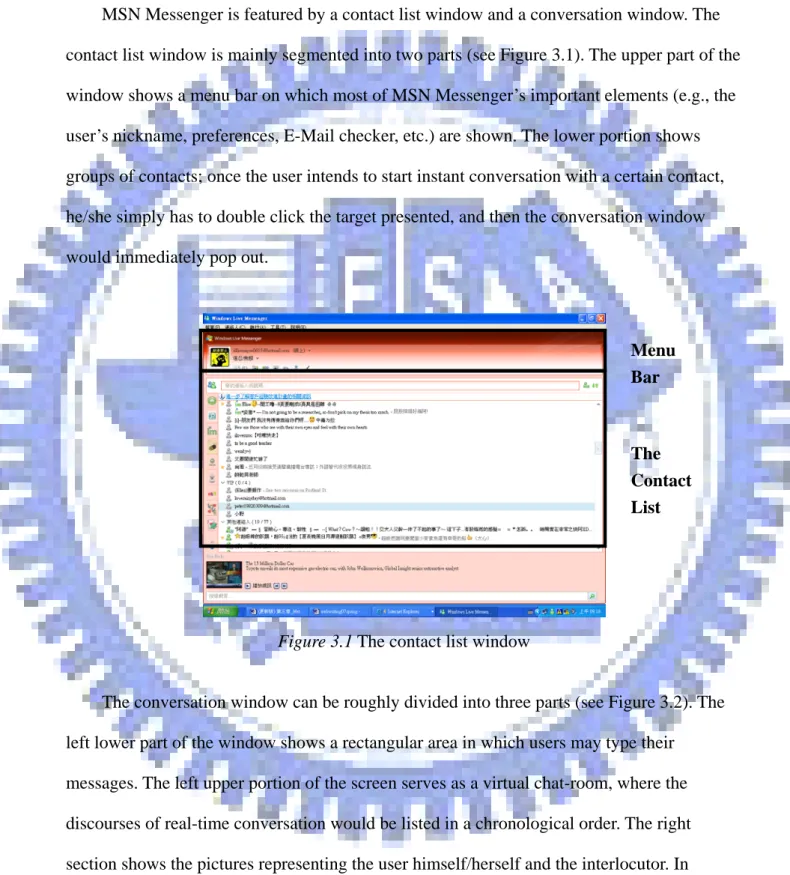
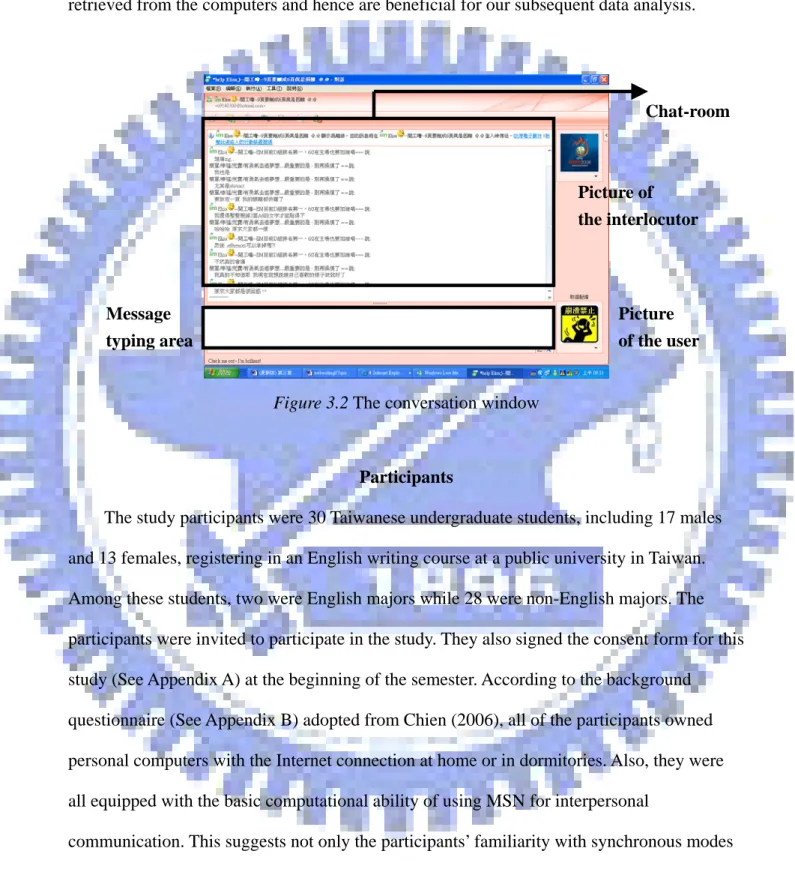
On-line Reviewing Environment – MSN Messenger ... 34
Participants ... 36
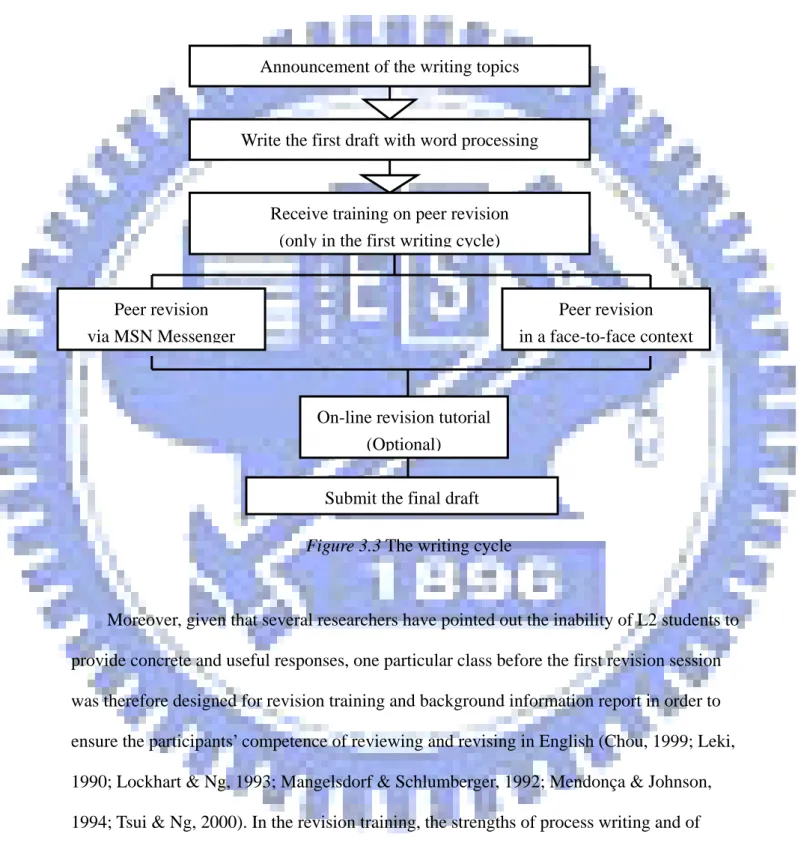
Procedure ... 37
Data Collection and Analysis ... 40
Coding Schemes... 40
Quantitative and Qualitative Analysis ... 47
CHAPTER 4 RESULTS ... 48
Research Question 1 ... 48
Peer interactions along the continuum: Weaker vs. stronger “Reader/Write Interactive Revisions” ... 50
Attitude awareness and shift: Readers’ self-assumed responsibility vs. writers’ great sense of dependence ... 53
“Reader/Writer/Expert Interactive Revisions”: Experts as the stimuli to the reader/writer interactions ... 56
Research Question 2 ... 58
Authoritative vs. collaborative: Two subtypes of OTR/SER recapitulating ZPD ... 62
Symmetrical social relationships: SER/SER, OTR/OTR, and OBR/OBR ... 65
Research Question 3 ... 70
“Marking Critical Features” vs. “Demonstration”: The distinction between asymmetrical OTR/SER and OBR/SER interactions ... 71
Intrinsic vs. extrinsic: Two scaffolding types featuring OTR/SER interactions ... 74
CHAPTER 5 DISCUSSION AND CONCLUSION... 80
Discussion ... 80
Synchronous CMC as social milieu ... 80
Types of on-line interaction in the synchronous CMC context ... 81
Social impacts of synchronous CMC ... 82
Regulation and patterns of interaction during on-line peer revision ... 85
Mediated scaffolding during on-line peer revision ... 87
Non-scaffolding assistance ... 91
Conclusion ... 93
Limitations of the study ... 95
Pedagogical implications ... 96
Suggestions for future research ... 98
REFERENCES ... 99
APPENDIXES ... 112
Appendix A Consent Form... 112
Appendix B Background Questionnaire ... 113
Appendix D Types of Episodes ... 117
Appendix E Types of On-Task Episodes ... 118
Appendix F Cognitive Stages of Regulation ... 119
Appendix G Social Relationships ... 121
LIST OF TABLES
Table 3.1 Types of Episodes ... 41
Table 3.2 Types of On-Task Episodes ... 43
Table 3.3 Cognitive Stages of Regulation ... 44
Table 3.4 Social Relationships ... 44
Table 3.5 Scaffolding Functions ... 47
Table 4.1 Observed Frequencies and Percentages for Types of Episodes ... 48
Table 4.2 Observed Frequencies and Percentages for Types of On-Task Episodes ... 49
Table 4.3 Observed Frequencies and Percentages for Regulatory Stage Categorizations ... 59
Table 4.4 Observed Frequencies and Percentages for Regulatory Stage Categorizations according to Reader and Writer Roles ... 59
Table 4.5 Observed Frequencies and Percentages for Symmetrical and Asymmetrical Relationships in On-Task Episodes ... 60
Table 4.6 Observed Frequencies and Percentages for Symmetrical and Asymmetrical Relationships in Reader/Writer and Reader/Writer/Expert Interactive Revisions .... 61
Table 4.7 Observed Frequencies and Percentages for Types of OTR/SER interactions ... 62
Table 4.8 Observed Frequencies and Percentages for Scaffoldied Assistance according to Social Relationships in Interactive Episodes ... 70
Table 4.9 Observed Frequencies and Percentages for Scaffolding Categorizations according to Authoritative/Collaborative Interventions (OTR/SER) ... 75
LIST OF FIGURES
Figure 3.1 The contact list window ... 35Figure 3.2 The conversation window ... 36
CHAPTER 1 INTRODUCTION
Background and Rationale
Peer revision as an aid to writing in the second language (L2) classroom has been amply discussed in the past decades. Supported by the process writing approach (e.g., Emig, 1971), collaborative learning theory (e.g., Bruffee, 1984), and sociocultural theory (e.g., Vygotsky, 1978), L2 writing instructors and researchers have no longer regarded teachers as the only authority and sources of feedback for students’ writing. Instead, L2 writers now are encouraged to write via communication: they write and revise based on peers’ critical
comments received during reviewing sessions. Moreover, proponents have explicitly pointed out the advantages of peer revision in offering more informative responses than teachers’ comments; providing students with a larger audience than simply one teacher; enhancing students’ motivation with a more supported atmosphere; helping students learn more about writing and revision by having to read each other’s drafts critically (Chaudron, 1984). In this sense, peer revising activities, in which learners exchange oral or written comments in order to mutually refine or revise writing skills or ideas, have gained increasing popularity in a process-oriented writing classroom.
However, among those scholars exploring peer revision in a cognitive fashion are few indicating the need to look into its sociocultural dimensions. For Vygotsky (1978), it is the individuals’ milieu that all cognitive functions firstly originate from; only by constantly receiving and appropriating scaffolding provided by experts can novices gradually internalize linguistic knowledge and finally complete language learning tasks without any external assistance.
1988) have thus contended that language use and learning are socially constructed in nature. Revision, in this sense, is supposed to be perceived as actions encompassing both cognitive and social aspects of language learning. Moreover, it is also believed that the internalization from the inter- to intra-mental plane is a process of qualitative change and reconstruction in which novices and experts collaborate in creating a mutual activity frame, called zone of proximal development (ZPD) (Aljaafreh & Lantolf, 1994; Vygotsky, 1978). Based on the notions above, scholars have started to take a sociocultural stance on the issue of L2 revision. For example, some researchers have dedicated themselves to the analysis of different
scaffolding actions existing in expert-novice interaction (e.g., Bruner, 1978; Villamil & de Guerrero, 1996; Wood, et al., 1976). Other researchers have investigated the mechanism of effective, successful expert-novice scaffolding (e.g., Aljaafreh & Lantolf, 1994; Lantolf & Aljaafreh, 1996; Nassaji & Swain, 2000; Rogoff & Wertsch, 1984).
While recent research has shed light on the sociocultural dimensions of expert-novice interaction, some researchers have sought to broaden their scope to investigate interaction beyond experts and novices, that is, the interaction between peers. By observing scaffolding behaviors imbedded in peer interaction, Wells (1998) suggested that the concept of
scaffolding should not be limited to the less skillful or knowledgeable, but should be expanded to all participants. Other scholars (e.g., Swain & Laplin, 1998; Villamil & de Guerrero, 1998) also argued that the assistance provided between non-experts may result in positive learning as well.
Advocates of L2 revision, in this case, began to shift their attention to the potentially positive influences of peer scaffolding on L2 learners’ writing outcomes. For instance, Villamil and de Guerrero (1998) pioneered to explore the impact of peer scaffolding on L2 writing revision. By comparing students’ first and final drafts, they found a considerable percentage of modifications (74 percents) in students’ final versions resulting from peers’ scaffolding discourses, or more precisely, peers’ mutual critical comments. Also, they noted
learners’ autonomous behaviors of revising their own compositions alone after the revision sessions, considering such a self-regulated behavior to be an evidence of learning
achievements and internalization after series of peer interaction.
Among the abovementioned studies are even fewer that explore peer interaction via on-line media. With the emergence of sophisticated technology that breaks the confinement of time and space, peer interaction via on-line medium has inevitably become one of the crucial channels for L2 teaching and learning. Several researchers have indeed pointed out the merits of on-line peer scaffolding for L2 acquisition. For example, Cononelos and Oliva (1993) noted that peer scaffolding embedded in on-line interaction supported an ongoing conversation to develop among many participants and hence created a learner-oriented environment where students may co-create texts which were authentically interesting. This learner-centered interaction, according to Kern (1995) and Warschauer (1996), is the key factor that helps enhance students’ motivation for participation. However, it should be noted that such studies as the above have merely delineated the effects of electronic peer interaction; they, nevertheless, have not looked into the core of on-line peer interaction, that is, the
elements constituting on-line peer interaction, the relationships among the elements, and their influences on individuals’ language learning.
Purposes of the Study
To gain a deeper understanding of electronic peer interaction, this study employed Vygotskian sociocultural theory as the theoretical framework to probe the nature of peer revision via on-line medium. Specifically, the study is threefold. First, it explored the types of interaction occurring between members of a dyad engaged in on-line L2 peer revision.
Second, it examined the kinds of social relationships resulting from learners’ cognitive stages of regulation. Third, it investigated the relationships between L2 learners’ cognitive status and their received scaffolding.
Based on the rationales above, this present study attempted to address the following three research questions:
(1) What types of interaction occur between members of a dyad engaged in on-line L2 peer revision?
(2) What kinds of social relationships emerged from the participants’ cognitive stages of regulation?
(3) What is the relationship between the participants’ regulatory levels and their received scaffolding?
Organization of the Thesis
In addition to Chapter 1, this thesis consists of four chapters. In Chapter 2, I review the literature of peer revision, sociocultural theory, and computer-mediated communication, all of which bring out the necessity to investigate on-line peer revision from a sociocultural
perspective. In Chapter 3, I put forward the detailed study method, inclusive of the
information of the setting, participants, procedure, and data collection as well as analysis. In Chapter 4, I present the results in response to the three research questions. Chapter 5, as the final chapter, concludes the thesis by displaying the discussion and the summary of the study findings, the limitations of the study, pedagogical implications of this study, and suggestion for future research.
CHAPTER 2 LITERATURE REVIEW
This present study aims to use Vygotskian sociocultural theory to examine L2 on-line peer revision activities. In order to acquire a general picture of the study, the literature review addresses three main themes: peer revision, sociocultural theory, and computer-mediated communication.
Peer Revision
In the field of second language (L2) writing, evaluation of students’ final writing products was always the primary task and prerogative of teachers in the past (Rothschild & Klingenberg, 1990). The unique benefits learners themselves could provide each other, in this case, were seriously deprived. Over the last decades, however, such a failure of recognizing the potential of learners as writing teachers or tutors has given rise to a process-oriented writing approach (Liu & Hansen, 2002). Hairston (1982) outlined the process writing approach as follows:
It [Peer revision] focuses on writing as a process, with instruction aimed at intervening in that process; it teaches strategies for intervention and discovery; it emphasizes rhetorical principles of audience, purpose, and occasion, with evaluation based on how well a given piece meets its audience’s needs; it treats the activities of prewriting, writing, and revision as intertwining, recursive processes; and it is holistic, involving nonrational, intuitive faculties as well as reason. (p. 86)
As Hairston stated, the process writing approach does not follow the old-fashioned reductionist view that writing is merely an accumulation of pre-formulated ideas. Rather, it characterizes writing as a “dynamic, nonlinear, and recursive” (Liu & Hansen, 2002, p. 3) procedure containing steps of pre-writing, drafting, revising, and post-writing. Also, its
feature on the paradigm shift from writing as a silent and solitary activity to writing as a collaborative process has underscored not only the importance of social exchanges which has long been neglected in traditional writing instruction but also the necessity of establishing “a supportive environment in which students are acknowledged as writers, encouraged to take risks, and engaged in creating meaning” (Zamel, 1987, p. 697).
Revision, one of the steps at which student writers revise their own drafts according to the responses received from instructors, peers, or even themselves, has been identified as the most crucial factor in achieving high quality in their final product (Bereiter & Scardamalia, 1987; Elbow, 1981; Sommers, 1980; Zamel, 1983). Peer revision, in particular, is a frequently used technique that allows for “the intervention of other students as audience and
collaborators” (Villamil & de Guerrero, 1996, p. 52). Such a collaborative manner, featured by mutual respect among peers for free meaning negotiation and seeing texts through each other’s eyes, has been indicated to be more productive than authoritative and prescriptive attitudes (de Guerrero & Villamil, 1994; Lockhart & Ng, 1995; Mangelsdorf & Schlumberger, 1992; McGroarty & Zhu, 1997; Nelson & Murphy, 1993).
Proponents of peer revision in the first language (L1) settings have argued that while teachers tend to appropriate students’ writings in the way of “confusing the student’s purpose in writing and the instructor’s purpose in commenting” (Sommers, 1982, p. 149) and of “usurping the students’ rights to their writings” (Brannon & Knoblauch, 1982, p. 157), peers may play a more immediate and socially appropriate role in offering compelling impetus for student writers to revise (Clifford, 1981). Moreover, active and spontaneous interactions among peers have also been observed to force novices to try out, to work with unrehearsed language, and to be involved in “exploratory talk” (Barnes, 1976, p. 200). Such an
exploratory talk, termed “discourse as catalyst” by Cazden (1988), indeed helps students not only reconceptualize their ideas but also establish didactic relationships with their audiences. Additionally, these cognitive and social benefits are also claimed to support “forms of
learning which take place less readily in full class” (Barnes, 1976, p. 200).
The process writing approach and its highlights on peer revision have influenced L2 educators and researchers who regard L1 and L2 writing identical or, at least, very similar. In particular, Edelsky (1982) stressed that the process writing approach could both be operated in L1 and L2 writing classrooms, due to the “general process universals” (p. 227) shared among languages. Arapoff (1969) contended that foreign students should be encouraged to write via such a discovery and transformation process, especially when it had been proven to be beneficial for native speakers. In view of these general beliefs in the parallelism between L1 and L2 writing processes, there is no surprise that the merits of peer revision have been widely acknowledged in L2 instructional settings (Kroll, 1991; Leki, 1990; Mangelsdorf, 1989; Mangelsdorf & Schumerger, 1992; Mittan, 1989; Zamel, 1985).
For example, in terms of cognitive advantages, Mangelsdorf (1989) advocated that peer negotiation in revision sessions benefited L2 students in integrating language skills of four dimensions (listening, speaking, reading, and writing) and thus helped develop their general L2 competence. Also, she indicated that the attempts of students to test out and examine their hypotheses about L2 in authentic revision settings were critical for successful second
language acquisition (SLA). Following Mangelsdorf, Liu and Hansen (2002) asserted that peer revision facilitated “reading-writing connections” (p. 3) since it united “content, linguistic, and rhetorical schemata through multiple exposures to a text” (p. 3).
In addition to cognitive benefits, peer revision has also been proven to bear various affective advantages. Mittan (1989) observed that since student writers received authentic comments from readers, they gained a clearer understanding of their current performance and a higher motivation to continue their writings. Moreover, as Leki (1990) indicated, through observing others’ weaknesses and strengths in peer response activities, students would stand a better chance to develop self-confidence and reduce apprehension. Liu and Hansen (2002) further pointed out the potential of peer revision to establish collegial tie among students and
its capability of offering a more comfortable and secure learning environment for those who may easily feel isolated and misunderstood.
Studies on Efficacy of Peer Revision
In spite of the abovementioned benefits, writing instructors and researchers still show reservations about the efficacy of peer revision. This uncertainty mainly springs from the concern that students may not be sophisticated and objective enough to judge writings, nor do they have enough linguistic knowledge to detect and revise weaknesses in need of revision (Jacobs, 1989). In order to examine the effectiveness of peer revision, Nelson and Murphy (1992b) explored whether L2 language learners and instructors could detect similar areas needed to be revised in drafts. The results revealed that half of the L2 students and instructors indeed identified the same areas for revision.
Moreover, findings of other studies (e. g., Berg, 1999; Hedgcock & Lefkowitz, 1992; Lockhart & Ng, 1995; Mendonca & Johnson, 1994; Stanley, 1992; Villamil & de Guerrero, 1998) have also revealed that students, especially those who have received training on peer review, actually are able to give specific comments or to point out problems with content and rhetoric. In fact, peers may even provide better content feedback than teachers if they are paired up according to their individual specialties (Belcher, 1990). Furthermore, peer response has also been found to stimulate and instigate further revision after the end of reviewing activities, indicating that students would keep considering and expanding peer comments when revising their drafts on their own (Paulus, 1999; Villamil & de Guerrero, 1998).
Another way to examine the efficacy of peer revision is to observe if students truly implement peers’ suggestion in their final drafts. To this question, however, there is no definite answer. Some researchers (e.g., Connor & Asenavage, 1994; Zhang, 1995) found only a small percentage of peer comments incorporated in final writing. For instance, by
comparing the changes eight L2 students made in their compositions and the actual feedback they received, Connor and Asenavage (1994) found only 5% of the total revisions resulted from peer comments, while 35% resulted from teachers’ comments and 60% from others (e.g., tutors) or themselves. Similarly, Zhang (1995) also found that a high percentage (76 out of 81) of college freshmen chose teacher feedback when being asked to state their preference among teacher, peer, and self-feedback. Based on the findings of these researches, teacher comments were seemingly more effective, or at least more favorable, than peer comments.
Such inconsistency between multiple benefits of peer feedback reported and the surprisingly low ratio of being utilized and favored by students has called for further study. Several researchers (e.g., Jacobs, Curtis, Braine, & Huang, 1998; Nelson & Carson, 1998) have claimed that this conflict might result from misused or inappropriate research methods. For example, Jacobs et al. (1998) argued that studies that forced students to make decisions between peer and teacher comments were misguided, since peer and teacher comments should not be mutually exclusive. Their questionnaire survey of 121 L2 undergraduates showed that 93 percent of the students preferred to have peer feedback as one type of feedback for their writing, suggesting students’ general positive attitudes toward both peer and teacher comments when they are not forced to make a choice.
Moreover, Nelson and Carson (1998) contended that the expected effectiveness of peer revision would be seriously cut down due to learners’ selective manner when acquiring too many options for obtaining feedback. Liu and Sadler (2003) also indicated that language learners indeed had the capability to tell that “peer feedback seemed to be more focused on specific concerns, whereas teacher feedback was more global” (p. 195). In addition to those critiques on improper research designs, other scholars (e.g., Min, 2005, 2006; Stanley, 1992; Zhu, 1995) proposed another pedagogical factor that might also influence the effectiveness of peer revision, that is, whether students receive appropriate peer revision training.
stamp advice” (p. 119) when reviewing peers’ writing. This phenomenon is believed to result from students’ inability to provide concrete and useful feedback (Chou, 1999; Leki, 1990; Lockhart & Ng, 1993; Mangelsdorf & Schlumberger, 1992; Mendonca & Johnson, 1994; Tsui & Ng, 2000). Being aware of this dilemma, researchers have conducted series of studies investigating if training on peer evaluation could enhance the quality of feedback. For instance, Stanley (1992) offered lengthy training for L2 freshmen to familiarize with the genre of their peers’ writing and effective communicative techniques students might like to use in revision. Conversational analysis on peer feedback revealed the results of more
responses and more types of responses in the coached groups. Moreover, subsequent analyses on the drafts also displayed a higher percentage of peer response incorporated in writing in the coached groups than in the uncoached groups. Following Stanley, Zhu (1995) further found that peer responders who received response training on reviewing tactics and on identifying possible writing troublesources indeed could provide feedback of higher quality and quantity. Moreover, Min (2005, 2006) indicated that proper peer revision training could help inexperienced student reviewers not only produce more comments concerning global issues, but also sense the incongruity between writers’ intended meaning and the actual meaning perceived by readers. Based on these studies above, it is suggested that appropriate revision training may improve the effectiveness of peer revision in the way of enhancing the quality and quantity of peer response and of raising the ratio of incorporation in subsequent revision.
Limitations of Traditional Face-to-Face Peer Revision
Although peer revision has been theoretically supported by the process writing approach and proved to be one of the most crucial components in achieving writing quality, the
traditional face-to-face (FTF) peer revision was still criticized in two aspects: its ignorance of the sociocultural context (Silva, 1990) and its potentially tense FTF medium (Liu, 2000; Liu
& Sadler, 2003; Nelson & Murphy, 1992a).
First, since language use and learning is considered to be a socially constructed process of collaboration, interaction, and communication (Barnes, 1976; Cazden, 1988; Vygotsky, 1978), peer revision-- the process in which peers construct meaning within the context of social interaction-- should be perceived as the action combining both cognitive and social aspects of language. Pitifully, the traditional line of study is solely focused on such cognitive issues as impact and effectiveness of peer revision, but neglects sociocultural dimensions of peer revision. In an effort to fill the gap, some researchers (e.g., DiPardo & Freedman, 1988) have asserted that Vygotskian sociocultural theory is indeed the one that provides an ideal access to examine the relationship between humans’ talk and writing as well as to gain a better understanding of how social interactions contribute to writing development. Also, according to Villamil and de Guerrero (1996), the Vygotskian concept of “zone of proximal development” (ZPD) is exactly the key component that recognizes the significance of peer assistance in learning and thus applicable to explain collaborative activities occurring during peer revision. Based on such convictions, it is suggested that Vygotskian sociocultural theory could be a proper theoretical framework to analyze sociocultural interactions in on-line peer revision.
Second, traditional FTF peer revision has been criticized to make some students, especially those from Asia, feel uncomfortable due to its hostile atmosphere (Liu & Sadler, 2003; Nelson & Murphy, 1992a) and L2 students’ insecurity toward classroom participation in the target culture (Liu, 2000). According to Nelson and Murphy (1992a), students might present sarcastic, overly critical, and unkind attitudes when reviewing the writing of their peer classmates. Such negative attitudes would consequently cause a sense of discomfort, uneasiness, and even defensiveness among peers (Amores, 1997). Moreover, the lack or immaturity of L2 formal schemata might also lead L2 readers to inappropriately or even mistakenly review the content or the structure of texts and finally cause the doubt of writers
about the validity of peer comments (Liu & Sadler, 2003).
For some researchers (e.g., Liu & Hansen, 2002; Liu & Sadler, 2003), such conflicts and imperfection existing in the FTF medium could be drastically resolved if students’ drafts are revised via computer-mediated communication (CMC), due to its potential to enhance opportunities and motivation for authentic interaction and negotiation (Kern, 1995); reduce anxiety and improve self-confidence as well as linguistic proficiency (Beauvois & Eledge, 1996; Fanderclai, 1995); boost students’ confidence in writing and improve the quantity of either teacher or peer feedback (Braine, 1997); help generate an overall greater number of comments, a higher percentage of revision oriented comments, and an overall greater number of revisions (Liu & Sadler, 2003).
This present study explores the sociocultural dimension of electronic L2 peer revision in the hope of expanding traditional cognitive views and grasping the essence of on-line peer interaction and collaboration. As two key ingredients in this research, the literature of sociocultural theory and computer mediated communication (CMC) will be reviewed in the following sections.
Sociocultural Theory
Sociocultural theory, which originated from the work of L. S. Vygotsky, is very different from theories currently in favor in the mainstream SLA literature. That is, it combines the social interaction with human cognition, considering individuals’ cognitive thoughts and behaviors as the products of continuous social interaction, instead of the results of biological maturation. More specifically, within sociocultural theory, the concept of mediation plays a crucial role in the construct of activity and generation of higher mental processes.
As argued by Vygotsky (1987), while humans do not act directly on the physical world, they would rely on technical and psychological tools to change the world and mediate their relationships with others. These tools, whether physical or symbolic, are created and
modified by human cultures over time and are made available to succeeding generations, and therefore can “organize the properties of the natural, or biologically specified, brain into a higher, or culturally shaped, mind through the integration of symbolic artifacts into thinking” (Lantolf, 2000, p. 2). In other words, sociocultural theory opposes the orthodox, substantialist view that dichotomizes the mental and the social. It holds that human forms of mental
activities arise in social interactions where other members of our culture and the experiences we construct with culture-specific artifacts would determine the ways we regulate our mental processes. In this sense, the intentional and voluntary control on our higher mental
functioning (e.g., memory, attention, planning, rational thoughts, and problem solving) is mediated through historically-shaped artifacts, among which language – the “tool of tools” (Vygotsky, cited in Wells, 1994, p. 46) – is the basis of human intellect and thus is of the greatest significance (Vygotsky, 1978).
Given that any person’s experience with the external world is mediated, Lantolf (1994) suggested that the zone of proximal development (ZPD) is the prerequisite for successful mediation. Aljaafreh and Lantolf (1994) continued to emphasize the value of zone of proximal development (ZPD) as a framework that “brings all of the pieces of the learning setting together – the teacher, the learner, their social and cultural history, their goals and motives, as well as the resources available to them, including those that are dialogically constructed together” (p. 468). On account of its close affiliation to successful mediation and its potency of uniting all educational phenomena, the concept of ZPD, as well as its three tightly related ideas – internalization, scaffolding, and regulation, will be discussed in detail in the following sections.
Zone of Proximal Development (ZPD)
As acknowledged, all higher mental processes of individuals are mediated through technical and psychological artifacts, which organize the properties of the biological brain
into the higher, or culturally shaped, mind. In other words, all cognitive functions firstly originate from the society and later come to be internalized within the individual. This transfer from the social plane to the mental plane is clearly illustrated by Vygotsky (1978) as follows:
Every function in the child’s cultural development appears twice: first, on the social level, and later, on the individual level; first, between people (interpsychological), and then inside the child (intrapsychological). This applies equally to voluntary attention, to logical memory, and to the formation of concepts. All the higher functions originate as actual relations between human individuals. (p. 57)
Interpreting Vygotsky’s words, Aljaafreh and Lantolf (1994) regarded this transition from inter- to intra-mental functioning as a process of qualitative change and reconstruction in which novices and experts may collaborate in constructing a mutual activity frame. This activity frame displaying the differences between what a person can do alone and what he or she can do with assistance is ZPD.
ZPD, defined as the distance between learners’ actual developmental level and the level of potential development, is the site where social forms of mediation develop (Vygotsky, 1978). Specifically, the actual developmental level represents a result of certain already completed developmental cycles, whereas the level of potential development is the level at which individuals are able to complete tasks with assistance from, or in collaboration with, other more experienced experts (Aljaafreh & Lantolf, 1994).Thus, knowing an individual’s unassisted performance is just knowing this person’s history of development; only by knowing what individuals can achieve with assistance could we understand their potential development in the future. To emphasize again, ZPD is not a specific task embedded in interpersonal activities, but is a higher cognitive process emerging as a result of interactions (Lantolf & Appel, 1994).
Nevertheless, it should be noted that, for Vygotsky, the potential level of development is worth more attention than the actual one, since this level is more indicative of mental growth than actual development (Aljaafreh & Lantolf, 1994). That is, as a window into the future mental growth of individuals, the potential level of development defines the development “prospectively” (Vygotsky, 1978, p. 87), while the actual level only defines the development “retrospectively” (Vygotsky, 1978, p. 87). Hence, the proximal developmental range of an individual cannot be fully understood unless his/her upper boundary of the development is determined. From this perspective, the same IQ score of two individuals can only at best indicate their current actual developmental level, but cannot detect the potential
developmental level they might achieve; one might have a high IQ but a small ZPD, while another has a low IQ but a large ZPD (Dunn & Lantolf, 1998). In reference to language learning, a novice language learner who is able to receive and respond to the assistance of an expert is assumed to have a larger ZPD and hence might reach a better and higher
developmental position in a more rapid rate than another who fails to do so. In this sense, a learner who can appropriate and react to the materially- or socially-based help is supposed to stand at a more advanced position in second language learning.
Internalization
While learners move forward in their ZPD, they are believed to gradually get rid of external assistance and are able to solve problems with increasing autonomy and
independence. Central to this transition from inter- to intra-mental functioning in the ZPD is the process of internalization, or more properly for sociocultural theory, “appropriation” (Newman, Griffin, & Cole, 1989, p. 64). According to Lantolf (2000), the concept of
internalization is defined as “the process in which the novice learner moves from carrying out concrete actions with the assistance of objects and of other individuals to carrying out actions mentally without any external help is defined as internalization” (p. 14). In this view,
internalization can be perceived as the essential element for learners to reach a higher state of mental functioning in the ZPD (Kozulin, 1990). With regard to the language learning, the notion of internalization refers to the process in which language learners intend to “construct a mental representation of what was at one point physically present (acoustic or visual) in external form” (Lantolf, 2003, p. 351).
For Vygotsky (1987), imitation is fundamental to internalization. Noticeably, in
opposition to the imitation in traditional behaviorist paradigms, the imitation occurring in the process of internalization is not simply a repetition (Lantolf, 2003). Rather, such imitation “transforms the process itself and changes its structure and functions” (Vygotsky, 1981, p. 163) and hence implies agency and intentionality. More specifically, while waves breaking on a beach and the earth orbiting around the Sun represent the repetition with no agency and intentionality (Thorne, cited in Lantolf, 2003), imitation in Vygotsky’s sociocultural theory should be regarded as a qualitative transformation and understood as a goal-directed act through which human mental capacity could be formed in the transition from the external to the internal (Lantolf, 2003).
Aljaafreh and Lantolf (1994) further determined five general stages of internalization as learners move from reliance on the external assistance toward reliance on the self. These five levels are characterized in terms of three parameters: intervention, noticing an error, and correcting an error. That is, while learners at the first level represents those who are not able to notice and correct an error even with intervention from material artifacts or capable
individuals, learners at the fifth level are those who consistently and automatically use correct target forms in all contexts. Through these five stages, learners are believed to imitate and appropriate the external assistance provided and gradually show increasing autonomy in detecting and correcting their own mistakes without outside feedback.
However, this movement that a novice language learner internalizes either materially- or socially-based assistance in order to reach his/her full potential in the ZPD can never be
considered as a uniform and linear development (Lantolf & Aljaafreah, 1996). Instead, this higher mental development is dynamic and irregular. Lantolf and Aljaafreah (1996) employed the microgenetic method to observe how this “wave-like curves” (Van der Veer & Valsiner, 1991, p. 309) are manifested on the parts of the linguistic features and the regulation negotiated between novices and experts. Results showed that L2 learners would not necessarily improve their performance or increase the needs for implicit help after each episode of interaction; they would sometimes backslide to previous stages at which more explicit cues would be needed for task completion.
Such “regressive phenomena” (Kozulin, 1990, p. 211) not only reject the traditional cognitive view that mental development is the result of the gradual accumulation of separate changes, but also have further proved L2 development to be a dialectic, spiral-shaped
learning process. All in all, regression, or backsliding, should be considered to be a natural part of the language developmental process (Lantolf & Aljaafreah, 1996).
Scaffolding
Another concept central to the idea of ZPD is scaffolding. Vygotsky and Luria firstly used this metaphorical term “scaffold” to illustrate the way how adults introduce children to cultural means (de Guerrero & Villamil, 2000). Later, Bruner (1978) referred this to a mother’s verbal efforts that maintain conversation with a child and indirectly promote language acquisition. He further classified the features of this mother’s verbal scaffolding into five types: (a) reducing the complexity of the task, (b) getting the child’s attention and keeping it focused, (c) offering models, (d) extending the scope of the immediate situation, and (e) providing support so that the child moves forward and does not slip back (cited in de Guerrero & Villamil, 2000). This mother’s scaffolding behavior later has further been extended in educational psychology to refer to the assistance provided by experts for novice learners to solve problems. According to Wood, et al. (1976, cited in Anton, 1999, p. 305), the
scaffolding assistance provided by experts to adjust tasks that are originally above learners’ ability to the level within their capacity can be characterized by six distinct functions:
1. Recruitment: enlisting the learner’s interest in the task 2. Reduction in degree of freedom: simplifying the task
3. Direction maintenance: keeping the learner motivated and in pursuit of the goal 4. Marking critical features: highlighting certain relevant features and pointing out
discrepancies between what has been produced and the ideal solution 5. Frustration control: reducing stress and frustration during problem solving
6. Demonstration: modeling an idealized form of the act to be performed by completing the act or explicating the learner’s partial solution
As suggested by Wood, et al. (1976), these six scaffolding actions should be operated on an “implicit theory of the learner’s acts” (p. 99). That is, the expert has to understand not only the way tasks or problems can be completed, but also the current competence and
performance of the novice. In this sense, successful scaffolding greatly depends on the capabilities of the expert in realizing the task itself and the novice’s demands as well (de Guerrero & Villamil, 2000).
In light of successful scaffolding, a great number of researchers (e.g., Aljaafreh & Lantolf, 1994; Lantolf & Aljaafreh, 1996; Nassaji & Swain, 2000; Rogoff & Wertsch, 1984) have investigated the mechanism of effective scaffolding. For example, Rogoff and Wertsch (1984) identified two principles for effective scaffolding intervention within the ZPD. First, intervention should be graduated. That is, the expert is supposed to provide the minimum level of guidance and the most implicit help at first in order to stimulate the novice to function at his or her potential level of ability. It is only when novices make the request for further help can the increasingly specific and concrete guidance be gradually offered. Second, the scaffolding given should be contingent. In other words, the assistance is offered only when needed and should be immediately withdrawn when the novice rejects the help or
shows any sign of self-control and full problem-solving ability (Aljaafreh & Lantolf, 1994, 1996). In this sense, determining a novice’s ZPD in order to offer effective scaffolding is a negotiated process, which can only be completed by dialogic interactions between experts and novices.
Based on the rules of gradualness and contingence, Aljaafreh and Lantolf (1994) further proposed a regulatory scale in which thirteen levels of scaffolding ranging from implicit to explicit were labeled. According to them, these thirteen degrees of assistance constitute a collaborative frame, based on which the expert could dialogically help the novice in a subtle, but significant, way. Following this line of research, Nassaji and Swain (2000) conducted a small-scale research, proving the assistance provided in learners’ ZPD is indeed more
effective than that provided randomly. In their study, two Korean students learning to write in English as their second language were respectively treated to receive random assistance and assistance within the ZPD. Results showed that the learner receiving help within the ZPD indeed outperformed those receiving randomly determined explicit and implicit assistance.
Peer Scaffolding
Though ZPD was originally assumed to involve only interaction between experts and novices, it now has been expanded. According to Wells (1998), the concept of ZPD should not simply apply to the less skillful or knowledgeable, but is supposed to include all
participants engaged in activities. Supporting Wells’ statement, several scholars (e.g., Ohta, 1995; Swain & Laplin, 1998; Villamil & de Guerrero, 1998) have indicated that assistance in collaborative interaction could equally be provided between non-experts, and learning therefore may emerge in the absence of experts.
For example, Swain and Lapkin (1998) observed the ways how middle-school French immersion students solved puzzle stories and found that the students had the tendency to generate talks when searching and assessing possible solutions to formal language problems.
According to the reports of pre- and post-tests, they suggested that this joint problem-solving process resulted not only in the creation of knowledge but also in a higher level of
internalization of each student. Moreover, Villamil and de Guerrero (1998) affirmed the positive effect of peer collaboration on writing revision, that is, a overwhelming percentage (74%) of peer comments received during peer discussion were later incorporated in the final drafts. Also, they noted learners’ autonomous behaviors of revising their compositions alone after the revision sessions, suggesting students’ progression from other-regulation to
self-regulation. In addition, Ohta (1995), by comparing teacher-fronted and paired interaction, also observed such positive learning effects resulting from learner-learner collaborative
activities where the ZPD emerged.
Another line of research (e.g., de Guerrero & Villamil, 2000; DiCamilla & Anton, 1997; Donato, 1994; Ohta, 2000; Villamil & de Guerrero, 1996) has devoted themselves to the investigation of peer scaffolding patterns. For instance, Donato (1994), by examining how L2 development occurred through a triadic planning task, proposed a general, but fluid, way in which peer scaffolding functioned. That is, language learners may at the same time be
individual novices and collective experts, indicating the power of peers of a group acting as a collective to offer sources of new orientations and guide each other through complex
linguistic tasks.
To further specify peer scaffolding patterns, Villamil and de Guerrero (1996) carried out a detailed microgenetic analysis to observe the strategies used by 54
English-as-a-second-language (ESL) students during peer revision sessions. They finally identified five types of scaffolding strategies: (a) use of symbols and external resources, (b) use of the L1, (c) scaffolding assistance, (d) deploying interlanguage knowledge, and (e) externalizing private speech. Based on this study, Villamil and de Guerrero (2000) continued to discover a mutual scaffolding mechanism by which strategies of revision took shape and developed in the interpsychological space: (a) recruiting the writer’s interest and not letting it
flag throughout the interaction, (b) marking critical aspects or discrepancies in the writer’s text, (c) explicitly instructing or giving minilessons to the writer on issues of grammar and mechanics, and (d) modeling appropriate forms for the writer.
Furthermore, Ohta (2000) advanced to explore if scaffolding occurring in students’ ZPD was provided randomly. Findings revealed a negative answer to this hypothesis, that is, instead of being offered randomly, scaffolding appeared when peers bid for assistance either by explicitly asking for help or showing cues to indicate their readiness for assistance. Also, peers were observed to wait for their partners to improve their imperfect linguistic
performance; the duration of waiting time would be different according to peers’ mutual understanding as to when the partner was ready to produce appropriate utterances and when was not. These appropriate uses of cues and silence, according to Ohta (2000), implied not only learners’ sensitiveness to each other’s ZPD, but also a graduated and contingent pattern in which the scaffolding mechanism was constructed.
Regulation
Another concept tightly associated with the ZPD is regulation. According to Vygotsky (1978), children are initially subject to whatever object catches their attention, then gradually allow parents to dialogically influence their attention, and finally are able to control their own attention. Based on this pattern of children mental development, Lantolf and Appel (1994) proposed three kinds of regulation representative of three different cognitive stages:
object-regulation, other-regulation, and self-regulation. Specifically, object-regulation refers to the stage when children are still dominated by the objects in the environment and their actions are limited to those which do not require decontextualized representation.
Other-regulation refers to the phase when children are able to carry out actions with
assistance of parents, caretakers, or more skilled others. Self-regulation refers to the level at which children have internalized certain strategies and therefore can independently perform
actions. These three kinds of regulation occurring in the ZPD constitute a transition in which children gradually gain autonomy over tasks through a dialogic process where adults make necessary adjustments to tasks and direct children to solve problems in an increasingly independent manner.
The definition of these three stages of regulation was further expanded by de Guerrero and Villamil (1994) in reference to different phases of language acquisition. That is,
object-regulated language learners refer to novices who tend to be bound by a troublesource and easily distracted away from the task due to their inadequate and incomplete grasp of the goals and the lack of linguistic knowledge necessary to carry out tasks. Later, when learners enter the other-regulated phase, they would start to show distinctive capacities in identifying problems with others’ assistance. That is, contrary to the object-regulated learners who fail to engage in constructive dialogue with others, other-regulated learners may involve themselves in a collaborative negotiation in which they are able to be guided and recognize a
troublesource when pointed out. Last, when language learners finally reach the
self-regulation stage, they would successfully internalize the task requirements and hence present their full capacity for problem-solving or even the willingness to provide other less-regulated members with scaffolding.
Based on the definitions above, de Guerrero and Villamil (1994) compared 54 ESL students’ cognitive stages of regulation in the hope of realizing the social relationships in peer revision sessions. Findings revealed the existence of asymmetrical social relationships in peer revision. That is, student readers tended to assume control of revision tasks and thus were mostly self-regulated, whereas student writers contrarily tended to be other- or even object-regulated, indicating their great dependence on readers’ comments. Moreover, the most common type of asymmetrical relationship was other-regulation vs. self-regulation. According the researchers, this was consistent with Vygotsky’s idea that the most effective learning happens when more skilled peers assist less skilled ones in order to solve
troublesources. Similarly, Young and Miller (2004) also explained how an ESL student and his partner cocreated a participation framework changing over time. By analyzing the interactional discourse in revision talk, they discovered that the less skilled student finally moved from peripheral to fuller participation while the more knowledgeable one moved in reverse in order for the partner to develop the self-regulation.
CMC Overview
Computer Mediated Communication (CMC) is defined as “the communication that takes place between human beings via the instrumentality of computers” (Herring, 1996, p. 1) or more precisely as “use of computer systems and networks for the transfer, storage, and retrieval of information among humans” (Santoro, cited in Salaberry, 1996, p. 17). All in all, CMC is the context where participatory or interactive communication takes place between two or more people, using different computers to write or listen to each other either synchronously (simultaneously) or asynchronously (not simultaneously) via the Internet.
As the latest developmental stage of computer-assisted language learning (CALL), CMC not only reflects the wide application of networked computers in the field of language
learning and teaching but also represents a new era featured by sociocultural approaches to CALL (Kern & Warschauer, 2000). That is, while primitive mainframe computers and
microcomputers limited language learners of the 1970s and 1980s in mechanic computational drills, networked computers have revolutionarily shifted the pedagogical dynamic to
authentic human-to-human communication via the computer. In other words, language learners in this present period has no longer considered learning as an individual matter happening only in one’s brain, but rather a socially constructed phenomenon instead. Moreover, computers now act as toolkits (Crook, 1994) – through the mediation of toolkits, learners have access not only to more abundant information and data, but also to meaningful interaction in authentic discourse communities.
According to Chapelle (2001), CMC actually had been put in practice since the 1960s, the time when users exchanged messages in both synchronous and asynchronous modes via a primitive mainframe computer. However, not until 1990s when the LAN and the Internet had finally expanded the scope of the network, did language researchers and instructors begin to put CMC into pedagogical uses for teaching collaborative L1 writing and providing practice in L2 (Chapelle, 2001). A number of researchers (e.g., Black, 2000; Garnsey & Garton, 1992; Swaffar, 1998) have pointed out the benefits of CMC. For example, Garnsey and Garton (1992) indicated that CMC offered a solution to the constraints posed by time and space on geographically dispersed organizations seeking to communicate with each other. Moreover, Swaffar (1998) reported social and affective benefits of CMC; it facilitated language classes by promoting learners’ participation, enhancing their confidence, and boosting their greater enthusiasm in the communicative process than in oral classrooms. Further, Blake (2000) summarized the advantages of CMC reported in literature: (a) a text-based medium that amplifies students’ attention to linguistic form, (b) a stimulus for increased written L2 production, (c) a less stressful environment for L2 practice, and (d) a more equitable and non-threatening forum for L2 discussion, especially those involving minorities.
On account of these abovementioned advantages, CMC has made its way into language education as a promising, innovative, and popular tool. In the following, we will focus on four distinct perspectives that make CMC unique on its own in the field of language learning and teaching: a). perspectives on comparison between CMC and face-to-face communication, b). linguistic perspectives on CMC, c). cross-cultural perspectives on CMC, and d).
collaborative perspectives on CMC.
Perspectives on Comparison between CMC and Face-to-Face (FTF) Communication
Although few empirical studies had been conducted in earlier times of the development of CMC, futuristic and utopian speculation still far outstripped factual information (Herring,
1996). The need for descriptive and empirical research on computer-mediated interaction thus has driven scholars to compare learning outcomes acquired in CMC and FTF classrooms. Among these studies are two main areas that are the most salient: the quantity and quality of language production (e.g., Beauvois, 1998a; Chun, 1994; Gonzalez-Bueno, 1998; Kern, 1995; Schultz, 2000; Warschauer, 1996), and the equality of participation (e.g., Beauvois, 1998b; Huff & King, 1988; Kern, 1995; McGuire, Kiesler, & Siegel, 1987; Sproull & Kiesler, 1991; Warschauer, 1996).
The research focusing on the differences in language production between CMC and FTF communication is diversified in terms of different modes of the interaction. On one hand, parts of the scholars (e.g., Chun, 1994; Kern, 1995; Warschauer, 1996) aimed to compare discourses of FTF and synchronous CMC (e.g., InterChange). Chun (1994) examined electronic discourse logs of German students joining synchronous InterChange discussion and contended that learners in electronic discussions tended to interact directly with each other, as opposed to passively following a rigid pattern of teacher question, student reply, and teacher evaluation in traditional teacher-dominant classrooms. In other words, this positive student-centered interaction contributed to increased peer learning and decreased students’ reliance on teachers. Moreover, learners were also observed to develop such sociolinguistic competence as greeting, requesting confirmation or clarification, and apologizing more easily through this real-time computer-mediated discussion.
Expanding Chun’s (1994) study, Kern (1995) compared the quantity and quality of the discourse produced respectively in an Interchange session and a FTF oral discussion.
Similarly, results showed that learners in InterChange sessions not only had a higher level of direct student-to-student interaction, but also produced a larger quantity of outputs. Also, students’ discourse in InterChange was found to manifest an overall greater level of
sophistication in terms of the range of morphosyntactic features and the variety of discourse functions.
Following this line of research, Warschauer (1996) conducted a counter-balanced, repeated measures study to compare the language students produced during FTF and synchronous InterChange discussions. Findings revealed that students in electronic
discussions used more lexically and syntactically complex language than those used in FTF interaction. Moreover, the electronic discussion was found to include more formal
expressions, which might be absent from FTF discussions. These findings above were also corroborated by Beauvois (1998a) and Gonzalez-Bueno (1998) in their similar comparisons.
On the other hand, the studies of Wang (1994) and Gonzalez-Bueno (1998) are best representative of those comparing asynchronous CMC and FTF interaction; they both examined the effectiveness of using E-mail as a tool to promote language learning by
comparing dialogue journals written via E-mail and paper-and-pencil. Similar results showed that students using E-mail for their dialogue journals produced a greater amount of language with richer language functions and a more conversational tone than those in the
paper-and-pencil group. Moreover, Gonzalez-Bueno (1998) also noted different time and space arrangements might result in different production of electronic dialogue journals, that is, students with terminals at home would feel more comfortable and hence produced more elaborated and longer messages containing greater variety of topics than those using public terminals and were pressed for time.
In addition to language production, researchers have also dedicated to compare the equality of participation in CMC and FTF. As suggested, instructors in traditional FTF learning tend to occupy a pivotal role, standing in front of seated students, allocating turns and directing questions, correction and clarifications; the relationship between learners and instructors, in this case, is asymmetrical. However, learners in CMC contrarily enjoy more opportunities to be involved in direct student-to-student interactions and take a more active role in discourse management as well as in topic construction and expansion (Chun, 1994; Kern, 1995). That is, such student-centered atmosphere in CMC would inherently attenuate
the power and authority of teachers, and finally equalize the status of learners and instructors (Kern 1995).
Moreover, according to Hiltz and Turoff (1978), this equalized effect may even be reinforced due to the lack of paralinguistic cues (e.g., intonation, tones, loudness, etc.) in CMC. That is, without the disturbance of these paralinguistic cues, learners could better concentrate on contents and factors such as ethnic, gender, personality, and moods of
interlocutors may hence be neutralized. For instance, Sproull and Kiesler (1991) reported that all six studies they reviewed showed a higher degree of equality in CMC participation, but a relatively low level of equality in FTF discussion. McGuire, Kiesler, and Siegel (1987) found that women took the initiative as often as men in CMC discussion, but only one-fifth as often in FTF interaction. Huff and King (1988) observed that topics proposed by lower-status members would be more easily accepted in CMC discussion, but hardly accepted in FTF contexts. Chun (1994) and Gonzalez-Bueno (1998) noted that the alleged anonymity in CMC would help eliminate the fear and anxiety of making mistakes in public, stimulate shyer and quieter participants to be more “prolific” (Chun, 1994, p. 21), and thus enhance the equality of participation consequently. Also, Warschauer (1996) pointed out a strong correlation between students’ participation and extra-linguistic factors (e.g., nationality, attitudes, and years of staying in target language countries), suggesting that students’ wills for participation would be higher if paralinguistic factors could be removed.
Linguistic Perspective on CMC
Just as Johansson (1991) observed, electronic language has indeed brought with it new forms of discourse, which differ from traditional FTF language and thus has aroused serious discussion on the linguistic characteristics of CMC. Herring (1996) indicated that the
language of CMC is typed and hence like writing, but it is exchanged rapidly and thus like spoken conversation as well. In other words, CMC language is neither spoken nor written in
terms of the conventional sense of speaking or writing. Spitzer (1986) quoted comments from his colleagues in which this new variety of literacy was described as “talking in writing” (p. 19) because participants in on-line panel discussions “must use language as if they were having conversation, yet their message must be written” (p. 19). In order to specify linguistic features that distinguish CMC from other modes of communication, several researchers (e.g., Collot & Belmore, 1996; Yates, 1996; Werry, 1996; Negretti, 1999) have examined not only heterogeneous CMC styles and genres but also CMC registers that have unique features of their own.
Collot and Belmore (1996), based on Biber’s (1988) hypothesis that linguistic features co-occurring in CMC and other “textual dimensions” (Bibers, 1988, p. 3) may serve as indicators of particular communicative functions, conducted one typical corpus-based study in which the language used on Bulletin Board System (BBS) was compared with varieties of spoken and written English. Results showed that the language of BBS most resembled the genre of public interviews and letters, manifesting linguistic features lying between the extreme of speaking and of writing. Similarly, Yates (1996) conducted another large
corpus-based study where Halliday’s (1978) model was applied to compare the discourse of the spoken, written, and electronic mails (E-mail) with regards to the following three aspects: textual, interpersonal, and ideational. Findings revealed the complex nature of CMC; the textual function of language used in E-mails is more like written language in light of the vocabulary use, while the interpersonal dimension is otherwise more similar to spoken language with respect to the use of personal pronouns. Yates (1996) also asserted that some characteristics (e.g., the great use of modal auxiliaries) displayed in E-mail was actually
shaped by social structural and situational factors and thus were beyond speaking and writing. In addition, scholars also intended to discover paralinguistic or other linguistic
correlated features that are unique to CMC. For instance, Werry (1996), by examining
short length and abbreviated forms of language were created to accommodate limited screen sizes, slow typing speed, and less response time. He also found that complex sets of
orthographic strategies designed to compensate the lack of paralinguistic and prosodic cues were employed for the effects of voice, gesture, and tone in CMC.
Similar findings were also reported by Negretti (1999), that is, interlocutors in Web-chat were found to utilize alternative communicative devices to convey the semantic load, which is usually carried by paralinguistic features in oral speech. Specifically, emoticons (e.g., : D and >__< ) were utilized to substitute for visual cues in order to express particular meanings and attitudes toward the content of the message. Onomatopoetic devices (e.g., “Oh!”, “Ah!”, “Oh, hey!”, and “zzz…zzz…”), representing aural cues in face-to-face interaction, served the function of conveying feelings and shades of meanings. Moreover, punctuation (e.g., question, commas, dots, and exclamation marks) functioned in many ways including indicating
prosody and intonation contours and presenting semantic shades and implicatures.
Overall, Metz (1992) categorized emoticons into four forms: (1) those for verbalizing physical cues (e.g., hehehe), (2) those for describing physical actions (e.g., *hug* and *kiss*), (3) those for emphasis (e.g., “no, I *won’t* go.”), and (4) shorthand forms for physical
condition (e.g., :-D for a smiling face). Such uses of emoticons, as well as capitalized words (e.g., “HELLO!”) for expressing screaming and repetition of letters (e.g., veeeeeeeeery) for emphasis, have all been observed to help learners develop conversation-like languages which they might fail to acquire in actual FTF classrooms due to the shyness or fear of making mistakes (Gonzalez-Bueno, 1998; Maynor, 1994; Negretti, 1999; Werry, 1996). However, it is also necessary to note that such potentially less accurate and simplified linguistic features might disappear in asynchronous CMC contexts, since individuals could take their time to consult references and edit their messages before sending out when using asynchronous communicative tools (Gonzalez-Bueno, 1998).