www.elsevier.comrlocatermolcata
Synthesis and catalytic properties of Ti-substituted SAPO
molecular sieves
Bo-Ya Hsu
a, Soofin Cheng
a,), Jin-Ming Chen
ba
Department of Chemistry, National Taiwan UniÕersity, RooseÕelt Road Sec. 4, Taipei, 106 Taiwan
b
Synchrotron Radiation Research Center, Hsinchu, 300 Taiwan Received 13 October 1998; accepted 17 February 1999
Abstract
The effect of wall polarity on liquid-phase oxidation reactions catalyzed by Ti-substituted SAPO molecular sieves was examined. Titanium and silicon were incorporated into two different aluminophosphate molecular sieves of relatively large pores, namely AlPO -5 and VPI-5, through hydrothermal synthesis. The synthesized compounds were characterized with4 XRD, XANES, SEM, Raman, UV–Vis and FT-IR spectroscopies, as well as surface area measurements. The hydrophilicity of aluminophosphate was retained by keeping the SirAl atomic ratio in the synthesis gel at 0.1. Using hydrogen peroxide as the oxidant, the Ti-substituted SAPO molecular sieves demonstrated marked catalytic activity in phenol hydroxylation reaction. However, little catalytic activity was observed in oxidation of organic substrates of low polarity, such as alkenes. The parameters which might affect the catalytic activities in phenol hydroxylation were investigated. These included the titanium content, the crystalline structure of the catalyst, the relative concentration of the reactants, as well as the polarity of the solvent. The catalytic reactions were considered to proceed mainly on the external surfaces of the aluminophosphate molecular sieves. q 1999 Elsevier Science B.V. All rights reserved.
Keywords: SAPO; Synthesis; Molecular sieves
1. Introduction
The class of microporous materials based on aluminophosphate was discovered by Wilson et
w x
al. 1,2 in 1982. In comparison to the Si–O bond in zeolites, the Al–O–P bond has more ionic character and is more flexible in bond angle. Therefore, AlPO -based molecular sieves4
of a great variety of crystalline structures have w x
been synthesized and affirmed 3,4 . These com-pounds are isoelectronic to zeolites composed of
)
Corresponding author
SiO2 and the framework is virtually neutral. However, the surface adsorption selectivity of the AlPO4 molecular sieves is reported to be
w x
weakly to mildly hydrophilic 5 . For the pur-pose of promoting the catalytic activities of these molecular sieves, various heterovalent ele-ments have been incorporated into the frame-work. The modified aluminophosphate molecu-lar sieves were generally found to incorporate negative charges onto the framework, and extra-framework cations are therefore present to balance the charges. In the so-called SAPO-n
Ž .
molecular sieves, a portion of P V is replaced
Ž . Ž .
by Si IV , while in MAPO-n, portions of Al III 1381-1169r99r$ - see front matter q 1999 Elsevier Science B.V. All rights reserved.
Ž .
are replaced by metal ions of q2 oxidation Ž . Ž . w x
state, such as Mg II , Co II , etc. 5 .
The structure of aluminophosphate molecular Ž
sieves, AlPO -5 with AFI structure hexagonal4
. w x
symmetry , was affirmed by Bennett et al. 6 in 1983. The framework is built by rings of
four-Ž .
and six-TO4 T s Al or P units. The main Ž channels compose of rings with 12-TO4 T s Al
.
or P units and an opening of 0.73 nm diameter. AlPO -5 has high thermal stability, and it is4
easy to obtain crystalline phase even incorporat-ing hetero-element into its framework. Hence, there have been many reports concerning the synthesis and characterization of SAPO-5 and
w x
MAPO-5 7,8 . Another aluminophosphate molecular sieve of relative large pore is VPI-5. Its synthesis was first reported in 1988 by Davis
w x
et al. 9 . The unidirectional channels are formed by 18 T-membered ring with an internal diame-ter of 1.2 nm. Many studies have been carried out on this material because its pore diameter is greater than that of commonly used zeolites w10–13 .x
The substitution of hetero-elements into the framework of molecular sieves was usually re-ported to create acidic sites, while the incorpo-ration of transition metal elements, such as Ti, V, Cr, Mn, Fe and Co, endows sites for redox reactions. Ti-substituted zeolites, such as TS-1, Ti-beta, Ti-ZSM-12 were reported to have re-markable redox catalytic activities, particularly in oxidation reactions with hydrogen peroxide w x as oxidant at mild reaction temperatures 14–20 . In comparison to the syntheses and reaction studies of Ti-substituted silica-based zeolites, only very limited number of reports deals with
w x Ti-substituted aluminophosphate 21–23 . Crys-talline aluminophosphates incorporated with ti-tanium were found difficult to obtain, and the
w x maximum Ti-loadings were very low 23 . In order to compare the catalytic properties of Ti-substituted aluminophosphate with that of
w x
TS-1, Tuel and Taarit 24,25 have synthesized Ti-substituted SAPO-5. The maximum amount
Ž .
of Ti IV loaded into SAPO-5 without forma-tion of TiO was reported to be TirSi atomic2
ratio of 0.5. However, a relatively large amount of Si was incorporated into SAPO-5, in which the atomic ratio of Si:Al:P is in the range of Ž0.4–1 :1:1. The resultant Ti-substituted SAPO-. 5 was reported to be rather hydrophobic and active as a catalyst in the epoxidation of cyclo-hexene. In this study, the Si content in the synthesis gel was maintained at a SirAl atomic ratio of 0.1 in order to retain the hydrophilic character of the aluminophosphate wall. The Ti-substituted SAPO molecular sieves of AlPO -5 and VPI-5 structures were synthesized4
with a different procedure and method from those reported by Tuel et al. Especially, the more general and cheaper Al source, pseudo-boehmite, was used instead of aluminum iso-propyloxide. Samples with various TirAl ratios have been prepared and characterized. The cat-alytic properties of these Ti-SAPO molecular sieves in oxidation of various organic com-pounds with hydrogen peroxide were studied, and the reaction parameters were examined.
2. Experimental methods 2.1. Synthesis of catalysts
Titanium and silicon were introduced into the framework of aluminophosphate molecular
Ž . Ž .
sieves by adding Ti IV and Si IV species into the synthetic gels before hydrothermal reaction. The Ti-SAPO-5 was synthesized based on the substrate composition of Al O :P O :0.2SiO :2 3 2 5 2 Ž0.04–0.12 TiO :Et N:30H O,. 2 3 2 and Ti–Si– VPI-5 on the composition of Al O :P O :2 3 2 5
Ž .
0.2SiO : 0.02–010 TiO :Pr NH:40H O. To an2 2 2 2
aqueous suspension of pseudoboehmite powder ŽVista, 73.5% Al O , a solution of phosphoric2 3.
Ž .
acid Janssen, 85% and water in 3:5 weight ratio was added, followed by violent stirring for
Ž
3 h. A mixture of TEOS tetraethyl orthosili-.
cate, Janssen, 98% and titanium isopropyloxide ŽJanssen, 98% was then added in drop-by-drop.. After stirring for another hour, the organic
tem-Ž plate was added, which was triethylamine
Jans-.
sen, 99% for AlPO -5 series and dipropylamine4 ŽJanssen, 99% for the VPI-5 series. The mix-. ture was stirred for 4 h more. The homogeneous gel was then transferred to an autoclave and crystallized in a pre-heated oven under hy-drothermal condition. The temperature and time period of hydrothermal crystallization for Ti-SAPO-5 series was 2008C, 48 h, and those for Ti–Si–VPI-5 series was 1488C, 40 h. The prod-ucts were washed with deionized water, filtered, and dried at 508C for 24 h. Ti-SAPO-5 samples were calcined in air at 5508C to remove the templating agent.
A TS-1 sample was also prepared and used Ž
as the catalyst. Proper amount TirSi atomic
. Ž .
ratio of 0.03 of Ti OC H2 5 4 was added into a beaker under ice-bath containing 71 ml water. After stirring the solution for 30 min, 40 ml of H O was added slowly to obtain a clear orange2 2
solution. The solution was transferred to a flask and 60 g of colloidal silica was added. The mixture was stirred at room temperature for 2 h and at 90–1008C for another 16 h. 130 g of TPAOH was added in. The mixture was stirred at 808C for another 7 h, then transferred to an autoclave and crystallized under 2008C for 12 days. The resultant solids were washed thor-oughly and calcined at 5508C, followed by ion-exchange with NH Cl solution and calcination4
again.
2.2. Catalyst characterization
The elemental compositions of the samples Ž
were analyzed by ICP-AES Kontron Plas-.
makon, Model S-35 with HF-dissolved solu-Ž .
tions. X-ray diffraction XRD patterns were obtained using a Scintag X1 diffractometer with CuK a radiation. Infrared spectra were recorded with a Bomem MB155 Fourier transformed spectrophotometer using KBr pellets. UV–Vis diffused reflectance spectra were taken with a Shimadzu UV2101PC spectrometer equipped with an integral sphere. Barium sulfate was used as the reflectance standard. The size and morphology of the samples were determined by
SEM. Surface areas were measured by physical adsorption of nitrogen at liquid N temperature2
using a volumetric system. The Ti K-edge X-ray absorption spectra were obtained in the trans-mission mode at the Synchrotron Radiation Re-search Center in Taiwan. The ion chambers which were used for measuring the incident and transmitted photon intensities were filled with a mixture of nitrogen and argon, and argon gas, respectively. The photon energies were cali-brated using the known absorption edge of Ti foil.
2.3. Catalytic reactions
The catalytic activities of the Ti-SAPO molecular sieves in oxidation of various organic compounds were examined using a batch reac-tor, which composed of a three-neck flask con-nected with a reflux condenser, a thermometer and a syringe pump for the feed of hydrogen
Ž .
peroxide 32–33%, Acros Organics . The reac-tion was operated at 808C under atmospheric pressure. The liquid products were separated with a DP-1 capillary column and detected by a FID detector in a Chrompac CP9000 GC.
3. Results and discussion 3.1. Characteristics of Ti-SAPO
The TirSi-containing aluminophosphate samples prepared in this study were well-crys-tallized materials. The AlPO -5 and VPI-54
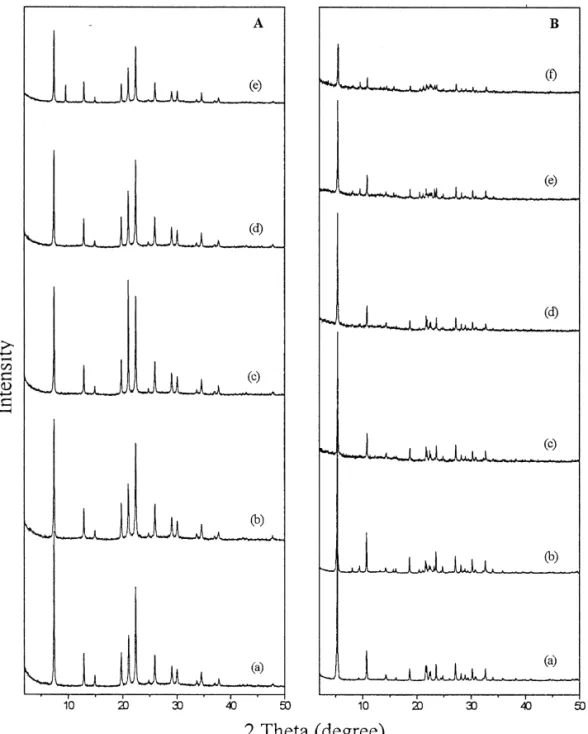
structures were confirmed by X-ray diffraction in Fig. 1A and B, respectively. The synthetic condition for TirSi-substituted VPI-5 was found to be more critical than that for AlPO -5. At4
hydrothermal temperature of 1428C, which is generally used for synthesis of VPI-5, the het-ero-element-substituted products are mainly AlPO -11 and AlPO -H3 phases instead of VPI-4 4
5. When the hydrothermal temperature was raised to 1488C, VPI-5 structure could be ob-tained reproducibly. However, some of the
Ž . Ž . Ž . Ž . Ž . Ž . Ž .
Fig. 1. XRD patterns of A AlPO -5 series: a AlPO -5, b SAPO-5, c 2% Ti-SAPO-5, d 4% Ti-SAPO-5, e 6% Ti-SAPO-5, and B4 4
Ž . Ž . Ž . Ž . Ž . Ž .
VPI-5 series: a VPI-5, b Si-VPI-5, c 1% Ti–Si-VPI-5, d 2% Ti–Si-VPI-5, e 3% Ti–Si-VPI-5, f 5% Ti–Si-VPI-5.
products still contained a small amount of AlPO -11 phase. The as-synthesized VPI-5 con-4 tained no organic templates in the channels, and would transform to AlPO -8 structure when4 heating at temperatures higher than 808C in air. Fig. 1 shows that the peak intensity of the XRD patterns decreases slightly with Ti content, im-plying that the incorporation of Ti into the
framework would decrease the crystallinity of the samples. However, obvious shrinkage in the intensity of the XRD peaks is only observed when the TirAl atomic ratios in the gels were 6 and 5% for SAPO-5 and Si-VPI-5, respectively. Above this maximum Ti-loadings, the crys-talline phases of these two molecular sieves could no longer be reproducibly obtained.
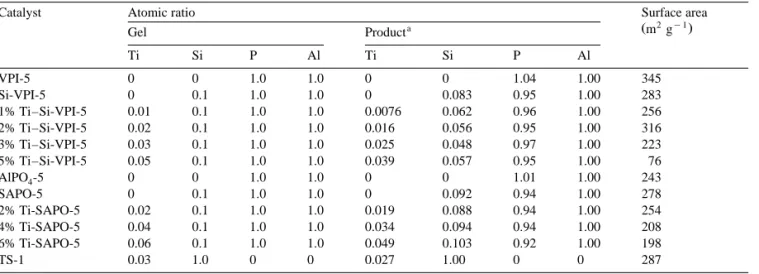
The amount of Ti and Si incorporated into the aluminophosphate molecular sieves was ana-lyzed by ICP-AES and the results are tabulated in Table 1. The Si contents in the AlPO -54
series are all close to a SirAl atomic ratio of 0.1, which is the ratio started in the gels. In contrary, the SirAl ratios in VPI-5 series are apparently lower than that in the gels. More-over, the Si content decreases markedly with the increase in Ti-loading. On the other hand, the Ti content in the solid products, based on the TirAl atomic ratio, is proportional to but slightly lower than that added in the gels. The TirAl ratio of ca. 0.05 is the maximum amount of Ti that can be incorporated into SAPO-5, while ca. 0.04 for Si-VPI-5. These results indi-cate that the crystalline structure of AlPO -5 can4
tolerate greater amount of hetero-element substi-tution than that of VPI-5. Moreover, since the PrAl atomic ratios for hetero-atom-substituted
Ž . samples are all lower than 1, the Si IV and
Ž .
Ti IV are likely replaced by the phosphorus positions in the framework.
Table 1 also shows that the surface areas retain relatively high up to TirAl ratios of 0.025 and 0.049 for Si-VPI-5 and SAPO-5, respectively. A marked decrease in surface area
however was seen on Si-VPI-5 with TirAl s 0.039. In the AlPO -5 series, the variation of4
surface areas is less obvious, although samples of higher Ti contents have slightly lower surface areas. These results imply that some amorphous structures probably form on catalysts of high Ti-loading.
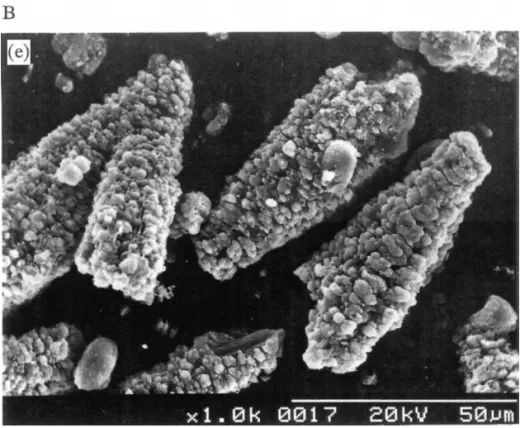
SEM photographs shown in Fig. 2 demon-strate that the morphology has little changes for AlPO -5 series but great changes for VPI-54
series when Ti is incorporated. Crystallites in rectangle rod shape were observed for AlPO -54 and all the Ti-SAPO-5 compounds. For TirSi-substituted VPI-5, the morphology changes from crystalline rods of smooth surfaces to rods grafted with small grain particles. Moreover, the grain particles grow larger as the Ti-loading increases. However, neither XRD nor Raman spectroscopy detected any TiO phases present2 in the samples. Since the sizes of the grain particles were in sub-microns to microns, they should be detectable with Raman spectroscopy if they were TiO particles. Therefore, the grain2
particles should still be the VPI-5 structure in-stead of TiO . Similar morphological changes2
w x
were observed on MeVPI-5 26 . The surface defects were considered to serve as seeds for the
Table 1
Sample composition and surface area
Catalyst Atomic ratio Surface area
2 y1 a Žm g . Gel Product Ti Si P Al Ti Si P Al VPI-5 0 0 1.0 1.0 0 0 1.04 1.00 345 Si-VPI-5 0 0.1 1.0 1.0 0 0.083 0.95 1.00 283 1% Ti–Si-VPI-5 0.01 0.1 1.0 1.0 0.0076 0.062 0.96 1.00 256 2% Ti–Si-VPI-5 0.02 0.1 1.0 1.0 0.016 0.056 0.95 1.00 316 3% Ti–Si-VPI-5 0.03 0.1 1.0 1.0 0.025 0.048 0.97 1.00 223 5% Ti–Si-VPI-5 0.05 0.1 1.0 1.0 0.039 0.057 0.95 1.00 76 AlPO -54 0 0 1.0 1.0 0 0 1.01 1.00 243 SAPO-5 0 0.1 1.0 1.0 0 0.092 0.94 1.00 278 2% Ti-SAPO-5 0.02 0.1 1.0 1.0 0.019 0.088 0.94 1.00 254 4% Ti-SAPO-5 0.04 0.1 1.0 1.0 0.034 0.094 0.94 1.00 208 6% Ti-SAPO-5 0.06 0.1 1.0 1.0 0.049 0.103 0.92 1.00 198 TS-1 0.03 1.0 0 0 0.027 1.00 0 0 287 a
growth of the smaller crystallites grafted on the large crystal surfaces. These results again imply that the process of crystal growth for VPI-5 is much more sensitive than that for AlPO -5.4
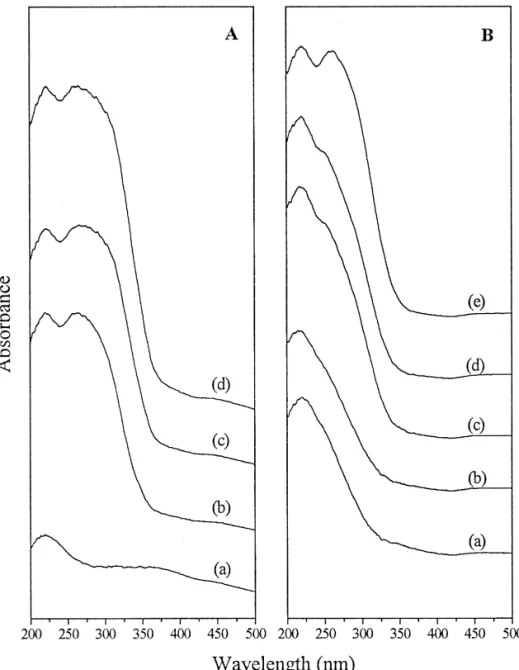
The UV–Vis spectra of Ti-substituted SAPO molecular sieves are shown in Fig. 3. The peak at ca. 225 nm is usually assigned to charge transfer from O2y to Ti4q and is observed on
Ž . Ž . Ž . Ž . Ž . Ž .
Fig. 2. SEM photographs of A AlPO -5 series: a AlPO -5, b 2% Ti-SAPO-5, c 4% Ti-SAPO-5, d 6% Ti-SAPO-5, and B VPI-54 4
Ž . Ž . Ž . Ž . Ž .
Ž .
Fig. 2 continued .
all the spectra of oxide samples containing Ti. However, pristine aluminophosphate has an ab-sorption around 220 nm, which is partially over-lapping with the O–Ti charge transfer band.
The other band at 250–330 nm is attributed to electron transfer from the valence band to the conduction band of TiO . The intensity and2
Ž .
Ž .
Fig. 2 continued .
Ti-loading. These results indicate that the for-mation of extra framework TiO crystallites in2
the SAPO samples cannot be excluded. The
partial blockage of the pores by tiny TiO parti-2
cles probably also accounts for the lower sur-face area of SAPO samples of higher
Ti-Ž .
Fig. 2 continued .
loadings. Nevertheless, the size of the TiO2
particles must be too tiny to be detected by Raman spectroscopy.
Fig. 4 shows the IR spectra of Ti-substituted SAPO samples in the framework vibration re-gion. Although both kinds of molecular sieves have absorption appear in a similar region, the VPI-5 structure gives better resolved peaks than AlPO -5. Hence, the changes in spectra as a4
function of Ti-loading are more obvious for the VPI-5 series than for the AlPO -5 series. As the4
Ti-loading increases, the absorption bands be-come broader for both molecular sieve struc-tures, implying a decrease in crystallinity. That is consistent with the XRD results. The main peaks at 1050 and 1170 cmy1 in the IR spectra
of VPI-5 remained well-resolved when only Si was incorporated, but they merged to become one broad band when Ti is also introduced. The Ti-substituted SAPO-5 structure of high Si-load-w x ing was synthesized by Tuel and Taarit 25 with different methods. They observed an IR absorption around 970 cmy1 on their calcined
samples. Although there are still arguments about the assignment of this peak, it is generally considered to correspond to Si–O–Ti stretching vibration. In our case, however, the 970 cmy1
peak was only observed on the 5% Ti–Si-VPI-5 sample, which has a very distorted structure and low surface area. Therefore, the IR spectra of our samples contribute no diagnostic informa-tion about whether Ti is incorporated in the aluminophosphate framework or not.
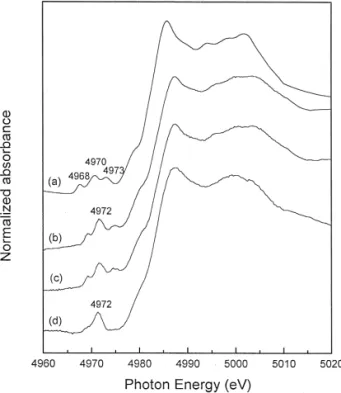
Fig. 5 shows the Ti K-edge X-ray absorption
Ž .
near-edge structure XANES spectra of Ti-sub-stituted SAPO compounds. For comparison, the XANES spectrum of anatase TiO2 is also
dis-Ž . played in Fig. 5. As indicated in Fig. 5 a , the spectrum of anatase TiO2 shows three weak peaks at 4968, 4970 and 4973 eV in the near-edge region. These peaks are assigned to 1s™ 3d transition, which is Laporte forbidden in the
w x
octahedral coordination 27 . Before degassing, the Ti-SAPO-5 samples also show three peaks in the near-edge region. However, the peaks shift toward higher energy and the intensity of
Ž . Ž . Ž . Ž . Ž .
Fig. 3. Diffuse reflectance UV–Vis spectra of A AlPO -5 series: a AlPO -5, b 2% Ti-SAPO-5, c 4% Ti-SAPO-5, d 6% Ti-SAPO-5,4 4
Ž . Ž . Ž . Ž . Ž . Ž .
and B VPI-5 series: a VPI-5, b Si-VPI-5, c 1% Ti–Si-VPI-5, d 2% Ti–Si-VPI-5, e 5% Ti–Si-VPI-5.
the 4972 eV peak is stronger than that of the other two. For the degassed samples, only the 4972 eV peak is retained. The 4972 eV peak of relatively strong intensity is assigned to 1s™3d transition of tetrahedral Ti, in which the transi-tion is Laporte allowed. The change in spectral patterns was found to be reversible when the degassed sample was rehydrated. Although de-tailed analysis of the extended X-ray absorption
Ž .
fine structure EXAFS is impossible due to the low Ti-loading in the samples, these results reveal that most of Ti in Ti-SAPO of low Ti-loadings is incorporated in the framework of the molecular sieves. The samples without de-gassing contain Ti of both tetrahedral and octa-hedral coordinations, and the coordination envi-ronment of Ti varies with the extent of
hydra-Ž .
Ž . Ž . Ž . Ž . Ž .
Fig. 4. FT-IR spectra in framework vibration region of A AlPO -5 series: a AlPO -5, b 2% Ti-SAPO-5, c 4% Ti-SAPO-5, d 6%4 4
Ž . Ž . Ž . Ž . Ž . Ž .
Ti-SAPO-5, and B VPI-5 series: a VPI-5, b Si-VPI-5, c 1% Ti–Si-VPI-5, d 2% Ti–Si-VPI-5, e 5% Ti–Si-VPI-5.
bond with water molecules reversibly, it should be able to serve as a catalytic center for coordi-nation with reactants.
3.2. Catalytic properties of Ti-SAPOs
The catalytic behaviors of Ti-SAPO molecu-lar sieves were studied in the oxidation of
sev-eral organic compounds using hydrogen perox-ide as the oxidant. Table 2 shows that Ti-SAPOs have very low activities in the oxidation of alkenes. The activities were slightly higher for alkenes with hydroxyl or amino functional groups. It suggests that the organic substrates are hard to approach and be adsorbed on the hydrophilic surfaces of aluminophosphate
mole-Ž .
Fig. 5. Ti K-edge X-ray absorption spectra of a anatase TiO ,2 Ž .b 2% Ti-SAPO-5, c 4% Ti-SAPO-5, d 2% Ti-SAPO-5 afterŽ . Ž .
degassing under 0.1 Torr for 3 h.
cular sieves. Instead, the surface should be cov-ered up by water or H O2 2 molecules. The adsorption is improved when polar functional groups are attached to the reactants. The cat-alytic activity was further enhanced when
phe-Ž .
nol was the reactant Table 3 . The main prod-Ž .
ucts were catechol CAT and hydroquinone ŽHQ . In addition, the procedure of adding H O. 2 2
was found critical. Adding H O2 2 dropwise to the mixture of organic reactants and catalyst heated at reaction temperature gives better phe-nol conversion than mixing H O and the sub-2 2
strates beforehand. 3.3. Phenol hydroxylation
The influence of solvents on phenol hydrox-ylation is shown in Table 3. Without adding other solvents, the water present in 33% H O2 2 solution serves as the solvent. The phenol con-version reaches 12.3% and the selectivities of CAT and HQ are 67%. When other solvents were added with the phenolrsolvent molar ra-tios kept at 1:2, phenol conversion was found to vary markedly with the polarity of the solvents. The phenol conversion increases in the order of water ; methanol - THF < acetone, while the dielectric constant of the solvents decreases in
Ž . Ž .
the order of water 80.2 ) methanol 32.7 )
Ž . Ž .
acetone 20.7 ) THF 7.6 . In other words, the solvents of mild polarity give the optimal activ-ity. The low conversions of phenol in solvents of high polarity such as water and methanol are attributed to that the solvent molecules are pre-ferred to phenol in covering up the hydrophilic surfaces of the catalyst. Consequently, the pro-ceeding of reaction is impeded. However, a solvent of low polarity such as THF is not favored either. It is probably due to polar
prod-Table 2
The catalytic activities of Ti-SAPOs in oxidation of alkenes with H O2 2
Catalyst s 0.2 g; Molar ratio of H O :organic substrate:solvents 1:1:1; Reaction period s 6 h.2 2
a Ž .
Catalyst Solventrtemperature Reactant Conversion %
1% Ti-SAPO-5 acetoner608C 1-Hexene ; 1
2% Ti-SAPO-5 acetoner608C 1-Hexene ; 1
2% Ti–Si-VPI-5 acetoner608C 1-Hexene ; 1
2% Ti-SAPO-5 THFr658C 1-Hexene ; 2
2% Ti-SAPO-5 acetoner608C Allyl alcohol 3.3
2% Ti-SAPO-5 THFr708C Allyl alcohol 5.3
2% Ti-SAPO-5 ethanolr808C Allyl alcohol 7.0
2% Ti-SAPO-5 THFr708C Allyl amine 2.5
2% Ti-SAPO-5 THFr708C Diallyl amine 6.8
2% Ti-SAPO-5 THFr708C Triallyl amine 1.8
a
Table 3
Effect of solvent on hydroxylation of phenol
Ž .
Catalyst s 0.2 g 2% Ti-SAPO-5, H O :phenol s 1:1 molar ratio , reaction temperature s 808C, reaction period s 6 h.2 2 a
Ž .
Solvent Phenol:solvent:water Phenol Yield % Selectivity of CATrHQ
Žmolar ratio. conversion %Ž . CAT HQ HQ q CAT %Ž .
– 1:0:3.7 12.3 6.2 2.1 67 2.95 Water 1:2:3.7 7.8 3.7 1.2 63 3.08 Methanol 1:2:3.7 6.6 4.1 2.2 95 1.86 THF 1:2:3.7 9.2 4.8 3.1 86 1.55 Acetone 1:2:3.7 17.3 9.3 7.2 95 1.29 Acetone 1:5:3.7 10.6 5.1 4.2 88 1.21 Acetone 1:1:3.7 22.4 10.1 7.5 79 1.35 Acetone 1:0.5:3.7 29.7 16.4 10.6 91 1.55 Acetone 1:0.2:3.7 37.6 21.1 14.3 94 1.48 a
Water from 33% H O solution.2 2
ucts formed on the catalyst surface that cannot be efficiently removed by the solvents of low polarity.
Table 3 also shows that the solvents of high polarity can induce polar products. The molar ratios of CAT to HQ are higher in water and methanol but lower for THF and acetone. That is, another evidence that the solvent plays an important role in removing the products away from the catalyst surfaces.
Another factor that affects phenol conversion is the phenol-to-solvent ratio, as shown in Table 3. When larger amount of acetone is used, the conversion becomes lower. In addition, some low molecular weight products were observed from GC analysis when large amount of acetone was used as solvent. It suggests that acetone may react with H O and consume a portion of2 2 H O2 2 in addition to the dilution of the reac-tants. Therefore, a large amount of acetone is not preferred. The highest conversion is achieved when phenolracetone ratio is ca. 1:0.2, and this optimum concentration was used for the cat-alytic studies hereafter.
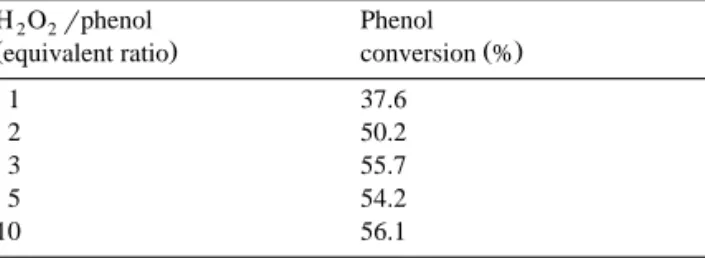
The effect of the molar ratio of the reactants is shown in Table 4. The phenol conversion increases from ca. 38 to 55% when H O rphe-2 2
nol molar ratio increases from 1 to 3. Then the conversion retains around 55% and is indepen-dent of the increase in H O2 2 quantity. The plateau is caused by water concentration
in-creases with H O rphenol ratio and the com-2 2
petitive adsorption of H O molecules on the2
active sites reduces the effect of increase in H O concentration.2 2
The influence of Ti content and different crystalline structure of molecular sieves on the catalytic activity is demonstrated in Table 5. Both pure aluminophosphate and SAPO molec-ular sieves gave low activities in phenol hydrox-ylation, but the conversion is obviously im-proved when Ti is incorporated in the molecular sieves. For both Ti-SAPO-5 and Ti–Si-VPI-5, the phenol conversion reaches a maximum and then decreases with the increase in Ti content. It is attributed that a portion of Ti probably forms extra framework TiO2 when the Ti-loading is high. These TiO crystallites would catalyze the2
decomposition of H O2 2 to H O and O , and2 2 decrease the effective H O2 2 concentration for
Table 4
Effect of reactant concentration on the hydroxylation of phenol Catalyst s 0.2 g 2% Ti-SAPO-5, phenol:acetone:water s1:0.2:3.7
Žmolar ratio , reaction temperatures808C, reaction period s6 h..
H O rphenol2 2 Phenol
Žequivalent ratio. conversion %Ž .
1 37.6
2 50.2
3 55.7
5 54.2
Table 5
Effect of Ti content and crystalline structure of Ti–Si-AlPO molecular sieves on the hydroxylation of phenol
Catalyst s 0.2 g, phenol s 2.5 g, reaction temperature s 808C, reaction period s 6 h, molar ratio of phenol:H O :acetone:waters2 2
1:1:0.2:3.7.
Ž .
Catalyst Phenol Yield % Selectivity of CATrHQ
Ž . Ž . Ž .
conversion % CAT HQ CAT q HQ % molar ratio
Blank 4.7 1.6 – 34 – VPI-5 7.2 3.3 1.7 69 1.94 Si-VPI-5 9.7 4.1 2.1 64 1.95 1% Ti–Si-VPI-5 28.7 17.4 10.8 98 1.61 2% Ti–Si-VPI-5 33.9 20.0 12.8 97 1.56 3% Ti–Si-VPI-5 28.4 16.5 11.1 97 1.48 5% Ti–Si-VPI-5 14.3 7.2 4.8 84 1.50 AlPO -54 7.6 3.2 1.9 67 1.68 SAPO-5 11.2 4.3 2.7 63 1.59 2% Ti-SAPO-5 37.6 19.7 13.0 87 1.52 4% Ti-SAPO-5 39.2 21.1 14.3 90 1.48 6% Ti-SAPO-5 34.1 18.1 11.8 88 1.53 a Uncalcined-2% Ti-SAPO-5 35.3 16.9 11.7 81 1.44 TS-1 15.2 6.9 6.4 88 1.08 a
The Ti-SAPO-5 catalyst without calcination to retain the templates in the pores.
phenol oxidation. Besides, under this optimal reaction condition for Ti-SAPO catalysts, the phenol conversion over TS-1 is lower than those of Ti-SAPO catalysts. The selectivities of the hydroxylation products, CAT and HQ, over TS-1 are also significantly different from that over Ti-SAPO molecular sieves. The polar product, CAT, is preferred to the less polar product, HQ, over Ti-SAPO catalysts, while the product ratio is around 1 over the hydrophobic TS-1.
The crystallinity of the molecular sieves is important for catalytic reactions. The 5% Ti–Si-VPI-5 catalyst of poor crystallinity and low surface area gives only half of the phenol con-version in comparison with those over well-crystallized samples. Nevertheless, the catalytic activity has no correlation with the pore size. The two aluminophosphate structures under in-vestigation are AlPO -5 containing pores of 0.734
nm diameter and VPI-5 containing pores of 1.21 nm diameter. The phenol conversions over Ti-SAPO-5 of different Ti-loadings fall in the range around 34–39%, and that over Ti–Si-VPI-5
Ž
varies from 28 to 34% without considering the .
poor-crystallized 5% Ti–Si-VPI-5 . Since VPI-5 has larger pore diameter than AlPO -5, these4
results suggest that the internal surfaces of the
aluminophosphate molecular sieves probably are not involved in the catalytic reactions. This proposal was affirmed by using one of the uncalcined Ti-SAPO-5 samples with template molecules still in the pores as the catalyst. Similar activity and product selectivity were found as those of the calcined sample.
That the catalytic reactions merely proceed on the external surfaces of the Ti-SAPO molec-ular sieves is different from those observed over
w x
TS-1. Tuel et al. 28 proposed that external surfaces of TS-1 are responsible for CAT for-mation and the internal channels for HQ forma-tion. Two main reasons may account for the internal surfaces of aluminophosphates having little contribution to the catalytic reactions. First, the one-dimensional channels of AlPO molecu-4
lar sieves limit the interdiffusion of the solvent and the reactant molecules. Second, the pores of AlPO4 molecular sieves are probably tightly filled with water or other polar molecules. In contrast, over TS-1 of pentasil zeolite structure, polar molecules are relatively easy to diffuse in and out through the inter-connected channels. Besides, the interactions between the solvent molecules and the silica walls are weaker than that on aluminophosphate.
Two explanations may account for the Ti-SAPO-5 catalysts having slightly higher activi-ties in phenol hydroxylation than Ti–Si-VPI-5. First, the actual amount of Ti incorporated in the framework of SAPO-5 is higher than that on Si-VPI-5 when well-crystallized structures are concerned. Second, the structure of the pore mouth may be important in anchoring the reac-tants and facilitating the hydroxylation reaction to proceed.
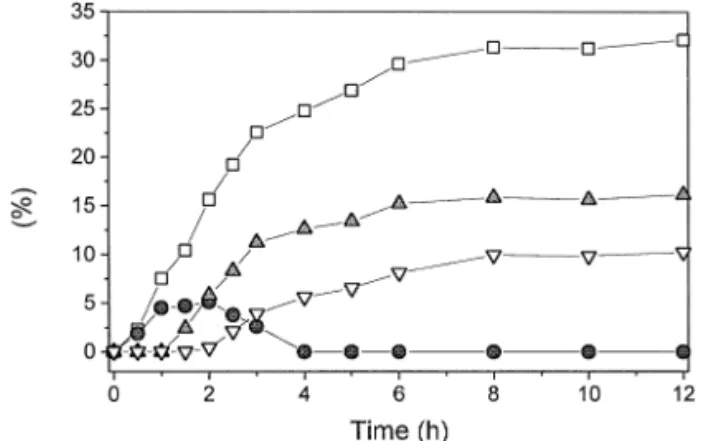
The typical course of the hydroxylation reac-tion as a funcreac-tion of reacreac-tion period is shown in Fig. 6. In the first hour of the reaction,
para-Ž .
benzoquinone PBQ was detected as the only product formed in the solution. The amount of PBQ formed reaches a maximum after 2 h, then decreases and disappears completely after ca. 4 h. CAT appears after 1.5 h, while HQ appears even later, after ca. 2 h. Both CAT and HQ yields increase with further progress of the reac-tion, and the increments slow down after about 6 h. The presence of PBQ in the early stage of the reaction was also observed by several
au-w x
thors 29–31 over titanium silicalites. Allian et w x
al. 32 suggested that PBQ was a reaction intermediate and it might act as an autocatalyst or an intermediate and cause the oxidation of H O to O and reduction of PBQ to HQ. Since2 2 2 HQ appears almost the moment PBQ yield started to decrease, this proposal may also be applied to our system. However, the observation
Fig. 6. Phenol conversion and product distribution as a function of
Ž .
reaction period over 2% Ti-SAPO-5 catalyst; I phenol
conver-Ž . Ž . Ž .
sion, ' yield of CAT, \ yield of HQ, and ` yield of PBQ.
of dark polymeric species since the beginning of the reaction implies that another mechanism, in which PBQ is the over-oxidized product of HQ and an intermediate in the formation of tar w31,33 , cannot be excluded. A detailed study onx the reaction mechanism is undergoing in our laboratory.
4. Conclusions
The TirSi-substituted aluminophosphate molecular sieves of AlPO -5 and VPI-5 crystal4
structures were synthesized successfully through hydrothermal methods. As the SirAl atomic ratio in the synthesis gel was kept around 10%, the resultant samples retained the hydrophilic character of aluminophosphate. The crystalline structure of AlPO -5 can tolerate greater substi-4
tution of hetero-element than that of VPI-5. The surface area of Ti–Si-VPI-5 was found to de-crease with Ti-loading, but the change is less obvious for Ti-SAPO-5. The incorporation of
Ž .
Ti IV on the framework of SAPO was con-firmed by the Ti K-edge X-ray absorption
spec-Ž .
tra. The Ti IV centers transformed from octa-hedral to tetraocta-hedral coordination after the sam-ples were dehydrated.
Because of the hydrophilic nature of the syn-thesized Ti-SAPO molecular sieves, they have low catalytic activities in the oxidation of or-ganic substrates of low polarity using hydrogen peroxide as the oxidant. On the contrary, this material catalyzes the hydroxylation of phenol to CAT and HQ efficiently, especially under the condition of slow addition of H O . The con-2 2
version of phenol and the selectivities of CAT and HQ were found to be affected by the polar-ity of the solvent, the crystalline structure of aluminophosphate and the Ti content. Solvents of medium polarity such as acetone are pre-ferred because they can efficiently transfer the reactants to and products away from the catalyst surfaces. The CATrHQ molar ratios in prod-ucts are always higher with Ti-SAPOs as the catalysts than with TS-1, probably because the
hydrophilic surface of aluminophosphate stabi-lizes the polar product, CAT.
Ti-substituted SAPO-5 molecular sieves show higher catalytic activities than Ti–Si-VPI-5, al-though the latter has a larger pore diameter than the former. Besides, similar catalytic activities were observed on Ti-SAPO-5 with and without templating molecules. Therefore, phenol hy-droxylation reaction is considered to proceed mainly on the external surfaces of the AlPO4
catalysts. The internal surfaces of the particles have little contribution to the catalytic reactions due to the fill-up of the pore volume by the polar molecules present in the solutions.
Acknowledgements
Financial support from the National Science Council of Taiwan, Republic of China and the free supply of pseudoboehmite from CONDEA Vista, USA are gratefully acknowledged.
References
w x1 S.T. Wilson, B.M. Lok, E.M. Flanigen, US Patent 4310440,
1982.
w x2 S.T. Wilson, B.M. Lok, C.A. Messina, T.R. Cannan, E.M. Ž .
Flanigen, J. Am. Chem. Soc. 104 1982 1146.
w x3 B.M. Lok, C.A. Messina, R.L. Patton, T.R. Cannan, E.M. Ž .
Flanigen, J. Am. Chem. Soc. 106 1984 6092.
w x4 W.M. Meier, D.H. Olson, C.H. Bearlocher, Zeolites 17 Ž1996 A1..
w x5 E.M. Flanigen, R.L. Patton, S.T. Wilson, in: P.J. Grobet, et Ž .
al. Eds. , Innovation in Zeolite Materials Science, Elsevier, Amsterdam, 1987, p. 13.
w x6 J.M. Bennett, J.P. Cohen, E.M. Flanigen, J.J. Pluth, J.V. Ž .
Smith, ACS Symp. Ser. 218 1983 109.
w x7 E.M. Flanigen, B.M. Lok, R.L. Patton, S.T. Wilson, Pure Ž .
Appl. Chem. 58 1986 1351.
w x8 K.J. Chao, S.P. Sheu, H.S. Sheu, J. Chem. Soc., Faraday Ž .
Trans. 88 1992 2949.
w x9 M.E. Davis, C. Saldarriaga, C. Montes, J. Garces, C. Crow-Ž .
der, Nature 331 1988 698.
w10 W. Schmidt, F. Schuth, H. Reichert, K. Unger, Zeolites 12x ¨ Ž1992 2..
w11 M.J. Duer, H. He, W. Kolodziejski, J. Klinowski, J. Phys.x Ž .
Chem. 98 1994 1198.
w12 A. Karlsson, D. Akporiaye, M. Stocker, Microporous Mater.x ¨ Ž .
4 1995 31.
w13 J.R. Anderson, W.R. Jackson, D. Hay, Z. Yang, E.M. Campi,x Ž .
Zeolites 16 1996 15.
w14 T. Blasco, M.A. Camblor, A. Corma, J. Perez-Pariente, J.x ´ ´ Ž .
Am. Chem. Soc. 115 1993 11806.
w15 M.A. Camblor, A. Corma, A. Martınez, J. Perez-Pariente, J.x ´ ´ ´
Chem. Soc., Chem. Commun., 1992, p. 589.
w16 D.C. Huybrechts, L.D. Bruycker, P.A. Jacobs, Naturex ŽLondon 345 1990 240.. Ž .
w17 R.S. Reddy, J.S. Reddy, R. Kumar, P. Kumar, J. Chem. Soc.,x
Chem. Commun., 1991, p. 413.
w18 J.S. Reddy, P.A. Jacobs, J. Chem. Soc., Perkin Trans. 1 22x Ž . Ž1993 2665..
w19 T. Tatsumi, N. Jappar, J. Catal. 161 1996 570.x Ž . w20 A. Bhaumik, T. Tatsumi, J. Catal. 176 1998 305.x Ž . w21 B.M. Lok, M.B. Kristoffersen, E.M. Flanigen, EP 121232,x
1984.
w22 B.M. Lok, B.K. Marcus, E.M. Flanigen, US Patent 4,500,651,x
1985.
w23 N. Ulagappan, V. Krishnasamy, J.C.S. Chem. Commun.,x
1995, p. 373.
w24 A. Tuel, Zeolites 15 1995 228.x Ž .
w25 A. Tuel, Y. Ben Taarit, J.C.S. Chem Commun., 1994, p.x
1667.
w26 B.-Y. Hsu, S. Cheng, Microporous Mesoporous Mater. 21x Ž1998 505..
w27 F. Babonneau, S. Doeuff, A. Leaustic, C. Sanchez, C. Cari-x Ž .
tier, M. Verdaguer, Inorg. Chem. 27 1988 3166.
w28 A. Tuel, S. Moussa-Khouzami, Y. Ben Taarit, C. Nacchche,x Ž .
J. Mol. Catal. 68 1991 45.
w29 A. Thangaraj, R. Kumar, S.P. Mirajkar, P. Ratnasamy, J.x Ž .
Catal. 131 1991 294.
w30 P.R.H.P. Rao, A.V. Ramaswamy, Appl. Catal. A 93 1993x Ž .
123.
w31 A. Tuel, Y. Ben Taarit, Appl. Catal. A 102 1993 69.x Ž . w32 M. Allian, A. Germain, F. Figueras, Catal. Lett. 28 1994x Ž .
409.
w33 J.S. Reddy, S. Sivasanker, P. Ratnasamy, J. Mol. Catal. 71x Ž1992 373..