Bright red-emitting electrophosphorescent device using osmium complex as a triplet
emitter
Joo Hyun Kim, Michelle S. Liu, Alex K.-Y. Jen, Brenden Carlson, Larry R. Dalton, Ching-Fong Shu, and
Rajasekhar Dodda
Citation: Applied Physics Letters 83, 776 (2003); doi: 10.1063/1.1593230
View online: http://dx.doi.org/10.1063/1.1593230
View Table of Contents: http://scitation.aip.org/content/aip/journal/apl/83/4?ver=pdfcov
Published by the AIP Publishing
Articles you may be interested in
Correlation of photoluminescent quantum efficiency and device characteristics for the soluble electrophosphorescent light emitter with interfacial layers
J. Appl. Phys. 104, 024511 (2008); 10.1063/1.2959817
Ohmic hole injection in poly(9,9-dioctylfluorene) polymer light-emitting diodes
Appl. Phys. Lett. 83, 707 (2003); 10.1063/1.1596722
Effective ionic charge polarization using typical supporting electrolyte and charge injection phenomena in molecularly doped polymer light-emitting diodes
J. Appl. Phys. 92, 5971 (2002); 10.1063/1.1513886
High-performance polymer light-emitting diodes doped with a red phosphorescent iridium complex
Appl. Phys. Lett. 80, 2308 (2002); 10.1063/1.1462862
Red electrophosphorescence from osmium complexes
Appl. Phys. Lett. 80, 713 (2002); 10.1063/1.1445272
This article is copyrighted as indicated in the article. Reuse of AIP content is subject to the terms at: http://scitation.aip.org/termsconditions. Downloaded to IP: 140.113.38.11 On: Thu, 01 May 2014 05:28:25
Bright red-emitting electrophosphorescent device using osmium complex
as a triplet emitter
Joo Hyun Kim, Michelle S. Liu, and Alex K.-Y. Jena)
Department of Materials Science and Engineering, Box 352120, University of Washington, Seattle, Washington 98195
Brenden Carlson and Larry R. Dalton
Department of Chemistry, Box 351700, University of Washington, Seattle, Washington 98195 Ching-Fong Shu and Rajasekhar Dodda
Department of Applied Chemistry, National Chiao Tung University, Hsin-Chu, Taiwan, 30035, Republic of China
共Received 22 January 2003; accepted 19 May 2003兲
A series of efficient and bright double-layer light-emitting devices have been fabricated using the osmium 共Os兲 complex as the triplet emissive dopant in both a blue-emitting polyfluorene derivative 共PF–TPA–OXD兲 containing hole-transporting triphenylamine 共TPA兲 and electron-transporting oxadiazole 共OXD兲 as side chains and a blend of
2-共4-t-butylphenyl兲-5-共4-biphenylyl兲-1,3,4-oxadizole 共PBD兲 in poly(N-vinylcarbazole兲 共PVK兲. Due to a balanced charge
injection and transport in PF–TPA–OXD and very efficient energy transfer from this polymer to the Os complex, the resulting device共indium tin oxide/HTL/OsCF3:PF–TPA–OXD/Ca/Ag兲 reaches a
maximum external quantum efficiency of 2.1% with a peak brightness of 2920 cd/m2. These results are significantly higher than those obtained from the commonly used host, PVK:PBD共0.49% and 1270 cd/m2). © 2003 American Institute of Physics. 关DOI: 10.1063/1.1593230兴
Recently, tremendous efforts have been focused on im-proving the efficiency of organic light-emitting diodes
共OLEDs兲 through either the development of better materials
or more efficient device structures. In an OLED, both the holes and electrons are injected form the opposite electrodes then combined together to form excitons. However, the ra-diative decay of the singlet excitons is very fast but that of the triplet excitons is usually inhibited by the rule of the spin conservation and is very inefficient. Therefore, the develop-ment of OLEDs has been mostly based on the fluorescent emissive materials. However, by employing triplet-based phosphorescent dye in small molecule- and polymer-based LEDs where both singlet and triplet excited states partici-pate, the internal efficiency can reach as high as 100%.1,2 Red-emitting LEDs based on the triplet emitters such as trivalent Ir complexes,3,4 Pt phophyrine derivatives,5,6 and tris共polypyridyl兲 Ru共II兲 complexes7,8 have been demon-strated with very high efficiency. Compared to the analogues tris共polypyridyl兲 Ru共II兲 complexes, the Os共II兲-based com-plexes have rarely been used in LED applications. This is because the tris共polypyridyl兲 Os共II兲 complexes usually pos-sess relatively low quantum yields in the order of 0.1% and very short emission lifetimes in the order of 50 ns9 when compared to those of the Ru complexes. In addition, the emission of the tris共polypyridyl兲 Os共II兲 complexes is signifi-cantly red-shifted compared to the tris共polypyridyl兲 Ru共II兲 complexes and is in the near-IR region. Nguyen et al.10 showed that the use of strong -acid ligands, such as phos-phine and CH3CN, combined with polypyridyl ligands will
yield Os共II兲 complexes with triplet life time of up to 1.84s.
The *or d orbitals of Os共II兲 are very high in energy com-pared to the * of the ligands. The metal-to-ligand-charge-transfer 共MLCT兲 bands are dominantly from the t2g of the
Os metal to*of the ligands. When a polypyridyl ligand is replaced with a-acid ligand共such as phosphine and arsine ligand兲, there is a shift to higher energy in the absorption and emission bands from the tris共polypyridyl兲 Os共II兲 complexes.11–14 Therefore, these mixed-ligand systems are suitable for the triplet-based LED applications. It can blue-shift the emission colors from near-IR to orange-red and in-crease the emission quantum yields up to 45%.11Recently, a series of Os complexes have been developed and efficient red-emitting LEDs have been demonstrated using polymer blends as the host materials.11,12
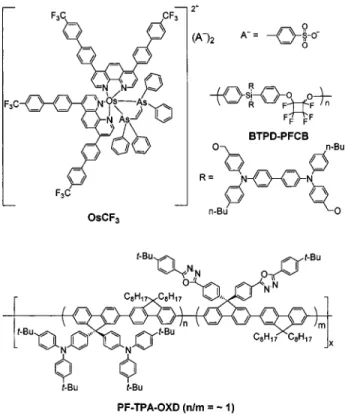
In the dye doped systems for LEDs, two kinds of emission mechanisms are possible. One is based on the Fo¨ster or Dexter type energy transfer from the host to the dopant, the other is based on the direct recombination of the injected charges on the dopant site, i.e., charge trapping mechanism. In this letter, we demonstrate that by employing a host polymer with optimized charge injection and transport, we can take advantage of both mechanisms to improve device’s efficiency and brightness. Figure 1 shows the chemical structures of the osmium complex (OsCF3) and the in situ polymerizable hole-transporting material, bis - tetraphenylenebiphenyldiamine – perfluorocyclobutane
共BTPD–PFCB兲, and the highly efficient blue-emitting
poly-fluorene containing both hole- and electron-transporting moi-ety as side chains共PF–TPA–OXD兲15used in this work. The electroluminescence共EL兲 devices were fabricated on indium tin oxide共ITO兲-coated glass substrate that were cleaned and treated with oxygen plasma before use. A layer of 20-nm-thick BTPD–PFCB was first fabricated by spin coating the
a兲Electronic mail: [email protected]
APPLIED PHYSICS LETTERS VOLUME 83, NUMBER 4 28 JULY 2003
776
0003-6951/2003/83(4)/776/3/$20.00 © 2003 American Institute of Physics
This article is copyrighted as indicated in the article. Reuse of AIP content is subject to the terms at: http://scitation.aip.org/termsconditions. Downloaded to IP: 140.113.38.11 On: Thu, 01 May 2014 05:28:25
monomer from its solution in 1,2-dichloroethane共DCE兲 and annealing at 225 °C for 1 h under nitrogen atmosphere.16,17 Then, a layer of 3.0 wt % Os complex doped blend of poly(N-vinylcarbazole兲
共PVK兲/2-共4-t-butylphenyl兲-5-共4-biphenylyl兲-1,3-4-oxadizole 共PBD兲 共PVK:PBD⫽7:3 by
weight兲 or PF–TPA–OXD were spin coated, from their so-lution in DCE 共⬃10 mg/mL兲, onto the top of the BTPD– PFCB layer. A cathode layer of 30-nm-thick Ca was vacuum deposited onto the top of the OsCF3 doped polymer film at
below 1⫻10⫺6 Torr, and then a layer of 120-nm-thick Ag was deposited as the protecting layer.
UV-visible 共UV–VIS兲 and photoluminescence 共PL兲 spectrum of OsCF3 in ethanol solution are shown in Fig. 2.
The absorption spectrum of OsCF3 in ethanol solution关Fig.
2共a兲兴 shows a strong absorption at 280–330 nm, which cor-responds to the–*transition of the ligands. The moderate absorption band in the region of 350– 460 nm corresponds to
the singlet MLCT absorption. In addition, a weak absorption band between 460 and 560 nm corresponds to the triplet MLCT absorption. The extinction coefficients共⑀兲 at 280 and 375 nm are 125 000 and 40 000 L⫺1cm⫺1mol⫺1, respec-tively. The PL of the solution of OsCF3关Fig. 2共d兲兴 emits red light with a maximum at 632 nm. As can be seen in both Figs. 2共b兲 and 2共c兲, the films of PVK:PBD blend and PF– TPA–OXD emit violet and blue light, respectively. Since the MLCT states of the OsCF3 complex absorb light in the
re-gion of 350–580 nm, therefore, both the polymer and the blend can be used as host materials for efficient energy trans-fer.
In the EL devices based on the OsCF3 complex doped in
the blend of PVK:PBD, a doping ration of 3.0 wt % was employed and it is sufficient to quench the emission of the host. This matches well with our previous results that a dop-ing level between 2.5 and 5.0 wt % gives the best device performance.12 Although the energy transfer could be im-proved by increasing the concentration of the dopant, this will also increase the non-radiative decay due to self-quenching. As can be seen in Fig. 3共a兲, the EL spectrum of device 1 共ITO/HTL/OsCF3:PVK:PBD/Ca/Ag兲 emits strong
red light with a maxat 630 nm under the forward bias. The
maximum external quantum efficiency (max) of device 1
was calculated to be 0.49% at a current density of 0.025 A/cm2 共at a brightness of 109 cd/m2 with a driving voltage of 13.0 V兲. The maximum brightness (Bmax) of device 1 reaches 1270 cd/m2 at a voltage of 19.0 V and a current
density of 0.44 A/cm2. In the EL device based on the PF–
TPA–OXD host 关ITO/HTL/OsCF3:PF–TPA–OXD/Ca/Ag, device 2 in Fig. 3共b兲兴, the peak wavelength 共628 nm兲 and the shape of the spectrum is similar to that of the device 1. This indicates that the host materials do not affect the emission properties. However, device 2 shows a very weak emission which originates from the emission of polyfluorene backbone
共in the region of 400–500 nm兲. Themaxof the device 2 was
calculated to be 2.1% at a current density of 0.0085 A/cm2
共at a brightness of 166 cd/m2 with a driving voltage of 12.0
V兲, which is four times higher than the value obtained with host material of PVK:PBD共device 1兲. The Bmaxof device 2
FIG. 1. Chemical structure of osmium complex (OsCF3), hole transporting material共BTPD–PFCB兲, and polyfluorene derivative 共PF–TPA–OXD兲.
FIG. 2.共a兲 UV–VI spectrum of OsCF3solution in ethanol,共b兲 PL spectrum of PVK:PBD blend film,共c兲 PL spectrum of PF–TPA–OXD film, 共d兲 PL spectrum of OsCF3solution in ethanol.
FIG. 3. EL spectra of共a兲 ITO/BTPD–PFCB/OsCF3:PVK:PBD/Ca/Ag and 共b兲 ITO/BTPD–PFCB/OsCF3:PF–TPA–OXD/Ca/Ag共offset for clarity兲, 共c兲 ITO/BTPD–PFCB/PF–TPA–OXD/Ca/Ag, and 共d兲 ITO/BTPD–PFCB/ PVK:PBD/Ca/Ag.
777
Appl. Phys. Lett., Vol. 83, No. 4, 28 July 2003 Kimet al.
This article is copyrighted as indicated in the article. Reuse of AIP content is subject to the terms at: http://scitation.aip.org/termsconditions. Downloaded to IP: 140.113.38.11 On: Thu, 01 May 2014 05:28:25
reaches 2920 cd/m2 at a voltage of 20.5 V and a current density of 0.49 A/cm2.
The efficiency of the devices can be explained from the energy transfer point of view, which is most likely through the Fo¨ster mechanism in these devices, from the host to the Os complex dopant. In Fo¨ster energy transfer, the energy transfer efficiency is proportional to the overlap integral be-tween the emission spectrum of the donor and the absorption spectrum of the acceptor. In order to investigate the overlap integral between the emission of the host and the absorption of OsCF3, we also fabricated bilayer EL devices based on
the host materials, which do not contain OsCF3. The EL
spectra of the devices show quite different features from their PL spectra关Figs. 2共b兲 and 2共c兲兴. As can be seen in Fig. 3共d兲, EL intensity of the bilayer device based on PVK:PBD
共ITO/HTL/PVK:PBD/Ca/Ag兲 around 580–800 nm is much
higher than that of 350–580 nm. The emission at 580– 800 nm is due to the exciplex formation,13 which arise from the interface between the HTL and the PVK:PBD layer. On the other hand, the EL spectrum of the bilayer device based on
the PF–TPA–OXD 共ITO/HTL/PF–TPA–OXD/Ca/Ag兲
showed quite different feature. The EL intensity in the region of 400–580 nm is higher than that in the region of 580– 800 nm. As a result, the overlap integral between the absorption of OsCF3 and the emission of PF–TPA–OXD is better than
that of OsCF3 and PVK:PBD. Therefore, the efficiency of
the device based on PF–TPA–OXD is much higher com-pared to the device based on PVK:PBD host. Themaxand Bmaxof ITO/HTL/PF–TPA–OXD/Ca/Ag are 1.1% and 8900 cd/m2, respectively, which are significantly higher than those
derived from the ITO/HTL/PVK:PBD/Ca/Ag 共0.11% and 82.4 cd/m2). This imply that OsCF3 dopant in device 2 can
receive more emitted photons from the host than that from device 1 based on PVK:PBD. Figure 4 shows the current density and brightness as a function of the bias voltage re-spectively. The turn-on voltage 共defined as the voltage re-quired to give a luminance of 1 cd/m2) of device 2 is 8.0 V, which is similar to that of device 1共7.5 V兲. In addition, the current density of the OsCF3 doped devices is smaller than
that of the undoped devices. This is because OsCF3complex
also acts as trap site for injected charges from the opposite electrodes 共both holes and electrons兲. The p orbital of the
polypyridine ligands in the Os complex 共correspond to the lowest unoccupied molecular orbital level of the complex,
⫺3.33 eV兲 can be easily reduced and can act as the trapping
sites for electrons injected from the cathode. The d orbital of the Os共II兲 ion 共correspond to the highest occupied molecular orbital level,⫺5.47 eV兲 can also act as the trapping sites for holes injected from the ITO anode.18 The external quantum efficiency of the device slightly decreases with the increasing of current density共inset of Fig. 4兲. This may be due to the EL originates from the recombination of long lifetime triplet excitons,5 which causes saturation of emissive sites and triplet–triplet annihilation. This will result in significant de-crease in efficiency.2
In summary, we have developed very bright red-emitting LEDs with high quantum efficiency by using Os complex as dopant in a conjugated polymer host. Due to a balanced charge injection and transport and very efficient energy transfer from this polymer to the Os complex, the resulting device 共ITO/HTL/OsCF3:PF–TPA–OXD/Ca/Ag兲 reaches a
maximum external quantum efficiency of 2.1% with a peak brightness of 2920 cd/m2. These results are significantly higher than those obtained from the commonly used host, PVK:PBD 共0.49% and 1270 cd/m2).
Financial supports from the National Science Foundation
共NSF–NIRT and the NSF–STC Program under Agreement
No. DMR-0120967兲 and the Air Force Office of Scientific Research 共AFOSR兲 under the MURI Center on Polymeric Smart Skins are acknowledged. A.K.-Y.J. thanks the Boeing–Johnson Foundation for its support. J.H.K. thanks the support from the Korea Science and Engineering Foun-dation 共KOSEF兲. C.-F.S. thanks the National Science Coun-cil of the Republic of China.
1M. A. Baldo, M. E. Thompson, and S. R. Forrest, Nature共London兲 403,
750共2000兲.
2C. Adachi, M. A. Baldo, M. E. Thompson, and S. R. Forrest, J. Appl.
Phys. 90, 5048共2001兲.
3
S. Lamansky, P. Djurovich, D. Murphy, F. Abdel-Razzaq, H. Lee, C. Ada-chi, P. E. Burrows, S. R. Forrest, and M. E. Thompson, J. Am. Chem. Soc.
123, 4304共2001兲.
4F. Chen, Y. Yang, M. E. Thompson, and J. Kido, Appl. Phys. Lett. 80,
2308共2002兲.
5M. A. Baldo, D. F. O’Brien, Y. You, A. Shoustikov, S. Sibley, M. E.
Thompson, and S. R. Forrest, Nature共London兲 395, 151 共1998兲.
6R. C. Kwong, S. Silbey, T. Dubovoy, M. Baldo, S. R. Forrest, and M. E.
Thompson, Chem. Mater. 11, 3709共1999兲.
7
E. S. Handy, A. J. Pal, and M. F. Rubner, J. Am. Chem. Soc. 121, 3525
共1999兲.
8H. Rudmann, S. Shimada, and M. F. Rubner, J. Am. Chem. Soc. 121, 4918 共2002兲.
9
M. L. Fetterolf and H. W. Offen, J. Phys. Chem. 89, 3320共1985兲.
10
T. T. Nguyen and J. C. Martin, J. Am. Chem. Soc. 102, 7383共1980兲.
11B. Carlson, G. D. Phelan, W. Kaminsky, L. R. Dalton, X. Jiang, S. Liu,
and A. K.-Y. Jen, J. Am. Chem. Soc. 124, 14162共2002兲.
12X. Jiang, A. K.-Y. Jen, B. Carlson, and L. R. Dalton, Appl. Phys. Lett. 80,
713共2002兲.
13X. Jiang, M. S. Liu, and A. K.-Y. Jen, J. Appl. Phys. 91, 10147共2002兲. 14S. Bernhard, X. Gao, G. G. Malliaras, and H. C. Abruna, Adv. Mater.
共Weinheim, Ger.兲 14, 433 共2002兲. 15
C.-F. Shu, R. Dodda, F.-I. Wu, M. S. Liu, and A. K.-Y. Jen, Macromol ecules共to be published兲.
16X. Jiang, S. Liu, M. S. Liu, H. Ma, and A. K.-Y. Jen, Appl. Phys. Lett. 76,
2985共2000兲.
17S. Liu, X. Jiang, H. Ma, M. S. Liu, and A. K.-Y. Jen, Macromolecules 33,
3514共2000兲.
18Y. Ma, H. Y. Zhang, J. C. Shen, and C. Che, Synth. Met. 94, 245共1998兲. FIG. 4. Current density–bias voltage–brightness relationship of ITO/
BTPD–PFCB/OsCF3:PF–TPA–OXD/Ca/Ag. Inset is external quantum ef-ficiency vs current density relationship.
778 Appl. Phys. Lett., Vol. 83, No. 4, 28 July 2003 Kimet al.
This article is copyrighted as indicated in the article. Reuse of AIP content is subject to the terms at: http://scitation.aip.org/termsconditions. Downloaded to IP: 140.113.38.11 On: Thu, 01 May 2014 05:28:25