
中國醫藥大學機構典藏 China Medical University Repository, Taiwan:Item 310903500/23813
5
0
0
全文
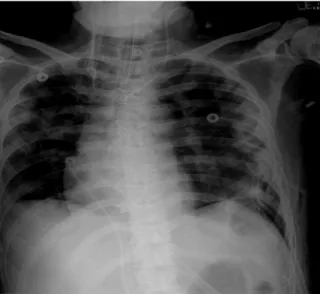
(2) Tsung-Shih Li, et al.. above the clavicle under fluoroscopy. The stump of the catheter, together with the knot, was pulled out through an incision in the internal jugular vein (Fig. 4). DISCUSSION. Catheter knotting may lead to thrombosis, arrhythmia, or infection, and can cause vein rupture if withdrawn by force. According to Karanikas et al, the reported incidence of PAC knotting increased after the introduction of the pulmonary artery catheter [3]. The risk of knot formation while passing a catheter between the. 231. chordae tendineae is particularly high in patients with tricuspid valve regurgitation [4]. Knotting can be avoided by continuous monitoring of pressure waves during insertion and manipulation. The length of insertion is another very important factor in preventing the PAC from looping in heart chambers. Partial loops with large diameters can form in the right atrium or ventricle if excess length is inserted. Lopes et al recommended that no more than 10 to 15 cm be inserted into the right atrium or ventricle during an attempt to position the catheter [5]. If an attempt fails, the catheter must. Fig. 1. Initial position of Swan-Ganz catheter after surgery. The tip of catheter is at adequate position and without knotting.. Fig. 2. The Chest radiography shows knotting of catheter in superior vena cava one day after reposition failed.. Fig. 3. Failure to untie the knot with guidewire under fluoroscopy.. Fig. 4. Knotted Swan-Ganz catheter after surgical removal..
(3) 232. be gently withdrawn into the right atrium before a new attempt is made to direct it to the pulmonary artery. The catheter should be carefully withdrawn to the 30 cm mark and re-advanced, avoiding careless maneuvers. If resistance persists during these maneuvers, the procedure must be stopped, and CXR must be obtained to rule out a looping or knotting formation. The risk of complications is high when resistance is encountered during removal of a catheter. If the PAC becomes knotted, a movable core-guided wire under fluoroscopic control can be used to untie the knot [5]. An alternative approach is to tighten the knot as much as possible so that it can be removed through the vein of insertion [6]. A deflection wire can also be used. The wire is locked in the first turn of the knot and the catheter is withdrawn. The knot is released using a retrieval basket [7], a loop-snare [8] formed by a doubled-over guide wire and endo-myocardial biopsy forceps [9], or even an angioplasty balloon (which, when inflated, expands the diameter of the knot). Open surgical removal is reserved for cases in which the size of the knot is large and many loops are involved–the so called “bow tie” knots–or when intracardiac fixing of the knot is encountered [6]. If knotting occurs and cannot be released by interventional radiological techniques, surgical removal of the catheter is another option, and is necessary in about 34% of PAC knotting cases [3]. The guidelines for pulmonary artery catheter placement [10] state that if a right ventricular waveform is not observed after inserting the catheter to the 40 cm mark, coiling in the right atrium is likely. If a pulmonary artery waveform is not observed after inserting the catheter to the 50 cm mark, coiling in the right ventricle has probably occurred. In our patient, the adequate wedge position was at the 50 cm mark. Therefore, the knot may have formed in the right ventricle as we advanced the catheter to the 70 cm mark before withdrawing it. After placement, PACs soften due to exposure to warm body temperatures, which complicates the readvancement of the catheter. Injecting small amounts (2 to 3 mL) of icy water will stiffen the catheter and facilitate the procedure.. Complication of Swan-Ganz Catheter. We first attempted to untie the knot with a guidewire. However, this patient was in critical condition and could not tolerate multiple attempts to remove the knot. Therefore, after several failures, we chose surgical intervention to remove the knot. Fortunately, the knot was able to be withdrawn with the sheath to the internal jugular vein, and was removed superior to the clavicle. If the knot had been inferior to the clavicle, sternotomy may have been necessary to remove the knot. The benefits of pulmonary artery catheters outweigh the associated complications in selected cardiac surgery patients [11]. Although uncommon, intracardiac knotting of the catheter represents a possible complication associated with PAC insertion. The physician should be aware of the risk for knotting, especially at insertion and when resistance is encountered during removal. Knots that cannot be released by interventional radiological techniques should be managed by surgically removing the catheter. REFERENCES 1. Roizen MF, Berger DL, Gabel RA, et al. Practice guidelines for pulmonary artery catheterization: an updated report by the American Society of Anesthesiologists Task Force on Pulmonary Artery Catheterization. [Review] Anesthesiology 2003;99: 988-1014. 2. Johansson L, Malmstrom G, Ugglia LG. Intracardiac knotting of the catheter in heart catheterization. J Thorac Surg 1954; 27:605-7. 3. Karanikas ID, Polychronidis A, Vrachatis A, et al. Removal of knotted intravascular devices. Case report and review of the literature. [Review] Eur J of Vasc Endovasc Surg 2002;23:189-94. 4. Arnaout S, Diab K, Al-Kutoubi A, et al. Rupture of the chordae of the tricuspid valve after knotting of the pulmonary artery catheter. Chest 2001;120:1742-4. 5. Lopes MC, de Cleva R, Zilberstein B, et al. Pulmonary artery catheter complications: report on a case of a knot accident and literature review. [Review] Rev Hosp Clin Fac Med Sao Paulo 2004;59:77-85. 6. Georghiou GP, Vidne BA, Raanani E. Knotting of a pulmonary artery catheter in the superior vena cava: surgical removal and a word of caution. Heart 2004; 90:e28..
(4) Tsung-Shih Li, et al.. 7. Hood S, McAlpine HM, Davidson JA. Successful retrieval of a knotted pulmonary artery catheter trapped in the right ventricle using a dormier basket. Scott Med J 1997;42:184. 8. Cho SR, Tisnado J, Beachley MC, et al. Percutaneous unknotting of intravascular catheters and retrieval of catheter fragments. AJR Am J Roentgenol 1983;141: 397-402. 9. Mehta N, Lochab SS, Tempe DK, et al. Successful nonsurgical removal of a knotted and entrapped. 233. pulmonary artery catheter. Cathet Cardiovasc Diagn 1998;43:87-9. 10. Mark JB, Slaughter TF. Cardiovascular monitoring. In: Miller RD, ed. Miller's Anesthesia, 6 th edition. Philadelphia: Elsevier Churchill Livingston, 2005:1303. 11. Bossert T, Gummert JF, Bittner HB, et al. Swan-Ganz catheter-induced severe complications in cardiac surgery: right ventricular perforation, knotting, and rupture of a pulmonary artery. J Card Surg 2006;21: 292-5..
(5) 234. 29 X. 2007;12:230-4. 404. 2. 2007. 5. 28. 2007. 7. 27. 2007. 7. 20.
(6)
數據
相關文件
command tells Vim to run the text through a UNIX command.The ‘a tells the editor that the text to be worked on starts at the current line and ends at mark a.. The command that
The case presented here is of a geriatric patient who presented to us with a fracture at the right parasymphysis and left dentoalveolar region of the mandible and was su ffering
Histological sections showed tumor cells at a distance of 8 mm from the clinical and radiographic limit of the lesion, so the elimination of at least 1 cm of peripheral bone margin
The chairman/representative director, and at least 2/3 of the board of directors of a limited company or a company limited by shares providing the above services shall be the Republic
Buttermilk, curdled milk and cream, Yogurt, kephir and other fermented or acidified milk and cream, whether or not concentrated or containing added sugar or other sweetening matter
Milk and cream, in powder, granule or other solid form, of a fat content, by weight, exceeding 1.5%, not containing added sugar or other sweetening matter.
Finally, I am going to learn how to play the flute, because I want to play a song for my daddy’s birthday this winter.. SPRING SUMMER FALL
After the SARS crisis in 2003, there is a huge and on-going reform in the post-graduate medical training program to improve the medical service in Taiwan. Our institute has
