Sensation Seeking and Internet Dependence of
Taiwan High School Adolescents
Sunny S. J. Lin, Chin-Chung Tsai
Center for Teacher Education
National Chiao Tung University,
Hsinchu 300, Taiwan
Correspondence:
Sunny Lin, Ph.D.
Center for Teacher Education, National Chiao Tung University
Hsinchu 300, Taiwan
Phone: 886 (3) 5731714
FAX: 886 (3) 573-8083
[email protected]
Running head: Sensation Seeking and Internet Dependence
Keywords: sensation seeking, Internet dependence, adolescence
Sensation Seeking and Internet Dependence of
Taiwan High School Adolescents
ABSTRACT
The present study examined excessive Internet use of Taiwan adolescents and a psychological aspect of users, sensation seeking, thus to differentiate motivation of Internet dependent and non-dependent adolescents. Seven hundred and fifty three Taiwan high school students were selected using cluster sampling and 88 of them were categorized. Results demonstrated that the Internet dependents spent more time on-line than the non-dependents. While they perceived significantly more negative Internet influences on daily routines, school performance, and parental relation than the non-dependents, both Internet dependents and non-dependents regarded Internet use enhanced peer relationships. Making friends through the Internet, a critical need of adolescence, may become a demanding activity leading to excessive use of the Internet. Internet dependents scored significantly higher on overall sensation seeking and disinhibition than the Internet non-dependents. However, both groups displayed no differences on life experience seeking subscale and thrill and adventure seeking subscale. This finding is incompatible to Lavin et al. (2000). Some possible reasons accounted for the incongruent findings were suggested. Explanations for the
association of Internet dependence and disinhibition in Taiwan adolescents were provided.
INTRODUCTION
Recently Internet has become a popular media for mass and personal communication. With intention to cultivate Taiwan’s international competition
capacities, Taiwan government played a substantial role in the promotion of Internet use around the whole country for business and education purposes. In Taiwan since the introduction of the Internet for popular consumption in 1995, there has been an explosion in the rate of growth of people subscribing to Internet Service Providers (ISPs). In July 2000, an Internet survey company – Iamasia - released an estimate 30% of whole Taiwan population, about 6 million people, used the Internet at least once in the past four weeks (Chen, 2000).
Though people value the Internet as a powerful tool, previous studies have called attention of policy makers and educators to realize the negative influences of Internet, especially the inadequate use of Internet, the related physical and
psychological problems, and harmful consequences toward significant others
(Brenner, 1996, 1997; Egger, 1996; Greenfield, 2000; Griffths, 1997; Kandell, 1998; Young, 1996a, 1997). These studies used both quantitative and qualitative methods to identify Internet addicts, or used terms such as Internet dependents, technology addicts, problematic Internet users, or pathological users. Several researchers in Taiwan (e.g. Chen, 1998; Chou, Chou, & Tyan, 1999; Chou & Hsiao, 2000)also reported college students’ excessive use of the Internet (about 20 hours per week) and the pattern was very similar to the findings of the USA and Europe studies.
After connecting campus computer networks in universities, Taiwan
government now is promoting the set up of network in high school campuses around the country. When high school students gain more access to the Internet, they are more vulnerable to Internet dependence. Though problematic Internet use for high school students is likely to surface, unfortunately empirical studies that place attention particularly on Internet dependent adolescents are still deficient. Previous studies of Internet addition were mainly based on undergraduates, adults, or general
users voluntarily responded to Internet survey (Griffiths, 1998; Greenfield, 2000). The present study examined excessive Internet use of Taiwan adolescents and one of the psychological aspects of users, sensation seeking, thus to differentiate an important motivation aspect of Internet dependent and non-dependent adolescents. This study is a second year follow up of a research project “Internet addiction among Taiwan high school students”. In the first phase, Lin and Tsai (1999) and Tsai & Lin (1999) designed a measurement tool to identify Internet dependent among Taiwan adolescents, examined its reliability and validity, and investigated the relationship of Internet vulnerability, perception, and affect in using the Internet. In the second phase of the study, the authors tired to analyze whether sensation seeking is a possible explanation about adolescents’ problematic use of the Internet.
Sensation (novelty) seeking is a significant feature during the adolescence period (e.g., Farley & Cox, 1971; Newcom & McGee, 1991) and highly related to some risk or adventure behaviors, such as drug use (Donohew, Hoyle, Clayton, Skinner, Colon, & Rice, 1999), drinking driving (Jonah, 1997), diving, or parachuting (Zarevski, Marusic, Bunjevac, & Vukosav, 1998). Surfing Internet is seemed as an adventure around the world of high tech and therefore could be related to sensation seeking. In sum, the association between sensation seeking and Internet dependence among adolescence is an interesting field to explore.
RELATED STUDIES
Griffiths (1998) offered a stereotype of Internet or computer addicts. They tend to be “socially unskilled male teenagers who have little or no social life and/or self confidence, and are described by names such a nerd, geek, and or anorak (pp. 63).” Though Young (1996b), breaking the stereotype, provided a Internet addition case of a middle age women lived in the U.S. as a homemaker, Kandell (1998) indicated that
college students is more vulnerable to Internet problematic use than other groups in the society.
Several reasons account for this phenomenon. Most College students move away from home to dorm that help them achieve physically cutting lose from family. Away from parent’s monitor, they have more chances and freedom involving in the Internet than ever before. College students are dealing with developmental tasks to strive for personal identity as well as to develop meaningful interpersonal relationship or intimacy. These inner needs may lead them to explore the huge social network connected by the Internet. In addition, because the Internet has been labeled as super high way to high tech world and a new world of great imagination, the education system and the whole society encourage college students to use the Internet. When the Internet is more accessible to a younger group, high school students, we expect the similar problems may begin to emerge.
Lin and Tsai (1999) identified a small group (N = 61) of possible Internet addict among Taiwan high school students. These Internet addicts displayed a heavy
Internet usage, about 20 hours per week. The most frequent used Internet applications for these young Internet addicts were listed in descending sequence, WWW (5.79 hours/per week), BBS (3.85 hr/pw), Chat Rooms/IRC (3.61hr/pw), FTP (2.73 hr/pw), Net games/MUD (2.04hr/pw), and Email (1.77hr/pw).
The Internet addictive adolescents admitted that if they don’t spend more time or engage in the Internet activities in a more extensive manner, then it is impossible to gain the pleasure or satisfaction they had experienced when they initially touched (began to use) the Internet. Though they could not stop the urge to connect with the Internet, they admitted that Internet casting negative influences on their life, e.g. school learning, health, and parental relationship. These high school students
demonstrated similar symptoms of Internet addicts found in young adult subjects in previous studies (e.g., Young, 1996, 1997), such as skipping meals, reducing sleep and study time, as well as rearranging daily routines or avoiding interpersonal interaction in order to save time for more involvement on the Internet. Because they realized the problems, most of them tried many times to cut down Internet usage but seldom successfully to gain control. In addition, when they tried to cut down, they felt depressed, anxious, and a sense of emptiness.
A 17 year-old boy, Roger identified by Tsai & Lin (2000) as an Internet addict, reported to spend 3-4 hours on-line daily and longer on weekend or vacation (more than 6 hours). He mainly used the Internet to talk with friends and admitted to have more Internet friends than real life friends. He said hanging around on-line is a way of living. When he met new friends in IRC, he often felt a little bit excited but talking with familiars is ordinary (not excited, like drink water). Basically, Roger did not regard the Internet as sensation evoking place.
Roger’s parents, obtained less than 9-year education, could not understand the technique their son engaged. The parents ran a family business that kept them away from home at least 12 hours a day, so Roger could stay on-line as long as he could afford. Roger once stayed on-line for 11 consecutive days, without sleeping, and claimed to hit the record high. As the consequence, Roger’s school performance dropped since he spent excessive amount of time on the Internet. His teacher then once went to his house to plug off his Internet utilities from the computer and hide them away.
The parents have long refused to pay Roger’s telephone bill. Roger took several part time jobs, mainly assembled personal computers for sale or designed homepages, to pay off his bill, average 300 US dollars per month. Roger tried many times to cut
off or control Internet use but failed. However, his record to break rules of family and school discipline has gained him a hero status among his Internet adolescence friends. Admiration from friends enhanced his low confidence damaged by failure to achieve the expectations of parents and teachers. From this case and cases of Griffiths (2000), the authors believe that Internet dependent behaviors maybe used by some
adolescents as one of their coping strategies.
In the past thirty years, sensation seeking has emerged as an important
explanatory variable for a variety of behaviors. Sensation seeking has been defined by Zuckerman (1979) as a trait illustrating “the need for varied, novel, and complex sensations and experiences and the willingness to take physical and social risks for the sake of such experience (p.10). Sensation seeking may include a wide variety of activities such as drug use, aggression, sex, skydiving, body-contact sports, hiking and camping, or playing computer and video games (Zuckerman, 1979).
Zuckerman’s sensation seeking scale (1979) measures individual differences in sensation seeking along four dimensions: thrill and adventure seeking, experience seeking, disinhibition, and susceptibility to boredom. While the adventure seeking dimension encompasses thrill taking behaviors such as engaging in physically risky activities, the experience seeking dimension measures pursuing behaviors of new experiences through travel, music, art, and drugs. The disinhibition dimension
features behaviors ignoring social constraints as in fighting, seeking social stimulation through parties, social drinking, and a variety of sex partners. The susceptibility to boredom subscale measures level to avoid boredom produced by unchanging circumstances.
Lavin, Marvin, McLarney, Nola, & Scott (2000) investigated 342
addiction is positively correlated with sensation seeking. They identified 43 (12.6%) participants as Internet dependents and found the results were contradictory to the expectation. Comparing with non-dependents, Internet dependents scored
significantly lower on overall sensation seeking, thrill and adventure seeking, as well as experience seeking. Lavin and others then further explained their finding and suggested that sensation seeking of Internet dependents might not be of physical, as measured by Zuckerman scale, but rather mental or social. Unfortunately, this study included subjects from only one institution that is under representative to its
population, the university students in the United States.
METHODS
SubjectsAbout one thousand Taiwan high school students were selected as the
participants of the present study using cluster sampling. The population of high school students in Taiwan was clustered into three demographic areas, Northern, Central, and Southern Taiwan. Eight schools were selected from the three areas. For each school, 2 to 3 classes were randomly selected to form the original subject pool, about 900 students. However, if any subject has never used the Internet, the data was excluded for further statistic analyses. Therefore, 753 subjects were remained in the final sample pool.
More boys were remained in the final subject group, about two times more than girls (see Table 1). The evidence that more male than female used the Internet is parallel with Internet usage research conducted all over the world (e.g., Griffiths, 1988). Subjects who scored more than 80 in Internet Addiction Scale for Taiwan High Schoolers (N = 88, 11.69% of subject) were categorized as the Internet dependents in this study.
Measurements
Internet Addiction. Internet Addiction Scale for Taiwan High Schoolers (IAST,
Lin & Tsai, 1999) was used to collect subjects’ responses about problematic use of the Internet. The IAST has 29 items with Likert style scale, ranging from 1 (strongly agree) to 4 (strongly disagree), to indicate the degree of agreement on how the statement describe their Internet use behavior.
Four subscales were extracted and accounted for 53.7% of total variance
explained, i.e., tolerance (10 items), compulsive use and withdrawal (7 items), related problems: family, school, and health (8 items), and related problems: interpersonal and financial (4 items). Lin & Tsai (1999) and Tsai and Lin (1999) also ported that the reliability and validity index of IAST were both satisfactory.
Typical questions of the subscale of compulsive use and withdrawal noted:
“Though I plan to use the Internet for just a while, I stay on-line longer than originally intended;” and “When I tried to cut down Internet use, I felt anxious.” The example of tolerance subscale described: “Comparing with the time I got to know internet, now I have to search more exciting information in order to achieve the original satisfaction.” The related problematic consequences of Internet addicts encompassed problems with family, school, and health. The typical question stated: “For more than one time, I skipped classes to use the Internet for something irrelevant to school learning.” The fourth subscale describing interpersonal and financial problems with statements as, “Hanging around with on-line friends is more interesting than with people met in real life.
Sensation Seeking. Young (1987) and Chiu (1990) translated and adapted
Zuckerman’s (1979) original Sensation Seeking Scale (SSS). The original scale is a 40-item questionnaire with four subscales, thrill and adventure seeking, experience
seeking, disinhibition, and boredom susceptibility. Sensation Seeking Scale Taiwan version (SSST) contained only 27 items designated to three dimensions, (1) Life experience seeking (11 items) combining the original factors of experience seeking and boredom susceptibility; (2) thrill and adventure seeking (9 items); and (3) disinhibition (7 items). The scale displayed good reliability indexes, Cronbach α from .61 to .81, and validity. Each item contains two statements from which a person has to choose. The number of items a person chooses was summed corresponding to each dimension and then an overall score was obtained by summing scores of three dimensions.
RESULTS
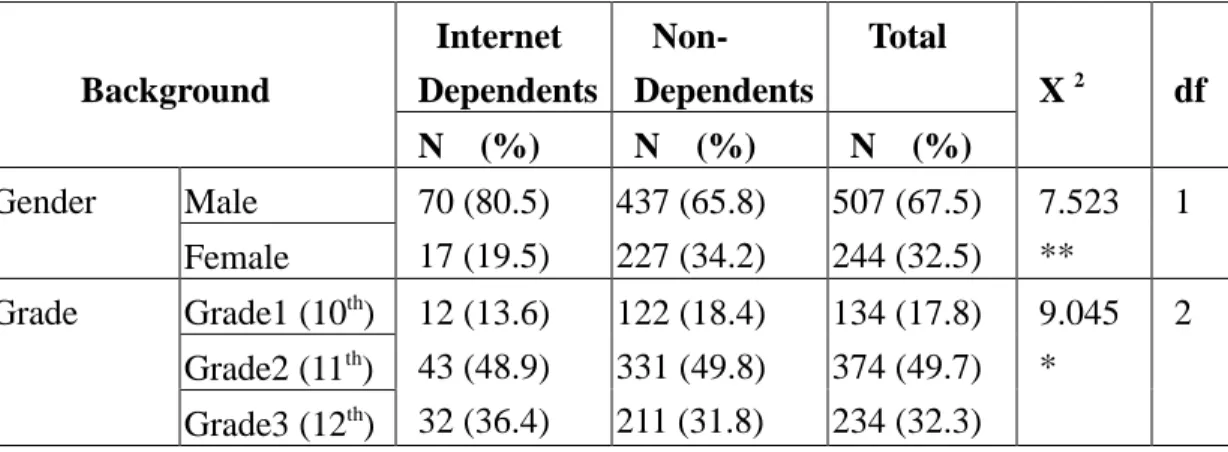
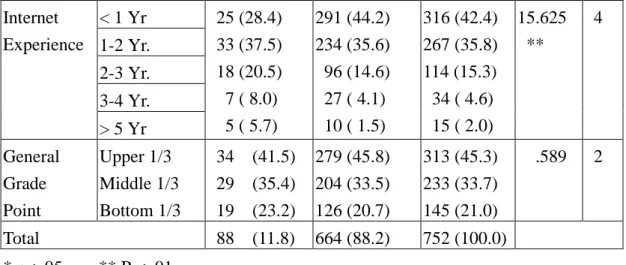
Demographic DataThe backgrounds of the Internet dependents were different from the
non-dependents. For example, Internet dependents included significantly more boys (ratio of 4 boys to 1 girl), more 11th and 12th graders, and longer Internet experiences than the non-dependents. However, these two groups were about the same in their school achievement.
Table 1: Frequencies and X2
tests of Internet dependents and non-dependents differences on gender, grade, and Internet experience.
Inter net Dependents Dependents Total Background N (% ) N (% ) N (% ) X 2 df Male Gender Female 70 (80.5) 17 (19.5) 437 (65.8) 227 (34.2) 507 (67.5) 244 (32.5) 7.523 ** 1 Grade1 (10th ) Grade2 (11th ) Grade Grade3 (12th ) 12 (13.6) 43 (48.9) 32 (36.4) 122 (18.4) 331 (49.8) 211 (31.8) 134 (17.8) 374 (49.7) 234 (32.3) 9.045 * 2
< 1 Yr 1-2 Yr. 2-3 Yr. 3-4 Yr. Internet Experience > 5 Yr 25 (28.4) 33 (37.5) 18 (20.5) 7 ( 8.0) 5 ( 5.7) 291 (44.2) 234 (35.6) 96 (14.6) 27 ( 4.1) 10 ( 1.5) 316 (42.4) 267 (35.8) 114 (15.3) 34 ( 4.6) 15 ( 2.0) 15.625 ** 4 General Grade Point Upper 1/3 Middle 1/3 Bottom 1/3 34 (41.5) 29 (35.4) 19 (23.2) 279 (45.8) 204 (33.5) 126 (20.7) 313 (45.3) 233 (33.7) 145 (21.0) .589 2 Total 88 (11.8) 664 (88.2) 752 (100.0) * p< .05 ** P < .01
Vulnerability of Internet dependents
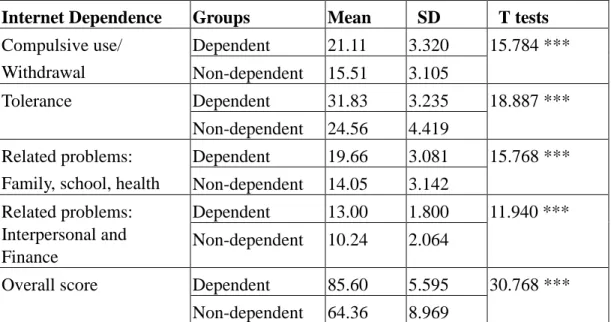
The Internet dependents obtained significantly higher overall IAST score and scores on four subscales (tolerance, compulsive use and withdrawal, related problems: family, school, health, and related problems: Interpersonal and finance) than the non-dependents (see Table 2).
The Internet dependents reported to stay on-line significantly longer in using WWW, Chat room/ IRC, BBS (Bulletin Board System which is a very popular Internet application in Taiwan), and ftp than the non-dependents (see Table 3). However, these two groups spent about the same amounts of time in using E-mail, playing Net game/ MUD, and browsing Newsgroup that are relatively not-so-popular applications of Internet for Taiwan high school students. Though E-mail is a very popular application for Taiwan college students, few high school computer centers in Taiwan distribute E-mail accounts to their students. In addition, not many Taiwan high students, about 1/14 of our participants, ever tried to play Net games (MUD) and Newsgroup.
Table 2: Means, standard deviation, and t tests on IAST subscales and overall score for Internet dependents (N = 88) and non-dependents (N = 665).
Inter net Dependence Groups Mean SD T tests Dependent 21.11 3.320 Compulsive use/ Withdrawal Non-dependent 15.51 3.105 15.784 *** Dependent 31.83 3.235 Tolerance Non-dependent 24.56 4.419 18.887 *** Dependent 19.66 3.081 Related problems:
Family, school, health Non-dependent 14.05 3.142
15.768 *** Dependent 13.00 1.800 Related problems: Interpersonal and Finance Non-dependent 10.24 2.064 11.940 *** Dependent 85.60 5.595 Overall score Non-dependent 64.36 8.969 30.768 *** *** p < .001
Table 3: Average amounts of time spent (hours/per week), standard deviation, and t tests on various Internet applications for Internet dependents and non-dependents.
Inter net usage (hr s/per week) Groups Mean SD T tests
Dependent 4.727 5.208 WWW
Non-dependent 2.845 3.777
3.139 **
Dependent 3.079 5.880 Chat room/ IRC
Non-dependent 1.109 2.344 2.908 ** Dependent 3.076 4.194 BBS Non-dependent 1.409 2.701 3.490 ** Dependent 2.324 4.148 ftp Non-dependent .821 1.422 3.192 ** Dependent 1.604 3.570 Email Non-dependent .995 2.743 1.786 Dependent 2.071 3.954 Net game/ MUD
Non-dependent 1.274 2.813 1.708 Dependent .693 1.579 Newsgroup Non-dependent .519 1.023 .925 ** p < .01
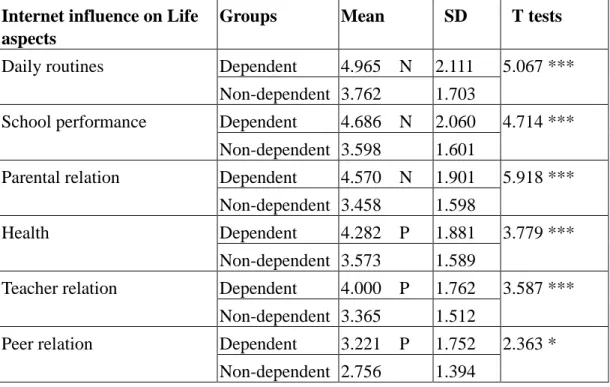
Internet influences on all six aspects of life (see Table 4). The Internet dependents reported Internet to have negative influences toward their daily routines, school performance, and parental relationships (4.965, 4.686, and 4.570 are larger than the midpoint, 4.5 in the 8-point scale, 1 = extremely positive, 8 = extremely negative). However, they felt the Internet positively influencing on their health, teacher
relationships, and peer relationships. For the non-dependents, Internet have positive influences toward all aspects of life.
Table 4: Means, standard deviation, and t tests on Internet influences toward various life aspects. Internet influence on life aspects were measured using a 8-point Likert style scale, raining from 1 = extremely positive, 8 = extremely negative, for Internet dependents and non-dependents.
Inter net influence on Life aspects
Groups Mean SD T tests
Dependent 4.965 N 2.111 Daily routines Non-dependent 3.762 1.703 5.067 *** Dependent 4.686 N 2.060 School performance Non-dependent 3.598 1.601 4.714 *** Dependent 4.570 N 1.901 Parental relation Non-dependent 3.458 1.598 5.918 *** Dependent 4.282 P 1.881 Health Non-dependent 3.573 1.589 3.779 *** Dependent 4.000 P 1.762 Teacher relation Non-dependent 3.365 1.512 3.587 *** Dependent 3.221 P 1.752 Peer relation Non-dependent 2.756 1.394 2.363 *
N: negative Internet influences. P: positive Internet influences.
Sensation seeking and Internet dependence
The result of t tests showed that Internet dependent adolescents scored significantly higher on overall sensation seeking and disinhibition than the Internet
non-dependents. However, both groups displayed no differences on the life experience seeking subscale and the thrill and adventure seeking subscale (see Table 5). This finding was very different from the results of Lavin et al. (2000) in which the Internet addicted American college students scored significantly lower on the thrill and adventure seeking, experience seeking, and overall score of sensation seeking.
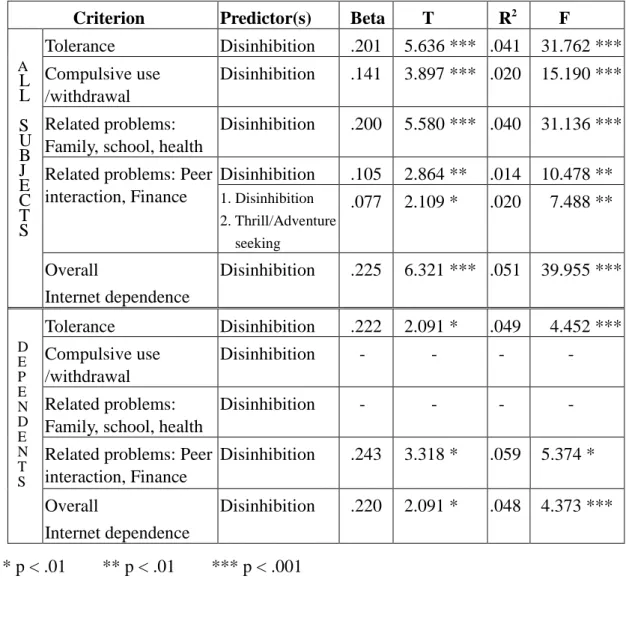
Within the whole subject pool, the regression of sensation seeking on Internet dependence indicated that only disinhibition is the significant predictor on scores of three addiction subscales: compulsive use and withdrawal, tolerance, and related problem: family, school, and health, as well as the overall score of Internet
dependence (see Table 3). To predict score on Internet related problem: interpersonal and finance, both disinhibition and thrill and adventure seeking entered into the regression using stepwise (forward). While, for the Internet dependents, disinhibition successfully predicted tolerance, Internet related problem: interpersonal and finance, and overall IAST score.
Table 5: Means, standard deviations and t tests for Internet dependent and non-dependent high school adolescents in sensation seeking.
Sensation seeking Groups N Mean SD T tests
Dependent 88 8.506 2.236 Life experience seeking Non-dependent 665 8.263 2.525 1.903 Dependent 88 7.617 2.356 Thrill and
adventure seeking Non-dependent 665 7.561 2.380
.418 Dependent 88 4.750 1.651 Disinhibition Non-dependent 665 4.348 1.518 4.662 *** Dependent 88 20.872 4.546 Overall score Non-dependent 665 20.171 4.773 2.627 ** ** p < .01 *** p < .001
Table 6: For the whole subjects (N = 753) and Internet dependents (N = 88), the regression of sensation seeking on 4 dimensions of and overall Internet dependence: the standardized regression coefficients and coefficients of determination.
Cr iter ion Predictor (s) Beta T R2
F Tolerance Disinhibition .201 5.636 *** .041 31.762 *** Compulsive use /withdrawal Disinhibition .141 3.897 *** .020 15.190 *** Related problems: Family, school, health
Disinhibition .200 5.580 *** .040 31.136 ***
Disinhibition .105 2.864 ** .014 10.478 ** Related problems: Peer
interaction, Finance 1. Disinhibition 2. Thrill/Adventure seeking .077 2.109 * .020 7.488 ** A L L S U B J E C T S Overall Internet dependence Disinhibition .225 6.321 *** .051 39.955 *** Tolerance Disinhibition .222 2.091 * .049 4.452 *** Compulsive use /withdrawal Disinhibition - - - -Related problems: Family, school, health
Disinhibition - - -
-Related problems: Peer interaction, Finance Disinhibition .243 3.318 * .059 5.374 * D E P E N D E N T S Overall Internet dependence Disinhibition .220 2.091 * .048 4.373 *** * p < .01 ** p < .01 *** p < .001
CONCLUSION
This study intended to investigate one of the significant psychological features of adolescence, sensation seeking, and their vulnerability to Internet dependence. The results showed that problematic Internet usage (about 20 hours per week) of the dependent adolescents is similar to the problems young adults experienced, documented in the previous studies. For example, Brenner (1997) reported that average time on-line for Internet addictive adults in the United States is about 21
hours per week and for Taiwan college students, Chen (1998) reported 19 hr/pw and Chou, Chou, & Tyan (1999) reported 23 hr/pw. In Taiwan, high school students have to go through a very competitive entrance examination, so ordinarily they must engage in intensive learning. The Internet dependents reported to spend 20 hours a week on-line is relatively long according to high students’ tight learning schedule in Taiwan.
The dependents regarded that the Internet have negative influences toward many aspects of their life. While they perceived significantly stronger negative Internet influences on daily routines, school performance, and parental relation than the non-dependents, both Internet dependents and non-dependents regarded Internet use have positive effects on peer relationships. This result confirmed Kandell’s (1998) suggestion that the Internet were used to fulfill the needs to obtain and maintain meaning interpersonal relationships and intimacy. Surprisingly that all subjects, Internet dependent or not, reported that teacher relationships were enhanced by the use of Internet. It seems that high school teachers in Taiwan have not yet realized the problems their students may have in use of the Internet or perhaps they value the Internet as the super highway and underestimate its negative effects toward adolescents.
If various subgroups of Internet dependents were categorized by the most intensive activities they are engaging, such as Internet game, discussion about certain theme (Star Trek), or virtual sex (Griffiths, 2000, Tsai & Lin, 2000), Internet use for establishing non-face-to-face social network might be a very fascinating and
demanding pitfall for adolescents. However, future study is needed before this implication can be confirmed.
higher scores of disinhibition and overall sensation seeking than the Internet non-dependents, while they obtained similar scores on life experience seeking, and thrill and adventure seeking. Regression analyses showed parallel result. Disinhibition is the most important predictor of Internet dependence for both whole subject group or the Internet dependents.
Inhibition is regarding behavior constraints produced through inner self-conscious states such as anxiety about social situations or worries about public
evaluation (Zimbardo, 1977). Disinhibition then is the reverse term of the same factor describing how people reduce public self-awareness, less concern about the
judgement of others, and thus ignoring conventional constraints.
Non-face-to-face and anonymous are significant features for the Internet interaction environment. In such environment, social cues are easily removed. Moreover, nickname even provides Internet users a way to create new social cues. Therefore, Joinson (1999) stated that normal constraints and rules of social interaction may not exist on the Internet. The problematic use of Internet use among Taiwan high school adolescents may reflect their motivation to strive for personal identity through breaking social inhibition. In adolescent ages, youth strive for independence may struggle too hard and reach an extreme of anti-establishment (Kaplan, 1988). The authors suggest that autonomy claim is one of the important reasons that Taiwan high school adolescents become Internet dependent. With the very same motivation, previous studies have shown many adolescents engaging in risks, such as taking drug, alcohol, or experiencing unsafe sex.
Such result is incompatible with the findings of Lavin, et al. (1999). Lavin et al. (1999) investigated relatively more mature subjects, college students in late adolescence, in different culture, the United States. Their results indicated that
Internet dependents obtained significant lower scores on thrill and adventures seeking, excitement seeking, and overall sensation seeking than non-dependents. The
differential findings of these two studies may be attributed to either age or cultural differences. Further studies are needed to resolve this confusion.
ACKNOWLEDGEMENT
The authors would like to thank the National Science Council of the Republic of China for financially supporting this research under Contracts No. NSC 89-2520-S-009-010 and NSC 89-2511-S-009-007-N.
REFERENCES
Chen, T. Y. (2000, July 24). Taiwan Internet users has reached 640 million people.
United Daily Evening News, p.26.
Brenner, V. (1996). An initial report on the online assessment of Internet addiction: The First days of the Internet usage survey. [Online] Available at
http://www.ccsnet.com/prep/pap/pap8b/638b012p.txt
Brenner, V. (1997). Psychology of computer use: XLVII. Parameters of Internet use, abuse, and addiction: the first 90 days of the Internet usage survey.
Psychological Reports, 80, 879-882.
Chen, S. H. (1998). An Internet addiction measurement for Taiwan college students. Paper presented in TANET 98.
Chiu, H. C. (1990). The correaltional study of need for cognition, sensation seeking, social anxiety, and personal creativity. Unpublished master thesis of Fu Jeng University, Taiwan.
Chou, C., Chou, J., & Tyan, N. N. (1999). An exploratory study of Internet addiction, usage and communication pleasure – The Taiwan’s case. International Journal of Educational Telecommunications, 5(1), 47-64.
Chou, C., & Hsiao, M. C. (2000).
Donohew, R. L., Hoyle, R. H., Clayton, R. R., Skinner, W. F., Colon, S. E., & Rice, R. E. (1999). Sensation Seeking and Drug Use by Adolescents and Their Friends: Models for Marijuana and Alcohol. Journal of Studies on Alcohol, 60(5), 622-631.
Egger, O. et. Al. (1996). Results of Internet behavior questionnaire. [Online]
Available at http://www.ifap.bepr.ethz.ch/egger/ibq/res.htm. Switzerland: Work and Organizational Unit, Swiss Federal Institute of Technology at Zurich. Farley, F. H., & Cox, S. O. (1971). Stimulus-seeking motivation in adolescents as a
function of age and sex. Adolescence, 6, 207-218.
Greenfield, D. N. (2000). Psychological characteristics of compulsive internet use: A preliminary analysis. CyberPsychology and Behavior, 5(2), 403-412.
Griffiths, M. (1996). Gambling on the Internet: A brief note. Journal of Gambling Studies, 12(4), 471-473.
Griffiths, M. (1997). Psychology of computer use: XLVII. Some comments on ‘Addictive use of the internet’ by Young [Comment]. Psychological Reports,
80(1),81-2.
Griffiths, M. (1998). Internet addiction: Does it really exist? In Gackenbach, J. (Ed.), Psychology and the Internet: Intrapersonal, interpersonal, and traspersonal implications (pp. 61-75). San Diego, CA: Academic Press.
Griffiths, M. (2000). Does Internet and computer addiction exist? Some case study evidence. CyberPsychology and Behavior, 3(2), 211-218.
Joinson, A. (1999). Causes and implications of disinhibited behavior on the Internet. In Gackenbach, J. (Ed.), Psychology and the Internet: Intrapersonal,
interpersonal, and traspersonal implications (pp. 43-60). San Diego, CA: Academic Press.
Jonah, B. A. (1997). Sensation seeking and risky driving: A review and sythesis of the literature. Accident Analysis and Prevention, 29(5), 651-665.
Kandell, J. (1998). Internet addiction on campus-The vulnerability of college students. CyberPsychology and Behaviro, 1, 46-59.
Kaplan, P. S. (1988). The human odyssey: Life span development. St. Paul, MN: West
Publishing Co.
Lavin, M., Marvin, K., McLarney, A., Nola, V. & Scott, L. (2000). Sensation seeking and collegiate vulnerability to Internet dependence. CyberPsychology and Behavior, 2(5), 425-430.
Lin, S. S. J., & Tsai, C. C. (1999). Internet addiction among high schoolers in Taiwan. Paper presented at the annual convention of American Psychological
Association, Boston, MA.
Newcom, M., & McGee, L. (1991). Influence of sensation seeking on general
deviance and specific problem behaviors from adolescence to young adulthood.
Journal of Personality and Social Psychology, 61(4), 614-628.
Tsai, C. C. & Lin, S. S. J. (1999). An analysis of attitudes toward computer networks and Internet addictions. Paper presented at the annual convention of American Psychological Association, Boston, MA.
Tsai, C. C., & Lin, S. S. J. (1999). Internet addiction of Taiwanese adolescents: An in-depth interview study. Paper presented at the annual convention of American Psychological Association, Washington, DC.
Young, K.S. (1996a). Internet addiction survey. [Online] Available at
http://www.pitt.edu/~ksy/survey.htm
Young, K.S. (1996b). Psychology of computer use: XL. Addictive use of the internet: A case study that breaks the stereotype. Psychological Reports, 79, 899-902.
Young, K. S. (1997). Internet addiction: The emergence of a new disorder. Paper resented in annual meeting of American Psychological Association.
Young, K. F. (1987). Sensation seeking and the relation with creativity and juvenile delinquency. Unpublished master thesis of National Cheng Chi University, Taiwan.
Zarevski, P., Marusic, I., Zolotic, S., Bunjevac, T., & Vukosav, Z. (1998).
Contribution of Arnetts inventory of sensation seeking and Zuckerman sensation seeking scale to the differentiation of athletes engaged in high and low risk sports. Personality and individual differences, 25 (4), 763-768.
Zimbardo, P. G. (1977). Shyness:What is it and what to do about it. London, Pan Books.
Zuckerman, M. (1979). Sensation seeking: Beyond the optimal level of arousal. Hillsdale, New Jersey: LEA.