行政院國家科學委員會專題研究計畫 成果報告
老人健康促進運動之長期效應的評估
研究成果報告(精簡版)
計 畫 類 別 : 個別型 計 畫 編 號 : NSC 99-2410-H-028-003- 執 行 期 間 : 99 年 08 月 01 日至 100 年 07 月 31 日 執 行 單 位 : 國立臺灣體育學院體育學系 計 畫 主 持 人 : 吳鴻文 共 同 主 持 人 : 許弘昌 計畫參與人員: 碩士班研究生-兼任助理人員:李榕津 碩士班研究生-兼任助理人員:郭恬如 其他-兼任助理人員:李淑雅 報 告 附 件 : 出席國際會議研究心得報告及發表論文 公 開 資 訊 : 本計畫涉及專利或其他智慧財產權,2 年後可公開查詢中 華 民 國 100 年 10 月 31 日
中文摘要: 人們隨著歲月增長老化,除了造成感覺、運動、認知能力的衰 退,肌力、肌耐力、心肺適能、關節活動度、平衡能力也會下 降。由於遺傳因子及運動形式的差別,下降趨勢亦因人而異。 減緩老化除了醫療等方式的介入外,運動亦已被證實是一有效 的方式。完整的老人運動課程應該包括肌力、心肺、柔軟度、 平衡能力的訓練。ACSM、WHO、U.S. Surgeon General 及國內 的國民健康局等,也大力推廣老人運動的重要性。然而,因運 動課程的設計,過去文獻並未有提出一套完整運動課程,包含 肌力、心肺、柔軟度與平衡能力的具體成效,也少有肌力與平 衡能力的生物力學量化評估。American Council on Exercise (ACE)老人健康促進運動在美國已推廣多年,以運動科學當基 礎,課程中包括了肌力、心肺、柔軟度與平衡能力等訓練,且 不需要太多的器材,不受場地的限制。課程的強度與內容,亦 可隨時配合不同參與者。本計劃在台中市及南投的社區進行帶 ACE 老人運動 6 個月,並探討運動前後的差異。結果顯示,經 過 6 個月運動後,受試者在功能性體適能檢測中,下肢肌耐 力、二頭肌肌耐力、肩部柔軟度、心肺耐力及靈敏度上有明顯 改善。同時,在跨越障礙物結果,運動後會明顯減少 Leading foot 之 toe 與障礙物之距離。在由椅子站立之結果,運動後受試 者會增加膝關節活動度及踝關節 plantarflexion moments. 這些科 學化的分析提供運動科學的依據,提供老人健康促進的運動具 體確實的證據,也更有助於運動推廣促進老人健康。
英文摘要: The sensory, motor and cognitive abilities will be declined with aging. The muscle strength, muscle endurance, range of motion and balance will also be decreased with aging. However, the reduction rate of the physical performance is dependent on the individual and the exercise habit. It has been investigated in literature that exercise is one of the most efficient methods to decrease the aging effect. A comprehensive exercise course for elder people includes muscle strengthening, cardiopulmonary endurance training, range of motion exercise and balance training. The importance of exercise for elder people has been widely promoted by the following institutions, ACSM, WHO, US surgeon general and department of health in Taiwan. However, there was lack of science based evidences in literature for evaluating the exercise for elder people. ’Senior functional chair exercise’ is developed as the health promotion exercise in the American Council on Exercise in United Status. It consists of muscle strength, muscle endurance, flexibility and balance. The powers of senior functional chair exercise are minimal equipment needed and no environment limitation. The aim of this study was to compare the difference on the parameters of physical fitness and biomechanical analysis between pre-exercise and post-exercise. The results showed that there were significant differences on the muscle strength endurance of arm curl test, chair stand test
(muscle strength endurance of lower limbs), shoulder flexibility (back scratch test), cardio endurance (2-minute Step Test), and the agility/dynamic balance (8-Foot Up-And-Go-Test) in the functional fitness assessment after exercise. Besides, there was significant decrease in leading foot toe-obstacle distance during obstacle crossing. There were also significant increases on the knee joint range of motion and ankle plantar-flexion moments. With the scientific analysis of this exercise, it provides the strong objective support to promote the exercise for elder people so as to reduce the social cost and improve the quality of life in the elders.
老人健康促進運動之長期效應的評估
中、英文摘要及關鍵詞 (keywords)
人們隨著歲月增長老化,除了造成感覺、運動、認知能力的衰退,肌力、肌耐力、心肺適能、關節活 動度、平衡能力也會下降。由於遺傳因子及運動形式的差別,下降趨勢亦因人而異。減緩老化除了醫 療等方式的介入外,運動亦已被證實是一有效的方式。完整的老人運動課程應該包括肌力、心肺、柔 軟度、平衡能力的訓練。ACSM、WHO、U.S. Surgeon General 及國內的國民健康局等,也大力推廣老 人運動的重要性。然而,因運動課程的設計,過去文獻並未有提出一套完整運動課程,包含肌力、心 肺、柔軟度與平衡能力的具體成效,也少有肌力與平衡能力的生物力學量化評估。American Council on Exercise (ACE)老人健康促進運動在美國已推廣多年,以運動科學當基礎,課程中包括了肌力、心肺、 柔軟度與平衡能力等訓練,且不需要太多的器材,不受場地的限制。課程的強度與內容,亦可隨時配 合不同參與者。本計劃在台中市及南投的社區進行帶 ACE 老人運動 6 個月,並探討運動前後的差異。 結果顯示,經過 6 個月運動後,受試者在功能性體適能檢測中,下肢肌耐力、二頭肌肌耐力、肩部柔 軟度、心肺耐力及靈敏度上有明顯改善。同時,在跨越障礙物結果,運動後會明顯減少 Leading foot 之 toe 與障礙物之距離。在由椅子站立之結果,運動後受試者會增加膝關節活動度及踝關節 plantarflexion moments. 這些科學化的分析提供運動科學的依據,提供老人健康促進的運動具體確實的證據,也更有 助於運動推廣促進老人健康。 關鍵詞:老人運動、生物力學、健康促進
The sensory, motor and cognitive abilities will be declined with aging. The muscle strength, muscle endurance, range of motion and balance will also be decreased with aging. However, the reduction rate of the physical performance is dependent on the individual and the exercise habit. It has been investigated in literature that exercise is one of the most efficient methods to decrease the aging effect. A comprehensive exercise course for elder people includes muscle strengthening, cardiopulmonary endurance training, range of motion exercise and balance training. The importance of exercise for elder people has been widely promoted by the following institutions, ACSM, WHO, US surgeon general and department of health in Taiwan. However, there was lack of science based evidences in literature for evaluating the exercise for elder people. “Senior functional chair exercise” is developed as the health promotion exercise in the American Council on Exercise in United Status. It consists of muscle strength, muscle endurance, flexibility and balance. The powers of senior functional chair exercise are minimal equipment needed and no environment limitation. The aim of this study was to compare the difference on the parameters of physical fitness and biomechanical analysis between pre-exercise and post-exercise. The results showed that there were significant differences on the muscle strength endurance of arm curl test, chair stand test (muscle strength endurance of lower limbs), shoulder flexibility (back scratch test), cardio endurance (2-minute Step Test), and the agility/dynamic balance (8-Foot Up-And-Go-Test) in the
functional fitness assessment after exercise. Besides, there was significant decrease in leading foot toe-obstacle distance during obstacle crossing. There were also significant increases on the knee joint range of motion and ankle plantar-flexion moments. With the scientific analysis of this exercise, it provides the strong objective support to promote the exercise for elder people so as to reduce the social cost and improve the quality of life in the elders.
Keywords: Older Adults Activity, Biomechanics, Health Promotion
前言 近年來人口老化的問題已漸漸浮現,不只是世界各先進國家,台灣人口結構也有明顯高齡化社會的趨 勢。減緩老化或是在年齡增長時維持健康適能,都是大家所熱烈關切討論的課題。隨著老化的進行, 人體身理機能會隨之下降,許多退化性疾病或慢性病將隨之而來。對於老年人而言跌倒已經成為值得 重視的問題,對於改善平衡減少跌倒發生的問題也逐漸受到重視。若是能夠增進養成中老年時期運動 習慣,將會對改善下肢肌力衰退及增進本體感覺都會對預防跌倒發生的情形有正面的幫助。
關於老人的運動課程及訓練原則,美國 Consensus Development Conference (CDC)、American College of Sports Medicine (ACSM)或是 American Heart Association (AHA),都建議成人每星期最好每天從事有氧 運動,每次也都要達到 30 分鐘以上,運動強度也要達到中高強度以上。而且提到不只是從事有氧運動, 也要從事阻力訓練。Nelson et al., (2007) 整理了 ACSM/AHA 在 2007 年針對老年人設計的課程,提出 了一個針對有氧運動、肌力訓練、柔軟度及平衡的訓練建議。在心肺運動部份:中強度運動至少 5 次/ 週,或高強度 3 次/週,強度以中強度在 10 分的量表中大約是 5-6 分,高強度則大約是 7-8 分。持續時 間為中強度運動累積至少 30 分鐘,每次至少 10 分鐘,高強度至少連續 20 分鐘。在肌力及肌耐力訓練 運動部分:頻率為每週至少 2 次,運動需包括 8-10 種主要大肌群的訓練,組數和反覆次數為 10-15 反 覆次數。柔軟度及平衡方面:每週至少伸展 2 次。對於那些有跌倒風險者,運動要包含能改善或維持 平衡能力。
美國運動協會(American Council on Exercise, ACE)的推出的銀髮族功能性體適能運動,在美國已推廣多 年。藉由椅子的輔助讓教練在安全的環境下運動,課程中納入了運動科學當基礎,課程中包括肌力、 心肺、柔軟度與平衡及協調能力的訓練,且不需要太多的器材,也較不受場地的限制。課程的強度與 內容,亦可隨時調整,配合不同體能能力的參與者。 研究目的 本研究的目的為探討 ACE 的銀髮族功能性體適能運動在社區執行,對老人健康促進的成效。分析銀髮 族功能性體適能檢測資料(血壓、腰臀圍、30 秒椅上站立、啞鈴手臂屈曲、2 分鐘抬膝、坐椅體前彎、 手臂後伸展以及椅上起立及 8 英呎步行迴轉),為了更進一步科學量化在日常功能的成效,本研究請銀 髮族受試者到實驗室進行日常功能活動(椅子坐姿起立及跨越障礙物)的人體動作生物力學參數,來評估 運動對老人的效應。
文獻探討 近年來,有很多學者投入老人運動的推廣,也提出很多關於老人的運動,常見的運動包括:太極拳、 瑜珈、椅上運動、肌力訓練、走路課程、民族舞蹈、有氧舞蹈及水中運動等。隨著運動種類的增加, 運動強度的變化大,運動傷害的發生率也跟著提升,因此這幾年開始流行"身心靈結合"的運動,美 國很多運動機構(如 YMCA 等)也開始推廣太極拳運動。關於老人參與太極拳課程的長短期效應的研究 也很多,大部份研究提到太極拳有助於改善收縮壓及舒張壓(Chen et al., 2008),也可提升握力及柔軟度 增加(Thornton et al., 2004; Chen et al., 2008)、可改善膝關節及踝的肌力,增進靜態或動態平衡及活動能 力降低跌倒風險(Choi et al., 2005; Tsang et al., 2008; Taggart, 2002; Thornton et al., 2004)。Woo et al., (2007) 亦提到太極拳對女性老年人有降低骨質流失的風險。瑜珈也是一種流行的身心靈結合運動,Tekur et al., (2008) 研究發現老人長期參與瑜珈課程,可減少背痛及增加軀幹的柔軟度。 Shigematsu et al., (2002) 提到舞蹈方式的有氧課程,可改善老年人的平衡能力及靈敏度,Shimamoto et al., (1998)則建議低衝擊 有氧舞蹈對於改善體脂等身體組成有相當好的效果。 有很多些學者亦研究老人參與民族舞蹈及有氧舞蹈的效益。Alpert et al., (2009)提出修正式爵士舞蹈有 助於改善老人的感覺統合能力,Eyigor et al., (2009)探討社區團體運動型式的土耳其舞蹈對老人平衡的 改善有明顯助益,老年人參家傳統希臘舞蹈 10 週後,也有明顯增加平衡能力(Sofianidis et al., 2009)。 走路訓練是最常用於護理之家的老人運動,Schoenfelder et al., (2004)發現定期的走路訓練有助於改善護 理之家老年人平衡能力及害怕跌倒的感覺,Melzer et al., (2003)亦提出定期的走路課程可增加膝關節及 踝關節的肌力與全身的平衡能力。 而在居家運動與團體運動方式的差異及功效上,Liu-Ambrose et al., (2008) 研究指出居家運動,可降低 老年人跌倒發生率及改善認知能力。Lord et al., (2003) 及 Barnett et al., (2003) 都提到社區團體運動有 助於降低跌倒風險及維持老人體能狀況。雖然在站立平衡能力有改善,但肌力、反應時間與走路速度 並沒有改變很大。Arai et al., (2009)建議長期(12 個月)的社區團體體能活動與平衡訓練可明顯改善平衡 能力。Mcmurdo et al., (1993)指出在安養中心,讓老人每週進行椅上運動 2 次,握力、柔軟度可明顯改 善,由椅子坐姿站立時間也顯著減少。Cyarto et al., (2008)則提到:團體課程比居家個人運動更可改變 平衡能力,其原因可以用 Forkan et al., (2006)研究發現來解釋:病人(老人)在物理治療後的進行居家運 動,其成效並不好。37%老年人無法持續進行居家運動,造成沒練習主因為沒興趣、健康不佳、氣候、 消沈、身體虛弱、害怕跌倒、呼吸不順、預期沒效應等。
在阻力訓練的效應上,Brouwer et al., (2003)研究指出阻力運動有助於降低跌倒風險,Manini et al., (2007) 提到規律肌力訓練比功能性方式運動更能增加肌力,但在身體組成及心肺功能上並不太有差異。Rosie et al., (2007) 建議由坐到站(Sit-to-stand)是當作居家式運動的很好方面,其可明顯改善平衡及肌力。 Carter et al., (2001)研究老年人進行 10 週的社區肌力及平衡訓練,但由於強度與頻率的差別,並未發現 有顯著成效。 也很多學者提出多樣式的複合運動更能增進老人運動的成效,Silsupadol et al., (2009)研究發現多樣化的 平衡訓練相對較能改善步行速度及平衡能力,Islam et al., (2004)指出感覺統合平衡訓練及肌力訓練有助
於改變平衡,Baker et al., (2007)研究提到複合型運動有助於降低跌倒風險,但因參與課程差異及頻率 與強度不同,在身體及功能性上的改變差異不明顯(未有統計上差異)。Bobo et al., (1999)在長期追蹤研 究結果發現單純的心肺有氧舞蹈並未明顯提升柔軟度及協調性,建議課程內應加入其他訓練,如伸展 與平衡等動作等。Bocalini et al., (2008) 則提到水中有氧運動比陸上走路運動更能提昇心肺能力。 上述這些研究都是單一在有氧運動、肌力訓練、柔軟度去訓練,而不是 ACSM 所建議的完整運動課程 也因此在運動效益上並非全面性的改善。美國運動協會的推出的銀髮族功能性體適能運動,課程中包 括肌力、心肺、柔軟度與平衡及協調能力的訓練。然而,並未有相關文獻去探討此套運動對體能上改 善的效益。因此,本研究的目的為探討銀髮族在參與 ACE 的銀髮族功能性體適能運動後,在功能性體 適能及日常功能性動作策略上的改變,以評估此套運動的實際效益,作為日後運動課程設計安排及推 廣的參考。 研究方法 本研究以在大台中市及南投地區之 4 個社區及仁愛之家,由具有美國 YMCA 老人體適能證照之教 練(本計劃之兼任助理;研究生)帶銀髮族進行美國老人健康促進運動 (American Council on Exercise, ACE),共約 82 名銀髮族參與課程共 6 個月,每週運動三次,每次一小時。課程內容包括心肺訓練、 肌力訓練、柔軟度訓練及平衡與協調動作訓練。在平均每週有參與 2 次運動課程以上者,再進行銀髮 族功能性體適能檢測,最後共有 27 位完成前後測驗。在人體動作生物力學分析部份,則徵求有意願者, 將其帶到國立臺灣體育學院運動生物力學實驗室進行,探討跨越障礙物及由坐姿到站立之下肢生物力 學,最後共有 12 位完成此部份之前後測驗。 在運動課程心肺訓練部分,為了確保運動的安全性主要是以椅子運動 (Chair exercise)以及在椅子 周圍進行有氧運動訓練的主軸。動作簡易,讓老人可以輕鬆跟上運動的節奏。動作的設計上,會從腳 先開始動作然後再加入上半身的動作。腳的動作包含腳跟抬起(Heel raise)、腳尖抬起 Toe raise、腳尖朝 外與朝內(Toe in/out)、腳尖或腳跟點地(Tap toes/heels)、原地踏步(March in place)、踏併(Step touch)、抬 膝(Knee lift)、踢步(Kick)、膝蓋伸直(Knee extension)、開開合合(Out out in in)、開合(Knee together and apart)、V 字步(V Step)、椅上開合跳(Jumping jack)、前前後後(Forward and back)……等。上半身的動作 包含肩膀上提(Lift shoulder)、繞圈(Circle shoulder)、前後移動(Move shoulder forward and back),手臂向 下、向前、上舉、打開、彎曲、向前划,手腕彎曲、伸直,手掌抓握、手指開合、拍手……等。課程 中亦藉由左右手及左右腳搭配組合,增加課程的變化性,以達到協調訓練的目的。在肌力訓練部份則 採用椅上或是站姿的方式來訓練 8-10 種主要肌群,使用的器材有彈力帶、橡皮繩、小啞鈴或是小皮球 等道具讓老年人達到訓練的效果之外,還可以增加老年課程的豐富與安全性。動作的設計包含胸大肌 訓練(Chest press)肩上肌力訓練(Overhead press)、闊背下拉(Overhead pull-downs)、直立划船(Upright rowing)、下蹲(Squat)、腿後肌訓練(Hamstring curl)、膝蓋伸直(Knee extension)、大腿外展與內收 (Thigh abduction / adduction)、二頭肌彎曲(Biceps curl)、三頭肌伸直(Triceps extension)或是功能性的前臂手腕 轉動(Forearm and 、手掌抓握(球)……等。柔軟度訓練部分則考慮老年人屬於跌倒高危險的對象,應該
要搭配維持或增進平衡的運動來降低跌倒的危險性。柔軟度運動以較適合於老年人的靜態伸展為主, 心肺及肌力訓練課程中有用到的大肌群皆會進行伸展。平衡的訓練須在椅子周圍進行以確保安全,動 作的設計像是維持墊腳尖的姿勢、單腳站立(包含抬膝、後勾、腳伸直)等。 銀髮族體適能檢測則包括血壓、腰臀圍、椅上站立 30 秒的次數(下肢肌耐力)、手臂彎曲 30 秒的次 數(上肢肌耐力;男性用 8 磅、女性用 5 磅啞鈴)、2 分鐘踏步總次數(心肺耐力)、坐椅體前彎(下背及髖 部的柔軟度)、手臂後伸展(肩部柔軟度)、椅上起立及 8 英呎步行迴轉(靈活度及平衡能力)等。 人體動作生物力學評估部份,徵詢意願之銀髮族,並分別帶到國立臺灣體育學院運動生物力學實 驗室進行從椅子站立(sit to stand)及跨越障礙物等人體動作分析,以量化老年人在日常功能性動作時, 肌力、平衡能力、協調能力上的變化。從椅子站立站立之椅高則以每位受試者之膝高來定義。本實驗 使用 VICON 人體動作分析系統( 8 台高速攝影機),採樣頻率為 250 赫茲,配合貼於身上特定肢段的反 光球來偵測受測者於空間中的三維軌跡(three-dimensional trajectory),使用 AMTI 測力板取得地面反作 用力的資料,採樣頻率是 1000 赫茲。利用逆向動力學方式(inverse dynamics method) 計算下肢上肢各 關節力量及力矩及重心的軌跡與對稱性。
圖二:銀髮族功能性體適能檢測情形
結果與討論
由功能性體適能結果顯示(如圖四),經過 6 個月運動後,受試者在下肢肌耐力、二頭肌肌耐力、肩部柔 軟度、心肺耐力及靈敏度上有明顯改善(pair-t test, p<.05)。其表示此 ACE 功能性體適能運動,在短中 期時間,相對較容易改善銀髮足受試者之肌耐力、心肺耐力及平衡與靈敏度。而在血壓上,不論是收 縮壓或舒張壓皆有下降,但未達顯著差異。若將運動持續更長久時間(一年以上),或許可明顯在血壓上 有下降。而在體重及腰臀圍上,運動前後並無明顯差別,其表示體重及腰臀圍受飲食等其他因子影響 較大。
表一:運動前後跨越障礙物之生物力學參數(*: p<.05)
運動前 運動後
Step Length (cm) 54.21 ±2.99 54.96 ±5.30
Swing Time lead (%) 53.46 ±2.58 53.54 ±4.51
Swing Time trail (%) 43.26 ±2.35 43.81 ±2.81
Peak Approach Speed (cm/s) 104.00 ±14.28 108.49 ±13.32
Heel Clearance lead (cm) 10.25 ±3.08 13.55 ±3.13
Heel Clearance trail (cm) 34.35 ±6.25 32.39 ±4.36
Toe-OBS Distance trail (cm) 19.36 ±4.34 19.68 ±2.53
Toe Clearance lead (cm) * 17.36 ±5.51 15.68 ±3.94
Toe Clearance trail (cm) 14.10 ±2.79 13.99 ±1.99
圖五: 由椅子站立之下肢關節活動度(Range of motion, ROM)及關節力矩(moment); F/E:
flexion/extension; Ab/Ad: abduction/adduction; rot: rotation; PF/DF: plantarflexion/dorsiflexion; F: flexion; E: extension. PF: plantarflexion
由跨越障礙物結果顯示(表一),運動後受試者會明顯減少 Leading foot 之 toe 與障礙物之距離。而在由
0.0 0.2 0.4 0.6 0.8 1.0 1.2 1.4
Hip_F Hip_E Knee_E Knee_F Ankle_PF
J o in t M o me n t (N m/ kg ) pre post *
椅子站立之實驗結果(圖五)顯示,運動後受試者會增加膝關節活動度及踝關節 plantarflexion moments, 此結果有可能是因起立的過程中,軀幹前傾增加所造成。過去文獻顯示老年人相對年輕人在跨越障礙 物時,會增加 Leading foot Toe-Clearances, Trailing toe-obstacle distance, Leading foot peak hip flexion, Trailing foot peak hip flexion and Trailing foot ankle dorsiflexion 角度,並且會下降 Trailing foot Toe-Clearances, Leading heel-obstacle distance, step length,Leading foot peak ankle dorsiflexion 角度(Lu et al., 2006; Lamoureux et al., 2007; Chen et al., 2006)。而在本研究中,銀髮族在運動後只有在 Leading foot Toe-Clearances,雖然功能性體適能數值顯示,銀髮族在六個月運動後,肌耐力、心肺耐力及平衡與靈 敏度皆著改善,但就生物力學之參數上並未明顯改變,其可能因子為跨越障礙物及由椅子站立之生物 力學之運動學及動力學參數,在評估體能改變上的 sensitivity 並不如功能性體適能參數。
參考文獻
ACSM. ACSM’s guidelines for exercise testing and prescription. 6th Ed. LWW. 2000.
Alpert, P. T., Miller, S. K., Wallmann, H., Havey, R., Cross, C., Chevalia, T., et al. (2009). The effect of modified jazz dance on balance, cognition, and mood in older adults. Journal of the American Academy of Nurse Practitioners, 21, 108-115.
American Council on Exercise. (1998) Exercise for older adults: ACE’s guide for fitness professionals. Champaign, IL: Human Kinetics.
Arai, T., Obuchi, S., Inaba, Y., Shiba, Y., & Satake, K. (2009). The relationship between physical condition and change in balance functions on exercise intervention and 12-month follow-up in Japanese
community-dwelling older people. Archives of Gerontology and Geriatrics, 48, 61-66.
Baker, M. K., Atlantis, E., & Singh, M. A. F. (2007). Multi-modal exercise programs for older adults. Age and Ageing, 36, 375-381.
Barnett, A., Smith, B., Lord, S.R. Williams, M., Baumand, A. (2003). Community-based group exercise improves balance and reduces falls in at-risk older people: a randomized controlled trial. Age and Ageing, 32(4), 407-414.
Bobo, M., & Yarbrough, M. (1999). The effects of long-term aerobic dance on agility and flexibility. J Sports Med Phys Fitness, 39, 165-168.
Bocalini, D. S., Serra, A. J., Murad, N., & Levy, R. F. (2008). Water-versus land-based exercise effects on physical fitness in older women. Geriatr Gerontol Int, 8, 265-271.
Brouwer, B. J., Walker, C., Rydahl, S. J., & Culham, E. G. (2003). Reducing fear of falling in seniors through education and activity programs: A randomized trial. J Am Geriatr Soc, 51, 829-834.
Carter N D, Khan K M, Petit M A, Heinonen A, Waterman C, Donaldson M G, et al. (2001). Results of a 10 week community based strength and balance training programme to reduce fall risk factors: A randomised controlled trial in 65-75 year old women with osteoporosis. Br J Sports Med, 35, 348-351.
Chen, H. L., Lu, T. W., (2006) Comparisons of the joint moments between leading and trailing limb in young adults when stepping over obstacles. Gait Posture. 23(1):69-77.
Chen, K.-M., Chen, M.H., Hong, S.M., Chao, H.C., Lin, H.S., & Li, C.H. (2008). Physical fitness of older adults in senior activity centres after 24-week silver yoga exercises. Journal of Clinical Nursing, 17, 2634-2646.
Choi, J.H., Moon, J.S. Song, R. (2005) Effects of Sun-style Tai Chi exercise on physical fitness and fall prevention in fall-prone older adults. Journal of Advanced Nursing, 51(2), 150-157.
Cyarto, E. V., Brown, W. J., Marshall, A. L., & Trost, S. G. (2008). Comparative effects of home- and group-based exercise on balance confidence and balance ability in older adults: Cluster randomized trial. Gerontology, 54, 272-280.
Eyigor, S., Karapolat, H., Durmaz, B., Ibisoglu, U., & Cakir, S. (2009). A randomized controlled trial of Turkish folklore dance on the physical performance, balance, depression and quality of life in older women. Archives of Gerontology and Geriatrics, 48, 84-88.
Forkan R., Pumper B., Smyth N, Wirkkala H, Ciol M.A., Shumway-Cook A. (2006). Exercise adherence following physical therapy intervention in older adults with impaired balance. Phys Ther, 86, 401-410. Liu-Ambrose T., Donaldson, M.G., Ahamed, Y., Graf, P., Cook, W.L., Close, J., Lord, S.R., Khan, K.M. (2008). Otago home-based strength and balance retraining improves executive functioning in older fallers: A randomized controlled trial. J Am Geriatr Soc, 56, 1821-1830.
Lord, S. R., Castell, S., Corcoran, J., Dayhew, J., Matters, B., Shan, A., et al. (2003). The effect of group exercise on phaysical functioning and falls in frail older people living in retirement villages: A randomized, controlled trial. J Am Geriatr Soc, 51, 1685-1692.
Lu, T. W., Chen, H. L., Chen, S. C. (2006). Comparisons of the lower limb kinematics between young and older adults when crossing obstacles of different heights. Gait Posture. 23(4):471-479.
Lamoureux, E., Sparrow, W. A., Murphy, A., Newton, R.U. (2003). The effects of improved strength on obstacle negotiation in community-living older adults. Gait Posture. 17(3):273-283.
Manini, T., Marko, M., VanArnam, T., Cook, S., Fernhall, B., JeanmarieBurke, et al. (2007). Efficacy of resistance and task-Specific exercise in older adults who modify tasks of everyday life. Journal of Gerontology: Medical Sciences, 62A(6), 616-623.
McMurdo, M. E. T., & Rennie, L. (1993). A controlled trial of exercise by residents of old people's homes. Age and Ageing, 22, 11-15.
Melzer, I., Benjuya, N., & Kaplanski, J. (2003). Effects of regular walking on postural stability in the elderly. Gerontology, 49, 240-245.
Nelson M.E., Rejeski W.J., Blair S.N., Duncan P.W., Judge J.O., King A.C., Macera C.A., &
American College of Sports Medicine and the American Heart Association. Medicine & Science in Sports & Exercise. 39(8), 1435-45.
Rikli Roberta, Jones C. Jessie (2001). Senior fitness test manual. Champaign, IL: Human Kinetics. Rosie, J., Taylor, D. (2007). Sit-to-stand as home exercise for mobility-limited adults over 80 years of age-GrandStand System may keep you standing? Age and Ageing, 36, 555-562.
Silsupadol P., Shumway-Cook A., Lugade V., van Donkelaar P., Chou L.S., Mayr U., Woollacott M.H. (2009). Effects of single-task versus dual-task training on balance performance in older adults: A double-blind,
randomized controlled trial. Arch Phys Med Rehabil, 90, 381-387.
Shigematsu, P., Chang, M., Yabushita, N., Sakai, T., Nakagaichi, M., Nho, H., et al. (2002). Dance-based aerobic exercise may improve indices of falling risk in older women. Age and Ageing, 31, 261-266. Shimamoto, H., Adachi, Y., Takahashi, M., & Tanaka, K. (1998). Low impact aerobic dance as a useful
exercise mode for reducing body mass in mildly obese middle-aged women. Appl Human Sci, 17(3), 109-114. Sofianidis, G., Hatzitaki, V., Douka, S., & Grouios, G. (2009). Effect of a 10-week traditional dance program on static and dynamic balance control in elderly adults. Journal of Aging and Physical Activity, 17, 167-180. Taggart, H. M. (2002). Effects of Tai Chi exercise on balance, functional mobility,and fear of falling among older women. Applied Nursing Research, 15(4), 235-242.
Tekur, P., Singphow, C., Nagendra, H. R., & Raghuram, N. (2008). Effect of short-term intensive yoga program on pain, functional disability, and spinal flexibility in chronic low back pain: A randomized control study. The Journal of Alternative and Complementary Medicine, 14(6), 637-644.
Thornton, E. W., Sykes, K. S., & Tang, W. K. (2004). Health benefits of Tai Chi exercise: improved balance and blood pressure in middle-aged women. Health Promotion International, 19(1), 33-38.
Tsang, W. W.N., & Hui-Chan, C. W.Y. (2008). Sensorimotor control of balance: A Tai Chi solution for balance disorders in older subjects. Med Sport Sci. Basel, Karger, 52, 104-114.
Woo, J., Hong, A., Lau, E., Lynn, H. (2007). A randomised controlled trial of Tai Chi and resistance exercise on bone health, muscle strength and balance in community-living elderly people. Age and Ageing, 36, 262-268.
國科會補助專題研究計畫項下出席國際學術會議心得報告
日期: 100 年 4 月 6 日一、參加會議經過
3 月 28~30 日 搭機前往美國 Newark 機場&租車開往 Troy, New York
3 月 31 日
Rensselaer Polytechnic Institute
4 月 01~03 日 參加研討會
4 月 04~06 日 開車前往美國 Newark 機場搭機返台
二、與會心得
在生物力學上的領域,美國東北區的研究,一直都是扮演相當重要的角色。也
因此,Northeast Bioengineering Conference 一直是很受注重的研討會。今年因受
到經濟景氣及東北區下雪影響,參加研討會人數不如往年,但仍有將近 300 篇
學 術 之 發 表 。 主 要 主 題 包 括 : Biomedical Design, Modeling & Imaging,
Instrumentation, Regenerative Medicine & Stem Cells, Biomechanics, Biomaterials,
Biological Engineering, Tissue Engineering & Regenerative Medicine…等。如同往
年,研討會皆會提供相當高額獎金給年輕學子作為論文競賽,鼓勵學生投入相
關研究工作,是相當值得學習的地方。此外,此次研討會之發表文章的質,品
相當不錯,每篇文章的內容皆經過一定的審核與修改,不同於國內的部份研討
會,有投稿就會接受的情形。Rensselaer Polytechnic Institute 是一個不大的學校,
但申請到的研究計畫合作案相當多,特別是與產業的合作計畫。也因此,學校
整體電子網路設備的運用,相當普及。如研討會報名作業,完全網路化、發表
計畫編號
NSC99-2410-H-028-003-
計畫名稱
老人健康促進運動之長期效應的評估
出國人員
姓名
吳鴻文
服務機構
及職稱
國立臺灣體育學院 體育學系
會議時間
2010 年 4 月 1 日至
2010 年 4 月 3 日
會議地點
Troy, New York, USA
會議名稱
(中文) 第三十七屆西北生醫工程研討會
(英文) 37th Annual Northeast Bioengineering Conference
發表論文
題目
(中文) 槓鈴蹲舉之下肢三維動力學分析
海報的列印,皆可透過校園網路申請,30 分鐘即可到圖書館取件、遠距教學與
開會的進行…等。這些都顯示學校的運作具有時效及體制的。另外,也觀察到
校園內的學生來自很多不同的國家及種族。亞洲國家以印度人在此唸書或研究
者相當多,可能是因地點在紐約州中北部以及學費不便宜,並未見到我國學生
在此學校。
三、考察參觀活動(無是項活動者略)
略
四、建議
目前 Institute of Electrical and Electronics Engineers (IEEE)下,依不同主題有相當
多 的 分 會 , 每 年 都 分 別 辦 有 不 同 性 質 的 研 討 會 。 Northeast Bioengineering
Conference 一 直 是 IEEE 很 重 要 的 研 討 會 , 每 年 Northeast Bioengineering
Conference 發表之論文,都會製作成 IEEE 論文集專刊,並將電子檔放於 IEEE
網頁中,是一個值得鼓勵學生去參加發表的研討會。
五、攜回資料名稱及內容
論文集光碟片一份
六、其他
確定列印 關閉
wuh
寄件人:RPI NEBEC < [email protected] >
寄件日期:Fri, 11 Mar 2011 13:29:13 -0500
主旨:NEBEC 2011 Acceptance Notification
Congratulations! We are pleased to inform you that your paper has been selected for presentation at the 2011 Northeast Bioengineering Conference. You have been scheduled to present a poster during Poster Session III, which will be held from
12:15 - 1:30pm on Sunday, April 3rd.
The poster session will be held at the CBIS Lobby.
Sunday, April 3rd:
Poster set-up: 8am to 11:30am Poster removal: 1pm to 6pm
Posters must be no larger than 48” x 48”. Your registration packet will have a number that will correspond to the numbered space where your poster should be hung.
Please contact us at [email protected] with any questions and we look forward to seeing you at the conference.
Sincerely, 2011 NEBEC 確定列印 關閉 Page 1 of 1 HiNet 網頁郵件服務 2011/3/12 http://sg1003.webmail.hinet.net/mailService/mail/M_pri_1.do?msg=7C1696E3B8A35...
Three-Dimensional Kinetic Analysis of Lower
Limbs in Barbell Squat
Hong-Wen Wu1, Su-Ya Lee2, Jia-Yu Kao1, Shin-Yuan Wang3
1
Graduate Institute of Physical Education, 3Department of Exercise and Health Science, National Taiwan College of Physical Education, Taichung, TAIWAN
2
Department of Biomedical Engineering, National Cheng Kung University, Tainan, TAIWAN
Abstract—Barbell squat can improve the lower body strength for weightlifter to enhance their performance. Previous studies mentioned that the full three-dimensional biomechanical analysis of lower limbs is greatly helpful for understanding the musculoskeletal mechanism in barbell squat exercise. The purpose of this study was to estimate the joint kinetics of lower limbs during the barbell squat. Thirteen male weightlifters from college weightlifting teammembers performed barbell squat with 85% weight of his one repetition maximum in the motion analysis laboratory. Motion analysis system and two force plateforms were used to collect the kinematic and kinetic data. The results showed that the major joint movements were not only occurred in the sagittal plane, but also in the frontal plane and transverse plane. The knee and hip joints suffered high compression forces and shear forces. The results also showed that ankle plantarflexor, knee extensor, hip flexor, and abductor were dominant muscles in barbell squat exercise. These finding could provide the additional guidelines for sports injury prevention and treatment, as well as guidelines of strength training program design for the coaches and athletic trainer.
I. INTRODUCTION
Barbell squat can improve the lower body strength for weightlifters to enhance their performance. Squat is a powerful movement. Weightlifters used barbell squat with high bar and 85% weight of his/her one repetition maximum (1RM) as the training programs to train their lower body and trunk strength. Barbell squat technique may determine success in a weightlifting competition. Previous studies only reported the kinematical and kinetic data in the sagittal plane. However, there is hip joint abduction as the feet turn outward in barbell squat exercise. It is necessary to study the full three-dimensional joint kinematics and kinetics of lower limbs during barbell squat exercise. Hence, the purpose of this study was to estimate the full three-dimensional joint forces and moments during a barbell squat.
II. METHODS
Thirteen male weightlifters (age: 20.0f2 years old; body height: 170.7f 6.8; body weight: 88.8 f 20 kgw) from college weightlifting team members were recruited in this study. Informed consent was obtained from all participants before experiment. Each subject was asked to perform the barbell squat with high bar position and 85% weight of his 1RM (barbell’s weight: from 135 kgw to 180 kgw). Twenty-five reflective markers were placed on selected anatomic landmarks bilaterally of lower limbs of each subject and barbell. VICON motion analysis system (VICON Motion
System Ltd., UK) was used to collect the trajectories of the markers at 250 Hz. Two force plateforms (Kistler Instrumente AG, Switzerland) were synchronized with the motion analysis system to collect ground reaction forces and moments at 1000 Hz. The events of barbell squat were defined by movements in truck and knee. Three events include initial movement, maximum knee flexion, and end point in this study. The descending phase is from initial movement to maximum knee flexion. The ascending phase is from maximum flexion to end point.
III. RESULTSAND DISCUSSION
Previous study mentioned that a three-dimensional biomechanical analysis of the squat is more accurate than a two-dimensional biomechanical analysis. The full three-dimensional biomechanical results were showed in this study. For the results of joint kinematics showed that the joint movements were not only occurred in the sagittal plane, but also in the frontal plane and transverse plane. During descending phase, the major movements were hip flexion, hip joint flexion, hip abduction, hip internal rotation, knee flexion and ankle dorsiflexion. The results in Table 1 were the range of motion of major joint movements for ankle, knee, and hip joints during barbell squat.
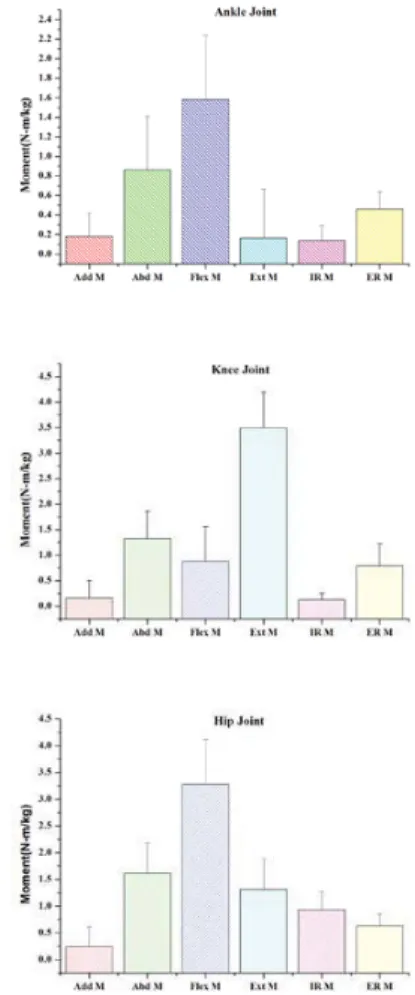
The peak joint forces and joint moments normalized by subject’s body weight were showed in Figures 1 and 2. The peak compression forces of hip, knee, and hip joints increased with knee flexion and reached 14.47 N/kg, 15.43N/kg, and 17.99 N/kg, respectively. The peak knee joint forces toward anterior direction and peak hip joint forces toward posterior direction reached 11.82 N/kg and 15.86 N/kg, respectively. It suggested that the knee and hip joints suffered high compression forces and shear forces. It maybe major factors that resulting in joint osteoarthritis in weight-lifter. During the descending phase, the peak knee extensor moments increased with knee flexion and reached 3.49 N-m/kg at maximum knee flexion position. The hip flexor moments and abductor moments also increased with knee flexion. The peak hip flexor moment and abductor moment reached 3.28 N-m/kg and 1.61 N-m/kg, respectively. During the early ascending phase, the peak ankle plantarflexor moments increased and reached 1.58 N-m/kg. These results suggest that ankle plantarflexor, knee extensor, hip flexor, and abductor play an important role in barbell squat exercise.
Table 1: The range of motion of ankle, knee, and hip joint during barbell squat (degrees)
Ankle Dorsiflexion/Plantarlexion 39.82²4.01 Knee Flexion/Extension 125.21²10.70 Hip Flexion/Extension 89.94²9.10 Adduction/Abduction 21.32²6.24 Internal/External Rotation 29.25²7.18 ACKNOWLEDGEMENT
This study was supported by the grant of National Taiwan College of Physical Education (100DG00107), TAIWAN.
REFERENCES
[1] Escamilla, R.F., et al., A three-dimensional biomechanical analysis of
the squat during varying stance widths. Med Sci Sports Exer, 2001.
33(6): p. 984-998.
[2] Escamilla, R.F., Knee biomechanics of the dynamic squat exercise. Med Sci Sports Exer, 2001. 33(1): p. 127-141.
[3] Lake JP et al., Does Side Dominance Affect the Symmetry of Barbell
End Kinematics during Lower-Body Resistance Exercise? J Strength
Cond Res. 2011, 25(3): p. 872-878.
[4] Hales ME et al.,Kinematic analysis of the powerlifting style squat and
the conventional deadlift during competition: is there a cross-over effect between lifts? J Strength Cond Res. 2009, 23(9): p.2574-2580.
Figure 1: The peak forces for ankle, knee and hip joints. Ant: anterior, Pos: posterior, Med: Medial, Lat: lateral, Com: compression
Figure 2: The peak moments for ankle, knee and hip joints. Add: Adduction, Abd: Abduction, Flex: Flexion, Ext: Extension, IR: internal rotation, ER: external rotation
國科會補助計畫衍生研發成果推廣資料表
日期:2011/10/31國科會補助計畫
計畫名稱: 老人健康促進運動之長期效應的評估 計畫主持人: 吳鴻文 計畫編號: 99-2410-H-028-003- 學門領域: 運動生物力學無研發成果推廣資料
99 年度專題研究計畫研究成果彙整表
計畫主持人:吳鴻文 計畫編號: 99-2410-H-028-003-計畫名稱:老人健康促進運動之長期效應的評估 量化 成果項目 實際已達成 數(被接受 或已發表) 預期總達成 數(含實際已 達成數) 本計畫實 際貢獻百 分比 單位 備 註 ( 質 化 說 明:如 數 個 計 畫 共 同 成 果、成 果 列 為 該 期 刊 之 封 面 故 事 ... 等) 期刊論文 0 0 100% 研究報告/技術報告 0 0 100% 研討會論文 0 0 100% 篇 論文著作 專書 0 0 100% 申請中件數 0 0 100% 專利 已獲得件數 0 0 100% 件 件數 0 0 100% 件 技術移轉 權利金 0 0 100% 千元 碩士生 2 2 100% 計畫原核准 2 位碩 士生研究生,因帶 運 動 據 點 較 分 散 及 實 驗 人 力 需 求,在原經費下調 整 增 加 一 位 臨 時 工協助。 博士生 0 0 100% 博士後研究員 0 0 100% 國內 參與計畫人力 (本國籍) 專任助理 0 0 100% 人次 期刊論文 0 2 100% 預 期 可 分 成 兩 部 份投稿,目前撰稿 中。 研究報告/技術報告 0 0 100% 研討會論文 0 2 100% 篇 預期 2012 研討會 發表 論文著作 專書 0 0 100% 章/本 申請中件數 0 0 100% 專利 已獲得件數 0 0 100% 件 件數 0 0 100% 件 技術移轉 權利金 0 0 100% 千元 碩士生 0 0 100% 博士生 0 0 100% 博士後研究員 0 0 100% 國外 參與計畫人力 (外國籍) 專任助理 0 0 100% 人次其他成果