Ž . Optics Communications 156 1998 53–57
Broadly tunable self-starting passively mode-locked Ti:sapphire
laser with triple-strained quantum-well saturable Bragg reflector
Jia-Min Shieh
a, T.C. Huang
b, K.F. Huang
b, Chi-Luen Wang
c, Ci-Ling Pan
a,)a
Institute of Electro-Optical Engineering, National Chiao Tung UniÕersity, 1001 Ta-Hsueh Road, Hsinchu 30010, Taiwan
b
Department of Electrophysics, National Chiao Tung UniÕersity, 1001 Ta-Hsueh Road, Hsinchu 30010, Taiwan
c
Precision Instrument DeÕelopment Center, Science-Based Industrial Park, Hsinchu 300, Taiwan Received 22 April 1998; accepted 22 June 1998
Abstract
We demonstrate broadband mode-locking of femtosecond Ti:sapphire lasers with a new type of saturable Bragg reflector
ŽSBR . Triple-strained quantum wells with separate and sequential bandgaps were used as the absorbing layer. The.
saturation fluence was as low as 7 mJrcm2. Self-starting sub-100 fs pulses tunable from 768 to 804 nm were generated in a
standard X-folded cavity without intracavity tight focusing on the SBR or temperature tuning. The threshold fluence for self-starting mode-locking was 1 mJrcm2. q 1998 Elsevier Science B.V. All rights reserved.
PACS: 42.55.Rz; 60.Fc; 42.65.Rc; 85.30.De
In the past few years, wide-bandwidth solid-state gain media such as Ti:sapphire, Cr:LiSAF, Nd:glass, and
4q w x
Cr :YAG 1–4 have been successfully utilized to gener-ate mode-locked femtosecond pulses. Non-linear elements commonly used to establish passive mode-locking in these lasers include saturable dye, Kerr-lens medium, and semi-conductor saturable absorbers. Kerr-lens effect, in particu-lar, has been extensively studied as an equivalent saturable absorber. It is, however, relatively difficult to self-start a
Ž .
Kerr-lens mode-locked KLM solid-state laser. The KLM cavity has to be especially designed and aligned as the operation point is usually very close to the limit of the
w x
stability regime 5 . A more recent development is the
Ž .
semiconductor saturable-absorber mirror SESAM . These have also been successfully employed in mode-locked solid-state laser systems for generating femtosecond pulses
w x
from visible to the infrared 6–8 . There are two major types of SESAMs: a semiconductor multiple-quantum-well
ŽMQW saturable absorber monolithically integrated be-. Ž
tween two reflecting mirrors the antiresonant Fabry–Perot
)
Corresponding author. E-mail: [email protected]
. w x
saturable absorber, A-FPSA 6 ; and the Bragg reflector
Ž .
with a single quantum well QW buried in the last growth
Ž . w x
layer saturable Bragg reflector, SBR 7 . Pulses as short
w x
as 6.5 fs were recently achieved using the SESAM 9 . The starting mechanism of femtosecond lasers with SESAM was based on nonlinear reflectivity from resonant excitonic transitions of the QW absorber. However, the absorption band of the SESAM usually limits the tuning range.
Previ-w x
ously, Tsuda et al. 7 showed that it is possible to enlarge
Ž .
the self-starting mode-locking range D l of a Cr:LiSAF
Ž . Ž y2.
laser l s 840 nm to 30 nm D lrl s 3.7 = 10 by heating the SBR to 1508C. With two identical quantum wells in a lr2-thick layer on a distributed Bragg reflector
ŽDBR mirror as a SBR, a tuning range of 47 nm D lrl. Ž
y2
. 4q
s3.0 = 10 for the passively mode-locked Cr :YAG
w x
laser at l s 1500 nm has been demonstrated 10 . This use of two QWs instead of one on the DBR enhances the absorption strength and allows the laser to mode-lock near the tail of the absorption band. Recently, Kopf et al. demonstrated broadband mode-locking of a Cr:LiSAF laser with a SESAM device using broadened absorption edge of
Ž .
low-temperature molecular beam epitaxially MBE grown
w x
GaAs quantum wells 11 . Sub-200 fs pulses with a tuning
0030-4018r98r$ - see front matter q 1998 Elsevier Science B.V. All rights reserved. Ž .
range of 50 nm were generated. For meeting the require-ment for self-starting mode-locking of solid-state lasers, tight-focusing configuration with high intensity on the SESAM was usually required to overcome high saturation
Ž .
intensity lower cross-section of the SESAM. High optical intensity on the SESAM, however, will adversely affect mode-locking stability or timing jitter of the laser.
In this paper, we propose and demonstrate a new type of semiconductor saturable Bragg reflector with low satu-ration intensity and broad tuning range. The strained
sat-Ž .
urable Bragg reflector SSBR consists of an absorbing layer of triple-strained-layer QWs with separate and se-quential absorption peaks on a DBR mirror. The design concept was derived from two ideas. First of all, it is well known that passively mode-locked Ti:sapphire lasers with
Ž .
mixed dye DDI q HITCI q IR140 solution as saturable absorber can generate femtosecond pulses over almost the
w x
entire gain bandwidth of the laser 12 . Thus it should be possible to use several absorbers with different absorption peak wavelengths to broaden the tuning range. Secondly,
Ž .
Fig. 1. a Structure of the SSBR with the DBR and an additional lr2 layer of Al0.25Ga0.75As; three quantum wells with different Ž .
absorption peak were inserted into this layer. Calculated standing wave patterns are also shown. b Reflectivity spectrum of the SSBR and cw PL signal of the triple QWs.
the threshold currents of strained-layer quantum-well diode lasers are known to have decreased due to enhancement of
w x
the gain cross-section by the strained structure 13 . The same enhancement effect should be applicable to strained QW absorbers. We incorporated these features to design a semiconductor saturable Bragg-reflector with high absorp-tion cross-secabsorp-tion and wide absorpabsorp-tion bandwidth.
Fig. 1a shows the structure of our strained-layer
sat-Ž .
urable Bragg reflector SSBR . An DBR with 15 pairs of high–low lr4 layers of AlAsrAl0.25Ga0.75As was grown by MBE. An additional lr2 layer of Al0.25Ga0.75As was grown on the top layer of the DBR mirror. Three quantum wells with separate and sequential absorption peaks were inserted into this layer. The spacings of the QWs were such that the peaks of the standing-wave patterns corre-sponded to peak wavelengths of each of their absorption spectra. We designed the absorption peak of our SSBR device at l s 785 nm. That is, x s 0.15 and y s 0.6, for the center strained-layer In Alx 1yxyyGa As QW. They width and spacing of the three QWs were 10 and 5 nm, respectively. The reflectivity of our SSBR was measured to be greater than 94% for wavelengths in the 770–800 nm band. This is shown in Fig. 1b. From cw
photo-lumines-Ž .
cence PL measurement of the SSBR, we find that the bandwidth and peak wavelength of the central absorbing
Ž
quantum well are 17 and 765 nm, respectively see Fig.
.
1b . Due to the requirement that the mode-locking wave-length must be longer than the absorption peak of the QW, the tuning range will be maximum when the absorption wavelengths of strained QWs were set at the short-wave-length edge of DBR. Spectroscopic features corresponding to the absorption peaks of the three QWs can also be observed in the PL spectra. The spacing between the peaks is about 7.5 nm.
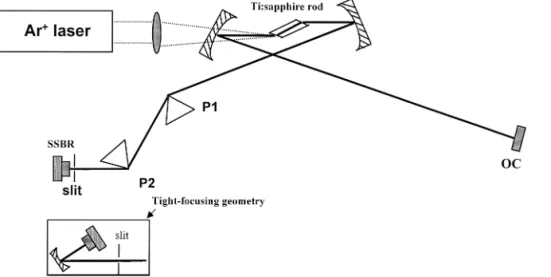
The laser cavity configuration is shown in Fig. 2. This standard X-folded cavity consists of a 5-mm Ti:sapphire
rod, two 10-mm radius-of-curvature folding mirrors, a pair of SF10 prisms separated by f 200 mm for intracavity
Ž
dispersion compensation, and the output coupler R s
.
95% . The lengths of the dispersion–compensation arm and the other arm with the output coupler were 900 and 700 mm, respectively. We used the SSBR as the end mirror in the dispersion–compensation arm. A slit was placed between the SSBR and the adjacent prism for wavelength selection. By using slit-width measurement and ABCD matrix calculation, we estimate that the spot size at the SSBR was about 1 mm.
At a pump power of 5.5 W, the output power of the locked laser was ; 270 mW. Self-starting mode-locking was achieved over the 768–804 nm band. This is shown in Fig. 3. Throughout this tuning range, the pulse widths can be maintained at sub-100 fs with Gaussian shapes. The corresponding spectral widths were all about 8 nm. The time–bandwidth products were in the range of 0.47–0.45, very close to the transform-limited value of
Ž
0.44. As the laser was tuned toward 765 nm peak
wave-.
length of the PL spectrum of the central strained QW , the laser could not be mode-locked. This is attributed to dominance of the slow response of the QW near the absorption peak. It provides a wider gain window and net
w x
gain for the tails of the pulses 7 . Since we did not employ tight-focusing, the actual optical fluence on the SSBR mirror was estimated to be only about 6.5 mJrcm2.
More-over, this laser could be mode-locked at an output power
Ž .
as low as 40 mW pumped at 2.5 W . The corresponding threshold fluence on the SSBR was as low as 1 mJrcm2.
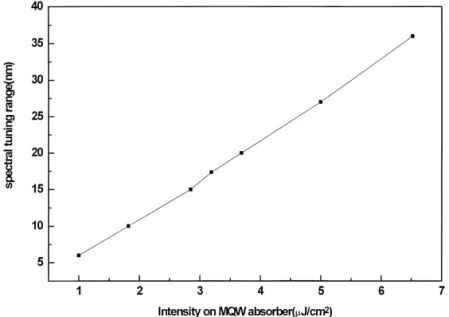
Tuning range for self-starting mode-locking operation as a function of the intracavity fluence on the SSBR is shown in Fig. 4. A linear dependence on fluence was observed up to a pump power of 5.5 W.
If we replaced the SSBR by a dielectric high-reflector
Ž .
mirror R s 99.98% in the present cavity, the output
Fig. 2. Cavity configuration of the femtosecond Ti:sapphire SSBR laser: OC, output coupler; P1, P2, SF10 prisms; SSBR, strained-layer saturable Bragg reflector. Inset: tight-focusing geometry.
Fig. 3. Pulse width and spectral width as a function of wavelength in the tuning range. Inset: corresponding spectra when the laser was tuned in steps of 2 nm.
power of the laser was increased from 100 to 450 mW. Femtosecond mode-locked pulses could not be sustained, however. This is due to alignment of the present cavity which could not support self-starting KLM operation. Un-strained single or triple QWs have also been tested as SBRs in our laser. In this case, we find that it is very difficult to self-start and sustain the femtosecond pulses without tight focusing on the SBR mirror. These experi-ments verify that the threshold fluences of conventional SBRs used for self-starting mode-locking are larger than for our SSBR mirror.
For further comparison between the characteristics of the strained and unstrained SBRs, we also investigated a tight-focusing cavity. An additional 150-mm radius-of-curvature highly reflective mirror was employed to reduce
Ž .
the spot size on the SBRs see the inset of Fig. 2 . The estimated spot size was about 70 mm. The fluence on the SBR increased ; 170 times compared with that of the original cavity configuration. For the SSBR, the wave-length tuning range was ; 40 nm if the laser output power was larger than ; 10 mW. The corresponding pulse en-ergy density on the SSBR was 0 50 mJrcm2. This tuning
Fig. 4. Tuning range for self-starting mode-locking operation versus the intracavity fluence on the SSBR. The spot size on the SSBR is f 1 mm.
range was limited by the reflective bandwidth of the Bragg
Ž .
reflector f 45 nm . The tuning ranges of the tight-focus-ing cavity with stight-focus-ingle and triple unstrained QWs for the SBR were ; 8 and ; 30 nm, respectively. That is, SBR with triple QWs exhibits tuning range about 3 times as large as that of a single QW device. It is also interesting to compare the performance of our SSBR with the work of
w x
Kopf et al. 11 who demonstrated a tuning range of 50 nm. The pulse energy density on their A-FPSA device was as large as ; 800 mJrcm2. The tuning range was about 40 nm for sub-100 fs pulses. Near the edge of the tuning range, the pulse width was limited by the bandwidth of the A-FPSA device and broadened to 0 150 fs. In contrast, we are able to generate sub-100 fs pulses throughout the tuning range. This is an indication of the strong pulse-shortening force provided by the SSBR.
It has been proposed that the buildup time of the mode-locked laser is inversely proportional to the
pulse-w x
shortening force 14 . With tight-focusing geometry, we find that the buildup times of our femtosecond laser with SSBR and SBR were about 40 and 120 ms, respectively. On the other hand, the femtosecond laser with SSBR can also self-start with starting time of ; 5 ms for a cavity without tight-focusing. We have also examined self-start-ing picosecond pulses generated by a tight-focusself-start-ing cavity without compensating prisms. For this cavity, the width and the shape of the pulses were essentially determined by the pulse-shortening force provided by the SSBR and the pulse-broadening force due to intracavity positive disper-sion. The pulse widths of the lasers with SSBR and unstrained SBR were measured to be 7.8 and 15 ps, respectively. The correlation traces of these picosecond pulses are both best-fitted by two-side exponential func-tions. Similar picosecond pulses were generated by a pas-sively mode-locked Ti:sapphire laser with dye solution at
Ž y3 .
higher concentration DDI s 1.1 = 10 M as the
sat-w x
urable absorber 15 . This result demonstrated that the pulse-shortening force of both the SSBR and SBR are strong enough to generate picosecond pulses. With low saturation fluence, the stronger amplitude modulation pro-vided by the SSBR results in shorter buildup time and narrower steady-state picosecond pulsewidth.
To further characterize the SSBR, we have measured its saturation fluence and absorption recovery time. The two-step decay time of SSBR was determined through time-re-solved reflectivity measurements. At l s 790 nm, the fast and slow decay times were 280 fs and 40 ps, respectively. The lifetimes of the unstrained SBRs are about the same. The saturation intensity for the SSBR was about 1.7 = 109 Wrm2or the saturated fluence f 7 mJrcm2 by using the
w x
method proposed by Keller et al. 6 . It is about
one-Ž
twentieth smaller than that of the unstrained SBR E ssat 2
.
150 mJrcm . For the cavity without focusing on SSBR, we are able to achieve self-starting femtosecond
mode-locked pulses with intracavity optical fluence as low as 1–5 mJrcm2.
In conclusion, we have demonstrated a new type of saturable Bragg reflector for broadband self-starting mode-locked femtosecond solid-state lasers. Triple-strained quantum wells with separate and sequential bandgaps were used as the absorbing layer. The saturation fluence was as low as 7 mJrcm2. Self-starting sub-100 fs pulses tunable from 768 to 804 nm were generated in a standard X-folded-cavity Ti:sapphire laser without intracavity tight focusing on the SBR or temperature tuning. This is limited by the bandwidth of the DBR. The threshold fluence for self-starting mode-locking was 1 mJrcm2. The SSBR is
potentially attractive for self-starting mode-locking in lasers with low intracavity power, e.g. diode-pumped solid-state lasers.
Acknowledgements
This work was supported in part by various grants of the National Science Council of Taiwan, Republic of China.
References
w x1 A. Stingl, M. Lenzner, Ch. Spielmann, F. Krausz, R. Szipocs,
Ž .
Optics Lett. 20 1995 602.
w x2 M.J.P. Dymott, A.I. Ferguson, Optics Lett. 20 1995 1157.Ž . w x3 P.J. Conlon, Y.P. Tong, P.M.W. French, J.R. Taylor, A.V.
Ž .
Shestakov, Optics Lett. 19 1994 1468.
w x4 D. Kopf, F.X. Kartner, U. Keller, W.J. Weingarten, Optics
Ž .
Lett. 20 1995 1169.
w x5 M. Lai, Optics Lett. 19 1994 722.Ž .
w x6 U. Keller, K.J. Weingarten, F.X. Kartner, D. Kopf, B. Braun, I.D. Jung, R. Fluck, C. Honninger, N. Matuschek, J.A. der
Ž .
Au, IEEE J. Sel. Topics Quantum Electron. 2 1996 435. w x7 S. Tsuda, W.H. Knox, S.T. Cundiff, W.Y. Jan, J.E.
Cunning-Ž .
ham, IEEE Sel. Topics Quantum Electron. 2 1996 454. w x8 S. Tsuda, W.H. Knox, S.T. Cundiff, Appl. Phys. Lett. 19
Ž1996 1538..
w x9 I.D. Jung, F.X. Kartner, N. Matuschek, D.H. Sutter, F. Morier-Genoud, G. Zhang, U. Keller, V. Scheuer, M. Tilsch,
Ž .
T. Tschudi, Optics Lett. 22 1997 1009.
w10 M.J. Hayduk, S.T. John, M.F. Frol, C.P. Pollock, R.P.x
Ž .
Leavitt, Optics Comm. 137 1997 55.
w11 D. Kopf, A. Prasad, G. Zhang, M. Moser, U. Keller, Opticsx
Ž .
Lett. 22 1997 621.
w12 U. Keller, W.H. Knox, G.W. ’tHooft, IEEE J. Quantumx
Ž .
Electron. 28 1992 2123.
w13 R.L. Williams, M. Dion, F. Chatenoud, K. Dzurko, Appl.x
Ž .
Phys. Lett. 58 1991 1816.
w14 F.X. Kartner, L.R. Brovelli, D. Kopfm, M. Kamp, I. Calasso,x
Ž .
U. Keller, Opt. Eng. 34 1995 2024.
w15 C.-L. Pan, C.-D. Hwang, J.-C. Kuo, J.-M. Shieh, K.-H. Wu,x
Ž .