Broadband coherent anti-Stokes Raman scattering
light generation in BBO crystal by using two
crossing femtosecond laser pulses
Jun Liu,1,2Jun Zhang,1and Takayoshi Kobayashi1,2,3,4,* 1Department of Applied Physics and Chemistry and Institute for Laser Science, University of Electro-Communications, Chofugaoka 1-5-1, Chofu, Tokyo 182-8585 Japan
2
International Cooperative Research Project (ICORP), Japan Science and Technology Agency, 4-1-8 Honcho, Kawaguchi, Saitama 332-0012, Japan
3
Department of Electrophysics, National Chiao Tung University, 1001 Ta Hsueh Road, Hsinchu 300, Taiwan
4
Institute of Laser Engineering, Osaka University, Yamadakami 2-6, Suita 565-0871, Ibaraki 567-0047, Japan
*Corresponding author: [email protected]
Received April 1, 2008; accepted May 10, 2008; posted May 29, 2008 (Doc. ID 94396); published June 26, 2008
As broad as12000 cm−1coherent anti-Stokes Raman scattering (CARS) light from ultraviolet to infrared was generated in a BBO crystal by using two crossing femtosecond laser pulses with 30% conversion effi-ciency. More than fifteenth-order anti-Stokes and second-order Stokes Raman sidebands were observed with nice Gaussian spatial mode. The effect of the crossing angle between two input beams on the spectrum and emitting angle of the Raman sidebands was studied in detail. Calculation shows that the phase-matching condition determines the frequencies and angles of the sidebands. © 2008 Optical Society of America
OCIS codes: 190.5650, 190.5890, 190.4720, 320.2250. In the past decade, collinear high-order stimulated Raman scattering (RS) [1] and high-order harmonic generation (HHG) [2] have been extensively studied to generate ultrabroadband spectra for the purpose of generating subfemtosecond light pulses. Although subfemtosecond pulses have been generated by means of HHG extensively [3], RS still offers an at-tractive alternative to obtain ultrashort pulse owing to its higher conversion efficiency than HHG. A 1.6 fs ultrashort pulse has been generated through Fourier synthesis of several discrete Raman sidebands of cooled D2gas [4]. Recently, a similar RS phenomenon was found even in solid-state materials by using two crossing femtosecond laser beams, such as YFeO3[5], SrTiO3 [6], KTaO3 [7], LiNbO3 [8], KNbO3 [9], and TiO2 [10], all at room temperature. As many as 20 anti-Stokes (AS) and 2 Stokes (S) coherent beams were generated in a lead tungstate共PbWO4兲 very re-cently [11], and this kind of RS could be selectively excited by using a pair of time-delayed linearly chirped pulses [12].
Here, we report broadband high-order coherent anti-Stokes RS generation in a BBO crystal. This is very interesting, because BBO crystal is the most fre-quently used crystal in few-cycle ultrashort femtosec-ond pulse generation in visible by means of noncol-linear optical parametric amplification [13–15].
A femtosecond laser system 共Micra+Legend − USP兲 produces 2.5 mJ, 40 fs, and 1 kHz pulses cen-tered around 800 nm. The laser pulses were divided into two beams by a beam splitter. One beam (beam 1) was spectrum broadened in a hollow fiber and then was dispersion compensated with a chirped-mirror pair and a pair of glass wedges. The other beam (beam 2) passed through a delay stage with better than 3 fs resolution. The two laser beams were at-tenuated by a variable neutral-density (ND) filter and then focused into a 2-mm-thick BBO (type I,
= 21°, = 0°) crystal. The laser polarizations of both beams were parallel to the optic axis of BBO. The spectra of different order CARS signal were mea-sured by a spectrometer (USB4000) through an opti-cal fiber attached to an arm on a moveable stage nor-mal to the diffracted signal beam.
The laser spectrum after the hollow fiber extended from 660 to 900 nm. The pulse before the crystal was positively chirped to about 100 fs duration owing to the variable ND filter and the glass wedge pair. At first the crystal was placed before the focal point of a lens. The beam diameters of both beams on the crys-tal were measured to be about 0.8 mm. The pulse en-ergies on the BBO crystal were 40J (beam 2) and 54J (beam 1). The angle between the two beams in the air was 1.75° and nearly normal to the surface of the crystal. When the two laser beams were well overlapped temporally and spatially, multiple bright sidebands were generated on both sides of the two in-put beams. A photograph of sidebands light on a white sheet of paper placed behind the BBO crystal is shown at the top of Fig.1(a). As many as 15 AS side-bands and 2 S sideside-bands were generated, and they were well separated spatially. The spectra of different order RS signal were also measured and shown in Fig. 1(c). The spectrum of the sidebands can extend from the ultraviolet to the infrared with more than 1 octave. When the delay time of beam2 was tuned less than 20 fs, multiple AS sidebands moved to the side of beam2 [Fig.1(b)]. In this case, beam2 was used as a pump. The wavelengths of the same order side-bands were shifted when the AS sideside-bands emit on the different side of the two input beams. The fre-quency spacings between two neighboring sidebands were also different between the signals shown in Figs.1(a)and1(b).
Dependence of the sideband spectra on the crossing angle was studied by changing the direction of the 1494 OPTICS LETTERS / Vol. 33, No. 13 / July 1, 2008
beam1 with a fixed direction of beam2. In the experi-ment, two beams were set at five different crossing angles in the air: 1.53°, 1.75°, 2.18°, 2.62°, and 3.05°. The spectra of the sidebands and the conversion effi-ciency were found to be changed by varying the cross-ing angle. This phenomenon was also reported re-cently by Zhi and Sokolov [11]. The brightest sideband signals were observed when the crossing angle was set at 1.75°. As the crossing angle was de-creased, the sidebands became close to each other both in frequency and space. A weak continuous line was generated when the crossing angle was reduced to smaller than 1.0°. The frequency spacing between the two neighboring sidebands increased gradually with the crossing angle. The spectrum of AS1 at dif-ferent crossing angles is shown in the inset of Fig.2. The spectrum of AS1 was shifted to high frequency when the crossing angle was increased. We could see that the center wavelength of the sidebands can be tuned in a large bandwidth simply by changing the crossing angle. As the sideband order increased, the frequency separation between the two neighboring sidebands gradually decreased, as shown in Fig. 2. The frequency spacing between AS1 and AS2 was about 1117 cm−1 for 2.18° crossing angle, which is gradually decreasing to 691 cm−1 for AS8 and AS9.
In the CARS process, the laser beams should obey the energy conservation and momentum conserva-tion laws: AS= 2p−s and 2kជp− kជs− kជAS= 0, respec-tively, as shown in Fig. 3. Here, s and p (seed and pump) refer to the two input laser beams, while AS refers to the generated sidebands. Using the two con-servation laws, the dependence of the AS1 wave-length on the crossing angle were calculated, the re-sults being shown in Fig.3. In the calculation, we fix the wavelength of s at 800 nm and vary the wave-length of p light from 660 to 780 nm to accord with the two input beams under the experiment condition. It can be seen that the calculated results agree very well with the experiment results. Therefore,
fre-quency dependence on the angle can be explained in terms of the phase matching. High conversion effi-ciency is obtained when the crossing angle is around 2°. It is because the frequency difference between the
p and s in the calculation is close to the broad Raman
line at 1547 cm−1 [16], and it is enhanced by the difference-frequency resonance as in the ordinary Ra-man process. The observed frequencies of RaRa-man shift are different from the Raman shift measured by the conventional Raman spectrum [16]. This is prob-ably because the four-wave mixing process is taking place being associated with optical phonon mode, which satisfies the phase-matching condition [9,10].
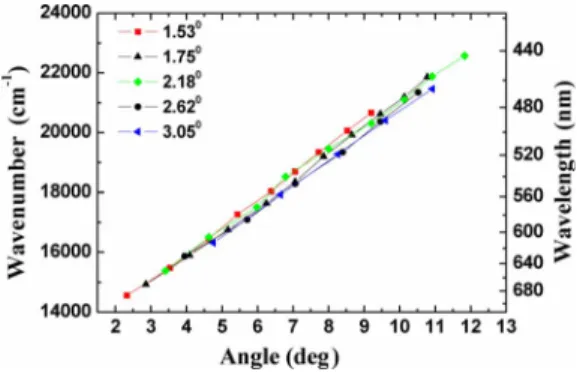
The dependence of the center wavenumber and wavelength of different order AS on the emitting angle at different crossing angles is plotted in Fig.4. As can be seen, the slope for center wavenumber to output angle is almost constant, which is about Fig. 2. (Color online) Center wavenumber (wavelength) of different sidebands varies with the anti-Stokes order num-ber when the crossing angle between two input beams is 1.53°, 1.75°, 2.18°, 2.62°, and 3.05°. The inset shows the spectra of the first-order sidebands when the crossing angles between the two beams are 1.53°, 1.75°, 2.18°, 2.62°, and 3.05°.
Fig. 1. (Color online) Photograph of the sidebands in a white sheet of paper behind the BBO crystal when (a) beam1 works as a pump and (b) beam2 works as a pump. (c) Spectra of sidebands from Fig.1(a); A Sm共m=1–10兲 re-fers to the mth-order anti-Stokes spectrum, and Sn共n = 1 , 2兲 refers to the mth-order Stokes spectrum.
Fig. 3. Dependence of peak wavelength of the first-order AS sidebands on the crossing angle of two input beams. The crossing angle was measured in the air. Squares, ex-perimental results. Curve, calculated results by using the phase-matching condition.
843 cm−1/ deg. This means that the emitting angle of sidebands is not related to the AS number but to the center wavelength of the sidebands. This linear rela-tionship between the emitting angle and the wave-length of sidebands makes it possible to synthesize these sidebands by using dispersion optics that has been recently realized by Matsubara et al. [8].
When the crystal was located on the focal point of the lens, the beam diameter was measured to be about 200m. When the energy of each incident la-ser pulse was 3J, bright sidebands were also ob-served. The spatial profile of the sidebands was also measured by using a CCD camera behind the crystal. Figure 5 shows a spatial profile of the AS2 and AS3 sideband signals. The figure also shows the spectrum of pump laser with and without the seed. The conver-sion efficiency of pump into the sidebands was higher than 30%, as also can be seen from spectral intensity of pump pulse with and without the seed in Fig. 5. There was almost no dependence of the spectrum of the first-order AS sidebands on the phase-match
angle 共兲 within ±15°. There was no sidebands gen-eration when the polarization of one input beam was rotated 90°.
In summary, we have observed a broadband CARS signal generation in a most frequently used nonlin-ear crystal BBO pumped by using two crossing fem-tosecond laser pulses. More than 1 octave spectrum from ultraviolet to infrared was obtained in this way. The energy conversion efficiency in this kind of non-linear process is about 30% in the experiment. The phase matching in crystal plays an important role in the CARS process. This phenomenon will extend the possible application of BBO crystal in a new device. Subfemtosecond light may be able to be obtained by synthesizing this kind of sideband in the future.
The authors thank Miaochan Zhi for his helpful discussion and Zhiguang Wang for his technical as-sistance.They also thank Eiichi Hanamura for his valuable discussion. This work was partly supported by the grant from the Ministry of Education in Tai-wan under the ATU Program at National Chiao Tung University. A part of this work was performed under the joint research project of the Laser Engineering, Osaka University, under contract subject B1-27. References
1. A. V. Sokolov, M. Y. Shverdin, D. R. Walker, D. D. Yavuz, A. M. Burzo, G. Y. Yin, and S. E. Harris, J. Mod. Opt. 52, 285 (2005).
2. M. Hentschel, R. Kienberger, Ch. Spielmann, G. A. Reider, N. Milosevic, T. Brabec, P. Corkum, U. Heinzmann, M. Drescher, and F. Krausz, Nature 414, 509 (2001).
3. R. Kienberger, E. Goulielmakis, M. Uiberacker, A. Baltuska, V. Yakovlev, F. Bammer, A. Scrinzi, Th. Westerwalbesloh, U. Kleineberg, U. Heinzmann, M. Drescher, and F. Krausz, Nature 427, 817 (2004). 4. M. Y. Shverdin, D. R. Walker, D. D. Yavuz, G. Y. Yin,
and S. E. Harris, Phys. Rev. Lett. 94, 033904 (2005). 5. J. Takahashi, E. Matsubara, T. Arima, and E.
Hanamura, Phys. Rev. B 68, 155102 (2003).
6. J. Takahashi, M. Keisuke, and Y. Toshirou, Opt. Lett. 31, 1501 (2006).
7. E. Matsubara, K. Inoue, and E. Hanamura, Phys. Rev. B 72, 134101 (2005).
8. E. Matsubara, T. Sekikawa, and M. Yamashita, Appl. Phys. Lett. 92, 2008, 071104 (2008).
9. H. Matsuki, K. Inoue, and E. Hanamura, Phys. Rev. B 75, 024102 (2007).
10. K. Inoue, J. Kato, E. Hanamura, H. Matsuki, and E. Matsubara, Phys. Rev. B 76, 041101(R) (2007). 11. M. Zhi and A. V. Sokolov, Opt. Lett. 32, 2251 (2007). 12. M. Zhi and A. V. Sokolov, New J. Phys. 10, 025032
(2008).
13. A. Baltuska, T. Fuji, and T. Kobayashi, Opt. Lett. 27, 306 (2002).
14. A. Shirakawa, I. Sakane, M. Takasaka, and T. Kobayashi, Appl. Phys. Lett. 74, 2268 (1999).
15. A. Shirakawa, I. Sakane, and T. Kobayashi, Opt. Lett. 23, 1292 (1998).
16. J. L. You, G. C. Jiang, H. Y. Hou, Y. Q. Wu, H. Chen, and K. D. Xu, Chin. Phys. Lett. 19, 205 (2002). Fig. 4. (Color online) Relationship between the center
wavenumber (wavelength) of different sidebands and the emitting angle of different sidebands. The crossing angles between the two input beams of which direction is normal to the crystal surface are 1.53°, 1.75°, 2.18°, 2.62°, and 3.05°.
Fig. 5. (Color online) Spectrum of the pulse after the hol-low fiber compressor (solid curve) and the spectrum of the pulse after the BBO crystal with CARS effect (dotted curve). The inset is the photograph showing the spatial profile of the second-order (left) and the third-order (right) sidebands.