行政院國家科學委員會專題研究計畫 期中進度報告
嬰兒聲調知覺發展(1/2)
計畫類別: 個別型計畫 計畫編號: NSC93-2413-H-002-028- 執行期間: 93 年 08 月 01 日至 94 年 07 月 31 日 執行單位: 國立臺灣大學心理學系暨研究所 計畫主持人: 曹峰銘 計畫參與人員: 邱怡菱 報告類型: 精簡報告 處理方式: 本計畫可公開查詢中 華 民 國 94 年 5 月 30 日
本研究的目的在於探究嬰兒國語聲調知覺的發展,是否在六到十二個月之間呈現明顯 的變化。此外,本研究也將檢視聲調對比之間聲學特性相似的程度,是否會影響嬰兒對不 同聲調辨識的發展。在第一年的研究計畫當中,經由國外嬰兒研究單位的技術協助,我們 已經設立了具有隔音功能的嬰兒語音知覺發展實驗室。在實驗室成立之後,我們已經進行 第一個實驗,也就是比較七和十一個月大嬰兒分辨國語一聲和三聲的敏感度,以檢視年紀 對聲調知覺發展的作用。實驗的假設是年紀對聲調知覺發展有作用,也就是預期年紀較大 的嬰兒,將比年紀較輕的嬰兒更能準確地分辨聲調的差異。目前已有近週歲兒童的資料, 而且結果顯示他們很容易區分國語一聲和三聲(平均正確率 = 80.49%);此外,男嬰和女 嬰對此聲調配對的區辨敏感度非常相似。除了測試七個月嬰兒區辨國語一聲和三聲之外, 未來一年將收集不同年紀嬰兒區辨其他聲調(例如,二聲和三聲)的資料,以示國語聲調 知覺發展的歷程。
Abstract
The goal of this study was to explore the developmental change of perceiving Mandarin tones. In addition, this study addressed whether the acoustic similarity between lexical tones could have any effects on perceptual development. Through the international collaboration with a world-leading infant study laboratory at the University of Washington, we have established the infant speech perception laboratory during the first project year. We also collected the infant data for the Experiment 1 that was designed to test the age effect on tone perception. The perceptual change of 7- and 11-month-old Mandarin-learning infants discriminating lexical tones was
examined by utilizing a Mandarin Tone 1 vs. Tone 3 contrast. The results of the older infant group demonstrated that this tone contrast was not difficult for this age group to discriminate (mean percent correct = 80.49%) and no significant gender difference on perceiving this tone contrast was obtained for the 10-12 month-old Mandarin-learning infants. In addition to testing younger infants on the same tone contrast, the on-going project will use various tone contrasts to examine the tone perception development in the following second project year.
1
INTRODUCTION
Speech perception development is one of the major achievements of infancy. Research has documented changes in speech perception development that have been shown in experimental tests on infants across cultures. Infants begin life with a universal capacity to differentiate the fine-grained acoustic events that differentiate phonemes across languages, and this ability is exhibited until about 6 months of age. For example, in the early months of life, young infants have been shown to discriminate a 20-ms difference in voice-onset-time (VOT), an acoustic difference that is sufficient to distinguish English voiced (/b, d, g/) from voiceless (/p, t, k/) stop consonants (e.g, Eimas, Siqueland, Jusczyk, & Vigorito, 1971). Subtle acoustic differences among vowel sounds are also discriminated, allowing infants to distinguish the vowels of many languages early in life (e.g., Trehub, 1973; Aldridge, Stillman, & Bower, 2001). However, no available studies have examined the lexical tone perception of Mandarin-learning infants. The goal of this study was to explore whether the development trend of perceiving Mandarin tones was similar to other phonetic units.
There is increasing evidence that in the first year of life infants are acquiring detailed information about language by listening and analyzing linguistic input (Jusczyk, 1997; Kuhl, 2004; Werker & Tees, 1999). A variety of studies show, for example, that infants' exposure to ambient language results in rapid learning. By 6 months of age, infants engage in a detailed analysis of the distributional properties of sounds contained in the language they hear, and this alters perception to produce more native-like phonetic processing (Kuhl, Williams, Lacerda, Stevens, & Lindblom, 1992; Maye, Werker, & Gerken, 2002).
By 8-10 months of age, infants are capable of segmenting distinct lexical items from the continuous stream of speech by detecting transitional probabilities between syllables (Goodsitt, Morgan, & Kuhl, 1993; Saffran, Aslin, & Newport, 1996) and the synchronization between the visual input periodicity and speech inputs (Hollich, Newman, & Jusczyk, 2005). At 8-9 months of age, infants are sensitive to the phonotactic and prosodic rules governing words, responding to the probability of occurrence of phonetic sequences and (Johnson & Jusczyk, 2001; Jusczyk, Friederici, Wessels, Svenkerud, & Jusczyk,, 1993; Mattys, Jusczyk, Luce, & Morgan, 1999). Thus, these results suggest that between 6 and 9 months of age, with increasing linguistic experience, infants improve their segmentation of lexical units.
By 10-12 months of age, the developmental change of phoneme perception is apparent. Consonant discrimination shows a steep decline for non-native phonemes and improvement for native phonemes, again reflecting a change that depends on linguistic experience (Tsao,
2001;Rivera-Gaxiola, Klarman, Garcia-Sierra, & Kuhl, 2005); Werker & Tees, 1984). A brief exposure to a non-native language altered this developmental decline for non-native phonemes (Kuhl, Tsao, & Liu, 2003). The ability to discern phonetic differences in language input is essential for the kinds of distributional analyses that infants appear to be performing.
These patterns of results show that listening experience with the native language would alter the perceptual abilities on detecting phonetic segments and lexical units between 6 and 12 months
of age. Despite of the extensive literature available on infant’s perception of phonetic segments (e.g., vowels and consonants) and phonetic suprasegments (e.g., prosody), there are no available data on the development of lexical-tone perception in infants learning a language that pitch patterns serve to contrast the word meaning among syllables. The fine-grained perceptual skills and development patterns shown early in infancy raise a question for studying speech perception: Could Mandarin-learning infants use the exquisite speech perception skills shown in early
infancy to perceive lexical tones of their native language? Would the listening experience with Mandarin tones alter infant’s perception during the second half of the first year of life?
The patterns of F0 contour distinguish lexical tones but some Mandarin tones have similar F0 contours. For example, Tones 2 and 3 exhibit similar F0 contours in isolated syllables: both have a concave F0 shape. The acoustic similarity between Tones 2 and 3 would be the reason that this tone contrast is frequently confused for non-tonal language speakers (e.g., Wang, Spence, Jongman, & Sereno, 1999) and even Mandarin listeners (Moore & Jongman, 1997; Shen & Lin, 1991). In addition, the perceptual confusion between tones might associate with the slower acquisition age of Tones 2 and 3 production in Mandarin-learning children. Tones 2 and 3 were reported to be more frequently misarticulated than Tones 1 and 4 to Mandarin-learning children aged 1;6 to 3;0 (Li & Thompson, 1977).
In brief, this study aimed to examine the perceptual development of Mandarin tones in Mandarin-learning infants between 6 and 12 months of age. Two related questions were
addressed. First, do developmental changes of tone perception occur during the second-half of the first year of life? Second, do adults’ patterns of perceptual confusion among lexical tones
associate with the developmental difference of Mandarin tones in infants?
Three experiments were planned to explore these questions. Experiment 1 examined the effects of native language experience on tone perception. The development of lexical tone
perception was examined in 7- and 11-month-old infants by utilizing a Mandarin Tone 1 vs. Tone 3 contrast. The hypothesis is that infants would improve their sensitivity with age for these test stimuli. Experiment 2 is designed to examine whether the developmental trend of perceiving Mandarin tones differ with the acoustic similarity between tone contrasts. Mandarin-learning infants aged 7 and 11 months will be tested on the discrimination of a frequently confused tone pair for adult non-tonal language speakers: Tone 2 vs. Tone 3. The hypothesis is that a
developmental change would also be obtained with this tone contrast. The performance difference between Experiments 1 and 2 would indicate the effects of acoustic similarity on the
discrimination of Mandarin tones. Experiment 3 would adopt a longitudinal design to examine the within-infant developmental changes perceiving Mandarin tones between 7 and 11 months of age. This project began from August 2004. We have set up the infant speech perception
laboratory and collected the data of the Experiment 1 at this point.
ACCOMPLISHMENTS DURING THE FIRST YEAR OF STUDY
3
The infant head-turn procedure (detailed in the following paragraphs) was used to explore the perceptual development of Mandarin tones. During the first year of this project, we have established the infant head-turn testing laboratory. In addition to using the commercial products, the head-turn testing procedure needs customized electronic equipment and computer program to randomly present speech stimuli, control the reinforcers, and record infant’s responses. There were no infant research labs in Taiwan ever using the similar testing procedure. We could not establish the infant test lab in Taiwan within months without the international collaborations. Through the technical supports from the world-leading infant study expert, Professor Patricia K. Kuhl at the Institute of Learning and Brain Sciences, University of Washington, Seattle, the infant speech perception lab has been established.
Apparatus
Speech stimuli were reproduced with 22050 Hz, 16-bit samples per second and presented by a computer (HP Compaq DC7100). The sounds were amplified (Yamaha RX V350) and delivered to infants in an adjoining sound treated test room via a loudspeaker (Bowers & Wilkins DM303). Parents and experimenters wore headphones (SONY MDR-CD 280) and listened to CD recorded music during the tests so they could not distinguish between the stimuli presented to infants. Infants’ responses were monitored in the control room via use of a digital camera (SONY Handycam PC350) and a video monitor. The computer used a data acquisition board (National Instrument PCI-6503) to activate the reinforcer and record infant’s head-turn responses by an experimenter who pushed a button on a hand-held switch.
Test Suite
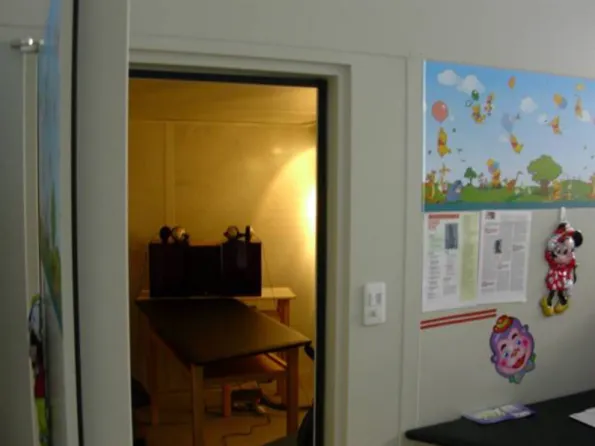
The test suite was consisted of two rooms. In the sound-attenuation test room (Figure 1), an infant was held on its parent's lap, facing forward while an assistant sat at a 90-degree angle to the infant's right side. An assistant maintained the infant's attention by manipulating a series of engaging, silent toys to bring the child's gaze to midline (straight ahead of the infant). A bank of two visual reinforcers, located at a 90 degree angle to the infant's left side, each consisted of a dark plexiglas box (13" x 13" x 13") containing a commercially-available mechanical toy (e.g. a bear pounding a drum). The toys are not visible until activated and lights mounted inside the box are illuminated. The visual reinforcers are placed on either side of the loudspeaker, and are at eye level for the infant. A camera, located in front of the infant, fed an image of the test room to the adjoining control room, where an experimenter observed the infant's behavior.
Procedure
The Head-Turn (HT) technique was used to assess infants' discrimination abilities (Kuhl, 1985; Werker, Polka, & Pegg, 1997). Infants first were trained to produce a head turn for visual reinforcement whenever the "background" speech sound, e.g., / tÇh
i1/, repeated once every two seconds, would be changed to the "target" speech sound, e.g., / tÇh
i3/. The experimental protocol requires a two-step training phase followed by a test phase, all of which were under computer control.
The first step of the training phase consisted of Conditioning (+Intensity). During this phase, infants are trained to associate presentation of the target speech sound with the activation of the
visual reinforcers (Figure 2). The target sound interrupts the repetitive presentation of the background speech sound, and is presented at a level 4 dBA higher than the background speech sound. During the training phase, every trial is a target trial. The target stimulus is presented three times in a row. The onset-to-onset interstimulus interval is 2000 ms. The infant quickly learns to anticipate the visual reinforcer when the speech sound is changed from the background to the target. The infant has to respond to the sound change within 6 sec after the first presentation of target sound to watch the visual reinforcement. When the infant correctly anticipates the visual reinforcers with a head turn on two consecutive trials, the test proceeds to the next training phase, Conditioning (-Intensity).
In the Conditioning (-Intensity) phase, the target sound is presented at the same level as the background sound; infants can only use the phonetic difference between sounds as a cue. All other parameters of the experiment remain the same. Infants must correctly produce three anticipatory head turns to advance to the testing phase.
The test phase is consisted of 30 trials, an equal number of target and control trials, presented in random order. Infants is tested in 20 minute sessions on consecutive days, when possible, but all completed testing within one week. Up to three sessions is required to complete the test. Infants who fail to pass the two-phase training in two sessions are eliminated from the experiment.
In all phases of training and testing, trials are initiated by the assistant, who shows toys to the infant in the test room. The assistant initiates trials when infants appear ready (focusing on the toys held by the assistant). The experimenter cannot hear the stimuli presented during trials (a computer controlled gating network cuts out the sound during a trial) and is unaware of the type of trial selected automatically by the computer. The experimenter judges the head turn and push a button on a hand-held switch connected with the computer through the data acquisition board to indicate a head-turn. The assistant cannot hear the stimuli being presented at any time during the experiment, but is informed that a trial is underway by a small light (out of the infant's view) that is automatically activated for the duration of a trial, necessary information for the assistant who is instructed not to change the toy in the midst of a trial.
II. Experiment 1: The perceptual development of discriminating Mandarin Tones 1 and 3
This experiment aimed to explore the perceptual development of perceiving Mandarin tones between 6 and 12 months of age. We have collected the Tones 1 and 3 discrimination data of 10-12 month-old infants and are testing the Tones 2 and 3 discrimination when writing this progress report. Therefore, the preliminary results are on the Tones 1 and 3 discrimination of 10-12 month-old infants.
Participants
The participants were 19 infants in the age range of 10-12 months (mean age at test = 11.5 months; range = 9.4 to 13.6 months; boys = 12, girls = 7). An additional 5 infants failed to complete testing due to an inability to pass the training (2), an equipment failure (1), or a failure to return for all of the required sessions (2). Pre-established criteria for inclusion in the study
5
were that infants had no known visual or auditory deficits, were full term (born +/- 14 days from due date), had uncomplicated deliveries, were normal birth weight (6-10 lbs.), were developing normally, and that members of their immediate families had no history of hearing loss. Parents were paid NT$600 for completing the experiment.
Mandarin-learning infants were recruited either through listings of names on the House Registry of the Da-An and Chung-Cheng Areas, Taipei City, Taiwan. Although Taiwan is a multi-lingual society, Mandarin Chinese is the most dominant language in homes. The
Mandarin-dominant (or only) language environment of Taiwanese infants was verified through a language background questionnaire in Chinese that was administrated to the caregiver before the study began.
Stimuli
The speech stimuli were / tÇhi1/ and / tÇh
i3/ syllables recorded by a female Mandarin-native speaker syllable-by-syllable with normal speaking rate and digitized with the speech analysis software, Computerized Speech Lab (CSL 4400) at 22050 sampling rate, 16-bit resolution. The digitized speech samples were then edited with sound-editing software, Sound Forge 7.0, to equalize the RMS level of each syllable.
RESULTS
The head-turn response data for each infant during the test phase of the experiment were summarized in terms of the four outcomes in a signal detection task: "Hits," "Misses,"
"False-positives," and "Correct rejections." Using these data, each infant's performance was converted to a percent correct measure by adding the percentage of hits and the percentage of correct rejections and dividing by 2.
Percent corrects for discriminating Mandarin Tones 1 and 3 in 10- to 12-month-old Mandarin-learning infants are 80.49% (SD = 6.92, Range = 63.34% – 90.21%), significantly above the 50% chance level at p < .0001, one-sample t-test, t(18) = 19.2. There was no gender difference discriminating the tone contrast at 10-12 months of age. Boys (M = 79.37%, SD = 7.40) and girls (M = 82.41%, SD = 6.04) performed similarly discriminating the tone contrast, one-way ANOVA F(1, 17) <1.
Compared with the perceptual discrimination of other Mandarin phonetic contrasts, 10- to 12-month-olds are very sensitive to the phonetic difference between tones 1 and 3. For example, the percent correct of discriminating the Mandarin affricate /tÇhi / - fricative /Çi/ contrast was
67.75% for Mandarin-learning infants of the similar age (Tsao, 2001). The results suggest that Mandarin-learning infants are more sensitive to the tonal difference than the affricate-fricative consonant difference. Is this the general developmental trend or the specific example varied with the types of tone contrasts? The tone 1 vs. tone 3 discrimination could be easier than other tone contrasts, e.g., tone 2 vs. tone 3. The on-going project is to collect the tone 2 vs. tone 3
discrimination data to explore whether perceptual sensitivity varies with tone contrasts. In the end of this project, more data will be able to depict the better picture of lexical tone development. These results would be very attractive to persons interested in infant speech perception development when presented in the international infant study conference.
Conclusion
The preliminary results are not sufficient to reveal the perceptual development for the Mandarin tones during the second half of the first year of life. The results, however, demonstrate that the 10-12 month-old Mandarin-learning infants are easily to perceive the difference of a lexical tone contrast, tone 1 vs. tone 3. This is anticipated to be an easy tonal contrast for infants since the adult English-speakers do not experience the great difficulty to discriminate this
contrast. Various tonal contrasts and infant age groups will be tested in the following project year to explore the perceptual development trends for lexical tones between 6 and 12 months of age. In addition to revealing the lexical tone development, results of this study should provide the important evidence to assess whether there is the similar trend for perceiving phonetic segments and suprasegments (i.e., lexica tones) in infancy.
References
Aldridge M.A., Stillman R.D., & Bower T.G.R. (2001). Newborn categorization of vowel-like sounds. Developmental Science, 4, 220-232.
Eimas, P. D., Siqueland, E. R., Jusczyk, P., & Vigorito, J. (1971). Speech perception in infants. Science, 171, 303-306.
Goodsitt, J. V., Morgan, J. L., & Kuhl, P. K. (1993) . Perceptual strategies in prelingual speech segmentation. Journal of Child Language, 20, 229-252.
Hollich, G., Newman, R. S., & Jusczyk, P. W. (2005). Infants' Use of Synchronized Visual Information to Separate Streams of Speech. Child Development, 76(3), 598-613.
Johnson. E. K., & Jusczyk, P. W. (2001). Word segmentation by 8-month-olds: When speech cues count more than statistics. Journal of Memory and Language, 44, 548-567.
Jusczyk, P. W. (1997). The discovery of spoken language. Cambridge, MA: MIT Press. Jusczyk, P. W., Friederici, A. D., Wessels, J. M. I., Svenkerud, V. Y., & Jusczyk, A. M. (1993). Infants’ sensitivity to the sound patterns of native language words. Journal of Memory
and Language, 32, 252-293.
Kuhl, P. K. (1985). Categorization of speech by infants. In J. Mehler and R. Fox. (Eds.),
Neonate cognition: Beyond the blooming buzzing confusion (pp. 231-262). Hillsdale, NJ:
Erlbaum
Kuhl, P. K. (2004). Early Language Acquisition: Cracking the Speech Code. Nature Reviews
Neuroscience, 5(11), 831-843.
Kuhl, P. K., Tsao, F. M., & Liu, H. M. (2003). Foreign-language experience in infancy: Effects of short-term exposure and social interaction on phonetic learning. Proceedings of the
National Academy of Sciences, USA, 100, 9096-9101.
Kuhl, P. K., Williams, K. A., Lacerda, F., Stevens, K. N., & Lindblom, B. (1992). Linguistic experience alters phonetic perception in infants by 6 months of age. Science, 255, 606-608.
7
Li, C. N., & Thompson, S. A. (1977). The acquisition of tone in Mandarin – speaking children. Journal of Child Language, 4, 185-199.
Mattys, S. L., Jusczyk, P. W., Luce, P. A., Morgan, J. L. (1999). Phonotactic and prosodic effects on word segmentation in infants. Cognitive Psychology, 38, 465-494.
Maye, J., Werker, J. F., & Gerken, L. (2002). Infant sensitivity to distributional information can affect phonetic discrimination. Cognition, 82, B101-111.
Moore, C.B., and Jongman, A. (1997). Speaker normalization in the perception of Mandarin Chinese tones. Journal of the Acoustical Society of America, 102, 1864-1877.
Rivera-Gaxiola, M. C., Klarman, L., Garcia-Sierra, A., & Kuhl, P. K. (2005). Neural patterns to speech and vocabulary growth in American infants. Neuroreport., 16(5), 495-498.
Saffran, J. R., Aslin, R. N., & Newport, E. L (1996). Statistical learning by 8-month-old infants. Science, 274, 1926-1928.
Shen, X., Lin, M., & Yan, J. (1993). F0 turning point as an F0 cue to tonal contrast: A case study of Mandarin tones 2 and 3. Journal of the Acoustical Society of America, 93, 2241-2243.
Trehub, S. E. (1973). Infants’ sensitivity to vowel and tonal contrasts. Developmental
Psychology, 9(1), 91-96.
Tsao, F. M. (2001). The effects of language experience on the perception of affricate and fricative consonants in English-speaking and Mandarin-speaking adults and young Infants. Unpublished doctoral dissertation. University of Washington.
Wang, Y., Spence, M. M., Jongman, A., & Sereno, J. A. (1999). Training American listeners to perceive Mandarin tones. Journal of the Acoustical Society of America, 106, 3649-3658.
Werker, J. F., & Tees, R. C. (1984). Cross-language speech perception: Evidence for
perceptual reorganization during the first year of life. Infant Behavior and Development, 7, 49-63. Werker, J. F., & Tees, R. C. (1984). Cross-language speech perception: Evidence for
Figure 1. The test room of the infant speech perception development study.
Figure 2. The infant turned to the visual reinforer when heard the background speech sound changed to the target speech sound.