Traceless Synthesis of Hydantoin Fused
Tetrahydro-β-carboline on Ionic Liquid
Support in Green Media
Barnali Maiti, Kaushik Chanda, and Chung-Ming Sun*
Laboratory of Combinatorial Drug DiscoVery, Department of Applied Chemistry, National Chiao Tung UniVersity, Hsinchu 300-10, Taiwan
[email protected] Received August 10, 2009
ABSTRACT
A novel ionic liquid (IL) supported, green synthetic protocol has been developed toward the synthesis of oxo and thio hydantoin analogues tethered with tetrahydro-β-carboline by the use of focused microwave irradiation. IL-bound tryptophan underwent a Pictet-Spengler reaction with various carbonyl compounds to generate the IL- immobilized tetrahydro-β-carbolines in aqueous isopropanol media. Subsequent reaction of substituted tetrahydro-β-carboline derivatives with various isocyanates and isothiocyanate provided a three-dimensional combinatorial library in a traceless fashion.
Tetrahydro-β-carbolines (1a), a key constituent of most naturally occurring indole alkaloids, have received consider-able attention by medicinal chemists owing to their important bioproperties including antiaggregation, in vitro trypanocidal activity, antimalarial, and anticonvulsant activity.1Recently, it has been found that hydantoin and thio hydantoin deriva-tives (1b) also possess several pharmacological properties including dual action for anticonvulsant and antimuscarinic activity, insulinotropic properties, and antifungal activity.2 However, the ring system 2 as the conceptual derivation of
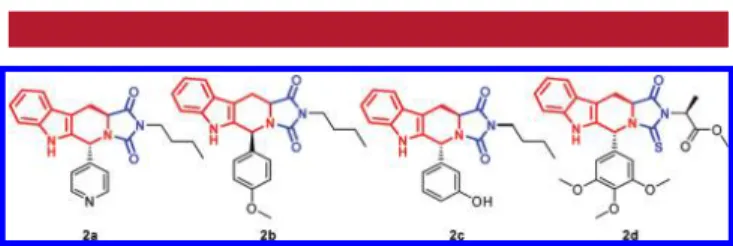
a new scaffold, which represents the amalgamation of two important pharmacophores, is much less known (Figure 1). The generation of tetracyclic skeletons with tetrahydro-β-carboline and hydantoin thus has a substantial intellectual appeal due to their resemblance to drug-like molecules. This type of compound has been documented for the inhibition of cGMP-phosphodiesterase (2a, 2b), a chemical messenger in the body that activates cGMP kinase, and as a novel antimitotic agent (2c) and a novel Eg5 inhibitor (2d).3,6 Because of their diverse array of biological activities, these
(1) (a) Zhao, M.; Bi, L.; Bi, W.; Wang, C.; Yang, Z.; Ju, J.; Peng, S.
Bioorg. Med. Chem. 2006, 14, 4761. (b) Valdez, R. H.; Tonin, L. T. D.;
Ueda-Nakamura, T.; Dias Filho, B. P.; Morgado-Diaz, J. A.; Sarragiotto, M. H.; Nakamura, C. V. Acta Trop. 2009, 110, 7. (c) Tonin, L. T. D.; Barbosa, V. A.; Bocca, C. C.; Ramos, E. R. F.; Nakamura, C. V.; Costa, W. F.; Basso, E. A.; Nakamura, T. U.; Sarragiotto, M. H. Eur. J. Med.
Chem. 2009, 44, 1745. (d) Jenkins, P. R.; Wilson, J.; Emmerson, D.; Garcia,
M. D.; Smith, M. R.; Gray, S. J.; Britton, R. G.; Mahale, S.; Chaudhuri, B.
Bioorg. Med. Chem. 2008, 16, 7728. (e) Gupta, L.; Srivastava, K.; Singh,
S.; Puri, S. K.; Chauhan, P. M. S. Bioorg. Med. Chem. Lett. 2008, 18, 3306.
(2) (a) Hudkins, R. L.; DeHaven-Hudkins, D. L.; Doukas, P. Bioorg.
Med. Chem. Lett. 1997, 7, 979. (b) Sergent, D.; Wang, Q.; Sasaki, N. A.;
Ouazzani, J. Bioorg. Med. Chem. Lett. 2008, 18, 4332. (c) Tan, C; Wei, L.; Ottensmeyer, F. P.; Goldfine, I.; Maddux, B. A.; Yip, C. C.; Batey, R. A.; Kotra, L. P. Bioorg. Med. Chem. Lett. 2004, 14, 1407.
(3) (a) Domonique, B.; Ganesan, A. J. Comb. Chem. 2002, 4, 546. (b) Daugan, A.; Grondin, P.; Ruault, C.; Gouville, A. M.; Coste, H.; Kirilovsky, J.; Hyafil, F.; Labaudinire, R. J. Med. Chem. 2003, 46, 4525. (c) Daugan, A.; Grondin, P.; Ruault, C.; Gouville, A. M.; Coste, H.; Linget, J. M.; Kirilovsky, J.; Hyafil, F.; Labaudinire, R. J. Med. Chem. 2003, 46, 4533.
ORGANIC
LETTERS
2009
Vol. 11, No. 21
4826-4829
10.1021/ol901857h CCC: $40.75 2009 American Chemical Society
novel drug-like molecules are interesting to explore in early screening (Figure 2). The advent of combinatorial chemistry for the rapid generation of numerous collections of small molecules has greatly helped in the design and choice of lead structures in the drug discovery process.7
Ionic liquids are used as ecofriendly solvents as well as catalysts in organic synthesis because of their unique chemical and physical properties.8,9 On the basis of the choice of cations and anions, ionic liquids can be reused, and the solubility can be adjusted readily for phase separation from organic as well as aqueous media.10When the hydroxyl group is on the cation of an ionic liquid, these ionic liquid have been used as synthetic equivalents of classical low molecular weight soluble polymer supports in combinatorial synthesis of structurally diverse small molecules. There are some literature reports regarding the employment of alcohol-functionalized ILPs as a soluble support in liquid-phase
combinatorial synthesis.11 Significant interest has recently been garnered in the development of organic reactions in aqueous medium.12,14Water, a profuse and non-toxic solvent, could be a greener option because of its nonflammable, nonhazardous properties. Due to numerous favorable proper-ties, isopropyl alcohol (IPA) was preferred as the cosolvent by lessening the polarity of the reaction medium and thus enhancing the solubility of organic substrates. It is cheap, safe, and easily biodegradable via the acetone pathway and a predominantly favorable organic cosolvent.15Higher yields and shorter reaction times are the two features that make microwave irradiation superior to meet the increased de-mands of high-throughput synthesis.16Ionic liquid support in aqueous systems increases the power of microwave irradiation and makes the reaction sequences more attractive in terms of aqueous chemistry perspective. Herein, we describe a simple and efficient synthetic protocol for the fast synthesis of substituted indole alkaloids under microwave irradiation in aqueous IPA media.
To attain the target compound on ionic liquid support, the most essential reaction involves the coupling of Boc-protected L-tryptophan 4 to hydroxyl ethyl methyl imida-zolium tetrafluoroborate 3c17 (Scheme 1). For comparison purposes, this coupling reaction was carried out under a set of different conditions, involving (i) room temperature for 48 h; (ii) thermal heating at refluxing temperature for 12 h; and (iii) microwave irradiation in a closed vessel system under pressure (80°C, 2 bar) which reduced the time to 12 min. After completion of the reaction, the dicyclohexyl urea (DCU) was filtered off and IL-conjugates 5 were precipitated with addition of cold ether, which was then filtered to obtain the IL-conjugates 5. Unlike other solid supports, the main advantage of using ionic liquid soluble support was its direct monitoring capacity by standard analytical technique such as 1H and 13C NMR and mass spectroscopy. For the first
time, we have demonstrated here that the product conversion was quantitative, monitored by regular proton NMR spec-troscopy in each intermediate step with an attached IL-tag.
(4) Hotha, S.; Yarrow, J. C.; Yang, J. G.; Garrett, S.; Renduchintala, K. V.; Mayer, T. U.; Kapoor, T. M. Angew. Chem., Int. Ed. 2003, 42, 2379.
(5) (a) Sunder-Plassmann, N.; Sarli, V.; Gartner, M.; Utz, M.; Seiler, J.; Huemmer, S.; Mayer, T. U.; Surrey, T.; Giannisa, A. Bioorg. Med. Chem.
2005, 13, 6094. (b) Singh, B.; Sundaram, G. S. M.; Misra, N. C.; Ila, H. Tetrahedron Lett. 2009, 50, 366.
(6) (a) Garrido, M.; Lopez-Rodriguez, M. L.; Morcillo, M. J.; Garrido, M.; Benhamu, B.; Perez, V.; de la Campa, J. G. J. Org. Chem. 1994, 59, 1583. (b) Daugan, A. C. M.; Labaudiniere, R. F. U.S. Patent 2000, 6143757. (7) (a) Morales, G. A.; Corbett, J. W.; DeGrado, W. F. J. Org. Chem.
1998, 63, 1172. (b) Nefzi, A.; Ostresh, J. M.; Yu, J.; Houghten, R. A J. Org. Chem. 2004, 69, 3603. (c) Kuo, B. B.; Zhang, F.; Yang, T. M.; Liu,
G J. Comb. Chem. 2006, 8, 841.
(8) (a) Flanagan, S.; Hall, E.; Bowie, W.; Fuhs, J. W.; Logan, R.; Maniei, F.; Hunt, A. Green Chem. 2005, 7, 333. (b) Lau, R. M.; Rantwijk, F. V.; Seddon, K. R.; Sheldon, R. A Org. Lett. 2000, 2, 4189. (c) He, X.; Chan, T. H. Tetrahedron 2006, 62, 3389. (d) Xu, L.; Chen, W.; Ross, J.; Xiao, J.
Org. Lett. 2001, 3, 295.
(9) Wasserschied, P., Welton, T. Ionic Liquids in Synthesis; Wiley-VCH Verlag: Stuttgart, Germany, 2002.
(10) (a) Wang, G.; Yu, N.; Peng, L.; Tan, R.; Zhao, H.; Yin, D.; Qiu, H.; Fu, Z.; Yin, D. Catal. Lett. 2008, 123, 252. (b) Leone, A. M.; Weatherly, S. C.; Williams, M. E.; Thorp, H. H.; Murray, R. W J. Am. Chem. Soc.
2001, 123, 218.
(11) (a) Fraga-Dubreuil, J. M.; Famelart, H.; Bazureau, J. P. Org. Process
Res. DeV. 2002, 6, 374. (b) Cai, Y.; Zhang, Y.; Peng, Y.; Lu, F.; Huang,
X.; Song, G. J. Comb. Chem. 2006, 8, 636. (c) Sang, G.; Cai, Y.; Peng, Y.
J. Comb. Chem. 2005, 7, 561. (d) Miao, W.; Chan, T. H. J. Org. Chem. 2005, 70, 3251. (e) Miao, W.; Chan, T. H. Org. Lett. 2003, 5, 5003. (f) He,
X.; Chan, T. H. Org. Lett. 2007, 9, 2681. (g) Legeay, J. C.; Goujon, J. Y.; Vanden, E.; Jean, J.; Toupet, L.; Bazureau, J. P. J. Comb. Chem. 2006, 8, 829. (h) Debdam, M.; Mongin, F.; Bazureau, J. P. Synthesis 2006, 23, 4046. (i) Miao, W.; Chan, T. H. Acc. Chem. Res. 2006, 39, 897.
(12) (a) Capello, C; Fischer, U.; Hungerbu¨hler, K. Green Chem. 2007,
9, 927. (b) Sheldon, R. A. Green Chem. 2005, 7, 267.
(13) Qu, G. R.; Zhao, L.; Wang, D. C.; Wu, J.; Guo, H. M. Green Chem.
2008, 10, 287.
(14) (a) Manabe, K.; Limura, S.; Sun, X. M.; Kobyashi, S. J. Am. Chem.
Soc. 2002, 124, 11971. (b) Chankeshwara, S. V.; Chakraborti, A. K. Org. Lett. 2006, 8, 3259. (c) Khatik, G. L.; Kumar, R.; Chakraborti, A. K. Org. Lett. 2006, 8, 2433.
(15) (a) Alfonsi, K.; Colberg, J.; Dunn, P. J.; Fevig, T.; Jennings, S.; Johnson, T. A.; Kleine, H. P.; Knight, C.; Nagy, M. A.; Perry, D. A.; Stefaniak, M. Green Chem. 2008, 10, 31. (b) Li, C. J. Chem. ReV. 2005,
105, 3095. (c) Li, C. J.; Chan, T. H. ComprehensiVe Organic Reactions in Aqueous Media; Wiley & Sons: New York, 2007. (d) Chanda, A.; Fokin,
V. V. Chem. ReV. 2009, 109, 725.
(16) (a) Polshettiwar, V.; Varma, R. S. Curr. Opin. Drug DiscoVery
DeV. 2007, 10, 723. (b) Polshettiwar, V.; Varma, R. S. Acc. Chem. Res. 2008, 41, 629. (c) Dallinger, D.; Kappe, C. O. Chem. ReV. 2007, 107, 2563.
(17) Li, M.; Sun, E.; Wen, L.; Sun, J.; Li, Y.; Yang, H. J. Comb. Chem.
2007, 9, 903. Figure 1.Conceptual derivation of a new scaffold.
Figure 2.Representative examples of biologically active hydantoin analogues tethered with tetrahydro-β-carbolines.
It has been found that protons of the -CH2CH2OH group
of the free IL appeared at 3.94 ppm in proton NMR spectra A (Figure 3), whereas the same protons were shifted to 4.48 ppm after attachment to the Boc-protected L-tryptophan 4 as a result of the electron-withdrawing nature of the ester linkage to the IL-tag in spectra B. The generation of β-carbolines by [5 + 1] approach could be realized by the NHBoc deprotection and subsequent Pictet-Spengler cy-clization with carbonyl compounds in aqueous acidic me-dium.18,19 It is noteworthy that NHBoc deprotection and subsequent cyclization were carried out in one pot manner using 20% TFA in H2O-IPA (1:1) under microwave
irradiation (80 °C, 2 bar) for 20-30 min. The NHBoc deprotection was achieved in 10 min under microwave irradiation, which was further confirmed from the disap-pearance of tert-butyl group around 1.44 ppm in spectra C. The in situ generated amine was subsequently reacted with various carbonyl compounds in the same reaction media to generate imines that subsequently underwent intramolecular cyclization to achieve the tetrahydro-β-carbolines 6 with the IL-tag remaining intact. When ketones were used in the Pictet-Spengler cyclization, more harsh reaction conditions (130°C, 9 bar, 20 min) were required to complete cyclization owing to the deactivating nature of the ketone functionality. Moreover, the same set of reactions was finished in 18 h under refluxing condition. After the reaction was finished, the water and IPA were removed from the reaction mixtures under reduced pressure, and the residue remaining was redissolved in CH3CN, further precipitated with ether, and
filtered through a fritted funnel to remove unreacted carbonyl compounds and other side products to obtain the IL-conjugates 6.
The formation of the IL-immobilized tetrahydro-β-carbo-line was evident from1H NMR spectra, which indicates the
appearance of a NH proton of β-carboline moiety at 10.5 ppm and two methyl group absorbances manifested at 2.0 ppm in spectra D. The formation of cis and trans diastere-omers in various ratios of IL-bound β-carboline 6 is determined through proton NMR analysis.
To create the second diversity point in target structures, the terminal hydantoin moiety is constructed across IL-immobilized β-carbolines by the reaction with various isocyanates and thioisocyanates under microwave irradiation to form urea intermediate 7. Simultaneous intramolecular cyclization of IL-conjugated urea 7 in water/IPA cosolvents followed by cleavage of the ionic liquid support led to a traceless synthesis of tetracyclic scaffold 8 in high yield and high purity. The cyclization of the hydantoin ring and subsequent traceless cleavage of the ionic liquid support was performed in one step under mild basic conditions in triethylamine. The reaction was eventually completed in 12
min (80°C, 2 bar) as compared to requiring 10 h in refluxing conditions. Reaction progress was directly monitored by TLC, which indicated the complete release of the desired compound 8 from the IL support to confirm the traceless nature of the reaction. The solvents were removed, and the residue remaining was redissolved in CH3CN and further
purified by precipitation in ether to obtain the targeted compounds 8. The formation was achieved from proton NMR spectra, which clearly indicated the nullifying of the signal at 10.5 ppm and the disappearance of the characteristic signal of the IL-tag at 4.8-4.7 ppm (-CH2CH2-). Moreover,
all intermediates of IL-supported products could be confirmed
(18) (a) Chang, W. J.; Kulkarni, M. V.; Sun, C. M. J. Comb. Chem.
2006, 8, 141. (b) Lee, S. C.; Choi, S. Y.; Chung, Y. K.; Park, S. B. Tetrahedron Lett. 2006, 47, 6843. (c) Lin, M. J.; Zhang, W.; Sun, C. M. J. Comb. Chem. 2007, 9, 951. (d) Chen, C. H.; Chang, C. M.; Chen, H. Y.;
Lai, J. J.; Sun, C. M. J. Comb. Chem. 2007, 9, 618.
(19) (a) Sarma, P. V. V. S.; Cook, J. M. Org. Lett. 2006, 8, 1017. (b) Suzuki, K.; Takayama, H. Org. Lett. 2006, 8, 4605. (c) Bandini, M.; Melloni, A.; Piccinelli, F.; Sinisi, R.; Tommasi, S.; Umani-Ronchi, A. J. Am. Chem.
Soc. 2006, 128, 1424.
Scheme 1.Ionic Liquid Supported Synthesis of Hydantoin Fused Tetrahydro-β-carbolines
Figure 3.Stepwise monitoring toward the formation of
tetrahydro-β-carboline fused oxo and thio hydantoin analogues on ionic liquid
support.
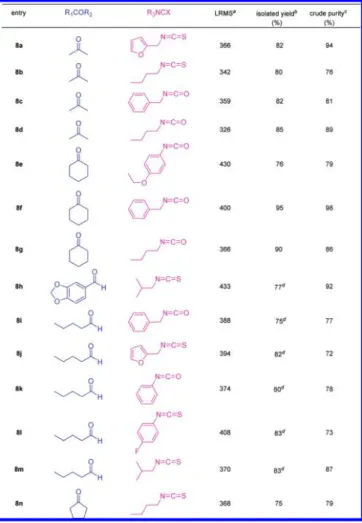
with mass spectra (MS). The analytical data including crude yield and purity are reported in Table 1.
The predominantly trans stereochemistry of tetrahydro-β-carboline hydantoins 8h-8m is based on spectral data through comparison with earlier works by Cook’s research group.20To further confirm the obtained results, we
under-took the 1D NOE analysis of compound 8l, which showed that there is no correlation between C2-Ha and C12-Hb
protons, which demonstrates clearly the trans stereochemistry (Figure 4). Moreover, the irradiation of Hf caused the enhancement of He and Hb by 9.00% and 2.03% respectively which further enhanced the Hd by 2.70%. Similarly, the irradiation of Hd caused the enhancement of Ha and Hc by 4.86% and 23.48%. In the same way, the irradiation of He caused the enhancement of Hb and Hf signals by 1.81 and 12.4% respectively. We also obtained the signal enhancement of Hc by 3.18% followed by irradiation of Ha.
In this study, an efficient and green methodology for the gram-scale synthesis of pharmacologically interesting trisub-stituted indole alkaloids through the use of commercially available building blocks has been demonstrated. Final libraries are usually obtained in high purity and yield just by simple precipitation and washings of each IL-attached intermediate with minimum column purification. In contrast to the solid-phase synthesis, the reaction progress of IL-bound support was successfully monitored by a conventional analytical technique without the “cleave-&-analyze” method. Moreover, the aqueous chemistry provides a practical prospect for the sustainable development of future science and technologies in drug discovery.
Acknowledgment. The authors thank the National Science
Council of Taiwan for the financial assistance.
OL901857H
(20) (a) Ungemach, F.; Soerens, D.; Weber, R.; DiPierro, M.; Campos, O.; Morkry, P.; Cook, J. M.; Silverton, J. V. J. Am. Chem. Soc. 1980, 102, 6976.
Table 1. Microwave-Assisted, IL-Supported Synthesis of Tetrahydro-β-carboline Hydantoin and Thio Hydantoins (8a-8n)
aLRMS were detected with ESI ionization source.bYields are based
on loading of ionic liquid soluble support.cDetermined by HPLC analysis
at UV 254 nm of the crude product.dIsolated as only the trans isomer.
Figure 4.Some important NOE interactions in the 8l trans isomer.