Synthesis and characterization of liquid crystalline multiblock
copolyesters of oxybenzoate and ethylene terephthalate
Jia-Chong Ho, Yih-Shyh Lin, Kung-Hwa Wei*
Department of Materials Science and Engineering, National Chiao Tung University, Hsinchu, Taiwan 30049, ROC Received 28 April 1998; received in revised form 27 July 1998; accepted 20 August 1998
Abstract
Multiblock copoly(oxybenzoate-p-ethylene terephthalate) (POB-PET) was synthesized by a direct reaction of poly(hydroxybenzoic acid) (PHBA), acetoxybenzoic acid and poly(ethylene terephthalate). The synthesized multiblock POB-PET becomes more blocky and less soluble in the mixed solvent of trifluoroacetic acid and chloroform when the degree of polymerization of PHBA used in the synthesis is higher as evidenced in the solid-state and liquid-state nuclear magnetic resonance study. The thermal curves displayed by the synthesized multiblock 20/80 and 40/60 POB-PET contained distinctive contributions from both PET blocks and POB blocks in the copolymers when the degree of polymerization of PHBA used in the synthesis is seven. Only 20 mol% of POB is needed to form liquid crystalline phase in these multiblock POB-PET as opposed to a minimum of 40 mol% of POB is required to form liquid crystalline phases for random POB-PET. 䉷 1999 Elsevier Science Ltd. All rights reserved.
Keywords: Liquid crystalline multiblock copolyesters; Oxybenzoate; Ethylene terephthalate
1. Introduction
Thermotropic liquid crystalline polymers (TLCPs) posses low melt viscosity during processing and can have high modulus in oriented direction in solid state [1,2]. Most synthesized TLCPs were close to random copolymers such as in the case of copoly(oxybenzoate-p-ethylene
terephthalate) (POB-PET) and
copoly(oxybenzoate-p-oxynaphthalate) (POB-PON). In order to exhibit liquid crys-talline phase, both of these two TLCPs need to contained about 40 mol% of POB. To have practical application, more than 60 mol% of POB in these TLCPs are usually prepared such as in the cases of commercialized POB-PET at molar ratio of 60/40 and POB-PON at molar ratio of 73/27. The high cost of acetoxybenzoic acid used for forming the POB segments reduced the application of these TLCP.
Blending of TLCPs with thermoplastics therefore became a seemingly viable route to impart improved mechanical and thermal properties of the thermoplastics. The in situ composites formed out of TLCP blends indeed drew a lot of research attention recently [3–7]. The compatibility between the TLCP and the matrix polymer seemed the most critical one in deciding the mechanical properties of these TLCP composites because most failures appeared at the interfaces. However, due to its stiff structure, TLCP
were usually immiscible with flexible-coil amorphous poly-mers. Phase separation occurred when the TLCP blends were subject to high stress and high temperature [8]. In previous studies [9,10], it was found that by adding a small amount of a second random thermotropic liquid crys-talline polymer to the reinforcing TLCP and the matrix amorphous polymer, the mechanical properties of these ternary blends increased substantially as compared to that of binary TLCP blends because of the enhanced compat-ibility in the blends. Moreover, the misccompat-ibility of the blends of TLCPs with polyesters could be also enhanced by trans-esterification [11,12].
It is our expectation that a block TLCP containing both rigid-rod and flexible-coil blocks would further improve the compatibility in blends of the TLCP and thermoplastics. Second, the amount of acetoxybenzoic acid used in the synthesis of block TLCP can be reduced to a minimum while maintaining the liquid crystalline character. Addition-ally, we can obtain molecular level reinforcement of flex-ible-coil block by the rigid liquid crystalline block. The block TLCP that we are interested in synthesizing is block copoly(oxybenzoate-p-ethylene terephthalate) (POB-PET).
Random POB-PET was first synthesized by melt blending
of 4-acetoxybenzoic acid (ABA) and poly(ethylene
terephthalate) (PET) [13]. The reaction in synthesizing random POB-PET consisted of alcoholysis, acidolysis and midchain transreaction (transesterification) [14]. The
0032-3861/99/$ - see front matter䉷 1999 Elsevier Science Ltd. All rights reserved. PII: S 0 0 3 2 - 3 8 6 1 ( 9 8 ) 0 0 6 0 7 - 7
characterization of the random POB-PET with 1H and
13
C nuclear magnetic resonance showed that the content of POB has to be about 40 mol% and at least three POB repeating units to exhibit liquid crystalline phase [15].
Moreover, the 60/40 POB-PET was not completely random since it contained blocky part and POB-rich part as separated by the solubility test in chloroform [16]. These results led us to explore the possibility of
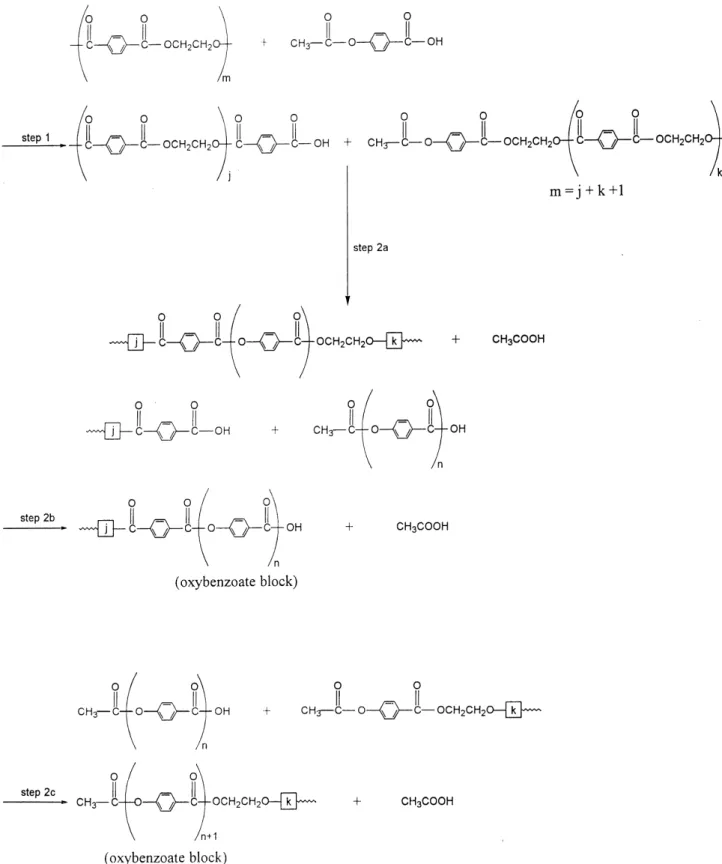
Fig. 1. The reaction mechanism of acetoxybenzoic acid (ABA), poly(hydroxybenzoic acid) (PHBA) and poly(ethylene terephthalate) (PET) in the synthesis of copoly(oxybenzoate-p-ethylene terephthalate).
a more efficient way of exhibiting liquid crystalline phase by having a short POB block, usually containing four or five repeating units. However, if the POB block is too long, then the TLCP becomes infusible and of no prac-tical application.
There have been different methods in producing multi-block TLCPs. Lenz and co-workers [17–19] used crystal-lization-induced reaction (CIR) of random POB-PET to form multiblock POB-PET judging from the insolubility of POB-PET in trifluoroacetic acid. Later, liquid crystalline
block copolymer containing oxybenzoate–butylene
terephthalate block of four units and butylene terephthalate
block was successfully synthesized in suspensions by Lenz et al. [20].
In this study, we adopted a slightly different approach by first synthesizing poly(hydroxybenzoic acid) (PHBA) of low degree of polymerization that was described elsewhere [21–24]. In this study acetoxybenzoic acid (ABA) and medium intrinsic viscosity PET were mixed, and formed homogenous melt at high temperature. Then, the PHBA was added into the melt. In this reaction order, the PET chain was cleaved by 4-acetobenzoic acid (ABA), and produced segments of PET terminated with carboxylic acid end groups (PET–acid) and PET terminated acetoxy
Fig. 1. Continued.
Table 1
Codes for reactants and resulted polymers
General names Codes for the
synthesized polymers
Reactant compositions Apparent mole ratio
20/80 POB-PET P28 ABA/ABA/PET 10/10/80 P28D7 ABA/PHBA DP 7/PET 10/10a/80 P28D14 ABA/PHBA DP 14/PET 10/10a/80 40/60 POB-PET P46 ABA/ABA/PET 20/20/60 P46D7 ABA/PHBA DP 7/PET 20/20a/60 P46D14 ABA/PHBA DP 14/PET 20/20a/60 60/40 POB-PET P64 ABA/ABA/PET 30/30/40 P64D7 ABA/PHBA DP 7/PET 30/30a/40 P64D14 ABA/PHBA/DP 14/PET 30/30a/40
end groups (PET–aceto) as shown in the step 1 in Fig. 1. PHBA has less probability of dissecting PET chain directly than that of dissecting PET chain by ABA since the degree of polymerization of PHBA is more than 7. Segments of
PET–acid and PET–aceto can react among themselves and produced an insertion of an oxybenzoate unit in the PET chain as shown in step 2a, or they can individually react with PHBA as shown in steps 2b and 2c of Fig. 1.
Table 2
The solubility and the composition of synthesized POB-PET copolymers
Solubility (%)a Copolymer, mole fractionb Soluble part, mole fractiona Insoluble part, mole fractionc
POB PET POB PET POB PET
P28 100 0.19 0.81 0.19 0.81 P28D7 94.10 0.20 0.80 0.17 0.83 0.63 0.37 P28D14 93.78 0.19 0.81 0.14 0.86 0.79 0.21 P46 100 0.37 0.63 0.37 0.63 P46D7 92.59 0.35 0.65 0.33 0.67 0.70 0.30 P46D14 88.50 0.36 0.64 0.30 0.70 0.82 0.18 P64 100 0.58 0.42 0.58 0.42 P64D7 86.40 0.59 0.41 0.56 0.44 0.78 0.22 P64D14 65.86 0.60 0.40 0.47 0.53 0.84 0.16 a
Obtained from1H n.m.r. spectra in the solvent of CF3COOD/CDCl3(95/5 by volume). b
Obtained from13C DD/MAS n.m.r. spectra.
c
Obtained from Eqs. (15) and (16).
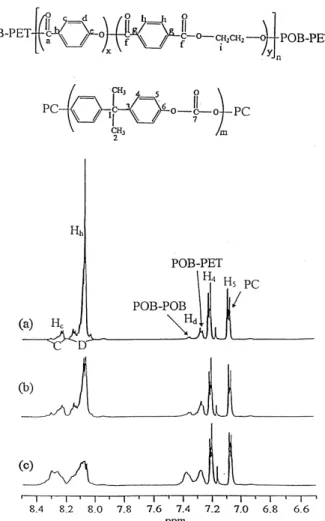
Fig. 3. The1H nuclear magnetic resonance spectroscopy of the soluble portion of POB-PET in the mixed solvent. (a) P28D7 (b) P46D7 (c) P64D7. Fig. 2. The dipolar decoupled/magic angle spinning13C solid-state nuclear
All reactions in step 2 generated acetic acid. The other possible reactions of segments PET–acid and PET–aceto are also described in Fig. 1. These reactions included the
coupling of segment PET–(OB)n and segment PET–
(OB)n⫹1to form the chain with the insertion of oligomeric oxybenzoate as indicated in step 3. The ABA or PHBA can also react with itself, respectively, and produced acetic acid as shown in step 4. The ABA and PHBA were therefore involved in two parallel reactions. Apparently, it needed PHBA to build up oxybenzoate blocks in the PET chain. On the other hand, it needs the high end group density of ABA to dissect PET chain and to produce the reaction inter-mediates. In this approach, multiblock POB-PET will be produced, but random POB-PET can also appear. However, in this study we termed multiblock POB-PET to include the mixture of synthesized block and random POB-PET.
2. Experimental
4-Acetoxybenzoic acid was purchased from SanFu Chemical Co., Taiwan. Poly(ethylene terephthalate) (PET) was obtained from Shin-Kwang Synthetic Fiber Co., Taiwan. Poly(hydroxybenzoic acid) was synthesized in Therminol 66 by suspension polycondensation of ABA following the procedure of Kricheldorf and Schwarz [22].
The synthesis of multiblock POB-PET can be described in the following. The PET powder was dried in a vacuum oven at 80⬚C for 24 h. The dried PET and ABA monomers were fixed at a molar ratio at 285⬚C in a 250 c.c. reactor
submerged in a salt both of KNO3/NaNO3. After the
mixtures became homogeneous at 285⬚C under purging
nitrogen gas for 30 min, the reacting mixture was heated up to 305⬚C. The PHBA was added into the reacting mixture at 10-min intervals three times, and the reaction was allowed for 30 min under nitrogen gas. Finally the mixture continued for 4 h at 305⬚C under vacuum. The resultant acetic acid was evacuated under a vacuum of 10⫺2 Torr. The resultant polymer was cooled in ice water, and then was put in a vacuum oven at 100⬚C for 24 h before analysis. The POB and the PET content in the synthesized POB-PET were measured with the dipolar decoupled (DD)/magic angle spinning (MAS) 13C spectroscopy in a solid-state n.m.r., Bruker model DSX-400, Germany. For the solubility tests, we chose CF3COOD/CDCl3(95/5, v/v) as the solvent.
The random POB-PET can be dissolved completely in the mixed solvent, but the synthesized multiblock POB-PET can not be dissolved completely in mixed solvent. The concentration of the polymers in the mixed solvent was 2% by weight. These partial soluble polymer solutions were maintained at room temperature for 48 h. It is essen-tially impossible to collect the insoluble portion of POB-PET from the mixed solvent due to its gel state. The solu-bility of POB-PET copolymer in mixed solvent can be decided by adding a known small amount of polycarbonate
Fig. 4. The preference of forming block POB-PET at different POB content and at different DP of PHBA.
(PC). PC can be completely dissolved in the chloroform in the mixed solvent. The relative amount of POB-PET and PC dissolved in mixing solvent can therefore be determined from the relative proton peak strength in n.m.r. spectra. The proton n.m.r. data were obtained in a Bruker DMX-600 spectrometer. The thermal properties of all polymers were measured with differential scanning calorimetry (d.s.c.) using a Du Pont model 2910. The PHBA was vacuum-dried at 120⬚C overnight before the d.s.c. measure-ment. The temperature range was from 25 to 330⬚C, and the heating rate was 20⬚C/min. The first heating curve was taken as the d.s.c. curve of the samples. For the synthesized POB-PET, the samples were heated up from 25 to 350⬚C at a heating rate of 20⬚C/min, and then were quenched immedi-ately into liquid nitrogen. The cooled samples were heated up again at the same heating rate. The second heating curve was taken as the d.s.c. curve of the samples. The birefrin-gence of these polymers was studied using a Carl Zeiss
Axiophot microscope, at magnification of 400× , equipped with a Mettler FP82HT hot stage. The samples were heated to 350⬚C, and the samples were quenched to room tempera-ture. The quenched samples were transferred to a hot stage in a polarizing microscope. Subsequently, the samples on the hot stage were heated from room temperature to 310⬚C at a heating rate of 20⬚C/min for birefringence study.
3. Results and discussion
In order to be concise, the codes for the synthesized POB-PET and the reactants used are given in Table 1. In Table 1, the apparent moles of PHBA used in the synthesis of POB-PET copolymer is defined as the actual moles of PHBA times its degree of polymerization (i.e. the moles of POB contained in PHBA). In this way, we can calculate the moles of POB that exist in the POB-PET copolymers of different POB block length. For an accurate analysis of the apparent molar ratio of POB in these copolymers, the DD/MAS solid-state n.m.r. spectra of these copolymers were obtained. We only show the solid-state n.m.r. spectra of the copolymers
that were synthesized from PHBA DP 7, and they are
displayed in Fig. 2. In Fig. 2a, the 13C peak at 155 ppm was contributed from both Ca in POB segment and Cf in
PET segment in the P28D7 copolymer, while the13C peak at
147 ppm was caused by Cein POB segment in the P28D7
copolymer. The Ce peak became larger when the POB
content increased, as shown in Fig. 2b,c. A few equations are needed for calculating the exact amount of POB and PET in these copolymers from their solid-state n.m.r. spectra, and they are
F POBsd⫹ 2F PETsd kA 1
F POBsd kB 2
F POBsd⫹ F PETsd 1 3
Where F(POB)sd and F(PET)sd are the mole fractions of
POB and PET in the solid copolymer, respectively. A and
B are the area under peaks Ca, Cfand Ce, respectively. The
constant k can be obtained in the following by putting Eqs. (1) and (2) into Eq. (3).
k 2= A ⫹ B 4
Then we obtained the molar fraction of POB and PET from Eqs. (5) and (6).
F POBsd 2B= A ⫹ B 5
F PETsd A ⫺ B= A ⫹ B 6
The calculated mole fractions of POB and PET in the solid copolymers are given in Table 2. In Table 2, the synthesized POB-PET copolymer contained rather accurate POB and PET apparent mole ratio as designed.
The solubility of POB-PET copolymer can be obtained from proton n.m.r. spectra as depicted in Fig. 3. In Fig. 3a,
Fig. 6. The differential scanning calorimetry curves of PHBA DP 43 at first heating and of PHBA DP 7 at first and at second heating.
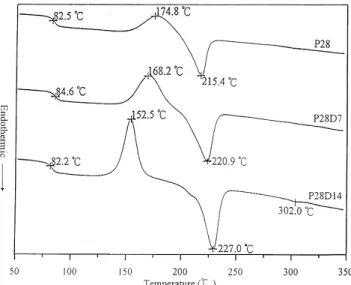
Fig. 7. The differential scanning calorimetry curves of 20/80 POB-PET copolymers synthesized from ABA, PET, and PHBA of different degrees of polymerization (DP).
Hh and Hc peaks stand for the relative amount of the
aromatic protons in PET and in POB segments, respectively,
in the soluble part of P28D7. H4 peak represents the
aromatic protons in bisphenol-A segments of PC. From the ratio of Hhand Hcto H4in the n.m.r. spectra, the
solu-bility of these copolymers in the solvent can then be calcu-lated. In Fig. 3b,c, the Hc peak grew bigger because of
higher POB content. The solubility results are also given in Table 2. In Table 2, the solubility of synthesized multi-block POB-PET decreased with the increasing DP of PHBA used in the synthesis. This trend became more intensive for the copolymer of higher POB/PET ratio that can be mani-fested by the fact that the probability of forming blocky POB increased with the POB content in the copolymers [19]. Therefore, the resultant POB-PET copolymers are
more blocky when the DP of PHBA used in the synthesis is higher.
The composition of the soluble portion of these multi-block POB-PET can also be obtained from the proton n.m.r. analysis and by the following equations.
2F POBsoluble k0C 7
4F PETsoluble k0D 8
F POBsoluble⫹ F PETsoluble 1 9 Where F(POB)solubleand F(PET)solubleare the mole fraction
of POB and PET in the soluble portion of the copolymer, respectively. C and D are the areas under peaks Hcand Hh,
respectively. k0is a constant. By putting Eqs. (7) and (8) into Eq. (9), one obtained
k0 4= 2C ⫹ D 10
The mole fraction of POB and PET in the soluble portion of these copolymer can therefore be determined in the follow-ing equations.
F POBsoluble 2C= 2C ⫹ D 11
F PETsoluble D= 2C ⫹ D 12
The mole fraction of POB and PET in the soluble part of multiblock POB-PET are given in Table 2. In Table 2, the POB content in the soluble portion of the multiblock POB-PET decreased with the increasing DP of PHBA used in the synthesis. Specifically, the POB molar fractions in the solu-ble portion of P28D7 and P28D14 were about 14% and 22% lower than that of P28, respectively. This can be explained by the fact that the POB-POB sequence length of the synthe-sized POB-PET increased with the DP of PHBA in the synthesis. When the POB-POB sequence length in PHBA is greater than six, the PHBA became insoluble in all common solvent [22]. Therefore, the POB mole fraction in the soluble part of POB-PET decreased with the increas-ing POB-POB sequence length.
The sequence length of the POB segment in the soluble portion of multiblock POB-PET were obtained from their proton n.m.r. spectra. The probabilities of attaching one POB to another POB and attaching one POB to another PET are proportional to the area under the peak at 7.38 ppm and under the peak at 7.28 ppm of the proton n.m.r. spectra, respectively, as indicated in Fig. 3a. For a comple-tely random POB-PET, the probability of attaching one POB to another POB, P(POB-POB), can be defined by the following equation [15,25].
P POB-POB F POB={F POB ⫹ 2F PET} a 13 Where F(POB) and F(PET) are the mole fractions of POB and PET in the copolymer. The relative blockiness in the POB-PET copolymer can be expressed in the following equation.
Fig. 8. The differential scanning calorimetry curves of 40/60 POB-PET copolymers synthesized from ABA, PET and PHBA of different DP.
Fig. 9. The differential scanning calorimetry curves of 60/40 POB-PET copolymers synthesized from ABA, PET and PHBA of different DP.
P POB-POB ma 14 Where m is the preference factor. The POB-PET is comple-tely random when m 1, and is more blocky as m becomes larger. In Fig. 4, the synthesized random POB-PET has a preference factor (m) of 1.14. For the soluble portions of
multiblock POB-PET at PHBA DP 7 and at PHBA DP
14, the m values are 1.36 and 1.65, respectively. This is a direct evidence that the soluble part of the synthesized POB-PET copolymers became more blocky when the DP of the PHBA used increased.
The composition of the insoluble portion of multiblock POB-PET can be deduced from the difference in the compo-sition of the solid and the soluble portion of the polymer. The mole fraction of POB and PET in the insoluble portions
of these copolymer can be calculated from the following equations.
F POBinsoluble {F POBsolid⫺ SF POBsoluble}={1 ⫺ S} 15 F PETinsoluble {F PETsolid⫺ SF PETsoluble}={1 ⫺ S}
16 Where F(POB)insolubleand F(PET)insolubleare the mole
frac-tions of POB and PET in the insoluble porfrac-tions of multi-block POB-PET, respectively. S is the solubility of multiblock POB-PET in the mixed solvent. The solubility of POB-PET results are given in Table 2. In Table 2, the molar ratio of POB to PET becomes higher in the insoluble portion of the POB-PET as the DP of PHBA increased. This trend decreased with the increasing POB content in the copolymer, and is complementary to the trend in the soluble portion of POB-PET copolymer. From these results, we can elucidate two conclusions. As the DP of the PHBA increased in the synthesis, the multiblock POB-PET became less soluble and more blocky. Secondly the synthesis method used can enhance the blockiness of the POB-PET copolymer especially when the POB content in the copoly-mer is low.
The thermal curves of PET of PHBA are shown in Fig. 5. In Fig. 5, the glass transition temperature (Tg) and the
crys-tallization temperature (Tc) of PET were 82.3 and 169.8⬚C,
respectively. The melting temperature (Tm) of PET was
254.0⬚C. Additionally, in Fig. 5, PHBA with degree of
Table 3
The enthalpy changes in crystallization and in melting, (DHcandDHm), for
various POB-PET copolymers
DHc(J/g) DHm(J/g) P28 17.3 17.3 P28D7 28.7 29.5 P28D14 31.2 32.9 P46 —a 19.1 P46D7 4.3 22.4 P46D14 16.3 26.5 P64 —a —a P64D7 —a 4.2 P64D14 —a 8.8 a Non-existent.
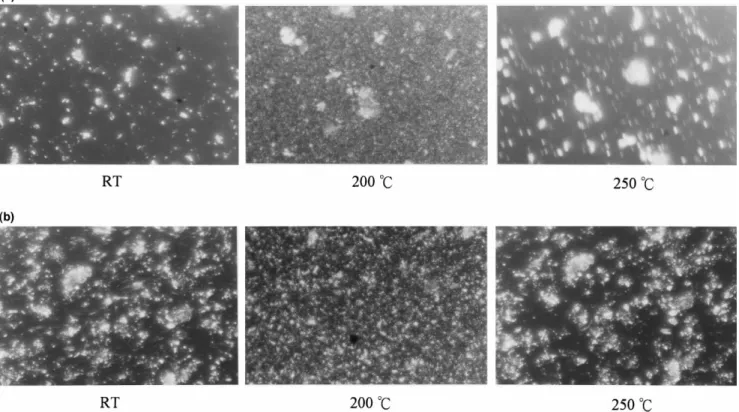
Fi g. 11. The birefringence pictures of (a) P64D 7 (b) P64D14 at dif ferent tempera tures.
polymerization equaling seven (DP 7) displayed two distinctive endothermic peaks at 263.1 and 280.2⬚C, and there were also two similar peaks at 282.6 and 300.9⬚C for PHBA DP-14. The first endothermic peak (at 263.1⬚C)
was the melting peak of PHBA DP 7. The second
endothermic peak (at 280.2⬚C) was the melting peak of PHBA having a larger molecular weight (DP⬎ 7) resulted from a continuing reaction of PHBA DP 7. This thermal behaviour of PHBA oligomer was mentioned briefly by Kricheldorf and Schwarz [22] and Economy et al. [23] in their previous studies. As to whether the double endother-mic peaks of these PHBA oligomers were directly caused by the double molecular weight distribution of PHBA, we can only check them indirectly since PHBA DP 7 are insol-uble in all known solvents [22]. This means that the gel permeation chromatography (g.p.c.) method cannot be used to measure their molecular weight in this case. At a
second heating of PHBA DP 7, the double endothermic
peaks converged to a broad single peak as shown in the d.s.c. curve in Fig. 6, indicating some reaction taking place. Furthermore, for PHBA DP 43, there is only one endothermic peak at 313.2⬚C as displayed in Fig. 6. This can be explained by the fact that the end-group concentration of PHBA decreased with the increasing DP of PHBA. When the DP of PHBA increased, the probability of continuing reaction of oligomeric PHBA decreased. Consequently, the PHBA of higher DP display a single endothermic (melting) peak. Therefore, we concluded that the double endothermic
peaks of PHBA D⫹ P 7 were not caused by the double
molecular weight distribution of PHBA.
The d.s.c. curves of 20/80 POB-PET synthesized from a mixture of ABA, PHBA and PET at the apparent molar ratio of 10/10/80 were presented in Fig. 7. There are three cases: P28, P28D7 and P28D14. In Fig. 7, the Tgof these 20/80
POB-PET copolymers was between 82 and 85⬚C. The Tcof
these 20/80 POB-PET decreased with the increasing DP of the PHBA. Moreover, when the DP of PHBA increased, both of the enthalpy changes in melting and in crystalliza-tion of these 20/80 POB-PET increased. This thermal beha-viour can be explained by the fact that both of the acidic end-groups of ABA and PHBA were capable of slicing PET chains during the synthesis of POB-PET. Either ABA or PHBA contained only two end-groups. For the purpose of comparison, the total apparent moles of POB contributed from both ABA and PBHA is fixed in any one of the synthe-sized 20/80, 40/60 and 60/40 POB-PET, independent of their PHBA block length, as given in Table 1. In other words, if the DP of PHBA increased (at the expense of ABA), then the total number of acidic end-groups contrib-uted from both PHBA and ABA decreased. This fact would unavoidably reduce the total number of slicing of PET by ABA and PHBA during the synthesis. Therefore, when the DP of PHBA is higher, it resulted in longer PET block, and the synthesized POB-PET became more blocky. Conse-quently, the crystallization peak by the PET block in P28D14 copolymer was much sharper than that by the
PET block in P28 and P28D7. Additionally, the POB block can serve as nucleating seeds in the crystallization of PET, and this nucleation effect increased with the increasing POB block length in 20/80 POB-PET block copolymer. This thermal behaviour of multiblock 20/80 POB-PET is similar to that of other TLCP block copolyester [20]. Since the samples were heated from room temperature to 350⬚C in the d.s.c. measurements, the induced crystal-lization temperature of multiblock 20/80 POB-PET became lower as the POB block length in copolymer increased. Moreover, there is a small endothermic peak at 302.0⬚C for P28D14. This peak is probably the transition peak of POB blocks [19]. The same phenomenon can be observed in the three cases of 40/60 POB-PET copolymer, but with a slight modification, as shown in Fig. 8. In Fig. 8, noticeably, both the Tcand Tgpeaks contributed by PET blocks became
less prominent in P46 and P46D7 as compared to that contributed by PET blocks in P28 and P28D7. This is caused by the more intensive acidolysis of PET chains as a result of more ABA during the synthesis of POB-PET. The thermal behaviour of P46D14 was slightly different from that of P46 and P46D7 by having an obvious contribution from PET blocks. P46D14 also displayed a transition peak of POB
blocks at 302.5⬚C. In the case of 60/40 POB-PET, the
synthesized POB-PET displayed much less PET thermal characteristics as a result of much shorter PET blocks as shown in Fig. 9. In Fig. 9, the Tc, Tgand Tmpeak
contribu-tion by PET blocks in P64, P64D7, and P64D14 became obscured. Additionally, the transition peak at 304.5⬚C contributed by POB block in P64D14 became more promi-nent. The enthalpy changes in crystallization and in melting of these copolymers were given in Table 3.
In a complementary study, the liquid crystalline phase and the crystalline phase of these copolymers were exam-ined with polarizing optical microscopy. The birefringence pictures of P28D7 and P28D14 at various temperatures are presented in Fig. 10a and Fig. 10b, respectively. For mini-mizing the effect of thermal history, all multiblock
POB-PET were heated to 350⬚C, and subsequently it was
quenched in liquid nitrogen to avoid the crystallization prior to the birefringence study. The first picture of P28D7 was taken at room temperature. In Fig. 10a, P28D7 displayed both nematic phase and amorphous phase at room temperature (solid state). When P28D7 was heated to 200⬚C (over its crystallization temperature of 168⬚C by d.s.c. measurement), the crystalline phase of PET-rich domain of P28D7 was observed. When P28D7 was heated to 250⬚C (over its melting point of 220⬚C by d.s.c. measure-ment), the P28D7 melt displayed both liquid crystalline phase and amorphous phase, that resulted from POB-rich domain and PET-rich domains, respectively. In Fig. 10b, the multiblock P28D14 exhibited a similar phenomenon but with denser liquid crystalline phase at melt state. Previously, the POB content in random POB-PET copolymer has to be about 40 mol% to show liquid crystalline phase [15]. This multiblock POB-PET only required 20 mol% of POB to
exhibit liquid crystalline phase. The multiblock P64D7 exhibited both a major nematic phase and a minor amor-phous phase at room temperature (solid state) as shown in Fig. 11a. When P64D7 was heated to 180⬚C (over its crys-tallization temperature of 115⬚C), it exhibited a much smal-ler crystalline phase (contributed by PET-rich domain) than that of P28D7. When P64D7 was heated to 250⬚C (over its melting point), the melt state of P64D7 displayed a liquid crystalline phase by POB-rich domain and an amorphous phase by PET-rich domain simultaneously. For P64D14, it appeared to separate into two phases at room temperature as shown in Fig. 11b. The first phase (I*) had higher POB content and appeared homogeneous. The other phase (II*) containing dark regions had low POB content and higher PET content. The crystalline phase by PET-rich domain was obscured by the rich nematic phase of the high POB content in both the two phases at different temperatures (room
temperature, 180 and 310⬚C). When P64D14 was heated
to 310⬚C (over its transition peak at 304.5⬚C), the high POB content liquid crystalline phase (I*) became brighter. This is owing to the phase transition of POB block in P64D14. These phenomena corresponded to the phase tran-sition temperatures of these multiblock POB-PET obtained by the d.s.c. measurement very well.
4. Conclusions
In conclusion, the direct reaction of low-degree polymer-ization PHBA, ABA and PET can produce multiblock POB-PET. At a fixed amount of POB, the synthesized multiblock POB-PET becomes less soluble in the mixed solvent of trifluoroacetic acid and chloroform when the DP of PHBA used in the synthesis is higher. In the soluble portion of these multiblock POB-PET, the blockiness of these polymers increased with the DP of PHBA, while the POB content decreased with the DP of PHBA as evidenced in the nuclear magnetic resonance study. When the POB content in the copolymer increased, the effect of the PHBA’s DP on the blockiness of POB-PET became diminished. The thermal curves displayed by the synthesized multiblock 20/80 and 40/60 POB-PET contained distinctive contributions from both PET blocks and POB blocks in the copolymers when the DP of POB blocks is 14. Only 20 mol% of POB is
needed to form liquid crystalline phase in these multiblock POB-PET even at short POB block (DP 7) as opposed to a minimum of 40 mol% of POB is required to form liquid crystalline phases for random POB-PET.
Acknowledgements
The authors appreciated the financial support provided by the National Science Council through Project NSC87-22 16-E-009-005.
References
[1] Economy J, Goranov K. In: Hergenrother PM, editor. Advances in polymer science. Berlin: Springer-Verlag, 1994.
[2] Donald AM, Windle AH. Liquid crystalline polymers. Cambridge: Cambridge University Press, 1992.
[3] Kiss G. Polym Eng Sci 1987;27:40.
[4] Kolhi A, Chung N, Weiss RA. Polym Eng Sci 1989;27:573. [5] Brostow W. Polymer 1990;31:979.
[6] Sukhadia AM, Done D, Baird DG. Polym Eng Sci 1990;30:519. [7] Wei KH, Kiss G. Polym Eng Sci 1996;36:713.
[8] Tang P, Reimer JA, Denn MM. Macromolecules 1993;26:4269. [9] Wei KH, Kwang JL, Tyan HL. Polymer 1996;37:2087. [10] Wei KH, Tyan HL. Polymer 1998;39:2013.
[11] Wei KH, Jang HC, Ho JC. Polymer 1997;38:3521. [12] Wei KH, Ho JC. Macromolecules 1997;30:1587.
[13] Jackson WJ, Kuhfuss HJ. J Polym Sci Polym Phys Ed 1976;14:2043. [14] Mathew J, Ghadage RS, Ponrathnam S. Macromolecules
1994;27:4021.
[15] Nicely VA, Dougherty JT, Renfro LW. Macromolecules 1987;20:578.
[16] Quach L, Hornbogen E, Volksen W, Economy J. J Polym Sci Polym Chem Ed 1989;27:775.
[17] Lenz RW, Go S. J Polym Sci 1973;A1(11):2972. [18] Lenz RW, Go S. J Polym Sci Polym Chem Ed 1974;12:1. [19] Lenz RW, Jin J, Feichtinger KA. Polymer 1982;24:327.
[20] Ignations F, Lenz RW, Kantor SW. Macromolecules 1994;27:5248. [21] Economy J, Storm RS, Matkovich VI, Cottis SG, Nowak BE. J Polym
Sci Polym Chem Ed 1976;14:2207.
[22] Kricheldorf HR, Schwarz G. Makromol Chem 1983;184:475. [23] Economy J, Volksen W, Viney C, Geiss R, Siemens R, Karis T.
Macromolecules 1988;21:2777.
[24] Guo M, Zachmann HG. Macromolecules 1996;29:6790.
[25] Vollmert B. Polymer chemistry. New York: Springer-Verlag, 1973:117–23.