中文摘要
近年來的網路流量特性之量測研究顯示,真實網路封包序列 (Packet-Train) 流量具有 自我類似 (Self-Similar) 的特性。換句話說,封包序列的瞬時增減 (Bursty) 特性具有非常 長時程的統計相關性。這個觀察與分析的結果,正好與傳統使用的僅具有短時程統計相關 性之封包序列流量模式大不相同。並且,過去根植於傳統封包序列流量模式如波以松 (Poisson) 與瞬時波以松 (Bursty Poisson)的分析與模擬結果,所得到的評估效能將會和此 裝置在真實網路上使用所得到的量測效能產生相當大的差異。在此三年的研究計畫中,我 們 先 探 討 現 今 網 路 之 封 包 流 量 的 長 程 相 依 特 性 是 如 何 從 原 本 的 馬 可 夫 模 式 的 網 路 (Markov-Modeled Network Arrival) 中產生。在計畫的第二年,我們提出一個根據濾波器原 理所設計的類化封包訊務產生器,並且從理論上分析其類化性質。我們注意到網路量測封 包訊務的類化性質,雖然延續至超越目前工程技術可掌控的範圍,但終究會收斂為非類化 訊務。因此合成並使用一個類化性質延續至極限範圍的訊務來作為模擬依據是否為必要, 是一個值得商確的問題。基於此,另一種出發點為合成一個類化性質延續至所需要的範圍, 而極限時則呈現非類化性質的訊務似乎更合乎實際量測訊務的行為。我們所提出的方法不 僅程式相當簡單且符合以上的觀察需求,更要的是我們的模式也不會有另外兩個知名類化 訊務產生器(傅立業轉換模式、隨機中點取代模式)的兩個問題: (1)所產生的封包序列可能為 負整數;(2)需事先設定所需產生的封包量,換句話說,當所需要製造的封包序列長度改變 時,整個封包序列必需要重新產生。在計畫的第三年,我們首先將第二年的濾波器類化封 包訊務產生器,由有限時間脈衝響應 (FIR) 延伸到無限時間脈衝響應 (IIR) 的情況。然 後,我們對自我類化訊務模式在資訊理論 (Information Theoretic) 上的特性展開探討。我們 發現,我們提出的類化訊務產生器所生成的訊務在自相關函數 (Autocorrleation Function) 上的長程相依性質與其在交互資訊 (Mutual Information) 的長程相依性質存在一個直接的 關係。 關鍵詞:統計模式、自我類似特性、長時程相關性、訊務產生器、交互資訊 I
英文摘要
Recent empirical studies have shown that the modern computer network traffic is much more appropriately modeled by long-range-dependent self-similar processes than traditional short-range-dependent processes such as Poisson. Hence, if long-range dependence is not considered when synthesizing experimental network traffic, it will lead to incorrect assessments of performance evaluation in network system. This arise the need of a well synthesizing trace with long-range dependence.
In the first year of this 3-year project, we defined and subsequently analyzed the degree of self-similarity for Markov packet sources. In this second-year project term, we developed a filter-based self-similar traffic generator, and theoretically analyze its self-similar property. Notably, the true measured network traffic, although appearing self-similar beyond the range of engineering manageability, is still ultimately non-self-similar. Therefore, it may be arguable to synthesize and use an ultimate self-similar traffic for system performance evaluation. An alternative that generates a traffic that has the desired degree of self-similarity in a controlled range, and that becomes non-self-similar beyond may be closer to the true traffic behavior. As expected, our generator can fulfill the above need. Most importantly, our generator eliminates two of the problems of two other well-known self-similar traffic generators (Paxson-FFT and Random-Mid-Point): (1) the synthesized traffic may be negative; (2) the length of the synthesized traffic must be pre-specified; namely, for different length of the synthesized traffic, the entire traffic must be re-generated. In the third-year project term, we extended the finite duration impulse response (FIR) filter-based self-similar traffic generator developed in the second year to the infinite duration impulse response (IIR) filter-based self-similar traffic generator. Besides, we discuss the information theoretic characteristic of the self-similar traffic. We found that the autocorrelation function and the mutual information of the traffic generated by the FIR filter-based self-similar traffic generator have a direct relationship.
Keywords: Network Traffic Model, Self-Similarity, Long-Range Dependence, Traffic generator, Mutual Information
目 錄
中文摘要
I
英文摘要
II
一、前言
1
二、研究目的、方法、結果與討論
3
2.1 Extensions of Self-Similarity to Markov Processes
3
2.1.1 Motivations
3
2.1.2 Main Results and Discussions
4
2.2 On the Generator of Network Arrivals with Self-
Similar Nature
7
2.2.1 Motivations
7
2.2.2 A Filter-Based Self-Similar Traffic Generator
7
2.2.3 Conclusions
9
2.3 On the Mutual Information Function of the Self-
Similar Traffic
11
2.3.1 Main Results
11
2.3.2 Concluding Remarks and Future Work
13
三、參考文獻
14
四、研究成果自評
16
一、前言
Recent empirical studies have demonstrated that the packet network traffic is actually self-similar in nature [1, 2]. Therefore, the analysis and simulations, as well as their implications, based on the traditional traffic models, such as Poisson, may no longer be applicable to such self-similar networks. This results in the need of a new research direction over packet networks.
In early days, Poisson processes were commonly used as traffic models for packet network system. This was done under the premise that the traffic behavior in network system is similar to that in circuit-switch telephony system. Although the traffic behaviors of these two systems are both due to human behavior, the situation for the network system is more complicated because of its packet-switch nature. Other factors [3], such as network protocols, even further complicate the resultant traffic characteristic.
The measurement studies in [2, 4, 5, 7, 8] have shown that the actual network traffics for different networks (e.g. Ethernet LAN, WAN, CCSN/SS7, ISDN, and VBR Video) are clearly distinguishable from the synthesized traffics by traditional Poisson or related models. Specifically, Leland and Wilson, who recorded hundreds of millions of Ethernet packets with recorded time-stamp accurate to within 100 s, compared the measured traffic data on Ethernet LAN at Bellcore with the Markovian modeled sequences for the same load [2]. They found that in contrast to traditional models, measured traffic varies over a wide range of time scales, and the predicted performance with traditional models as the input stream is quite different from the performance with measured data as the input stream. Therefore, for performance assessments and predictions of these network systems, a good model that emulates the long-range dependence of the measured data becomes necessary. A representative long-range-dependent model is the self-similar model.
Self-similar processes were first introduced by Mandelbrot and his co-workers in 1968 [9, 10, 11]. These processes were thereafter found applications in many fields, such as astronomy, chemistry, economics, engineering, mathematics, physics, statistics, etc. Recently, measurement studies have shown that the actual traffic from computer networks is long-range dependent [2, 4, 5, 7, 8], and thus another new application of self-similar processes on network was initiated. Mandelbrot [12] characterizes the self-similarity as: “When each piece of a shape is geometrically similar to the whole, both the shape and the cascade that generates it are called
self-similar.”
Consider a wide-sense stationary real-valued stochastic process X = {Xi}i=1,2,… with finite marginal mean , marginal variance 2, and autocorrelation function r k( ) . Let X(m) denote the m-averaged process of the original series, where X(m) = ( ( )
1 m X , ( ) 2 m X ,…) and ( m) t X = (Xtmm+1 + Xtmm+2 + … + Xtm) / m. Obviously, X(m) is also a wide-sense stationary stochastic process. Denote the autocorrelation function of X(m) by r(m)(k). Then we can introduce several definitions of self-similar processes as follows.
Definition 1.1 [13] A wide-sense stationary stochastic process X = {Xi}i=1,2,… is called exactly
second-order self-similar with parameter H = 1 (β / 2), where 0 < β < 1, if either of the
following conditions holds:
(1) { 1 2 1 } 2 ) ( 2 2 2 2 H H H k k k k r , k =…, 1, 0, 1, 2,… (2) r( )m ( ) =k r(k)m, k =…, 1, 0, 1, 2,…, and m = 1, 2, ….
Definition 1.2 [13] A wide-sense stationary stochastic process X = {Xi}i=1,2,… is called
asymptotically second-order self-similar with parameter H = 1 (β / 2), where 0 < β < 1, if either
of the following conditions holds:
(1) { 1 2 1 } 2 ) ( lim 2 2 2 2 ) (m H H H mr k k k k , k =…, 1, 0, 1, 2,…. (2) 1 ) ( ) ( lim L k k r
k , where L(τ) is a slowly varying function, satisfying for any x 0, 1 ) ( / ) ( lim L x L .
The simplest self-similar process is the Fractional Gaussian Process, which has the autocorrelation function ( )
| 1|2H | |2H | 1|2H
/2k k
k k
r . For other commonly used
models including Fractional Autoregressive Integrated Moving-Average (FARIMA) Processes, see [10, 14, 15, 16].
二、研究目的、方法、結果與討論
2.1 Extensions of Self-Similarity to Markov Processes
2.1.1 Motivations
Among all researches on network self-similarity, determination of its cause seems the most essential. Without a right interpretation of incoming traffic statistics, the network designers may not be able to come up with a due scheme to accommodate such network sources. For example, if the self-similar nature of the network arrivals is a consequence of the existing network protocols, to examine the performance of a newly proposed replacement protocol in terms of a self-similar incoming traffic will become an unjustifiable circle.
In [8], Paxson and Floyd found through the investigation of 24 network traces that user-initiated traffics, such as TELNET and FTP connection arrivals, are well-modeled as Poisson processes; however, protocol-involved packet arrivals, such as SMTP, NNTP and FTP data transfers, are better modeled using self-similar processes [17]. In addition, non-self-similar models such as Poisson are still the typical source models for circuited-switched telecommunication traffics [18], where the initiation and termination of a call are both controlled by the users. Although it is likely that there are multiple factors contributing to the self-similar behavior observed in real packet networks, the above observations seem to suggest the coincidence between the self-similarity phenomenon of aggregated traffics and the situation where the source (or end-point) protocols are involved in traffic generation. It is then nature to conjecture that the protocol-involved traffic generation, such as re-transmission, is perhaps one of the main causes for the self-similar statistics of overall incoming traffics.
The previous conjecture is numerically substantiated by Peha [19]. In his work, he showed that even with the traditional Poisson packet arrival, a simple re-transmission mechanism makes the aggregated traffic appear self-similar over time scales of engineering interest. Moreover, he found that some conventional techniques intended to decrease the likelihood of congestion also have the effect of prolonging congestion when it does occur and reinforcing the appearance of self-similarity. This motivates us to seek a theoretical interpretation for his results.
Along this research direction, we first found that his simple network scenario can be described through Markovians. Specifically, the network arrivals can be modeled as a stochastic function of the previous system state, where the system state parameterizes through the number of backlog packets in the system. From the knowledge of the current arrival and the previous network state comes the next network state. Since the state-dependent stochastic arrival function is assumed time-stationary, the system arrival is further simplified to a first-order Markov process.
We then notice that there are two possible gaps between the Markovian techniques and the current self-similar definitions. First, in the conventional definitions of exact and asymptotic discrete-time self-similarities, (second-order) stationary is always assumed [13], where the autocovariance function is required to be a function of the time difference only. This is not always
the case even for the commonly used first-order Markov-modeled network arrival, and the autocovariance function is in general a function of both the absolute time and the time difference. Yet, simulations that aim at determining the self-similar parameter of the network arrivals, based on these second-order self-similar definitions, often implicitly assume that the possible non-stationary arrival behavior is only transient in time and can be negligible if the simulation data are collected after a sufficiently large initial time period. A likely mis-interpretation of the simulation data may therefore arise.
Secondly, a Markov process can be made stationary by selecting a proper initial statistics. However, the most common initial state taken in system simulations is an empty backlog queue (more specifically, the number of backlog packets is initially set to zero). These two initial conditions often do not coincide. This may lead to a gap between the implication concluded from system simulations, and the analysis obtained through assuming stationary on Markovians, especially when the equilibrium initial probability is not asymptotic achievable in time from zero backlog queue.
We therefore propose an extension definition of self-similarity to Markov processes by incorporating the prior probability as an argument. If the prior is taken to be the equilibrium initial distribution of the Markov process, our definition reduces to the conventional second-order self-similarity. As did by the conventional definition to second-order-stationary processes, the extension definition answers the main concern of self-similarity that whether the variability of a Markov-modeled network arrival can be smoothed out by block averaging.
2.1.2 Main Results and Discussions
Suppose that X1, X2, X3, … is a first-order Markov process with stationary transition probability T[pij],where pij Pr(X2 xj |X1 xi),and {x1, x2, x3, …} is the state space of the Markov process. We assume that the state space is either finite or countable. The tth order transition probability of {Xi}i1 is equal to T . This implies that the autocovariance function t for the initial probability is
, )
,
(t T x xT T x
b XTt Tt
where the capital letter “T” on superscript denotes the transpose operation, and X is a diagonal matrix with diagonal being the states x1, x2, … and xT
=[ x1, x2, …]. It can be seen from the formula that the autocovariance function of a first-order Markov process depends on both the time difference and the prior probability on X1. We thus propose to define the asymptotic self-similarity for first-order Markov processes as follows.
Definition 2.1.2.1 (Asymptotic self-similarity for Markov processes) A discrete-time first-order Markov process X1, X2, X3, … is asymptotic second-order self-similar with parameter H, where 1/2 H 1, and prior , if
, ) , 0 ( ) , 0 ( lim 2(1 H) j mj j b m b for m{1,2,3,...}.
With the above definition, a nature query for a Markov process is ``Does there exist a justifiable sufficient condition on the transition matrix T and prior under which the Markov process becomes self-similar?'' The question can be answered by obtaining the formula of
bm(0,) , i.e., . ) ( 2 2 ) ( 1 1 ) , 0 ( 1 1 1 0 T T T 2 1 1 1 0 T 2 1 0 T T T 2 1 1 T 2 x x m x m x x m x m b m i i m j i j j m i i m j i j m j j j m j j m
T T XT T Τ T X T This formula can be reduced to a computable formula if the transition probability matrix is
simple [20, Sec. 5.7], where T can be decomposed into T = SS1, and the superscript “1”
represents the matrix inverse operation, and is the diagonal matrix with diagonals being the eigenvalues of T, and the columns of S are the eigenvectors of T. For example, a two-state Markov process will yield
1 1 1 1 1 0 0
T S S m m j j m and 1 2 2 1 1 0 T T 1 ) 1 ( 1 ) 1 ( 1 ) 1 ( ) ( ) (
S S Τ T m m m T m j j j v v v m and 1 2 22 2 21 2 12 11 1 1 1 0 1 ) 1 ( ) 1 ( ) 1 ( 1 1 ) 1 ( 1 1 2 ) 1 (
S S XT T m m m m m i i m j i j m h m h m h m m h and , ) 1 ( 1 1 ) 1 ( 1 1 ) 1 ( 1 1 2 1 ) ( ) ( 1 2 2 2 2 2 2 2 T 1 1 1 1 0 T T
S S T T m m m m i i m j i j j m v m v m v ) m(m- where hij is the component of HS1XS, locating at ith row and jth column, and v is the second 5
component of ST. We can then examine the degree of asymptotic self-similarity of such a Markov process as:
0, 0 1, ; 1 , ) , 0 ( lim m m m b and , ) ( ) )( )( ( 2 ) )( 2 ( ) ( ) ( 2 ) ( ) )( 1 ( 2 ) ( ) ( ] [ ) , 0 ( lim 3 2 1 1 2 2 1 3 2 2 1 2 2 1 3 2 2 1 2 2 1 2 2 1 b a x x bx ax b a b a b a x x b a b a x x b a ab b a bx ax X E b m m n
where a = Pr{X2=x2|X1=x1} and b = Pr{X2=x1|X1=x2}. With the above formulas, we conclude that the variation of the block-average of the Markov process with simple transition probability matrix asymptotic vanishes in block size, and the prior does not affect the degree of asymptotic self-similarity but highly affect the time-finite self-similarity.
2.2. On the Generator of Network Arrivals with Self-Similar
Nature
2.2.1 Motivation
Whether a communication system is well operated or not resides on its reliability in communication quality from the user point of view. To illustrate, the current wired telephone system has been held in high esteem because it provides users reliable circuit-switch-based connections. In order to ensure the reliability of a system, a certain number of testing is a must-do before its deployment. These tests must be properly conducted so that the system performance after deployment can be predictable. This leads to the need of a synthesizing experimental traffic trace that well approximates the true traffic, possibly encountered in practice. As an example, the well-known Erlang B and Erlang C formulas, derived from the Markovian models, successfully characterize the user behaviors by accurately predicting the overall call blocking and queuing probability. We therefore realize the significance of a traffic model for system testing.
Several approaches have been proposed for synthesizing long-range dependent self-similar traffic data. In [21], Paxson synthesized self-similar traffic data by means of traffic spectrum fitting to fractional Gaussian noise. Lau, et al, [6] proposed a so-called random midpoint displacement algorithm to generate a self-similar network trace. We then noted two drawbacks of adopting these approaches. First, the required length of a traffic data should be determined prior to the generation of the traffic data; hence, when a longer traffic sequence is required, one needs to go through the entire process of data synthesization to obtain it. In other words, the traffic data cannot be generated in an on-the-fly fashion. In addition, their traffic generators may produce negative integers, unreasonable for any packet train arrival. Most importantly, the true measured network traffic, although appearing self-similar beyond the range of engineering manageability, is still ultimately non-self-similar. Therefore, it may be arguable to synthesize and use an ultimate self-similar traffic for system performance evaluation. An alternative that generates a traffic that has the desired degree of self-similarity in a controlled range, and that becomes non-self-similar beyond may be closer to the true traffic behavior. This leads us to develop a new approach that can compensate these drawbacks.
2.2.2 A Filter-Based Self-Similar Traffic Generator
The key idea of our generator is based on power spectrum fitting. Let Sy(w) denote the power spectrum of the discrete random process Y[n] obtained by passing the random process X[n] with power spectrum Sx(w) through a filter with transfer function H(w). Then Sy(w) = |H(w)|2
Sx(w). As a result, if we let the input X[n] be i.i.d., and also design a filter whose transfer function satisfies that |H(w)|2 approximates the power spectrum of self-similar traffics, then the filter output straightforwardly become self-similar.
The autocovariance function of an exactly second-order self-similar process with self-similar parameter H is given by ] | 1 | | | 2 | 1 )[| 2 / (c k 2H k 2H k 2H
for some constant c > 0; thus, its power spectrum FH(w) is
jw k H k w e c|1 |2 | 2 |1 2for w . By taking the major term with k = 0, and replacing, inside the summand,|w| by | 1 | jw e , we obtain jw H H w c e F 1 2 | 1 | )
( for w . Hence, the problem is reduced to find a good filter for Poisson i.i.d. input with mean to yield
H jw x y w H w S w H w e S 2 2 1 2 | 1 | | ) ( | ) ( | ) ( | ) ( .
When transforming the problem to its equivalent domain of Z-transform, we can achieve our goal by letting H(z)(1z1)0.5H, and result in
H H H x y z z z z z H z H z S z S 5 . 0 1 5 . 0 5 . 0 1 1 ) 2 ( ) 1 ( ) 1 ( ) ( ) ( ) ( ) ( .
Apparently, by taking zejw into the formula,
H jw H jw jw y w e e e S 0.5 12 | 1 | ) 2 ( ) ( .
Now let us examine the effect of such a filter-based self-similar traffic generator. The impulse response of the filter is equal to h[n](nH 0.5)/[(n1)(H 0.5)] for n0, where
) (
represents the Euler gamma function.
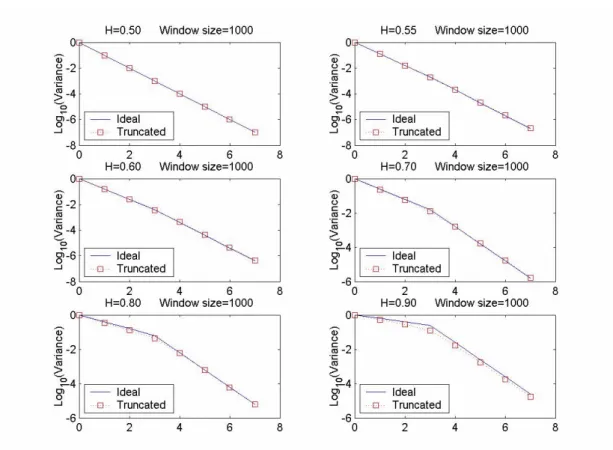
As h[n] is an infinite series, which is impractical in implementation, we limit its window size to W, i.e., h[n] is forced zero for n > W. Denote the variance of m-aggregated series with average window m and truncation window being W by Cm(0;W). Figure 1 illustrates the relation between log[Cm(0;103)] and log[m]. We found that for 0 log10[m] log10[W], the straight line with slope 2H2 fits the curve of log[Cm(0;103)] against log[m]. The resultant H’ at the filter output is listed in Tab. I. From these data, we discovered that when the average window m is less than or equal to the truncated window W, the resultant H’ tends to be a little smaller than the target H, although the deviation, defined as (H’H)/H, is acceptably small in all cases. As a result, the degree of self-similarity is more accurate for smaller H.
For the case of m > W, Cm(0;W) can be represented by AH(W)m1 BH(W)m2, and thus
) ( / ) ( ) ( / ) ( 1 ) log( )] ; 0 ( log[ w A w B m w A w B m W C H H H H m
Accordingly, the degree of self-similarity is determined by the ratio where O(·) is the big-O notation.
Besides, we can also establish that if we wish to obtain a resultant H’ (0.5, 1) (close to the target H) up to the average window m’ > W, then it requires that
2 ' 2 ) ( / ) ( ' ) ( / ) ( 1 H w A w B m w A w B H H H H which implies ) ( ) ( 1 ' 2 ' 2 ' w A w B H H m W H H .
This indicates that the output self-similarity for the truncated model can be extended up to
) ( 2 ) 5 . 1 ( ) 5 . 0 ( ) 5 . 0 ( 1 ' 2 ' 2 ) ( ) ( 1 ' 2 ' 2 12H H H W H O W H H H H H w A w B H H
Since for W > 0 and 0.5 < H < 1,
, ) ( ) ( 2 ) 5 . 1 ( ) 5 . 0 ( ) 5 . 0 ( ' w A w B H W H H H W m H H
provided ideally that H’ = H. The above inequality, together with m’ > W, gives that
, 1 2 2 2 5 . 1 ) 5 . 0 ( OW1 2H H H H W H contradicting to W > 0. We then conclude that as long as exact self-similarity is concerned (i.e.,
H’=H), to extend the output self-similarity up to the truncated window is impossible. From Fig.1,
we further show by numerical that even if H’ is allowed to be a little smaller than H, the conclusion remains.
2.2.3 Conclusions
In this section, we proposed a new model for self-similar traffic sythesization, based on the filter theory. This model is long range dependent with adjustable levels of bustiness and correlation. The model is parsimonious in its number of input parameters. Specially, it only depends on three parameters: H is the self-similar parameter, which controls the burstiness and autocorrelation of the synthesized traffic, defines the mean of the synthesized traffic and W determines not only the length of the filter but also the valid aggregation size of self-similar nature. Though filter length W limits the valid aggregation size of self-similarity, this phenomenon turns out to match the measured behavior of true network traffic, where the self-similar nature only lasts beyond a practically manageable range, but disappears as the considered aggregated window is much further extended. Other advantages of this model are that this filter-based model can synthesize traffic on the fly and always generate non-negative integers to represent network arrivals.
We verify the validity of our filter-based model through the mathematical analysis of its variance-time relation and statistics tests of V-T plot, R/S plot and periodogram plot (cf. table II). And we conclude that our model guarantee to synthesize self-similar traffic with high degree of accuracy in terms of self-similar parameter, H.
Table I. The resultant H’ versus the targeted H. Deviation = (H’H)/H. Window Length = 104
Targeted H Resultant H’ Deviation E
Table II. H used versus H resultant. Window Length = 104 H used H resultant (V-T Plot) H resultant (R/S Plot) H resultant (Periodogram) 0.5001 0.4913099 0.5423777 0.5149618 0.55 0.5243788 0.5839482 0.5433228 0.6 0.5661478 0.6248291 0.5953569 0.7 0.6860798 0.6991949 0.6902056 0.8 0.7558080 0.7792713 0.7968477 0.9 0.8662405 0.8784192 0.8822255
Figure 1. Variance-Time Analysis for W = 103. The slope of the blue line is equal to 2H 2 for m W, and 1 for m > W.
2.3. On the mutual information function of the self-similar
traffic
2.3.1 Main Results
(A) Preliminary
A stochastic process is wild-sense stationary (WSS) if the marginal mean and the autocorrelation function are invariant to a time shift. A stochastic process is asymptotic second-order self-similar if its autocorrelation function decreases with power law (Boris Tsybakov and Nicolas D. Georganas [13]). In general, it seems no significant information-theoretic meaning could be found for the asymptotic second-order self-similar process. However, we found that the mutual information between two different instant values of the asymptotic second-order self-similar process also decreases with power law if it is generated by our filter type generator. Besides, we also show that the mutual information between two different instant values of any binary-valued WSS or any Gaussian process is about half the square of the autocorrelation coefficient.
(B) Nearly Independent
Two random processes X1, X2, … , Xn and Y1, Y2, … , Yn are called nearly independent if when n goes to infinity, the correlation coefficient of Xn and Yn approach to zero, and Xn and Yn are almost independent, i.e.,
),
(
)
(
)
(
)
(
)
(
)
,
(
, Y n Y Y X X X n Y X Y XP
x
o
y
x
P
x
y
P
x
P
y
x
P
n n n n n n n n n n
where ρn is the correlation coefficient of Xn and Yn, that is,
,
n n n n Y Y X X ny
x
E
XE
{
X
n},
n
YE
{
Y
n},
n
},
)
{(
2 n n X XE
x
and{(
)
2}.
n n Y YE
x
(C) Mutual information of two different instant samplesProposition 1: For two nearly independent random processes X1, X2, …, Xn and Y1, Y2, …,
Yn , the mutual information of Xn and Yn are
2 22
1
)
;
(
X
nY
n no
nI
. The proof is omitted here.(D) Mutual information of a sequence of two Gaussian random variables
If X1, X2, … , Xn and Y1, Y2, … , Yn are two nearly independent random processes, and each (Xn, Yn) are two jointly Gaussian random variables, the mutual information of Xn and Yn are [2],
.
2
1
)
1
log(
2
1
)
;
(
X
nY
n n2 n2o
n2I
.If Xn is asymptotic second-order self-similar Gaussian process with parameter H = 1 (β / 2), 0 <
β < 1, and Yn= Xn+m, then
,
as
,
)
1
2
(
}
)
1
(
2
)
1
{(
2
1
)
(
2
2
2
k
k
H
H
k
k
k
k
g
n
and.
,
)
2
1
(
2
)
(
2
1
)
)
(
1
log(
2
1
)
;
(
2
2
2
2 2
g
k
g
k
H
H
k
k
X
X
I
n n k (E) Mutual information between two outputs of a filter
In last two years, we proposed a filter based method to generate an asymptotically self-similar traffic, which not only generates self-similar traffic on the fly but also fits the required self-similar Hurst parameter, H. The impulse response of the filter is equal to
)] 5 . 0 ( ) 1 ( /[ ) 5 . 0 ( ] [n nH n H
h for n0, where represents the Euler gamma () function defined as
0 1
]
[n tn e tdt , and the transfer function of the filter is H jw e w H 0.5 ) 1 ( )
( . When an uncorrelated wide sense stationary sequence Z[n] is inputted, we have showed that the filter output X[n] becomes asymptotically second-order self-similar and its correlation function b(n) is power-law decreasing. Note h[n]0 for n0. Define a filter
) 1 ( ) 2 1 ( ) 2 1 ( ) ( ) 2 1 ( ] [ ] [ ] [ 1 0
i H i H M M H i h i h i p M ifor M 1i0, and p[i]0 for i M 1or i0. If an i.i.d. sequence Z[n] is inputted to the filter p[i], and the output sequence is
1 0 [ ] [ ]
]
[ M
k p k Z n k
n
X . Then we can find
.
,
as
,
)
2
1
(
2
)
]
[
)(
]
[
(
])
[
]
[
(
2
1
])
[
];
[
(
2 2 2 0 2 0 2 2 0
M
k
k
H
H
i
h
i
h
k
i
h
i
h
k
n
X
n
X
I
n k i n i n i (F) Mutual information of a sequence of two binary-valued random variables
If X1, X2, … , Xn and Y1, Y2, … , Yn are two binary-valued random processes, and each (Xn, Yn) are two binary-valued random variables, the mutual information of Xn and Yn are,
),
1
1
(
)
1
(
)
(
)
(
)
;
(
n n n n n n n X n Y b X X n Y b X Y b n nr
h
r
h
h
Y
X
I
where hb(.) is the binary entropy function,
Xn
E
{
X
n},
Yn
E
{
Y
n},
and)}.
)(
{(
n n Y X nE
x
y
r
If rn approaches zero as n goes to infinity, then we have.
2
/
)
;
(
2 n n nY
X
I
In particular, if Xn is any binary-valued asymptotic second-order self-similar process with parameter H = 1 (β / 2), where 0 < β < 1, then,
as
,
)
2
1
(
2
2
1
)
;
(
2
2
2 2
H
H
k
k
X
X
I
n n k
k is also power law decreasing.
2.3.2 Concluding Remarks and Future Work
We already show that the mutual information between two different instant values of the asymptotic second-order self-similar process also decreases with power law if it is nearly independent. We also illustrate three different nearly independent sequences, i.e., the output of our filter type self-similar traffic generator with any i.i.d. inputs, the self-similar Gaussian process, and the binary-valued asymptotic second-order self-similar process. However, the mutual information between two aggregated traffic is still unsolved which is a challenging future work.
三、參考文獻
[1] Mark E. Crovella and Azer Bestavros, “Self-similarity in world wide web traffic: Evidence and possible causes,” IEEE/ACM Trans. Networking, vol. 5, no. 6, pp. 835-846, Dec. 1997. [2] Will E. Leland, Muard S. Taqqu, Walter Willinger and Daniel V. Wilson, “On the self-similar
nature of Ethernet traffic (extended version),” IEEE/ACM Trans. Networking, vol. 2, no. 1, pp. 1-15, Feb. 1994.
[3] J. M. Peha, “Retransmission mechanisms and self-similar traffic models,” IEEE/ACM/SCS
CNDSMS, pp. 47-52, Jan. 1997.
[4] J. Beran, R. Sherman, M. S. Taqqu, and W. Willinger, “Long-range dependence in variable-bit-rate video traffic,” IEEE Trans. Commun., pp. 1566-1579, 1995.
[5] D. E. Duffy, A. A. Mclntosh, M. Rosenstein and W. Willinger, “Statistical analysis of CCSN/SS7 traffic data from working subnetworks,” IEEE JSAC, pp. 544-551, June 1994. [6] W.-C. Lau, A. Erramilli, J. Wang, and W. Willinger. “Self-similar traffic generation: the
random midpoint displacement algorithm and its properties,” ICC’95, pp. 466-472, June 1995. [7] K. Meier-Hellstern, P. E. Wirth, Y. L. Yan and D. A. Hoeflin, “Traffic models for ISDN data
users: Office automation application,” In Proc. 13th ITC, Copenhagen, Denmark, pp. 167-172, 1991.
[8] V. Paxson and S. Floyd, “Wide area traffic: The failure of Poisson modeling,” IEEE/ACM
Trans. Networking, pp. 226-244, June 1995.
[9] B. B. Mandelbrot, “A fast fractional Gaussian noise generator,” Water Resources Research, vol. 7, pp. 543–553, 1971.
[10] B. B. Mandelbrot and J. W. Van Ness, “Fractional Brownian motions, fractional noises and applications,” SIAM Rev., vol. 10, pp. 422–437, 1968.
[11] B. B. Mandelbrot and J. R. Wallis, “Computer experiments with fractional Gaussian noises,” Water Resources Research, vol. 5, pp. 228–267, 1969.
[12] Mandelbrot B.B., The Fractal Geometry of Nature, pp. 17-18, San Fransisco: W.H. Freeman and Co., 1982.
[13] Boris Tsybakov and Nicolas D. Georganas, “Self-similar processes in communications networks,” IEEE Trans. Inform. Theory, vol. 44, no. 5, pp. 1713–1725, Sep. 1998.
[14] G. E. P. Box and G. M. Jenkins, Time Series Analysis: Forecasting and Control, 2nd ed. San Francisco, CA: Holden Day, 1976.
[15] C. W. J. Granger and R. Joyeus, “An introduction to long-memory time series models and factional differencing,” J. Time Series Anal., vol. 1, pp. 15-29, 1980.
[16] J. R. M. Hosking, “Fractional differencing,” Biometrika, vol. 68, pp. 165-176, 1981. [17] Gennady Samorodnitsky and Murad S. Taqqu, Stable Non-Gaussian Random Processes:
Stochastic Models with Infinite Variance, Chapter 7, Chapman & Hall: New York, 1994.
[18] V. Frost and B. Melamed, “Traffic modeling for telecommunications networks,” IEEE
Commun. Mag., vol. 33, pp. 70-80, Mar. 1994.
[19] Jon M. Peha, “Retransmission mechanisms and self-similar traffic models,”
IEEE/ACM/SCS Communications Networks and Distributed Systems Modeling and Simulation Conference, Phoenix, Arizona, pp. 47-52, Jan. 1997.
[20] Jack L. Goldberg, Matrix Theory with Applications, New York: McGraw-Hill, 1991. [21] V. Paxson, “Fast, approximate synthesis of fractional Gaussian noise for generating
self-similar network traffic,” Computer Communication Review, pp. 5-18, Oct. 1997.
四、研究成果自評
The study focus on three topics: (1) Discuss how the long-range dependence emerges from current Markov-modeled network arrival; (2) Synthesize the self-similar traffic; (3) The information theoretic characteristic of the self-similar traffic. We basically follow up the main plan of the project, and accomplished three main results: (1) Show the existence of time-finite self-similarity phenomenon and its definition for Markov-modeled network; (2) Propose and analyze a real-time, positive valued self-similar traffic generator; (3) Determine that the mutual information of several self-similar traffics are all power law decreasing. The results of the study are currently prepared for the submission to the IEEE Transaction on Information Theory.