Fabrication of plastic microlens arrays using
hybrid extrusion rolling embossing with a
metallic cylinder mold fabricated using dry film
resist
Liang-Ting Jiang, Tzu-Chien Huang, Chien-Ren Chiu, Chih-Yuan Chang, and Sen-Yeu Yang*
Department of Mechanical Engineering, National Taiwan University, Taipei 106, Taiwan *Corresponding author: [email protected]
Abstract: This paper reports a novel and effective method to fabricate
microlens arrays on polycarbonate films by hybrid extrusion rolling embossing. The metallic cylinder mold bearing an array of micro-holes is fabricated using photolithography with dry film resist. During the extrusion rolling embossing process, the extruded PC film is immediately pressed against the surface of the roller mold. Under the influence of the rolling pressure and surface tension, an array of convex microlenses is formed. The uniformity and optical properties have been verified. An efficient continuous mass production technique has been demonstrated.
©2007 Optical Society of America
OCIS codes: (220.0220) Optical design and fabrication; (220.4000) Microstructure fabrication;
(230.0230) Optical devices; (230.3990) Microstructure devices References and links
1. D. Daly, R. F. Stevens, M. C. Hutley, and N. Davies, “The manufacture of microlenses by melting photoresist,” Meas. Sci. Technol. 1, 759-766 (1990). http://www.iop.org/EJ/toc/0957-0233/1/8
2. X.-C. Yuan, W. X. Yu, N. Q. Ngo, and W. C. Cheong, “Cost-effective fabrication of microlenses on hybrid sol-gel glass with a high-energy beam-sensitive gray-scale mask,” Opt. Express 10, 303-308 (2002). 3. W. X. Yu, and X. -C. Yuan, “UV induced controllable volume growth in hybrid sol-gel glass for fabrication
of a refractive microlens by use of a grayscale mask,” Opt. Express 11, 2253-2258 (2003).
4. C. Y. Chang, S. Y. Yang, L. S. Huang, and K. H. Hsieh, “Fabrication of polymer microlens arrays using capillary forming with a soft mold of micro-holes array and UV-curable polymer,” Opt. Express 14, 6253-6258 (2006).
5. V. Bardinal, E. Daran, T. Leïchlé, C. Vergnenègre, C. Levallois, T. Camps, V. Conedera, J. B. Doucet, and F. Carcenac, “Fabrication and characterization of microlens arrays using a cantilever-based spotter,” Opt. Express 15, 6900-6907 (2007).
6. W. L. Chang, and P. K. Wei, “Fabrication of a close-packed hemispherical submicron lens array and its application in photolithography,” Opt. Express 15, 6774-6783 (2007).
7. S.-I. Chang, and J.-B. Yoon, “Shape-controlled, high fill-factor microlens arrays fabricated by a 3D diffuser lithography and plastic replication method,” Opt. Express 12, 6366-6371 (2004).
8. R. Guo, S. Xiao, X. Zhai, J. Li, A. Xia, and W. Huang, “Micro lens fabrication by means of femtosecond two photon photopolymerization,” Opt. Express 14, 810-816 (2006).
9. B.K. Lee, D.S. Kim and T.H. Kwon, “Replication of microlens arrays by injection molding, Microsystem Technologies,” 10, 531-535 (2004).
10. N. S. Ong, Y. H. Koh and Y. Q. Fu, “Microlens array produced using hot embossing process,” Microelectron. Eng. 60, (2002) 365-379.
11. S.-M. Kim and S. Kang, “Replication qualities and optical properties of UV-moulded microlens arrays,” J. Phys. D: Appl. Phys. 36, 2451–2456 (2003).
12. C. Y. Chang, S.Y. Yang, and J. L. Sheh, “A roller embossing process for rapid fabrication of microlens arrays on glass substrates,” Microsyst. Technol. 12 754-759 (2006).
1. Introduction
In recent years, microlens arrays (MLAs) have been employed in many electro-optical systems, such as flat panel display, micro-scanning system, fiber-coupling and optical
#84212 - $15.00 USD Received 18 Jun 2007; revised 12 Aug 2007; accepted 13 Aug 2007; published 7 Sep 2007
communication. For MLA fabrication, many methods have been reported, including thermal reflow [1], gray-scale photolithography [2-3], micro-transfer molding [4-5], reactive ion etching [6], 3-D diffuser lithography [7] and two photon photopolymerization [8]. The thermal reflow method has been widely used due to its simplicity, but the cycle time is still long. To improve the productivity, several replication methods for manufacture of plastic microlens arrays have been used, including injection molding [9], hot embossing [10] and UV-molding [11]. All methods achieve good precision and relatively high throughput, but their efficiency is limited because they are batch-wise processes. To further improve the productivity, we have reported a rolling embossing process for continuous fabrication of UV-cured plastic microlens arrays on glass substrates [12]. The roller used was an aluminum cylinder wrapped with an electroplated nickel sheet bearing an array of microlens-cavity.
In this paper, we present a novel fabrication method for microlens arrays by hybrid extrusion rolling embossing technology. The roller mold is fabricated using dry film resist (DFR). The DFR is patterned by photolithography and then laminated onto a copper roller. The micro-hole array is generated directly on the metallic roller surface by wet etching. This roller mold is employed in the rolling unit under the slit-die on the extruder. During the extrusion rolling embossing process, the extruded hot film is immediately pressed against the surface of roller mold. An array of convex microlenses is generated by partial protrusion of the film into the micro-holes of the mold under the action of rolling pressure and surface tension. The uniformity and optical properties of the microlenses array have been verified with microscope, surface profiler and beam profiler.
2. Fabrication of the roller with micro-hole array using dry film resist 2.1 Fabrication procedure
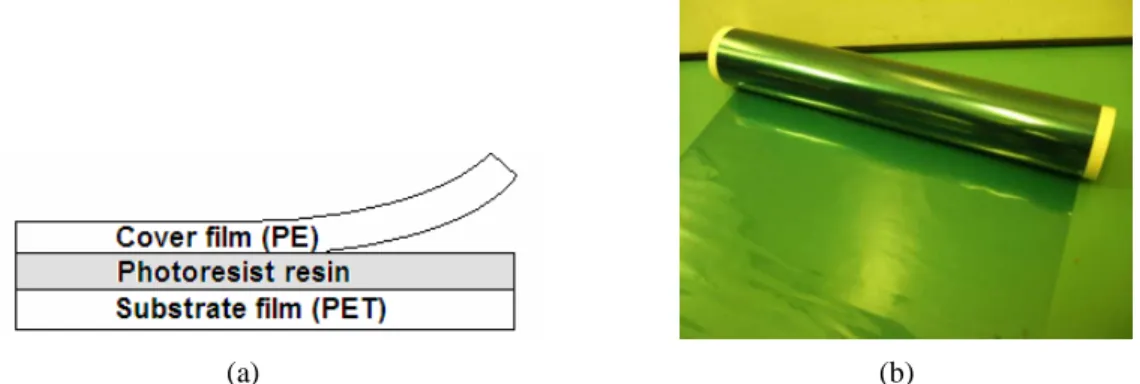
Figure 1 shows the conformation and photograph of dry film resist (DFR, ETERTEC® HT-115T, Eternal, Taiwan). The steps in the fabrication procedure as shown in Fig. 2 are as follows:
(a) A suitable size DFR sheet is patterned using photolithography with a plastic photomask with an array of printed opaque circles of 200 μm diameter and 400 μm pitch. Remove the cover film.
(b) Upon heating and with a proper laminating pressure, the patterned resist of DFR is laminated onto a copper roller of 88 mm in diameter and 110 mm in length. The substrate film of DFR is then removed.
(c) The resist on roller is developed using 0.85% sodium carbonate solution. (d) The copper roller is etched using ferric chloride solution.
(e) After the remaining DFR is stripped using 5% NaOH, a copper roller with a micro-hole array is obtained.
(a) (b)
Fig. 1. Dry film resist (a) schematics showing the conformation (not to the scale) (b) photograph of the roll of DFR
#84212 - $15.00 USD Received 18 Jun 2007; revised 12 Aug 2007; accepted 13 Aug 2007; published 7 Sep 2007
(a) (b)
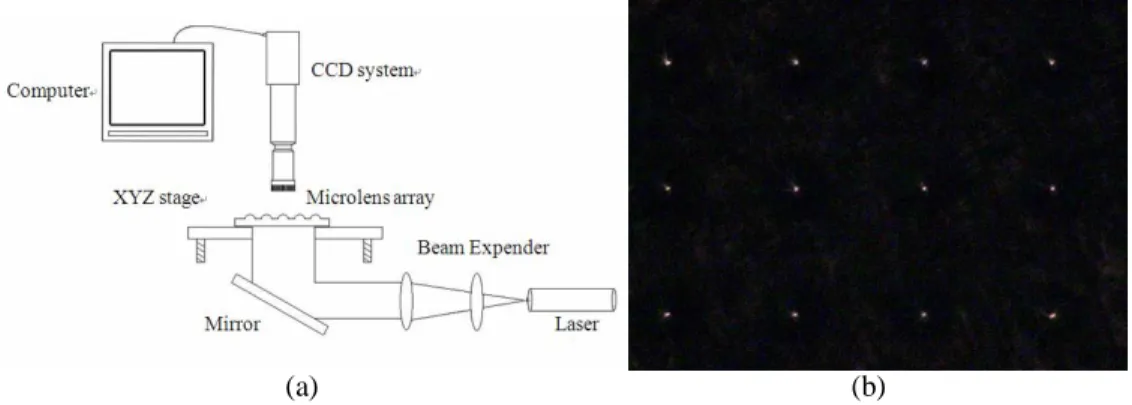
Fig. 7. microlens array focal length measurement system 4. Conclusions
This paper reports a novel and effective method to fabricate microlens arrays on polycarbonate films by hybrid extrusion rolling embossing with a metallic cylinder mold. The roller mold bearing micro-hole array used is fabricated using photolithography using dry film resist. During the extrusion rolling embossing process, the extruded hot film is immediately pressed against the surface of the rollers. Convex microlenses are partially protruded in the micro-holes on the roller mold under the influence of rolling pressure and surface tension. The microlens surface quality is determined primarily by surface tension, rather than the mold. By adjusting the processing parameters, this method enables the manufacture of microlenses array of specified sag heights within a certain range using the same roller mold. The uniformity, profiles and optical properties of the microlenses have been characterized and verified. The technique shows the potential of a cost-effective continuous mass-production process for microlens arrays fabrication.
#84212 - $15.00 USD Received 18 Jun 2007; revised 12 Aug 2007; accepted 13 Aug 2007; published 7 Sep 2007