行政院國家科學委員會專題研究計畫 成果報告
台灣南島語役使句與應用句研究(2/2)
研究成果報告(完整版)
計 畫 類 別 : 個別型 計 畫 編 號 : NSC 95-2411-H-002-006- 執 行 期 間 : 95 年 08 月 01 日至 96 年 07 月 31 日 執 行 單 位 : 國立臺灣大學語言學研究所 計 畫 主 持 人 : 黃宣範 計畫參與人員: 博士班研究生-兼任助理:黃惠如、葉郁婷、洪媽益、陳依婷 報 告 附 件 : 出席國際會議研究心得報告及發表論文 處 理 方 式 : 本計畫可公開查詢中 華 民 國 96 年 12 月 24 日
臺灣南島語役使句與應用句研究 [2/2]
Table of Contents
Causative and Applicative: Their Split and Syncretism in Formosan
Languages . . .
1
Causatives
in
Kavalan . . .
43
Causatives
in
Cebuano . . .
65
References
. . .
87
Appendix I: Bunun
(Isbukun)
causatives . . .
89
Causative and Applicative: Their Split and
Syncretism in Formosan Languages
1. Introduction
The grammar of causative and applicative constructions has been an object of intensive linguistic research over the last twenty years or so and rightly so, since causation is a fundamental cognitive category and is thus an ideal target of serious investigation for insights into language universals and probable limits of linguistic variation. The nature of the grammar of causatives and applicatives in Formosan languages has, however, remained largely underexplored. A primary goal of the present study represent an attempt to undertake a cross-linguistic investigation of all types of causatives in five Formosan languages( Kavalan, Tsou, Saisiyat, Squliq Atayal and Bunun) and at least two Philippine languages ( Tagalog and Cebuano) , hoping thereby to fill in the lacuna in our understanding of causative constructions in Formosan languages and thus contribute to a general theory of linguistic typology of causatives and applicatives.
A causative construction is a valence-augmenting construction that brings an extra participant into the agent (A) role. An applicative is a valence increasing operation that ascribes a peripheral participant to the direct object (O). These and other valence-changing processes can be schematized as follows:
-A: passive and other A-removing or A-demoting processes +A: causatives ( both direct and indirect)
-O: antipassive or other O-removing or O-demoting processes +O1: transitivization by addition of first object
( as in English laugh:mock) +O2: applicatives: addition of second object
The first two can be termed A-affecting processes and the others O-affecting processes. The frequencies of these processes vary, but A-affecting processes have been known to be much more common than o-affecting processes. Of the latter, transitivation is much less frequent than antipassive or applicatives.
Although both causativization and applicativization increase verbal valence, they have very different syntactic consequences. In this paper we assume that non-Agent focus clauses in Formosan languages are a species of the applicative construction, since they can be used to promote a peripheral argument into the core argument role, namely the nominative. A major goal of this paper is to investigate the complex coding patterns for causative and applicative in three Formosan languages and to trace out the changing nature of the interaction between causative and
applicative. Along the way we will also consider how putatively universal discourse patterns such as Preferred Argument Structure (PAS) (Du Bois 2003) play out in our narrative data involving causative and applicative constructions.
When a new argument is added to a clause, how does this affect the
grammatical coding of the other arguments? There is crosslinguistic variation in the way causer and causee are case-marked and this variation has been much discussed in the literature (e.g. Comrie 1976, 1989, Polinsky 1995). Comrie (1976) proposes that the causer functions as the ‘subject’ of the causative sentence and that the grammatical relation of the causee is usually predictable based on the base verb type. If the base verb is intransitive, then the causee tends to assume DO properties. If the base verb is transitive, the causee tends to assume IO properties. If the base verb is a
ditransitive, the causee is usually treated as an oblique. In other words, the causee takes the highest available position on the causee accessibility hierarchy in Figure 1.
Figure 1 The Causee Accessibility Hierarchy
But Comrie’s hierarchy was based on data from accusative languages, especially Hungarian. The question is, does the hierarchy apply to ergative
languages as well. All of the Formosan languages examined here have a split case marking system. That is, there is more than one case-marking pattern in the language. In Tsou and Squliq, if the (base) verb to which the causative morpheme attaches is AF, it follows one case marking pattern; if the verb is NAF, it follows another case marking pattern. There are also exceptional case marking subpatterns in these languages, particularly with lexicalized causative verbs. In Tsou, when the causer, the new argument, is introduced into the sentence, it always takes the genitive/oblique case while the case assignment patterns for the causee and other arguments basically are not affected. In Squliq, the causer is assigned depending on the transitivity of the base verb. Thus, the causer always takes the genitive/oblique in NAF clauses, but the nominative in the AF clause. The causee is not affected in the AF clause, but is assigned a case depending on the transitivity of the base verb. In Saisiyat, transitivity of the base verb determines the case assignment for both the causer and the cause. Furthermore, lexicalized causative verbs often require a different coding assignment than regularly formed causative verbs. Directness of causation also bears on the choice of a coding pattern. These and other details will be discussed further in the following sections. In any event, such cross-linguistic
differences mean that no general case assignment rules for the Formosan ergative languages can be formulated. What is clear is that the coding patterns for causatives in Squliq, Tsou and Saisiyat and in ergative languages generally violate Comrie’s causee accessibility hierarchy.
To redress the balance, Van Valin and LaPolla (1997:368) have proposed the following case assignment rules for (morphologically) ergative languages:
2. Case assignment rules for ergative pattern
a. Assign absolutive case to the lowest-ranking macrorole argument b. Assign ergative case to the other macrorole argument
c. Assign dative case to non-macrorole arguments (default)
We will show below that (2) is seriously flawed and cannot accommodate the Formosan data and that the coding patterns for causer and causee in the Formosan languages studied here are much more complex than those specified in (2).
2. Causative and applicative in Tsou 2.1 Coding types
We first consider the data of a language with a coding pattern that seems to us to be most neat and straightforward. This language is Tsou. Tsou, a rigid verb-initial language, has an elaborate and vibrant case marking system, with a set of nominative markers indicating ‘subject’, depending on the visibility and/or psychological distance of the subject NP in relation to the speaker, and another set of oblique markers
indicating non-subjects and genitive NPs. Tsou has no distinct locative case markers. In Tsou there are two types of causative affix that attach to verbal stems in morphological causatives: p(o)a-VAF(-a) , where the optional –a is, interestingly, probably a PF suffix, and p(o)a-VPF/LF-neni, where –neni is a marker for BF verbs. P(o)a- (-a) occurs with AF vergbs, and p(o)a- -neni with NAF verbs. In Tsou, PF focus marker –a defines its nominative as the patient of the verb, and the BF
marker –neni defines its nominative as either a transported theme, or a beneficiary, or a cause.
(3)Tsou
a. i-si na’na pa-yonghu(-a) to ino-si ’o paicU NAF-3S.Gen very.NAF Cau-pretty.AF-a Obl mom-3S.Gen Nom PN “PaicU’s mother made her very pretty.”
b. os-’o poa-bonU(-a) to ave’u ’o fokunge NAF-1S.Gen Cau-eat.AF(-a) Obl rice Nom frog “I made the frog eat rice.”
c. i-si poa-ana-neni to pasuya to voyu ’o f’ue NAF-3S.Gen Cau-eat.PF-BF Obl PN Obl PN Nom yam “Voyu made Pasuya eat the yam.”
d. os-’o pa-sii-neni to naveu to paicU ’o cavang-’u NAF-1S.Gen Cau-put.LF-BF Obl rice Obl PN Nom bowl-1S.Gen ‘Mo’o caused his mother to be pleased about him.’
e. i-si poa-aveoveoeni to ino-si ’o mo’o NAF-3S.Gen Cau-pleased about.BF Obl mom-3S.Gen Nom PN “Mo’o caused his mother pleased about him.”
f. os-’o pa-siisneni to tonhivza to ’o’oko ’o hapuyu NAF-1S.Gen Cau-smear.BF Obl wall Obl children Nom lime “I made children smear a wall with lime.”
g. ’o mo’o, i-si pa-toUsvUsvUtneni to haah’o ho hucma Nom PN NAF-3S.Gen Cau-discuss.BF Obl all tomorrow na te hia mayasvi
Nom Fut how Mayasvi
“Mo’o had everyone discuss how (to prepare for) mayasvi tomorrow.” h. mi-‘o p’onU to naveu to av’u
Aux.AF-1S. Nom feed.AF Obl rice Obl dog “I fed dogs with rice.”
i. mi-ta pa’hi-cocvo ‘e pasuya Aux.AF-3S.Nom Cau-laugh.AF Nom PN
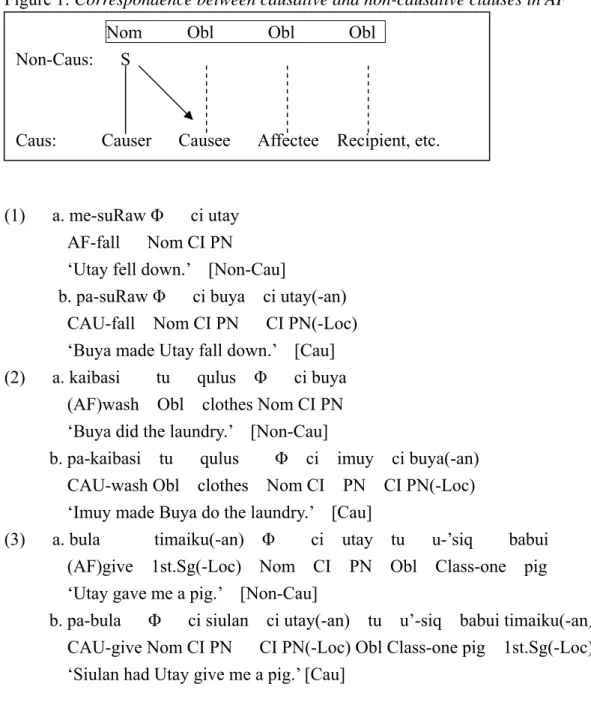
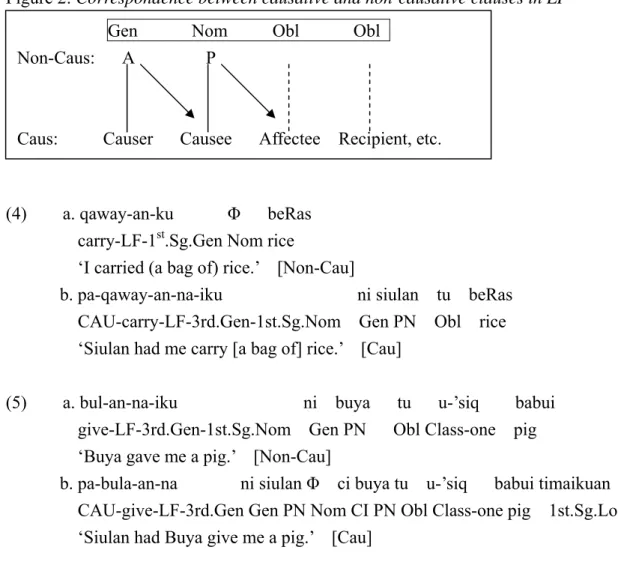
In non-causative AF clauses in Tsou, nominative is assigned to the only core argument of the clause. In causative clauses, the causer is always in the
genitive/oblique, except for rare exceptions like lexicalized causatives in (h) and (i). In (3a) where the verb is in AF, the Causer is in the genitive and the Causee in the oblique. In (3b) where the verb is semantically transitive, the Causer is in the genitive, the Causee in the nominative and the patient nominal takes the oblique. In (3c), where the base verb is in PF, the causer nominal is in the oblique, the causee is also in the oblique and the patient takes the nominative. In (3d), where is the base verb is in LF, the causer is in the genitive, the cause in the oblique, the patient in the oblique and the goal nominal is in the nominative. In (3e), where the base verb is in BF form, the nominative NP mo’o is the cause for as well as the beneficiary of his mother’s happiness. The experiencer nominal is in the oblique. Since the sentence describes the trigger for and the experiencer of, an emotion, no causer or causee is involved. In (3f), where the base verb is also in BF form, the causer is in the genitive, the causee in the oblique, and the transported theme (the lime) is in the nominative. In (3g), another clause with a BF base verb, the cause is in the oblique and ‘direct object’ nominal (te hia mayasvi) is in the nominative.
Case marking in Tsou is thus assigned on the basis of a distinction between AF clauses, which are lower in transitivity and NAF clauses, which are higher in
transitivity:
(4)
A. In intransitive causative AF clauses, the causer is assigned the oblique, and the causee is assigned the nominative.
B. In causative NAF clauses, the causer is assigned the oblique, the causee and the ‘direct object’ are also assigned the oblique. The nominative NP goes to the benefactee, transported theme or the goal of an action or event, depending on the nature of the lexical verb semantics.
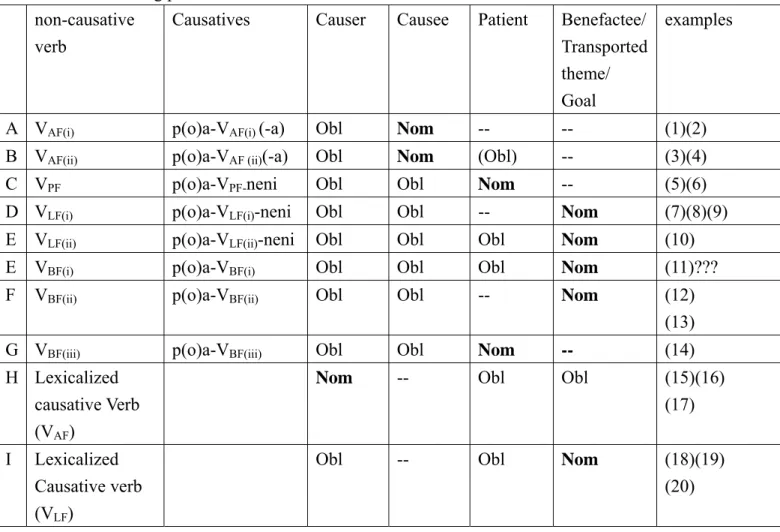
Table 1 below provides a comprehensive list of all of the elicited coding types for causer and causee.
Table 1 Coding patterns for causatives in Tsou non-causative
verb
Causatives Causer Causee Patient Benefactee/ Transported theme/ Goal
examples
A VAF(i) p(o)a-VAF(i) (-a) Obl Nom -- -- (1)(2)
B VAF(ii) p(o)a-VAF (ii)(-a) Obl Nom (Obl) -- (3)(4)
C VPF p(o)a-VPF-neni Obl Obl Nom -- (5)(6)
D VLF(i) p(o)a-VLF(i)-neni Obl Obl -- Nom (7)(8)(9)
E VLF(ii) p(o)a-VLF(ii)-neni Obl Obl Obl Nom (10)
E VBF(i) p(o)a-VBF(i) Obl Obl Obl Nom (11)???
F VBF(ii) p(o)a-VBF(ii) Obl Obl -- Nom (12)
(13)
G VBF(iii) p(o)a-VBF(iii) Obl Obl Nom -- (14)
H Lexicalized causative Verb (VAF)
Nom -- Obl Obl (15)(16)
(17)
I Lexicalized Causative verb (VLF)
Obl -- Obl Nom (18)(19)
(20)
2.2 Exceptional coding patterns
Three coding types stand out from the rest and these are types G, J and K. Type G is unusual in that the causer is in the nominative rather than in the more expected oblique case, as exemplified in (5). (5) contains an emotion verb and describes an indirect causation where something about the nominative NP Mo’o causes his mother to be proud of him. In indirect causation, the causer takes the nominative case as opposed to more direct causation in which the causer is in the oblique.
(5) isi poa-aveoveoeni to ino-si ‘o mo’o NAF-3S.Gen CAu-pleased about.BF Obl mother-3S.Gen Nom PN “ (What )Mo’o (did) made his mother proud of him.”
Types J and K each contain a lexicalized causative verb. Lexicalized causative verbs often require a distinct coding pattern from their non-lexicalized counterparts. In Type J the causer also takes the nominative case and the causee the oblique. As illustrated in (6) and (7), the main verbs p’onU ‘ to feed” / pa’hi-cocvo ‘ to be funny; to make people laugh’, are lexicalized causatives, but are construed as intransitives. The object noun phrase av’u in (6) is not specific or definite, and in (7) the causee NP can only be implicit.
(6) mi’o p’onU to naveu to av’u Aux-1S.Nom feed. AF Obl rice Obl dog ‘ I fed dogs with rice.”
(7) mi-ta pa’hi-cocvo ‘e Pasuya Aux-3S. Nom Cau-laugh. AF Nom PN ‘ Pasuya was being funny’
Type K, where the causer is in the expected oblique and the causee is in the nominative, rather than in the more expected oblique, is illustrated in (8) and (9). The main verbs in these two sentences are the same as those in (6) and (7), except that they are now in NAF form. What is also unusual about Type K is that the verb is in NAF, and yet it does not take the BF ending –neni characteristic of morphosyntax of NAF clauses in the language, as can be seen by comparing Type K with Types D and E.
(8) Lexicalized causative verb (VLF)
os-’o p’ani to naveu ’o av’u Aux.NAF-1S.Gen feed.LF Obl rice Nom dog ‘I fed the dog with rice.’
(9) Lexicalized Causative verb (VLF)
i-ta pa’ hi-cocvi ta pasuya ’o yangui Aux.NAF-3S.Gen cause-laugh.LF Obl PN Nom PN ‘Pasuya made Yangui laugh.’
(8), (9) along with other sentences illustrated in Table 1 strongly suggest that Tsou uses different coding strategies to signal degree of the control or volitionality of the causee. It is common for a causee with little control or volitionality to appear in a core case (e.g. nominative) and a causer with greater control to appear in an oblique. In both (8) and (9), the causee may be interpreted as not acting volitionally, while the causees in Types C through I may be interpreted as acting volitionally. In other words, a nominative causee exhibits less control or volitionality than an oblique causee.
Coding types C through I share the commonality that both the causer and the causee are marked by the oblique and the verb takes a ‘compound’ causative marker p(o)a-… -neni where p(o)a- is the regular causative morpheme, and -neni is the applicative BF marker. –neni serves a range of diverse functions. The nominative NP in Type F refers to the goal of the associated activity; in Type G to the cause of the associated emotion; in Type H to the transported theme of the associated action; in Type I to what may be termed sociative causation involving multiple agents in the execution of the caused event. Thus, these coding types with compound causative markers suggest that the causative p(o)a- and the applicative –neni are converging in their functions on these various clause types. So what we have here represents a case of partial causative/applicative overlap or syncretism. Shibatani and Pardeshi (2001) suggest that the applicative meanings of comitative, instrumental and benefactive can be connected to sociative causation. Huang (2005) shows that a distinct majority of the nominative arguments in BF or RF clauses in our Formosan language corpus are primarily used to encode transported theme, an entity that undergoes movement,
physically or metaphorically, from one location to another. Other RF/BF clause functions of indicating an instrument, cause, beneficiary or sociative action (commitment) can be shown to be derivable from the basic meaning of indicating transported theme. It is the sociative causation function of the marker –neni that figures in the compound causative marker p(o)a-….-neni, and moreover it is the absence of this element of sociative causation that explains the absence of the
applicative marker –neni from Types A. B, J and K. We will show further below that it is sociative causation that leads to causative/applicative overlap in the Formosan languages studied here.
2.2 Indirect causation
Unlike Squliq and Saisiyat, Tsou does not use the regular RF applicative morpheme (*si-) to indicate indirect causation. Rather it uses the grammatical morpheme koa or nomzo for this purpose. The koa and nomzo constructions are schematized in (10) and sentences in (11) are illustrations.
(10)
a. [ ] cause [ koa ] effect
b. [ nomzo ]cause [ ]effect/nmz
(11)
a. ‘a no tmacongo taini na koa mita o’te meelU Evi PF sick. 3S.Gen Nom KOA Aux-3S. Neg can uh tan’e maintan’e
come here today
“ He could not come today because he was sick.”
b. mi’o nomzo to ino-‘u ho miski ne vioyin Aux-1S. because.of Obl mother-1S.Gen Conj stay Loc hospital
3. Causative and applicative in Squliq
We turn next to look at the structures of causative and applicative constructions in Squliq, a language which exhibits an even more complex, even tantalizing, interplay between causative and applicative. Squliq is one of the two major dialects of the Atayal language. It is verb-initial, has a focus system similar to that of Tsou and a set of oblique markers ( squ’/sa/te/I’) whose functional differences from each other have yet to be sorted out. Unlike Mayrinax, the other Atayal dialect, but like Tsou, Squliq has no ‘purely’ locative case markers.
Consider first the following Squliq data.
(12) Squliq
a. hera’ ga’, m<s>hilaw-ku’ squ’ raNi’-mu’ yesterday Top AF<s>energetic-1S.Nom Obl friend-1S.Gen “I enlivened my friends yesterday.”
b. nyux p-kita’ squ’ yumin sa inluNan-nya’ qu’ mit qani. Asp Cau-see Obl PN Obl feeling-3S.Gen Nom ass Det “ The ass let Yumin see its feelings.”
c. wal-mu p-kut-un i’ yumin qu’ paris-ta’
Asp-1S.Gen Cau-kill.PF Obl PN Nom enemy-1PI.Gen “I made Yumin kill our enemy.”
d. p<in>qniq-an-maku’ na’ qulih qu ngyaw qa. Cau<Perf>eat-LF-1S.Gen Obl fish Nom cat this ‘ I had this cat eat fish.’
e. p-in-nbw-an-maku’ na’ qwox qu’ yumin Cau-PF-drink-LF-1S.Gen Obl wine Nom PN ‘I let Yumin drink wine.’
f. ini’ puN-i ke’-mu’ qu’ lagi’-mu’ ru Neg hear-LF.Neg word-1S.Gen Nom Child-1S.Gen Conj s-p-htuy-mu’ i’ mlikuy-mu’ qu’ hya’ RF-Cau-block-1S.Gen Obl man-1S.Gen Nom 3S.Nom
“My child didn’t obey me, so I let my husband bar him (from going out).”
g. wal biq-an ni’ ciwas sa huzil qu’ laqi’ qa. Asp give-LF Gen PN Obl dog Nom child this ‘ Ciwas gave the child a dog.’
h. s-un-nya’ squ’ ciwas, “biq-i huzil laqi’ hya’.” Say.thus.-PF-3S.Gen Obl PN give-LF dog child 3S. Nom.F ‘He told Ciwas, ‘ Give a dog to the child.”
In (12a), where the verb is in AF, the Causer is in the nominative and the Causee in the oblique. In (12b), where the verb is also in AF, the Causer is in the nominative and the Causee in the oblique. In (12c), where the verb is in PF, the Causer is in the genitive, the Causee in the oblique and the ‘direct object’ is in the nominative. In (12d) and(12e), the verb is in LF, and the causer is in the genitive, the causee in the nominative and the direct object in the oblique. Note that the verbs ‘eat’ and ‘drink’ in (12d) and (12e) are syntactically intransitive. In (12e), the verb is in RF, the Causer goes to the genitive, the Causee goes to the oblique and the ‘direct object’ the nominative.(12g) is a normal ditransitive clause and, apparently to avoid the use of too many obliques, the causative event of a ditransitive is brought about by verbal commands, as in (12h).
Based on the data in (12), case marking in Squliq causatives seems to be assigned on the basis of the following considerations:
(13)
A. In causative AF clauses, the verb is intransitive, the nominative case is assigned to the only core argument and the oblique is assigned to the non-core argument.
B. In causative NAF clauses, the Causer is always assigned the genitive/oblique; the Causee is assigned the oblique, if the base verb is transitive; nominative, if the base verb is intransitive. The ‘direct object’ takes the nominative if it is referentially definite; oblique if referentially indefinite.
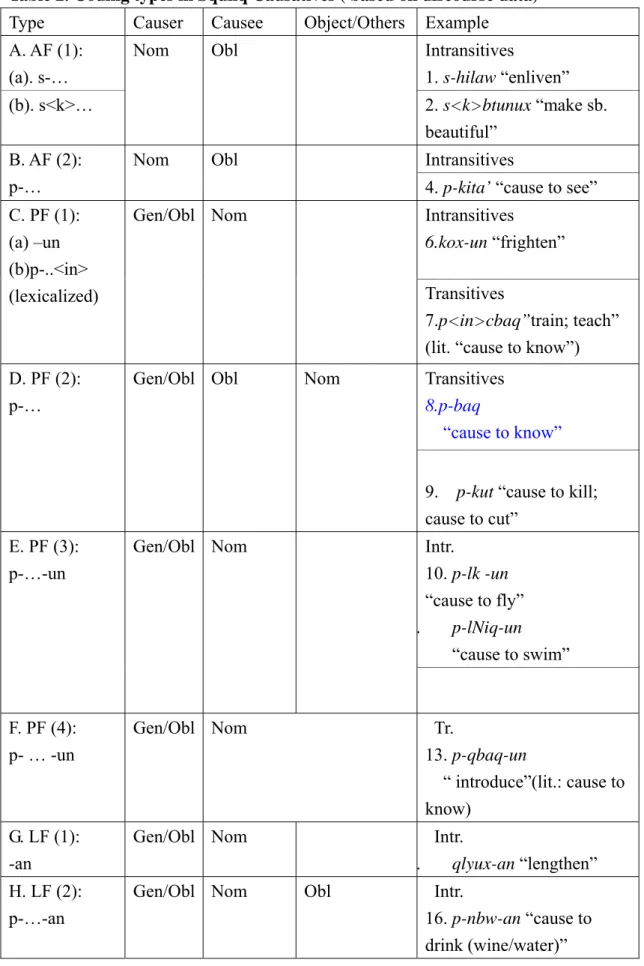
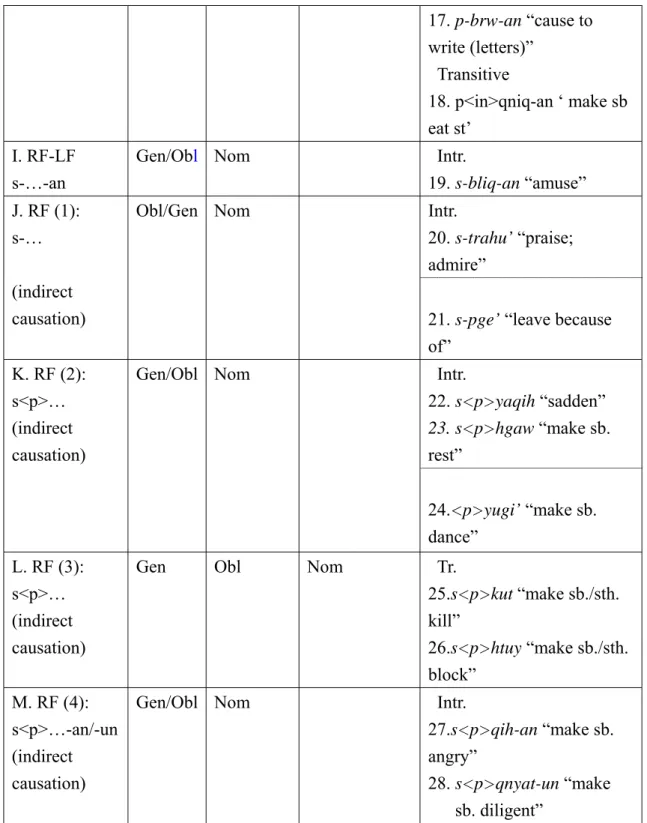
causatives is given in Table 2.
Table 2. Coding types in Squliq Causatives ( based on discourse data)
Type Causer Causee Object/Others Example A. AF (1): (a). s-… Intransitives 1. s-hilaw “enliven” (b). s<k>… Nom Obl 2. s<k>btunux “make sb. beautiful” Intransitives B. AF (2): p-… Nom Obl
4. p-kita’ “cause to see” Intransitives 6.kox-un “frighten” C. PF (1): (a) –un (b)p-..<in> (lexicalized) Gen/Obl Nom Transitives 7.p<in>cbaq”train; teach” (lit. “cause to know”) Transitives
8.p-baq
“cause to know” D. PF (2):
p-…
Gen/Obl Obl Nom
9. p-kut “cause to kill; cause to cut” Intr. 10. p-lk -un “cause to fly” . p-lNiq-un “cause to swim” E. PF (3): p-…-un Gen/Obl Nom F. PF (4): p- … -un Gen/Obl Nom Tr. 13. p-qbaq-un “ introduce”(lit.: cause to know) G. LF (1): -an
Gen/Obl Nom Intr.
. qlyux-an “lengthen” H. LF (2):
p-…-an
Gen/Obl Nom Obl Intr.
16. p-nbw-an “cause to drink (wine/water)”
17. p-brw-an “cause to write (letters)” Transitive 18. p<in>qniq-an ‘ make sb eat st’ I. RF-LF s-…-an
Gen/Obl Nom Intr.
19. s-bliq-an “amuse” Intr. 20. s-trahu’ “praise; admire” J. RF (1): s-… (indirect causation) Obl/Gen Nom
21. s-pge’ “leave because of” Intr. 22. s<p>yaqih “sadden” 23. s<p>hgaw “make sb. rest” K. RF (2): s<p>… (indirect causation) Gen/Obl Nom 24.<p>yugi’ “make sb. dance” L. RF (3): s<p>… (indirect causation)
Gen Obl Nom Tr.
25.s<p>kut “make sb./sth. kill” 26.s<p>htuy “make sb./sth. block” M. RF (4): s<p>…-an/-un (indirect causation)
Gen/Obl Nom Intr.
27.s<p>qih-an “make sb. angry”
28. s<p>qnyat-un “make sb. diligent”
Table 2 presents an array of the formal devices used to form causative costructions. It also reveals a number of interesting differences in the way argument NPs in causatives in Squliq and Tsou are coded. Causative AF clauses in Squliq, unlike those in Tsou, have a Causer-Nom, Causee-oblique coding pattern. In Squliq
depending on the volitionality or control of the causee NP. In ( 14a), for example, the main verb p<in>cbaq ‘ train’ , which comes from a transitive base verb, is a
lexicalized causative that takes just two arguments, namely causer-oblique,
causee-nominative ,while the main verb in (14b) is a regularly formed causative and takes three arguments, causer-oblique, causee-oblique and direct object-nominative. An object of training, such as dogs in (14a), certainly involves less volition and less control than Yumin, the causee in (14b). Verbs like p<in>cbaq “ train” and
p-baq-un ‘ introduce’ in Type F suggest that morphological causativization in a language may reduce the number of arguments through lexicalization, without necessarily resorting to strategies like detransitivization, as in Blackfoot, or object incorporation, as in Southern Tiwa (cf.Song 2001).
(14) Squliq
a. baq p<in>cbaq na’ yumin qu’ huzil. can P<PF>teach Gen Yumin Nom dog “Yumin was good at training dogs.”
b. p-baq-mu’ i’ yumin qu’ zyaw qa. P-know-1S.Gen Obl Yumin Nom thing Det “I let Yumin know the thing.”
3.2 Indirect causation
An examination of Table 2 also shows a number of interesting ways in which the applicative RF morpheme s- and the causative p- interact in causative
constructions in Squliq. First, the prefix s- has an applicative and a causative function. The prefix s- has evolved into a causative marker, via its basic function of indicating a transported theme, especially when it occurs with stative verbs, as seen in Types A and I. This is another case of the partial applicative/causative syncretism. If the s- occurs with an activity verb in a sentence, it functions as a benefactive applicative marker, as
illustrated in (15).
(15)
a. s-usa’-mu’ qu’ huzil qa. RF-go-1S.Gen Nom dog this “ I went ( to someplace) for the dog.”
b. s-paqut misu’ tali suhan RF-ask 1S.Gen-2S.Nom PN tomorrow “ I’ll ask Tali ( about something) for you tomorrow.”
Squliq and Tsou differ in the degree to which they allow the construal of intransitive events in terms of the benefactive schema. Shibatani (1996) suggests that benefactives are based on the schema of ‘give’ constructions. This is probably why intransitives in Tsou are difficult to be construed in terms of the benefactive –neni construction. The only intransitive verbs allowed in the –neni construction are
emotion verbs; other intransitive verb types are prohibited. Squliq appears to be more tolerant in this respect, as (15) shows.
A second way in which the applicative s- and the causative p- interact is that the applicative prefix s- and the causative prefix p- can occur on the same verb root in a fixed order, with s- expressing an indirect causation for the caused event signaled by the following p- and the verb root, as seen in (16)[Type K], (17)[Type L] and
(18)[Type M]. In our corpus data, this indirect cause always appears in a preceding clause, followed by a caused event in the second clause, as exemplified below.
(16) ini’ swal m-agal squ’ kneril qa qu’ yumin ru s<p>yaqih Neg agree AF-take Obl woman Det Nom PN Conj S<P>bad qu’ hya’.
Nom 3S.Nom.F
(17) m-usu’ qu’ pnaNa’-mu’ qaya’ qani ru AF-heavy Nom carry.on.back-1S.Gen object Dem Conj
s<p>hgaw-mu’ kun nanak. S<P>rest-1S.Gen 1S.Nom.F only
“My bag was so heavy that I let myself take a rest.”
(18) ini’ puN-i ke’-mu’ qu’ laqi’-mu’ ru Neg hear-LF.Neg word-1S.Gen Nom child-1S.Gen Conj s<p>htuy-mu’ i’ mlikuy-mu’ qu’ hya’. S<P>block-1S.Gen Obl husband-1S.Gen Nom 3S.Nom.F
“Because my child didn’t listen to me, I asked my husband to bar him (from going out).”
Indirect causation may be signaled by s- alone and does not require the
presence of the causative morpheme p-. This indirect causation signaling function of s- may appear in either of the following schematic forms and the sentences in (20) are illustrations. (19) a. [ s- ] effect [ ] cause b.[s- ] cause [s- ] effect/NMZ (20)
a. nanu qu’ s-wah-nya’ qani’ ga’, m-wah qsyuw pila’ what Nom RF-come-3S.Gen Top AF-come borrow money “ The reason he came here was because he wanted to borrow
money.”
b. s-qsyuw-nya’ sa’ pila’ qu’ s-wah-nya’ qani.
“ The reason he came here was because he wanted to borrow some money.”
4. Causative and applicative in Saisiyat
are two types of transitive clauses, those that occur in AF and those that occur in NAF, with the former co-occurring mostly with imperfective aspect markers and the latter almost exclusively with perfective markers. Thus, Saisiyat provides a good case study of how argument NPs in a split-ergative language are encoded may differ from that in a non-split-ergative language such as Tsou or Squliq. Causatives in Saisiyat are indicated by any of the following causative or applicative prefixes: pa-, pak-, si-, sik, si-pa-, si-pak. It turns out that of the three languages examined in this study, Saisiyat has the most complex system of coding patterns, in part because of the
causative/applicative syncretism conditioned by lexically specific verb classes. Consider first the following Saisiyat data.
(21) Saisiyat
a. sia pak-tikot 3S.Nom Cau-be.afraid “ He is frightening.”
b. ‘obay pak-boe:oe’ iyakin PN Cau-be.angry 1S.Acc “ Obay made me angry.”
c. yao am pak-hayza’ ‘ini’ ‘obay ka kaShaw 1S.Nom Asp Cau-exist Dat PN Acc drinks “ I am preparing drinks for Obay ( because he is coming).”
d. ma’an pak-hayza’ ka ralom ‘ini’ ‘obay 1A.Gen Cau-exist Acc water Dat PN “ I am preparing water for Obay.”
e. ‘Obay pa-ra:iw noka mingkoringan PN Cau-leave Gen woman “ Obay’s wife left on him.”
f. noka wae’ae’ pak-sahae’en ray ‘atas ila hini kamasal Gen deer Cau-fall.PF Loc cliff pfv here below “ The deer threw (them) over the cliff.”
g. in-kakhayza’-an-a ma’an si-pak-baz’ ka korkoring past 1s.Gen RF-Cau-hear Nom child
“ I told the children stories about the past.” h. ma’an sik-pa-ki’noya’ ka korkoring 1S.Gen RF-CAu-be starved Nom child “ The child was starved (because of) me.
In (21a), the verb is in AF, the causer is in the nominative, but the causee is not overtly expressed. In (21b), the causer is in the nominative and the causee in the accusative. In (21c) and (21d), the main verb pak-hayza’ ‘to prepare” is a lexicalized transitive, but interestingly it has two case marking patterns. In (21c), the causer ( the agent) is in the nominative and the causee ( the recipient) in the dative. However, in (21d), the causer is in the genitive and the causee ( the recipient) is in the dative. In (26e), the verb is in AF, but the causer is in the genitive and the causee in the
nominative. In (21f), the verb is in PF, and the causer is in the genitive, the causee in the nominative. In (21g) and (21h), the verb is in RF, the causer is in the genitive and the causee in the nominative. Thus, case marking in Saisiyat causatives and
applicatives seems to be assigned on the basis of the following stipulations:
22.
A. In causative AF clauses, the causer is assigned the nominative, the causee the accusative and the direct object is in the accusative. B. In causative NAF clauses, the causer is assigned the genitive, the
causee the nominative and the ‘direct object’ the accusative.
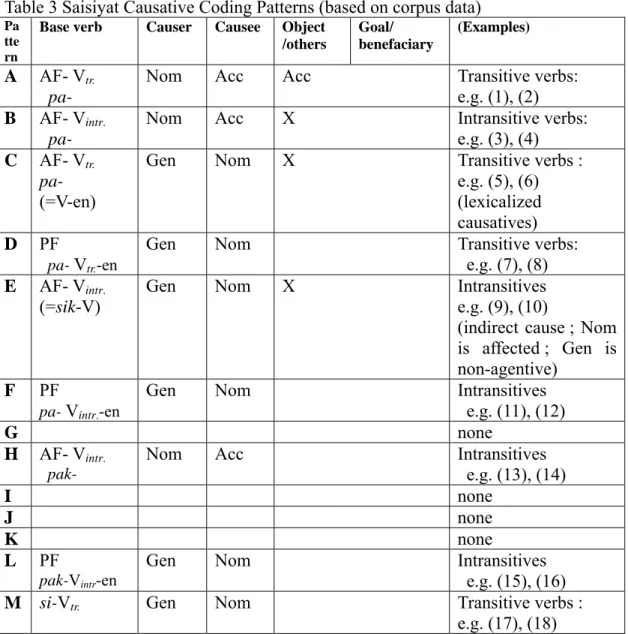
There are exceptions to the case assignment rules given in (22). One type of exception is verbs like pa-hangal and pa-‘a’apol, which require the causer to be in the genitive and the causee in the nominative. These verbs belong to Type C in Table 3 below. A second type of exception is verbs like pa-ra:iw, which require the causer to be in the genitive, and the cause in the nominative. These verbs belong to Type E in Table 3 and have exactly the same coding and interpretation as Types N and P. In each case, an indirect causation interpretation is intended: the genitive NP does something
and the nominative NP is affected as a result. This is an instantiation of
causative/applicative syncretism, but one which is lexically conditioned. Other instances of the syncretism will be noted below. A third type of exception is the verb pak-hayza’, which strangely has either a causer-nominative, causee-dative, or a causer-genitive, causee-nominative coding pattern, as if the native speaker has not yet decided on which coding pattern to opt for. This is represented as Type U in Table 3. Type U together with other coding types suggest that the oblique has the highest degree of control by the causee, followed by the nominative, which is in turn followed by the accusative.
Table 3 Saisiyat Causative Coding Patterns (based on corpus data)
Pa tte rn
Base verb Causer Causee Object /others Goal/ benefaciary (Examples) A AF- Vtr. pa-
Nom Acc Acc Transitive verbs:
e.g. (1), (2)
B AF- Vintr. pa-
Nom Acc X Intransitive verbs:
e.g. (3), (4)
C AF- Vtr. pa- (=V-en)
Gen Nom X Transitive verbs :
e.g. (5), (6) (lexicalized causatives)
D PF
pa- Vtr.-en
Gen Nom Transitive verbs:
e.g. (7), (8)
E AF- Vintr.
(=sik-V) Gen Nom X Intransitives e.g. (9), (10) (indirect cause ; Nom is affected ; Gen is non-agentive)
F PF
pa- Vintr.-en
Gen Nom Intransitives
e.g. (11), (12)
G none
H AF- Vintr. pak-
Nom Acc Intransitives
e.g. (13), (14)
I none
J none
K none
L PF
pak-Vintr-en
Gen Nom Intransitives
e.g. (15), (16)
M si-Vtr. Gen Nom Transitive verbs :
N si-Vintr. Gen Nom Intransitive verbs : e.g. (19), (20)
O sik- Vtr. none
P sik- Vintr. Gen Nom Intransitive verbs : e.g. (21), (22)
Q si-pa- Vtr. Gen Nom Transitive verbs : e.g. (23), (24)
R si-pa- Vintr. Gen Nom Intransitive verbs : e.g. (25)
S si-pak- Vtr. Gen Nom none
T si-pak- Vintr. Gen Nom Intransitive verbs : e.g. (26)
Nom Dat Acc (27a)
Gen Nom (28a)
U
AF
pak-
si-pak- Gen Nom Acc (28b)
Verb ‘to have’
V AF- Nom Acc Acc Dative di-transitives
e.g. (29), (30)
Note: All of the coding types except for the last two types ( U and V) are based on corpus data.
Elsewhere in Table 3 we also find other instances of the
causative/applicative syncretism beyond the functional overlap between Types E, N and P just noted.. For example, the four coding types, namely Type C, with a causative pa- prefix, Type M , with an applicative si- , Type Q, with both an
applicative si- and a causative pa, and Type T, which also contains both an applicative si- and a causative pak-, have the same coding pattern and the same interpretation: the nominative NP in each case is a transported theme. In functional overlap involving Types E, N and P, the syncretism develops when there is a benefactive/malfactive reading associated with the causative construction. In functional overlap involving Types C, M, Q, and T, the syncretism develops when there is a causative reading ( moving an entity from one locale to another) associated with the applicative si-/sik- .
5. Interim summary
Squliq and Saisiyat, and pointed out that there are exceptional coding patterns in each of the languages. In Tsou, the causer is always assigned the oblique; the cause is assigned the nominative or the oblique, depending on its degree of control or
volitionality. A causee with little control appears in the nominative and a cause with a greater degree of control appears in the oblique. This observation also applies to Squliq. Saisiyat has the most complex set of case assignment rules, partly because of a lexically conditioned causative/applicative syncretism. Thus pa-causatives frequently have the same coding patterns and interpretations as sik-causatives. Saisiyat also makes a finer three-way contrast in degree of control.
Language no control less control greatest control
Tsou nominative oblique Squliq nominative oblique Saisiyat accusative nominative oblique
6. Causative and Preferred argument structure
Although Tables 1,2 and 3 present an astonishing array of formal devices for coding argument NPs in causatives and applicatives, these coding types are basically based on elicited data ( Saisiyat data excepted). But elicited data are just that. They tell us preciously little about how language responds to the demands placed on it by its users ( Du Bois 2003:11), or how discourse pressure might shape the argument structure and hence the morphosyntax of a language. Moreover, Table 1 shows that in Tsou causative NAF clauses, the causee NP always doubles up on the oblique case that is already taken up by at least one of the other core argument NPs. The doubling up of grammatical relation was addressed briefly in Comrie(1989:178), his conclusion being that all languages allow such a possibility. It is precisely because of such forced
have problem with determining the ‘acceptability’ of transitive or ditransitive causative sentences when they are asked to. But what do causatives look like in natural discourse data? In this section we examine natural discourse data in order to understand the interaction between argument structure and discourse pragmatics.
When natural narrative data are examined, what we find is a radically different picture of how causative and applicative clauses are deployed by the language users.
The doubling up of grammatical relation turns out to be a non-issue, since there is simply no doubling up of grammatical relation in the discourse data. It is true that the coding patterns given in the preceding tables for causatives provide structural
facilitation for a given function, but they do not really tell us whether certain argument realizations in certain argument positions are preferred, while defining others as dispreferred.
The hypothesis of preferred argument structure (PAS) proposed by Du Bois (1987) has a grammatical and a pragmatic dimension. In the grammatical dimension, there is a constraint that limits the lexical core argument to no more than one and a second constraint that excludes the lexical argument from appearing in A role. In the pragmatic dimension, there is a constraint that limits the new argument to no more than one per clause, and a second constraint that excludes the new argument from the A role. PAS has been investigated in numerous studies extending across a
typologically and genetically diverse array of languages and there is now enough crosslinguistic evidence to suggest that PAS can be considered a discourse universal ( Du Bois 2003:33).
If we look at causatives with transitive base verbs in natural discourse data, with their three structural positions for lexical argument realization, we nevertheless find that the same PAS constraints are observed as for ordinary transitives. Table 4 shows that causative clauses in Tsou with zero argument are vastly more frequent
(68.2%) than clauses with one or more arguments. This means that the preferred argument structure pattern for the causatives in Tsou is for the causative verbs to occur alone. This result seems to say something unusual about the behavior of
causatives in discourse, since an investigation of non-causative clauses based on the same discourse data shows that only 31.4% of the clauses are verbs alone, as
presented in Table 5.
Table 4 PAS in Tsou causatives
verb type all
core arguments present 1 argument covert 2 arguments covert
Verb alone sum total
corpus elicited corpus elicited corpus elicited corpus elicited corpus elicited
A p(o)a-VAF(i)-a 3 8 4 5 0 0 14 1 21 14 35 % 13.64% 25% 18.18% 15.62% 0 0 63.63% 3.32% 95.45% 38.89% 43.75% 25.92% 64.81% B p(o)a-VAF(ii)-a 0 1 0 7 0 1 0 1 0 10 10 % 0 3.12% 0 21.87% 0 3.13% 0 3.33% 0 0 31.25% 18.52% 18.52% C p(o)a-VPF-neni 0 0 0 1 0 0 0 0 0 1 1 % 0 0 0 3.13% 0 0 0 0 0 3.13% 1.85% 1.85 D
p(o)a-VLF(i)-neni
0 4 0 0 0 0 1 2 1 6 7 % 0 12.5% - 0 0 0 4.55% 6.65% 4.55% 1.85% 20% 11.11% 12.96% F p(o)a-VBF(i) 0 0 0 1 0 0 0 0 0 1 1 % 0 0 0 3.13%% 0 0 0 0 0 0 3.13% 1.85% 1.92% Total 3 13 4 14 0 1 15 4 22 32 54
40.74% 59.26% 100%
Table 5 Non-causative clauses and PAS
Full arg 1 arg om’ed 2 arg om’ed Verb alone total
natural 207 147 10 167 531
39% 27.7% 1.9% 31.5% 100%
elicited 43 39 1 24 107
40.2% 36.5% 0.9% 22.4% 100%
Causative sentences in Tsou tend to appear toward the end in the description of an episode, with the causer and the causee having been introduced or identified earlier in the discourse. (23) is typical.
(23) (Snake:268-272)
268 …(1.6)mio ’sio=.. maezo na’no taso ‘e ba’efkoi hoci cu AF actually also very strong.AF Nom snake if Perf kahkUmnU
thick
"Actually, the snake is also very strong if it is already thick."
269 …i’o mo c’o eu’vavhongU Nom AF only thin.AF
270 …(1.1)te c’o sonU ho te boemi ta hpongU ho Fut. easy when Fut use.AF Obl stick and 271 …(1.0) zohpongi ho=
pinch.LF and
272 …(2.6) o’te poa-aut’ou-a ho ta cu tUtpUta NEG Cau-move.AF-PF when Fut ADV catch.PF
"As for the thin one, it is rather easy to pinch it with a forked stick. Then when it is caught, it won’t move."
Tsou is also known to exhibit a strong tendency to avoid the use of
complementation and choose instead to use a coordination strategy for the expression of complex ideas. In (24), a causative event is split into two clauses where one could
have said it with one single clause.
(24) i-si skuna ‘o voyu ho poa-sochipi-(a) to ‘oko Aux.-3S.Gen order.PF Nom PN Conj Cau-take_care.AF(-PF) Obl child
Table 4 also shows that of all the verb types, intransitives in Tsou are far and away the most preferred targets for causative derivation. 95.4% (21 out of 22) of the causative sentences in our corpus have intransitives as base verbs, which of course explains in part the total absence of the doubling up on grammatical relation in the corpus data.
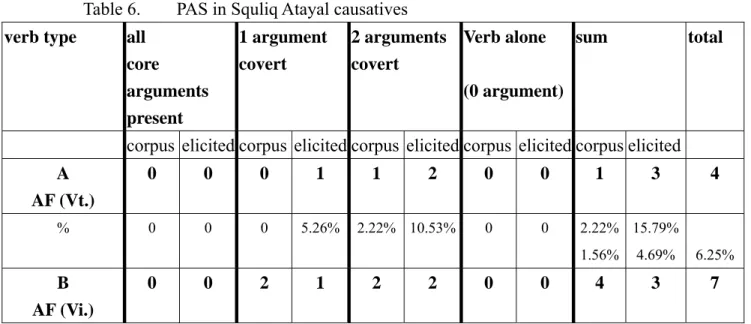
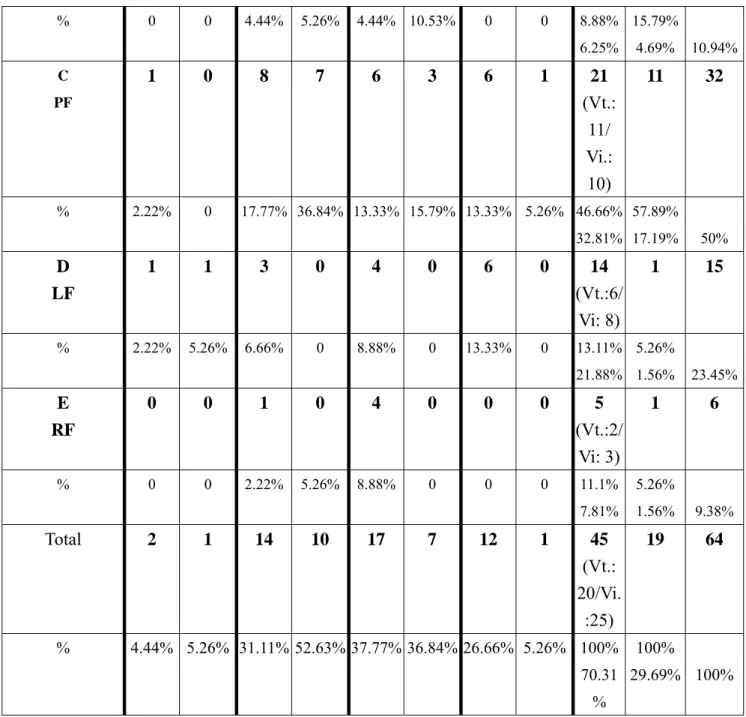
The Squliq data given in Table 6 gives a somewhat less striking picture , but the general thrust of the PAS of the causative sentences in the language remains basically valid. 26.7% of all causative clauses in the data contained just the verbs only and nothing else. This together with the 37.8% of the clauses with two arguments omitted means that 64.5% of all the causative clauses had at least one or two or three of their argument NPs not realized. Thus, the PAS of the language is to allow a maximum of one argument per clause, or just the verbs alone. By comparison, just 5.3% of the elicited data had verbs alone.
Table 6. PAS in Squliq Atayal causatives
verb type all
core arguments present 1 argument covert 2 arguments covert Verb alone (0 argument) sum total
corpus elicited corpus elicited corpus elicited corpus elicited corpus elicited
A AF (Vt.) 0 0 0 1 1 2 0 0 1 3 4 % 0 0 0 5.26% 2.22% 10.53% 0 0 2.22% 1.56% 15.79% 4.69% 6.25% B 0 0 2 1 2 2 0 0 4 3 7
% 0 0 4.44% 5.26% 4.44% 10.53% 0 0 8.88% 6.25% 15.79% 4.69% 10.94% C PF 1 0 8 7 6 3 6 1 21 (Vt.: 11/ Vi.: 10) 11 32 % 2.22% 0 17.77% 36.84% 13.33% 15.79% 13.33% 5.26% 46.66% 32.81% 57.89% 17.19% 50% D LF 1 1 3 0 4 0 6 0 14 (Vt.:6/ Vi: 8) 1 15 % 2.22% 5.26% 6.66% 0 8.88% 0 13.33% 0 13.11% 21.88% 5.26% 1.56% 23.45% E RF 0 0 1 0 4 0 0 0 5 (Vt.:2/ Vi: 3) 1 6 % 0 0 2.22% 5.26% 8.88% 0 0 0 11.1% 7.81% 5.26% 1.56% 9.38% Total 2 1 14 10 17 7 12 1 45 (Vt.: 20/Vi. :25) 19 64 % 4.44% 5.26% 31.11% 52.63% 37.77% 36.84% 26.66% 5.26% 100% 70.31 % 100% 29.69% 100%
Notes: Narrative data in this table is based on 20 Squliq Atayal narratives in an electronic database( website: http://formosan.sinica.edu.tw/ ).Elicited data are based on three elicited narratives (A Story of Rimuy) . Bound pronouns on the auxiliaries are considered as instances of core arguments.
Table 5 also shows that, as expected, more intransitives than transitives ( 25 vs. 20, or 55% vs. 45%) enter into causative formations in the narrative data in Squliq, a result consistent with the universal preference for intransitives to form morphological cauativization.
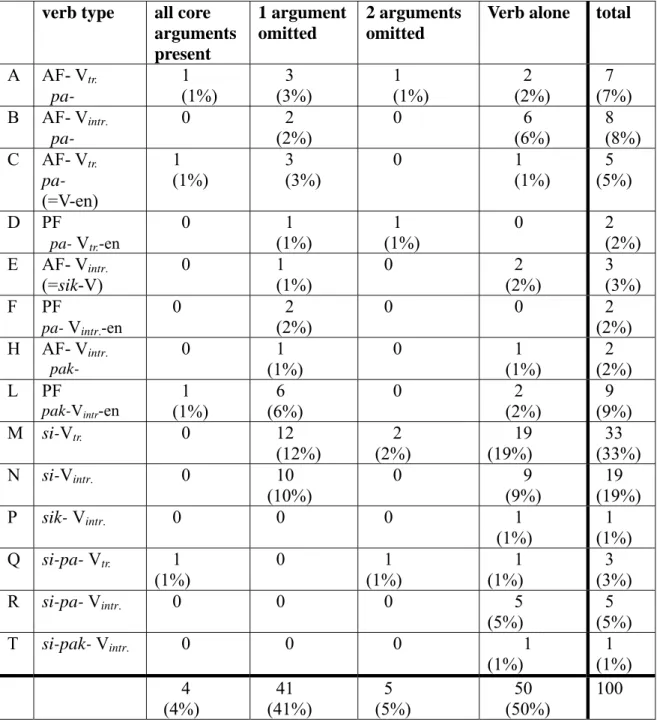
that the PAS of the causatives in this language is to have just verbs alone (50%). Again, causatives that allow the full complement of argument NPs to be present are vanishingly rare ( 4%).
Table 6 PAS in Saisiyat Causatives
verb type all core arguments present 1 argument omitted 2 arguments omitted
Verb alone total
A AF- Vtr. pa- 1 (1%) 3 (3%) 1 (1%) 2 (2%) 7 (7%) B AF- Vintr. pa- 0 2 (2%) 0 6 (6%) 8 (8%) C AF- Vtr. pa- (=V-en) 1 (1%) 3 (3%) 0 1 (1%) 5 (5%) D PF pa- Vtr.-en 0 1 (1%) 1 (1%) 0 2 (2%) E AF- Vintr. (=sik-V) 0 1 (1%) 0 2 (2%) 3 (3%) F PF
pa- Vintr.-en
0 2 (2%) 0 0 2 (2%) H AF- Vintr. pak- 0 1 (1%) 0 1 (1%) 2 (2%) L PF
pak-Vintr-en
1 (1%) 6 (6%) 0 2 (2%) 9 (9%) M si-Vtr. 0 12 (12%) 2 (2%) 19 (19%) 33 (33%) N si-Vintr. 0 10 (10%) 0 9 (9%) 19 (19%) P sik- Vintr. 0 0 0 1 (1%) 1 (1%) Q si-pa- Vtr. 1 (1%) 0 1 (1%) 1 (1%) 3 (3%) R si-pa- Vintr. 0 0 0 5 (5%) 5 (5%) T si-pak- Vintr. 0 0 0 1 (1%) 1 (1%) 4 (4%) 41 (41%) 5 (5%) 50 (50%) 100
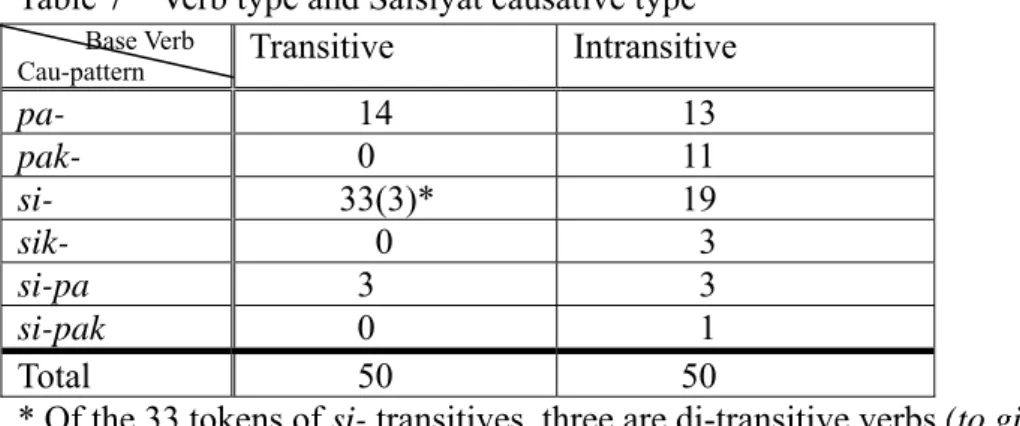
The distribution of transitives and intransitives in Saiyat causatives, based on corpus data, is given in Table 7. Numbers in the table are dominated by the presence of si- causatives, in both intransitives and transitives, which are in turn dominated by
a single verb, si-’oe’oe ‘ RF-call”. If we remove tokens of this particular verb from the count, it is easy to see that Saisiayt causatives prefer to occur with intransitives.
Table 7 Verb type and Saisiyat causative type Base Verb
Cau-pattern Transitive Intransitive
pa- 14 13 pak- 0 11 si- 33(3)* 19 sik- 0 3 si-pa 3 3 si-pak 0 1 Total 50 50
* Of the 33 tokens of si- transitives, three are di-transitive verbs (to give).
7. Conclusions
a. Case marking of the causee ( and thus the causer as well) is sensitive to the causee’s degree of control or volitionality in the caused event. Lexicalized causative verbs often show distinct coding patterns.
b. Causatives in split-ergative languages (e.g. Saisiayt) seem to exhibit both features of case marking for ‘ regular’ ergative languages and features of case marking for accusative languages.
c. Partial causative/applicative syncretism develops in these languages, but each via a different route. In Tsou, the applicative morpheme -neni has developed the function of sociative causation and it is this function that converges with the causative p(o)a- on causative PF and LF clauses. In Squliq, the applicative s- has evolved into a causative marker, via its basic function of indicating a transported theme. In the compound morpheme sequence s-p-, the applicative s- represents an indirect causation for the caused event signaled by the causative p-. In Saisiyat, the causative morphemes pa-, pak- have developed the applicative function of indicating benefactive argument.
Appendix
A. Example sentences for the causative coding patterns in Tsou (1) p(o)a-VAF(i) (-a) (Nom is the Causee)
i-si na’na pa-yonghu(-a) to ino-si ’o paicU NAF-3S.Gen very.PF Cau-pretty.AF-a Obl mom-3S.Gen Nom PN ‘PaicU’s mother made her very pretty.’
(2) p(o)a-VAF(i) (-a) (Nom is the Causee)
pa-coni(-a) to yUsU a’o, mi-’o na’no soyUmU Cau-one(-a) Obl cloth 1S.Nom Aux.AF-1S.Nom very.AF cold
‘Give me one item of clothing, (because) I (feel) very cold.’
(3) p(o)a-VAF (ii)(-a) (Nom is the Causee)
os-’o poa-bonU(-a) to ave’u ’o fokunge Aux.NAF-1S.Gen Cau-eat.AF(-a) Obl rice Nom frog ‘I made the frog eat rice.’
(4) p(o)a-VAF (ii)(-a) (Nom is the Causee)
os-’o pa-cmofu(-a) to naveu to te-si ana ’o pasuya Aux.NAF-1S.Gen Cau-wrap.AF(-a) Obl rice Obl Fut-3S.Gen eat.PF Nom PN ‘I made Pasuya wrap up the rice he wanted to eat.’
(5) p(o)a-VPF -neni (Nom is a action patient)
i-si poa-ana-neni to pasuya to voyu ’o f’ue Aux.NAF-3S.Gen Cau-eat.PF-neni Obl PN Obl PN Nom yam ‘Voyu made Pasuya eat the yam.’
(6) p(o)a-VPF -neni (Nom is an action patient)
os-’o pa-cfu(a)-neni to paicU ’o i-si o-ngacvi Aux.NAF-1S.Gen Cau-wrap.PF-neni Obl PN Nom NAF-3S.Gen eat-left.PF ‘I made PaicU wrap up (the leftover) which she had eaten.’
(7) p(o)a-VLF-neni (Nom is a goal)
os-’o p(o)a-cohiv-neni ta ’oko ’o ’a’ausna ne noana’o Aux.NAF-1S.Gen Cau-know.LF-neni Obl child Nom matters Obl long_ago ‘I made the child know the history.’
(8) p(o)a-VLF-neni (Nom is a goal)
Os-’o pa-cap(i)-neni ta pasuya si evi Aux.NAF-1S.Gen cau-climb.LF-neni Obl PN Nom tree ‘I made Pasuya climb the tree.’
(9) p(o)a-VLF-neni (Nom is a goal)
os’o poa-pom(i)-neni ta mamespingi ’o zoyu-’u Aux.NAF-1S.Gen Cau-weed.LF-neni Obl female Nom field-1S.Gen ‘I made female worker(s) weed my field.’
(10) p(o)a-VLF(ii)-neni
os-’o pa-sii-neni to naveu to PaicU ’o caving-’u Aux.NAF-1S.Gen Cau-put.LF-neni Obl rice Obl PN Nom bowl-1S.Gen ‘I made PaicU fill my bowl with rice. ’
(11) p(o)a-VBF(i) (Nom is a benefactee)
os-’o poa-teaineni no s’ofu ta pasuya na a’o Aux.NAF-1S.Gen Cau-make.BF Obl cane Obl PN Nom 1S ‘I made Pasuya make a cane for me.’
(12) p(o)a-VBF(ii) (Nom is a cause)
i-si poa-aveoveoeni to ino-si ’o mo’o Aux.NAF-3S.Gen Cau-delight_in.BF Obl mother-3S.Gen Nom PN ‘Mo’o made his mother delighted in Mo’o. ’
(13) p(o)a-VBF(ii) (Nom is a transported theme)
os-’o pa-siisneni ta tonhivza to ’o’oko ’o hapuyu Aux.NAF-1S.Gen Cau-smear.BF Obl wall Obl children Nom lime ‘I made children smear a wall with lime’
(14) p(o)a-VBF(iii)
’o mo’o, i-si pa-toUsvUsvUtneni to haah’o ho hucma Nom PN Aux.NAF-3S.Gen Cau-discuss.BF Obl all tomorrow na te hia mayasvi
Nom Fut how Mayasvi
(15) Lexicalized causative Verb (VAF) (Nom is the Agent)
mi-ta ma’cohio pasunaeno to ’o’oko ’e ino Aux.AF-3S.Nom teach.AF sing.AF Obl Red-child Nom Mother ‘The mother taught children to sing.’
(16) Lexicalized causative Verb (VAF) (Nom is the Agent)
mi-’o p’onU to naveu to av’u Aux.AF-1S.Nom feed.AF Obl rice Obl dog ‘I fed the dog with rice.’ Or ‘I fed rice to the dog.’
(17) Lexicalized causative Verb (VAF) (Nom is the Agent)
mi-ta pa’hi-cocvo ‘e pasuya Aux.AF-3S.Nom cause-laugh.AF Nom PN
‘Pasuya joked.’ (People laughed because Pasuya said something or did something).
(18) Lexicalized Causative verb (VLF) (Nom is the Goal)
os-’o pa’cohivi to ’a’ausna ne noana’o ’e ’oko Aux.NAF-1S.Gen teach.LF Obl matter in_the_past Nom child ‘I taught history to the child.’
(19) Lexicalized Causative verb (VLF) (Nom is the Goal)
os-’o p’ani to naveu ’o av’u Aux.NAF-1S.Gen feed.LF Obl rice Nom dog ‘I fed the dog with rice.’
(20) Lexicalized Causative verb (VLF) (Nom is Goal)
i-ta pa’hi-cocv-i ta pasuya ’o yangui Aux.NAF-3S.Gen cause-laugh-LF Obl PN Nom PN ‘Pasuya made Yangui laugh.’
B. Example sentences for the causative coding patterns in Squliq 1. hera’ ga’, m<s>hilaw-ku’ squ’ raNi’-mu’ yesterday Top AF<S>energetic-1S.Nom Obl friend-1S.Gen “I enlivened my friend yesterday.”
2. qutux k’man qani ga’, thoyay s<k>btunux na’ rimuy. one grass Det Top able S<K>beautiful Obl female.name “The kind of grass was capable of making Rimuy beautiful.”
3. musa’-ku’ p-wah squ’ hoNu’ na’ yaqih kira’. Asp-1S.Nom P-come Loc bridge Lig bad later “I will pass that bad bridge later.
4. nyux p-kita’ squ’ yumin sa inluNan-nya’ qu’ mit qani. Asp P-see Obl Yumin Obl emotion-3S.Gen Nom ass Det “The ass let Yumin see its mind.”
5. nyux-nya’ thzy-un qu’ sswe’-mu’. Asp-3S.Gen tease-PF Nom brother-1S.Gen “He is teasing my young brother.”
6. kox-un-mu’ kwara’ qu’ pzit. frighten-PF-1S.Gen all Nom sparrow “I frightened all the sparrows (away).”
7. baq p<in>cbaq na’ yumin qu’ huzil. can P<PF>teach Gen Yumin Nom dog “Yumin was good at training the dog(s).”
8. p-baq-mu’ i’ yumin qu’ zyaw qa. P-know-1S.GenObl Yumin Nom thing Det “I let Yumin know the thing.”
9. wal-mu p-kut i’ yumin qu’ paris-ta’. Asp-1S.Gen P-kill Obl Yumin Nom enemy-1PI.Gen “I have made Yumin kill our enemies.”
10. wal-mu’ p-lk-un qu’ qhniq. Asp-1S.Gen P-fly-PF Nom bird “I let (the) bird fly (away).”
11. p-lNiq-un-maku’ qu’ yumin. P-swim-PF-1S.Gen Nom Yumin “I made Yumin swim.”
12. wal p-qihl-un ni’ yumin qu’ mqu’. Asp P-die-PF Obl Yumin Nom snake “I made Yumin cause the snake dead.”
13. p-qbaq-un-maku’ qu’ ciwas kin yumin.
P-know-PF-1S.Gen Nom Ciwas Com Yumin “I let Ciwas and Yumin know each other.”
“ I introduced Ciwas and Yumin to each other.”
14. htag-an squliq kryax qu’ hoNu’ qa. fall-LF person often Nom bridge Det “The bridge often makes people fall.”
15. qlyux-an-mu qu’ snyuw qa. long-LF-1S.Gen Nom rope Det “I had the rope lengthened.”
16. p<in>nbw-an-maku’ na’ qwox qu’ yumin. P<Perf>drink-LF-1S.Gen Obl Obl wine Nom Yumin “I let Yumin drink wine.”
17. p<in>brw-an-maku’ na’ tegami qu’ yumin. P<Perf>write-1S.Gen Obl letter Nom Yumin “I let Yumin write a letter.”
18. p<in>qniq-an-maku’ na’ qulih qu’ ngyaw qa. Cau<Perf>eat-LF-1S.Gen Obl fish Nom cat this ‘ I had this cat eat fish.’
19. cyux s-bliq-an ni? yumin qu? kneril-nya?. Asp S-good-LF Gen Yumin Nom woman-3S.G “Yumin is amusing his wife.”
20. blaq na’ laqi’ qu’ rimuy qani; nanu_yasa_qu’, s-trahu? good Poss child Nom Rimuy Det therefore S-praise kwara’ squliq qu’ hya’.
all person Nom 3S.Nom.F
“Rimuy was a good child , so all of the people praised her.”
21. s<in>pge’ ni’ lawa’ qu’ mlikuy-nya’. S<Perf>leave Gen Lawa’ Nom husband-3S.Gen “Lawa’ left (her family) because of her husband.”
22. ini’ swal m-agal squ’ kneril qa qu’ yumin ru s<p>yaqih Neg agree AF-take Obl woman Det Nom Yumin Conj S<P>bad qu’ hya’.
Nom 3S.Nom.F
“Yumin didn’t agree to marry the girl, so he made her sad.”
23. m-usu’ qu’ pnaNa’-mu’ qaya’ qani ru AF-heavy Nom carry.on.back-1S.Gen object Det Conj s<p>hgaw-mu’ kun nanak.
S<P>rest-1S.Gen 1S.Nom.F only
“My bag was so heavy that I let myself take a rest.”
24. baq m-yugi’ qu’ sayun ru s<p>yugi’-maku’ qu’ hya’. can AF-dance Nom Sayun Conj S<P>dance-1S.Gen Nom 3S.Nom.F “Sayun was good at dancing so I let her dance.”
25. s<p>kut-mu’ i’ yumin qu’ Nta’ qasa. S<P>cut-1S.Gen Obl Yumin Nom chicken Det “I made Yumin kill that chicken.”
26. ini’ puN-i ke’-mu’ qu’ laqi’-mu’ ru Neg hear-LF.Neg word-1S.Gen Nom child-1S.Gen Conj
s<p>htuy-mu’ i’ mlikuy-mu’ qu’ hya’. S<P>block-1S.Gen Obl husband-1S.Gen Nom 3S.Nom.F
“Because my child didn’t listen to me, I let my husband bar him (from going out).”
27. wal-mu’ hriq-an tuboN ni’ yumin; nanu_yasa_qu’ Asp-1S.Gen break-LF window Gen Yumin therefore
s<p>qih-an-mu’ qu’ hya’. S<P>bad-LF-1S.Gen Nom 3S.Nom.F “I broke Yumin’s window, so I made him angry.”
28. m-qilaN balay qu’ yumin qa ru s<p>qnyat-un-mu’ AF-lazy true Nom Yumin Det Conj S<P>hard-PF-1S.Gen
qu’ hya’.
Nom 2S.Nom.F
Yumin was so lazy that I made him work hard.
C. Example sentences for causative coding patterns in Saisiyat
Pattern A
(1) ‘oya pa-si-ael ka korkoring (ka ‘alaw) mother Cau-eat Acc child (Acc fish)
‘Mother fed the child (fish). (Lit.: Mother caused the child to eat (fish).)’ (2) yao pa-bok hi ‘obay ka walisan
1S.Nom Cau-kill Acc PN Acc boar ‘I made Obay kill (the) boar (for me).’
Patter B
(3) Flood
76 …(0.8) komosa hawaeh iniya’om ka=
say open 1stPl Acc
77 .. palono’ pa-kas’aboe iniya’om
boat Cau-enter 1stPl
“Open your boat; let us get in.”
(4) Frog 6
147 … la-langoy ila ray=
Red-swim Pfv Loc 148 … ralom
water
“They swam in the water.”
149 …(0.8) hiza ahoe nisia mari’-in pa-hangal
there dog 3S.Gen take-PF Cau-carry
150 …(2.4) XXX pa-lalangoy ila Cau-swim Pfv
Pattern C
(5) pa-hangal = (PF) hangal-en
5a. yao hangal ka talka’ 1S.Nom AF-lift Acc table ‘I lifted (the) table.’
5b. talka’ ma’an pa-hangal table 1S.Gen Cau-lift ‘I lifted the table.’
5c. talka’ ma’an hangal-en table 1S.Gen lift-PF ‘I lifted the table.’ (6) pa-‘a’apol=’a’apol-on
6a. yao ‘a’apol ka korkoring 1S.Nom distribute Acc child
‘I sent out (distributed) (my) children (to others).’ 6b. yao pa-‘a’apol ka korkoring 1S.Nom Cau-distribute Acc child ‘I was (also) given a child.’
Pattern D
(7) Kathethel
26. … ‘æhæ’ tatini’
one elder
一 老人
27. …e= …pa-kit-kita’-en ri’sa’ isa= ‘æhæ’ ima
Cau-Red-see-PF there there one Asp
使役-重疊-看-受事 在那裡 一 進行貌
rœhan-an ila sa’œwaz
evening-Loc Pfv indeed
晚上-AN 完成貌 真
(8) Pear 4
42. ...(2.4) kasna'- ima=
43. ...(1.6) nia ka-papama'-an pa-kalben-en k-om-ita'
3rdGen KA-ride-Loc PA-lay.down-PF see-AF
sisil-in 'aehae' kala' ‘askan-en ray=
lift-PF one basket put-PF Loc
44. ...(0.9) ka-papama'-an nisia karma'-en 'aras-en ila
KA-ride-Loc 3rdGen steal-PF take-PF Pfv
"(He) put down his bike and (I) saw (him) lift one basket on (his) bike. (And then) he (rode) his bike and left."
Pattern E
(9) pa-ra:iw = sik-ra:iw
9a. ‘obay pa-ra:iw noka minkoringan PN Cau-leave Gen woman ‘Obay was home alone, (because) his wife left.’ 9b. = ‘obay sik-ra:iw noka minkoringan PN RF-leave Gen woman ‘Obay was home alone, (because) his wife left.’ 9c. ma’an ka ahoe’ si-pak-ra:iw
1S.Gen Nom dog RF-Cau-leave ‘My dog left on me.’
(10) Frog 8
80 …(0.8) komita’ somaksaakaw
see softly
81 …(0.8) raiw ila
leave Pfv
82 …(1.2) pa-raiw ila ila hato noka=
Cau-leave Pfv go there Gen
83 … ahoe ki=
dog and
84 … korkoring child
“The boy and the child left slowly.”
Pattern F
(11) Flood
45 … pazay ma’ nonak
rice too a_space_for_each
46 .. ralom ma’ nonak
water too a_space_for_each
47 .. ahoe’ ma’ nonak ma’iaeh ma’ nonak
dog too a_space_for_each man too self
“There was room for putting the rice and water, as well as for the animals and the family members.”
48 …(0.9) pak-’isaza pa-kas-’aboe-en ka=
Cau-there Cau-into-inside-PF Nom
49 …(1.2) simpan-an maybiil ila ka ma’iaeh
raise-LF later Pfv Nom man
“The animals were brought first into the boat. The people entered last.”
(12) Frog 8
71 …(1.0) ahoe’ pa-langoy-on amaray horok am ka babaw
dog Cau-swim-PF through flatland Fut top “The dog swam and moved over the ground.”
Pattern H
(13) Flood
45 … pazay ma’ nonak
rice too a_space_for_each
46 .. ralom ma’ nonak
water too a_space_for_each
47 .. ahoe’ ma’ nonak ma’iaeh ma’ nonak
dog too a_space_for_each man too self
“There was room for putting the rice and water, as well as for the animals and the family members.”
48 …(0.9) pak-’isaza pa-kas-’aboe-en ka=
Cau-there Cau-into-inside-PF Nom
49 …(1.2) simpan-an maybiil ila ka ma’iaeh
raise-LF later Pfv Nom man
(14) Frog 4
74. …(1.5) hini’ ahoe’ ma=
this dog too
75. …(1.6) h-om-ahli ka pak-sahae’ ka boya’
shake-AF Acc Cau-fall Acc beehive
76. … sowaw-en ila noka boya’
Pattern L
(15) Frog 1
91. ...(1.0) korkoring kayni’ aras-en
child Neg take-PF
92. ...(0.9) pa-taaes ka=
Cau-separate Acc
93. ... b-in-ilis kah’oeng
hold-Pfv antler
“The child, not wanting to be taken away, let go (of the deer), of which the antler he held with hands.”
94. ...(2.1) sahae’ ila hiza ra-
fall Pfv that
“The child fell.”
95. ...(0.8) hiza ila ahoe’
there Pfv dog
“There went the dog.”
96. ...(4.7) hiza korkoring
that child
97. ... pak-sahae’-en ila hao ray ralom ‘i’izo’
Cau-fall-PF Pfv there Loc water inside
(16) kathethel
67. ... papnabih komosa hini kabinao’
say say-AF this lady
談論 說-主事 這個 小姐
68. .. hayza ka ‘al’alak
Exist Nom youth
男孩子 主格 年輕
69. ...e= ..pak-ray’aboe ila lasia
Cau-wed Pfv 3rdP.Nom
致使-結婚 完成貌 他們 主格 The hunters wanted a young man to marry the young lady.
「打獵的人回來,談論說,這個小姐和年輕的男生,要讓他們結婚。」
70. ...a= ..’in’alay isaza
from there
從 那時
71. ... somiwa’ hayzaeh ‘aehae’ ‘al’alak
agree Exist one youth
同意 有 一 年輕
72. ... ima= ‘i’ini’ rwaseki isaa lasia pak-rwaseken ila
Asp Neg live that 3rdP Cau-live-PF Pfv
進行否定詞 結婚 那個 他們 允許 完成貌
The young man who has not yet married agreed to get married with her. 「允許他們的婚事。」
Pattern M
(17) Frog 1
118. ... si-mari’ ‘aehae’ ka takem ila-hao
RF-take one Nom frog go_there
“He took one frog and went there.”
(18) Frog 3
136 . noka= Gen
137 . wae’ae’ sowaw-en ila
deer chase-PF Pfv
138 ...(0.9) e- si-’osa\ RF-throw
139 .. ta lasia hini
3P.Nom here
"The deer chased them, and tossed them (into the water)."
Pattern N
(19) Molaw
78 (1.6) samiyan a= kano’ k-om-ita’
god what see-AF
神明 什麼 主焦-看
Then one day there appeared a god from another place.” 「不知道是神還是什麼,」
79 si-’olaw
RF-molt 主焦-蛻皮
“A Saisiyat molting had been seen.”
(20) Frog 2
73 (1.0) si-panra:an ila ‘aras-en ila hiza ahoe’
RF-walk Pfv take-PF Pfv that dog
74 tanisowaw tanisowaw ka korkoring
follow follow Acc child
75 noka wae’ae’
Gen deer
76 … ‘aras-en bring-PF
“The dog followed the child being taken away by the deer.”
Pattern P
(21) Frog 3
17. ...(0.9) s-om-isil ma=
lift-AF
18. .. pa-kalben ka ka-papama-an
Cau-lay.down Acc KA-ride-Loc
19 .. s-om-isil ka boway
lift-AF Acc fruit
20. ...(1.3) mari-in 'in'alay ra:i' ka-papama-an
take-PF from ground KA-ride-Loc
21. .. sik-ra:iw ila leave-RF Pfv