Tsan-Piao Lin(1*) and Wei-Min Lin(2)
1. Institute of Plant Biology, National Taiwan University, 1 Roosevelt Road, Section 4, Taipei 106, Taiwan.
2. 2nd Fl., 104 Da-an Road, Section 2, Taipei 106, Taiwan.
*Corresponding author. Tel: +886-2-33662537; Email: [email protected]
(Manuscript received 19 July 2011; accepted 31 August 2011)
ABSTRACT: In this report, four new species (Lecanorchis latens sp. nov., Liparis liangzuensis sp. nov., Malaxis shampoae sp. nov., and Spiranthes nivea sp. nov.), and one new record (Hancockia uniflora) are presented. Descriptions and figures are also provided.
KEY WORDS: Hancockia uniflora, Lecanorchis latens, Liparis liangzuensis, Malaxis shampoae, Native orchids, Spiranthes
nivea.
INTRODUCTION
The junior author continues to spend time searching for native orchids in Taiwan, especially in the much-ignored southern portion of the island. In this paper, we present several new orchid species which were recently found. It is becoming difficult to find new species of orchids in the northern part of Taiwan because of intensive searches in the past. The remarkable finding of Hancockia uniflora from a mountainous area of the Hsueh Shan Ridge suggests that other rare or uncommon species which occur in nearby countries could be found unexpectedly in the future.
TAXONOMIC TREATMENTS
Lecanorchis latens T.P. Lin & W.M. Lin, sp. nov.
士賢皿柱蘭 Figs. 1A, 2
A L. nigricans disco labelli glabro differt. – Typus: Shyh-Shiarn Lin s.n. (holo TAI 274551, Mar. 6, 2010,
Shuangliou Forest Recreation Area, Pingtung County). Rhizome black, crooked, with short internode, covered with rudimental scale-sheath at nodes, bearing many thick roots about 0.5 cm in diameter. Flowering stem about 30 cm above ground; scape blackish, hardened, flattened, with several small sheaths; inflorescence usually branched, can last for more than 1 year, bearing several flower buds on terminal part, usually 1 or rarely 2 blossom at a time. Flowers opening widely, 1-1.3 cm across, lightly violet tinged green at ends of sepals; floral bracts triangular, small; pedicellate ovary about 1 cm long, dark-brown, glabrous. Sepals oblong, 7 mm long, 1.8 mm wide,
obtuse. Petals oblong, 7 mm long, 2.5 mm wide, obtuse. Lip oblong, 7.5 mm long, 3.5 mm wide when spread out, more or less 3-lobed, adnate 1/4 of length to column from base, glabrous inside, forming a sac on front; mid-lobe of labellum erose-lacerate, acute, with margins curving upwards. Column white, 5 mm long, bearing short white hair on ventral side. Anther white, glabrous, fleshy. Capsules black, fusiform, erect.
Flowering time: Mainly between March and September, but inflorescence with flowering buds can be seen year round.
Ecology: Lecanorchis latens sp. nov. grows on forest floor in Shuangliou Forest Recreation Area, Pingtung County at elevations of 400-500 m.
Note: The species name “latens” refers the concealed nature of the plant in the wild. This herb is characterized by the glabrous lip disc which usually grows dense hair or is papillose in other species of
Lecanorchis. Mr. Shyh-Shiarn Lin discovered this
saprophyte long before the recorded day, and he has visited the site many times to observe the flowers.
Liparis liangzuensis T.P. Lin & W.M. Lin, sp. nov.
良如羊耳蘭 Figs. 1B, 3
A L. laurisilvatica Fukuyama foliis multo longis et floribus parvis differt. – Typus: Liang-Zu Chang s.n.
(holo TAI 276924, Mar. 18, 2011 in cultivation, Fushan, Taipei County).
Usually lithophytic. Pseudobulbs close, usually not arranged in a linear fashion, ovoid, somewhat compressed, about 2.2 cm long, 1.2 cm in diameter, 1-rarely 2-leaved. Leaf linear, 20-26 cm long, 1.3-1.4 cm wide, narrowing very gradually to base, green. Flowering stem terminal on pseudobulb, erect or
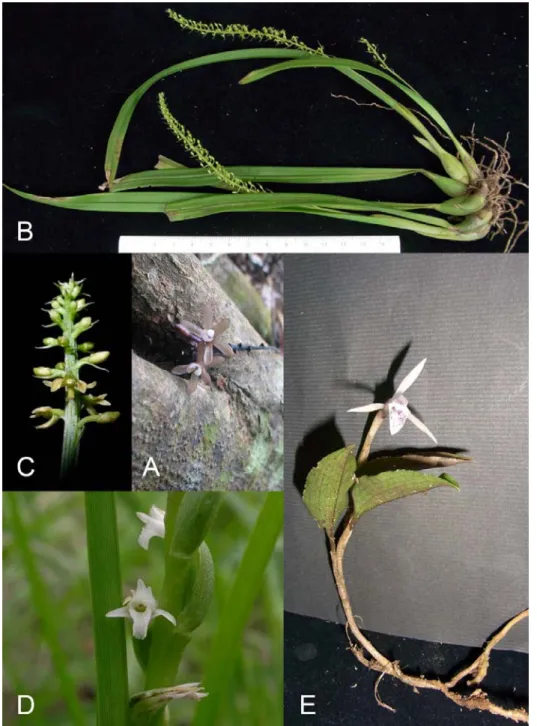
Fig. 1. Image of the new orchids. A: Lecanorchis latens T.P. Lin & W.M. Lin (courtesy of Mr. Shyh-Shiarn Lin). B: Liparis
liangzuensis T.P. Lin & W.M. Lin. The ruler is 15 cm long. C: Malaxis shampoae T.P. Lin & W.M. Lin (courtesy of Mr. Yi-Fu
Wang). D: Spiranthes nivea T.P. Lin & W.M. Lin (courtesy of Mr. Yi-Fu Wang). E: Hancockia uniflora Rolfe.
somewhat arcuate, compressed, about 18 cm long; scape about 8-9 cm long, usually without sheath-bract. Floral bracts lanceolate, shorter or longer than pedicel and ovary. Pedicel and ovary 3.5 mm long, greenish. Flowers small, 2-3 mm across, light-green, spreading; sepals oblong, 2.5 mm long, pale-greenish; petals linear, 2.3 mm long, same color as sepal, reflexed. Lip fiddle-shaped,2 mmlong,2 mmwide, distal part bent
downwards, broad apex with a short tip, basal disc with 2 slight projections. Column arcuate, 1 mm long, slightly winged in front; rostellum white; pollinia 4, yellow.
Flowering time: March to April.
Ecology: Epiphytic on rock close to creek in Fushan area, Taipei County.
J F B H N L K G O E D C A I M
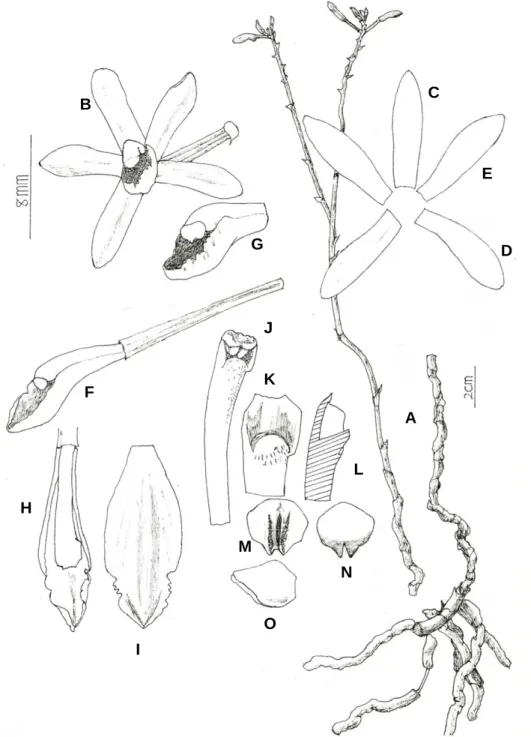
Fig. 2. Lecanorchis latens T.P. Lin & W.M. Lin. A: Plant body and inflorescence. B: Front view of flower. C: Upper sepal. D: Lateral sepal. E: Petal. F: Side view of column, lip, and ovary. G: Side view of column and lip. H: Top view of column and lip. I: Lip. J: Ventral view of column and anther cap. K: Ventral view of column. L: Longitudinal section of column. M: Ventral view of anther cap. N: Top view of anther cap. O: Side view of anther cap.
Note: The species name was created in dedication to Mr Liang-Zu Chang who is the first one to collect this orchid. This new species is similar to L. laurisilvatica but differs in having much longer, linear leaves and much smaller flowers. This new species is definitely muchlessabundantthanL.laurisilvatica.This species
was overlooked by the authors because it was considered to be L. laurisilvatica. Mr Liang-Zu Chang collected this species with no special attention from the Fushan area and grew this herb in his garden. He was sensitive enough to discern the uniqueness of the species when he saw the plant and flowers. For
F G E C D M L O N K J B A
Fig. 3. Liparis liangzuensis T.P. Lin & W.M. Lin. A: Plant body and inflorescence. B: Cross-section of pseudobulb. C: Cross-section of leaves. D: Front view of flower. E: Side and bottom views of flower. F: Front view of flower. G: Bottom and side views of flower. H: Front and side views of flower. I: Side view of flower. J: Lip in a natural state. K: Lip after spreading out. L: Side view of column and anther cap. M: Ventral view of anther cap. N: Column and anther cap. O: Pollinia.
example, pseudobulbs of L. laurisilvatica are arranged in a linear fashion because only one new bulb is produced from the old one, while in L. liangzuensis pseudobulbs are not deployed in a linear fashion because more than 1 new bulb is produced, thus forming a clustered mass. Another character notably
presenting in L. liangzuensis is a well-developed side-lobe of the labellum that is usually not the case in other single-leafed Liparis in Taiwan. The flowering time was recorded under cultivation and greatly differed from that of L. laurisilvatica which is between October and November.
H I J G F N K L B A D E C M B
Fig. 4. Malaxis shampoae T.P. Lin & W.M. Lin. A: Plant body and inflorescence. B: Cross-section of stem. C: Side view of flower. D: Top view of flower. E: Bottom view of flower. F: Side view of flower. G: Floral bract. H: Upper sepal. I: Lateral sepal. J: Petal. K: Top view of column and lip. L: Side view of column and lip. M: Top view of lip. N: Ventral view of anther cap.
Malaxis sampoae T.P. Lin & W.M. Lin, sp. nov.
三伯花柱蘭 Figs. 1C, 4
A M. latifolia J.E.Sm plantis multo brevioris differt. – Typus: Shyh-Shiarn Lin s.n. (holo TAI
274758, Shouka, Pingtung County).
Terrestrial. Plants variable in size, 8-25 cm tall, greenish, bearing 4-5 leaves. Stem slightly compressed. Leaves plicate, obliquely elliptic; the largest leaf-blade 9 cm long, 4 cm wide, acute, basally constricted into a broad petiole. Flowering stem angled, usually 7-10 cm long,rachisabout 2-3cm long,many-flowered. Bracts
triangular, blunt; mid-lobe triangular, obtuse; disc concave. Column 1.2 mm long; pollinia 4, yellowish. Capsules cylindrical.
Flowering time: July.
Ecology: Malaxis sampoae sp. nov. grows in mixtures with grasses that receive direct sunlight in Shouka (Pingtung County) at elevations of 300-400 m. Note: The type specimen was originally collected by Mr. Shyh-Shiarn Lin on July 20, 2010. The species name “sampo” refers to his nickname. The plant can grow to 20-25 cm tall in the nearby forest. When the plant grows to a larger size, it can bear a very dense inflorescence like M. latifolia, but they can be differentiated by the greenish inflorescence and flowers.
Spiranthes nivea T.P. Lin & W.M. Lin, sp. nov.
義富綬草 Figs. 1D, 5
A S. chinensis floribus niveis et parvis differt. –
Typus: Yi-Fu Wang s.n. (holo TAI 270634, May 20, 2009, Tahanshan, Pingtung County).
Terrestrial. Roots thick. Stem very short. Leaves about 6, linear, 6.5 cm long, 13 mm wide, acute, fasciculate, fleshy. Flowering stem short, 8 cm long; spike with dense flowers. Flowers about 10, spiral, sub-open, white; ovary pedicellate, 4 mm long, green, glabrous; bracts lanceolate, longer than 1 cm, acuminate; sepals lanceolate, 4 mm long, 1.5 mm wide; petals linear, 3.3 mm long, 1 mm wide. Lip white, oblong, 4 mm long, 2.5 mm wide, short-clawed, recurved at apex and crispate on margin, slightly concave at base, base of lip with a round callosity on each side; disc glabrous. Column 1.5 mm long, enclosed by lip; pollinia 4, powdery, oblong, yellow.
Flowering time: May.
Ecology: Spiranthes nivea sp. nov. grows along with grasses on roadside slopes that receive sufficient sunshine on Tahanshan at an elevation of 1,500 m. Note: The name refers the white flowers. This herb was originally discovered by Mr. Yi-Fu Wang in 2009, and a small population was found again on Tahanshan in 2011. This species is close to S. sinensis but differs from it by the floral bract exceeding the length of flower, white flowers, glabrous lip-disc, and lanceolate sepals.Inaddition,thesmallerstigmaontheventral of
Rhizomes creeping, gracile, loosely arranged. Each shoot about 5 cm tall, with 3-4 internodes, bearing a single leaf; the internode just below leaf sometimes swollen slightly and dark brown. Leaf blade elliptic, green on upper side, reddish-brown on lower side because of many reddish-brown veins, 5-7 cm long, 2-3 cm wide, acute, papery, base contracted forming a petiole-sheath about 1.2 cm long. Inflorescence ca. 7 cm long, enclosed in membranous tubular sheaths, originating from middle node of shoot and producing a single flower; floral bracts cymbiform, 2.2 cm long, 0.9 cm wide, tinged with reddish-brown spots. Flower pink or tinged with reddish-brown spots, 3 cm across; pedicel and ovary 2.5 cm long; sepals similar, free, linear, 2.5 cm long, 3 mm wide, apex acuminate. Petals similar to sepals, 2.3 cm long, 2 mm wide, apex acuminate. Lip elongate rhombate, tinged with reddish-brown spots, with no outgrowth on disc, 2.1 cm long, 1.1 cm wide, about 3 parallel veins running entire length, 3-lobed; lateral lobes triangular, smaller; mid-lobe more or less triangular, 9 mm long, 8 mm wide, obtuse; spur 2.5 cm, slightly compressed, crooked in middle, apex 2-forked. Column 1.5 cm long, free from lip. Rostellum conspicuous; pollinia 8, yellow. Taiwan: The first specimen (L. Z. Chang s.n., TAI 274629) was collected on July 30, 2010 in a heavily shaded forest, Fu-Hsing Township, Taoyuan County, at 900-1000 m.
Distribution: Yunnan Prov., China; Ryukyu Islands, Japan; northern Vietnam.
Flowering time: July.
Ecology: Hancockia uniflora is an astonishing plant bearing a single showy flower on the forest floor, and not easily found. It represents another species with a disjunct distribution. In the location where H. uniflora grows, no more than 20 individual plants were found after an intensive search. It must be a very rare species which can only grow in an environment meeting critical requirements.
Note: This species was originally found by Mr. L. Z. Chang in 2009 but only the vegetative part remained which provided no hint to any existing native orchids. Judging from the morphology, Nephelaphyllum is probably the most similar species. The genus name
Hancockia was created by R. A. Rolfe in dedication to
Mr. F. L. S. Hancock who was the first one to collect this orchid from Yunnan, China. The original
F H I B N E J G C L O A M K D
Fig. 5. Spiranthes nivea T.P. Lin & W.M. Lin. A: Plant body and inflorescence. B: Cross-section of leaf. C. Bottom view of flower and floral bract. D: Side view of flower. E: Top view of flower. F: Floral bract. G: Upper sepal. H: Lateral sepal. I: Petal. J: Side view of column, lip, and ovary. K: Top view of lip. L: Side view of lip. M: Side view of column borne on ovary. N: Top view of column and anther cap. O: Top view of column and anther cap.
description mentioned that the disc of the labellum has three obscure keels (Hooker 1911), but this was not found in our specimen. Our plant agrees well with the figure presented in Seidenfaden (1992).
ACKNOWLEDGEMENTS
We wish to express our thanks toProf. H. Y. Liu for
assisting with the Latin names for the new species.
LITERATURE CITED
Hooker, J. D. 1911. Icones Plantarum, Tabula 2945.
Seidenfaden, G. 1992. The orchids of Indochina. Opera
1. 國立臺灣大學植物科學研究所,106 臺北市羅斯福路四段1 號,臺灣。 2. 106 臺北市大安路二段104號2樓,臺灣。
* 通信作者。Tel: +886-2-33662537; Email: [email protected]
(收稿日期:2011年7月19日;接受日期:2011年8月31日)