Electronic structures and bonding properties of chlorine-treated
nitrogenated carbon nanotubes: X-ray absorption and scanning
photoelectron microscopy studies
S. C. Ray, C. W. Pao, H. M. Tsai, J. W. Chiou, and W. F. Ponga兲 Department of Physics, Tamkang University, Tamsui 251, Taiwan
C. W. Chen
Department of Materials Science and Engineering, National Taiwan University, Taipei 106, Taiwan M.-H. Tsai
Department of Physics, National Sun Yat-Sen University, Kaohsiung 804, Taiwan P. Papakonstantinou
NRI, School of Electrical and Mechanical Engineering, University of Ulster at Jordanstown, Newtownabbey, County Antrim BT37OQB, Northern Ireland, United Kingdom
L. C. Chen
Center for Condensed Matter Sciences, National Taiwan University, Taipei 106, Taiwan K. H. Chen
Institute of Atomic and Molecular Sciences, Academia Sinica, Taipei 106, Taiwan W. G. Graham
Department of Physics and Astronomy, Queens University of Belfast, Belfast, Antrim BT71NN, Northern Ireland, United Kingdom
共Received 8 February 2007; accepted 19 April 2007; published online 8 May 2007兲
The electronic and bonding properties of nitrogenated carbon nanotubes 共N-CNTs兲 exposed to chlorine plasma were investigated using C and N K-edge x-ray absorption near-edge structure 共XANES兲 and scanning photoelectron microscopy 共SPEM兲. The C and N K-edge XANES spectra of chlorine-treated N-CNTs consistently reveal the formation of pyridinelike N-CNTs by the observation of 1s→*共e
2u兲 antibonding and 1s→*共b2g兲 bonding states. The valence-band photoemission spectra obtained from SPEM images indicate that chlorination of the nanotubes enhances the C–N bonding. First-principles calculations of the partial densities of states in conjunction with C K-edge XANES data identify the presence of C–Cl bonding in chlorine treated N-CNTs. © 2007 American Institute of Physics.关DOI:10.1063/1.2737392兴
Carbon nanotubes共CNTs兲 have attracted extensive atten-tion, partly owing to their favorable electronic properties.1 The doping of nitrogen impurities in CNTs was found to be a possible route to tune the band gap such that CNTs can be exploited to make various electronic devices.2 The fluori-nated CNTs can be tuned from metal to semiconductor/ insulator with high resistivity at elevated temperatures.3 Fluorination can also improve the wetting of nanotubes in water by inducing a surface dipole layer on the nanotube wall. This effect may be useful in battery and supercapacitor applications.4Iodine- and bromine-doped CNTs were found to enhance the electronic/electrical properties by increasing the density of free charge carriers.5Therefore, it is interest-ing to understand the effect of chemical modification of CNTs using halogens共F, I, Br, and Cl兲. Fluorine-, iodine-, and bromine-treated CNTs 共Refs. 3–5兲 and CNT-based
nanomaterials6–8 have been investigated previously. The electronic and bonding properties of chlorine-treated nitroge-nated carbon nanotubes 共N-CNTs:Cl兲 have not been fully carried out. Here, the electronic structures and bonding prop-erties of freshly prepared N-CNTs, which were further treated with chlorine plasma in an inductively coupled plasma system, have been studied using x-ray absorption
near-edge structure 共XANES兲 and scanning photoelectron microscopy共SPEM兲.
The C and N K-edge XANES, and SPEM measurements were performed at the National Synchrotron Radiation Re-search Center in Hsinchu, Taiwan. In the preparation of CNTs, the vertically oriented multiwall N-CNTs were ini-tially synthesized by microwave-plasma-enhanced chemical-vapor deposition on silicon substrates precoated with an
e-beam evaporated thin Fe catalytic layer.9 Then, the ob-tained N-CNTs were chlorinated in an inductively plasma-coupled reactor in flowing Cl gas at 5 sccm for periods of 1 and 5 min 关denoted as N-CNTs:Cl 共1 min兲 and N-CNTs:Cl 共5 min兲 later on兴.
Figure1displays C K-edge XANES spectra of N-CNTs with and without chlorine treatment and the highly oriented pyrolytic graphite共HOPG兲 as a reference. The feature with the maximum intensity at approximately 285.5 eV for HOPG was attributed to the*antibonding state originated from the out-of-plane bonds in the sp2 bonding configuration.10
The positions of*resonance feature in the C共1s兲 XANES spec-tra of N-CNTs and N-CNTs:Cl located at ⬃286.4 and 286.7 eV, respectively, which are shifted by ⬃0.9 eV for N-CNTs and 1.2 eV for N-CNTs:Cl with respect to that of HOPG共285.5 eV兲, correspond to the 1s→*共e2u兲 transition as in the pyridinelike sp2 C–N structure.11
Pyridine is also well known to have two unfilled*orbitals共as in benzene兲
a兲Author to whom correspondence should be addressed: electronic mail: [email protected]
APPLIED PHYSICS LETTERS 90, 192107共2007兲
0003-6951/2007/90共19兲/192107/3/$23.00 90, 192107-1 © 2007 American Institute of Physics Downloaded 09 Dec 2008 to 140.112.113.225. Redistribution subject to AIP license or copyright; see http://apl.aip.org/apl/copyright.jsp
with e2u共an antibonding state whose wave functions are an-tisymmetric兲 and b2g共a bonding state whose wave functions are symmetric兲 symmetry.11
The latter is observed at ⬃289.2 eV in the*region for N-CNTs:Cl, and its intensity increases with the Cl-treatment time. This feature is attribut-able to the transition of 1s→*共b
2g兲 similar to that of the pyridine structure with the symmetric bonding state,11and/or C–Cl bonds, as observed by Unger et al. at 289.0 eV in x-ray photoelectron analysis of Cl-functionalized multiwall CNTs.12Previous works of carbon systems revealed a similar double feature in the C共1s兲 XANES spectra.13For N-CNTs, a small shoulder observed at⬃289 eV 共indicated by a verti-cal arrow兲 was attributed to the presence of interlayer graph-ite states, which was correlated with the calculated electronic state of dual-layer graphite sheets.14 In the * region, the centers of the maximum features of N-CNTs and N-CNTs:Cl appear at⬃293.2 and 293.6 eV, respectively, similar to those of the pyridine structure.11 Interestingly, the intensities of 1s→*共e
2u兲 共286.4/286.7 eV兲 and * 共293.2/293.6 eV兲 features decrease, while that of 1s→*共b
2g兲 feature 共indi-cated by the arrow兲 increases with the increase of Cl-treatment time, as clearly shown in the inset of Fig.1. This trend suggests the formation of a more symmetric bonding state in the N-CNTs than in the pyridine structure. To iden-tify clearly these features, the p-projected conduction-band partial densities of states共PDOSs兲 of pure CNTs, N-CNTs, and N-CNTs:Cl are calculated using the CASTEP code,15 which is a plane-wave pseudopotential program based on the density functional theory and local density approximation, and are shown in Fig. 2. The benzene, pyridine, and pyridine-Cl cluster models are employed to represent local
bonding configurations of CNTs, N-CNTs, and N-CNTs:Cl, respectively. The hydrogen atoms in these models saturate the dangling bonds of carbon atoms, so that these carbon atoms mimic those in CNTs, N-CNTs, and N-CNTs:Cl. The insets共a兲–共c兲 in Fig. 2present the bonding configurations of these three CNTs; blue and green colors in the bonding struc-tures indicate the attachment of N and Cl atoms in pure CNTs, respectively. Details of the calculations for the cluster models of these CNTs with various geometries can be found elsewhere.16 In Fig. 2, the feature located at ⬃2.6 eV be-tween* and * for the cluster model of pyridine-Cl may correspond to the extra feature indicated by the arrow be-tween* and* features in the inset of Fig. 1 and can be attributed to the C–Cl bond.
Figure 3 displays the N K-edge XANES spectra of the N-CNTs and N-CNTs:Cl samples. The two main features centered at⬃403.2 and ⬃409.5 eV are associated with tran-sitions into unoccupied* and * orbitals, respectively. As stated above, the pyridine structure has two unfilled* or-bitals with e2u and b2gsymmetries, which are typically ob-served in the N K-edge XANES spectra at ⬃400.0 and ⬃403.7 eV, respectively, for nitrogenated carbon films.11 The features in the N K-edge XANES spectra in Fig.3 are similar for all N-CNTs. The prominent feature centered at ⬃403.2 eV in the* resonance has the b
2gsymmetry of the pyridine structure.11 Jimènez et al.17 also observed this fea-ture at 403.5 eV for sp2-hybridized nitrogenated carbon films, for which the * region can be resolved into four peaks. The broad feature centered at ⬃409.5 eV in the * region is associated with the C–N bond and is identical to that of the pyridine structure.11,17The inset in Fig.3 reveals that the intensity of the*features in the N K-edge XANES spectra decreases with the Cl-treatment time consistent with the trend of the C K-edge XANES spectra shown in the inset of Fig. 1, which consistently indicate that Cl treatment in-creases the occupation of the b2g symmetry states or en-hances the pyridinelike C–N bonding.
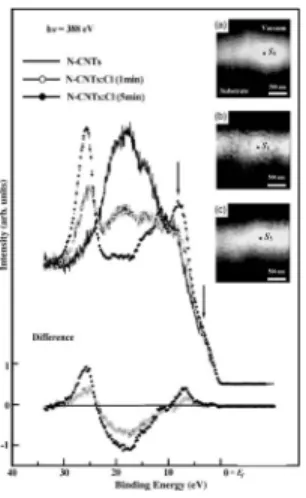
Figure4displays spatially resolved valence-band photo-emission spectra of N-CNTs and N-CNTs:Cl with corre-sponding C 1s SPEM cross-sectional images. The bright area in the SPEM image corresponds to the N-CNTs and N-CNTs:Cl with a maximum C 1s intensity. The spectra pre-sented in Fig.4 exhibit photoelectron yields from the bright regions S0 共N-CNTs兲, S1 共1 min Cl treated兲, and S5 共5 min Cl treated兲, which correspond to the sidewalls of the respec-tive N-CNTs, N-CNTs:Cl 共1 min兲, and CNTs:Cl 共5 min兲.
FIG. 1. C K-edge XANES spectra of unchlorinated/chlorinated N-CNTs and reference HOPG. The inset highlights the*region.
FIG. 2.共Color online兲 PDOSs of various CNTs. Insets 共a兲, 共b兲, and 共c兲 show the cluster models, which represent the local bonding configurations of CNTs, N-CNTs, and N-CNTs:Cl, respectively. Blue- and light-green colored balls indicate N and Cl atoms, respectively.
FIG. 3. N K-edge XANES spectra of unchlorinated/chlorinated N-CNTs. The inset highlights the*region.
192107-2 Ray et al. Appl. Phys. Lett. 90, 192107共2007兲
The spectra contain two weak structures at binding energies of⬃3.5 and 8.2 eV 共shown by down arrows兲 associated with the C 2p and bonds, respectively.18–20 The spectra of N-CNTs:Cl共1 min兲 and CNTs:Cl 共5 min兲 show that chlorine treatment of N-CNTs broadens the feature of thebond and increases its intensity. The change in the-bond feature may be associated with chlorine-derived states and can be caused by the formation of C–Cl and/or N–Cl bonds. How-ever, the physical origin of this feature remains uncertain. Features observed at⬃15 eV 共mixed s and p characters of the C–N bond兲 and ⬃19 eV 共C 2s兲 are typically observed in nitrogenated carbon films with a graphitic structure.21 The intensities of these two features共⬃15 and 19 eV兲 decrease with the chlorine treatment, while the intensity of another new feature in the 24– 30 eV range 共centered at ⬃26 eV兲, which is attributable to N 2s states, increases with the chlo-rine treatment. This result reflects the increase and decrease of the numbers of C–N and C–C bonds, respectively, and the formation of a pyridine structure in nitrogenated carbon films, as described by Bhattacharyya et al. for nitrogenated carbon films.21The N 2s peak is very prominent, despite the fact that the N/C at. % ratio is only 0.033共for N-CNTs兲 and 0.054共for N-CNTs:Cl兲, which may suggest that N 2s orbital has a larger effective cross-section area or transition prob-ability than those of C valence orbitals for the 388 eV pho-ton. This feature is observed in various nitrogen-based mate-rials, and its intensity increases with the nitrogen concentration.22 The difference between N-CNTs:Cl and N-CNTs spectra, as shown in the lower inset of Fig.4, illus-trates the effect of the treatment of N-CNTs with chlorine. The difference spectra contain two positive features in the and regions 共within the range of 0–9 eV兲 and another feature共in the range of 24–30 eV兲 centered at ⬃26 eV. A negative feature centered at ⬃18 eV is a signature of the decrease in the number of C 2s bonds, which is consistent with an increase of the intensity of the feature at⬃26 eV and the formation of the C–N bond. It may also be associated with the formation of either C–Cl and/or N–Cl bonds by the substitution of C–C bonds.
The increase of the intensity of the feature between * and*in the C K-edge XANES spectra共at ⬃289.2 eV in the inset of Fig.1and the C–Cl bond peak共at ⬃2.6 eV shown in
Fig.2兲 in the calculated conduction-band PDOSs are a strong
evidence of the contribution of C–Cl bonds in N-CNTs:Cl. The decrease of the intensity of the*feature共shown in the inset of Fig.3兲 and the increase of the intensity of the feature
at⬃289.2 eV 共shown in the inset of Fig.1兲 with the increase
of the Cl-treatment time in the N K-edge and C K-edge XANES spectra, respectively, indicate the formation of sp2 C–N bonded N-CNTs with more symmetric pyridinelike structures. In the case of SPEM shown in Fig. 4, chlorine treatment of N-CNTs broadens the p-bond associated with chlorine-derived states and markedly increases the inten-sity of the new feature at⬃26 eV, which is attributable to N 2s states.22 This unusually sensitive N signal may indicate that N is on the surface. These observations in conjunction with the theoretical calculation suggest that the formation of pyridine, the increased symmetry of the N-CNTs states, and the possible formation of mixed C–Cl, N–Cl, and sp2 C–N bonds are due to chlorination.
1M. S. Dresselhaus, G. Dresselhaus, and P. C. Eklund, Science of Fullerenes and Carbon Nanotubes共Academic, San Diego, 1996兲. 2S. H. Lim, H. I. Elim, X. Y. Gao, A. T. S. Wee, W. Ji, J. Y. Lee, and J. Lin,
Phys. Rev. B 73, 045402共2006兲.
3K. N. Kudin, H. F. Bettinger, and G. E. Scuseria, Phys. Rev. B 63, 045413 共2001兲.
4E. T. Mickelson, I. W. Chiang, J. L. Zimmerman, P. J. Boul, J. Lozano, J. Liu, R. E. Smalley, R. H. Hauge, and J. L. Margrave, J. Phys. Chem. B
103, 4318共1999兲.
5A. M. Rao, P. C. Eklund, S. Bandow, A. Thess, and R. E. Smalley, Nature 共London兲 388, 257 共1997兲.
6C. L. Yueh, J. C. Jan, J. W. Chiou, W. F. Pong, M.-H. Tsai, Y. K. Chang, Y. Y. Chen, Y. F. Lee, P. K. Tseng, S. L. Wei, C. Y. Wen, L. C. Chen, and K. H. Chen, Appl. Phys. Lett. 79, 3179共2001兲.
7J. W. Chiou, C. L. Yueh, J. C. Jan, H. M. Tsai, W. F. Pong, I.-H. Hong, R. Klauser, M.-H. Tsai, Y. K. Chang, Y. Y. Chen, C. T. Wu, K. H. Chen, S. L. Wei, C. Y. Wen, L. C. Chen, and T. J. Chuang, Appl. Phys. Lett. 81, 4189 共2002兲.
8S. C. Ray, J. W. Chiou, W. F. Pong, and M.-H. Tsai, Crit. Rev. Solid State Mater. Sci. 31, 91共2006兲.
9L. C. Chen, C. Y. Wen, C. H. Liang, W. K. Hong, K. J. Chen, H. C. Cheng, C. S. Shen, C. T. Wu, and K. H. Chen, Adv. Funct. Mater. 12, 687共2002兲. 10S. Anders, J. Díaz, J. W. Ager III, R. Y. Lo, and D. B. Bogy, Appl. Phys.
Lett. 71, 3367共1997兲.
11S. Bhattacharyya, M. Lübbe, and F. Richter, J. Appl. Phys. 88, 5043 共2000兲.
12E. Unger, A. Graham, F. Kreupl, M. Liebau, and W. Hoenlein, Curr. Appl. Phys. 2, 107共2002兲.
13M. Imamura, H. Shimada, N. Matsubayashi, M. Yumura, K. Uchida, S. Oshima, Y. Kuriki, Y. Yoshimura, T. Sato, and A. Nishijima, Jpn. J. Appl. Phys., Part 2 33, L1016,共1994兲.
14D. A. Fischer, R. M. Wentzcovitch, R. G. Carr, A. Continenza, and A. J. Freeman, Phys. Rev. B 44, 1427共1991兲.
15M. C. Pyane, M. Teter, D. C. Allan, and J. D. Joannopoulos, Rev. Mod. Phys. 64, 1045共1992兲.
16C.-W. Chen and M.-H. Lee, Nanotechnology 15, 480共2004兲.
17I. Jimènez, W. M. Tong, D. K. Shuh, B. C. Holloway, M. A. Kelly, P. Pianetta, L. J. Terminello, and F. J. Himpsel, Appl. Phys. Lett. 74, 2620 共1999兲.
18H. Ago, T. Kugler, F. Cacialli, W. R. Salaneck, M. S. P. Shaffer, A. H. Windle, and R. H. Friend, J. Phys. Chem. B 103, 8116共1999兲. 19S. Suzuki, Y. Watanabe, T. Kiyokura, K. G. Nath, T. Ogino, S. Heun, W.
Zhu, C. Bower, and O. Zhou, Phys. Rev. B 63, 245418共2001兲. 20S. C. Ray, C. W. Bao, H. M. Tsai, J. W. Chiou, J. C. Jan, K. P. Krishna
Kumar, W. F. Pong, M.-H. Tsai, W.-J. Wang, C.-J. Hsu, T. I. T. Okpalugo, P. Papakonstantinou, and J. A. McLaughlin, Appl. Phys. Lett. 85, 4022 共2004兲.
21S. Bhattacharyya, C. Spaeth, and F. Richter, J. Appl. Phys. 89, 2414 共2001兲.
22G. Beamson and D. Briggs, High Resolution XPS of Organic Polymers 共Wiley, New York, 1992兲.
FIG. 4. Valence-band photoemission spectra obtained from selected bright-spot S0, S1, and S5of C 1s SPEM cross-sectional images of unchlorinated/ chlorinated N-CNTs at the excitation photon energy of 388 eV. The inset shows difference between N-CNTs:Cl and N-CNTs spectra.
192107-3 Ray et al. Appl. Phys. Lett. 90, 192107共2007兲