噶瑪蘭語言談與認知研究(1/2)
計畫類別: 整合型計畫 計畫編號: NSC93-2411-H-002-095-MG 執行期間: 93 年 08 月 01 日至 94 年 07 月 31 日 執行單位: 國立臺灣大學語言學研究所 計畫主持人: 黃宣範 報告類型: 精簡報告 處理方式: 本計畫可公開查詢中 華 民 國 94 年 5 月 27 日
Chapter One
Word Order
1.0 Introduction
Kavalan is a predicate-initial language with predicate-argument order as well as most other Formosan languages. Predicates can be a variety of syntactic categories such as verbs, nouns, existential markers, different kinds of interrogatives, negators, etc. Verbs are the typical predicate.
Taking the arguments into consideration, word order can be realized in terms of 3 valency roles, A, S, and O. A and O refer to the typical agent and patient of a transitive verb, abbreviated as Vt, and S to the only one argument of an intransitive verb Vi. Different constructions bring forth different kinds of NP alignment. So in this chapter, we would like to investigate the Kavalan word order in some particular constructions.
The data observed consists of 3 narratives (1 Frog Story and 2 Pear Stories). Only word order pattern in the main clauses is considered in this study.
1.1 Patterns & Distributions
In this section, we would like to discuss patterns of word order in three texts; we would also tabulate each pattern’s distribution. Let’s first start with the discussion on AF intransitive clauses.
1.1.1 Patterns & Distributions of AF Intransitive Clauses
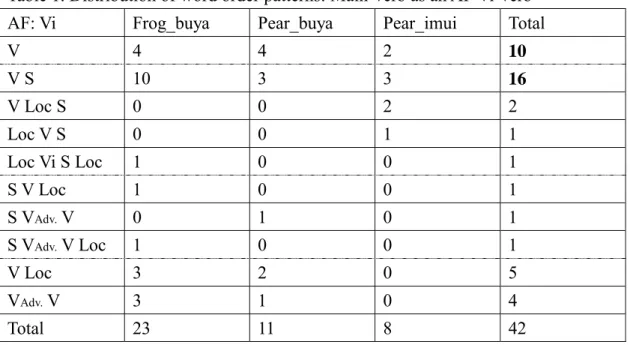
Table 1. Distribution of word order patterns: Main Verb as an AF Vi Verb AF: Vi Frog_buya Pear_buya Pear_imui Total V 4 4 2 10 V S 10 3 3 16 V Loc S 0 0 2 2 Loc V S 0 0 1 1 Loc Vi S Loc 1 0 0 1 S V Loc 1 0 0 1 S VAdv.V 0 1 0 1 S VAdv.V Loc 1 0 0 1 V Loc 3 2 0 5 VAdv.V 3 1 0 4 Total 23 11 8 42
As can been seen in Table 1, with regard to the proportion, pattern which consists of one verb and the only one argument- the SV pattern, are the most; the second is the V pattern. The whole sum of AF intransitive clauses is 42.
We have examples for each pattern as follows.
(1) AF: Vi
nakuni t-em-ibuk-ti nani. (Frog_buya: 23) how AF-fall-Pfv DM
“… and somehow it falls.”
wiya-ti, (Pear_buya_44)
leave-Pfv “..., went away.”
(2) AF: Vi S
Ramneng sunis ‘nay atu wasu-na nani. (Frog_buya: 12) wake child that and dog-3S.G DM
“The child and his dog wake up.”
t-m-ibuk-ti penay ‘nay. (Frog_buya: 45) AF-fall-Pfv bee that
(3). AF: Vi Loc S
tangi nani ..suRaw-ti ta-bataz-an na razan .. ‘nay sunis today DM fall-Pfv Loc-halfway-Loc Gen road that child a yawu.\
Link that
“Then the child stumbled halfway.” (Pear_imui: 15)
(4). AF: Loc Vi S
ta tibuR sayza s-em-aqay ‘nay kintulu ay sunis Loc south maybe AF-walk that three.human RV child a yawu. \
Link that
“Those three children came over, perhaps toward the south. “ (Pear_imiu: 27)
(5). AF: Loc Vi S Loc
ta- nani ta=zian ta=-pa-paRin-an mazmun .. muaza paRin FS DM here Loc-Red-tree-Loc FS many tree tayan nani.\
there DM
“There are lots of trees in the forest.” (Pear_imui: 32)
(6). AF: S Vi Loc
wasu ‘nay …t-em-uqaz ta-tengat-an. (Frog_buya : 22) dog that AF-go_up Loc-window-Loc
“The dog climbs up to the window”
(7). AF: S VAdv. Vi
baqi-an ‘nay pameng-ti me-nga-ngaR tya t-em-ita,/ grandfather-AN that this.way-Pfv AF-Red-slack.jawed DM AF-see “… while he slack-jawed and looked.” (Pear_buya: 70)
(8). AF: S VAdv. Vi Loc
‘nay biat ‘nay, pa=qanas-ti me-zukat ta-peRasku-an, that frog that careful-Pfv AF-go_out Loc-bottle-Loc
(9). AF: Vi Loc
me-lazyu ta-kinil-an-na,/ (Pear_buya: 14) AF-pass Loc-side-Loc-3S.Gen
“… passing him by.”
(10). AF: VAdv. Vi
pameng-ti me-nga-ngaR tya t-em-ita.\ (Pear_buya: 65) this.way-Pfv AF-Red-slack.jawed DM AF-see
“(He) slack-jawed and looked (at the children).”
1.1.2 Patterns & Distributions of AF Transitive Clauses
Table 2 below shows a result on the distribution of AF transitive clauses in Kavalan texts.
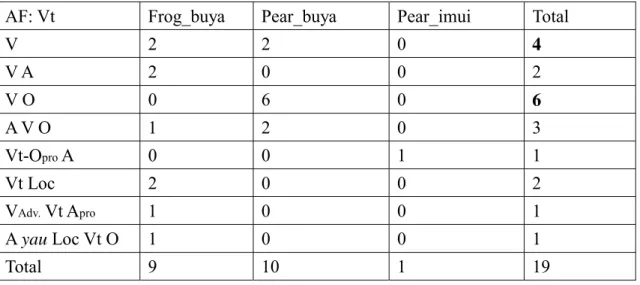
Table 2. Distribution of word order patterns: Main Verb as an AF Vt Verb AF: Vt Frog_buya Pear_buya Pear_imui Total
V 2 2 0 4 V A 2 0 0 2 V O 0 6 0 6 A V O 1 2 0 3 Vt-Opro A 0 0 1 1 Vt Loc 2 0 0 2 VAdv. Vt Apro 1 0 0 1 A yau Loc Vt O 1 0 0 1 Total 9 10 1 19
Comparing all patterns in Table 2, the VO pattern has the highest frequency and its token is 6. The V pattern which has no any one argument is in the second rank; following the V pattern is the AVO pattern.
We also list examples for each pattern below.
(11). AF: Vt
q-em-Ras...nani. \ (Frog_buya: 41)
AF-yell DM “… and calls (it).”
(12). AF: Vt A
t-em-anuz-ti turiq ‘nay sayza nani.\ (Frog_buya: 50) AF-chase -Pfv wasp that maybe DM
“… and the wasps chase (them).”
(13). AF: Vt O
q-em-usqus tu quRu.\ (Pear_buya: 71) AF-scratch Obl head
“... scratched head.”
(14). AF: A Vt O
razat ’nay k-em-awit tu sizi._ (Pear_buya: 13) person that AF-pull_along Obl goat
“… a man pulled along a goat…”
(15). AF: Vt-Opro A
qay- ..qay-byabas ’nay,_ razat ’nay nani.\ (Pear_imui: 5-6) QAY- QAY-guava that person that DM
“That person picked guavas.”
(16). AF: Vt Loc
k-em-irin tayan… nani.\ (Pear_buya: 34) AF-find there DM
“They look for the frog there.”
(17). AF: VAdv. Vt Apro
pameng-ti k-em-i-ki-kirim qanyawu, (Frog_buya: 14) no_other_choice-Pfv AF-Red-find 3Pl.Nom
“They keep looking for (the frog).”
(18). AF: A yau Loc Vt O
razat-na nani yau tayan ta- t-m-ita tu tangan nani.\ person-3Sg.Gen DM Exist there FS AF-see Obl hole DM
1.1.3 Patterns & Distributions of LF Clauses
Table 3 display the distribution of valency role orders of LF clauses in Kavalan texts.
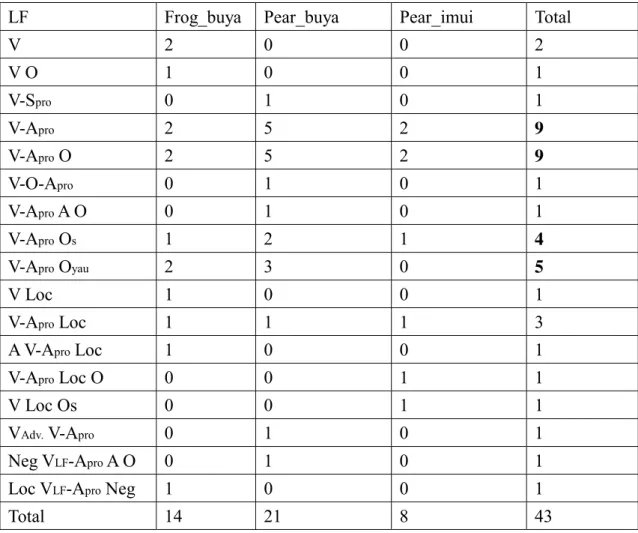
Table 3. Distribution of word order patterns: Main verb as a LF verb
LF Frog_buya Pear_buya Pear_imui Total
V 2 0 0 2 V O 1 0 0 1 V-Spro 0 1 0 1 V-Apro 2 5 2 9 V-Apro O 2 5 2 9 V-O-Apro 0 1 0 1 V-Apro A O 0 1 0 1 V-Apro Os 1 2 1 4
V-Apro Oyau 2 3 0 5
V Loc 1 0 0 1
V-Apro Loc 1 1 1 3
A V-Apro Loc 1 0 0 1
V-Apro Loc O 0 0 1 1
V Loc Os 0 0 1 1
VAdv. V-Apro 0 1 0 1
Neg VLF-Apro A O 0 1 0 1
Loc VLF-Apro Neg 1 0 0 1
Total 14 21 8 43
Based on Table 3, we found that the V-Apro pattern takes rank with the V-Apro O
one; the two patterns occur more frequently than others. The second-ranked two patterns are the V-Apro Oyau pattern and the V-Apro Os pattern; both the two patterns
have a complement as the O role or the O role in a complement respectively. The sum of LF clauses in texts is 43, which is higher than the sum of AF intransitive clause.
Following the same pattern in Sec. 2.1 and Sec. 2.2, we have examples for each Kavalan LF pattern below.
(19). LF: V
ri=zaq-an nani.\ happy-LF DM
“(The child) is happy.” (Frog_buya: 97)
(20). LF: V O
sinunu=ng-an penay ‘nay,_ (Frog_buya: 36) along-LF bee that
“(They) follow the bees.”
(21). LF: V-Spro
taliqut-an-na si-qubu-an-na-ti nani.\ (Pear_buya: 53) look_back-LF-3S.Gen SI-hat-LF-3S.Gen-Pfv DM
“He looked back and wore the hat.”
(22). V-Apro
pipi=t-an-na nani.\ (Pear_buya: 5) pluck-LF-3S.Gen DM
“(He) kept plucking.”
(23). V-Apro O
kyara-an-na-ti ... ’nay byabas a yawu,/ (Pear_imui: 7) pick_up-LF-3Sg.Gen-Pfv that guava Link that
“He picked up that guava.”
(24). V-O-Apro
taliqut-an-na si-qubu-an-na-ti nani.\ (Pear_buya: 53) look_back-LF-3S.Gen SI-hat-LF-3S.Gen-Pfv DM
“He looked back and wore the hat.”
(25). V-Apro A O
ara-an-na sunis ‘nay usiq ‘nay qanas ‘nay=,__ take-LF-3S.Gen child that one that basket that sinsuli ‘nay,/
plum that
(26). V-Apro Os
nani ala-an-na-ti usiq ‘na=y,_ (Frog_buya : 91-92) DM take-LF-3Sg.Gen-Pfv one that
iza- an-na nani ni-qulu-an-na masang o.\
that.way-3Sg.Gen DM NI-breed-AN-3Sg.Gen before DM “The child takes a frog, which seems to be the one he used to raise.”
(27). V-Apro Oyau
maseq ..<F tita-an-na F>._ arrive see-LF-3S.Gen
baqi-an ’nay yau ta babaw na paRin,/ elder_male-AN that Exist Loc above Gen tree na sinsuli nani.\
Gen plum DM
“(He) saw the old man is up on the plum tree.” (Pear_buya: 17-19)
(28). V Loc
suzit-an-ti ta libeng.\ (Frog_buya: 55) fall_backwards-LF-Pfv Loc below
“The child falls backwards.”
(29). V-Apro Loc
tuqaz-an-na-ti ‘nay z- ‘nay ..‘nay suRna nani.\ go_up-LF-3Sg.Gen-Pfv that FS that that ice DM
“And he climbs up to the ice.” (Frog_buya: 61)
(30). A V-Apro Loc
nani wasu ‘nay nani pa-susuR-an-na (Frog_buya: 17-18) DM dog that DM Cau-enter-LF-3Sg.Gen
ta= -peRasku-an quRu-na,_ Loc-bottle-Loc head-3Sg.Gen nani.\
DM
“The dog puts his head in the bottle.”
(31). V-Apro Loc O
qalisinpu-an-na-ti ta-= qaypi-an ‘nay .. ‘nay te- ‘nay gather-LF-3Sg.Gen-Pfv Loc-basket-Loc FS FS FS that
byabas a yawu nani.\ (Pear_imui: 21) guava Link that DM
“He gathered the guavas in the big basket.”
(32). V Loc Os
mu-zaqis pa-zaqis ta-= zitinsya-an.\ (Pear_imui: 11-13) AF-take(FS) Cau-take Loc- bicycle-Loc
’nay ni-kyara-an na tama-na tu byabas, that NI-pick_up-AN Gen father-3Sg.Gen Obl guava ta-bunguR-an na paRin.\
Loc-trunk-Loc Gen tree
“put the guavas picked up by his father around the trunk on the bicycle.”
(33). VAdv. V-Apro
azu-ti sa- supa- supaR-an-na.__ (Pear_buya: 20) seem-Pfv SA- FS know-AN-3S.Gen
“(It seems that he) knew him.”
(34). Neg VLF-Apro A O
mai ma tita-an-na baqi-an ‘nay sezay nani.\ Neg DM see-an-3S.Gen elder.male-AN that this_way DM
“The old man was not paying attention.” (Pear_buya: 23)
(35). Loc VLF-Apro Neg
mai ma tita-an-na baqi-an ‘nay sezay nani.\ Neg DM see-an-3S.Gen elder.male-AN that this_way DM
“The old man was not paying attention.” (Pear_buya: 23)
1.1.4 Patterns & Distributions of other Clauses
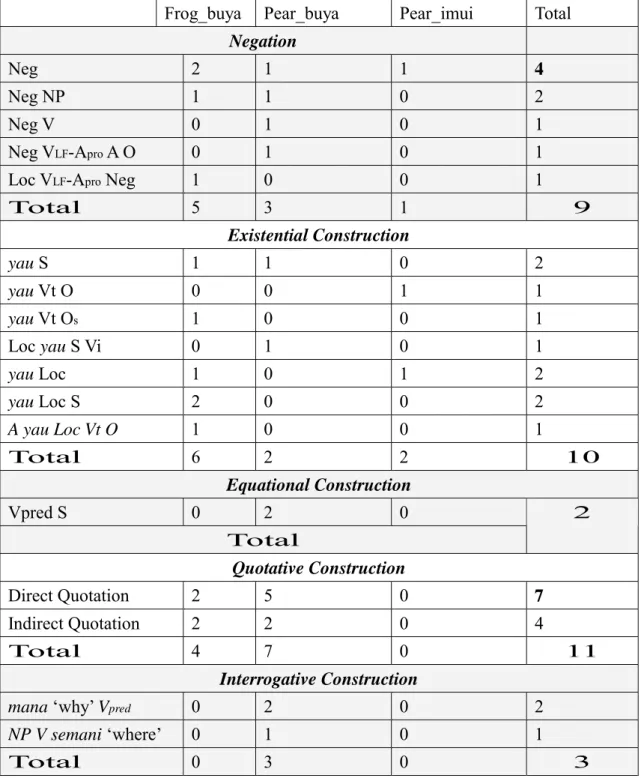
Except for the AF and LF clauses, other constructions may also display in a variety of patterns in Kavalan texts. So, this section contains the discussion on constructions including negation, existential construction, equational construction and quotative construction, and interrogative construction. Table 4 shows the patterns and distribution of these constructions. Following Table 4 are their corresponding examples.
Table 4. Distribution of word order patterns: Other Patterns
Frog_buya Pear_buya Pear_imui Total
Negation
Neg 2 1 1 4
Neg NP 1 1 0 2
Neg V 0 1 0 1
Neg VLF-Apro A O 0 1 0 1
Loc VLF-Apro Neg 1 0 0 1
Total 5 3 1 9 Existential Construction yau S 1 1 0 2 yau Vt O 0 0 1 1 yau Vt Os 1 0 0 1 Loc yau S Vi 0 1 0 1 yau Loc 1 0 1 2 yau Loc S 2 0 0 2 A yau Loc Vt O 1 0 0 1 Total 6 2 2 10 Equational Construction Vpred S 0 2 0 Total 2 Quotative Construction Direct Quotation 2 5 0 7 Indirect Quotation 2 2 0 4 Total 4 7 0 11 Interrogative Construction
mana ‘why’ Vpred 0 2 0 2
NP V semani ‘where’ 0 1 0 1
Total 0 3 0 3
(36). Negation: Neg
ma=i, nani.\ (Frog_buya: 20-21)
Neg DM
(37). Negation: Neg NP
mai-ti biat ‘nay.\ (Frog_buya: 13)
Neg-Pfv frog that “The frog has disappeared.”
(38). Negation: Neg VP
mai tu ni-imet-an,/ (Pear_buya: 64) Neg Obl NI-touch-AN
“(The children) did not touch (anything).”
(39 (=34)). Negation: Neg VLF-Apro A O
mai ma tita-an-na baqi-an ‘nay sezay nani.\ Neg DM see-an-3S.Gen elder.male-AN that this_way DM
“The old man was not paying attention.” (Pear_buya: 23)
(38 (=35)). Negation: Loc VLF-Apro Neg
tanian ki-kirim-an-na mai.\ (Frog_buya: 16) where Red-find-LF-3Sg.Gen Neg
“They cannot find it anywhere.”
(39). Exiential: yau S
yau baqi-an ‘nay usiq._ (Pear_buya: 1) Exist elder.male-AN that one
“There was an old man.”
(40). Existential: yau Vt O
yau-ti q-em-an tu byabas a yawu … (Pear_imui: 26) Exist-Pfv AF-eat Obl guava Link that
“Those three persons ate the guavas.”
(41). Existential: yau Vt Os
yau ni-qulu-an-na tu= tu biat, / (Frog _buya : 4-5) Exist NI-breed-AN-3Sg.Gen Obl Obl frog
“He keeps a frog in the bottle.”
(42). Existential: Loc yau S Vi
Raylikuz-na uman nani yau-ti sunis ’nay qa-zitinsya._ behind-3S.Gen again DM Exist-Pfv child that QA-bicycle
“A child rode a bicycle in the backside.” (Pear_buya: 17)
(43). Existential: yau Loc
yau-ti ta-paRin-an sayza na qanyawu sa=--, / (Frog_buya: 79) Exist-Pfv Loc-tree-Loc maybe Gen 3Pl.Nom FS
“Fortunately, there is a trunk.”
(44). Existential: yau Loc Ss
yau ta-kinir-an-na yau [X‘nay ‘nayX] tangan Exist Loc-side-Loc-3Sg.Gen Exist FS FS hole
‘nay nani. \ (Frog_buya:38)
that DM
“There is a hole near the beehive,…”
(45 (=18). Existential: A yau Loc Vt O
razat-na nani yau tayan ta- t-m-ita tu tangan nani.\ person-3Sg.Gen DM Exist there FS AF-see Obl hole DM
“That person sees a hole there.” (Frog_buya: 53)
(46). Quotation: Indirect Quotation
pasi yau tayan biat ‘nay zin-su nani. \ (Frog_buya: 33) likely Exist there frog that say-2Sg.Gen DM
“The frog might be there.”
(47). Quotation: Direct Quotation
t-em-uqaz-pa-iku ‘nay k-em-i-kirim zin-na nani,_ AF-go_up-Fut-1.Sg.Nom that AF-Red-find say-3Sg.Gen DM
“He said, “I will climb up to look for the frog.”” (Frog_buya: 60)
(48). Interrogative Construction: mana ‘why’ Vpred
uzusa-ti ta-qanas-an nani.\ (Pear_buya: 61-62) two.nonhuman-Pfv Loc-basket-Loc DM
..mana usiq-ti ma zin-na.\ why one-Pfv DM say-3S.Gen
(49). Interrogative Construction: NP V semani ‘where’
Utulun pasani semani._ (Pear_buya: 68) three.nonhuman toward where
“Where run (the three)?”
1.2 A comparison between transitive clauses and intransitive clauses with different focus verbs
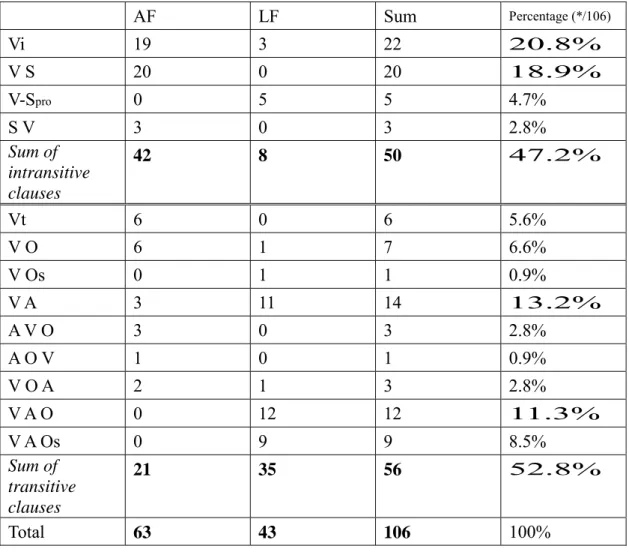
In this section, we would like to make a word-order-pattern comparison between transitive and intransitive clauses in Kavalan AF/LF constructions. The basis comes from the result from sections 1.1.1 to 1.1.3. After counting the frequency of each pattern, we get the following table which may display the distinction between transitive clauses and intransitive clauses.
Table 5. A comparison between transitive clauses and intransitive clauses
AF LF Sum Percentage (*/106) Vi 19 3 22 20.8% V S 20 0 20 18.9% V-Spro 0 5 5 4.7% S V 3 0 3 2.8% Sum of intransitive clauses 42 8 50 47.2% Vt 6 0 6 5.6% V O 6 1 7 6.6% V Os 0 1 1 0.9% V A 3 11 14 13.2% A V O 3 0 3 2.8% A O V 1 0 1 0.9% V O A 2 1 3 2.8% V A O 0 12 12 11.3% V A Os 0 9 9 8.5% Sum of transitive clauses 21 35 56 52.8% Total 63 43 106 100%
As shown in Table 5, the sum (52.8%) of transitive clauses is higher than that (47.2%) of intransitive clauses; however, the distinction isn’t significant.
Compare all patterns, the Vi pattern occurs most frequently (with the percentage of 20.8%) and following the Vi pattern is the VS pattern (18.9%); the third one is the VA pattern (13.2%). So, taking the second-ranked and third-ranked patterns into consideration, we can find that the language tends to take the S or A role, i.e., the agent, as its only one argument; that is, the construction that consists of a main verb and an agent is preferable (18.9%+13.2%= 32.1%) in Kavalan. If the clause contains two participants, the VAO pattern is the best candidate; the percentage of the VAO pattern stands at 11.3%.
1.3 Summary
This chapter examined the word order in Kavalan. We had concluded all patterns of word order in different constructions, including AF, LF, negation, existential construction, equational construction and quotative construction, and interrogative construction and gave each pattern one example.
We have also compared transitive clauses to intransitive clauses. We found that the frequency between the two ones is similar; besides, the Vi pattern occurred most frequently. Also, if adding one argument into a clause, the best candidate must be the agent; thus, if adding another one into a clause, the word order tended to be a VAO type. In sum, Kavalan is a predicate-initial language with predicate-argument order.
This study is a short result based on three texts, lasting for no more than 10 minutes. The whole observation on word order in Kavalan is believed to be not displayed. We would like to trace the issue by means of further study.
Chapter Two
Noun Phrases
2.0 Introduction
In this preliminary chapter we will discuss the basic construction of Kavalan noun phrases, nominalization, relativization, numerals, and kinship terms. Based on limited data, we will construct a tentative basic word order of noun phrases in Kavalan, which will be covered in section 1 of this chapter. Section 2 will touch on nominalization. Nominalization involves many issues; in this section, we will first look at how the language forms lexical items for novel concepts. In section 3, where we discuss relativization, we find that the relativizer ay in Kavalan appears directly after the verb in Agent-focus relative clauses; in non-agent relative clauses, the relativizer ay attaches after the clause consisting of the verb and the Agent/genitive phrase. In Section 4, we provide a preliminary account of the numeral system in Kavalan. Section 5 deals with kinship terms; we will show that kinship terms can be categorized into two groups: one indicating genealogical relation and the other one indicating relationship acquired through marriage, and both groups can be further functionally classified into terms for addressing and terms for indicating relationship.
This preliminary report will by no means exhaust all the issues on Kavalan noun phrases. In future reports, we hope to include more topics for discussion. For example, we will try to construct a more comprehensive schema of noun phrases in Kavalan that would include case markers, numerals, demonstratives, and so on. We will also augment the section on the counting system and numerals in Kavalan. Moreover, a more in-depth inquiry into nominalization and relativization in Kavalan will also be conducted.
2.1 Basic Construction of Kavalan NP
Simple noun phrases in Kavalan are usually composed of a head noun and a demonstrative usually following it. The demonstrative ’nay can appear even in newly-mentioned referents in a discourse, as in (1), and may be sometimes employed as a pause filler, as in (2).
(1) Pear Buya 1
yau baqi-an ‘nay usiq._ Exist elder.male-AN that one ‘There was an old man.’
(2) Pear Buya 24-25
24. … (0.5) ara-an-na sunis ‘nay usiq ‘nay qanas ‘nay=.__ take-PF-3S.Gen child that one that basket that 25. …(0.88) sinsuli ‘nay,/
plum that ‘The child took a basket of plums.’
Word order seems to be flexible in noun phrases with one or two modifiers, especially when one of them is the demonstrative ‘nay. For example,
(3)
usiq betu ‘nay ‘(that/a) (one) stone’
usiq betu / betu usiq / ‘nay betu / betu ‘nay
However, when the noun phrase involves two adjective modifiers, word order is restricted. For example,’
(4) usiq Raya-ay betu ‘one big stone’
But, usiq betu Raya-ay ‘(there is) one stone (that is) big’ ?Raya-ay betu usiq ‘(a) big stone there is one’
head noun. For example,
(5) kintulu Raya-ay sunis ‘three big children’ But, *Raya kintulu-ay sunis ‘big three children’
Raya-ti kintulu-ay sunis ‘the three children have grown’
As in (5), modifiers are more integrated to the head noun than numerals. If they are positioned preceding the numerals referring to the head noun, then the modifiers become predicates. Although the modifiers usually precede the head noun, they can also follow the head noun in spontaneous speech, as in (6):
(6) Frog Buya 54
54. …me-zukat qaya ‘nay.. alam Raya nani. \
AF-go.out also that bird big DM ‘The big bird flew out too.’
Based on limited data, a tentative word order of noun phrases can be made:
(7) Numeral-Attribute-head noun-Demonstrative
Noun phrase connectors in Kavalan may include atu ‘and’ and u ‘or,’ as in (8) and (9), respectively. There is also a ligature a, which usually appears between a head noun and a demonstrative (usually yawu), as in (9).
(8) Frog Buya 1-2
1. ..ma=sang nani yau usiq sunis ‘nay,_ before DM Exist one child that 2. …(1.7) atu wasu-na, /
and dog-3Sg.Gen
(9) Pear Imui 2-4
2. …qay-byabas ay razat a yawu ta- .. ta-iza-an u.\ QAY-guava Rel person Lig that ta- Loc-somewhere-Loc or
3. ... ta-= pa- FS FS
4. ... ta-bunguR-an na na= byabas a yawu,_ Loc-trunk-Loc na Gen guava Lig that ‘that person picking guavas there or around that guava tree’
2.2 Nominalization
There are various Noun-formation strategies in Kavalan, One is through morpho-syntactic means, namely, reduplication. The first syllable is usually reduplicated to form a noun that is plural in meaning. For example, ta-pa-paRin-an ‘place of many trees’ > ‘forest’; ta-zan-zanum-an ‘place with much water’ > ‘pond/river/sea’; and na-nawung ‘mountains.
Moreover, non-traditional concepts and objects that are the result of modern technology and civilization are most usually expressed in Kavalan through a number of ways: categorization and the use of traditional terms; grammatical means, which includes relativization; and the use of loan words from Japanese and from Chinese.
a. Categorization and the use of traditional terms
If a novel object can be categorized as belonging to a certaingroup then the super-ordinate term is used for naming the item. For example, anything that resembles a pair of shoes may be called zupu; anything that is worn on the body is kulus.
Traditional terms are also used in naming novel concepts. In ancient times, the Kavalan people call their tribal leaders oRoq ‘head’ or tama ‘father.’ As the democratic way of government is introduced into their system, all the leaders at
any level, e.g., of a county or village, are named oRo na damu or tama na damu. Another example has to do with dental hygiene. Before the introduction of the toothbrush, the people used sand to brush their teeth, which they termed
sakoRowan tu bangRaw, the action of which is now used to refer to the action
of brushing the teeth with a modern toothbrush.
b. Grammatical means
One way of forming nouns is to employ the nominalizer –an (10) or the locative ta-V/N-an. A modifier (in the form of a genitive NP) is often added (11) to distinguish the referents of a novel noun phrase by the object that the nominalized verb takes. For example, sepaw-an is a place for putting (things). Either na kaytun ‘of cars’ or na hikoki ‘of airplanes’ is added to distinguish a ‘parking lot’ from an ‘airplane port/hangar.’ Moreover, some concepts can only be expressed by using verbal phrases, such as in (12).
(10) Nominalizer –an
taksi-an ‘place for studying’ > ‘school’
pa-kiskis-an ‘place for (having hair) trimmed’ > ‘barber shop/beauty parlor’ ta-ising-an ‘at the doctor’s place’ > ‘hospital/clinic’
(11) Nominalizer –an with a modifier
sepaw-an na kaytun ‘place for putting cars’ > ‘parking place’ teqez-an na kaytun/jitinsia ‘place for stopping cars/bicycles’
> ‘parking place for cars/bicycles’
pa-kurut-an tu bokes ‘place for curling hair’ > ‘beauty salon’
saseniz-an na hikoki = saseniz-an-ay tu hikoki ‘place for descending planes’
> ‘airport’
kulus na pataksi’an ‘clothes worn for studying’ > ‘school uniform’
mahong-ay tusongan na kulus ‘long sleeves of clothes’ > ‘long-sleeved
(12) verbal phrases
see a doctor/dentist/ophthalmologist
matiw sa isin (pa-kita’ tu bangRaw/mata)
Sometimes, relativization, through the use of the relativizer ay, is used instead of genitive phrases, as in (13):
(13) relativization
si-kuvu-ay razat ‘person wearing a hat’ > ‘policeman’ temanbaseR-ay putit ‘flying object’ > ‘airplane’
pa-kiskis-an-ay tu bokes (razat) ‘(person) trimming hair’ > ‘barber’
saseniz-an na hikoki = saseniz-an-ay tu hikoki ‘place for descending planes’
> ‘airport’
c. Use of loan words
Loan words are abundant in Kavalan, especially lexical words borrowed from Japanese and Chinese, particularly Taiwanese. Some Japanese loan words include hikoki ‘airplane’; ripoyin ‘legislator’; terebi ‘television’; zitinsya ‘bicycle’; and shinbun ‘newspaper.’ Chinese (Taiwanese loan words) include
taizin ‘policeman’; sabon ‘soap’; jiazhao-su ‘your driver’s license’; shenfenzheng-ku ‘my identification card’; taksi ‘study’; and zongtong
‘president.’
Morphemes in Kavalan nominalization
In forming nouns that refer to ‘people who V,’ certain Formosan and Philippine Austronesian languages distinguish between people who V as a profession/habit (by the use of a special marker), and people who V at a given time (by nominalization of regular focus markers by employing the case markers), as in English thief and one
who steals something, respectively. Kavalan seems to make use of the morpheme qay.
(14)
Tagalog: mag-na-nakaw person.who-Red-steal > ‘thief’ Kavalan: qay-Ruziq-ay (Razat) ‘do-steal’ > ‘thief’
2.3 Relativization
Relativization in Kavalan is marked by the relativizer ay in AF clauses, as in (15). In (16), the relativizer ay is covert because the head is zero. If the head is mentioned, the relativizer ay would attach behind the verb in the relative clause and come before the object taken by the verb, if any, as in (17).
(15) Pear Imui 2
[qay-byabas [GAP]] ay razat a yawu ta- .. ta-iza-an u.\
QAY-guava [Nom] Rel person Lig that ta- Loc-there-Loc or ‘that person who is picking guavas there’
(16) Pear Imui 26
26. … yau-ti [q-em-an [GAP] tu byabas] ø a yawu
Exist-Pfv AF-eat [Nom] Acc guava Link that ‘Those (three boys) eating the guavas.’
(17)
yau-ti [q-em-an ay *(tu) byabas] sunis a yawu
In non-Agent focus relative clauses, as in (18) and (19), the relative clause is directly expressed through a non-agent focus verb affixed with Aspect markers (ni- which is Perfective, in both examples) and followed by the cliticized genitive pronoun. The constituent composed of the verb and the Genitive phrase, which is also a possessive noun phrase, is followed by the object marked by tu or the relativizer ay.
(18) Pear Buya 9-10
9. .. uzusa pungiR-ti ni-izan-an-na nani.\ two.nonhuman fill-Pfv Past-load-AN-3S.Gen DM
10. …(1.10) [ni-pipit-an-na [GAP]] tu/ay sinsuli,/ Past-pluck-AN-3S.Gen [Nom] Acc/Rel plum
‘Two (of the three baskets) were filled (with) the plums that he had plucked.’
(19) Pear Imui 11-13
11. ... mu-zaqis pa-zaqis ta- zitinsya-an.\ AF-take.(FS) Cau-take Loc- bicycle-Loc
12. ...’nay [ni-kyara-an na tama-na [GAP]] tu/ay byabas,_ that Past-pick-AN Gen father-3Sg.Gen [Nom] Acc/Rel guava 13. ..ta-bunguR-an na paRin.\
Loc-trunk-Loc Gen tree
‘(He) put the guavas that were picked by his father around the trunk on the bicycle.’
2.4 Numerals
In this section we will discuss the Kavalan numeral system. By observing expressions of counting, the principles listed in (20) are found to represent the operation of the numeral system in Kavalan. The counting form of Saisiyat is decimal, and its numeral expressions are combinations of numbers receiving lexical representation by addition. From ten onwards, the tens digit is expressed by the combination of a number and the lexical representation of ten.
(20) generating rules for numbers in Kavalan
a) below 10: terms with lexical representation b) from 10 to 99:
X yau a)
X: lexical term consisting of a lexical representation of a numeral and the lexical representation of ten (betin)
c) from 100 to 999: Y yau b)
Y: lexical term consisting of a lexical representation of a numeral and the lexical representation of one hundred (Rasibu)
d) from 1000 to 9999 Y yau c)
Y: lexical term consisting of a lexical representation of a numeral and the lexical representation of one thousand (mararazan)
e) 10,000 on wards Y yau d)
Y: lexical term consisting of a lexical representation of a numeral and the lexical representation of ten thousand (banan)
Numerals more than ten require a conjunctor yau between two lexical items; the order followed in a complex numeral expression is: the larger numeral precedes the smaller numeral. The lexical representation for the number 9,999 would be usiwa
mararazan yau usiwa’ kasibu yau usiwa betin yao usiwa. Table 1 below lists the
numeral expressions in Kavalan.
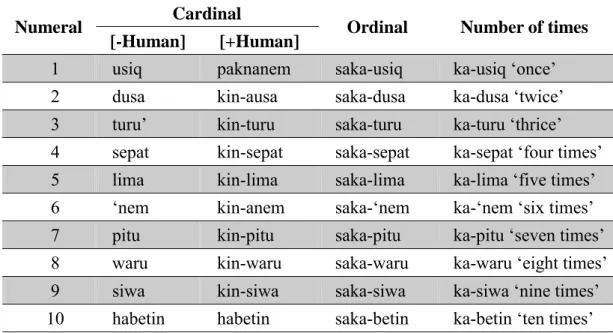
Table 1. Numeral expressions in Kavalan Cardinal
Numeral
[-Human] [+Human] Ordinal Number of times 1 usiq paknanem saka-usiq ka-usiq ‘once’
2 dusa kin-ausa saka-dusa ka-dusa ‘twice’ 3 turu’ kin-turu saka-turu ka-turu ‘thrice’ 4 sepat kin-sepat saka-sepat ka-sepat ‘four times’ 5 lima kin-lima saka-lima ka-lima ‘five times’ 6 ‘nem kin-anem saka-‘nem ka-‘nem ‘six times’ 7 pitu kin-pitu saka-pitu ka-pitu ‘seven times’ 8 waru kin-waru saka-waru ka-waru ‘eight times’ 9 siwa kin-siwa saka-siwa ka-siwa ‘nine times’ 10 habetin habetin saka-betin ka-betin ‘ten times’
In counting objects [-Human] the cardinal system, as in the second column in Table 1, is used. There is a separate system for counting persons from one to nine, as in the third column in Table 1. Numeral expressions can be used as verbs.
(21) Numerals as verbs
saka-dusa-ti q-em-an aizipna Ord-two-Pfv eat-AF 3S
‘He has eaten his second (serving).’ (Elicited)
ka-dusa-ti q-em-an aizipna times-two-Pfv eat-AF 3S
‘He has eaten twice.’ (Elicited)
2.5 Kinship terms
Kinship terms in Kavalan are basically nominal kind terms. The terms indicating genealogical relation and those indicating relations through marriage are basically the same. Moreover, there is no difference between terms for addressing and terms indicating relationship.
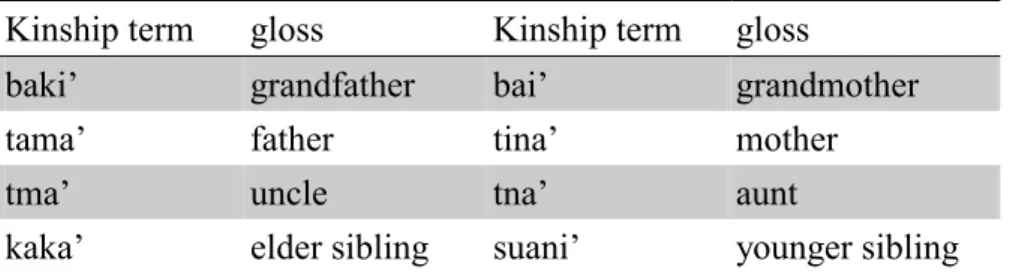
Kinship terms indicating genealogical relationship refer to terms used in one group of people who are related to each other by blood. Terms for addressing are how members in the same blood group address each other. These terms for addressing are often extended to second- and third- degree relations, and even to familiar persons in the community and to strangers. Although people living in the same community can identify each other’s complicated relations, e.g., ‘sister of wife’s uncle’s mother-in-law,’ it is interesting to note that they have not developed expressions to refer to such complicated relationships. Addressing terms are usually binary, and these are shown in Table 2.
Table 2. Addressing terms in Kavalan
Kinship term gloss Kinship term gloss
baki’ grandfather bai’ grandmother tama’ father tina’ mother
tma’ uncle tna’ aunt
kaka’ elder sibling suani’ younger sibling
The terms in Table 2 can basically function both to address and to indicate specific relationship between members in one genealogical group. These can
oftentimes be extended to distant relations as well as to addressing strangers on the street. Similar to Saisiyat, there is no extra lexical item in current use coding ‘parent’ as the lexical item in English. However, an old person’s terms for addressing one’s grandchildren are the same as how they are addressed by these grandchildren. That is, grandsons are addressed baki’ while granddaughters are bai’. There is no specific lexical item indicating ‘son’, ‘daughter’, ‘grandchildren;’ in actual use, the addressing form is the individual’s name.
The only kinship term indicating relationship acquired through marriage is kdavu, which indicates as well as is used for addressing ‘sons-/daughters-in-law.’ Other relationships and terms of address follow the basic pattern in Table 2. Therefore there is basically no difference in the term and form of address between blood relations and relationship acquired through marriage. Again, the same forms of address are used to address people not related at all to the address-er.
2.6 Summary
In this chapter we have discussed the basic construction of Kavalan noun phrases, nominalization, relativization, and kinship terms. We constructed a tentative basic word order of noun phrases in Kavalan based on limited data. We also looked at how the language forms lexical items for novel concepts. In the section discussing relativization, we found that the relativizer ay in Kavalan appears directly after the verb in Agent-focus relative clauses; in non-agent relative clauses, the relativizer ay attaches after the clause consisting of the verb and the Agent/genitive phrase. As for kinship terms, they can be categorized into two groups: one indicating genealogical relation and the other one indicating relationship acquired through marriage, and both groups can be further functionally classified into terms for addressing and terms for indicating relationship. The addressing terms in both groups can also function to
denote the relation between people, but terms indicating relationship do not function to address people.
This study has by no means exhausted the issues on Kavalan noun phrases to be investigated and discussed. There are more topics that need to be addressed; for example, we still have to construct a more comprehensive schema of noun phrases in Kavalan that would include case markers, numerals, demonstratives, and so on. We will also have to investigate the counting system and numerals in Kavalan. Moreover, a more in-depth study into nominalization and relativization in Kavalan has to be conducted.
Chapter Three
Case Marking System
3.0. Introduction
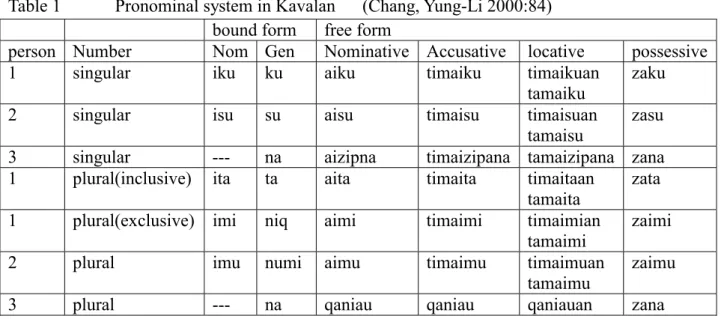
According to previous studies (cf. Li 1978; Lee 1997; Chang 1997, 2000), the case marking system for the Kavalan nominals are Nominative, Accusative, Genitive, and Locative case, of which each can be divided into common nouns and proper and personal names, as shown in Table 1.
In Kavalan, tu often marks the ‘Patient’ of a dyadic clause (in the AF or the so-called m- clause). Tu has been analyzed as an accusative case marker (Li 1978; A. Lee 1997; Hsin 1996; Y. L. Chang 1997, 2000), or as an oblique marker (Li 1996; Liao 2002, 2004). A crucial presupposition underlying the debate is: are actor-focus (or actor-voice) clauses in Kavalan transitive or intransitive? And the extended question is: is Kavalan an ergative, accusative, or split ergative language typologically?1
Based on Dixon and Aikhenvald’s (2000) theory on verb valency and transitivity and Hopper and Thompson’s (1980) study on the Transitivity in Grammar and Discourse, Liao interprets tu as an oblique marker and nicely classifies Kavalan as a purely ergative language.
The main arguments she holds are (1) the distribution of the marker tu is varied and (2) the tu marked arguments tend to be indefinite and thus better be analyzed as a non-core argument; thus, the marker tu better be analyzed as an oblique marker. The result may be true though; she did not provide any statistic evidence to support the argument (i.e. she did not say to what degree that the tu marked argument tends to be
1 It is believed that there are three levels of ergativity: morphological, syntactical, and discoursal;
therefore, when talking about ergativity, we have to specify which level we are in. Though she does not specify which level is her main concern, Liao (2002, 2004) seems to restrict her discussion on the syntactic ergativity of Kavalan.
indefinite). Besides, unlike English and Eskimo data Liao provides, as repeated in (1) and (2), there is no morphosyntactic evidence to identify the tu marked argument in Kavalan is an extended (non-core) argument, as in (3)-(6):
(1) English (data from Dixon & Aikhenvald (2000:3) 1a. dyadic transitive with a direct object theme O Harry kicked the ball
Agent Object
1b. dyadic intransitive with an oblique theme E Harry kicked at the ball
Agent Extension
(2) Central Arctic Eskimo (data from Manning 1996:15) 2a. antipassive clause with an indefinite theme Jaani tuktumik takuvuq Janni.NOM caribou.MOD see.IND.INTR.?3S “Janni sees a caribou.”
2b. canonical transitive with a definite theme Janniup tuktu takuvaa
Janni.ERG caribou.NOM see.IND.TR.?3S.?3S “Janni sees the caribou.”
Besides, she is so ready to reach to the conclusion that tu is an oblique marker that she neglects and oversimplifies the behavior of the marker tu. The main problem in her argument is that it is not un-often to find tu marked arguments to be definite, as shown in (3) to (6).
(3) (Kav, 040414_imui, 66)
t-em-ita=iku tu razat ‘nay AF-see=1Sg.Nom TU person that “I saw that person.”
(4) (Kav, 040519_imui, 12)
m-abuth tu sunis ‘nay aizipna AF-fight TU child that 3Sg.Nom
(5) (Kav, 040519_imui, 77)
m-ara=iku tu taqan a zau AF-take=1Sg.Nom TU table Lin this “I took this table.”
(6) (Kav, 040519_abas, 75)
m-etung ci-abas tu sunis-na AF-kill Ncm-ABAS TU child-3Sg.Gen
“Abas killed her child”
One the one hand, she lacks of the morpho-syntactic evidence; on the other hand, she does not tell us the percentage of the definiteness of the tu marked argument in her texts. Even if she did, the problem still remains: to what degree of the definiteness of the tu marked argument can the marker tu be claimed to be an oblique marker? Therefore, we can see that the challenge confronted Liao in her analysis is hardly surmountable.
The main purpose of this paper is thus twofold: (1) to provide another perspective to look at some important issues neglected by Liao (2002, 2004) concerning the marker tu in Kavalan, and (2) to give a uniform account to explain the distribution and functions of Kavalan tu. This paper is organized as follows. Section 2 first gives a brief sketch of the case marking system on nominals and personal pronominals in Kavalan, and then, reviews previous studies, with a particular focus laid in Liao (2002; 2004), on the analysis of Kavalan tu. Section 3 gives a detailed account of the distribution and the functions of the marker tu with an attempt to provide a uniform framework to explain Kavalan tu. Some concluding remarks and questions for further study are given in Section 4.
3.1 Previous Studies on Kavalan tu
3.1.1 A Brief Sketch of the Case Marking System in Kavalan
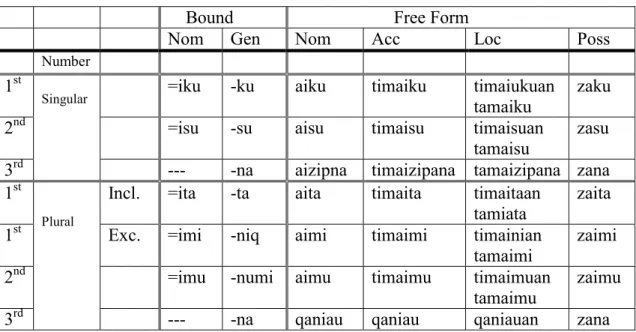
Oblique), Genitive, and Locative, as shown in Table 1, with a corresponding marking system on personal pronouns, as shown in Table 2. Personal pronouns are mainly of two forms: bound forms (analyzed as clitic pronouns by some linguists) and free forms.
Table 1 The Case Marking System in Kavalan (cf. Chang 2000:68)
Nominative Accusative/Oblique Genitive Locative
Common noun ya/a tu na ta…an
(in/on/at) sa- (to) maq- (from) Personal Name &
Proper Name
ya/a tu ni …an
Table 2 The Personal Pronominal System in Kavalan (cf. Chang 2000:84) Bound Free Form
Nom Gen Nom Acc Loc Poss
Number
1st =iku -ku aiku timaiku timaiukuan
tamaiku
zaku
2nd =isu -su aisu timaisu timaisuan
tamaisu
zasu 3rd
Singular
--- -na aizipna timaizipana tamaizipana zana 1st Incl. =ita -ta aita timaita timaitaan
tamiata zaita 1st Exc. =imi -niq aimi timaimi timainian
tamaimi zaimi
2nd =imu -numi aimu timaimu timaimuan
tamaimu zaimu 3rd
Plural
--- -na qaniau qaniau qaniauan zana
3.1.2 Previous Studies on Kavalan tu
The tu marked argument in Kavalan has long been a source of puzzlement and thus a hot debate among Formosanists. Generally speaking, there are three proposals concerning Kavalan transitivity and actancy: a passive analysis (Li 1978; Hsin 1996), a split ergative analysis (Lee 1997; Chang 1997, 2000; Chang & Tsai 2001), and an
ergative analysis (Li 1996; Liao 2002, 2004). The debate is decided on the grammatical status of the marker tu. Passive analysis treats the tu marked argument in the AF constructions as an accusative object of an active transitive construction but the genitive marked argument in the NAF constructions as a demoted agent. Split analysis treats the tu marked argument in the AF construction as an accusative object, and the genitive-marked argument as an agent of the other type of transitive construction.2 The ergative analysis treats the tu marked argument in the AF constructions an oblique (non-core, or extended core) argument and the genitive marked argument as an agent of a canonical transitive construction.
By employing Dixon and Aikhenvald’s (2000) Basic Linguistic Theory and Hopper and Thompson’s (1980) theory outlined in Transitivity in Grammar and Discourse, Liao analyzes Kavalan tu as an oblique case marker. Therefore, the transitivity of the AF clauses (or m- clauses) is closely related to the ergativity of the language. Yet, as pointed out by Ross (2002), ‘transitive’ has come to be used in at least two different senses: one semantic, the other morphosyntactic. Semantic transitivity derives from the work of Hopper and Thompson (1980) and consists of features of the clause which includes agentivity, perfective aspect, and individuation of the ‘Patient’. ‘Individuation’ includes, among other things, specificity (definiteness).
Inspired by Chang’s (2000:68-9) observation that the tu marked argument tends to be indefinite, repeated here as (7), Liao pursues the line and claims that the tu marked argument is usually indefinite.
2 This is what Ross (2002:24) called the Symmetrical-Voice Hypothesis: both AF and NAF clauses are
(7) (data from Chang 2000: 68-69)
a. q-em-al tu rasung ya sunis AF-dig TU well Nom child “The child is digging a well.”
b. qal-an na sunis ya rasung dig-PF Gen child Nom well “The/a child dug the well.”3
She argues that since the tu marked ‘Patient’ is usually indefinite, the clause is of low transitivity according to Hopper and Thompson’s (1980) semantic criterion of ‘Nonindividuation’ (indefinite); and since it is of low transitivity, it is a non-core argument, and thus, tu is an oblique marker. As a matter of fact, as we mention previously, even though the tu marked argument tends to be indefinite4, there is no substantial evidence, both morphological and syntactic, to support that the marker tu is grammaticized as an indefinite marker. Concerning this, Liao also admits that the determination of definiteness of Kavalan noun phrases is based on discourse cues. (Liao 2002: 150, footnote 16)
Though she gives quite a few examples to illustrate the fact that tu can mark an indefinite or a nonindividuated theme of a dyadic (or triadic) clause (cf. Liao 2002: 150-1, examples 17-22), she does not give any statistics to show the overall percentage of the indefiniteness of the tu marked ‘Patient’. As we may see in (8)–(10), counterexamples are as many as (perhaps outnumber) the examples Liao provides.
3 It is very interesting to note that Liao glosses the genitive marked argument with ‘the/a’, which
obviously is against her own argument that genitive marked agent is a core argument, since it is not usually definite. (cf. Liao 2002: 149, example 15)
4
The definiteness of the TU marked argument in our narrative texts (four Pear stories and four Frog stories) is as follows:
definite 57 (64.77%) indefinite 31 (35.33%)
(8) (Kav, 040517_abas, 13)
m-uRing=ti sunis a yau tu tina-na
AF-cry=Pfv child Lin Exist TU mother-3Sg.Gen “The child cries for his mother.”5
(9) (Kav, 040519_abas, 75)
m-etung ci-abas tu sunis-na AF-kill Ncm-ABAS TU child-3Sg.Gen “Abas killed her child.”
(10) (Kav, Frog_imui2)
12... wiya-ti qanyawu q-em-eRas tu ... biat a yawu atu=,_ leave-Pfv 3Pl.Nom AF-yell Acc frog Lin that and 13... wasu a yawu nani, /
dog Link that DM
“They went to call that frog, and so did the dog. Then,..”
Furthermore, as pointed out by Ross, crosslinguistically, trivalent verbs usually have three core arguments, as in I gave the man the apple, or two core and one oblique, as in I gave the apple to the man. Ross contends that he is “not aware of languages that have trivalent verbs with one core and two oblique arguments”. (Ross 2002:30) Therefore, the following Kavalan trivalent clause might have been at odds should the tu marked arguments be both oblique.
(11) (Kav, 040519_imui, 44)
t-um-ungaw=iku tu mian tu sunis ‘nay AF-deliver=1Sg.Nom TU salt TU child that “I delivered salt to that child/those children.”
At last, in both Liao (2002) and Liao (2004), she does not touch upon the corresponding personal pronominal arguments at all. Please note the following pair:
5 Please note that, like most Formosan languages, the case marking system on both nominals and
pronominals in Kavalan does not provide such information as definiteness, gender, and number. Only Atayal (cf. L. Huang 1995), Tsou (cf. S. Huang, and L. Sung 1999; Zaitoun 2000), and Puyuma (cf. L. Huang 2000) specify the definiteness of the case marked nominals and pronominals.
(12) a. (Kav, 040519_abas, 75)
m-etung ci-abas tu sunis-na
AF-kill Ncm-ABAS TU child-3Sg.Gen “Abas killed her child(ren).”
b. (Kav, 040519_abas, 76)
m-etung ci-abas timaisu/timaisuan AF-kill Ncm-ABAS 2Sg.Acc/2Sg.Loc “Abas killed you.”
(13)
a. (Kav, 040519_imui, 12)
m-abuth tu sunis ‘nay aizipna AF-fight TU child that 3Sg.Nom “He is fighting with that child/those children.” b. (Kav, 040519_imui, 13)
m-abuth timaizipana ya sunis ‘nay AF-fight 3Sg.Acc Nom child that “That child is fighting with him/her.”
If the tu marked argument were treated as oblique and the AF clauses (m- clauses) intransitive, we could not explain the occurrence of the accusative personal pronominals in the AF construction, as in (12)b and (13)b.
I have no objection in labeling Kavalan tu as an ‘Oblique’ marker should these questions thus aroused receive justified accounts.
3.2 Reinterpretation of Kavalan TU
In both Liao (2002) and Liao (2004), Liao just lists out the functions and the examples of each distribution of the marker tu without providing any account to explain the interrelationship among these various functions (distributions). Putting all the distribution of a marker together without further delineating and explaining the interrelations and, thus, stating that this is an oblique may obscure the real linguistic phenomenon.
distributions (functions), as discussed in Comrie (1991) and Blake (2001); perhaps the most widely known is the Dative.6 With a limited set of case markers to encode the thematic roles that are varied in type and in amount, it is quite often to observe several distributions (functions) are syncretized in a single formal case crosslinguistically. Therefore, what concerns us here is to delineate the intriguing relations among the various distribution and functions. As pointed out by Comrie, “[w]here a number of distributional cases merge into a single formal case, this implies that these distributional cases have some property in common.” (Comrie 1991:47) In other words, distributional cases can be split into features, so that a given pair of distributional cases may have some features in common.
In Liao (2002:150ff; 2004:232ff) she gives a list of the various distributions of Kavalan tu, as summarized below:
(a) Tu marks an indefiite theme of a dyadic m- or –um- clause
(b) Tu can mark a location noun (a place name or a common location noun) (c) Tu can mark an (inanimate) actor of a dyadic –an clause
(d) Tu can mark a temporal phrase (e) Tu can mark an instrumental noun (f) Tu marks a comitative NP
(g) Tu can mark an (inanimate) possessor
Among these functions identified by Liao, our texts shows that (c) and (g) are not acceptable. When the agent is an inanimate actor (very often, an instrument) in the PF clauses (or –an clauses), the genitive case marker, na, is preferred, as in (14) and (15).
(14) (Kav, 040519_imui, 74)
tnuqiq-an-na na bul ya punuz-ku pierce-PF-3Sg.Gen Gen bamboo.stick Nom buttock-1Sg.Gen “The bamboo stick pierced my buttock.”
6 Please see the discussions in the two volumes of The Dative, eds. by William Van Belle and Willy
(15) (Kav, 040519_abas, 91)
tnuqiq *tu / na bul ya punuz AF-pierce *TU / Gen bamboo.stick Nom buttock “A bamboo stick pierced (his) buttock.”
As to the function (g), it is almost not found in our texts; our texts show that, as in (16), Kavalan speakers usually use genitive marker, na, to mark inanimate possessor.
(16) (Kav, Frog_imui)
72....(1.1) yau qu a yawu ta babaw na paRing nani.\ Exist owl Lin that Loc above Gen tree DM “There was an owl on the tree.”
73...me-Retut=ti sunis a yawu suzitan,_ AF-scared-Pfv child Lin that fall.backward “The child was frightened and fell backwards.”
74..si-quling-ti sunis ‘nay nayzi ta= babaw na paRing SI-roll-Pfv child that from Loc above Gen tree “The child rolled down from the tree.”
Moreover, the function (f), comitative reading, is derived from the semantic-pragmatic cues (and the translations), rather than from the morpho-syntactic information, as in (17)-(20).
(17) (Kav, 040519_imui, 66)
m-asawa=imi tu ‘laq AF-at.war=1Pl.Nom TU other “We are at war with others.”
(18) (Kav, 040519_imui, 16)
m-atapun timaizipana ya sunis ‘nay AF-together 3Sg.Acc Nom child that “That child is together with him.”
(19) (Kav, 040407_buya, 52)
me-pukun=iku tu wasu AF-hit=1Sg.Nom TU dog “I hit a/the dog.”
(20) (Kav, 040407_buya, 57) me-pukun=iku ci-abas-an AF-hit=1Sg.Nom Ncm-ABAS-Loc
“I hit Abas.”
In addition to the distribution identified in Liao (2002; 2004), we have found other functions of Kavalan tu in our texts: as a complementizer and as a discourse marker. Therefore, we may summarize the distributions of the marker tu in our texts below:
a. tu marks the Patient in the AF clauses (m- clauses)
b. tu marks the Recipient or Theme in the PF clauses (-an clauses) c. tu marks the location
d. tu marks the temporal e. tu as a complementizer f. tu as a discourse marker
Although Liao uses Chang’s observation on the indefiniteness of the tu marked argument, she totally ignores Chang’s another important argument that the tu marked argument can never be oblique.
As noted in William (1980), oblique arguments cannot serve as obligatory controller:
(21) English (data from Chang 1997:89) a. Johni promised Mary [PROi to leave].
b. *Mary was promised by Johni [PROi to leave].
c. Johni struck Mary [PROi as pompous].
d. *Mary was struck by Johni [PROi as pompous].
Chang points out that the matrix verb in (22) is marked with AF affix and the direct object of the matrix verb, i.e. ‘that child’, is required to control the reference of the missing subjects (labeled as PRO) in the complement clauses. This suggests that ‘that child’ must remain a direct argument of the matrix verb rather than demoted to an oblique phrase. (Chang 1997:89)
(22) (data from Chang 1997: 89)
a. pawRat tama tu sunis ‘nay [___ q-em-an tu baut] force-AF father Acc child thati PROi eat-AF Acc fish
“Father forced that child to eat fish.”
b. p-um-upup tina-na tu sunis ‘nay [___ m-atiw sa bakung] persuade-AF mother-3Sg.Gen Acc child thati PROi AF-go SA Bakung
“That child’s mother persuaded him to go to Bakung.”
Furthermore, what catches our attention is the syntactic behavior of the corresponding personal pronominals and personal names, as in (23)-(28). When the personal name or personal pronoun is substituted for the tu marked nominal, it can take either accusative case or locative case.
(23) (Kav, 040407_buya, 57)
me-pukun=iku ci-abas-an AF-hit=1Sg.Nom Ncm-ABAS-Loc “I hit Abas.”
(24) (Kav, 040407_buya, 38)
m-etung aizipna ci-abas-an AF-kill 3Sg.Nom Ncm-ABAS-Loc “He killed Abas.”
(25) (Kav, 040519_abas, 76)
m-etung ci-abas timaisu/timaisuan AF-kill Ncm-ABAS 2Sg.Acc/2Sg.Loc “Abas killed you.”
(26) (Kav, 040519_abas, 21)
bura-an-na=ti ni utay ya hana timaisu/timaisuan give-PF-3Sg.Gen=Pfv Gen UTAY Nom flower 2Sg.Acc/2Sg.Loc “Utay gave you (a) flower(s).”
(27) (Kav, 040519_imui, 34)
m-Roin=ti tina-ku timaiku/timaikuan AF-give.birth.to=Pfv mother-1Sg.Gen 1Sg.Acc/1Sg.Loc “My mother gave birth to me.”
(28) (Kav, 040517_abas, 20)
m-tawa=iku timaisu/timaisuan AF-laugh=1Sg.Nom 2Sg.Acc/2Sg.Loc “I laughed at you.”
Therefore, based on the syntactic evidence mentioned above, it is justified to analyze tu as an accusative case with locative feature. In various Indo-European case languages the accusative expresses destination as well as direct (and sometimes indirect) object. In Latin, for example, one can say Misi legatos Romam (sent. I legates.ACC Rome.ACC) where legatos is the direct object and Romam a complement expressing destination. (Blake 2001:172) Therefore, it is not uncommon to find the accusative to encode the Theme or the Recipient in a trivalent clauses; this is exactly what we found in our Kavalan texts, as in (29)-(34):
(29) (Kav, 040519_abas, 41)
t-um-ungaw=iku tu beRas ci-abas-an AF-deliver=1Sg.Nom TU rice Ncm-ABAS-Loc “I delivered rice to Abas.”
(30) (Kav, 040519_abas, 42)
t-um-ungaw=iku tu beRas timaizipana AF-deliver=1Sg.Nom TU rice 3Sg.Acc “I delivered rice to him.”
(31) (Kav, 040519_abas, 43)
tungaw-an-ku tu beRas ci-abas deliver-PF-1Sg.Gen TU rice Ncm-ABAS “I delivered rice to Abas.”
(32) (Kav, 040519_abas, 44)
tungaw-an-ku tu beRas aizipna deliver-PF-1Sg.Gen TU rice 3Sg.Nom “I delivered rice to him.”
(33) (Kav, 040519_abas, 6)
bura-an-ku=pa tu ‘laq ya taqoq (zau) give-PF-1Sg.Gen=Fut TU other Nom chicken (this) “I will give this chicken to others.”
(34) (Kav, 040519_abas, 11)
bura-an-ku tu taqoq ya ‘laq ‘nay give-PF-1Sg.Gen TU chicken Nom other that “I gave (a) chicken(s) to others.”
From the above examples, we can see that either an accusative or a locative personal pronominal can be substituted for the tu marked Recipient or Theme; also, the personal name is also marked with the locative suffix –an. Such syntactic evidence leads us to hypothesize that Kavalan tu is an accusative-locative marker. Though we lack of historical data, it is not unreasonable to hypothesize the local case split into ta and tu in Kavalan:
ta (Locative Case: Location) LOCAL CASE
tu (Accusative: Patient-Location)
This may explain the syntactic behavior of the tu marked location. While Liao (2002; 2004) identifies that tu can mark a location (both common nouns and proper names), she does not give any explanations, nor does she distinguish the tu marked location from the ta marked location. As our Kavalan texts reveal, the tu marked location is usually the goal of a motion verb, or at the time the inanimate ‘Patient’ which the activity denoted by the verb acts upon, as in (35)-(38) and (42)-(45):
(35) (Kav, Frog_imui)
90…(2.8) m-zaqis tu,\ AF-climb
91…’nay siRmuq ‘nay sunis ‘nay/ deer child
“That child climbed upon the deer.” (36) (Kav, Frog_imui)
86…t-m-alawma=ti sayza.. tu= iza u,_ AF-cross=Pfv maybe something or
87… tu iRuR.\ TU river
“Maybe to cross something or…a river.” (37) (Kav, 040604_imui, 54)
t-m-uzus=ti ya kubaran tu lamu-na
AF-reach=Pfv Nom kavalan TU hometwon-3Sg.Gen “Kavalan reached their hometown.”
(38) (Kav, 040604_imui, 55)
t-m-uzus=ti ya kubaran ta-lamu-an-na
reach=Pfv Nom kavalan Loc-hometown-Loc-3Sg.Gen “Kavalan reached their hometown.”
Nevertheless, when it refers to the indigenous Location, e.g. the place where some activity takes place (say, swimming or sleeping), the selection of the marker tu may result in ungrammaticality, as in (39) and (41):
(39) (Kav, 040606_imui, 27)
m-nangui=iku ta-lazing-an /*tu lazing AF-swim=1Sg.Nom Loc-sea-Loc /* TU sea “I swim in the sea.”
(40) (Kav, 040604_imui, 20)
m-aynep=iku ta-zna-an-ku
AF-sleep=1Sg.Nom Loc-field-Loc-1Sg.Gen “I sleep in my field.”
(41) (Kav, 040604_imui, 18)
*m-aynep=iku tu zna AF-sleep=1Sg.Nom TU field “I sleep in my field.”
(42) (Kav, 040604_imui, 30)
m-Risiu=iku tu paRing AF-fell=1Sg.Nom TU tree “I fell trees.”
(43) (Kav, 040604_imui, 31)
m-Risiu=iku ta-paRing-an AF-fell-1Sg.Nom Loc-tree-Loc “I fell trees.”
(44) (Kav, 040604_imui, 4)
glawglaway ci-abas ta-zna-an AF-work Ncm-ABAS Loc-field-Loc “Abas works in the field.”
(45) (Kav, 040604_imui, 17) glawglaway=iku tu zna work=1Sg.Nom TU field “I work in the field.”
When someone fells trees, trees are the ‘Patient” as well as the ‘Location’ where the activity takes place; the same is also applicable to the activity of ‘working in the field; doing the farming’. As pointed out by Blake (2001:172), in all of these examples of local forms extending their range to cover syntactic relations, “the redundancy that arises from lexical choices plays a part”.
In our texts, we also found several cases where the marker tu marks temporal argument, as in (46). Such a usage won’t surprise us too much shall we treat tu as an Accusative with Locative feature, since as pointed out by Blake (2001:180), it is quite easy for a local case to extend its usage to cover temporal domain.
(46) (Kav, Frog_imui2)
6…(0.8) nani tita-an na .. qanyawu tu… taRbabi,/ DM see-PF Gen 3Pl.Nom TU1 morning “Then they saw in the morning.”
7…tita-an na sunis ‘nay tu taRbabi,/ see-PF Gen child that TU1 morning “That child saw in the morning.”
Last, from our texts, we have identified the marker tu be used as a complementizer, as in (47)-(49), and as a discourse marker, as in (50):
(47) (Kav, Frog_imui2)
53…(1.0) Rayngu-an-na tu=…’nay= …iza sayza u ‘nay=… ruqanaw not.know-PF-3Sg.Gen TU that something maybe or that tiger
Rana ‘nay siRemuq…’nay=\ FS that deer that
54…(1.2) ni-imet-an-na ay nani,/ NI-touch-AN-3Sg.Gen RV DM
“He didn’t know what he touched was (something or) a deer.” (48) (Kav, Frog_imui2)
57…Rayngu-an-na tu=..siRemuq sayza paRing zin-na,/ not.know-PF-3Sg.Gen TU deer maybe tree say-3Sg.Gen “He didn’t know it was a deer and thought it may be a piece of wood.” (49) (Kav, Frog_imui2)
2…(1.6) biat ‘nay tu .. ni-qulu-an-na ta- ... peRasku-an ... nani,_ frog that TU2 NI-breed-AN3Sg.Gen Loc-bottle-Loc DM “There is a child seeing the frog raised in the bottle. Then,”
(50) (Kav, Frog_imui2)
11…wasu a yawu.. ta-peRasku-an.. ‘nay quRu-na.. tu.\ dog Link that Loc-bottle-Loc that head-3Sg.Gen DM “The dog stuffed his head into the bottle.”
…
37…(0.8) tu=.. yau-ti sunis ‘nay .. t-em-uqaz pasazi ta=.\ DM exist-Pfv child that AF-go_up toward_here Loc- 38…(1.2) ta-bunguR-an na na= paRing ‘nay.\
Loc-root-Loc Gen Gen tree that “That child climbed the tree from the roots.”
In her study on the clausal complements in Paiwan, Tang (1997:8) also reports that Paiwan tu may be said to mark a tensed clausal complement as Accusative. As stated in Noonan (1985), complementizers are found to be derived historically from pronouns, conjunctions, adpositions or case markers; therefore, Tang contends that, “[t]aking into consideration all the Paiwan data with tu discussed so far, we claim that
tu with the object noun phrase acts as Accusative marker, while that with the finite
clausal complement serves as complementizer.” (1997:18)
It is generally agreed that semantic cases, especially local cases, can expand their territory and come to cover syntactic relations such as direct object, thereby becoming grammatical cases; e.g. the Latin preposition ad ‘to’ is reflected in Spanish as a, as shown in (51)to (52):
(51) (data from Blake 2001:17-1)
Juan vuelve a so hotel Juan return.3Sg. to his hotel “Juan returns to his hotel.”
(52) Le explique el caso a mi hermano 3Sg.IO explain.PAST.3Sg. the case to my brother “He explained the matter to my brother.”
(53) Vi a mi hermano saw.1Sg. A my brother “I saw my brother.”
In sum, we may use the following diagram to illustrate the interrelationship among the various functions of the marker tu:
LOCAL CASE Grammatical Cases Grammatical Marker Discourse Marker
ta (Locative Case: Location)
LOCAL CASE
tu (Accusative: Patient-Location) complementizer pause filler & particle Theme Recipient Goal
3.3 Concluding Remarks
In the first part of this paper, we have demonstrated the oblique analysis of Kavalan
tu is not an optimal analysis when taking into consideration such factors as the
determination and the degree of the definiteness of the tu marked arguments and the morpho-syntactic evidence. The definiteness is determined by the pragmatic inference, rather than by the case marker per se. When the same criterion set by Liao (2002; 2004) applies to the genitive marked argument in the PF clauses (-an clauses), the PF clauses is not at all canonical transitive construction, since the genitive marked
argument in the PF clauses (-an clauses) is not always definite. However, many Formosanists, including Liao (2002; 2004), take it for granted to regard it as a core argument.
Since it is not uncommon for a formal case to be used in a wide range of distributions (the functions), we have managed to explain the various functions of the marker tu in the second part of this paper, by identifying its core function as an Accusative-Locative.
Of course, we do not solve all the problems in this small paper, particularly with the personal pronominal system. For example, there are two variants of the locative personal pronoun; we still do not know whether they are free variations or there are any restrictions in selecting each variant. Also, in some of the trivalent clauses, the Recipient can take Nominative, Accusative or Locative case, when it is in pronominal form, as in (54) and (55):
(54) pa-liway-an-ku tu qelisiu-ku aisu/timaisu/timaisuan PA-borrow-PF-1Sg.Gen TU money-1Sg.Gen 2Sg.Nom/2Sg.Acc/2Sg.Loc “I lent you my money.”
(55) bura-an-ku aizipna/timaizipana ya taqoq give-PF-1Sg.Gen 3Sg.Nom/3Sg.Acc Nom chicken “I gave him (a) chicken(s).”
This paper may open up more questions than what are answered; however, we think it is on the right track to delineate the various functions of the marker per se before we make any claim on it.