Solvent mixtures for improving device efficiency of polymer photovoltaic devices
Fang-Chung Chen, Hsin-Chen Tseng, and Chu-Jung Ko
Citation: Applied Physics Letters 92, 103316 (2008); doi: 10.1063/1.2898153 View online: http://dx.doi.org/10.1063/1.2898153
View Table of Contents: http://scitation.aip.org/content/aip/journal/apl/92/10?ver=pdfcov Published by the AIP Publishing
Articles you may be interested in
Roles of donor and acceptor nanodomains in 6% efficient thermally annealed polymer photovoltaics Appl. Phys. Lett. 90, 163511 (2007); 10.1063/1.2730756
High efficiency polarization-sensitive organic photovoltaic devices Appl. Phys. Lett. 88, 253506 (2006); 10.1063/1.2214175
Morphology-dependent exciton emission and energy transfer in fluorene-polymer-related fluorescent and phosphorescent composite films spin cast from a mixture of two dissimilar organic solvents
J. Appl. Phys. 98, 103510 (2005); 10.1063/1.2132510
Improved morphology of polymer-fullerene photovoltaic devices with thermally induced concentration gradients J. Appl. Phys. 97, 036103 (2005); 10.1063/1.1845574
Creation of a gradient polymer-fullerene interface in photovoltaic devices by thermally controlled interdiffusion Appl. Phys. Lett. 81, 4607 (2002); 10.1063/1.1522830
This article is copyrighted as indicated in the article. Reuse of AIP content is subject to the terms at: http://scitation.aip.org/termsconditions. Downloaded to IP: 140.113.38.11 On: Wed, 30 Apr 2014 23:12:41
Solvent mixtures for improving device efficiency of polymer
photovoltaic devices
Fang-Chung Chen,1,2,a兲Hsin-Chen Tseng,1,2and Chu-Jung Ko3,4
1
Department of Photonics, National Chiao Tung University, Hsinchu, Taiwan 300, Republic of China
2Display Institute, National Chiao Tung University, Hsinchu, Taiwan 30010, Republic of China
3Institute of Electro-optical Engineering, National Chiao Tung University, Hsinchu, Taiwan 30010, Republic
of China
4National Nano Device Laboratories, Taiwan 30078, Republic of China
共Received 8 January 2008; accepted 22 February 2008; published online 14 March 2008兲
In this work, we used solvent mixtures, consisting of 1-chloronaphthalene 共Cl-naph兲, one solvent with a high boiling point, and o-dichlorobenzene, to prepare the polymer films for polymer photovoltaic devices. Because of the lower vapor pressure of the solvent mixtures, the polymer films dried slower. With higher Cl-naph concentration in the organic solvent, the polymer chains had longer time to self-organize themselves. As a result, the higher degree of crystalline led to lower device series resistance, thereby increasing the performance of the photovoltaic devices. © 2008 American Institute of Physics. 关DOI:10.1063/1.2898153兴
Continuous growth in world energy consumption, de-clining fossil reserves, and increasing climate change con-cerns have led to an enormous increase in demands for alter-native and economical energy sources. Solar energy is one of the renewable sources, which are clean and naturally replen-ished. Among the solar energy technologies, organic photo-voltaic共OPV兲 devices have received much attention because they have potential advantages, such as mechanical flexibil-ity, light weight, and low cost.1Recently, OPV devices based on polymer blends have been studied extensively.2The most common and efficient material system so far for polymer devices is the one consisting of poly共3-hexylthiophene兲 共P3HT兲 and 关6,6兴-phenyl-C61-butyric acid methyl ester
共PCBM兲. In addition, several groups have developed meth-ods to improve the power conversion efficiency共PCE兲 of the solar cells using the P3HT/PCBM system.3–5 For example, Padinger et al. used thermal annealing processes to improve the morphology.5Ma et al. found that the PCE of solar cells can be achieved up to 5.1% after postthermal annealing.4On the other hand, several works also discovered that the physi-cal behavior of the organic solvent used to dissolve the poly-mer blend dramatically affect the device performance.6–10 For example, Li et al. found that the PCE could be improved by reducing the solvent evaporation rate.7The so-called “sol-vent annealing” slows down the sol“sol-vent evaporation by cre-ating one solvent saturated environment. Therefore, the poly-mer chains have more time to undergo the self-organization process before complete solification. Apparently, the reduc-tion of evaporareduc-tion rate is a key step toward obtaining high device PCE.
The other possible method of reducing the solvent evaporation rate is to use a solvent with a high boiling point. For example, Vanlaeke et al. compared the devices made from two kinds of solvents with different boiling points and found that the polymer film made from the solvent having a higher boiling point has higher crystallinity, resulting in higher device performance.10Few studies, however, focus on solvent mixtures for polymer solar cells.6 Here, we
elabo-rately choose one solvent with a high boiling point, 1-chloronaphthalene共Cl-naph兲 共bp=259 °C兲, as the additive in o-dichlorobenzene 共DCB兲, 共bp=179 °C兲 to dissolve the P3HT/PCBM blends. The device efficiency was improved by using the solvent mixture. Because no solvent saturated en-vironment is involved, the fabrication procedure has been simplified.
The solar cells were made on indium tin oxide 共ITO兲-coated glass substrates. Poly共3,4-ethylenedioxythiophene兲: poly共styrenesulfonate兲 共PEDOT:PSS兲 共Baytron® PVP P兲 was first spin coated onto the ITO substrates. After baking of the PEDOT:PSS film at 120 ° C for 1 h, the P3HT/PCBM共1/1 in weight ratio兲 blends dissolved in the solvent mixtures, which were consisting of different composition of Cl-naph and DCB, were then spin-coated to form 250 共⫾10兲 nm-thick active layers. The layers were spontaneously dried in a N2-filled glove box. No solvent saturated environment was
intentionally created. After spin coating, the color of the ac-tive layer gradually turned from light orange to dark purple; we defined the time taken by this process as the drying time 共td兲. After the drying process, the polymer films were
ther-mally baked at 110 ° C for 15 min. The metals, Ca共50 nm兲 and Al 共100 nm兲, were thermally deposited on the active layer as the cathode. The current density-voltage 共J-V兲 curves were measured using a Keithley 2400 source-measure unit. The photocurrent was obtained under illumination from a Thermal Oriel solar simulator共AM1.5G兲. The illumination intensity was calibrated using a standard Si photodiode de-tector equipped with a KG-5 filter共Hamamatsu, Inc兲.11 The absorption spectra were measured by Lambda 650 UV-Vis spectrometer 共Perkin-Elmer兲. The atomic force microscopy 共AFM兲 images were taken on DI-Vecco multimode AFM with nanoscope controller. The grazing incident x-ray dif-fraction共GIXRD兲 patterns were recorded by a Philip X’pert Pro diffratometer.
Initially, we tried to use neat Cl-naph as the solvent to fabricate the devices. However, because of the strong surface tension, the P3HT/PCBM solution exhibited poor wetting behavior on the surface of PEDOT:PSS. The as-prepared films had poor uniformity and high density of defects. Owing
a兲Electronic mail: [email protected].
APPLIED PHYSICS LETTERS 92, 103316共2008兲
0003-6951/2008/92共10兲/103316/3/$23.00 92, 103316-1 © 2008 American Institute of Physics
This article is copyrighted as indicated in the article. Reuse of AIP content is subject to the terms at: http://scitation.aip.org/termsconditions. Downloaded to IP: 140.113.38.11 On: Wed, 30 Apr 2014 23:12:41
to the strong intermolecular force, an organic solvent with a high boiling point and low vapor pressure usually has higher surface tension. Therefore, although the drying speed be-comes slower, the dewetting behavior limits the formation of high-quality films.
On the other hand, when Cl-naph was used as a cosol-vent, the device exhibited improved performance. Figure1
displays the J-V characteristics under illumination for de-vices fabricated from various solvents. The cell made from neat DCB exhibited an open circuit voltage共Voc兲 of 0.61 V,
a short-circuit current density共Jsc兲 of 9.1 mA/cm2, and a fill
factor共FF兲 of 55.2%. The PCE of the device was therefore calculated as 3.1%. However, when the content of Cl-naph was 5.0% 共in volume ratio兲 in the solvent mixture, the Jsc, FF, and PCE reached 11.1 mA/cm2, 64.1%, and 4.3%,
re-spectively. In contrast, when the concentration of Cl-naph was further increased to 10%, both Jsc and Voc decreased,
resulting in a lower PCE. The lower Vocis probably due to the change in morphology or to the increased number of pinholes and/or microcracks of the polymer film. Table I
summarizes the overall device performance with respect to the Cl-naph concentration. The tdincreased with the
concen-tration of Cl-naph, suggesting that the evaporation rate in-deed slowed down after the addition of Cl-naph. Because the vapor pressure of Cl-naph is 0.029 mm-Hg, which is much lower than that of DCB共1.2 mm-Hg兲, the solvent mixture becomes less volatile. Hence, the drying speed was lower after the addition of Cl-naph.
The use of Cl-naph as a cosolvent has several benefits. First, because the buckminsterfullerene has higher solubility in Cl-naph than that in DCB,12Cl-naph may help the disper-sion of PCBM in the P3HT polymer matrix, resulting in
higher electron donor/acceptor interfacial area. Second, due to the slower evaporation rate, the P3HT polymer chains have longer time to self-organize themselves. As a result, the higher ordering of molecular structure leads to a higher hole mobility.
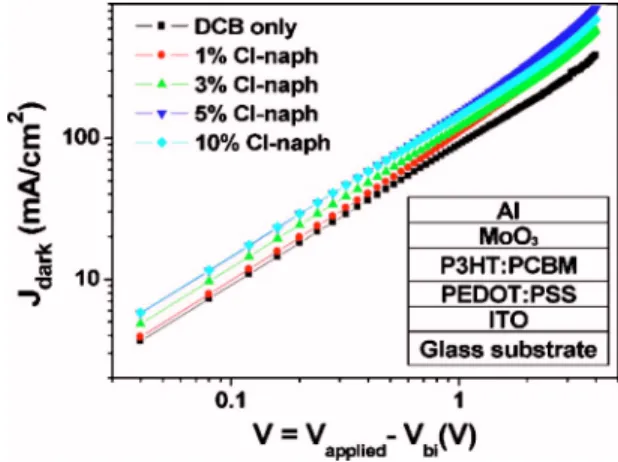
To measure the hole mobilities directly, we have fabri-cated hole-only devices using a high-work-function material, molybdenum oxide共MoO3兲, as the buffer layer at the cath-ode to block the injection of electrons.9 The hole mobilities of the polymer blends were extracted from the J-V curves of these hole-only devices in the dark, following the conven-tional model of space-charge limited current.9As shown in Fig.2, the hole mobility for the device using the neat DCB as the solvent was 4.68⫻10−8m2V−1s−1. The mobility
in-creased with the increasing concentration of Cl-naph in the solvent mixtures and became 8.36⫻10−8m2V−1s−1 when
the content of Cl-naph was 5.0%. Apparently, the use of the
FIG. 3. 共Color online兲 共a兲 Absorption spectra for P3HT:PCBM films fabri-cated from various solvent mixtures.共b兲 The AFM image, showing the sur-face morphology of the P3HT/PCBM blend films, deposited from neat DCB 共rms roughness=5.10 nm兲. 共c兲 The AFM image of the polymer blend depos-ited from a 5% Cl-naph solvent mixture共rms roughness=7.38 nm兲. FIG. 1. J-V curves of the polymer solar cells fabricated from various solvent
mixtures. The measurement was performed under illumination at 100 mW/cm2共simulated AM1.5G兲.
TABLE I. The performance of polymer solar cells made from different solvent mixtures under illumination with AM1.5G spectra共100 mW/cm2兲.
Solvent Voc 共V兲 Jsc 共mA/cm2兲 FF 共%兲 PCE 共%兲 Rs a 共⍀ cm2兲 Drying time 共min兲 DCB only 0.61 9.1 55.2 3.1 9.46 6 1.0% Cl-naph 0.61 9.6 57.2 3.3 10.16 8 3.0% Cl-naph 0.61 10.1 62.1 3.8 8.81 12 5.0% Cl-naph 0.61 11.0 64.1 4.3 7.98 18 10% Cl-naph 0.59 10.4 66.2 4.1 6.71 36
aExtracted from the J-V curves under illumination共Ref.15兲.
FIG. 2. 共Color online兲 The J-V characteristics of the hole-only devices measured in the dark. The bias was corrected for the build-in potential共Vbi兲,
which is 0.1 eV, owing to the difference in the work functions between the two electrodes. The inset shows the device structure of the hole-only de-vices. The thickness of MoO3was 50 nm.
103316-2 Chen, Tseng, and Ko Appl. Phys. Lett. 92, 103316共2008兲
This article is copyrighted as indicated in the article. Reuse of AIP content is subject to the terms at: http://scitation.aip.org/termsconditions. Downloaded to IP: 140.113.38.11 On: Wed, 30 Apr 2014 23:12:41
solvent mixtures indeed improves the hole mobility. To confirm the increased degree of the polymer chain alignment, the morphology of the polymer films was further examined. First, the adsorption spectra of the P3HT/PCBM films were obtained as Fig. 3共a兲. For the film spin coated from the neat DCB solution, the absorption peak was at 506 nm and two shoulders were at 545 and 600 nm. After the addition of Cl-naph, the three vibronic absorption peaks be-came more pronounced, indicating enhanced ordering of P3HT.13 Further, the redshift of the absorption peaks also implies better crystallinity, because lower density of confor-mational chain defects would lead to a longer-conjugation length and, hence, a lower bandlike energy.14
Figures3共b兲and3共c兲show the AFM images for various films prepared from different solvents. Apparently, the sur-face of the film spin coated from the solvent mixture was rougher than that prepared from neat DCB. The previous report by Li et al. indicated that the rough surface is prob-ably a signature of polymer organization.7 In Fig. 3共c兲, the rough surface made from the solvent mixture also suggests a higher degree of ordering. This order structure reduces the internal series resistance of the device, thus increasing the photocurrent.
Another evidence of self-organization of polymer chains comes from the GIXRD results. The diffraction pattern共Fig.
4兲 displays two sets of reflections: the three low-angle
dif-fraction peaks indexed共h00兲 共h=1–3兲 and the peak indexed 共010兲, which can be attributed to the reflections of P3HT.4
The former peaks are associated with the crystallographic
direction along the alkyl side chains 共a axis兲; the latter is associated with the-stacking direction of the backbones共b axis兲. From the enhanced intensity of the 共100兲 peak, it is proved that the crystallinity was indeed improved after the use of the solvent mixture.
In conclusion, we have used solvent mixtures to reduce the solvent evaporation rate during the preparation of poly-mer solar cells. With higher Cl-naph concentration in the solvent mixtures, the polymer chains have longer time to self-organize themselves. As a result, the higher degree of crystalline leads to lower device series resistance, thereby increasing the device PCE of the photovoltaic devices.
The authors would like to thank the financial support from National Science Council Grant No. 共NSC-96-2628-E-009-022-MY2兲 and Ministry of Economic Affairs Grant No. 共96-EC-17-A-08-S1-015兲 and Ministry of Education ATU Program.
1P. W. M. Blom, V. D. Mihailetchi, L. J. A. Koster, and D. E. Markov,Adv. Mater.共Weinheim, Ger.兲 19, 1551共2007兲.
2G. Yu, J. Gao, J. C. Hummelen, F. Wudl, and A. J. Heeger,Science 270,
1789共1995兲.
3J. Y. Kim, K. Lee, N. E. Coates, D. Moses, T. Q. Nguyen, M. Dante, and
A. J. Heeger,Science 317, 222共2007兲.
4W. L. Ma, C. Y. Yang, X. Gong, K. Lee, and A. J. Heeger,Adv. Funct. Mater. 15, 1617共2005兲.
5F. Padinger, R. S. Rittberger, and N. S. Sariciftci,Adv. Funct. Mater. 13,
85共2003兲.
6C. N. Hoth, S. A. Choulis, P. Schilinsky, and C. J. Brabec,Adv. Mater. 共Weinheim, Ger.兲 19, 3973共2007兲.
7G. Li, V. Shrotriya, J. S. Huang, Y. Yao, T. Moriarty, K. Emery, and Y.
Yang,Nat. Mater. 4, 864共2005兲.
8V. D. Mihailetchi, H. X. Xie, B. de Boer, L. M. Popescu, J. C. Hummelen,
P. W. M. Blom, and L. J. A. Koster,Appl. Phys. Lett. 89, 043504共2006兲.
9V. Shrotriya, Y. Yao, G. Li, and Y. Yang,Appl. Phys. Lett. 89, 063505
共2006兲.
10P. Vanlaeke, G. Vanhoyland, T. Aernouts, D. Cheyns, C. Deibel, J. Manca,
P. Heremans, and J. Poortmans,Thin Solid Films 511, 358共2006兲.
11V. Shrotriya, G. Li, Y. Yao, T. Moriarty, K. Emery, and Y. Yang,Adv. Funct. Mater. 16, 2016共2006兲.
12R. S. Ruoff, D. S. Tse, R. Malhotra, and D. C. Lorents,J. Phys. Chem.97,
3379共1993兲.
13T. A. Chen, X. M. Wu, and R. D. Rieke,J. Am. Chem. Soc. 117, 233
共1995兲.
14O. Inganas, W. R. Salaneck, J. E. Osterholm, and J. Laakso,Synth. Met.
22, 395共1988兲.
15A. Moliton and J. M. Nunzi,Polym. Int. 55, 583共2006兲.
FIG. 4. GIXRD spectra for P3HT/PCBM films deposited from different solvent mixtures.
103316-3 Chen, Tseng, and Ko Appl. Phys. Lett. 92, 103316共2008兲
This article is copyrighted as indicated in the article. Reuse of AIP content is subject to the terms at: http://scitation.aip.org/termsconditions. Downloaded to IP: 140.113.38.11 On: Wed, 30 Apr 2014 23:12:41