Preparation and Catalysis of a Tri-coordinated Copper(I) Complex with
Bulky P~N Ligand
Hsin-Pei Chen ( ), Chao-Yu Wang ( ), Yi-Hung Liu ( ), Shie-Ming Peng ( ) and Shiuh-Tzung Liu* ( )
Department of Chemistry, National Taiwan University, Taipei 106, Taiwan, R.O.C.
Coordination of a bulky pyridinyl-phosphine (P~N) ligand toward CuBr was investigated. However, this P~N donor behaves as a monodentate via the coordination of phosphine to form a bromide bridged dimeric [(P~N)Cu(m-Br)2Cu(P~N)], which was characterized by spectral and crystal structural analysis. It appeared that the “PCu(m-Br)2CuP” unit is planar with a short distance between Cu...Cu’ [2.7585(9) Å]. The catalytic activity on Sonogashira coupling of phenylacetylene with aryl halides was studied.
Keywords: Bulky phosphine; Copper; Catalysis; Coupling reaction.
INTRODUCTION
Construction of carbon-carbon or carbon-heteroatom bonds involving copper complexes as catalysts is an impor-tant research area in organic synthesis.1,2Thus study of coor-dination of copper ions toward various ligands has received much attention. In this context, there is a considerable inter-est in the design and synthesis of phosphine-copper com-plexes owing to their associated catalytic activity in organic transformations.1,2Compared with the extensive information on four-coordinate copper-phosphine complexes, two- or three-coordinate species have been less reported.3-24 It is known that both the halides and phosphine ligands influence the coordination sphere of metal centers and the bulky ter-tiary phosphines generally direct the formation of two- or three-coordinate copper complexes.12-24In our recent work, we have synthesized the bulky phosphine-pyridinyl (P~N) ligand and studied its coordination chemistry toward palla-dium(II) ions.25Here the preparation of copper(I) complex containing this bulky P~N ligand and its catalytic activity on C-C bond formation will be presented.
RESULTS AND DISCUSSION Copper complexes
The desired ligand P~N was prepared according to our previously reported method.25Ligand substitution reaction of P~N with CuBr in dichloromethane at room temperature readily provided the corresponding copper complex 1 in a quantitative yield. Upon recrystallization, the copper(I) com-plex yielded colorless crystalline solids. The31P nmr shift of the complex in CDCl3appeared at- 16 ppm (relative to 85% H3PO4), which shifted up-field from the ligand itself. The coordination chemical shift (dcomplex- dfree ligand) is 1 ppm, which is quite similar to those of phosphine-copper(I) com-plexes.3-24The significant difference of1H nmr spectra be-tween 1 and P~N comes from the shift of the methylene unit adjacent to the phosphorus. The signal corresponding to those hydrogens showed at 4.21 ppm with phosphorus cou-pling JP-H= 6.5 Hz, down-field shift from the free ligand (3.99 ppm). Although the shifts of the pyridinyl-carbon in13C nmr changed slightly from the free ligand, it could not be deter-mined whether the pyridinyl-nitrogen donor is coordinated to the metal center. The detailed structure of 1 was confirmed by its X-ray crystal analysis.
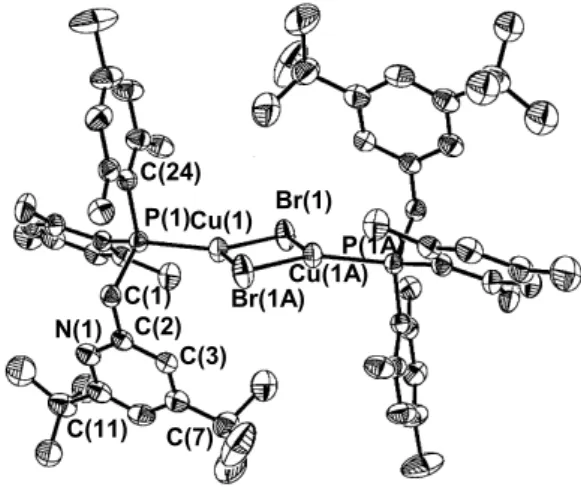
Single crystals of 1 were obtained by slow diffusion of ether into a dichloromethane solution at room tempera-ture under nitrogen atmosphere. Fig. 1 displays the ORTEP diagram of the copper complex (drawings with 30% proba-bility ellipsoids). It appears that this copper complex
con-Dedicated to Professor Ching-Erh Lin on the Occasion of his 66thBirthday and his Retirement from National Taiwan University
* Corresponding author. E-mail: [email protected]
N
P(Mes)2
tains one centrosymmetric dimer of the form [(P~N)Cu( m-Br)2Cu(P~N)]. It is quite clear that the pyridinyl-nitrogen does not coordinate to the metal center, i.e. the P~N behaves as a monodentate. It is known that the bulky monodentate phosphine would coordinate with copper halide in a 2:1 fash-ion to form a monomeric species [(R3P)2CuX], where the metal center is bound by two phosphorus donors. However, the nitrogen donor in this P~N ligand could not coordinate to the metal center, presumably due to the hindrance of the ter-tiary butyl group next to the nitrogen center.25
Selected bond distances collected of 1 and related complexes 2a-f are summarized in Table 1 for compari-son.12a,12e,14,18The bond distances around the metal center lie in the normal range of the closely related complexes (Table 1). The “PCu(m-Br)2CuP” unit is essentially planar, resem-bling those complexes containing [P2Cu2X2] moiety. How-ever, the distance Cu...Cu’ [2.7585(9) Å] is significantly shorter, while the distance of Br…Br’ [3.9963(9) Å] is longer than any other related species as indicated in Table 1. This ob-servation is quite similar to that of iodide-bridged species 2f [Cu…Cu’ 2.728(3) Å; I…I’ 4.361(3) Å], indicating a weak interaction between copper centers.12e
This copper complex in a chloroform or dichloro-methane solution remains in a dimeric form as evidenced by 1
H and31P nmr spectroscopy. However, the dimeric form was readily decomposed by the addition of extra phosphine ligands to the solution and led to a mixture of various substi-tuted products, some of which we were not able to character-ize.
Catalysis
The catalytic activity of 1 on Sonogashira coupling was investigated. Coupling reaction of aryl or vinyl iodides with terminal alkyne is a useful tool to yield arylalkynes and enynes, and the recent development in this catalysis is to use copper complexes as catalyst instead of the expensive palla-dium complexes.2,26,27Thus the catalytic activity of copper complex 1 was examined. In a typical experiment for the cou-pling reaction, aryl halides, phenylacetylene, and potassium carbonate in 1:1.5:1 ratio were added to a freshly distilled to-luene solution, followed by the addition of the catalyst. The mixture was heated in an oil bath at 110°C for 24 h. After the reaction was stopped, the reaction mixture was diluted with dichloromethane and washed with 5 N HCl and water. The or-ganic portion was extracted, concentrated, and characterized by GC and1H NMR spectroscopy. All of the results are sum-marized in Table 2.
In all instances, catalysis proceeded smoothly without using palladium complexes as co-catalysts. It appears that the extra phosphine ligand is required for better conversion. Without an extra phosphine ligand, complex 1 did not cata-lyze the coupling reaction (entries 1, 13). By comparison of entry 13 to the others, it is quite obvious that the presence of the P~N ligand readily promotes the catalysis. Complex 1 did catalyze the coupling of phenylacetylene with aryl iodides and activated aryl bromide to provide the corresponding diarylacetylene in reasonable yields except for o-iodotolu-ene; this was presumably due to the steric reason. Typically, the reaction of phenyl iodide with phenylacetylene cata-lyzed by 1 in the presence of triphenylphosphine provided the diphenylacetylene in 72% yield. As for the phenyl chlo-ride (entry 11) or deactivated aryl bromides (entries 7, 8), the copper complex did not show good activity in the cataly-sis. It is noticed that the in situ generation of copper species for the catalysis is also applied for the coupling reactions (entry 14). Cu(1) P(1) P(1A) Br(1) Br(1A) N(1) C(1) C(2) C(24) C(3) Cu(1A) C(7) C(11)
Fig. 1. ORTEP plot of 1. (Labeling for aromatic rings is omitted for clear view). P(1)-C(1) 1.858(3) Å; Cu(1)…N(1) 4.692(4) Å; P(1)…N(1) 3.494(4) Å; C(24)-P(1)-Cu(1) 103.6(1)°; C(15)-P(1)-Cu(1) 127.1(1)°; C(15)-P(1)-Cu(1) 127.1 (1)°. Cu X X Cu P P R R R R R R 2a R3= (o-Tol)3, X = Br 2b R3= (o-Anis)3, X = Br 2c R3= Ph2(Mes), X = Br 2d R3= Ph(Mes)2, X = Br 2e R3= (Cy)3, X = Br 2f R3= Ph(Mes)2, X = I
SUMMARY
Complexation of the bulky P~N ligand with copper bromide readily formed a bromide bridged dimeric complex 1. The bulky environment around the nitrogen donor prevents its coordination toward metal center, i.e. the P~N ligand acts as a monodentate. This copper complex shows the catalytic activity on the coupling of acetylene with aryl halides, which provides a method leading the Sonogashira coupling prod-ucts without using palladium complexes.
EXPERIMENTAL General Information
All reaction, manipulation, and purification steps were performed under a dry nitrogen atmosphere. Tetrahydrofuran
was distilled under nitrogen from sodium benzophenone ketyl. Dichloromethane was dried with CaH2and distilled un-der nitrogen. Other chemicals and solvents were of analytical grade and were used as received unless otherwise stated. Ligand P~N was prepared according to a published proce-dure.25
Nuclear magnetic resonance spectra were recorded in CDCl3on either a Bruker AM-300 or AVANCE-400 spec-trometer. Chemical shifts are given in parts per million rela-tive to Me4S for1H and relative 85% H3PO4for31P NMR. In-frared spectra were measured on a Perkin-Elmer 983G spec-trometer (Series-II) as KBr pallets, unless otherwise noted. Complex 1
A mixture of CuBr (60 mg, 0.42 mmol) and P~N ligand (200 mg, 0.42 mmol) in dichloromethane (10 mL) was stirred under nitrogen atmosphere at room temperature for 3 h. The Table 1. Selected bond distances (Å) and angles (deg) of 1 and 2a-f for comparison
Complex 1 (X = Br) 2a (X = Br)a 2b (X = Br)b 2c (X = Br)c 2d (X = Br)c 2e (X = Br)d 2f (X = I)c Cu-X 2.3506(6) 2.414(1) 2.356(1) 2.397(2) 2.393(2) 2.409(1) 2.554(3) Cu-X’ 2.5032(6) 2.431(1) 2.541(1) 2.441(2) 2.415(2) 2.430(1) 2.589(3) Cu-P 2.2013(9) 2.208(1) 2.194(1) 2.198(3) 2.197(3) 2.191(2) 2.201(4) X…X’ 3.9963(9) 3.716(1) 3.807(1) 3.748(2) 3.684(2) 3.717(1) 4.361(3) Cu…Cu’ 2.7585(9) 3.109(1) 3.085(1) 3.083(2) 3.052(3) 3.098(1) 2.728(3) Cu-X-Cu’ 69.18(2) 79.83(4) 78.01(3) 79.18(6) 78.80(7) 79.62(4) 63.49(7) X-Cu-X’ 110.82(2) 100.17(3) 101.99(3) 100.8(1) 100.1(1) 100.38(5) 116.0(1) P-Cu-X 141.46(3) 130.00(6) 141.38(5) 132.2(1) 130.9(1) 132.88(6) 128.3(1) P-Cu-X’ 106.86(3) 129.64(6) 116.53(5) 127.0(1) 128.7(1) 126.74(6) 114.9(1)
aReference 12d.bReference 14b.cReference 12a.dReference 12e.
Table 2. Results of coupling reactions catalyzed by copper complexesa
Entry Catalyst PPh3b Ar-X Product Yieldc
1 1 0 C6H5I C6H5CºCC6H5 trace 2 1 0.1 C6H5I C6H5CºCC6H5 34% 3 1 0.2 C6H5I C6H5CºCC6H5 72% 4 1 0.2 p-CH3C6H4I p-CH3C6H4CºCC6H5 65% 5 1 0.2 o-CH3C6H4I o-CH3C6H5CºCC6H5 22% 6 1 0.2 C6H5Br C6H5CºCC6H5 63% 7 1 0.2 p-MeOC6H4Br p-MeOC6H4CºCC6H5 19%d 8 1 0.2 p-MeC6H4Br p-MeC6H4CºCC6H5 22%d 9 1 0.2 p-CH3COC6H4Br p-CH3COC6H4CºCC6H5 65% d 10 1 0.2 C6H5Cl C6H5CºCC6H5 20% 11 CuCl 0.2 C6H5I C6H5CºCC6H5 47% 12 CuCl + P~N 0 C6H5I C6H5CºCC6H5 trace 13 CuCl + P~N 0.1 C6H5I C6H5CºCC6H5 71%e a
Phenylacetylene (0.137 mL, 1.25 mmol), aryl halide (1 mmol), K2CO3(0.18 g, 1 mmol) and
catalyst (0.1 mmol) in toluene (10 mL) was heated to reflux for 24 h under nitrogen atmosphere.bmmol of triphenylphosphine.cGC yield.dnmr yield.eIsolated yield.
reaction solution was evaporated to a volume of about 2 mL. Upon addition of ether, the desired complex was precipitated as white solids (0.25 g, 97%). Recrystallization from di-chloromethane/ether gave complex 1 as colorless single crys-tals.1H NMR (CDCl3, 400 MHz):d 7.07 (s, 2H, py-H5), 6.74 (s, 2H, py-H3), 6.71 (d, J = 3.0 Hz, 8H, Ar-H), 4.21 (d, JP-H= 6.5 Hz, 4H, CH2), 2.21 (s, 24H, Ar-CH3), 2.18 (s, 12H, Ar-CH3), 1.25 (s, 18H, CH3), 1.09 (s, 18H, t-Bu);31P NMR (CDCl3, 161.9 MHz):d-16;13C NMR (CDCl3, 100 MHz):d 169.0, 160.5, 153.6, 141.4 (d, J = 9.7 Hz), 139.5, 130.7 (d, J = 6.8 Hz), 126.4 (d, J = 33.0 Hz), 119.4, 114.7, 39.0 (d, J = 16 Hz), 37.5, 34.7, 30.4, 23.9, 23.8, 20.8. Anal. Calcd. for C64H88N2P2Br2Cu2: C, 62.28; H, 7.19; N, 2.27. Found: C, 61.90; H, 7.14; N, 2.29.
Catalysis
A mixture of phenylacetylene (0.137 mL, 1.25 mmol), aryl halide (1 mmol), K2CO3(0.18 g, 1 mmol), and catalyst (0.1 mmol) in toluene (10 mL) was heated to reflux for 24 h under nitrogen atmosphere. Upon concentration, the reaction mixture was analyzed by1H nmr and GC. In some cases, the products were isolated by column chromatography. Results are summarized in Table 2.
X-ray Crystallographic Analysis
Crystal suitable for X-ray determination was obtained for 1 by re-crystallization at room temperature. Cell param-eters were determined by a Siemens SMART CCD dif-fractometer. Crystal data of the complex X: C32H44BrCuNP, Fw = 617.10, monoclinic, P21/n, a = 13.1390(2) Å, b = 15.0160(2) Å, c = 17.1110(2) Å,a = 90°, b = 105.272(1)°, g = 90°, V = 3256.70(8) Å3
, Z = 4, Dcalcd= 1.259 Mg/m3, F(000) = 1288, 0.30´ 0.25 ´ 0.20 mm, 2q range = 2.21-27.49°, 7460 independent refln. (Rint= 0.0520) out of 36271 refln col-lected, Full-matrix least square on F2, R1 = 0.592, wR2 =
0.1553 [I > 2(I)], Goodness-of-fit on F21.066. Other crystal-lographic data have been deposited with the Cambridge Crys-tallographic Data Center: CCDC-236306 for 1. Copies of this information can be obtained free of charge and by applica-tion to CCDC, 12 Union Road, Cambridge CB2 1EZ, UK (Fax: +44-1223/336033; e-mail: [email protected] or www: http://www.ccdc.cam.ac.uk).
ACKNOWLEDGMENT
We thank the National Science Council for financial support (NSC93-2113-M-002-037).
Received August 27, 2004.
REFERENCES
1. Kunz, K.; Scholz, U.; Ganzer, D. Synlett. 2003, 2428, and references therein.
2. (a) Ley, S. V.; Thomas, A. W. Angew. Chem. Int. Ed. 2003, 42, 5400. (b) Hassan, J.; Sevignon, M.; Gozzi, C.; Schulz, E.; Lemaire, M. Chem. Rev. 2002, 102, 1359, and references therein.
3. Alyea, E. C.; Ferguson, G.; Malito, J.; Ruhl, B. L. Inorg. Chem. 1985, 24, 3720.
4. Soloveichik, G. L.; Eisenstein, O.; Poulton, J. T.; Streib, W. E.; Huffman, J. C.; Caulton, K. G. Inorg. Chem. 1992, 31, 3306.
5. Hadjikakou, S. K.; Akrivos, P. D.; Karagiannidis, P.; Raptopoulou, E.; Terzis, A. Inorg. Chim. Acta 1993, 210, 27. 6. Ainscough, E. W.; Brodie, A. M.; Burrell, A. K.; Freeman, G. H.; Jameson, G. B.; Bowmaker, G. A.; Hanna, J. V.; Healy, P. C. J. Chem. Soc., Dalton Trans. 2000, 144.
7. Goel, R. G.; Beauchamp, A. L. Inorg. Chem. 1983, 22, 395. 8. Batchelor, R. J.; Birchall, T.; Faggiani, R. Can. J. Chem.
1985, 63, 928.
9. Eller, P. G.; Kubas, G. J.; Ryan, R. R. Inorg. Chem. 1977, 16, 2454.
10. Davis, P. H.; Belford, R. L.; Paul, I. C. Inorg. Chem. 1973, 12, 213.
11. Krauter, T.; Neumuller, B. Polyhedron 1996, 15, 2851. 12. (a) Bowmaker, G. A.; Camp, D.; Hart, R. D.; Healy, P. C.;
Skelton, B. W.; White, A. H. Aust. J. Chem. 1992, 45, 1155. (b) Baker, L.-J.; Bowmaker, G. A.; Hart, R. D.; Harvey, P. J.; Healy, P. C.; White, A. H. Inorg. Chem. 1994, 33, 3925. (c) Bowmaker, G. A.; Hart, R. D.; Jones, B. E.; Skelton, B. W.; White, A. H. J. Chem. Soc., Dalton Trans. 1995, 3063. (d) Bowmaker, G. A.; Hanna, J. V.; Hart, R. D.; Healy, P. C.; White, A. H. Aust. J. Chem. 1994, 47, 25. (e) Bowmaker, G. A.; Boyd, S. E.; Hanna, J. V.; Hart, R. D.; Healy, P. C.; Skelton, B. W.; White, A. H. J. Chem. Soc. Dalton Trans.
2002, 2722.
13. (a) Churchill, M. R.; Rotella, F. J. Inorg. Chem. 1979, 18, 166. (b) Churchill, M. R.; DeBoer, B. G.; Mendak, S. J. Inorg. Chem. 1975, 14, 2041. (c) Churchill, M. R.; Rotella, F. J. Inorg. Chem. 1977, 16, 3267. (d) Churchill, M. R.; DeBoer, B. G.; Donovan, D. J. Inorg. Chem. 1975, 14, 617. 14. (a) Ramaprabhu, S.; Amstutz, N.; Lucken, E. A. C.;
Bernardinelli, G. J. Chem. Soc., Dalton Trans. 1993, 871. (b) Ramaprabhu, S.; Amstutz, N.; Lucken, E. A. C.; Bernardinelli, G. Z. Naturforsch., Teil A 1998, 53, 625. 15. Brauer, D. J.; Knueppel, P. C.; Stelzer, O. Chem. Ber.1987,
120, 81.
16. Fife, D. J.; Moore, W. M.; Morse, K. W. Inorg. Chem. 1984, 23, 1684.
17. Vlaar, M. J. M.; de Kanter, F. J. J.; Schakel, M.; Lutz, M.; Spek, A. L.; Lammertsma, K. J. Organomet. Chem. 2001, 617-618, 311.
18. Ainscough, E. W.; Brodie, A. M.; Burrell, A. K.; Freeman, G. H.; Jameson, G. B.; Bowmaker, G. A.; Hanna, J. V.; Healy, P. C. J. Chem. Soc. Dalton Trans. 2001, 144.
19. Dias, E. L.; Grubbs, R. H. Organometallics 1998, 17, 2758. 20. Schmidt, G.; Schittenhelm, N.; Behrens, U. J. Organomet.
Chem. 1995, 496, 49.
21. Negita, H.; Hiura, M.; Kushi, Y.; Kuramoto, M.; Okuda, T.
Bull. Chem. Soc. Jpn. 1981, 54, 1247.
22. Borsub, N.; Chang, S.-C.; Kutal, C. Inorg. Chem. 1982, 21, 538.
23. Hessler, G.; Knueppel, P. C.; Stelzer, O.; Sheldrick, W. S. Chem. Ber. 1990, 123, 653.
24. Leschke, M.; Lang, H.; Melter, M.; Rheinwald, G.; Weber, C.; Mayer, H. A.; Pritzkow, H.; Zsolnai, L.; Driess, A.; Huttner, G. Z. Anorg. Allg. Chem. 2002, 628, 349.
25. Chen, H.-P.; Liu, Y.-H.; Peng, S.-M.; Liu, S.-T. Daton Trans.
2003, 1419.
26. Zapf, A.; Beller, M. Top. in Catal. 2002, 19, 101.
27. Okuro, K.; Furuune, M.; Enna, M.; Miura, M.; Nomura, M. J. Org. Chem. 1993, 58, 4716.