Lian-Pin Hwang*
Department of Chemistry, National Taiwan University, P.O. Box 23-34, Taipei, Taiwan and Institute of Atomic and Molecular Sciences, Academia Sinica, Taipei, Taiwan
共Received 17 May 1999; revised manuscript received 1 February 2000兲
The magnetic and magnetotransport properties of La0.7Sr0.3Mn1⫺xNixO3(x⭐0.4) system have been studied.
It is found that Ni doping induces a ferromagnetic state to ferromagnetic cluster state transition near the metallic critical threshold composition. Interestingly, the largest low-temperature magnetoresistance共MR兲 at 77 K is found in the samples in the vicinity of the ferromagnetic threshold composition below which the sample shows both a rapid low-field MR and a slow high-field MR increase and above which only a slow MR increase is observed. The results suggest that the spin-dependent scattering from internal grain regions is also responsible for the low-temperature MR. The low-temperature and low-field MR effect is explained in terms of orientation of the magnetic domains or/and cluster moments associated with the magnetically disordered regions inside grains which may serve as the spin-dependent scattering centers as well as the pinning centers for magnetic domain walls.
I. INTRODUCTION
The hole-doped manganese materials with perovskite structure exhibit a negative colossal magnetoresistance
共CMR兲 effect at the temperature close to TC, 1,2
where they undergo a ferromagnetic-paramagnetic phase transition, ac-companied by a metal-insulator transition. A resistivity peak and a CMR peak in most cases are found in the vicinity of the ferromagnetic transition temperature TC. This intrinsic
CMR effect has been explained by the double exchange
共DE兲3,4interaction between Mn4⫹and Mn3⫹ions, which
me-diates the simultaneous ferromagnetism and metallic conduc-tance. Unfortunately, the CMR effect is usually achieved only in a strong magnetic field in the tesla range, which limits its practical applications.
On the other hand, the macroscopic magnetic and electric properties of real materials can be dramatically modified by various inhomogeneities existed in materials,5–7 such as chemical inhomogeneity, lattice constant, and possible struc-ture inhomogeneities, etc. Among the various inhomogene-ities, the effect of grain boundaries discovered recently in the metallic polycrystalline perovskites8–14is of particular inter-est. Besides the intrinsic CMR peak near TC, a large
low-field magnetoresistance共MR兲 effect has also been observed over a wide temperature range below TC, which is absent in
single crystals. Different from the intrinsic double-exchange-type CMR, the low-temperature and low-field MR effect is supposed to be from an extrinsic factor—grain boundaries where structural disorder and magnetic disorder do exist. The role of grain boundaries in low-field MR has further been determined by investigating the effects of particle size9–11
and single grain boundary on epitaxial manganese films.15,16 So far, the low-field and low-temperature MR effect has been explained mainly in terms of spin-dependent tunneling across the grain boundaries9,10 or spin-dependent magnetic domain scattering at the boundary regions.12,14However, all the observed results above polycrystalline samples do not give any convincing evidence for supporting either spin-dependent tunneling or spin-spin-dependent scattering. In classi-cal sense, if spin-dependent scattering at grain boundaries is responsible for the low-field MR, one may expect that spin-dependent scattering from the intragrain can also cause the low-field MR when such spin-dependent scattering centers exist inside the grains. One approach is to introduce some local spin disorder into the intragrain. This can be done by the direct replacement of Mn by Ni.
In this paper, the magnetism and the related MR behav-iors in a series of La0.7Sr0.3Mn1⫺xNixO3 (x⭐0.4)
polycrys-talline samples have been reported. It is found that the direct replacement of Mn by Ni destroys the long-range ferromag-netic order and induces a ferromagferromag-netic metallic state to cluster-glass-like insulating state transition. Also, Ni doping remarkably influences the low-temperature MR. A largely enhanced low-temperature MR effect is observed in the vi-cinity of ferromagnetic critical threshold. Furthermore, in or-der to unor-derstand the origins of low-temperature MR effect, the magnetotransport properties of Ni-doped and undoped samples have been compared. The results suggest that the spin-dependent scattering from the internal grain regions is responsible for the large low-field MR in these high-Ni-doped samples rather than the spin-dependent transport across grain boundaries.
PRB 61
II. EXPERIMENT
A series of ceramic samples La0.7Sr0.3Mn1⫺xNixO3 (x ⫽0, 0.05, 0.1, 0.15, 0.18, 0.2, 0.25, 0.3, and 0.4兲 were
syn-thesized by conventional solid-state reaction method in air. Stoichiometric mixtures of La2O3, SrCO3, MnO2, and NiO were ground, then fired at 800 °C for 24 h. The powders thus obtained, were ground, pelletized, and sintered at 1350 °C for 70 h with two intermediate grindings. The structure of the samples was characterized by x-ray diffraction共XRD兲 using Cu K␣ radiation and measured at room temperature. The resistivity of the samples was measured by four-probe method. The magnetic field direction was parallel to the cur-rent direction. The dependence of magnetization on tempera-ture was measured by a superconducting quantum interfer-ence device magnetometer共Quantum Design兲.
III. RESULT AND DISCUSSION A. Structure, magnetic, and electronic properties
The powder x-ray diffraction at room temperature shows that all the samples under investigation are of single-phase rhombohedrally distorted perovskite structure 共space group
R3¯ c) without any secondary or impurity phase. Although the
crystal symmetry of these samples remains the same, their lattice parameters change systematically and smoothly with Ni doping, as shown in Fig. 1. The crystal axis length a decreases and the rhombohedral angle␣increases gradually with increasing nickel concentration. This means that the re-placement of Mn by Ni increases the rhombohedral distor-tion. The uniaxial strain␦(⫽储⫺⬜) induced by this distor-tion, for example, is estimated about ⫺2.2⫻10⫺3 for the sample x⫽0.2, here 储 and⬜ represent the strains parallel to and perpendicular to the threefold symmetry axis, respec-tively.
Figure 2 shows the temperature dependence of magneti-zation obtained in the zero-field-cooled共ZFC兲 and the field-cooled共FC兲 processes with an applied magnetic field of 0.05 T for three typical La0.7Sr0.3Mn1⫺xNixO3 samples (x⫽0.1,
0.2, and 0.25兲. The ZFC magnetization curve indicates that the sample with x⭐0.2 undergoes a paramagnetic to ferro-magnetic transition. As nickel content x increases, both Curie temperature TCand magnetization M are systematically
low-ered, and the ferromagnetic transition becomes broader. Here the macroscopic Curie temperature TC is defined as the
tem-perature of the maximum slope in d M /dT. Clearly, the Ni doping suppresses the ferromagnetism. The FC and ZFC data for the sample x⫽0.2 do not coincide below a relatively high temperature, indicating that some randomly frozen-in mag-netic clusters are also present. This illustrates that there is a coexistence of ferromagnetism 共possibly the large ferromag-netic regions with multidomain structure兲 and magnetic clus-ters for T⬍TC. Moreover, there is a local maximum around
110 K on both FC and ZFC curves, suggesting the existence of some antiferromagnetic correlation. By contrast, the sample with x⭓0.25 shows the ferromagnetic cluster behav-iors without well-defined TC. Below freezing temperature
(Tf), the cluster-glass 共or spin-glass兲 behavior is observed,
which is characterized by the difference between the ZFC and FC magnetization data. Moreover, the nonlinearity of reciprocal magnetization 1/M (T) can be found far above Tf,
suggesting the clustering of magnetic moments. From the above results, it seems that for present La0.7Sr0.3Mn1⫺xNixO3
system there exists a ferromagnetic critical threshold of xcm ⬇0.2⬃0.25 by crossing which the system evolves into a
ferromagnetic cluster state from a ferromagnetic state. The above doping effect on magnetism could be understood in terms of Mn3⫹⫺Mn4⫹bond percolation, which will be
dis-cussed later.
FIG. 1. Lattice parameters for La0.7Sr0.3Mn1⫺xNixO3samples. FIG. 2. Left y axis: magnetization as a function of temperature in ZFC and FC processes with applied fields 0.05 T for samples La0.7Sr0.3Mn1⫺xNixO3. Right y axis: reciprocal magnetization 1/M as a function of temperature in ZFC process.
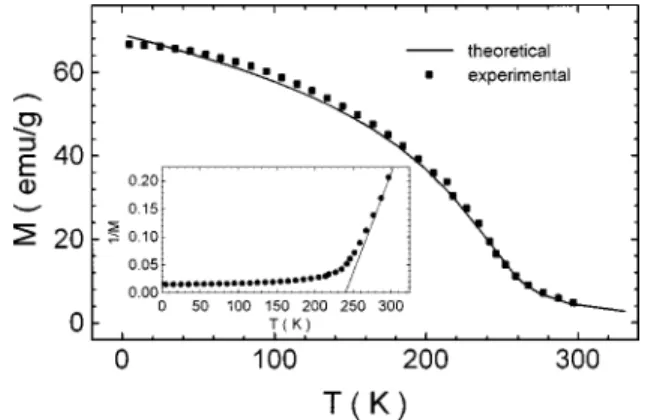
FIG. 3. Temperature dependence of magnetization of
La0.7Sr0.3Mn0.8Ni0.2O3at H⫽2 T. The points are experimental data, the solid is the calculated result. Inset, the reciprocal magnetization 1/M as a function of temperature.
Figure 3 shows the temperature dependence of magneti-zation at H⫽2 T for the sample x⫽0.2. To better understand the behavior of M (T), a simple classical mean-field model is used to parameterize the observed data. According to the mean-field model the magnetization is expressed as17,18
M
MS⫽L共␣兲 共1兲
with L(␣)⫽coth(␣)⫺1/␣ and
␣⫽kH BT⫹
3TCM T MS
, 共2兲
where kB is the Boltzmann constant. The above equations
contain three independent parameters: MS, the mean-field
saturation moment, TC, the mean-field Curie temperature, and, the magnetic moment of the basic magnetic clusters whose internal degrees of freedom are regarded to be frozen in the energy range of concern. The high-temperature data, as shown in the inset of Fig. 2, are used to estimate the mean-field Curie temperature TC and the Curie constant C ⫽MS/3kB. Taking the value of magnetization共5 K兲 under
2 T as MS,TC⫽240 K and⫽3kBC/ MS⬇7Bare thus
ob-tained. By substituting this set of parameters into Eqs. 共1兲 and 共2兲, one can calculate the magnetization curve M(T). The calculated result is also given in Fig. 3. From Fig. 3 it can be seen that the experimental data M (T) are well de-scribed by the simple mean-field model. However, it is worth pointing out that the experimental value of magnetization under H⫽2 T at 5 K is still about 12% lower than the theo-retical saturation magnetization. This may be attributed to the local disordered or canted spin alignment from the com-peting ferromagnetic double exchange and antiferromagnetic superexchange. While the effect of magnetic anisotropy
共mainly from the magnetostrictive strain and with the order
of magnitude 1⫻105erg/cm3共Ref. 19兲 on magnetization due to single frozen clusters is considered to be smaller under a field of 2 T.
Figure 4 shows the temperature dependence of resistively
共兲 of La0.7Sr0.3Mn1⫺xNixO3 (x⭐0.4) series at several dif-ferent magnetic fields, where the arrow and vertical line in-dicate the Curie temperature and the position of the
resistiv-related to the local magnetic disorder arising from statistical composition fluctuations or atomic short-range order due to Ni doping. However, for x⭓0.2 no any resistivity peak can be seen and the sample exhibits the insulating behavior in the whole experimental temperature range, either with or with-out application of the magnetic field. The above results show that Ni doping induces a metal-insulator transition. The me-tallic threshold composition is determined as xc⬇0.2 by the
change of resistivity temperature coefficient (d/dT) at low temperature range from positive in the metallic regime below the threshold to negative in the insulating regime above it. It is noted that this metallic threshold composition is close, but never exactly equal to the ferromagnetic critical threshold.
Summarizing the above low-temperature electronic phases together with the corresponding magnetic phases, there are three distinct phase regimes in La0.7Sr0.3Mn1⫺xNixO3 (x⭐0.4): 共i兲 ferromagnetic metallic regime for x⭐0.18; 共ii兲 cluster-glass 共or spglass兲-type in-sulating regime for x⭓0.25, and 共iii兲 transition regime (x
⬃0.2) where the low-temperature insulating phase exhibits
the supposition of ferromagnetic behavior and magnetic clus-ter behavior. In previous study of the La0.8Sr0.2Mn1⫺xCuxO3, only ferromagnetic metallic phase 关regime 共i兲兴 and spin-glass-like insulator关regime 共ii兲兴 were investigated.5
It is well known that the double exchange between Mn3⫹ and Mn4⫹ mediates ferromagnetism and metallic conduc-tance. When Ni is doped into the samples, it occupies ran-domly the Mn site in the lattice, which no longer effectively participates in the double exchange processes. It seems that in the La0.7Sr0.3Mn1⫺xNixO3a percolation of the Mn3⫹/Mn4⫹
pairs is necessary to simultaneously install double-exchange-like ferromagnetism and metallic conductance. By taking the probability of Mn3⫹/Mn4⫹pairs as the metallic critical per-colation probability in La0.83Sr0.17MnO3 where
low-temperature ferromagnetic metallic phase starts appearing,20 one can get an estimate of the metallic percolation threshold of xc⬇0.23 for La0.7Sr0.3Mn1⫺xNixO3. This value is in good
agreement with the observed ferromagnetic critical threshold (xc⬇0.20).
In the ferromagnetic metallic regime, there exists a metal-lic continuum including some magnetically disordered re-gions centered at Ni ions. Spins in these rere-gions are disor-dered or canted due to the locally weakened double exchange and the competing superexchange coupling.5In this case, the sample is metallic, and the resistivity increases with Ni dop-ing, owing to the strong electron scattering from magneti-cally disordered regions. While in the ferromagnetic cluster regime, due to fewer pairs of Mn3⫹/Mn4⫹, only some iso-lated ferromagnetic clusters can form in the Mn-rich regions, and they are buried in the insulating matrix that is
magneti-FIG. 4. Temperature dependence of resistivity共at zero field and under an applied field of H⫽2 or 5 T兲 for La0.7Sr0.3Mn1⫺xNixO3. Arrows and vertical lines indicate the Curie temperature and the metal-insulator transition temperature, respectively.
cally disordered. In this case, the conductance of the sample is controlled by electron transport across the insulating re-gions. Thus as a whole the sample is insulating. As for in the transition regime, the ferromagnetic metallic continuum is broken up into some large ferromagnetic regions and some small magnetic clusters, which leads to the supposition of ferromagnetic behavior and magnetic cluster behavior. The sample in this regime may also behave as an insulator at low temperature due to strong electron scattering from the in-creasingly magnetic disordered regions.
B. Magnetoresistance
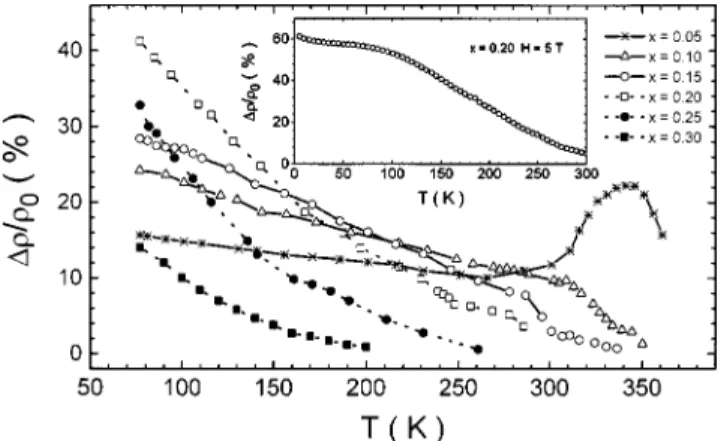
The MR ratio as a function of temperature at H⫽2 T for La0.7Sr0.3Mn1⫺xNixO3 is plotted in Fig. 5. The MR ratio is
defined as⌬/0⫽(0⫺H)/0, where0 is the zero-field resistivity andHis the resistivity in the applied field H. For
the sample with x⭐0.05, a MR peak that is close to both Curie temperature and metal-insulator transition temperature can clearly be seen. This may be interpreted as the CMR component related to insulator-metal transition. However, for the sample with x⭓0.1, no MR peak can be observed in the experimental temperature range whether the sample ex-hibits a metal-insulator transition or not. Furthermore, a sig-nificant MR ratio (H⫽2 T) appears in the low-temperature range for all samples, either metallic or insulating, and in-creases monotonically with decreasing temperature. It is noteworthy that the sample with x⫽0.2 which is near the ferromagnetic critical threshold exhibits a largely enhanced low-temperature MR ratio of about 60% at H⫽5 T 共see the inset in Fig. 5兲 or about 40% at H⫽2 T 共77 K兲. The above results reveal that Ni doping reduces the intrinsic CMR ef-fect and enhances low-temperature MR efef-fect for the sample with x⭐0.30. It is not surprising that Ni doping suppresses the CMR component. The zero-field resistivity0 is increas-ingly influenced by the presence of magnetically disordered regions. This together with that the change of resistivity共⌬兲 induced by applied field near TCdecreases due to the
broad-ening of ferromagnetic transition, gives rise to the reduction in CMR ratio.
It is worth mentioning that the magnetotransport behavior in present La0.7Sr0.3Mn1⫺xNixO3 system at low temperature
is somewhat similar to that obtained in heterogeneous
ferro-magnetic metal-insulator mixture. For convenience, the zero-field resistivity and MR ratio (H⫽2 T) as a function of nickel content at 77 K are summarized in Fig. 6. Two im-portant features should be noted in the Fig. 6. First, the MR ratio reaches its maximum of about 40% at xc⬇0.2, which is
located in the vicinity of the ferromagnetic critical threshold. Second, the resistivity increases rapidly near and above this threshold composition. The similar phenomena have also been observed in the heterogeneous granular ferromagnetic metal-insulator mixture.21
Figure 7 shows the MR ratio as a function of the applied field H at 77 K for the samples x⫽0, 0.15, 0.20, and 0.25. An important feature in Fig. 7 is that the sample with x
⭐0.2, which is ferromagnetic or ferromagnetic⫹cluster
magnetic, exhibits a sharp MR increase at low field H共⬍1.2 kOe兲 共i.e., so-called low-field MR effect兲 followed by a slow but still significant increase at higher field. The high-field MR increase is more remarkable in the sample with higher nickel content. Here, an important fact which should be em-phasized is that the low-field MR ratio does not decrease obviously with increasing Ni doping for the sample with x
⭐0.20 even though the low-temperature resistivity increases
by several orders of magnitude 共also see Fig. 6兲. However, for the sample with x⫽0.25 that exhibits cluster-like 共or spin-glass兲 magnetism, the low-field MR effect is not obvi-ous, and a large MR ratio can be achieved only at a much higher applied field.
Low-temperature MR has a low-field and high-field com-ponent. This has also been observed in some other polycrys-talline manganites, and attributed to the different physical
FIG. 5. MR ratio as a function of temperature at 2 T for La0.7Sr0.3Mn1⫺xNixO3. Inset, The MR ratio as a function of tem-perature at 5 T for the sample with x⫽0.20.
FIG. 6. Zero-field resistivity and MR ratio (H⫽2 T) as func-tions of nickel content at 77 K for La0.7Sr0.3Mn1⫺xNixO3.
FIG. 7. Variation in ⌬/0 with applied field H at 77 K for La0.7Sr0.3Mn1⫺xNixO3.
magnetic field is usually needed to align the neighboring spins completely. Moreover, with increasing Ni doping, magnetically disordered regions increase, thus leading to the enhanced high-field MR.
In the previous studies, on the other hand, the low-temperature and low-field MR effect has been explained in terms of spin-polarized electron transport across the grain boundary regions where the structural and magnetic disor-ders are regarded as tunneling barriers 共intergrain spin-polarized tunneling model兲9,10 or strong scattering centers
共spinpolarized scattering model兲.12,14
In both tunneling and scattering models, the magnetotransport depends on the rela-tive magnetization orientations of two neighboring grains. Moreover, both tunneling and scattering models predicate a low-field MR effect. In our case, the resistivity contribution for the undoped sample is mainly from the grain boundaries, and therefore the low-field MR can also be ascribed to the spin-polarized transport across the grain boundary regions. However, the resistivity at 77 K for the sample with x
⫽0.15 or 0.20 is about three or four orders of magnitude
higher than that of the undoped sample 共also see Fig. 4兲. Such a large resistivity is expected to be from the intragrain contribution rather than from the intergrain 共grain bound-aries兲 due to the strongly spin-disordered scattering inside the grains. The above fact implies that the grain boundary contribution to field MR can be neglected and the low-field MR effect is related to the internal regions of grains. A possible cause is suggested for the low-field MR effect ob-served in the present Ni-doped samples. The magnetically disordered regions 共centered around Ni ions兲 inside grains, introduced by Ni doping, may serve as the pinning centers for magnetic domain walls as well as the strong spin-scattering centers. A moderately low field can reduce the
their thermal fluctuation. Second, for the small clusters the MR contribution from the spin alignment of ions at cluster surfaces becomes dominant, which leads to the high-field MR effect.
IV. CONCLUSION
In summary, the magnetic and magnetotransport proper-ties of La0.7Sr0.3Mn1⫺xNixO3 (x⭐0.4) system have been studied. In the low-doping regime, Ni doping suppresses both ferromagnetic transition and metal-insulator transition, and causes a metal-insulator transition to occur at a tempera-ture far below the Curie temperatempera-ture. The CMR peak is weakened and even becomes unobservable with increasing Ni doping. Moreover, Ni doping induces a metal-to-insulator transition at a critical nickel composition close to which the system evolves into a cluster-glass state from a ferromag-netic state. Interestingly, the largest low-temperature magne-toresistance at 77 K is found in the samples in the vicinity of the metallic continuity threshold below which the sample shows both low- and high-field MR effects and above which the sample exhibits only a high-field MR effect. The results reveal that besides the grain boundaries the spin-dependent scattering from the internal grain regions also plays an im-portant role in both the low-field and high-field MR.
ACKNOWLEDGMENTS
Authors thank IAMS and the National Science Council for the financial support. One of us共J.W.F.兲 wishes to thank the members of IAMS for their hospitality, and also to thank IAMS for a fellowship.
*Author to whom correspondence should be addressed.
1R. Von Helmolt, J. Wecker, B. Holzapfel, L. Shulz, and K.
Sam-wer, Phys. Rev. Lett. 71, 2331共1993兲.
2S. Jin, T. H. Tfeel, M. McCormack, R. Ramesh, and L. H. Chen,
Science 264, 413共1994兲.
3C. Zener, Phys. Rev. 82, 403共1951兲. P.-G. de Gennes, ibid. 118,
141共1960兲.
4P. W. Anderson and H. Hasegawa, Phys. Rev. 100, 675共1955兲. 5R. von Helmolt, L. Haupt, K. Barner, and U. Sondermann, Solid
State Chem. 82, 693共1992兲.
6J. R. Sun, G. H. Rao, and Y. Z. Zhang, Appl. Phys. Lett. 72, 3208 共1998兲.
7Lide M. Rodriguez-Martinez and J. Paul Attfield, Phys. Rev. B
54, R15 622共1996兲.
8H. L. Ju, J. Gopalakrishnan, J. L. Peng, Qi Li, G. C. Xiong, T.
Venkatesan, and R. L. Greene, Phys. Rev. B 51, 6143共1995兲.
9H. Y. Hwang, S-W. Cheong, N. P. Ong, and B. Batlogg, Phys.
Rev. Lett. 77, 2041共1996兲.
10
Ning Zhang, Weiping Ding, Wei Zhong, Dingyu Xing, and You-wei Du, Phys. Rev. B 56, 8138共1997兲.
11R. Mahesh, R. Mahendiran, A. K. Raychaudhuri, and C. N. R.
Rao, Appl. Phys. Lett. 68, 2291共1996兲.
12X. W. Li, A. Gupta, Gang Xiao, and G. Q. Gong, Appl. Phys.
Lett. 71, 1124共1997兲.
13P. Schiffer, A. P. Ramirez, W. Bao, and S.-W. Cheong, Phys.
Rev. Lett. 75, 3336共1995兲.
14A. Gupta, G. Q. Gong, Gang Xiao, P. R. Duncombe, P. Lecoeur,
P. Trouilloud, Y. Y. Wang, V. P. Dravid, and J. Z. Sun, Phys. Rev. B 54, R15 629共1996兲.
L. MacManus-Driscool, L. F. Cohen, J. E. Evetts, and M. G. Blamire, Nature共London兲 387, 266 共1997兲.
16K. Steenbeck, T. Eick, K. Kirsch, K. O’Donnel, and E. Steinbeiß,
Appl. Phys. Lett. 71, 968共1997兲.
17J. I. Gittleman, Y. Goldstein, and S. Bozowski, Phys. Rev. B 5,
3609共1972兲.
18J. Z. Sun, L. Krusin-Elbaum, A. Gupta, Gang Xiao, and S. S. P.
Parkin, Appl. Phys. Lett. 69, 1002共1996兲.
19J. O’Donnell, M. S. Rzchowski, J. N. Eckstein, and I. Bozovic,
Appl. Phys. Lett. 72, 1775共1998兲.
20
A. Urushibara, Y. Moritomo, T. Arima, A. Asamitsu, G. Kido, and Y. Tokura, Phys. Rev. B 51, 14 103共1995兲.
21A. Milner, A. Gerber, B. Groisman, M. Karpovsky, and A.