行政院國家科學委員會專題研究計畫 期中進度報告
具有動態資源管理之高效能叢集式資訊檢索系統設計(2/3)
計畫類別: 個別型計畫 計畫編號: NSC93-2213-E-009-025- 執行期間: 93 年 08 月 01 日至 94 年 07 月 31 日 執行單位: 國立交通大學資訊工程學系(所) 計畫主持人: 單智君 共同主持人: 鍾崇斌 計畫參與人員: 鄭哲聖 報告類型: 精簡報告 報告附件: 出席國際會議研究心得報告及發表論文 處理方式: 本計畫可公開查詢中 華 民 國 94 年 5 月 26 日
中文摘要
為了服務網路上每秒成千上萬個的使用者需求,資訊檢索系統需要索引結構來加速資料的 搜尋。這個報告針對目前最熱門的索引結構─轉置檔案,提出一個查詢處理時間最佳化的 方法。在轉置檔案中,每一個字彙都有一個相對應的文件編號串列(稱為轉置串列)來指示 那一個文件包含這個字彙。壓縮轉置串列可以減少資訊檢索系統在查詢資料時所需的磁碟 讀取時間並大幅改善資訊檢索系統的查詢速度。我們觀察到透過指派合適的編號給文件可 以讓轉置串列在使用相同的壓縮方法下被壓縮的更好,並提升查詢處理的速度。在這個報 告中,我們提出一個新的演算法,稱為 Partition-based document identifier assignment (PBDIA) algorithm,來為文件產生合適的編號。這個演算法可以有效率地指派連續的編號 給那些包含有經常被查詢的字彙之文件,使得經查被查詢的字彙之轉置串列可以被壓縮得 更好。實驗顯示我們所提的 PBDIA 演算法可以有效縮短查詢處理時間,而對於長查詢(long queries)與平行資訊檢索(parallel IR)更有明顯的好處。我們相信所提出的演算法可以應用 於高效能與低成本的資訊檢索系統設計。 關鍵字: 轉置索引, 轉置檔案壓縮, 查詢處理, 文件編號指派, d-gap 技術英文摘要
Compressing an inverted file can greatly improve query performance of an information retrieval system (IRS) by reducing disk I/Os. We observe that a good document identifier assignment (DIA) can make the document identifiers in the posting lists more clustered, and result in better compression as well as shorter query processing time. In this paper, we tackle the NP-complete problem of finding an optimal DIA to minimize the average query processing time in an IRS when the probability distribution of query terms is given. We indicate that the greedy nearest neighbor (Greedy-NN) algorithm can provide excellent performance for this problem. However, the Greedy-NN algorithm is inappropriate if used in large-scale IRSes, due to its high complexity O(N2×n), where N denotes the number of documents and n denotes the number of distinct terms. In real-world IRSes, the distribution of query terms is skewed. Based on this fact, we propose a fast O(N×n) heuristic, called partition-based document identifier assignment (PBDIA) algorithm, which can efficiently assign consecutive document identifiers to those documents containing frequently used query terms, and improve compression efficiency of the posting lists for those terms. This can result in reduced query processing time. The experimental results show that the PBDIA algorithm can yield a competitive performance versus the Greedy-NN for the DIA problem, and that this optimization problem has significant advantages for both long queries and parallel information retrieval (IR).
Keywords: inverted index, inverted file compression, query evaluation, document identifier assignment, d-gap technique
報告內容:
(Accepted by Information Processing & Management)1. Introduction
Information retrieval systems (IRSes) that are wildly used in many applications, such as search engines, digital libraries, genomic sequence analyses, etc. (Kobayashi & Takeda 2000; Williams & Zobel 2002), are overwhelmed by the explosion of data. To efficiently search vast amounts of data, an inverted file is used to evaluate queries for modern large-scale IRSes due to its quick response time, high compression efficiency, scalability, and support for various search techniques (Witten et al. 1999; Zobel et al. 1998). An inverted file contains, for each distinct term in the collection, a list (called a posting list or synonymously an inverted list) of the identifiers of the documents containing that term. A query consists of keyword terms. To retrieve information, the query evaluation engine reads and decompresses the posting lists for the terms involved in the query, and then merges (intersection, union, or difference) corresponding posting lists to obtain a candidate set of relevant documents.
Compressing an inverted file can greatly increase query throughput (Zobel & Moffat 1995; Williams & Zobel 1999). This is because the total time of transferring a compressed posting list and subsequently decompressing it is potentially much less than that of transferring an uncompressed posting list. The document identifiers in a posting list are usually stored in ascending order. By using the popular d-gap compression approach (Witten et al. 1999; Moffat & Zobel 1992), efficient compression of an inverted file can be achieved. In addition, we observe that the d-gap compression approach can result in good compression if the document identifiers in the posting lists are clustered.
The query processing time in a large-scale IRS is dominated by the time needed to read and decompress the posting lists for the terms involved in the query (Moffat & Zobel 1996), and we observe that the query processing time grows with the total encoded size of the corresponding posting lists. This is because the disk transfer rate is near constant, and the decoding processes of most encoding methods used in the d-gap compression approach are on a bit-by-bit basis. If we can reduce the total encoded size of the corresponding posting lists without increasing decompression times, a shorter query processing time can be obtained.
A document identifier assignment (DIA) can make the document identifiers in the posting lists evenly distributed, or clustered. Clustered document identifiers generally can improve the compression efficiency of the d-gap compression approach without increasing the complexity of decoding process, hence reduce the query processing time. In this paper, we consider the problem of finding an optimal DIA to minimize the average query processing time in an IRS when the probability distribution of query terms is given. The DIA problem, that is known to be NP-complete via a reduction to the rectilinear traveling salesman problem (TSP), is a generalization of the problems solved by Olken & Rotem (1986), Shieh et al. (2003), and Gelbukh et al. (2003). Their research results showed that this kind of optimization problem can be
effectively solved by the well-known TSP heuristic algorithms. The greedy nearest neighbor (Greedy-NN) algorithm performs the best on average, but its high complexity discourages its use in modern large-scale IRSes.
In this paper, we propose a fast heuristic, called partition-based document identifier assignment (PBDIA) algorithm, to find a good DIA that can make the document identifiers in the posting lists for frequently used query terms more clustered. This can greatly improve the compression efficiency of the posting lists for frequently used query terms. Where the probability distribution of query terms is skewed, as is the typical case in a real-world IRS, the experimental results show that the PBDIA algorithm can yield a competitive performance versus the Greedy-NN for the DIA problem. The experimental results also show that the DIA problem has significant advantages for both long queries and parallel information retrieval (IR).
The remainder of this paper is organized as follows. Section 2 describes the inverted index and explains why a DIA can affect the storage space required and change query performance. Section 3 derives a cost model for the DIA problem, and presents how to use the well-known TSP heuristic algorithms to solve this optimization problem. In Section 4, we propose a fast PBDIA algorithm. We show the experimental results in Section 5. Finally, Section 6 presents our conclusion.
2. General Framework
An inverted index consists of an index file and an inverted file. An index file is a set of records, each containing a keyword term t and a pointer to the posting list for term t. An inverted file contains, for each distinct term t in the collection, a posting list of the form
ILt =<id1, id2, …, idft>,
where idi is the identifier of the document that contains t, and frequency ft is the number of
documents in which t appears. The document identifiers are within the range 1...N, where N is the number of documents in the indexed collection. In a large document collection, posting lists are usually compressed, and decompression of posting lists is hence required during query processing.
Zipf (1949) observed that the set of frequently used terms is small. According to Zipf’s law, 95% of words in all documents fall in a vocabulary with no more than 8000 distinct terms. This suggests that it is advisable to store the index records of frequently used terms in RAM to greatly reduce index search time. Hence, the significant portion of query processing time is to read and decompress the compressed posting list for each query term. This paper restricts attention to inverted file side only and investigates the DIA problem to improve the efficiency of an inverted file and the overall IR performance.
The d-gap compression approach (Witten et al. 1999; Moffat & Zobel 1992), the most popular approach for inverted file compression, consists of two steps. It first sorts the document identifiers of each posting list in increasing order, and then replaces each document identifier (except the first one) with the distance between itself and its predecessor. For example, the posting list <3, 8, 12, 15, 32> can be represented in d-gaps as <3, 5, 4, 3, 17>. And the second step is to
encode (compress) these d-gaps using an appropriate coding method. Many coding methods, such as γ coding (Elias 1975), Golomb coding (Golomb 1966; Witten et al. 1999), skewed Golomb coding (Teuhola 1978), and batched LLRUN coding (Fraenkel & Klein 1985), have been proposed to compress posting lists through the estimates of d-gap probability distributions. The more accurately the estimate, the greater the compression can be achieved.
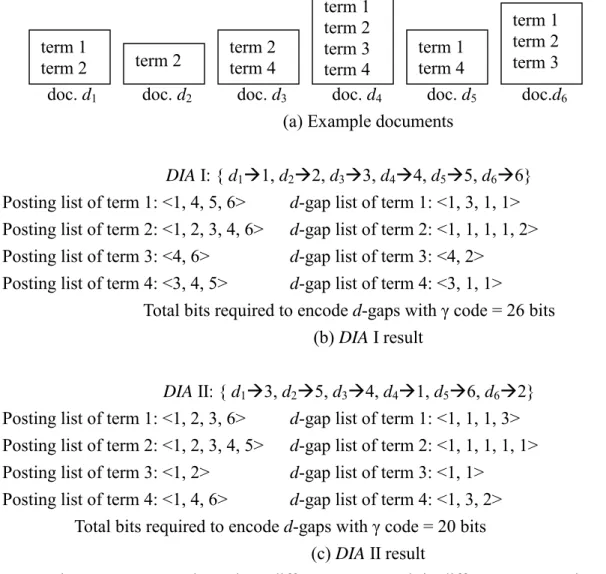
doc. d1 doc. d2 doc. d3 doc. d4 doc. d5 doc.d6 (a) Example documents
DIA I: { d1Æ1, d2Æ2, d3Æ3, d4Æ4, d5Æ5, d6Æ6} Posting list of term 1: <1, 4, 5, 6> d-gap list of term 1: <1, 3, 1, 1> Posting list of term 2: <1, 2, 3, 4, 6> d-gap list of term 2: <1, 1, 1, 1, 2> Posting list of term 3: <4, 6> d-gap list of term 3: <4, 2>
Posting list of term 4: <3, 4, 5> d-gap list of term 4: <3, 1, 1>
Total bits required to encode d-gaps with γ code = 26 bits (b) DIA I result
DIA II: { d1Æ3, d2Æ5, d3Æ4, d4Æ1, d5Æ6, d6Æ2} Posting list of term 1: <1, 2, 3, 6> d-gap list of term 1: <1, 1, 1, 3> Posting list of term 2: <1, 2, 3, 4, 5> d-gap list of term 2: <1, 1, 1, 1, 1> Posting list of term 3: <1, 2> d-gap list of term 3: <1, 1>
Posting list of term 4: <1, 4, 6> d-gap list of term 4: <1, 3, 2> Total bits required to encode d-gaps with γ code = 20 bits
(c) DIA II result
Figure 1. An example to show different DIAs result in different compression results
d-gap value x γ code 1 0 2 10 0 3 10 1 4 110 00
Table1. Some example codes for γ coding term 1 term 2 term 2 term 2 term 4 term 1 term 2 term 3 term 4 term 1 term 4 term 1 term 2 term 3
One common characteristic of coding methods used in the d-gap compression approach is that small d-gap values can be coded more economically than large ones. If we can shrink the d-gap values, the compression ratio and query performance can be improved. Consider a document collection of 6 documents shown in Figure 1(a). Each document contains one or more terms. For example, the document d1 contains term 1 and term 2, document d2 contains term 2, etc. In Figures1(b) and 1(c), the notation diÆj in DIAs I and II denotes that the document identifier j is
assigned to the document di. According to the documents in Figure 1(a) and the DIAs I and II, the
obtained posting lists and d-gap lists are shown in Figures 1(b) and 1(c). For DIA I, the d-gap values have nine 1s, two 2s, two 3s and one 4; whereas for DIA II, the d-gap values have eleven 1s, one 2 and two 3s. With γ coding in Table1, the compressed inverted file requires 26 bits for DIA I, whereas it requires 20 bits for DIA II. If every term is queried with equal probability, the query processing costs for DIA II will be much lower than that of DIA I. This is because DIA II can result in better compression for the given coding method without increasing the complexity of decoding process, hence improve query throughput by reducing both the retrieval and decompression times of posting lists. This example shows that different DIAs can result in different compression results and different query throughputs for a given coding method. In next section, we will introduce a query cost function for the DIA problem, and then derive a method to find a good DIA to shorten average query processing time when the probability distribution of query terms is given.
3. Document identifier assignment problem and its algorithm
The DIA problem is the problem of assigning document identifiers to a set of documents in an inverted file-based IRS in order to minimize the average query processing time when the probability distribution of query terms is given. In this section, we first formalize the problem, and then show how to use the well-known greedy nearest neighbor (Greedy-NN) algorithm to solve this problem.
3.1 Problem mathematical formulation
Let D={d1, d2, …,dN} be a collection of N documents to be indexed, and π :{ d1, d2, …,
dN }Æ{1, 2, …, N} be a DIA that assigns a unique identifier within the range 1…N to each
document in D. Let ft be the total number of documents in which term t appears and dt(1), dt(2), …,
dt(ft) be documents containing term t, then the posting list of the term t can be represented as ILt=<π(dt(1)), π(dt(2)),…, π(dt(ft))>. Without loss of generality, we assume that π(dt(1))<π(dt(2))<…<
π(dt(ft)). Assume a coding method C which requires C(x) bits to encode a d-gap x. The size of a posting list ILt for term t can then be expressed as
)) ( ) ( ( () ( 1) 1 − = −
∑
ti ti ft i d d C π π (1)where we let dt(0)=0 and π(dt(0))=0 to simplify the expression of Eq.(1). Assume that the probability
of a term t appearing in a query is pt. Let Xt be a random Boolean variable representing whether
term t appears in a query: Xt=1 if term t appears in a query and Xt=0 otherwise. The query
ILt for each query term t, (2) decompression time TimeD of posting list ILt for each query term t,
and (3) document identifier comparison time TimeComp. Since the document identifier comparison
time is relatively small (about 10% of query processing time) and does not change with different
DIAs, the query processing time in this paper is defined only as
)) ( ) ( ( R t D t t t QP X Time IL Time IL Time =
∑
× + (2)The average query processing time AvgTimeQP is the expected value of TimeQP. That is,
∑
× + = t t D t R t QP p Time IL Time IL AvgTime ( ( ) ( )) (3)Since the disk transfer rate is near constant and the decoding processes of most coding methods used in d-gap compression approach are on a bit-by-bit basis, the retrieval and decompression times of a posting list ILt for the term t appearing in a query grows with the size of the posting list
ILt. So
∑
= − − × = + ft i i t i t t D t R IL Time IL C d d Time 1 ) 1 ( ) ( ) ( )) ( ( constant ) ( ) (π
π
(4)Substituting Eq.(4) into Eq.(3), we obtain
∑
∑
= − − × × = t f i i t i t t QP t d d C p AvgTime 1 ) 1 ( ) ( ) ( )) ( ( constantπ
π
(5) We thus define the objective function Cost(π) to reflect the average query processing timeAvgTimeQP :
∑
∑
= − − × = t f i i t i t t t d d C p Cost 1 ) 1 ( ) ( ) ( )) ( ( ) (π
π
π
(6)The objective of this research is to find a DIA π : DÆ{1,2,3…,N} such that Cost(π) is minimal. This optimization problem is called the DIA problem, and it is reduced to the simple DIA (SDIA) problem if the value of pt for each term t is set to 1. The SDIA problem is the problem of finding a
DIA to minimize the size of inverted file, and it is known to be NP-complete via a reduction to the
rectilinear traveling salesman problem (Olken & Rotem 1986). Since the DIA problem is a generalization of the SDIA problem, the DIA problem is also a NP-complete problem.
3.2 Solving DIA problem via the well-known Greedy-NN algorithm
Shieh et al. (2003) showed that the SDIA problem can be solved by using TSP heuristic algorithms. Given a collection of N documents, a document similarity graph (DSG) can be constructed. In a DSG, each vertex represents a document, and the weight on an edge between two vertices represents the similarity of these two corresponding documents. The similarity Sim(di, dj)
between two documents di and dj is defined as:
(
∑
∩ ) ∈ = ) ( ) ( 1 ) , ( j i T d d T t j i d d Sim (7)where T(di) and T(dj) denote the set of terms appearing in di and dj, respectively, and ∩ denotes the
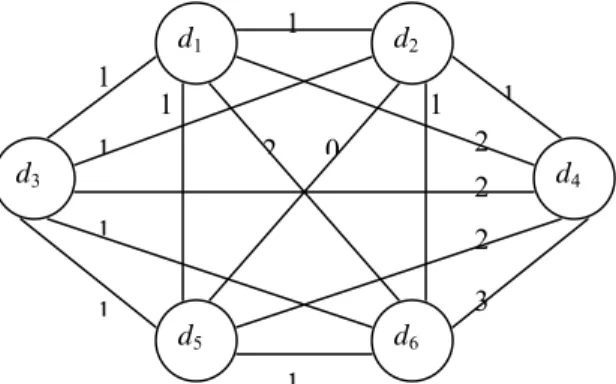
terms appearing in both documents. The DSG for the example documents in Figure 1(a) is shown in Figure 2. A TSP heuristic algorithm can then be used to find a path of the DSG visiting each vertex exactly once with maximal sum of similarities. If we follow the visiting order of vertices on the path to assign document identifiers, the sum of d-gap values for an inverted file can be decreased, and the size of inverted file compressed via the d-gap compression approach can be reduced. Shieh et al. (2003) showed that the Greedy-NN algorithm (Figure 3) can provide excellent performance for the SDIA problem.
Figure 2. DSG for the example documents in Figure 1(a).
Algorithm Greedy_nearest_neighbor
Input:
D={d1, d2, …, dN}: a collection of N documents to be indexed.
Output:
A TSP path: the visiting order of vertices is
{
v1,v2,...,vn}
Method:
1. Construct the DSG(V, E), where V is a set of vertices (in which each vertex represents a document) and E is a set of edges (in which each edge has a similarity value associated with it);
2. Pick a vertex v∈V as v1 such that the sum of similarity values associated with the adjacent
edges of v is maximal; 3. V′:=V −{v1}; i:=1;
4. Find v in V′ such that the similarity value of the edge (v,vi) is maximal: if more than one
such vertex exist, select one randomly; 5. };i:=i+1; vi :=v; V′:=V′−{vi
6. If i<N then goto 3;
7. Output a TSP path with its visiting order of vertices being
{
v1,v2,...,vn}
Figure 3. The Greedy-NN algorithm for the SDIA problem
Using the same approach, The DIA problem can be solved using the Greedy-NN algorithm described in Figure 3, if the similarity Sim(di, dj) between two documents di and dj in a DSG is
redefined as: (
∑
∩ ) ∈ = ) ( ) ( ) , ( j i T d d T t t j i d p d Sim (8)where the probability of a term t appearing in a query is known to be pt.
Although the Greedy-NN algorithm is very simple to implement, it is not very applicable to
1 d1 d2 d3 d4 d6 d5 1 1 1 1 1 1 1 3 2 2 2 1 2 0
large-scale IRSes due to its high complexity. Given a collection of N documents and n distinct terms, the number of comparisons for calculating Sim(di,dj) given fixed i and j is O(n), hence the
total number of comparisons to construct a DSG for the Greedy-NN algorithm is O(N2×n). An
algorithm with lower complexity yet still generates satisfactory results should be developed.
4. Partition-based document identifier assignment algorithm
Since the DIA problem is an NP-complete problem, the effort in search for an effective low-complexity method is needed. Although the Greedy-NN algorithm can be used to solve the
DIA problem, its complexity is too high. In this section, we first present an optimal DIA algorithm
for a single query term, and then propose an efficient partition-based document identifier
assignment (PBDIA) algorithm for the DIA problem. 4.1 Generating an optimal DIA for a single query term
Consider a posting list ILt for term t with ft document identifiers in a collection of N
documents. Using the d-gap technique, we can obtain ft d-gap values: d-gap1, d-gap2,…, d-gapft.
Assume a coding method C which requires C(x) bits to encode a d-gap x. We want to know which
d-gap probability distribution can minimize the size of posting list ILt after compression using
method C. That is, we want to know which d-gap probability distribution can minimize
∑
= t f i i d-gap C 1 ) ( (9) subject to k d-gap f t f i i t ≤∑
≤ =1 and (10) k d-gapi ≤ ≤ 1 for all i, 1≤i≤k (11)where k is the largest document identifier in the posting list ILt. It is known that C(x) is
approximately proportional to log2(x) for many popular coding methods, such as γ coding, skewed
Golomb coding, and batched LLRUN coding. For these coding methods, we can use dynamic programming technique (Bellman and Dreyfus 1962) and find that minimizing Eq.(11) should meet two requirements: (1) maximize the number of d-gap values of 1; and (2) minimize the largest document identifier, i.e., k, in the posting list ILt. If a DIA for term t can satisfy the above
two requirements, the best compression and the fastest query speed for the posting list ILt can be
achieved.
According to the above observation, we propose the simple partition-based document
identifier assignment (SPBDIA) algorithm to generate optimal DIAs for a given query term t. The SPBDIA algorithm consists of a partitioning procedure, an ordering procedure, and a document
identifier assignment procedure. The partitioning procedure divides the given documents into two partitions in terms of query term t: one partition P(t) consists of documents containing query term
t ; the other partition P(t') is made up of the documents without t. Then, the ordering procedure sets
the order of partitions as P(t) followed by P(t'). Finally, the document identifier assignment procedure generates an appropriate DIA for the ordered partitions according to query term t: the
documents in partition P(t) are assigned smaller consecutive document identifiers, while the documents in partition P(t') assigned larger consecutive document identifiers. The SPBDIA algorithm is illustrated in the following Example.
Example. There is a collection of 500 documents, among which 300 documents contain query
term t. After partitioning, P(t) has 300 documents and P(t') has 200 documents. Then, the ordering procedure sets the order of partitions P(t) followed by P(t'). Finally, the document identifier assignment procedure assigns the document identifiers 1~300 to the 300 documents in partition P(t) and assigns the document identifiers 301~500 to the 200 documents in partition P(t'). ■
Documents in a partition can be arbitrarily assigned identifiers within the given range, hence the
number of possible DIAs for the above Example is 300!×200!. Each of the 300!×200! DIAs
satisfies the two requirements for minimizing Eq.(9), and hence gives both the best posting list compression and fastest query speed for query term t. The SPBDIA algorithm is simple, and its complexity is O(N).
4.2 Efficient partition-based document identifier assignment algorithm for DIA problem
In a real-world IRS, a few frequently used query terms constitute a large portion of all term occurrences in queries (Jansen et al. 1998). Based on this fact, we assess that a DIA algorithm that allows those frequently used query terms to have better posting list compression can result in reduced average query processing time. Based on the SPBDIA algorithm, an efficient
partition-based document identifier assignment (PBDIA) algorithm for the DIA problem can be
developed.
Like the SPBDIA algorithm, the PBDIA algorithm also partitions the document set, orders these partitions, and then assigns document identifiers. The partitioning and ordering procedures of the PBDIA algorithm iterate n times given that there are n query terms. Then, the document identifier assignment procedure is performed as the last step of the PBDIA algorithm. Terms that are queried more frequently should take higher priority in document partitioning and partition ordering.
The PBDIA algorithm is given in Figure 4. A doubly linked list is used to store the partitions, and the two links of a partition maintain the ordering among these partitions. Given a collection of N documents and n distinct query terms, the number of comparisons for assigning documents to partitions in each iteration is O(N). Since the PBDIA algorithm iterates for n times,
the total number of comparisons for the PBDIA algorithm is O(N×n). Compared with the
Greedy-NN algorithm, this complexity of PBDIA algorithm is distinctively low. This advantage
brings the PBDIA algorithm a dark side, of course. Although the PBDIA algorithm targets on improving the compression efficiency for the frequently used query terms, it unavoidably decreases that for the other query terms. In reality, it is often the case that the popularities of the assorted query terms are very unbalanced. And this imbalance nature makes the PBDIA algorithm achieve very good query performance. In Section 5, we compare the search performance of the
Algorithm Partition_based_document_identifier_assignment
Input:
D={d1, d2, …, dN}: a collection of N documents to be indexed.
T={t1, t2, …, tn}: a set of n distinct terms appearing in D.
Prob={p1, p2, …, pn}: pi denotes the probability of the term ti∈T appearing in a query.
Output:
A document identifier assignment π :{ d1, d2, …, dN }Æ{1, 2, …, N} for the DIA.
Method:
1. Create an empty doubly linked list PartList; // to store partition 2. Create an empty doubly linked list TempList; //to store partition pairs 3. Assign all documents in D to a new partition P, and add P to the PartList;
4. Sort the terms in T in descending order according to their probabilities. Let trank1, trank2, …, trankn
represent the sorted list. 5. for i:=1 to n do
5.1 while PartList is not empty do /*partitioning procedure*/
5.1.1 Get a partition P from the head of PartList, and then remove P from PartList; 5.1.2 // At least one of the partitions P(tranki)and P(tranki') should be nonempty
Let P(tranki) be the partition containing the documents that are included in P and do
contain the term tranki ; let P(tranki') be the partition containing the documents that are
included in P and do not contain the term tranki ;
5.1.3 Add the partition pair {P(tranki),P(tranki')} to the tail of TempList;
5.2 while TempList is not empty do /*ordering procedure*/
5.2.1 Get a partition pair {P(tranki),P(tranki')} from the tail of TempList, and then remove
{P(tranki),P(tranki')} from TempList;
5.2.2 if P(tranki) is empty then add P(tranki') to the front of PartList and go to step 5.2;
5.2.3 if P(tranki') is empty then add P(tranki) to the front of PartList and go to step 5.2;
5.2.4 if PartList is empty then
Add P(tranki') to the PartList; add P(tranki) to the front of PartList;
else //PartList is not empty
Get a partition P from the head of PartList, and get a document d∈P ; if the document d contain the term trankithen
Add P(tranki) to the front of PartList; add P(tranki') to the front of PartList;
else // thedocument d does not contain the term tranki
Add P(tranki') to the front of PartList; add P(tranki) to the front of PartList;
6. i:=1;
7. while PartList is not empty do /*document identifier assignment procedure*/
7.1 Get a partition P from the head of PartList, and then remove P from PartList; 7.2 while P is not empty do
7.2.1 Get a document d∈P, and remove d from P;
7.2.2 Assign document identifier i to the document d, and then i:=i+1; Figure 4. The PBDIA algorithm for the DIA problem
5. Experiments
This section describes our experiments for evaluating the different DIA algorithms. Experiments were conducted on real-life document collections, and the average query processing
time and the storage requirement for each DIA algorithm were measured. We also investigated the
DIA problem in parallel IR.
5.1 Document collections and queries
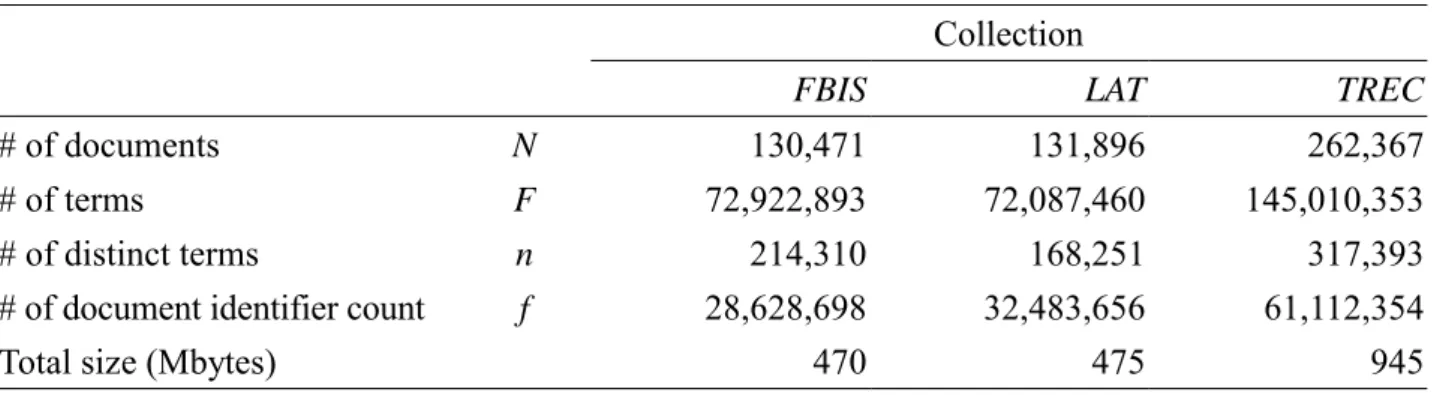
Three document collections were used in the experiments. Their statistics are listed in Table 2. In this table, N denotes the number of documents; n is the number of distinct terms; F is the total number of terms in the collection; and f indicates the number of document identifiers that appear in an inverted file. The collections FBIS (Foreign Broadcast Information Service) and LAT (LA Times) are disk 5 of the TREC-6 collection that is used internationally as a test bed for research in IR techniques (Voorhees and Harman 1997). The collection TREC includes the FBIS and LAT.
Table 2. Statistics of document collections
Collection
FBIS LAT TREC
# of documents N 130,471 131,896 262,367
# of terms F 72,922,893 72,087,460 145,010,353
# of distinct terms n 214,310 168,251 317,393
# of document identifier count f 28,628,698 32,483,656 61,112,354
Total size (Mbytes) 470 475 945
We followed the method (Moffat & Zobel 1996) to evaluate performance with random queries. For each document collection, 300 documents were randomly selected to generate a query set. A query was generated by selecting words from the word list of a specific document. To form the word list of a document, words in the document were folded to lower case, and stop words such as “the” and “this” were eliminated. The number of terms per query ranged from 1 to 65. For each query, there existed at least one document in the document collection that is relevant to the query. We also made the generated query set for each document collection have the following characteristics: (1) Query repetition frequencies followed a Zipf distribution; (2) The terms per query distribution followed the shifted negative binomial distribution. This made the distribution of generated queries closely resemble the distribution of real queries (Xie & O’Hallaron 2002; Wolfram 1992).
5.2 Experimental results
In Section 5.2.1, we first present the actual times taken by the Greedy-NN and the PBDIA algorithms. In Section 5.2.2, we then present the query performance of different DIA algorithms. In Section 5.2.3, we present the compression performance of different DIA algorithms. Finally, we study the DIA problem in parallel IR in Section 5.2.4.
The inverted files of the three test collections were constructed according to the DIAs generated by different DIA algorithms. We tested four different DIA algorithms: “Random”,
“Default”, “Greedy-NN”, and “PBDIA”. The Random algorithm means that the document in a collection is randomly assigned document identifier. The Default algorithm means that the document in a collection is assigned document identifier in chronological order. The Greedy-NN and PBDIA algorithms were described in Section 3.2 and Section 4.2, respectively. For each DIA algorithm, we also tested five coding methods: γ coding (Elias 1975), Golomb coding (Golomb 1966; Witten et al. 1999), skewed Golomb coding (Teuhola 1978), batched LLRUN coding (Fraenkel & Klein 1985), and unique-order interpolative coding method (Cheng et al. 2004). For the following experiments, the parameter b for each posting list in Golomb coding was calculated using Witten’s approximation (Witten et al. 1999), and the parameter g for unique-order interpolative coding was set to 4 (Cheng et al. 2004).
All experiments were run on an Intel P4 2.4GHz PC with 512MB DDR memory running Linux operating system 2.4.12. The hard disk was 40GB, and the data transfer rate was 25MB/sec. Intervening processes and disk activities were minimized during experimentation.
5.2.1 Time taken by Greedy-NN and PBDIA algorithms
In Table 3, the performance in terms of completion time is shown. The times reported are the actual times taken by the algorithms to generate a DIA for the given document collection that has been inverted. Please note that the times presented in Table 3 consider neither the time spent in preliminary inversion of the document collection, nor the time needed to rebuild an inverted file with a new DIA.
Table 3 shows that the PBDIA algorithm is much faster than the Greedy-NN algorithm. This fact makes the PBDIA algorithm viable for use in large-scale IRSes. Such a fast DIA algorithm can be very useful for situations such as:
1. Dynamically changing probability distribution of query terms, and 2. Dynamically changing document collection.
Table 3. Time consumed by the Greedy-NN and the PBDIA algorithms Collection
DIA algorithm
FBIS LAT TREC Greedy-NN 23 hrs 59 mins 24 hrs 37 mins 198 hrs 2 mins
PBDIA 9 secs 10 secs 18 secs
5.2.2 Query performance of different DIA algorithms
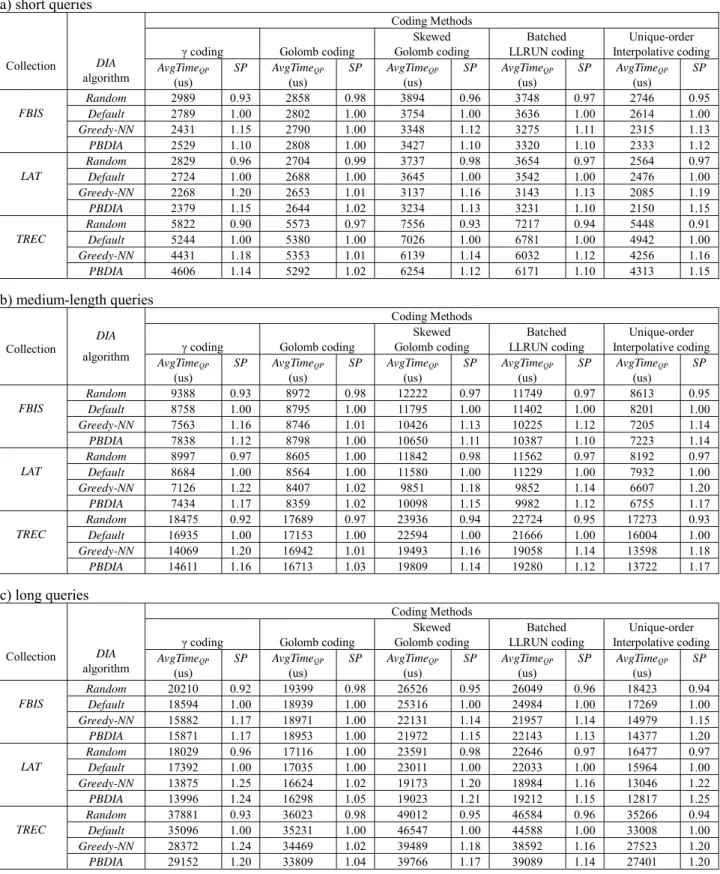
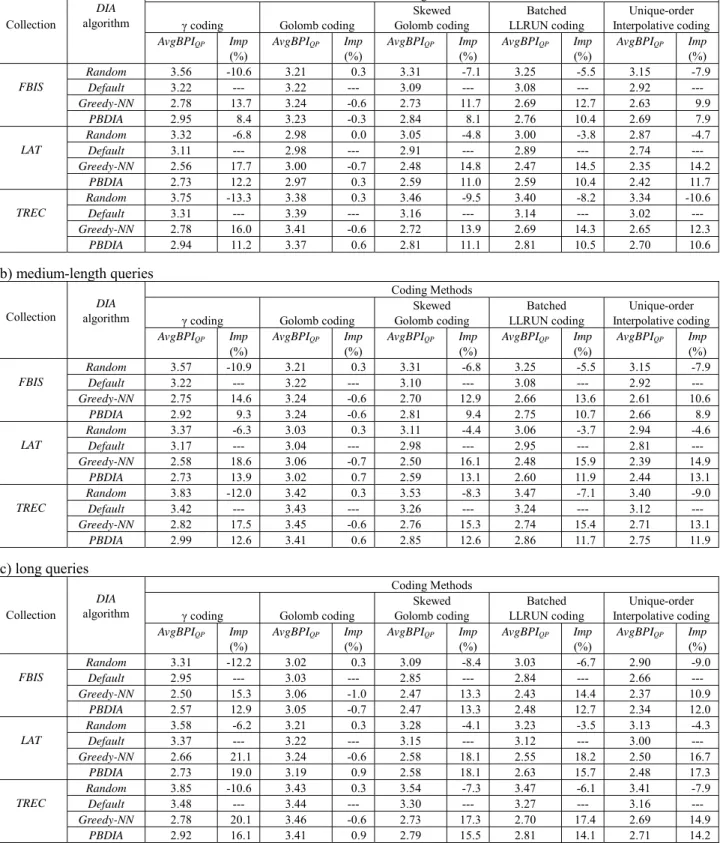
In Table 4, the average query processing time (AvgTimeQP) and the speedup relative to the
Default algorithm (SP) were measured according to Eq.(3). In Table 5, the average number of bits
required to retrieve and decode an identifier during query processing (AvgBPIQP) and the
improvement over the Default algorithm (Imp) were measured according to Eq.(6). For each document collection, the generated query set was divided into three subsets: the short query set, the medium-length query set, and the long query set. The number of terms per query for the short,
medium-length, and long query sets range from 1 to 8, 9 to 20, and 21 to 65, respectively. All decoding mechanisms were optimized, including:
1. Replaced subroutines with macros.
2. Replaced calls to the log function with fast bit shifts. 3. Careful choice for compiler optimization flags.
4. Implementation used 32-bit integers, as that is the internal register size of the Intel P4 CPU. Furthermore, the Huffman code of batched LLRUN coding was implemented with canonical prefix codes that can be decoded via a fast table look-up (Turpin 1998). With these optimizations, decoding of a document identifier only required tens of ns.
The experimental results are shown in Tables 4 and 5. Key findings are:
1. Table 4 shows that the query performance of the Default algorithm can be 10% faster than the
Random algorithm. This indicates that the Default algorithm already captures some clustering
nature, thus can serve as a rigid baseline in comparison with other fine-tuned algorithms.
2. Comparing Tables 4 and 5, one should observe that AvgTimeQP is proportional to AvgBPIQP.
This verifies Eq. (4) in Section 3.1, and explains why a good DIA can result in better compression and reduced query processing time.
3. From Table 5, one should observe that both the Greedy-NN and PBDIA algorithms can result in better compression of posting lists for all tested coding methods except Golomb coding. This indicates that the Greedy-NN and PBDIA algorithms can improve the cache efficiency if a posting list cache is implemented.
4. Table 4 shows that both the Greedy-NN and PBDIA algorithms can reduce average query processing time for all tested coding methods except Golomb coding. And the query speedup differences between the Greedy-NN and PBDIA algorithms were only 3% on average. Considering the algorithm complexity, the PBDIA algorithm is a good choice for the DIA problem.
5. From Table 4, one should observe that Golomb coding cannot benefit much from the
Greedy-NN and PBDIA algorithms in terms of query performance. This is because Golomb
coding assumes that the d-gap values in a posting list following a Bernoulli model (Witten et al. 1999), hence both the compression result and the query processing time of Golomb coding are independent of d-gap distribution.
6. From Table 4, one should observe that the query speedup obtained by the PBDIA algorithm becomes higher as the query length increases. This is because that, as the number of query terms increases, more frequently used query terms are likely to be included, resulting in more advantage due to the PBDIA algorithm.
7. Table 4 shows that both γ coding and unique-order interpolative coding are recommended for real-world IRSes due to their fast query throughputs. In addition, compared with the other tested coding methods, these two coding methods benefit more from the PBDIA algorithm. We conclude that the PBDIA algorithm is viable for use in real-world IRSes.
Table 4. Query performance of different DIA algorithms (AvgTimeQP is the average query
processing time, and SP is the speedup relative to the Default algorithm)
(a) short queries
Coding Methods γ coding Golomb coding
Skewed Golomb coding Batched LLRUN coding Unique-order Interpolative coding Collection DIA
algorithm AvgTime(us) QP SP AvgTime(us) QP SP AvgTime(us) QP SP AvgTime(us) QP SP AvgTime(us) QP SP
Random 2989 0.93 2858 0.98 3894 0.96 3748 0.97 2746 0.95 Default 2789 1.00 2802 1.00 3754 1.00 3636 1.00 2614 1.00 Greedy-NN 2431 1.15 2790 1.00 3348 1.12 3275 1.11 2315 1.13 FBIS PBDIA 2529 1.10 2808 1.00 3427 1.10 3320 1.10 2333 1.12 Random 2829 0.96 2704 0.99 3737 0.98 3654 0.97 2564 0.97 Default 2724 1.00 2688 1.00 3645 1.00 3542 1.00 2476 1.00 Greedy-NN 2268 1.20 2653 1.01 3137 1.16 3143 1.13 2085 1.19 LAT PBDIA 2379 1.15 2644 1.02 3234 1.13 3231 1.10 2150 1.15 Random 5822 0.90 5573 0.97 7556 0.93 7217 0.94 5448 0.91 Default 5244 1.00 5380 1.00 7026 1.00 6781 1.00 4942 1.00 Greedy-NN 4431 1.18 5353 1.01 6139 1.14 6032 1.12 4256 1.16 TREC PBDIA 4606 1.14 5292 1.02 6254 1.12 6171 1.10 4313 1.15 (b) medium-length queries Coding Methods γ coding Golomb coding
Skewed Golomb coding Batched LLRUN coding Unique-order Interpolative coding Collection DIA algorithm AvgTime QP (us) SP AvgTimeQP (us) SP AvgTimeQP (us) SP AvgTimeQP (us) SP AvgTimeQP (us) SP Random 9388 0.93 8972 0.98 12222 0.97 11749 0.97 8613 0.95 Default 8758 1.00 8795 1.00 11795 1.00 11402 1.00 8201 1.00 Greedy-NN 7563 1.16 8746 1.01 10426 1.13 10225 1.12 7205 1.14 FBIS PBDIA 7838 1.12 8798 1.00 10650 1.11 10387 1.10 7223 1.14 Random 8997 0.97 8605 1.00 11842 0.98 11562 0.97 8192 0.97 Default 8684 1.00 8564 1.00 11580 1.00 11229 1.00 7932 1.00 Greedy-NN 7126 1.22 8407 1.02 9851 1.18 9852 1.14 6607 1.20 LAT PBDIA 7434 1.17 8359 1.02 10098 1.15 9982 1.12 6755 1.17 Random 18475 0.92 17689 0.97 23936 0.94 22724 0.95 17273 0.93 Default 16935 1.00 17153 1.00 22594 1.00 21666 1.00 16004 1.00 Greedy-NN 14069 1.20 16942 1.01 19493 1.16 19058 1.14 13598 1.18 TREC PBDIA 14611 1.16 16713 1.03 19809 1.14 19280 1.12 13722 1.17 (c) long queries Coding Methods γ coding Golomb coding
Skewed Golomb coding Batched LLRUN coding Unique-order Interpolative coding Collection DIA
algorithm AvgTime(us) QP SP AvgTime(us) QP SP AvgTime(us) QP SP AvgTime(us) QP SP AvgTime(us) QP SP
Random 20210 0.92 19399 0.98 26526 0.95 26049 0.96 18423 0.94 Default 18594 1.00 18939 1.00 25316 1.00 24984 1.00 17269 1.00 Greedy-NN 15882 1.17 18971 1.00 22131 1.14 21957 1.14 14979 1.15 FBIS PBDIA 15871 1.17 18953 1.00 21972 1.15 22143 1.13 14377 1.20 Random 18029 0.96 17116 1.00 23591 0.98 22646 0.97 16477 0.97 Default 17392 1.00 17035 1.00 23011 1.00 22033 1.00 15964 1.00 Greedy-NN 13875 1.25 16624 1.02 19173 1.20 18984 1.16 13046 1.22 LAT PBDIA 13996 1.24 16298 1.05 19023 1.21 19212 1.15 12817 1.25 Random 37881 0.93 36023 0.98 49012 0.95 46584 0.96 35266 0.94 Default 35096 1.00 35231 1.00 46547 1.00 44588 1.00 33008 1.00 Greedy-NN 28372 1.24 34469 1.02 39489 1.18 38592 1.16 27523 1.20 TREC PBDIA 29152 1.20 33809 1.04 39766 1.17 39089 1.14 27401 1.20
Table 5. AvgBPIQP of different DIA algorithms (AvgBPIQP is the average number of bits required to
retrieve and decode an identifier during query processing, and Imp is the improvement over the
Default algorithm)
(a) short queries
Coding Methods γ coding Golomb coding
Skewed Golomb coding Batched LLRUN coding Unique-order Interpolative coding Collection DIA algorithm AvgBPIQP Imp (%) AvgBPIQP Imp (%) AvgBPIQP Imp (%) AvgBPIQP Imp (%) AvgBPIQP Imp (%) Random 3.56 -10.6 3.21 0.3 3.31 -7.1 3.25 -5.5 3.15 -7.9 Default 3.22 --- 3.22 --- 3.09 --- 3.08 --- 2.92 --- Greedy-NN 2.78 13.7 3.24 -0.6 2.73 11.7 2.69 12.7 2.63 9.9 FBIS PBDIA 2.95 8.4 3.23 -0.3 2.84 8.1 2.76 10.4 2.69 7.9 Random 3.32 -6.8 2.98 0.0 3.05 -4.8 3.00 -3.8 2.87 -4.7 Default 3.11 --- 2.98 --- 2.91 --- 2.89 --- 2.74 --- Greedy-NN 2.56 17.7 3.00 -0.7 2.48 14.8 2.47 14.5 2.35 14.2 LAT PBDIA 2.73 12.2 2.97 0.3 2.59 11.0 2.59 10.4 2.42 11.7 Random 3.75 -13.3 3.38 0.3 3.46 -9.5 3.40 -8.2 3.34 -10.6 Default 3.31 --- 3.39 --- 3.16 --- 3.14 --- 3.02 --- Greedy-NN 2.78 16.0 3.41 -0.6 2.72 13.9 2.69 14.3 2.65 12.3 TREC PBDIA 2.94 11.2 3.37 0.6 2.81 11.1 2.81 10.5 2.70 10.6 (b) medium-length queries Coding Methods γ coding Golomb coding
Skewed Golomb coding Batched LLRUN coding Unique-order Interpolative coding Collection algorithm DIA
AvgBPIQP Imp (%) AvgBPIQP Imp (%) AvgBPIQP Imp (%) AvgBPIQP Imp (%) AvgBPIQP Imp (%) Random 3.57 -10.9 3.21 0.3 3.31 -6.8 3.25 -5.5 3.15 -7.9 Default 3.22 --- 3.22 --- 3.10 --- 3.08 --- 2.92 --- Greedy-NN 2.75 14.6 3.24 -0.6 2.70 12.9 2.66 13.6 2.61 10.6 FBIS PBDIA 2.92 9.3 3.24 -0.6 2.81 9.4 2.75 10.7 2.66 8.9 Random 3.37 -6.3 3.03 0.3 3.11 -4.4 3.06 -3.7 2.94 -4.6 Default 3.17 --- 3.04 --- 2.98 --- 2.95 --- 2.81 --- Greedy-NN 2.58 18.6 3.06 -0.7 2.50 16.1 2.48 15.9 2.39 14.9 LAT PBDIA 2.73 13.9 3.02 0.7 2.59 13.1 2.60 11.9 2.44 13.1 Random 3.83 -12.0 3.42 0.3 3.53 -8.3 3.47 -7.1 3.40 -9.0 Default 3.42 --- 3.43 --- 3.26 --- 3.24 --- 3.12 --- Greedy-NN 2.82 17.5 3.45 -0.6 2.76 15.3 2.74 15.4 2.71 13.1 TREC PBDIA 2.99 12.6 3.41 0.6 2.85 12.6 2.86 11.7 2.75 11.9 (c) long queries Coding Methods γ coding Golomb coding
Skewed Golomb coding Batched LLRUN coding Unique-order Interpolative coding Collection DIA algorithm AvgBPIQP Imp (%) AvgBPIQP Imp (%) AvgBPIQP Imp (%) AvgBPIQP Imp (%) AvgBPIQP Imp (%) Random 3.31 -12.2 3.02 0.3 3.09 -8.4 3.03 -6.7 2.90 -9.0 Default 2.95 --- 3.03 --- 2.85 --- 2.84 --- 2.66 --- Greedy-NN 2.50 15.3 3.06 -1.0 2.47 13.3 2.43 14.4 2.37 10.9 FBIS PBDIA 2.57 12.9 3.05 -0.7 2.47 13.3 2.48 12.7 2.34 12.0 Random 3.58 -6.2 3.21 0.3 3.28 -4.1 3.23 -3.5 3.13 -4.3 Default 3.37 --- 3.22 --- 3.15 --- 3.12 --- 3.00 --- Greedy-NN 2.66 21.1 3.24 -0.6 2.58 18.1 2.55 18.2 2.50 16.7 LAT PBDIA 2.73 19.0 3.19 0.9 2.58 18.1 2.63 15.7 2.48 17.3 Random 3.85 -10.6 3.43 0.3 3.54 -7.3 3.47 -6.1 3.41 -7.9 Default 3.48 --- 3.44 --- 3.30 --- 3.27 --- 3.16 --- Greedy-NN 2.78 20.1 3.46 -0.6 2.73 17.3 2.70 17.4 2.69 14.9 TREC PBDIA 2.92 16.1 3.41 0.9 2.79 15.5 2.81 14.1 2.71 14.2
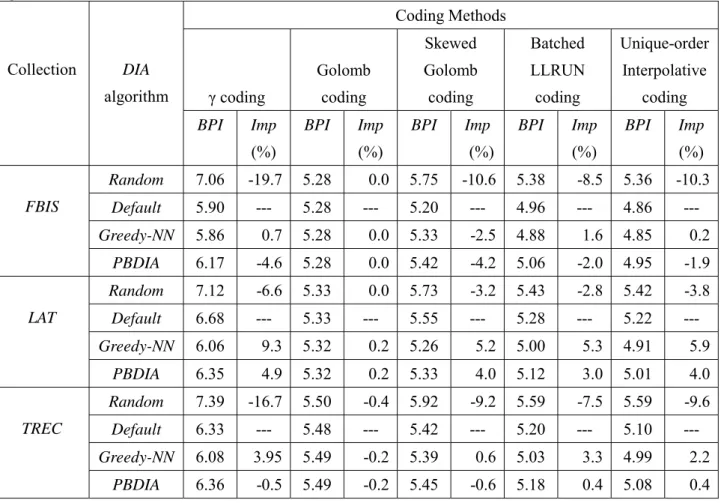
5.2.3 Compression performance of different DIA algorithms
The compression results are shown in Table 6, and the metric used is the average number of
bits per identifier BPI, defined as follows:
f BPI identfiers document of number file inverted compressed the of size The = .
To reduce average query processing time, both the Greedy-NN and PBDIA algorithms target on improving the compression efficiency for the frequently used query terms. However, this is at the cost of sacrificing the compression efficiency for the less frequently used query terms. We need to know how much space overhead is needed to trade for this speed advantage. Results in Table 6 show that the Greedy-NN and PBDIA algorithms can speed up query processing with very little or no storage overhead.
Table 6. Compression performance of different DIA algorithms (BPI is the average bits per identifier of the inverted file for the test collection, and Imp is the improvement over the Default algorithm) Coding Methods γ coding Golomb coding Skewed Golomb coding Batched LLRUN coding Unique-order Interpolative coding Collection DIA algorithm BPI Imp (%) BPI Imp (%) BPI Imp (%) BPI Imp (%) BPI Imp (%) Random 7.06 -19.7 5.28 0.0 5.75 -10.6 5.38 -8.5 5.36 -10.3 Default 5.90 --- 5.28 --- 5.20 --- 4.96 --- 4.86 --- Greedy-NN 5.86 0.7 5.28 0.0 5.33 -2.5 4.88 1.6 4.85 0.2 FBIS PBDIA 6.17 -4.6 5.28 0.0 5.42 -4.2 5.06 -2.0 4.95 -1.9 Random 7.12 -6.6 5.33 0.0 5.73 -3.2 5.43 -2.8 5.42 -3.8 Default 6.68 --- 5.33 --- 5.55 --- 5.28 --- 5.22 --- Greedy-NN 6.06 9.3 5.32 0.2 5.26 5.2 5.00 5.3 4.91 5.9 LAT PBDIA 6.35 4.9 5.32 0.2 5.33 4.0 5.12 3.0 5.01 4.0 Random 7.39 -16.7 5.50 -0.4 5.92 -9.2 5.59 -7.5 5.59 -9.6 Default 6.33 --- 5.48 --- 5.42 --- 5.20 --- 5.10 --- Greedy-NN 6.08 3.95 5.49 -0.2 5.39 0.6 5.03 3.3 4.99 2.2 TREC PBDIA 6.36 -0.5 5.49 -0.2 5.45 -0.6 5.18 0.4 5.08 0.4 5.2.4 DIA in parallel IR
This subsection investigates the DIA problem in an IRS that runs on a cluster of workstations. Assuming k workstations, the inverted file is generally partitioned into k disjoint sub-files, each for one workstation. When processing a query, all workstations have to consult only their own sub-files in parallel, and the query processing time is shortened. Ma et al. (2002)
indicated that near-ideal speedup on query processing can be obtained if an inverted file is partitioned using the interleaving partitioning scheme. For such a partitioning, DIA plays a crucial role in load balancing. The PDBIA algorithm can be applied to the inverted file to enhance the clustering property of posting lists for frequently used query terms, and can aid the interleaving partitioning scheme to yield better load balancing.
Table 7 shows the performance of parallel query processing using interleaving partitioning scheme with either the Default algorithm or the PBDIA algorithm. The metric is the speedup relative to sequential query processing with Default algorithm. Experiments were conducted on the
TREC collection. The sub-file on each workstation was compressed using the unique-order
interpolative coding method. The parallel query processing time was defined as max[T1,T2,…,Tk],
where Ti (1≤i≤k) was the time needed to retrieve and decompress the (partial) posting lists for the
query terms on the ith workstation. Note that Ti did not include the document identifier comparison
time (the reason being the same as described in Section 3.1). The experimental results show that the interleaving partitioning scheme can yield near-ideal speedups, as reported in Ma et al. (2002). In addition, using the PBDIA algorithm to enhance the clustering property of posting lists for frequently used query terms, the interleaving partitioning scheme yields super-linear speedups. Hence the DIA problem should deserve much attention in parallel IR.
Table 7. Speedup of parallel query processing
The number of workstations Method
1* 2 4 6 8 10
Default algorithm + Interleaving partitioning 1.00 1.90 3.75 5.61 7.44 9.35 PBDIA algorithm + Interleaving partitioning 1.17 2.23 4.41 6.57 8.70 10.93
*: Without interleaving partitioning
6. Conclusion
In this paper, we study the DIA-based query optimization techniques for an IRS in which the inverted file is used to evaluate queries. We first define a cost model for query evaluation. Based on this model, we propose an efficient heuristic, called partition-based document identifier
assignment (PBDIA) algorithm, for generating a good DIA to reduce average query processing
time. The PBDIA algorithm can efficiently assign consecutive document identifiers to the documents containing frequently used query terms. This makes the d-gaps of posting lists for frequently used query terms very small, and results in better compression for popular coding methods without increasing the complexity of decoding processes. This can result in reduced query processing time. Experimental results show that the PBDIA algorithm can reduce the average query processing time by up to 20%. We also point out that the DIA problem has vital effects on the performance of long queries and parallel IR. Compared with the well-known
Greedy-NN algorithm, the PBDIA algorithm is much faster and yields very competitive
modern large-scale inverted file-based IRSes.
Acknowledgements
This work was supported by National Science Council, ROC: NSC93-2213-E-009-025.
Reference
Bellman, R.E. & Dreyfus, S.E. (1962). Applied Dynamic Programming. Princeton, NJ: Princeton University Press.
Cheng, C.S., Shann, J.J.J., and Chung, C.P. (2004). A unique-order interpolative code for fast querying and space-efficient indexing in information retrieval systems. In P. K. Srimani et al. (Eds.), Proceedings of ITCC 2004 International Conference on Information
Technology: Coding and Communications Volume 2, (pp. 229-235), Las Vegas, Nevada,
Apr. Los Alamitos, CA: IEEE Computer Society Press.
Elias, P. (1975). Universal codeword sets and representations of the integers. IEEE Transactions
on Information Theory, IT-21(2), 194-203.
Fraenkel, A.S. & Klein, S.T. (1985). Novel compression of sparse bit-string-preliminary report. In A. Apostolico & Z. Galil (Eds.), Combinatorial Algorithms on Words: Vol. 12, NATO ASI Serials F. (pp. 169-183). Berlin: Springer-Verlag.
Gelbukh, A., Han, S.Y., and Sidorov, G. (2003). Compression of boolean inverted files by document ordering. In Proceedings of 2003 IEEE International Conference on Natural
Language Processing and Knowledge Engineering (IEEE NLPKE-2003), (pp. 244-249),
Beijing, China, Oct. Los Alamitos, CA: IEEE Computer Society Press.
Golomb, S.W. (1966). Run Length Encoding. IEEE Transactions on Information Theory, IT-12(3), 399-401.
Janson, B.J., Spink, A., Bateman, J., and Saracevic, T. (1998). Real life information retrieval: a study of user queries on the Web. SIGIR Forum, 32(1), 5-17.
Kobayashi, M. & Takeda, K. (2000). Information retrieval on the web. ACM Computing Surveys, 32(2), 144-173.
Ma, Y.C., Chen, T.F., and Chung, C.P. (2002). Posting file partitioning and parallel information retrieval. Journal of Systems and Software, 63(2), 113-127.
Moffat, A. & Zobel, J. (1992). Parameterised compression for sparse bitmaps. In N. Belkin, P. Ingwersen, and A.M. Pejtersen (Eds.), Proceedings of 15th annual international
ACM-SIGIR Conference on Research and Development in Information Retrieval, (pp.
274-285), Copenhagen, Jun. New York: ACM Press.
Moffat, A., Zobel, J., and Klein, S.T. (1995). Improved inverted file processing for large text databases. In R. Sacks-Davis and J. Zobel (Eds.), Proceedings of 6th Australasian
Database Conference, (pp. 162-171), Adelaide, Australia, Jan.
Transactions on Information Systems, 14(4), 349-379.
Olken, F. & Rotem, D. (1986). Rearranging data to maximize the efficiency of compression. In
Proceedings of the fifth ACM SIGACT-SIGMOD symposium on Principles of database systems, (pp. 78-90), Cambridge, Massachusetts, United States, Mar. New York: ACM
Press.
Shieh, W.Y., Chen, T.F., Shann, J.J., and Chung, C.P. (2003). Inverted file compression through document identifier reassignment. Information Processing and Management, 39(1), 117-131.
Teuhola, J. (1978). A Compression method for clustered bit-vectors. Information Processing
Letters, 7(6), 308-311.
Turpin, A. (1998.) Efficient prefix coding. (Ph.D. thesis). Melbourne: University of Melbourne. Voorhees, E. & Harman, D. (1997). Overview of the sixth text retrieval conference (TREC-6). In
E.M. Voorhees and D.K. Harman (Eds.), Proceedings of the Sixth Text REtrieval
Conference (TREC-6), (pp. 1-24). Gaithersburg, MD: NIST.
Williams, H.E. & Zobel, J. (1999). Compressing integers for fast file access. The Computer Journal, 42(3), 193-201.
Williams, H.E. & Zobel, J. (2002). Indexing and retrieval for genomic databases. IEEE
Transactions on Knowledge and Data Engineering, 14(1), 63-78.
Witten, I.H., Moffat, A., and Bell, T.C. (1999). Managing Gigabytes: Compressing and Indexing
on Documents and Images, Second Edition. San Francisco, CA: Morgan Kaufmann
Publishers.
Wolfram, D. (1992). Applying informetric characteristics of databases to ir system file design, part i: informetric models. Information Processing and Management, 28(1), 121-133.
Xie, Y. & O’Hallaron, D. (2002). Locality in search engine queries and its implications for caching. In P. Kermani, F. Bauer, and P. Morreale (Eds.), Proceedings of the 21th Annual Joint
Conference of the IEEE Computer and Communications Societies (INFOCOM'02), (pp.
1238-1247), New York, Jun.
Zipf G. (1949). Human Behavior and the Principle of Least Effort. New York: Addison-Wesley. Zobel, J. & Moffat, A. (1995). Adding compression to a full-text retrieval system. Software
Practice and Experience, 25(8), 891-903.
Zobel, J., Moffat, A., and Ramamohanarao, K. (1998). Inverted files versus signature files for text indexing. ACM Transactions on Database Systems, 23(4), 453-490.