Spectrum Handoff for Cognitive Radio Networks:
Reactive-Sensing or Proactive-Sensing?
Li-Chun Wang
∗and Chung-Wei Wang
∗ ∗National Chiao Tung University, Taiwan
∗
Email : [email protected] and [email protected]
Abstract— In this paper, we will investigate the
spectrum handoff schemes for the cognitive radio net-works. Spectrum handoff occurs when the primary users appear and the secondary users are using this particular primary user’s licensed channel. We com-pare two major types of spectrum handoff schemes. One is the reactive-sensing spectrum handoff, where the target channel for spectrum handoff is selected or sensed only after the spectrum handoff request is made. The other one is the proactive-sensing spec-trum handoff, for which the target channel is pre-determined. The advantage of the reactive spectrum handoff is the accuracy of the selected target channel, but pay the cost of sensing time. By contrast, the proactive spectrum handoff avoid the sensing time, but the pre-determined target channel may not be available. We will provide a Preemptive Resume Pri-ority M/G/1 queueing network model to analyze in which condition that the reactive- or proactive-sensing spectrum handoff should be used dependent of sensing time.
Index Terms— Cognitive Radio; Spectrum Handoff;
Spectrum Mobility; Transmission Latency; Preemp-tive Priority; Preemption, queueing Theory
I. Introduction
Cognitive radio (CR) can improve spectrum efficiency by allowing secondary users to temporarily access pri-mary users’ unused licensed spectrum [1]–[3]. Cognitive radio (CR) system requires four important functionalities [4]: (1) spectrum sensing (detecting unused spectrum); (2) spectrum management (selecting the best channel); (3) spectrum sharing (coordinating the channel access among multiple users) [5]; and (4) spectrum mobility (switching to other available channel when a licensed user appears).
In this paper, we focus on the spectrum mobility (or called spectrum handoff) issue, which is discussed less often in the literature than other spectrum issues of CR networks. Spectrum handoff occurs when the high-priority primary user appear at its licensed channel and find that the channel is occupied by secondary users [6]. In this case, secondary users are forced to vacate This work was supported in part by the MoE ATU Plan, and the National Science Council, Taiwan, under the contracts NSC 97-2221-E-009-099-MY3 and NSC 96-2628-E-009-004-MY3.
the occupied licensed spectrum. Spectrum handoff pro-cedures aim to help secondary users find suitable target channels to resume the unfinished transmission. In gen-eral, according to the target channel selection methods, spectrum handoff mechanisms can be categorized into: (1) proactive-sensing spectrum handoff; and (2) reactive-sensing spectrum handoff.
• For the proactive-sensing spectrum handoff,
sec-ondary users make the target channels for spectrum handoff ready before its transmission. In this case, secondary users periodically observe all channels to obtain the channel usage statistics, and determine the candidate set of target channels for spectrum handoff according to the long-term observation out-comes [7], [8].
• For the reactive-sensing spectrum handoff, the target
channels are searched by the on-demand manner. In this case, the instantaneous outcomes from wideband sensing will be used to determine the target channel selection for spectrum handoff [9]–[12].
Although many spectrum handoff schemes are proposed, the analytical model for characterizing these algorithms is not seen too much yet.
In this paper, we focus on developing an analytical model for the spectrum handoff in CR networks. The main contribution of this paper is to propose a pre-emptive resume priority (PRP) M/G/1 queueing net-work model to characterize the spectrum usage behaviors between primary and secondary users in CR networks. Based on this model, We can compare two major types of spectrum handoff schemes. Furthermore, we can also analyze in which condition that the reactive- or proactive-sensing spectrum handoff should be used dependent of sensing time.
The rest of this paper is organized as follows. Section II reviews the related literature about the spectrum usage models. In Section III, we introduce the basic operations of spectrum handoff protocols. Next, we propose a PRP M/G/1 queueing network to evaluate the latency per-formance in Section IV. Finally, we give our concluding remarks in V.
II. Related Work
The concept of spectrum handoff in CR networks is different from the traditional handoff mechanisms in wireless networks. In spectrum handoff, two types of users with different priorities are considered. The high-priority users have the right to interrupt the transmission of the low-priority users and ask them to leave the channel even though the signal strength of the low-priority user is still acceptable. In the traditional handoff, all users have the same priorities and the decision of changing channels are made mainly due to the deterioration of the current channel signal quality.
Basically, the modeling for spectrum handoff in the current literature can be categorized into four methods. Their advantages and disadvantages are discussed as follows.
A. Independent Channel Access Probability Model In [13], [14], authors assumed the access probability of primary users in each slot is independent. Based on this simplification, the distributions of both busy and idle pe-riods are exponentially-distributed. Hence, the complex probability model for channel usage in CR networks can be simplified due to the memoryless property of expo-nential distribution. However, this analytical approach cannot extend to the general traffic patterns.
B. Two-Dimensional Markov Chain
The authors in [15]–[19] used the two-dimensional Markov chain to analyze the performance measure of CR networks such as the blocking and the forced termination probabilities. In their models, each state corresponds the total numbers of primary users and secondary users in CR system. That is, in each state, we cannot distinguish which specific channels are used by users. Hence, their models are usually quite difficult to analyze the delay performance of secondary users for the proactive-sensing based spectrum handoff. Further, the overhead of the spectrum sensing was also not considered.
C. Markov Decision Process
In [20], [21], the frameworks of Markov decision process were proposed to select the target channel to maxi-mize throughput of secondary users. They assumed the traffic statistics of the primary network are such that the channel occupancy follows a discrete-time Markov process. Then, based on the decision-theoretic approach, secondary users can adaptively select the best target channel. However, this approach ignore the effect of secondary users’ traffic load. In fact, the past and future decisions of secondary users will affect the secondary users’ traffic load on each channel and thus also affect the statistics of channel occupancy.
D. PRP M/G/1 queueing Model
In [22]–[25], authors used PRP M/G/1 queueing model to characterize the spectrum usage behaviors. In [22], authors assumed primary users have not the preemptive priority. Next, in [23], [24], the secondary user is forced to stay on the current to resume its transmission when it is interrupted. Finally, although [25] allowed that secondary user can change its operating channel when it is inter-rupted, it does not consider the traffic load of interrupted users which come from other channels on each channel. Hence, this model cannot handle the interaction between different channels.
III. Spectrum Handoff Procedure
Spectrum handoff occurs when the primary customers appear in the channel occupied by the secondary cus-tomers. In this situation, the secondary customer shall immediately handoff (transit) from the current channel to the target channel.
A. Spectrum Handoff Mechanism for CR Networks The spectrum handoff mechanism has been discussed in many literature [26]–[28]. They consist of five key steps as follows.
1) Firstly, we assume the secondary users SU1 and SU2 communicate on the channel Ch1 as shown in Fig. 1(a).
2) Furthermore, when primary users appear on Ch1, SU1 can detect this appearance event and prepare to perform spectrum handoff procedure as shown in Fig. 1(b).
3) Next, SU1 pauses its current communication within a predefined duration as shown in Fig. 1(c). Fur-thermore, it must also notify SU2 of the interrup-tion event before another predefined time interval. 4) Then, SU1 and SU2 can resume its transmission on the selected target channel as as shown in Figs. 1(d)-(f).
5) Finally, because a frame may be interrupted many times during its transmission duration, the simi-lar spectrum handoff procedure may be performed many times.
Note that the target channel can be selected by different target channel selection methods for spectrum handoff as discussed in Section I. The different selection will lead to different handoff delays.
B. Handoff Delay for Spectrum Handoffs
The handoff delay of the interrupted customer is domi-nated by the selected target channel. In this paper, hand-off delay is defined as the duration from the instant of pausing frame transmission until the instant of resuming the transmission. Figure 1 shows the handoff delay for
Ch1
Ch2
H/LPC
SU1 wants to transmit to SU2 SU1 ==> SU2
(a) Secondary customers arrive.
Ch1
Ch2 H/LPC primary users want to transmit SU1 ==> SU2
(b) Primary customers arrive.
Ch1
Ch2
H/LPC SU1 ==> SU2
pause the transmission
(c) Secondary customers pause their transmission.
Ch1 Ch2
(case 1) H/LPC SU1 ==> SU2
SU1 ==> SU2 H/LPC
Choice 1: Change
resume the transmission
(d) Secondary customers resume their transmission on the other channel which is idle now.
Ch1 Ch2
(case 2) H/LPC H/LPC SU1 ==> SU2 SU1 ==> SU2 H/LPC
Choice 1: Change
resume the transmission
(e) Secondary customers resume their transmission on the other channel which is busy now.
Ch1
Ch2 H/LPC
SU1 ==> SU2 H/LPC SU1 ==> SU2
resume the transmission
Choice 2: Stay
(f) Secondary customers resume their transmission on the current channel.
Fig. 1. An example of target channel selection under a two-channel system. The notations “H/LPC” represents the occupation duration resulted from primary and secondary users.
different selections of target channel under a two-channel system. In general, when SU1 is interrupted by primary users, it will change its operating channel to the other channels, like Ch2. Hence, the remaining frame of SU1 will be a newly arriving secondary customer of Ch2. In this situation, there are two possible cases. In case 1, if the target channel Ch2 is idle, SU1 can immediately start transmitting its data frame as shown in Fig. 1(d). However, in case 2, if Ch2 is busy, SU1 needs to wait until all the other secondary users waiting for Ch2 in queue have been served as shown in Fig. 1(e). On the other hand, when choosing the target channel, the current channel (Ch1) can be also one of candidates as shown in Fig. 1(f). Hence, the remaining transmission of SU1 will be a newly arriving secondary customer of Ch1. In this situation, SU1 can continue accessing the channel only after the primary users finish the transmission because it is in the head of low-priority queue. Note that the similar
procedure will be applied if this secondary customer is interrupted again on the selected target channel.
IV. PRP M/G/1 queueing Network and Analysis Results
A. PRP M/G/1 queueing Network
In this paper, we use PRP M/G/1 queueing network which is proposed in [29], [30] to analyze in which con-dition that the reactive- or proactive-sensing spectrum handoff should be used dependent of sensing time. Some important properties for the PRP M/G/1 queueing net-work model are listed below:
• Primary customers have the preemptive priority to
interrupt the transmission of secondary customers.
• The interrupted secondary customer is designed to
resume the unfinished transmission, instead of re-transmitting the whole data frame.
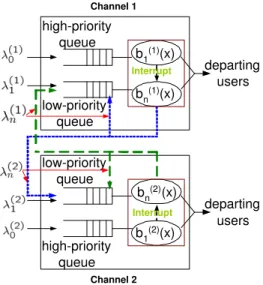
high-priority queue low-priority queue departing users b n (1)(x) b1(1)(x) Interrupt high-priority queue departing users b 1 (2)(x) b n (2)(x) Channel 1 Channel 2 low-priority queue Interrupt
Fig. 2. The PRP M/G/1 queueing network for two-channel system where n ≥ 1.
• The interrupted secondary customer’s target channel
can be different from its current operating channel, which is a key difference to the traditional PRP M/G/1 queueing theory [31].
Figure 2 shows the an example of the PRP M/G/1 queueing network with two channels, in which primary customers are put into the high-priority queue, and sec-ondary customers are put into the low-priority queue. When secondary customers are interrupted by primary customers, they can stay on the current channel or change their operating channels to another channel. First, in the change case, the unfinished data will be put into the tail of the low-priority queue of another channel. Second, the unfinished data can also be inserted into the head of the low-priority queue of the current channel when the stay case occurs. In both case, the unfinished transmission can be resumed when the channel becomes idle.
In this model, one of key parameters is the effective transmission time. It is the transmission duration from the time instant that frame is transmitted or resumed until the time instant that the interruption event oc-curs. For example, if a secondary customer finishes its frame transmission without any interruption, the effective transmission time is its whole frame length. On the other hand, a secondary customer can successfully transmit only partial frame to the corresponding receiver when it is interrupted by primary customers. In this case, the effective transmission time is the transmission duration of this partial frame.
B. Relationship between Spectrum Handoff Procedure and PRP M/G/1 queueing Network
The proposed PRP M/G/1 queueing network can mod-eled the five key steps of spectrum handoff mechanism
as discussed in Section III-A. They are summarized as follows.
1) Secondary customer arrival event as shown in Fig. 1(a): The arrivals of secondary customers whose default channel is channel k are modeled by the Poisson processes with mean rates λ(k)s .
Further-more, their service time distributions are denoted by b(k)s (x) with mean E[Xs(k)].
2) Primary customer arrival event as shown in Fig. 1(b): The arrivals of primary customers whose default channel is channel k are modeled by the Poisson processes with mean rates λ(k)0 . Further-more, their service time distributions are denoted by b(k)0 (x) with mean E[X0(k)].
3) Interruption event as shown in Fig. 1(c): In the pro-posed queueing network model, primary customers have the preemptive priority and thus can inter-rupt the transmission of secondary users. Hence, secondary customers must pause their transmission when primary customers appear.
4) Resumption on target channel as shown in Figs. 1(d)-(f): Secondary frame must be resumed on the selected target channel. This model can handle different results of target channel selection through different feedback paths. For example, in Fig. 2(f), when secondary customer selects to stay on the current channel, it will be inserted into the head of the low-priority queue of the current channel through the feedback path.
5) Multiple handoff event: The interrupted secondary frame will resume its transmission on the target channel. Hence, this unfinished frame will be the newly arriving secondary customer. For channel k, the arrival rate of the secondary customers with i−1 interruptions (i ≥ 1) is denoted by λ(k)i . Further-more, its effective transmission time is denoted by b(k)i (x) with mean E[Xi(k)].
C. Analysis Results of Transmission Latency
The closed-form expressions of transmission latency for reactive- and proactive-sensing spectrum handoff have been derived in [30] and [29], respectively. Now, we consider a two-channel system as shown in Fig. 2. We as-sume that each channel has the identical traffic patterns. Hence, the notation (k) in all system parameters can be dropped. Let µs = 1/E[Xs]. Then, the transmission
latency for reactive-sensing spectrum handoff can be expressed as follow: E[Lreactive] = E[Xs] + λ0 £ tpµs+ (E[X0])2λ0µs+ E[X0](λs− tpλ0µs) ¤ (1 − λ0E[X0])(µs)2 , (1)
where tp is the processing time which is the sum of
channel switch time (ts) plus channel sensing time (tf).
On the other hand, we have proved that there exist only two predetermined target channels sequence to minimize the handoff latency when we select the channel with the shortest handoff delay to be the target channel at each spectrum handoff. The first one is the always-stay case where the interrupted customer will always stay on its default channel until its packet is transmitted completely. In this case, the average transmission latency can be expressed as follows:
E[Lstay] = E[Xs] + λ0E[Xs] E[X0]
1 − λ0E[X0] . (2)
Furthermore, the second one is the always-change case where the target channels will alternately switch between two channels. In this case, the average transmission la-tency can be expressed as follows:
E[Lchange] = E[Xs] + E[N ](λ0(E[(X0)]) 2+ λs (λ0+µs)µs + ρ2 0 1−ρ0E[X0] 1 − ρ0− ρs + ts) , (3) where ts is the channel switch time, ρ0= λ0E[X0], and ρs = λsE[Xs]. Hence, in the proactive-sensing spectrum
handoff scheme, the optimal transmission latency can be expressed as follows
Lproactive= min{E[Lstay], E[Lchange]} . (4)
D. Numerical Results
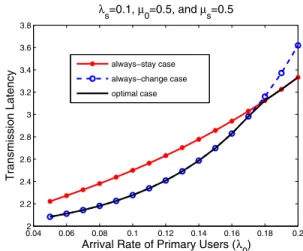
Figure 3 shows the transmission latency in the always-stay and the always-change cases. Based on (4), our proposed greedy selection can intelligently operate on the best target channel with the lowest transmission latency. With a lower value of λ0, the interrupted customer prefers
to change the operating channel. By contrast, λ0is large,
the interrupted customer prefers the always-stay strategy. This phenomenon can be also interpreted by the renewal theory as follows [32]: As λ0 increases, the busy period
increases. Thus, it is more likely that the randomly interrupted secondary customer will see a longer busy period. Hence, in this case, the interrupted customer prefers staying on the original channel.
Fig. 4 compares the transmission latency of spectrum handoff with reactive- and proactive-sensing spectrum handoff schemes. When the sensing time (tf) for
spec-trum handoff is zero, the reactive-sensing specspec-trum hand-off scheme has the shortest transmission latency. How-ever, the transmission latency increases as sensing time increases. For example, when tf = 0.7, the transmission
latency with reactive-sensing spectrum handoff scheme is not always better than that with proactive-sensing
0.042 0.06 0.08 0.1 0.12 0.14 0.16 0.18 0.2 2.2 2.4 2.6 2.8 3 3.2 3.4 3.6 3.8
Arrival Rate of Primary Users (λ0)
Transmission Latency
λs=0.1, µ0=0.5, and µs=0.5
always−stay case always−change case optimal case
Fig. 3. Comparison of transmission latency in the always-stay and the always-change cases where ts= 0 and µ0= 1/E[X0].
0.04 0.06 0.08 0.1 0.12 0.14 0.16 0.18 0.2 2.6 2.8 3 3.2 3.4 3.6 3.8 4 4.2 4.4
Arrival Rate of Primary Customer (λ0)
Transmission Latency (L)
λs=0.15, µ0=0.6, and µs=0.4
Proactive−based (optimal case) Reactive−based (t
f=2) Reactive−based (tf=0.7) Reactive−based (tf=0)
Fig. 4. Comparison of transmission latency for different spectrum handoff schemes where ts= 0 and µ0= 1/E[X0].
spectrum handoff scheme. As shown in this figure, when λ0 is smaller than 0.13, the proactive-sensing spectrum
handoff scheme has shorter transmission latency because the selected target channel is idle with higher probability.
V. Conclusions
In this paper, we compare two major types of spectrum handoff schemes. One is the reactive-sensing spectrum handoff, the other is proactive-sensing spectrum handoff. We provide a Preemptive Resume Priority M/G/1 queue-ing network model to analyze in which condition that the reactive- or proactive-sensing spectrum handoff should be used dependent of sensing time. Because this model can handle the case when the interrupted secondary users need to change their operating channels, the interaction between different channels can be elaborated exactly. Furthermore, the effects of traffic patterns and target channels selection strategies on transmission latency can be also considered simultaneously.
References
[1] J. Mitola and G. Q. Maguire, “Cognitive Radio: Making Soft-ware Radios More Personal,” IEEE Personal Communications, vol. 6, pp. 13–18, Auguest 1999.
[2] S. Haykin, “Cognitive Radio: Brain-Empowered Wireless Com-munications,” IEEE Journal on Selected Areas in Communi-cations, vol. 23, no. 2, pp. 201–220, February 2005.
[3] R. W. Thomas, L. A. DaSilva, and A. B. MacKenzie, “Cogni-tive Networks,” IEEE DySPAN, pp. 352–360, November 2005. [4] I. F. Akyildiz, W. Y. Lee, M. C. Vuran, and S. Mohanty, “NeXt Generation/Dynamic Spectrum Access/Cognitive Radio Wire-less Networks: A Survey,” Computer Networks Journal (Else-vier), vol. 50, pp. 2127–2159, September 2006.
[5] L.-C. Wang, C.-W. Wang, Y.-C. Lu, and C.-M. Liu, “A Con-current Transmission MAC Protocol for Enhancing Through-out and Avoiding Spectrum Sensing in Cognitive Radio,” IEEE Wireless Communications and Networking Conference, pp. 121–126, 2007.
[6] T. A. Weiss and F. K. Jondral, “Spectrum Pooling: An Inno-vative Dtrategy for the Enhancement of Spectrum Efficiency,” IEEE Communications Magazine, vol. 42, no. 3, pp. S8–S14, Mar. 2004.
[7] J. Gambini, O. Simeone, U. Spagnolini, Y. Bar-Ness, and Y. Kim, “Cognitive Radio with Secondary Packet-By-Packet Vertical Handover,” IEEE International Conference on Com-munications, pp. 1050–1054, May 2008.
[8] H. Kim and K. G. Shin, “Efficient Discovery of Spectrum Opportunities with MAC-Layer Sensing in Cognitive Radio Networks,” IEEE Transactions on Mobile Computing, vol. 7, no. 5, pp. 533–545, May 2008.
[9] W. Hu, D. Willkomm, G. Vlantis, M. Gerla, and A. Wolisz, “Dynamic Frequency Hopping Communities for Efficient IEEE 802.22 Operation,” IEEE Communications Magazine, pp. 80– 87, May 2007.
[10] D. Willkomm, J. Gross, and A. Wolisz, “Reliable Link Mainte-nance in Cognitive Radio Systems,” IEEE DySPAN, pp. 371– 378, November 2005.
[11] J. Tian and G. Bi, “A New Link Maintenance and Compensa-tion Model for Cognitive UWB Radio Systems,” InternaCompensa-tional Conference on ITS Telecommunications Proceedings, pp. 254– 257, June 2006.
[12] L.-C. Wang and C.-W. Wang, “Spectrum Handoff for Cogni-tive Radio Networks with ReacCogni-tive Sensing,” IEEE APWCS, Aug. 2008.
[13] L.-C. Wang and A. Chen, “On the Performance of Spectrum Handoff for Link Maintenance in Cognitive Radio,” Inter-national Symposium on Wireless Pervasive Computing, May 2008.
[14] Chun-Ting Chou and Sai Shankar N and H. Kim and K. G. Shin, “What and How Much to Gain From Spectral Agility?” IEEE Journal on Selected Areas in Communications, vol. 25, no. 3, pp. 576–588, April 2007.
[15] F. Capar, I. Martoyo, T. Weiss, and F. Jondral, “Compari-son of Bandwidth Utilization for Controlled and Uncontrolled Channel Assignment in a Spectrum Pooling System,” IEEE VTC, pp. 1069–1073, 2002.
[16] X. Zhu, L. Shen, and T.-S. P. Yum, “Analysis of Cognitive Radio Spectrum Access with Optimal Channel Reservation,” IEEE Communications Letter, vol. 11, no. 4, pp. 304–306, April 2007.
[17] B. Ishibashi, N. Bouabdallah, and R. Boutaba, “QoS Per-formance Analysis of Cognitive Radio-based Virtual Wireless Networks,” IEEE INFOCOM, pp. 2423–2431, 2008.
[18] S. Tang and B. L. Mark, “Performance Analysis of a Wireless Network with Opportunistic Spectrum Sharing,” Proceedings of IEEE Global Telecommunications Conference, November 2007.
[19] ——, “An Analytical Performance Model of Opportunistic Spectrum Access in a Military Environment,” IEEE Wireless Communications and Networking Conference, April 2008.
[20] Q. Zhao, L. Tong, A. Swami, and Y. Chen, “Decentralized Cognitive MAC for Opportunistic Spectrum Access in Ad Hoc Networks: A POMDP Framework,” IEEE Journal on Selected Areas in Communications, vol. 25, no. 3, pp. 589–600, April 2007.
[21] Q. Zhao, S. Geirhofer, L. Tong, and B. M. Sadler, “Oppor-tunistic Spectrum Access via Periodic Channel Sensing,” IEEE Transactions on Signal Processing, vol. 56, no. 2, pp. 785–796, Feb. 2008.
[22] S. Keshavamurthy and K. Chandra, “Multiplexing Analysis for Dynamic Spectrum Access,” IEEE Military Communications Conference, pp. 1–7, Oct. 2006.
[23] Ping Zhu and Jinglong Li and Xufa Wang, “A New Channel Parameter For Cognitive Radio,” CrownCom, pp. 482–486, Aug. 2007.
[24] ——, “Scheduling Model for Cognitive Radio,” CrownCom, pp. 1–6, May 2008.
[25] J. Heo, J. Shin, J. Nam, Y. Lee, J. G. Park, and H.-S. Cho, “Mathematical Analysis of Secondary User Traffic in Cognitive Radio System,” IEEE VTC, Sep. 2008.
[26] X. Liu and Z. Ding, “ESCAPE: A Channel Evacuation Pro-tocol for Spectrum-Agile Networks,” IEEE DySPAN, pp. 292– 302, April 2007.
[27] C. Han, J. Wang, and S. Li, “A Spectrum Exchange Mechanism in Cognitive Radio Contexts,” IEEE International Symposium on Personal, Indoor and Mobile Radio Communications, pp. 1–5, September 2006.
[28] Q. Shi, D. Taubenheim, S. Kyperountas, P. Gorday, and N. Correal, “Link Maintenance Protocol for Cognitive Radio System with OFDM PHY,” IEEE DySPAN, pp. 440–443, April 2007.
[29] L.-C. Wang and C.-W. Wang, “Modeling and Analysis for Proactive-Sensing Spectrum Handoff in Cognitive Radio Net-works,” submitted to ICC’09.
[30] ——, “Modeling and Analysis for Reactive-Sensing Spectrum Handoff in Cognitive Radio Networks,” submitted to INFO-COM’09.
[31] B. D. Choi and G. U. Hwang, “The MAP,M/G1, G2/1 Queue
with Preemptive Priority,” Journal of Applied Mathematics and Stochastic Analysis, vol. 10, no. 4, pp. 407–421, 1997. [32] W. L. Smith, “Renewal Theory and its Ramifications,” Journal