國立交通大學
外國語文學系外國文學與語言學碩士班
碩士論文
中文移動事件中的路徑標記
Specifying Path in Mandarin Motion Events—
A Study of Route Markers
研 究 生: 蔡幸珊
指導教授: 劉美君 教授
中文移動事件中的路徑標記
Specifying Path in Mandarin Motion Events—
A Study of Route Markers
研 究 生: 蔡幸珊 Student: Hsin-Shan Tsai
指導教授: 劉美君 Advisor: Meichun Liu
國立交通大學
外國語文學系外國文學與語言學碩士班
碩士論文
A Thesis
Submitted to Graduate Institute of Foreign Literatures and Linguistics
College of Humanity and Social Science
National Chiao Tung University
in partial Fulfillment of the Requirements
for the Degree of
Master of Arts
July 2013
Hsinchu, Taiwan, Republic of China
中 華 民 國 一 〇 二 年 七 月
i 中文移動事件中的路徑標記 學生:蔡幸珊 指導教授:劉美君 國立交通大學外國語文學系外國文學與語言學碩士班 摘 要 本研究為進一步地了解移動事件中的路徑,深入探討中文裡經常使用的三個路徑標記 「過」,「經」,「越」的語法和語意特徵,也藉由這些特徵來討論其語意和構詞之間的互
動關係。Liu et al. (2012a) 提出了路線(Path)可再被細分為三個互相關聯的語意成分:路 徑(Route),方向(Direction)和終點(Endpoint),而本研究針對路徑(Route)做深入探討。如 同下面例句所示,路徑(Route) 可以單純指出移動的軌道而不用說明路線的方向或是終 點,而路徑標記則是藉由標示出一個中界點帶出這條軌道來表達位移的概念。 (1) 經風暴,過黑夜,越洋海 這三個路徑標記帶有相同的標記功能且經常出現在以下句式中: (2) a 過/越/*經 < Route-NP 過/越/*經 [邊界/Route-NP]了
b. 過/越/經 < Route-NP < Motion Verb < Loc-NP
過/越/經 [淡水河/Route-NP][到/Motion Verb][對岸/Loc-NP] c. Verb < 過/越/經 [飛/Verb]過/越/經公路 從這些句式當中,我們可以看出路徑標記有著不同的語法功能。句式一中的路徑標 記可做為及物動詞使用,而在句式二裡,這三個路徑標記同時做為功能標記標示出中界 點並且做為動介詞和其它移動動詞一起出現。句式三為動詞複合詞,路徑標記做為其中 的第二個動詞。值得注意的是,「經」無法做為及物動詞出現在句式一當中。這說明了 「經」較偏向於功能性標記而沒有動詞的特性。藉由在各句式中的不同語法表現,我們 也發現每個路徑標記的不同語法特性。「經」偏於功能性標記且較無動詞特徵,「過」擁 有最多動詞特性而「越」則是介於兩者之間。 在語意方面,這三個路徑標記各自帶出不同的移動軌道(moving contour)。先前的研 究(Hsiao 2003, Zeng 2008)指出「過」可以帶出各種移動軌道。從語料當中我們得知「越」 限定其移動軌道為 ‘go over’,而「經」的移動軌道則未被限定(underspecified)。除了帶 出不同軌道外,從「過」和「越」可自身結束一個移動事件這點來看,其本身除了帶有 路徑(Route)的概念還隱含了終點(Endpoint)的概念,這點再度說明了這三個路徑標記在
ii 語意上的差異。這兩項語意差異和空間順序以及中文構詞原則的互動關係影響了其在構 詞上的表現,「過」可以和其他兩個路徑標記合用故「越過」和「經過」皆為合法複和 詞,然而其他組合皆不合法。 本研究深入探討中文移動事件中的路徑標記「過」,「經」,「越」之語法和語意特徵, 闡述詞彙語意和構詞之間的互動表現,最終更進一步了解中文移動事件中的路線(Path) 概念。 關鍵詞:移動事件,中文,路徑,路線
iii
Specifying Path in Mandarin Motion Events— A Study of Route Markers
Student: Hsin-Shan Tsai Advisor: Dr. Meichun Liu Graduate Institute of Foreign Literatures and Linguistics
National Chiao Tung University
Abstract
This paper specifies the path in motion events by investigating the grammatical properties and semantic distinction of the three commonly used Mandarin Route markers guò 過 ‘cross/pass’, jīng 經 ‘pass’ and yuè 越 ‘cross’. It further elaborates how morphological makeups reflect semantic details in motion events. According to Liu et al. (2012a), the semantic component Route may be decomposed from the traditional notion of PATH. It denotes the contour of motion without necessarily specifying a direction or endpoint of the path. Route markers serve to introduce the path contour where the figure moves past a landmark, normally specified as a middle point of the path. Unlike Endpoint markers such as
dào 到 ‘arrive’ that marks the aimed destination and Direction markers such as wǎng 往
‘move toward’ that marks the path direction, the Route markers in (1) describe the progressing contour of motion, profiling the process of moving with a locational change: (1) 經風暴,過黑夜,越洋海
jīng fēngbào,guò hēiyè, yuè yanghǎi
pass strorm pass dark-night cross sea
‘Pass through the storm and cross the night and the sea.’
These three markers have parallel functions and commonly appear in some syntactic patterns shown as below.
(2) a. 過/越/*經 < Route-NP
過/越/*經 [邊界/Route-NP]了 guò /yuè/ * jīng biānjiè le cross boundary ASP ‘(Someone) crossed the boundary.’
b. 過/越/經 < Route-NP < Motion Verb < Loc-NP
過/越/經 [淡水河/Route-NP][到/Motion Verb][對岸/Loc-NP]
Guò/ yuè/ jīng dànshuǐhé dào duìàn
cross Danshui.River arrive opposite
iv c. Verb < 過/越/經
[飛/Verb]過/越/經 公路
fēi-guò/ yuè/ jīng gong lù
fly-cross road
‘Fly over the road.’
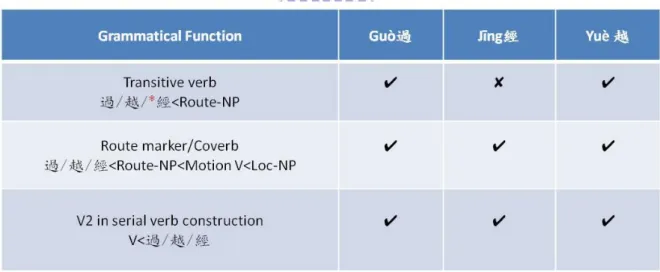
These three marker show different grammatical functions in the three syntactic patterns. In Pattern 1, they function as a transitive verb while in Pattern 2, they behave as a typical Route marker, specifying the following noun as the passing landmark and also a prepositional-like coverb, coocurring a motion verb followed by a Loc-NP which referring to a destination of the path. In Pattern 3, the three markers are the second verb in a serial verb construction. It is noted that jīng 經 does not show in Pattern 1, in other words, it cannot function as a transitive verb. A close look of corpus data illustrates that these three markers show different behaviors in each pattern and thus they have distinct grammatical status. Jīng 經 is the least verbal and most like a grammatical marker. Guò 過 is the most verbal and yuè 越 is in between.
In addition to grammatical properties, these three markers can be distinguished by their semantic distinction. First, they specify different moving contours. Guò 過 may denote all possible contours (Hsiao 2003, Zeng 2008) while yuè 越 specifies a particular contour ‘go over’. The moving contours in jīng 經 are underspecified and thus jīng 經 may be compatible with various path contours. Besides specifying different contours, guò 過 and
yuè 越 are lexically capable of encoding Endpoint while jīng 經 only reflects Route. The
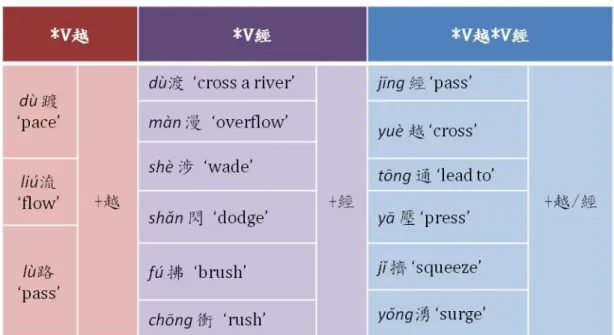
two semantic attributes differentiate these three markers and further correlate with their morphological makeups: guò 過 can be combined with the other two markers in a fixed sequence so that jīng-guò 經過 and yuè-guò 越過 are allowed but other combinations are not. The interations between the semantic distictions and two related principles: the spacial sequencing and Mandarin compounding principle account for the ungrammaticality.
This study reveals the syntactic and semantic distinctions of the three commonly-used Route markers, illustrating the interesting correlation between lexical semantics and morphological makeups, ultimately further specifying the path in motion events.
v
誌謝
這本厚厚的畢業論文拿在手上像是夢般的不真實卻又那麼地切確存在,每一個字都 記錄著這三年來的點滴心血和成長過程。這一路上絕不輕鬆,曾在谷底沮喪懷疑自己, 也曾在中途想過放棄,但如今回頭一看,那些低潮的日子正是走向終點的最後階段。感 謝同學和師長們的協助與鼓勵,我才能走出低谷重拾信心,感激身旁的每一分支持與關 懷,我才能一路堅持到底,順利完成碩士學業。 心中滿滿的感恩首先獻給指導教授劉美君老師,感謝老師的用心栽培與指導,藉由 每一次的討論磨練及充實我的思辨能力與研究技能,激勵我成長和改變,一路上亦步亦 趨地給予嚴謹的細心提醒和建議,以及在學術外身體力行地教導我們面對困難的態度。 在撰寫論文中從老師身上所學習到的實在太多太多,感謝上天讓我遇到了美君老師,這 麼一個轉變我人生促使我成長的良師。感謝口試委員鄭縈老師和黃漢君老師耐心地提供 許多寶貴意見,以及在口試階段的支持與鼓勵,著實讓我在撰寫論文的過程中打了一劑 強心針,更加有信心地堅持下去。感謝交大語言所的每位老師,三年的學習過程中您們 為我開啟語言學的視野,激起我對語言學的好奇與興趣,才有了動機完成這份研究。 感謝佳音學姐耐心地給予建議,當我在研究上遇到挫折和問題時不厭其煩地幫助我 度過難關,感謝學姐總是做為老師和我們這些小碩士生的溝通橋樑,真的是 304 的鎮室 之寶! 感謝一同作戰的俞汶,書平,孝勇,瑋芩,由衷感謝我們這個 motion group, 在每一次卡關的時候願意停下腳步為彼此想出解決辦法,傾聽彼此無論在學業上或生活 上的煩惱,一同面對研究過程中的龐大壓力,互相給予支持與鼓勵,一步一步地跌跌撞 撞,一起走到了最後。感謝睿良,忠豪,lala,韵庭和懿方,和你們在 304 討論的時光 會是我畢業後最想念的日子! 感謝一直陪在我身邊的家人,一路上給予我滿滿的愛與關 懷,每一句關心都讓我更加有動力繼續堅持下去,感謝上天,帶給我這麼多美好的人事 物,庇佑我一路順利地完成碩士學業。 在打下這最後幾行字的同時,我的碩士生涯也正式告一段落。帶著滿心的感恩和祝 福以及在交大所獲得的改變與成長,我將開啟另一段旅程的開始。vi
Table of Contents
Chapter 1 Introduction ... 1
1.1 The Background ... 1
1.2 The Issue: Route Markers ... 2
1.3 Scope and Goal ... 3
1.4 Organization of the Thesis ... 5
Chapter 2 Literature Review ... 6
2.1 The Approaches to define Path Verbs ... 6
2.2 Definition of Route ... 11
2.3 Previous Analysis of guò 過. yuè 越 and jīng 經 ... 12
2.3.1 Previous Analysis of guò 過 ... 12
2.3.2 Previous Anaylsis of yuè 越 ... 22
2.3.3 Previous Analysis of jīng 經 ... 23
Chapter 3 Database, Theoretical Framework and Methodology ... 25
3.1 Database ... 25
3.2 Theoretical Framework ... 25
3.2.1 Deictic-Incorporated Proto-Motion Event Conceptual Schema ... 25
3.2.2 Multi-layered Hierachical Structure ... 26
3.3 Methodology ... 27
Chapter 4 Findings ... 28
4.1 Syntactic Patterns ... 28
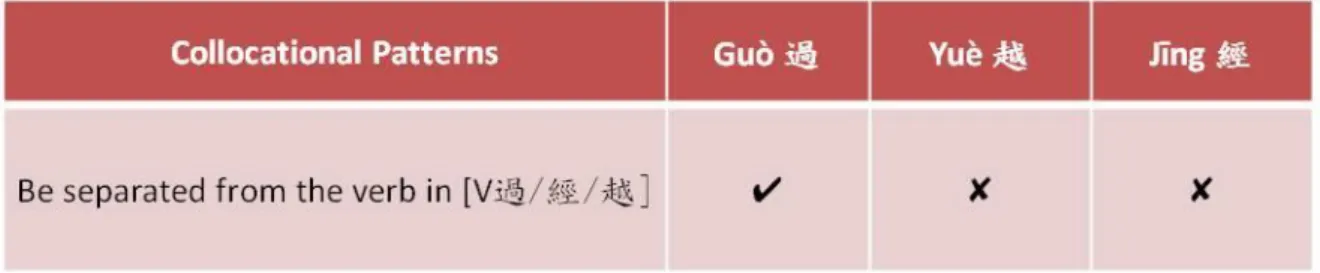
4.2 Collocational Patterns and Distribution among Syntacitic Patterns ... 32
4.2.1 The Different Behaviors in Pattern 1 ... 32
4.2.2 The Different Behaviors in Pattern 2 ... 37
4.2.3 The Different Behaviors in Pattern 3 ... 38
4.3. Moving Contours ... 45
Chapter 5 Analysis ... 49
5.1 The Differences among guò 過, jīng 經 and yuè 越 ... 49
5.1.1 Grammatical Distinction of guò 過, jīng 經 and yuè 越 ... 50
5.1.1.1 As Transitive Verbs in Pattern 1 ... 51
5.1.1.2 As Route Markers/Coverbs in Pattern 2... 52
vii
5.1.2 Semantic Distinction of guò 過,jīng 經, yuè 越... 53
5.1.2.1 The Moving Contours ... 54
5.1.2.2 The Endpoint ... 55
5.2 The Semantic-to-morphological Correlation ... 57
5.2.1 Collocation with Each Other ... 57
5.2.2 Collocation with Verbs ... 59
5.3 Incorporation of Frame-based Hierachical Structure ... 62
5.3.1 Conceptual Schema of Self-initiated Motion ... 63
5.3.2 The Hierarchical Structure of the Frame ... 65
5.3.2.1 Layer 1: Archiframe of Self-initiated Motion ... 65
5.3.2.2 Layer 2: Primary frame ... 67
5.3.2.2.1 Path Primary Frame ... 68
5.3.2.3 Layer 3: Basic frame ... 71
5.3.2.3.1 Layer 3: Route Basic Frame ... 72
5.3.3 Brief Summary ... 73 Chapter 6 Conclusion ... 74 6.1 Conclusion ... 74 6.2 Further Research ... 75 References ... 77 Website Sources ... 79
viii
List of Tables
TABLE 1: PATH AS A VERB-INTERNAL VS. VERB-EXTERNAL LEXICAL ELEMENT ... 9
TABLE 2. THE FREQUENCY OF GUÒ 過, YUÈ越, JĪNG經OCCURRING IN PATTERN 2 IN SINICA CORPUS ... 38
TABLE 3. THE VERBS THAT CANNOT COMBINE WITH JĪNG經/YUÈ 越 ... 41
TABLE 4 .THE GRAMMATICAL FUNCTION OF GUÒ 過/YUÈ 越/JĪNG經 IN THE THREE COMMON PATTERNS ... 50
TABLE 5 THE COLLOCATIONAL PATTERNS ASSOCIATED WITH PATTERN 1 ... 51
TABLE 6 THE COLLOCATIONAL PATTERNS ASSOCIATED WITH PATTERN 3 ... 53
TABLE 7.THE SEMANTIC DISTINCTION OF GUÒ 過, JĪNG經 AND YUÈ越 ... 57
ix
List of Figures
FIGURE 1. THE MAPPING BETWEEN SEMANTIC PARTICIPANT ROLES AND SERIAL VERB
MORPHEMES ... 11
FIGURE 2. CENTRAL SCHEMA FOR GUÒ 過 (WANG 2002) ... 13
FIGURE 3. VARIANT OF THE CENTRAL SCHEMA FOR GUÒ 過 (WANG 2002) ... 14
FIGURE 4.VARIANT OF THE CENTRAL SCHEMA FOR GUÒ 過 (WANG 2002) ... 14
FIGURE 5.VARIANT OF THE CENTRAL SCHEMA FOR GUÒ 過 (WANG 2002) ... 15
FIGURE 6.THE IMAGE SCHEMA OF THE MOTIONAL TRANSITION THROUGH AN INTERMEDIATE POINT OF A CROSSING MOVEMENT (HSIAO 2003) ... 16
FIGURE 7. THE IMAGE SCHEMA OF THE POST-TRANSITIONAL MOVEMENT TO AN ENDPOINT OF AN ARRIVING MOVEMENT (HSIAO 2003) ... 16
FIGURE 8.DEICTIC-INCORPORATED PROTO-MOTION EVENT SCHEMA IN MADARIN (LIU ET AL 2012A) ... 26
FIGURE 9.THE LEXICAL STATUS OF GUÒ 過,JĪNG經AND YUÈ越 ... 53
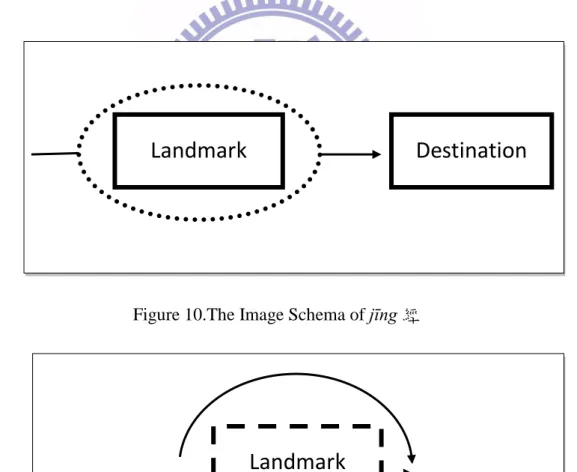
FIGURE 10.THE IMAGE SCHEMA OF JĪNG經 ... 54
FIGURE 11.THE IMAGE SCHEMA OF GUÒ 過 ... 54
FIGURE 12.THE IMAGE SCHEMA OF YUÈ越 ... 55
FIGURE 13: CONCEPTUAL SCHEMA OF SELF-INITIATED MOTION ... 64
FIGURE 14. CONCEPTUAL SCHEMA OF SELF-INITIATED MOTION ARCHIFRAME ... 66
FIGURE 15: PRIMARY FRAMES UNDER SELF-INITIATED MOTION ARCHIFRAME ... 68
FIGURE 16: CONCEPTUAL SCHEMA OF PATH PRIMARY FRAME ... 69
1
Chapter 1
Introduction
1.1 The Background
Motion is one of the fundamental domains in human cognition. The concepts of motion are vital in human experiences as motional relations provide the basic constructs in language use, which get widely applied from spatial to non-spatial domains. Talmy (1985, 2000) proposes that the basic motion event consists of four major components: an object (the Figure) moving with respect to another object (the Ground) along a path (Path) with the motional act (Move), which is normally specified by the way the Figure object moves (Manner). Various studies have shown that Path is one of the basic cognitive components in motion events. It plays an essential role in the semantic components in describing motion events. Generally speaking, there are two different ways of defining this semantic component: verb-internal and verb-external approaches. Studies on lexicalization patterns (e.g.,Talmy 2000, Tai 2003, Slobin 2004) as well as on syntax-to-semantics alternation (e.g., Levin 1993, Rappaport Hovav and Levin 2010) examine the semantic components lexicalized in verbs of motion, aiming at the verb-internal features and hence, Path is viewed to be encoded in verbs as a semantic attribute. On the other hand, studies on semantic frames (c.f. Fillmore and Atkins 1992) probe into the frame-specific elements coexisting in a motion event, focusing on verb-external participant roles. From this point of view, the frame of Path is evoked by a set of core participant roles related to the verbs defines the verbs as Path verbs. Liu et al. (2012a) integrate these two approaches, suggesting in Mandarin motion events, the range of semantic participant roles corresponds to the range of lexical semantic attributes and further indicate that the notion of Path proposed by Talmy (1985, 2000) and adopted in other previous studies (e.g., Slobin 2004, Lamarre 2007, Chen and Guo 2009) is quite broad in its sematic range.
2
Investigating the semantic components verb-externally and verb-internally, Liu et al. (2012a) redefine the notion of Path, decomposing it into three semantically separable but related components: Route (the contour of moving), Direction (spatial orientation), and Endpoint (final point of the contour).
With this integration and the further-defined notion of Path, this study probes into the contour of moving, Route, with a focus on Route markers, the morphemes marking the contour of moving, to specify Path in Mandarin motion events.
1.2 The Issue: Route Markers
Route is the trajectory of path along which the Figure moves. It is normally realized with
an overt marker (Liu et al 2012a), such as jīng 經 ‘pass’ in (1a), followed by a middle point or a passing reference (a Route-NP), such as dōngjīng 東京‘Tokyo’ in (1a). In other words, Route markers serve to introduce a trajectory to the motion event by specifying an intermediate point which the figure moves past along the trajectory and take the point as a complement (a Route-NP). Moreover, unlike Endpoint markers such as dào 到 ‘arrive’ that marks the aimed destination and Direction markers such as wǎng 往‘move toward’ that marks the path direction, Route markers describe the progressing contour of motion, profiling the process of moving with a locational change as the three commonly-used Mandarin Route markers guò 過 ‘cross/pass’, jīng 經 ‘pass’ and yuè 越 ‘cross’ show in (1b).
(1) a. 再飛經東京回台北
zài fēi jīng dōngjīng huí táiběi then fly pass Tokyo return Taipei
3
b.經風暴,過黑夜,度1阡陌,越洋海,
jīng fēngbào,guò hēiyè, dù qiānmò,yuè yanghǎi,
pass storm pass dark-night cross field cross sea
‘Pass through the storm and the night, cross the field and the sea.’
From the sentence above, we know that these three commonly-used Route markers have parallel functions on marking a passing landmark, physically or metaphorically. In general, they all express that a moving entity (Figure) moves with a path contour on which the Figure moves past some point (Route NP). However, what are the differences among these Route markers? To distinguish each route marker, this paper examines the corpus data to find the significant contrasts in the distributional patterns that might shed light on the unique meaning and grammatical status of the three commonly-used Route markers in Mandarin: guò 過 ‘cross/pass’, jīng 經 ‘pass’ and yuè 越 ‘cross’. After looking into the patterns, this paper attempts to find the answer to another question: What principle can account for these patterns?
With a detailed analysis of Route marking in Mandarin motion events, the study aims to reveal the semantic-to-morphological correlation as evidence from the collo-grammatical observation. By distinguishing the semantic details of each marker, the distributional patterns on morphological behaviors of these three markers could be accounted for with some principles related to the lexical semantics and the morphological makeup.
1.3 Scope and Goal
The scope of this research aims at the conecept of Route with a focus on the three commonly-used Route markers guò 過 ‘cross/pass’, jīng 經 ‘pass’ and yuè 越 ‘cross’,
4
which denote the path contour (Route) in Mandarin motion events. From the corpus data, we found that these three Route markers are not only commonly used in spatial motion events but also in expressing body posture such as huí guò shēn 回過身 ‘turn around’ and temperoal motion events. This study focuses on their usage in spatial motion events, which is one of the fundamental domains in human cognition.
To further understand how Route is realized into Mandarin, we investigate the three commonly-used Route markers on their grammatical status, morphological make-ups and their semantic attibutes. Also, the correlations among semantics and morphology are included. Semantically, Route markers are morphemes that introduce a trajectory into a motion event by specifying an intermediate point which the moving entity moves past. Thus, they require a Figure to move as well as a passing reference (a Route NP). Syntactially, these markers take the figure as the subject and the intermediate point as the complement.
The goal of this study is to specify Path in Mandarin motion events with a focus on the the three commonly-used Mandarin Route markers: guò 過 ‘cross/pass’, jīng 經 ‘pass’ and
yuè越 ‘cross’. It distinguishes these three similar markers both semantically and syntacticaly,
providing an evidence of the semantic-to-morphology correlation. The research aims to explore the following questions:
1) What are the collocational patterns associated with the commonly found Route markers
guò 過, jīng 經 and yuè 越?
2) How can the observed collocational patterns shed light on the grammatical and
semantic distinctions of guò 過, jīng 經 and yuè 越?
3) What are the semantic principles that can account for the collocational patterns and morphological sequencing associated with the three markers?
By answering these questions, this study may lead to a better understanding of Mandarin motion events by revealing how the concept of Route is realized into Mandarin.
5
1.4 Organization of the Thesis
The thesis is organized as follows: Chapter 1 is the general introduction of the study. Chapter 2 reviews previous works related to the notion of Path and the decomposed component, Route. The studies on the spatial usage of guò 過 ‘cross/pass’, jīng 經 ‘pass’ and yuè 越 ‘cross’ are also reviewed in this chapter. Chapter 3 describes the database, theoretical framework and methodology applied in this study. Chapter 4 presents the preliminary findings motivating this reaserch. Chapter 5 proposes a tentative analysis of the three Mandarin Route markers on their lexical status and meaning. In addition, the anaylsis is incorporated into a frame-based structure to illustrate the relation between Route and Motion. Chapter 6 concludes the study with the significance of the study and notes further research issues.
6
Chapter 2
Literature Review
2.1 The Approaches to define Path Verbs
To define the semantic components of a verb in motion events, generally speaking, there are two approaches that present different ways to encode the concept of motion, including the notion of Path, into a language. One is the verb-internal approach, which probes into the semantic components lexicalized in verbs of motion, looking for verb-internal lexical features. With this approach, Path is viewed to be encoded in verbs as a semantic attribute. The other is the verb-external approach, which attempts to identify the frame-specific elements coexisting in a motion event, i.e., verb-external participant roles. From this point of view, the verb-external participant roles define the verbs evoking the frame of Path as Path verbs.
Seeing Path is a semantic attribute lexicalized into the verbs, Talmy (2000) proposes Path is a single course/route which the Figure moves along in a motion event. He divides languages into two major types according to whether path information is encoded in a verb or not : verb-framed languages such as Korean, Turkish, Japanese lexicalize path into verbs as shown in (2a) while satellite-framed languages like English, Russian and German encode manner, the way the moving entity moves, into the verb and path is expressed in a satellite to the verb as shown in (2b). On the other hand, Slobin (2004) proposes a third type of languages: equipollently-framed languages such as Mandarin and other serial verbs languages express path and manner using morphemes with equivalent grammatical status as shown in (2c).
7
(2) a. La botella entró a la cueva (flotando). (Talmy 1985)
[Figure] [Move+Path] [Ground] [Manner]
‘The bottle moved-in to the cave (floating).’
b.The bottle floated into the cave. (Talmy 1985)
[Figure] [Move+Manner] [Path] [Ground]
c. fēi chū yì zhī māo tóu yīng (Slobin 2004) [Move+Manner] [Move+Path] [Figure]
‘An owl flies out.’
Talmy (2000) claims that Chinense is a satellite-framed language because the path is not expressed in the main verb. However, Tai (2003) is in a different position. He believes Mandarin encodes the information of Path into a verb. Tai (2003) proposes that what Talmy has called path satellites are main verbs for they can occur alone and be suffixed with the aspect marker -le 了 as shown in (3).
(3) a. 約翰飛過英吉利海峽 (Tai 2003)
Yuēhàn fēi-guò yīngjílì-hǎixiá
John fly-cross English-Channel
8
b. 約翰 過了 英吉利海峽 (Tai 2003)
Yuēhàn guò-le yīngjílì-hǎixiá
John cross-ASP English-Channel
‘John crossed the English Channel.’
Adopting Slobin (2004)’s work, Chen and Guo (2009) suggest Mandarin is an equipollently-framed language, extend the semantic components of motion verbs, and further classify Mandarin motion verbs into four types which include Path verbs. In their work, verbs such as dào 到 ‘arrive’, xià 下 ‘go down’, guò 過 ‘cross/pass point out the trajectory over which a figure moves, which is typically with respect to another reference object, the Ground.
Rappaport Hovav and Levin (2010) indicate that, in the domain of motion events, the distance of the figure with respect to the ground could be understood as a scale which is composed of points belonging to a set of contiguous locations which together form a path. In view of this, verbs which encode the scale are verbs lexicalizing Path, such as recede, return, and enter. Lin (2011) adopts the framework of scale structure into Mandarin motion morphemes, claiming Mandarin has morphemes which encode the scale, that is, morphemes lexicalizing Path, such as tui 退‘recede’, hui 回 ‘return’ and jin 進 ‘enter’.
Researches on semantic components of Path verbs could be complemented with another approach to lexical meanings. Fillmore and Atkins (1992) propose a frame-based approach, in which ‘a word’s meaning can be understood only with reference to a structured background of experience, beliefs, or practices, constituting a kind of conceptual prerequisite for understanding the meaning.’ Based on this approach, a verb evokes a semantic frame, in which the participant roles related to the verb help define the semantics of the verb. In other
9
words, the verb evoking the frame of Path is semantically specified with a set of core participant roles. Accroding to FrameNet (http://framenet.icsi.berkeley.edu/), which catergorizes verbs into frames based on Frame Semantics, Path is defined as follows: ‘Path is a series of conncected locations, traversed by a moving entity moving under its own power or under the influence of a physical force. The path may be described in various terms depending on whether it is bounded or not. If it is bounded, the path may be identified by its endpoints, which may be presented separately as source and goal.’ In this verb-external view, the verb-external elements, a moving entity and a source or goal, help us indentify the path verbs.
With these two different ways of defining semantic components, Path, the basic semantic component in describing motion events, could be viewed as a verb-internal lexical attribute or a verb-external participant role, as outlined below:
Verb-internal Lexical component encoded in a verb Enter [PATH V] Verb-external Frame-specific component in the
structured background
into + NP
[PATH PP] Table 1: Path as a verb-internal vs. verb-external lexical element2
To sum up, Path receives different treatments in different approaches. It may be lexicalized verb-internally as a semantic attribute in the meaning of the verb enter, or it can be specified verb-externally as a frame participant realized in the prepositional phrase [into+NP], serving as a core frame element in the structured background.
Integrating the two views of Path, Liu et al. (2012a) shows there is an apparent link between the verb-external and verb-internal components. They further indicate that the
2
10
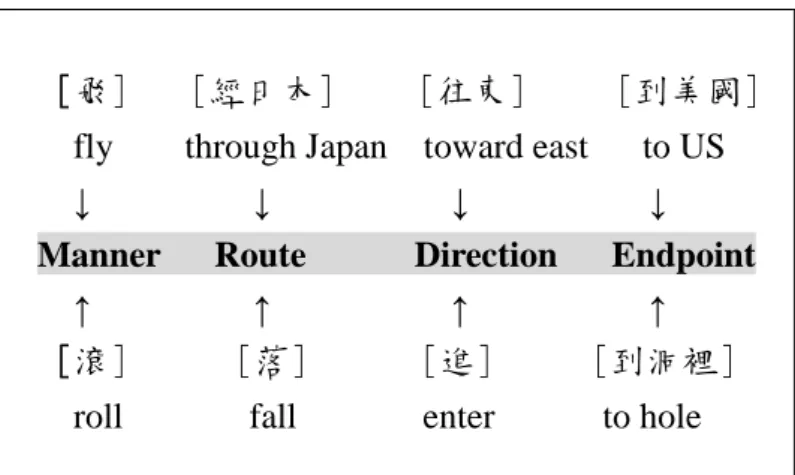
sequence of role components defining the conceptual framework can be mapped onto the sequence of verb morphemes with the same range of lexically specified semantic attributes. To be more specific, the range of semantic roles corresponds to the range of lexical semantic attributes. Examining Path verbs both verb-internally and verb-externally, Liu et al. (2012a) suggest the notion of Path proposed by Talmy (1985, 2000) and adopted in other previous studies (e.g., Slobin 2004, Lamarre 2007, Chen and Guo 2009) is quite broad in its sematic range and thus redefine the notion of Path as Route (the contour of moving), Direction (spatial orientation), and Endpoint (final point of the contour). As illustrated below, the same range of semantic components: Manner, Route, Direction and Endpoint can be realized as semantic participant roles in (4a) or be encoded into serial verb morphemes in (4b). Moreover, the mapping between semantic participants roles and serial verb morphemes which lexicalize the semantic components—[Manner][Route][Direction][Endpoint] is shown as Figure 1:
(4) a. 他 Manner[飛] Route[經日本] Direction[往東] Endpoint[到美國] (Liu et al. 2012a)
tā fēi jīng rìběn wǎng dōng dào měiguó
he fly through Japan toward east arrive America
‘He flew east through Japan to America.’
b. 球 Manner[滾] Route[落] Direction[進] Endpoint[到]洞裡 (Liu et al. 2012a)
qiú gǔn luò jìn dào dònglǐ
ball roll fall enter arrive hole
‘The ball rolled and fell into the hole.’
11
[飛] [經日本] [往東] [到美國] fly through Japan toward east to US
↓ ↓ ↓ ↓ Manner Route Direction Endpoint
↑ ↑ ↑ ↑ [滾] [落] [進] [到洞裡]
roll fall enter to hole
Figure 1. The mapping between semantic participant roles and serial verb morphemes (Liu et al. 2012a)
Liu et al. (2012a) identify the conceptual components lexicalized in Mandarin motion verbs in relation to the role components required in motion events, integrating the conceptual components into a structured background schema. Based on the integration of verb-internal and verb-external approaches, Liu et al.(2012a) decompose the notion of Path into three separate but related components and thus propose the concept of Route, the contour of moving.
2.2 Definition of Route
Liu et al (2012a) propose that Route is defined as a single course along which the Figure moves. It can be realized overtly with a Route-marker jing 經 ‘ pass’, which denotes a given route by specifying a passing point. Such a marker is used to mark a specific landmark and can only be followed by a passing point (a Route NP). Moreover, there are Route-encoded verbs such as yí 移 ‘move’. The Route verbs denote an act of moving along an implicated route that signals a locational change, without specifying a direction or endpoint. There are also some Route-encoded verbs, which on the other hand, may contain other components than “Route”. They may be lexically specified with a direction, forming Route-Direction verbs such as jiàng 降 ‘descend’, shēng 升 ‘ascend’, tuì 退 ‘recede’ ,
12
luò 落 ‘fall’. Besides, Route-encoded verbs may also lexically encode Direction as well as
Endpoint. Such verbs as huí 回 ‘return’ denote a path with contour of moving, the direction of moving and the goal of the motion. To probe into the concept of Route in Mandarin motion events, this study focuses on the morphemes that only encode this semantic component, functioning as Route markers which introduce a given trajectory into the motion event by specifying/marking an intermediate point.
2.3 Previous Analysis of guò 過. yuè 越 and jīng 經
Among the three commonly-used Route markers, guò 過 is discussed in a vast volume of studies for its interesting polysemy. This section reviews previous analysis of guò 過. jīng 經 and yuè 越 on their meaning related to motion events.
2.3.1 Previous Analysis of guò 過
Based on Talmy’s work on motion events, Wu (2000) notes that the trajectory encoded in guò 過 involves some Figure moves past some Ground, which is seen as the central meaning of guò 過. With the diverse nature of the Landmark, the central meaning is modified: the route in the motion event is either ‘going through’, or ‘going over/across’. In other words, guò 過 has more than one sense, which depends on the properties of the landmark. Wu further explains that Mandarin speakers do not always distinguish three-dimensional passing from two-dimension passing and thus encode both of these two ways of passing into guò 過. In Mandarin, the role of the contours and properties of landmarks seems not crucial enough to require some element to specify. Unlike English, which needs a preposition to refer to the route varying with the relation between the landmark and the trajector, the moving entity, Mandarin expresses the motion of traversing/crossing in the cases of going through an enclosed space (e.g., a tunnel or a bush) or in those of going over/across a surface (e.g., water surface, bridge, or street) by a single motion verb guò 過.
13
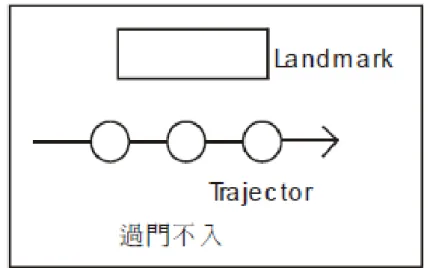
Similar to Wu’s view on the derived path-oriented senses of guò 過,Wang (2002) proposes a central image schema of guò 過 as shown below with an example guò mǎlù 過馬路 ‘to cross a road’:
Figure 2. Central schema for guò 過 (Wang 2002)
Wang (2002) illustrates the central meaning of guò 過 with the image schema above. In this schema, the arrow represents the route that the trajector/Figure is moving along, and the route goes across the Landmark from the boundary of one side to the boundary of the other side. That is, the core meaning of guò 過 describes a motion event in which the moving entity moves across the landmark. It is also noted that there is a contact between the trajector and the Landmark. This central schema can alter with the relation between the Figure and the Landmark and thus generate some elaborations referring to other route-oriented senses, ‘going through’, ‘going over’ and ‘pass by’. Though the trajectory has some contact with the Landmark, there are instances without contact as shown in the schema below with an example
14
Figure 3. Variant of the central schema for guò 過 (Wang 2002)
In addition, since the trajectory varies with the relation between the landmark and the trajector, the nature of the landmark also influences the route. The landmark may be viewed as different geometric shapes: as a two-dimensional arc in guò qiáo 過橋 ‘ to cross a bridge’, illustrated in Figure 4, or as a three-dimensional form with a passage through it as in
guò shāndòng 過山洞 ‘to go through a tunnel’ shown in Figure 5:
15
Figure 5.Variant of the central schema for guò 過 (Wang 2002)
In summary, as long as some information of the relation between the moving entity and the landmark is added to the central schema, other related senses of guò 過 can be derived. Wang (2002) concludes that the central schema could be modified with the rotation of the landmark (vertical or horizontal) or the transformation of the landmark (two dimensional or three dimensional). It is also noticed that there may be contact or no contact between the trajector and the landmark.
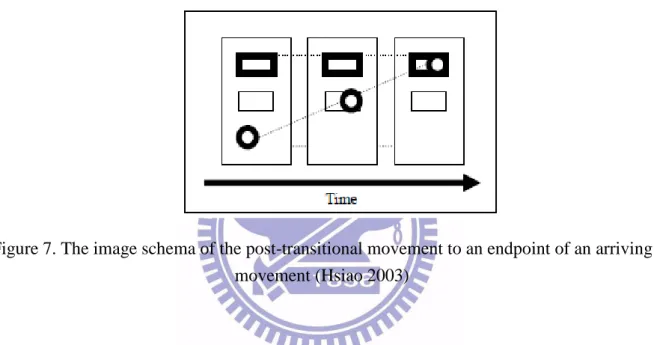
A bit different from the view of the central meaning of guò 過 in these two previous studies, Hsiao (2003) proposes that guò 過 predicates a prototypical activity such that a participant passes a particular intermediate point and reaches an endpoint. Mandarin conceptualizes two typical spatial senses of the verbal guò 過. First, it profiles the motional transition through an intermediate point of a crossing movement. Second, it profiles the post-transitional movement to an endpoint, focusing on the arriving movement. These two spatial senses of guò 過 are shown as below:
16
Figure 6.The image schema of the motional transition through an intermediate point of a crossing movement (Hsiao 2003)
Figure 7. The image schema of the post-transitional movement to an endpoint of an arriving movement (Hsiao 2003)
In these two schemas above, the rightward arrow at the bottom stands for the domain of conceived time, while the domain of physical space is represented by the larger vertical rectangles; the smaller horizontal rectangles refer to the states of the landmark, which is the intermediate point in Figure 6 and the endpoint/ destination in Figure 7. The little circles occurring at different distances from the landmark illustrate the sequential states of the trajector. The first spatial sense of guò 過 is shown in Figure 6 where the landmark profiles the intermediate points of a crossing movement such as in the events described by guò mǎlù 過馬路‘cross the road’ or bāxiān guòhǎi 八仙過海 ‘the eight immortals cross the sea.’ The road and the sea are the passing point the figure moves past in the crossing event. Figure 7 shows the second spatial sense of guò 過, which profiles the destination of an arriving
17
movement, such as the motion events in Tángshān guò táiwān 唐山過台灣 ‘Tangshan crossed (the Straits) to Taiwan.’ and guò fǔ yí xù 過府一敘 ‘go over to your home to have a chat.’ In these two events, Taiwan and your home are the goals of the arriving movement.
In addition to seeing guò 過 as a motion verb, Hsiao considers guò 過 a preposition when it follows a verb. Besides the two spatial senses mentioned above, He suggests that with the various landmarks, the prepositional guò 過 displays a set of route-oriented senses such as ‘over’ in (5a), ‘through’ in (5b) ‘across’ in (5c) and ‘via’ or ‘passing by’ in (5d).
(5) a. fēi-guò shāntóu 飛過山頭 ‘fly over the hill.’
b. chuān-guò suìdào 穿過隧道 ‘pass through the tunnel.’
c. chuān-guò cāochǎng 穿過操場 ‘go across the sports field.’
d. jīng-guò yóujú 經過郵局
‘passing by/via the post office.’ Hsiao (2003)
In summary of these previous strudies, guò 過 introduces a route into the motion event. Furthermore, there are three different routes involved in the motion event: 1) go over/across 2) go through 3) pass by. With various Landmark seen as different shapes, when guò 過 is followed by a surface (two dimensional) landmark, it denotes a contour of ‘go over/across’ ; while the landmark is an enclosed space (three dimensional), the Figure in the motion event described by guò 過 moves with a contour of ‘go through’. Moreover, if there is no contact
18
between the Figure and the landmark, in other words, the relation between them is not so intimate, the route in the motion event would be ‘pass by’. To conclude, the variants of the central schema of the motion verb guò 過 are specified by adding some further external information of the relation between Figure and the landmark, either the properties of landmark or the contact between the moving entity and the landmark.
As an intergration of these previous strudies on guò 過, Zeng(2008) proposes that the Figure in the motion event described by guò 過 can move past the reference object in all possible contours. By adding further information of the relation between the Figure and the reference object, various contours are generated. Depending on the relation, the reference object may be seen as a point, a line, or even a surface. Moreover, there may or may not be a contact between the Figure and the reference object. The following sentences adopted from Zeng (2008) illustrate the various possible contours by adding further information of the relation between the Figure and the reference object as shown in (6).
(6) a.他正在過橋 ‘go across’ (Zeng 2008) tā zhèngzài guò qiáo
He ASP cross bridge
‘He is crossing the bridge.’
b.小鳥… 飛呀飛呀,過了一座橋又過了一座山, ‘go over’ (Zeng 2008)
xiǎoniǎo…fēi ya fēi ya,guò-le yízuòqiáo yòu guò-le yízuòshān Bird fly RF fly RF cross ASP a-bridge and cross ASP a-mountain
19
c.小蝌蚪游了很久,過了很多座橋了, ‘go past’ (Zeng 2008)
xiǎo kēdǒu yóu-le hěnjiǔ, guò-le hěnduōzuò qiáo le
Little tadpole swim ASP a.long.time cross ASP many bridges CRS
‘The little tadpole has swum for a long time and gone past many brides.’
d.這是一條沿河路…一路上有一座橋,橋的附近有一個花園,你開車沿路過了那座 橋,離花園不遠的地方有一個白色房子, ‘pass by’ (Zeng 2008)
zhè shì yìtiáo yánhélù… yílùshàng yǒu yízuò qiáo, qiáo de fùjìn
This is a along.river.road all.the.way has a bridge, bridge DE neiborhood
yǒu yíge huāyuán, nǐ kāichē yán lù guò-le nàzuò qiáo, lí huāyuán bù yuǎn
has a garden you drive along road Cross ASP that bridge away garden not far
de dìfāng yǒu yíge báisè fángzi
DE place has a white house
‘This is a road along a river. On the road, there is a bridge nearby which there is a garden. Drive along the road and pass by the bridge, you will see a white house nearby the garden.’
In (6a), the Figure is a human being which only can move past the reference object, the bridge, in a contour of ‘go across’. The Figure in (6b), a bird, can move past the bridge by ‘going over’ while the Figure in (6c) is a tadpole which can move past the bridge in a contour beneath it. The information of the relation between the Figure and the reference object is further provided in (6d), specifying the contour as ‘passing by’.
To sum up, the meaning of guò 過 is to move past an intermediate landmark of the path in all possible contours which vary with the relation of the Figure and the intermediate landmark.
20
structure proposed by Rappaport Hovav and Levin (2010) into Mandarin motion morphemes. The Figure with respect to the ground could be understood as a scale which is composed of points belonging to a set of contiguous locations which together form a path. With the view of the scale, Lin (2011) suggests guò 過 does not lexically specify the direction the points are ordered in. To be more specific, she believes guò 過 does not denote a clear direction of moving. She further proposes that in the motion event described by guò 過, there is always an endpoint, i.e. the other side of the delimited entity to be moved past from the figure’s starting point. Although the exact endpoint is not specified, it can be retrieved from the context. For example, as illustrated in (7), we can infer from the context that the event of crossing the city wall starts from the side where the speaker is, and ends at the other side of the wall.
(7) 過城牆那邊兒是城外
guò chéngqiáng nàbiānr shì chéng-wài
cross city.wall that.side is city-outside
‘[If you] cross the city wall; that side [of the city wall] is outside of the city.’ (Lin 2011)
In addition to the retrival of the endpoint from the context, the scale lexicalized in guò 過 also points out that guò 過 does encode an endpoint. Lin (2011) believes guò 過 lexicalizes a closed scale, which means once the entire Landmark is being moved past (e.g., as indicated by a perfective marker -le in (8)), the motion event is finished. The length of the route is determined by the length of the Landmark, the complement guò 過 takes, and thus it is varied with the context. As illustrated in (8), guò 過 does not allow a gèng 更 ‘more’ comparative, because after the bridge is crossed, the figure’s motion is finished.
21 (8) 她在 5 分鐘前過了大橋,*現在過得更遠了
tā zài 5-fēnzhōng qián guò-le dàqiáo, *xiànzài guò de gèng yuǎn le she in 5-minute ago cross-ASP big.bridge now cross MOD more far ASP
‘She crossed the big bridge five minutes ago, and now she crossed further.’ (Intended meaning) (Lin 2011)
Lin claims that guò 過 lexicalizes an endpoint with a closed scale whose length is varied with the length of the Landmark, the complement it takes. Depending on the nature of the landmark, guò 過 behaves either like a multi-point or two-point closed scale motion verb. For instance, guò 過 can take a bridge as its complement. A bridge is a path that usually takes a figure some time to moves past so guò 過 in such a sentence is a multi-point closed scale motion morpheme as shown in (9): It is compatible with a duration phrase and describes an event in which the figure has been spending 20 minutes moving past the bridge.
(9) 他過大橋過了 20 分鐘還没過完
tā guò dàqiáo guò-le 20-fēnzhōng hái méi guò-wán he cross big.bridge cross-ASP 20-minute still NEG cross-finish
‘He had been crossing the big bridge for 20 minutes, but has not finished.’ (Lin 2011)
Besides the landmarks denoting complex paths, guò 過 can also take a boundary-like route NP as its complement. In such instances, it behaves like a two-point closed scale motion morpheme. For example, in (10), moving past a line is usually instantaneous so it does not allow a duration phrase:
22 (10) *他過警戒線過了二十分鐘
*tā guò jǐngjièxiàn guò-le 20-fēnzhōng he cross line cross-ASP 20-minute
‘He has been crossing the line for 20 minutes.’ (Intended meaning) (Lin 2011)
To conclude, Lin (2011) analyzes guò 過 as a special motion morpheme for it takes route NPs as its complement, partially lexicalizing the components of the scales, and determines the order of the points along the scale and the exact endpoint contextually.
2.3.2 Previous Anaylsis of yuè 越
Lin (2011) further probes into yuè 越 and views it as a bound morpheme for it cannot occur alone and has to be in combination with another morpheme. With the tests to examine the scale it lexicalizes, she believes yuè 越 also encodes a closed scale as shown below. As we can see in (11), once the entire landmark is being moved past, the motion event ends.
yuè 越 does not allow a gèng 更 ‘more’ comparative, because after the national boundary is
crossed, the figure’s motion is finished. Like the corresponding free morpheme guò 過, it takes either nouns denoting complex paths as the Endlish channel illustrated in (12a) or a boundary-like route NPs as the national boundary shown in (12b) as its complement, behaving as a multi-point closed-scale morpheme or a two-point closed-scale morpheme.
(11) 飛機五分鐘前飛越國境了,*現在飛越得更遠了
fēijī wǔ fēnzhōng qián fēi-yuè guójìng le *xiànzài fēi-yuè de airplane five minutes ago fly-cross nation.boundary ASP now fly-cross MOD
gèng yuǎn le
more far ASP
‘The plane flew across the national boundary five minutes ago, and now it flew across further.’ (Intended meaning) (Lin 2011)
23
(12) a. 飛機從法國飛越英吉利海峽到英國,飛越了20分鐘還沒到英國
fēijī cóng fàguó fēi-yuè yīngjílì –hǎixiá dào yīngguó
plane from France fly-cross English-Channel arrive British
fēi-yuè le èrshí fēnzhōng hái méi dào yīngguó
fly-cross ASP twenty minutes still NEG arrive British
‘The plane flew from France to British crossing the English Channel. It has been flying for 20 minutes, but has not arrived at British yet.’ (Lin 2011)
b. 飛機從法國飛越國境線到德國,*飛越了20分鐘還沒到德國
fēijī cóng fàguó fēiyuè guójìngxiàn dào déguó , *fēiyuè le
plane from France fly-cross nation.boundary arrive Germany fly-cross ASP
èrshí fēnzhōng hái méi dào déguó
twenty minute still NEG arrive Germany
‘The plane flew from France to Germany crossing the nationl boundary. It has been flying for 20 minutes, but has not arrived at Germany yet.’ (Intended meaning)
(Lin 2011)
2.3.3 Previous Analysis of jīng 經
Liu et al (2012a) decompose the notion of Path into three separate but related components and propose the concept of Route, the trajectory along which the Figure moves. Liu et al (2012a) suggest 經 jing ‘ pass’ is a Route marker which denotes a given trajectory by specifying a passing point such as Tokyo in the sentence below. Such a marker is used to mark a specific landmark and can only be followed by a Route-NP as shown in (1a) here noted again as (13):
24 (13) 再飛經東京回台北
zài fēi jīng dōngjīng huí táiběi then fly pass Tokyo return Taipei
‘(Someone) then flew through Tokyo and back to Taipei.’ (Liu et al 2012a)
As shown in previous section, in addition to jing 經, guò 過 and yuè 越 serve the similar function as a Route marker, introducing a given trajectory into motion events by specifying a passing point. In light of Liu et al (2012a)’s framework, this study aims to investigate the differences among the three commonly-used Route markers, which may shed light on the unique meanings of each marker and provide more information on Route-marking in Mandarin motion events.
25
Chapter 3
Database, Theoretical Framework and Methodology
3.1 Database
The corpus data used in this study come from Academic Sinica Balanced Corpus of Modern Chinese (http://dbo.sinica.edu.tw/SinicaCorpus/index.html), which involves vast texts with topics in society, life, literature, philosophy, science, and art; the Chinese Word Sketch (http://wordsketch.ling.sinica.edu.tw/), which shows grammatical co-occurrence statistics and differences of distribution patterns; and the online search engine Google (http://www.google.com/webhp?hl=zh-TW).
3.2 Theoretical Framework
3.2.1 Deictic-Incorporated Proto-Motion Event Conceptual Schema
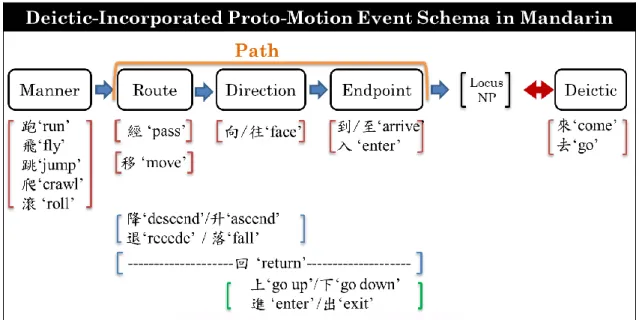
The study is based on the Deictic-Incorporated Proto-Motion Event Conceptual Schema proposed by Liu et al (2012a). Liu et al. (2012a) suggest the general notion of Path is quite broad in its sematic range and thus redefine the notion of Path as Route (the contour of moving), Direction (spatial orientation), and Endpoint (final point of the contour) as illustrated below. In the conceptual schema, a moving entity adopts a particicular way of movement (Manner). With a certain manner of motion, the moving entity decides on the motional contour in which it may pass an immediate point (Route NP) toward a location (Directional NP) and reach its final destination (Locative NP). The speaker-oriented perspective in describing a motion (Deictic) is independently specified in schematizing the self-initiated motion. Incorpoated into Motion, Deictic serves as an optional marker indicating the spatial orientation in relation to the deictic center, the Speaker. Moreover, the notion of Deictic is commonly used to signify the relative position of the Speaker to Locative
26
NP. In this sense, Deictic also helps to locate a Speaker-centered endpoint.
Figure 8.Deictic-Incorporated Proto-Motion Event Schema in Madarin (Liu et al 2012a)
Moreover, the PMS is based on an intergration of verb-internal and verb-external approaches.This study also adopts the intergration, examining the verb-external elements of Route as well as the verb-internal semantic attributes, aims to investigate Route-marking in an all-round way.
3.2.2 Multi-layered Hierachical Structure
To further understand the relation between Route and Motion, another framework adopted in this study is the multi-layered hierarchical structure of frames proposed by Liu and Chiang (2008). The framing system is as follows: Archiframe > Primary frame > Basic frame > Microframe. The lower-layered frames are subframes of the higher-layered frames. The higher frame encodes a broader semantic domain that provides background frame information. As Liu and Chiang’s illustration, Archiframe is a broad semantic domain defined with a general event schema; Primary frame is a subpart of the schema with a unique set of core frame elements; Basic frame highlights particular fram elements, realizing them in
27
particular constructions, called defining patterns; Microframe is further distinguished according to role-internal specifications of frame elements, such as Collocational Association, Semantic Attribute and Morphological Make-up. The frame of Route and the hierachial structure of Motion are illustrated in Chapter 5.
3.3 Methodology
To capture and analyze the unique meaning of each Route marker, three steps are taken successively as follows:
Step 1: Observing the collocational differences among the three commonly-used Mandarin Route Markers guò 過, jīng 經 and yuè 越.
The author searched and collected corpus data in Sinica Corpus, Chinese Word Sketch and Google.
Step 2: Analyzing the grammatical and semantic distinction of each marker.
To distinguish each Route marker, the author examined the data particularly in 1) syntactic patterns 2) collocation patterns 3) grammatical status 4) semantic attributes of each marker.
Step 3: Incorporating the analysis into a frame-based hierarchical structure.
To illustrate the relation between Route and Motion, the analysis of Route markers is
incorporated into a frame- based hierarchical structure proposed by Liu and Chiang (2008), which is introduced in Chapter 5.
28
Chapter 4
Findings
This chapter aims to present and describe the findings observed in corpus data. The study examined the syntactic behaviors of the three commonly-used Mandarin Route markers:
guò 過 ‘cross/pass’, jīng 經 ‘pass’ and yuè 越‘cross’, finding they have different syntactic
patterns: Pattern 1: * < Route-NP, Pattern 2: * < Route-NP < Motion verbs < Loc-NP and Pattern 3: Verbs < *. In corpus data, we found there are some different collocational patterns and distribution among these three patterns. In addition, we also examined the semantic differences on moving contours and the capability of encoding Endpoint of each marker. Based on the findings, these three markers with similar functions on Route-marking can be further analyzed and distinguished syntactically as well as semantically with a further understanding of Mandarin motion events. (See chapter 5).
4.1 Syntactic Patterns
In corpus data, we observe there are three common syntactic patterns in which the three
markers often appear. First, in Pattern 1, they are often followed by a Route-NP, a noun referring to a passing landmark, as illustrated below.
(14)a. 又過邊界了
yòu guò biānjiè le again cross boundary ASP
29 b.人不就可以很輕鬆地翻牆越障礙了嗎
rén bú jiù kěyǐ hěn qīngsōngdi fān qiáng people NEG exactly can very freely.and.easily go.over wall
yuè zhàngài le ma
cross obstacle ASP Q
‘Can’t people go over the wall and cross the obstacle freely and easily?’
One of the intriguing findings is that jīng 經 does not have such a pattern, which suggests the special status of jīng 經 among the three markers.
(15) *經邊界了 *jīng biānjiè le
In pattern 2, the three markers are observed to be followed not only by a Route-NP but also another motion verb immediately followed by a Loc-NP, a noun referring to the destination of the moving, as shown below:
(16) a. 從捷運淡水站過淡水河到對岸的八里
cóng jiéyùn dànshuǐ zhàn guò dànshuǐhé dào duìàn de bālǐ from MRT Danshui Station cross Danshui.River arrive opposite DE Bali ‘(Someone) crossed Danshui River to Bali in the opposite bank from MRT Danshui
30 b.順道越邊界到墨西哥去,
shùndào yuè biānjiè dào mòxīgē qù following.the road cross boundary arrive Mexico go
‘(Someone) followed the road and crossed the boundary to Mexico.’
c. 由大陸來的商船可經淡水河直達此地
yóu dàlù lái de shāngchuán kě jīng
from Mainland come DE business-ship Mod pass
dànshuǐhé zhí dá cǐdì
Dan.shui.River directly arrive this-place
‘The business ships from Mainland can go across Danshui River to this place directly.’
In addition, in Pattern 3, they are commonly found to be preceded by another verb to together specify a motion event as illustrated below:
(17) a. 直升機低空飛過公路
zhíshengjī dī kōng fēi-guò gong lù
helicopter low height fly-cross public road
‘The helicopter flew over the road in low height.’
b. 球兒直飛越觀眾席,
qiúér zhí fēi yuè zhòng xí
ball straight fly cross audience seat
31 c. 當時正好有一名駕駛員飛經該區,
dāngshí zhènghǎo yǒu yì míng jiàshǐyuán fēi-jīng
at.that.moment just exist Num CL driver fly-pass
gāi qū Dem area
‘A pilot just flew by that area at that moment.’
(18) a. 兩腳跨過門檻
liǎng jiǎo kuà-guò ménkǎn Num foot stride-cross threshold
‘(Someone) strides over the threshold.’
b.二十萬人跨越金門大橋
èrshíwàn rén kuà-yuè jīnméndàqiáo
Num people stride-cross Golden.Gate.Bridge
‘Twenty million people went across Golden Gate Bridge.’
c. 當時規劃鐵道外移須跨經基隆河兩岸
dāngshí guīhuà tiědào wàiyí xū kuà-jīng jīlónghé liǎng àn
then plan railroad relocation has.to stride-pass Jilong.River two bank
‘(Someone) planned the relocation of the railroad had to go across Jilong River then.’
In a word, these three markers are commonly found in the three syntactic patterns: Pattern1: * < Route-NP, Pattern 2: * < Route-NP < Motion verbs < Loc-NP and Pattern 3: Verbs < *. It is noted that jīng 經 does not show in Pattern 1. It cannot be followed only by a Route-NP while it can be followed by Route-NP and a motion verb followed by a Loc-NP,
32
which indicates the special status of jīng 經. Among these syntactic patterns, we found some different collocational patterns and distribution shown by these three markers, which are illustrated in the following sections.These different collocational patterns and distribution further display the grammatical status and semantic distinctions of each marker. (See Chapter 5).
4.2 Collocational Patterns and Distribution among Syntactic Patterns
Although the three markers are found in the three common patterns as shown in the previous section, they show some diffrerent behaviors in each pattern, which reveals the grammatical properties and semantic characteristics of each marker. The following sections illustrate the different behaviors on collocational patterns or distribution shown by the three markers in each pattern.
4.2.1 The Different Behaviors in Pattern 1
As shown in the previous section, in Pattern 1, except jīng 經, the markers are followed
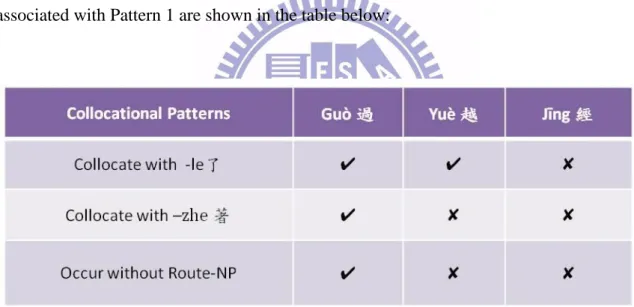
by a Route-NP, referring to the passing landmark. However, in some instances, guò 過 can occur alone without a clear Route NP following it but jīng 經 and yuè 越 cannot:
(19) a. 這陣子的生活就像眼前的列車呼嘯而過/*經/*越
zhè zhènzi de shēnghuó jiù xiàng yǎn qián de lièchē hūxiào ér this period DE life exactly similar eye in.front.of DE train bluster and
guò/*jīng/*yuè pass
33 b. 親愛的妳也匆匆而過//*經/*越了
qīnài de nǐ yě cōngcōng ér guò/*jīng/*yuè
beloved DE you also quickly and pass
‘Beloved you also passed quickly.’
c. 凡經此過/*經/*越,必留下痕跡
fán jīng cǐ guò/*jīng/*yuè , bì liúxià hénjī once pass here pass definitely leave trace
‘Once you pass through here, you will definitely leave some traces.’
d. 過/*經/*越來 guò/*jīng/*yuè lái pass come ‘Come over here.’
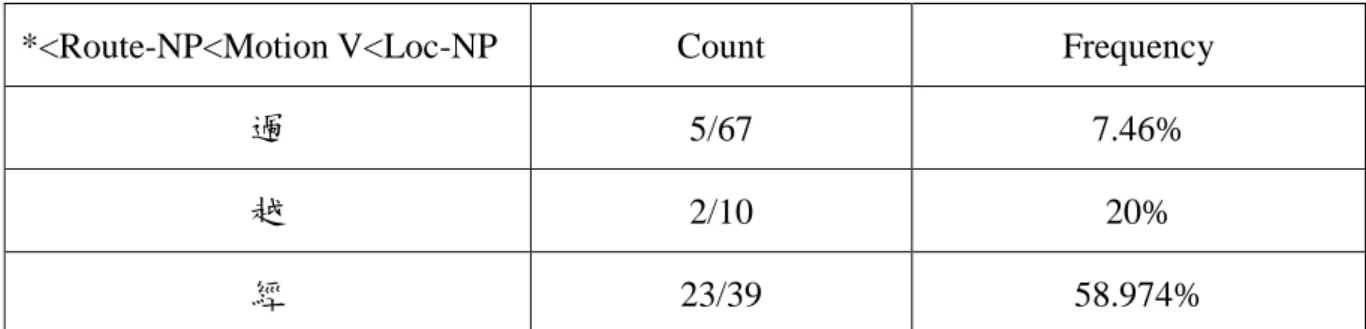
The finding that only 過 can occur alone without a clear Route-NP suggests its special status. In addition to the collocations with Route-NP, guò 過/ jīng 經/ yuè 越 also shows different behaviors when collocating with aspectual markers. First, guò 過 and yuè 越 can collocate with the perfective marker -le 了 but jīng 經 cannot. To be more specific, -le 了 can immediately follow guò 過 and yuè 越 or follow the complement of guò 過/yuè 越, that is, it can follow the construction of [過/越+NP] as shown below:
34
(20) a.三個人膽戰心驚,終於都過了那十餘丈狹窄的通道
sān ge rén dǎnzhànxīnjīng,zhōngyú dōu guò le nà shí yú zhàng de three CL people afraid.and.scared finally all cross ASP that ten more CL DE
xiázhǎi tōngdào
narrow passage
‘Three people were afraid and scared, crossing the narrow passage finally.’
b.誰越了界,馬上會被人拖到後面教訓一頓
shéi yuè le jiè, mǎshàng huì bèi rén tuō dào hòumiàn who cross ASP boundary immediately MOD BEI people drag arrive behind jiàoxùn yí dùn
teach.a.lesson one CL
‘Whoever crosses the boundary, he would be dragged behind to be beaten immediately.’
c. *經了通道 *jīng le tōngdào
(21) a.又過邊界了
yòu guò biānjiè le again cross boundary ASP
35 b.人不就可以很輕鬆地翻牆越障礙了嗎
rén bú jiù kěyǐ hěn qīngsōngdi fān qiáng people NEG exactly can very freely.and.easily go.over wall
yuè zhàngài le ma
cross obstacle ASP Q
‘Can’t people go over the wall and cross the obstacle freely and easily?’
c. *經邊界了 *jīng biānjiè
Besides the perfective marker -le 了, we found that only guò 過 can collocate with the durative marker –zhe 著.As shown below, only guò 過 can be immediately followed by –zhe 著.
(22) a. 孩子們小心翼翼地過著橋
háizimen xiǎoxīnyìyìdi guò zhe qiáo children carefully cross ASP bridge ‘Children are crossing the bridge carefully.’
b.*越著橋 *yuè zhe qiáo
c.*經著橋 *jīng zhe qiáo