行政院國家科學委員會補助專題研究計畫成果報告
期末報告
中國大陸多元經濟治理模式的政治邏輯
計 畫 類 別 : 個別型計畫 計 畫 編 號 : NSC 101-2410-H-004-134- 執 行 期 間 : 101 年 08 月 01 日至 102 年 11 月 30 日 執 行 單 位 : 國立政治大學政治學系 計 畫 主 持 人 : 蔡中民 計畫參與人員: 碩士班研究生-兼任助理人員:張斯涵 報 告 附 件 : 移地研究心得報告 處 理 方 式 : 1.公開資訊:本計畫可公開查詢 2.「本研究」是否已有嚴重損及公共利益之發現:否 3.「本報告」是否建議提供政府單位施政參考:否中 華 民 國 103 年 02 月 28 日
中 文 摘 要 : 本文以中國大陸「電力監管委員會」(電監會)為例,說明 經濟管制的政治邏輯。提出的論點有二:獨立管制機關需作 為改革的目的之一在改革啟動前成立;資源與權力的重分配 是新成立的獨立管制機關最重要的制度設計。可惜的是,中 國大陸的的電監會作為第一個以產業為主體的獨立監管機 關,並未按照此方式進行,已至陷入管制俘虜的困境,最終 無法運作,於 2013 年被撤銷,也打消了中國大陸政府繼續成 立獨立管制機關的想法。對於建構市場體制而言,中國大陸 在無法完善經濟治理的情形下,還有很多困難要克服。 中文關鍵詞: 中國大陸、電力監管委員會、管制俘虜、獨立管制機關 英 文 摘 要 : During economic transition, the Chinese state has
readjusted its relationship with industry and developed new regulatory schemes. China's first industry-specific independent regulatory agency, the State Electricity Regulatory Commission (SERC), was created in 2003. Nonetheless, its operation goes against Western experiences in adopting the best institutional arrangement for autonomous regulators. Why has SERC failed to function? Why has SERC been captured? I argue that because the process of creating a new regulator involves resource reallocation and power redistribution, SERC has suffered both endogenous and exogenous disadvantages since its inception. The compromised institutional design along with insufficient resources and
fragmented authority considerably weakens SERC's regulatory capacity. Moreover, SERC was not designed as part of the reform schedule but instead emerged later as a response to institutional necessities, which also contributes to its vulnerability. In doing so, the state exposed SERC to potential capture by both government entities and regulated enterprises. 英文關鍵詞: China, power reform, independent regulatory agency, State Electricity Regulatory Commission, regulatory capture
1
Article title: Regulating China’s Power Sector: Creating An Independent Regulator That Wasn’t Author name: Chung-min Tsai
Bio: Chung-min Tsai is Assistant Professor of Political Science at the National Chengchi University, Taipei, Taiwan, R.O.C. He received a Ph.D. in political science from the University of California at Berkeley in 2010. His research interests include comparative politics, political economy, and China studies. Professor Tsai’s research has been published in the Asian Survey.
E-mail: [email protected]
Address: Department of Political Science National Chengchi University
64, Sec. 2, Zhinan Rd., Wenshan Dist., Taipei, Taiwan, R.O.C. 11605
TEL: 886-2-29393091#50749 Word Count: 8,962
Abstract: During economic transition, the Chinese state has readjusted its relationship with industry and developed new regulatory schemes. China’s first industry-specific independent regulatory agency, the State Electricity Regulatory Commission (SERC), was created in 2003. Nonetheless, its operation goes against Western experiences in adopting the best institutional arrangement for autonomous regulators. Why has SERC failed to function? Why has SERC been captured? I argue that because the process of creating a new regulator involves resource reallocation and power redistribution, SERC has suffered both endogenous and exogenous disadvantages since its inception. The compromised institutional design along with insufficient resources and fragmented authority considerably weakens SERC’s regulatory capacity. Moreover, SERC was not designed as part of the reform schedule but instead emerged later as a response to institutional necessities, which also contributes to its vulnerability. In doing so, the state exposed SERC to potential capture by both government entities and regulated enterprises.
Keywords: China, power reform, independent regulatory agency, State Electricity Regulatory Commission, regulatory capture
2
Acknowledgment: The author thanks Lowell Dittmer, You-tien Hsing, Chih-shian Liou, Steven Vogel, and anonymous reviewers for their helpful comments and
suggestions. The research is partially supported by National Chengchi University’s Top University Project and Taiwan’s National Science Council (101-2410-H-004 -134 -).
3 Introduction
In adopting a gradualist approach to replace a rigidly planned economic system with a market economic system, the Chinese state has demonstrated how capable it has been in managing the reform process. Nonetheless, a rapidly evolving situation requires the Chinese state to distinguish its role vis-à-vis the industry. China now needs a new direction in which to position itself while mapping out further reform schemes. A major task for the central government is to adjust its role and redesign its administrative structure to enhance the sinews of governance and respond to the changing nature of economic growth. When examining development experiences in other countries to glean beneficial information, the Chinese state has a choice between two models, developmental state and regulatory state, and has moved toward the latter.1 As an essential element of the regulatory state model, independent regulatory agencies (IRAs) implement more credible, effective regulation because of their autonomy.2 Therefore, the advancement of Chinese IRAs reflects the interaction between the state and industry and the state’s determination to build up a functioning regulatory system.
In the industrial sector, the administrative reform of 1998 was a monumental effort in changing China’s government-industry relationship and led to the comprehensive restructuring of regulatory systems. It delivered a clear message that government functions and business activities shall be separated and the state shall ensure a level playing field between the state-owned enterprises (SOEs) and private firms. Against this background, the State Regulatory Electricity Commission (SERC) was created in 2003 to facilitate market competition and promote power reform. Moreover, the formation of SERC was also regarded as a milestone for China’s electricity reform, which was initiated in the mid-1980s. The reform scheme involved
1 Pearson 2005. 2 Majone 1997.
4
ownership reshuffling and industrial restructuring.3 While the World Bank developed a universal template for power reform and promoted it in developed and developing countries, the model failed to prevail due to involvement of international actors and different political and economic systems.4 China’s electricity reform was advised by international organizations, but it has been trapped in political struggles between the reformists and conservatives that have significantly delayed the reform process.5 Facing both exogenous defects and endogenous weaknesses, SERC fails to implement its mandate and carry out further reform. Despite SERC’s promising
intentions, the reform progress has stalled and the entire sector is dominated by the gigantic state power enterprises SERC is charged with regulating.
Why has SERC failed to function? How has it been captured by the industry? I argue that because the process of creating a new regulatory agency involves resource reallocation and power redistribution, SERC has faced challenges from other government entities since its inception. The compromised institutional design along with insufficient resources and
fragmented authority considerably weakens SERC’s regulatory capacity. In addition, SERC was not designed as part of the reform schedule but instead emerged later as a response to
institutional necessities, which also contributes to its vulnerability when facing the regulatees. The state has in fact exposed SERC to potential capture by government entities and regulated enterprises.
Debates on the limits of autonomy for functioning IRAs, their relationship with other government bodies, the political responsibility of their actions, and the mechanisms for enhancing their accountability have begun to heat up among scholars and state officials in
3 Xu 2002. 4
Xu 2004.
5 The study of SERC could be set within the broader contexts of either IRA development or power reform in China. The author situates the discussion in the former scenario. For more detailed information about China’s electricity reform, see Chen 2010 and Tsai 2011.
5
China.6 Policies to determine the main lines of institutionalization and consent have not yet fully matured. As the first industry-specific IRA and model for other industries such as
telecommunication,7 SERC provides a rich milieu for us to examine China’s regulatory development.
The data were gathered from archival studies and the author’s field trips to China between 2008 and 2011, where more than 40 interviews were conducted. The interviewees include scholars; government officials in SERC, the National Development and Reform Commission (NDRC), and State-owned Assets Supervision and Administration Commission (SASAC); local cadres; and corporate managers from SOEs and private power companies in various provinces, including Beijing, Heilongjiang, Henan, Shandong, Zhejiang, and Guangdong. Moreover, the author also obtained some unpublished documents from the interviewees.
This article begins by setting out brief discussions of the rise of IRAs. It is succeeded by a description of regulatory development in China and its power sector. Sections 3 and 4 examine the indigenous and exogenous factors preventing SERC from effective operation. The article concludes with the implications for China’s state-business relationship, industrial reform, and future regulatory development. By exploring SERC, this article contributes to our understanding of the government-industry nexus and interactions between state entities, thereby establishing that the demand for a functioning IRA remains impossible in China’s unique economic situation.
The Rise of Independent Regulatory Agencies
IRAs are governmental entities that possess and exercise some grant of specialized public authority and are separate from other institutions. They are neither directly elected by the people
6 Ma 2008; Wang and Zhou 2008.
7 Although China’s scholars and experts have actively called for an autonomous regulator in the telecommunication sector since 2005, the Chinese government has no plan to do so partly due to SERC’s unsuccessful experience.
6
nor directly managed by elected officials.8 The rise of IRAs has its origin in American political development dating back to the Progressive Movement and the New Deal. When faced with an economic crisis, the government decided to adopt neutral, professional administrative
mechanisms that were above party strife and sectional interests to control business. With their isolated status and legalistic tradition, IRAs have become a practical tool of economic
governance. In the 1960s, American regulatory development entered into a new age of social regulation in which innovative IRAs emerged to supervise a wide swath of issues such as safety and the environment, going beyond the original economic focus. Since the trend of globalization appeared in the early 1970s, American regulatory standards and institutional designs have spread out and deeply influenced the rise of state regulation in Britain.
The great economic crisis of the 1970s and a deep institutional crisis in British government immensely changed the policy direction from an interventionist state to a regulatory state and led to the implementation of an ambitious program of privatization and deregulation.9 Because public ownership had proved ineffective, the British government adopted a radical policy to sell state assets at large to tackle the problems of economic efficiency and public accountability. In doing so, the state solved these problems not by withdrawing from command but by unleashing the irresistible power of business. It had chosen to delegate authority to IRAs instead of making policies and managing the industries by itself because the IRAs provide the advantages of technological expertise and greater policy credibility and continuity.10 Most importantly, IRAs are able to maintain distance from political interference (elected politicians in general) and enjoy the autonomy that government ministries lack.11 The IRAs have become “one of the most
8
Thatcher and Sweet 2002, 2. 9 Marquand 1988.
10 David Levi-Faur and Sharon Gilad 2004. 11 Majone 1997, 152-5.
7
widespread institutions of modern regulatory governance,” and “the use of this kind of institution has mushroomed during the 1980s and 1990s and continues to increase.”12 State regulation through IRAs is regarded as the most viable tool of governance. A firm belief in the creation and diffusion of IRAs is that independence is important for sheltering regulatory functions from political and business controls.
The IRA has either appeared or been set as the eventual goal of reform in various industries to promote effective state regulation and ensure a reliable market. Hence, although the
macroeconomic circumstances are not all alike, the American and British experiences offer China beneficial lessons and guidelines to develop a modern regulatory mechanism that fits its unique political and economic system. It is too early to argue the rise of the regulatory state in China, but undoubtedly regulatory reform has been initiated to respond to shifting
macroeconomic circumstances in China.
Regulatory Development and IRAs in China
China had gradually adjusted its regulatory system during the reform era, but comprehensive regulatory development was initiated by large-scale SOE reform in 1997. While the major policies of “grasping the big, releasing the small” (zhuada fangxiao, 抓大放小) and “separating the government and industry” (zhengqi fenkai, 政企分開) were promulgated to reshuffle the state sector, extensive development of regulatory systems and government reorganization
followed in 1998. The administrative streamlining spearheaded by then-Premier Zhu Rongji had eliminated nine ministries that managed specific industries and further empowered
8
comprehensive and macroeconomic-oriented commissions.13 China’s regulatory systems and logic of economic governance have undergone a sea change. In the thriving private sector, the state has played the role of referee in the market. In the remaining influential state sector, the state has morphed from being controller to being owner and regulator. It concentrated public ownership in a governmental body and delegated the authority to regulatory institutions.
In the industrial sector, the presence of different paths toward regulatory development demonstrates that the central government has contemplated the heterogeneous conditions and diverse stages of reform and realized that “one model does not fit all.” Therefore, various types of regulatory agencies have sprung up such as IRAs, ministerial departments, and ministry-level bureaus. The Chinese state aims to reach the ultimate goal of separating the political and
regulatory functions (zhengjian fenkai, 政監分開) in order to supervise the SOEs well.14 Hence, we may expect two regulatory trends. First, more industry-specific IRAs will be created, and second, the existing regulators will expand their coverage to include more industries and transform into multi-sector regulatory bodies.15
To date, China has four IRAs in terms of economic regulation. Other than SERC, the remaining three are in the financial sector. The first IRA, China Securities Regulatory
Commission, was formed in 1992 as a response to increasing chaos in the unruly stock market in Shenzhen. The adoption of the IRA is an institutional emulation for which China’s policy makers consulted their Taiwanese counterpart and considered the lessons of financial history.16 To better manage the fast-growing financial sector and ensure trading platforms, the central authority
13
Lan 1999.
14 This step is designed to clarify the division of labor between policy-making bodies and regulatory entities under China’s unique economic regime. It is rarely found in regulatory development in Western countries because their regulatory agencies are also equipped with policy-making functions.
15 The latter point was demonstrated in the administrative reform of 2008, and the Chinese state created five super ministries.
9
followed a similar line of reasoning to create two more IRAs, the China Insurance Regulatory Commission and China Banking Regulatory Commission, in 1998 and 2003 respectively. Although the formation of these IRAs were not in advance of or even concurrent with reform implementation, the relevant laws passed or amended by the National People‘s Congress have provided strong and necessary backing to IRAs.17 Their organizational autonomy and clear legal mandate enable effective enforcement and prevent interference from other government entities and business interests. A noteworthy feature of IRAs in the financial sector is that there is a clear division of labor between them and two other critical supervisory ministries, the Ministry of Finance (MOF) and People’s Bank of China.
The Regulatory Evolution of China’s Power Sector in the Reform Era
After advancing into the reform era, China’s power sector adopted various regulatory
mechanisms in response to the reform agenda at different stages (see Figure 1). During the early stage of the reform, the ailing power sector was one of the foremost problems that threatened economic progress. Due to inefficient productivity and insufficient investment, a paucity of power was a major bottleneck impeding economic expansion.
Figure 1. Evolution of Regulatory Authority of the Power Industry since 1979
17
These laws include the Securities Law adopted in 1998 and revised in 2005, the Insurance Law promulgated in 1995 and amended in 2002, the Commercial Banking Law and the People‘s Bank of China Law--both adopted in 1995 and amended in 2003, and the Law on Banking Regulation and Supervision adopted in 2003 and amended in 2006.
1979 1982 1988 1993 1998 2003
MEP MWRE MOE MEP
SETC&
10
Source: by author.
The Chinese state reinstituted the Ministry of Electric Power (MEP) in 1979 to restore the devastated infrastructure and reinitiate stagnated power plant projects.18 In 1982, the Ministry of Water Resources and Electricity (MWRE) was established by integrating the MEP and the Ministry of Water Resources.19 This was due to the intense contradictions and ambiguous responsibilities of the two ministries.20 In the administrative restructuring of 1988, the new Ministry of Energy (MOE) was formed to incorporate the functions of several previous ministries including the MWRE, Ministry of Coal Industry, Ministry of Oil Industry, and Ministry of Nuclear Industry. It comprehensively managed the whole energy sector and facilitated the sector’s development at large. Moreover, the industry association, the China
Electricity Council (CEC), was created to serve as a bridge between the government and industry. It provides consultation and advice to power companies and delivers the industry’s feedback and concerns to the government. To date, both the state and companies continue to rely heavily on this communication channel.
Although the MOE reigned over different industries, it was unable to apply a similar reform program to all of them and needed to design separate projects to meet the specific requirements of each industry. The unsolvable difficulties in coordinating and managing various industries resulted in the abrogation of the MOE and formation of the MEP again in 1993. The MEP followed the existing guiding principles and kept the industrial structure intact. The CEC further strengthened its role as coordinator while some retired MEP senior officials took posts there.
18 The Ministry of Electric Power was first instituted in 1955 but was dismantled in 1958. 19 Dangdai zhongguo congshu bianji weiyuanhui 1994.
11
Another breakthrough was the promulgation of the Electricity Law in 1995. It provided a legal basis and comprehensive framework for the ensuing power reform and general provisions for the industry.
Despite the frequent reorganization of the administrative agencies, the Chinese state had not yet touched the fundamental issue of comprehensive industrial restructuring. China’s power reform was merely a response to economic constraints and an effort by the central state to maintain legitimacy.21 Limited reform and dominant state ownership had kept the industry under tight control at large, but the growing influence of local governments challenged the vertical supervisory structure as the local governments strived to protect their own interests.
Liberalization had not promoted market competition but instead introduced structural and regulatory paradoxes.
With the enforcement of the separation of government and enterprise, an extensive
restructuring plan for the power industry was undertaken in 1997. The first step was regarded as laying the structural foundation for subsequent reform. Due to economic concerns, the central government chose a policy of corporatization instead of privatization.22 The State Power Corporation of China (SPCC) was founded in 1997 as a separate economic entity to perform business functions. A colossal holding company that was fully owned by the State Council managed most of the infrastructure, including about 50 per cent of power generation and almost the entire network system. In 1998, the central government dismantled the MEP and transferred its functions to the State Economic and Trade Commission (SETC) and State Development and Planning Commission (SDPC). Thus they became the two major regulators of the power industry. The SETC was responsible for making policies and supervising the industry, while the SDPC
21 Yeh and Lewis 2004.
12
controlled the pricing systems and reviewed the investment projects. By restructuring in this way, the Chinese state significantly reduced the institutional difficulties involved in unifying
governmental administration and business functions, clarified duties, and decreased the misallocation of resources.
Nonetheless, the SPCC was too powerful to be regulated. While vertically integrating the power generation and grid systems, the SPCC enjoyed a monopoly status and was dominant over independent power plants. In addition, the fact that most former MEP senior officials moved to the SPCC made the SPCC a “corporatized ministry” and prevented state regulators from
achieving effective management. For instance, Shi Dazhen (史大楨), the last Minister of Electric Power, was the first general manager of the SPCC. The lack of technical expertise is another critical factor—the officials of SETC and SDPC did not have enough professional knowledge to supervise the industry. In general, the pre-2003 regulatory framework of the power sector suffered five major problems: the lack of a specific regulatory body along with dispersed authority; unclear goals and political interference; incomplete laws; inadequate regulatory capacity; and insufficient supervision over regulatory agencies.23
The Creation of the State Electricity Regulatory Commission
In the 1990s, there was a global trend towards electricity reform as a result of technological advancement. As a latecomer, the Chinese state identified the strengths and weaknesses of various reform experiences in other countries and received assistance from the World Bank and Asian Development Bank in designing an appropriate regulatory framework. It has thus realized the necessity of an IRA for monitoring the power industry and designated this as the core
13
element of the reform agenda. The idea of formulating an IRA in the power sector first appeared in the mid-1990s. At that time, the MEP and World Bank jointly worked on a project to explore the development of a regulatory framework for electricity reform. After three years of study and several seminars, this research concluded in a collaborative report published on 18 January 1997, two days after the SPCC was formally established.24 In this report the experts propose “a national regulatory authority (hereinafter referred to as the “National Power Regulatory Commission”) should be created separate from other government institutions and should be responsible to the State Council.”25 It also suggests that the state shall supervise the power sector through a functional regulatory and legal system rather than directly manage the sector through
administrative directives.26 Unfortunately, this proposal was not incorporated into the reform agenda until five years later.
Based on conclusions from the previous experience in electricity reform, then-Premier Zhu Rongji (朱鎔基) made a significant move from “reform from within” to “reform from the outside.” Originally, reform projects were proposed by the lead agency of an industry. This model was abrogated and replaced with a designated group comprised of representatives from various government institutions. In October 2000, the State Council issued the “Notice on Relevant Issues Concerning the Structural Reform of the Power Industry”. The central state made it clear that power reform should be led by the SDPC and organized the “Electricity Reform Coordination Leading Group” to draw up a new reform scheme. The director of the leading group was Zeng Peiyan (曾培炎), then-chairman of the SDPC. The SDPC presented the first reform proposal in May 2001. It was remarkable because it identified the creation of an
24 Shao et al 1997. 25 Ibid, p. 48. 26 Ibid, p. 53.
14
autonomous regulatory agency as the major goal. The project also suggested restructuring SPCC. Nevertheless, it was not regarded as a workable solution to breaking up the monopoly and
eliminating local protectionism, so it was brushed aside.27
After additional research on the reform experience in Western countries, the SDPC prepared a new reform scheme, which was approved by the State Council in January 2002. In the draft, the SPCC would spin off into two grid companies and five power firms. The central government would also create a ministry-level regulatory body to supervise the industry, but there was debate over the extent of the delegation of authority to this new regulator. There were three available options: first, the agency regulates all aspects of an industry; however, this design involves many government entities and is therefore hard to implement. Second, the agency is responsible for monitoring market operation; however, it runs the risk of having no real power. Third, the agency is a transitional institution, focusing on market regulation first and then gradually extending regulation to other areas; the problem is that there is no clear schedule on when the agency should expand its coverage, resulting in a prolonged and indefinite process. Obviously, each of these choices had its own difficulties and there were no clear resolutions. The central state eventually adopted the third idea and formed SERC.
Against this background, in 2002, the Chinese government issued a document detailing a landmark reform project, “Circular of the State Council Concerning the Reform of the Power Structure” (so-called Document No. 5), to mandate the divestiture of the SPCC in order to break up the monopoly and form an autonomous regulator. The creation of SERC represented the state’s determination to build up a modern regulatory system. The role of the state was delineated so that it is no longer both owner and manager, but a separate owner (SASAC) and regulator (SERC).
15
The SERC’s mission is to formulate regulatory rules for market operation, monitor the power markets, ensure fair competition, propose tariffs and adjustments, enforce safety standards, issue and manage business licenses, and supervise policy implementation.28 While both the state and the industry embraced this new agency, there was no way to gauge the effectiveness of SERC’s performance until a sufficient amount of time had passed. Later on, reform stagnation and regulatory contradictions revealed the reality: SERC suffered from both endogenous and exogenous defects and had been exposed to regulatory capture from its inception.
Endogenous Defects
The process of creating a new regulator involves resource reallocation and power redistribution, so SERC has faced challenges from within (organizational configuration) and from outside (other government entities). It bears a number of endogenous flaws due to insufficient resources that prevent it from functioning effectively.
Status of the Institution
SERC is a ministry-level administrative entity that is categorized as a “public service unit (PSU) directly under the State Council” (guowuyuan zhishu shiye danwei, 國務院直屬事業單位).29
PSUs were created as public service providers, similar to non-profit organizations.30 Different from IRAs in Western countries, SERC was not created by law but by two statutes promulgated by the State Council: “Regulations on Administration of the Establishment and Staffing of the Administrative Agencies of the State Council” and “Provisional Regulations on the Registration of Public Institutions.” SERC was instituted when the executive body issued “Provisions on the
28 For more information, see http://www.serc.gov.cn/english/index.htm. 29 The other three IRAs also have the same status.
16
Function Disposition, Internal Structure and Staffing of the State Electric Power Regulatory Commission.” The Chinese government made this disposition because the employees of PSUs are not recognized as bureaucrats. Therefore, the creation of SERC would not go against the downsizing movement in the administrative reform of 2003.31 In addition, this designation increases agency autonomy because the Chinese Premier can decide the leadership without the approval of the NPC.32 SERC, however, suffers from being designated as a PSU, which is inferior to traditional ministries in the State Council hierarchy. Although it was granted ministerial rank and regulatory functions, the new IRA does not possess the right to formulate rules or to make specific stipulations on punishing scofflaws.
Legal Framework
The Electricity Law was promulgated in 1995 and put into effect in 1996 as a sound legal basis for electricity reform. In 2003, modifying the Electricity Law was integrated into the NPC annual schedule, although nothing substantial has been done since then.33 Today, this unsuitable law has significantly hindered the industry’s development, as the industry has already undergone two rounds of restructuring. Experts and scholars have consistently proposed to amend the law to make it applicable to the changing situation, but the central government obviously has no plans to do so in the near future.34 With outdated stipulations, SERC can only wield its authority according to the “Regulations on Electricity Regulation” issued by the State Council in 2005. Because the regulations are decrees made by the State Council, they are unable to empower
31
Interview with research fellow, Beijing, 7 July 2009. 32 Pearson 2007, 723.
33 The NPC made minor changes to the wording of three clauses in 2009.
17
SERC to enforce as statute laws. The lack of legal basis makes it difficult for the IRA to clarify its responsibilities and therefore to enforce regulation.35
Moreover, the IRA is responsible for instituting the power markets while being delegated to supervising market operations. Only if the power markets are established and functioning can SERC perform its regulatory duties. The dilemma is that SERC is not fully supported by an adequate legal framework to create a market system. Hence, with nothing for the IRA to regulate, SERC is not regarded as a functioning body.
Organization
An understaffing issue has always afflicted SERC. Although the number of staff may increase depending on practical needs in the future and the employees of local branch offices are not included, SERC commits only 98 staff members to perform all tasks.36 In sharp contrast, there are more than 1.5 million employees in the State Grid Corporation (SGC). Moreover, a
surprising fact is that SERC was actually funded by the SGC during the first three years. Even though its financial source has changed to the MOF, SERC’s annual budget proposal still needs the approval of NDRC.37
SERC does have its own independent financial source because it can charge fees to issue business licenses and work permits—responsibilities that were originally handled by local governments. The local governments, however, are reluctant to transfer authority to SERC’s local offices because of their loss of revenue. For example, occupational qualification certificates are now issued by SERC, but local governments responded by concealing information about this
35
Zhou 2003.
36 Understaffing is also a problem for SERC’s local offices. At the regional and provincial levels, there are only 53 and 15 staff members respectively.
18
policy. As a result, power industry workers continue to apply for the certificates from local governments. Unfortunately, SERC is unable to punish or even challenge local officials who are not cooperating due to lack of clear regulations.38
SERC was not given sufficient support during its establishment process, particularly when it came to resource reallocation. Because of the tight budget and personnel shortage, SERC has difficulties creating local branches and therefore must appeal to the industry for support. This predicament is reflected in the facilities that SERC uses. Ironically, SERC is located in the SGC building in Beijing. Some of the provincial branches lease office space from the power groups.39 The regulator is beset by the fact that the regulated firms are its landlords. This unusual situation also happens in personnel arrangements. SERC requires a professional team, including experts on technology, management, and law, to manage complex electricity affairs. Since SERC has no predecessor and needs to be ready to perform its assignments, the IRA recruited staff from other government entities or the industry. At the central level, the majority of officials were mainly transferred from the SPCC and the former Department of Electricity of the SETC. At the local level, most staff members and technicians are transfers from the regulated SOEs. Some of them are even still paid by their home work units and can decide to either stay in SERC or return to their original positions.40 Insufficient resources and close ties to industry greatly impair SERC’s autonomy.
Leadership
38 Interview with local-level official, Shandong, 15 June 2008.
39 For example, SERC local offices in Harbin is located in the buildings owned by the Datang Group. Interview with enterprise manager, Henan, 3 July 2008.
40 It is a similar situation to the revolving-door phenomenon in the U.S. and amakudari in Japan. However, in the case of China’s power sector, the direction of mobility is from the industry to government, and these employees are not high-level managers. Interview with local-level official, Heilongjiang, 12 July 2009.
19
SERC’s first chairman was Chai Songyue (柴松岳), former governor of Zhejiang province. Chai had worked in the electricity industry for more than two decades until his promotion to the leadership of Zhejiang province in 1986. He was considered to be the best candidate who met the requirements set by the central leadership because he has a background in electricity but does not have close ties to the industry.41 When Chai took office in 2003, he showed his determination to develop the market and strengthen regulation. Chai raised the critical point that state regulation should come together with the development of the market in order to prevent chaos. However, this personnel appointment was by no means unquestionable—Chai was 61 years old and people doubted he would be able to accomplish much with only four years left until the mandatory retirement age of 65. This suspicion turned out to be true when Chai retired in January 2007. Although Chai successfully enhanced SERC’s authority and elucidated its duties, experiments in developing regional power markets were suspended and the price-setting struggles between SERC and NDRC remained. He left these difficulties to his successor, You Quan (尤權).
You was the deputy secretary-general of the State Council before becoming the chairman of SERC. His appointment reflected the central leadership’s expectations for the IRA because as an experienced high-level official in the central government, You has a better understanding of how to communicate and coordinate effectively with other ministries in comparison with his
predecessor Chai, who generally had been working at the local level.42 During You’s term, the liquidation of remaining power generation assets was completed, which marked a thorough separation of generation and network.43 SERC made a significant contribution to the power reform agenda in the Eleventh Five-Year Plan with a focus on segregating core and auxiliary
41 Bai and Yan 2005. 42 Wang Qiang 2007.
20
business. Despite these achievements, there was no progress in market development—there even may have been regression. In 2008, You returned to the State Council as the executive deputy secretary-general. It was reported that the Organization Department of the Chinese Communist Party (ODCCP) asked a vice-chairman of the NDRC to take the position, but this candidate declined for unknown reasons.44
In May 2008 Wang Xudong (王旭東), the former minister of Information Industry and vice-minister of the newly organized Ministry of Industry and Information Technology (for only one month), was designated to chair SERC. This personnel appointment had three possible
implications. First, Wang was selected because of his rich experience in market regulation during his tenure at the Ministry of Information Industry.45 However, to make an inference that Wang would be a capable leader of an IRA according to his performance as a minister is problematic because the job duties are very different. Second, Wang has no background in the power industry. Having been brought in as an outsider, Wang was expected to break down the serious problem of powerful vested interests and to enact regulations independently. On the flip side, this advantage may also turn into a weakness, as he could be isolated from the industry and even the existing officials and be unable to wield his full power.46 Third, Wang was already 62 years old and would retire in three years. This raised suspicions similar to those about Chai regarding the extent to which Wang would be devoted to his job. It came as no surprise that Wang retired in 2011 at the age of 65 and, according to the “Report on Electricity Regulation” issued by SERC in 2008, 2009, and 2010 respectively, he had done more investigation and research than substantial advancement during his three-year tenure.47 Reform implementation and power market
44
Caijing.com.cn 2008. “ 45 21cbh.com 2008.
46 Interview with university professor, Beijing, 8 July 2009. 47 Interview with research fellow, Beijing, 10 July 2009.
21 development remained stagnant.
Wu Xinxiong (吳新雄), former governor of Jiangxi, became SERC’s fourth chairman in June 2011. Different from his predecessors, Wu had worked in local government for 28 years (18 years in Jiangsu and 10 years in Jiangxi) before moving to SERC and had no working experience in the central government or the industry.48 In addition, Wu has the same age issue that Chai and Wang did. He is expected to retire in 2014, only one year from now. To date, it is not clear how much substantial progress Wu has made to improve market development and power regulation.
Transitional Nature
When the Chinese government instituted a new regulatory mechanism in the power sector, it aimed to establish an IRA that would not only function effectively but would also become a regulatory model for other industries. Nevertheless, with rising challenges in the energy sector such as soaring consumption, impact on the environment, and poor coordination, China realized it was imperative to ensure energy security and began drafting an energy law in early 2006. In the meantime, a government think tank (the Development Research Center of the State Council) and the World Bank recommended in a research report that China set up a sector-wide regulatory body—a ministry—to encompass and oversee all industries in the energy sector.49
With the expectation that the MOE would be re-established, it is clear that SERC would be dismantled and its authority transferred to the new government body. A surprise to many, the creation of MOE was not substantiated in the administrative reform of 2008. Instead, the Chinese government formed the National Energy Commission (NEC) to oversee the entire energy sector. This is because integrating relevant industries is too complicated and establishing a new ministry
48 Finance.sina.com.cn 2011. 49 Berrah et al 2007.
22
requires an infeasible number of staff. Thus, the central government decided to organize a high-level coordination institution first. NEC was eventually instituted in January of 2010 and directed by Premier Wen Jiabao. It is, however, merely a coordination entity and has no substantive power. An energy super-ministry might be created when the differences among the relevant industries are greatly reduced.50 All in all, the dissolution of SERC is envisioned.
The appointment of current Chairman Wu Xinxiong also contributes to SERC’s transitional nature. Since Wu will retire in two years, this personnel arrangement will decrease the difficulty of accommodating all senior staff if the MOE is created in the near future.51
In short, these endogenous flaws are major weaknesses of SERC. Although the central government has made great efforts to empower SERC to meet current demands in the past few years, there is still no sign that these problems will be solvable soon. Moreover, these
endogenous defects have deep roots in exogenous factors, which impose greater constraints on SERC and lead to regulatory failure.
Exogenous Constraints
Against the background of administrative reform and government downsizing, the formation process for SERC inevitably involves power redistribution and resource reconfiguration and suffers from political struggles among existing institutions. An IRA is, paradoxically, not
autonomous but embedded in a broader government structure. Organizational autonomy does not necessarily help prevent political intervention from the government, nor does it strengthen agency performance. The regulatory dilemma has causes that originate beyond the IRA itself. SERC’s interactions with other government entities and regulated enterprises show the paradox
50 Money.163.com 2012.
23
SERC faces. A new regulatory system in the power sector should be designed and formed before dismantling the SPCC. Otherwise, the IRA is destined to become a figurehead. In fact, this statement describes the fundamental principle that a pre-existing, functioning state regulator is the key to reform success.52 Unfortunately, this rule was generally ignored in the actual planning of China’s power reform.
Fragmented Authority
While launching electricity reform, the Chinese government aimed to achieve various policy goals including improving production efficiency, expanding infrastructure, promoting consumer welfare, and developing a viable market system. Nonetheless, creating an IRA is not sufficient to fulfill all these goals, and it requires the involvement of other government entities. This
necessary engagement has not come about in a cooperative way but in a disjointed manner instead. While multiple government bodies have been delegated authority to take charge of various duties, they have used the power to pursue their own interests, and their enforcement has turned into political intervention in the regulation process. While SERC is expected to further push power reform and promote market competition, it is in fact unable to avoid interference from other bureaucratic bodies. Possessing formal independence does not make SERC a functional IRA when it has not been given full authority. The regulatory power is scattered among different government entities, with each sharing a similar administrative rank but having different and conflicting goals and interests. Therefore, the regulatory framework of the power sector is not a holistic, unitary scheme but a hybrid, fragmented system.
Between 1998 and 2003, the Chinese government did not have a specific ministry in charge of electricity affairs, and instead they adopted a multi-agency supervisory structure in which the
24
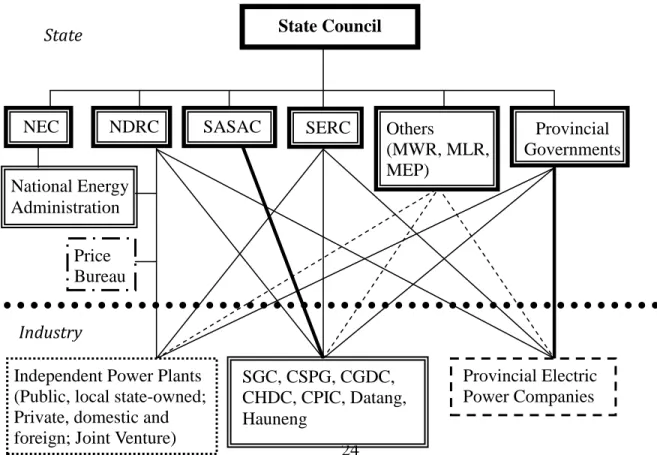
SETC, SDPC, MOF, and ODCCP all had respective regulatory duties. In addition, although the SPCC was a SOE, it also performed certain regulatory functions such as electricity dispatch and technology development. This multi-agency structure was a temporary, expedient substitute since another round of reform was underway and an innovative regulatory system with an IRA was coming into being. The central leadership planned to integrate the regulatory authorities and to achieve professional regulation in tandem with industrial restructuring. SERC, however, was created as an alternative to the SETC in the power industry rather than as a comprehensive, overarching state regulator. A fragmented regulatory structure remains (see Figure 2). In a multi-agency setting, SERC’s capability is seriously discredited when facing the electricity
corporations. Accordingly, state regulation is beset by an intractable and hydra-headed bureaucracy.
Figure 2: Current Supervisory Structure of China’s Electricity Industry
State State Council State Council Others (MWR, MLR, MEP) Provincial Governments SASAC SERC NDRC NEC National Energy Administration Price Bureau Industry Provincial Electric Power Companies SGC, CSPG, CGDC, CHDC, CPIC, Datang, Hauneng
Independent Power Plants (Public, local state-owned; Private, domestic and foreign; Joint Venture)
25
Source: by author.
In addition to SERC, the current regulatory structure is comprised of three other major agencies. The NDRC, a mighty policymaker, holds a wide range of administrative duties and inherits two exclusive rights regarding the supervision of electricity affairs as a part of its institutional legacy – setting the tariffs and reviewing and approving construction projects. Moreover, the NDRC deliberately misapplies these regulatory tools in an effort to manage the national economy.53 The NEC, a top-level coordinator, was delegated with drafting the nation’s energy development strategy. It makes policy recommendations and enforces its suggestions. SASAC, the state assets watchdog, manages the ownership and operation of the central SOEs. Since the five leading power generation companies and two major grid corporations are all central SOEs under SASAC’s purview, the conflicts of interest between SASAC and SERC are unavoidable. While SASAC seeks to maximize the corporations’ revenue and promote an oligopolistic market, SERC devotes itself to developing a functional electricity market that ensures fair and robust competition.
Although some other ministries do not directly intervene in electricity affairs, they are involved in the regulatory process due to their responsibilities—these include the Ministry of
53 For example, the NDRC has purposely kept the electricity prices low in order to not contribute to the increase in the consumer price index (CPI).
Vice-Ministerial-level Unit Ministerial /
Provincial-level Unit
Bold Lines: ownership relationship Solid Lines: supervisory relationship Broken lines: consultative relationship
No Administrative Ranks Unit Department-level Unit Bureau-level Unit
26
Environmental Protection for its environmental impact evaluation of power plant projects, the Ministry of Land Resources for its land-use reviews, and the Ministry of Water Resources for water-related affairs in hydropower issues. Moreover, because of the close relationship between power development and economic growth, local governments are very sensitive to electricity affairs. They are expected to play the role of gatekeeper in the regulatory process and to be in charge of preliminary reviews of prices schemes and power plant projects. Nonetheless, the local governments side with the power companies due to their own economic considerations and do not follow the central directives as part of the supervisory framework. As a result, local governments help the power firms to lobby the central authority or to evade state monitoring, thereby gaining revenues in return. They become rent seekers and a hindrance to state
regulation.54
Although the Chinese government aims to allocate authority and clarify the supervisory structure in the power sector, the ambiguous designation of IRAs has complicated the system and seriously weakened the credibility of SERC. It is the interaction and contradiction among these institutions that lead to regulatory failure and reform stagnation. The problematic design of the supervisory mechanism has resulted in a regulatory paradox in the Chinese electricity industry: the creation of an IRA was supposed to improve regulatory effectiveness, but it failed to make regulation work. SERC is a nominal IRA that only has formal regulatory independence. Its practical regulatory independence is significantly less than the level of independence anticipated by the reform plan.
Business Involvement and Indirect Regulatory Capture
27
Under the authoritarian regime, China’s power enterprises take a non-traditional approach to lobbying: the industry communicates with government institutions instead of elected politicians to meddle in the policymaking process and attempt to procure regulatory favors. The electricity enterprises do not target Congress but focus on the administrative bureaucracy instead because the NPC has not proved to be a well-functioning legislative body. The delegates have limited power and can only follow the Chinese Communist Party’s (CCP’s) guidance. The business groups therefore have no incentive to persuade the representatives to propose or pass preferential legislation; rather they endeavor to deliver their concerns directly to the various levels of
administration through different channels to capture SERC (see Figure 3).
Figure 3: Business Lobbying and Regulatory Capture in China’s Power Sector
Source: by author.
Because of the fragmented supervisory system and discrepancies among the interests of various government agencies, the state-owned power corporations have greater power over government and are able to exploit their unique status to influence government decisions in their favor.55 The SGC has strengthened its monopoly by persuading the NDRC to establish an ultra-high voltage system, and it has obstructed the further separation of the transmission and
55 Interview with university professor, Beijing, 20 May 2010.
Electricity Enterprises Various Ministries National People’s Congress Local Governments SERC
28
distribution sectors.56 Moreover, the five leading state power generators (the Big Five) develop into oligopolies and smother a competitive market in its infancy. They exploit an exclusive channel to negotiate with policymakers. Additionally, the Big Five have been striving to become dominant actors since SASAC set up a policy goal of building its best central SOEs into national champions and continuing to reduce the number of central SOEs. SASAC is expected to have only two or three conglomerates left; i.e., only the largest power groups will survive. In order to stay on top, the Big Five view each other as major rivals and expand as much as possible in total disregard of SERC’s efforts to create a functional market. When the policy goals of SASAC and SERC collided, the power companies undoubtedly followed SASAC, their bureaucratic
supervisor, and concurrently lobbied SASAC to endorse their projects and negotiate with the state regulator on their behalf if necessary.
At the local level, bureaucratic supervisors shelter the power firms owned by provincial or city governments so they can expand their business without abiding by central regulations. They collude with local officials to evade state monitoring from the central government and to gain profit. In return, local governments earn revenues and secure a constant power supply for local use. At this point, rampant rent-seeking is due to the coexistence of decentralized local
governments and local SOEs in a for-profit structure. The distinctive interaction between the Chinese state—at the central and local levels—and SOEs illustrates a different picture of lobbying compared to that in Western countries. In China, both central and local SOEs are reinvigorated and are becoming the mightiest interest groups in the country. SERC’s inability to supervise these powerful public interest groups reveals SERC’s insufficient capacity.
Moreover, while the Chinese state liberalizes the power generation sector and promotes competition, the independent power producers (IPPs)—including domestic, joint venture, and
29
foreign—are in an inferior position and exposed to a rigorous environment. Due to unfair competition and a dysfunctional state regulator, they do not envision a bright future for their investment but rather dreary days. It is not a win-win scenario for the IPPs and the state power companies, but a zero-sum game in which the only private agents are engulfed by their ambitious public rivals. The efforts the Chinese state has made to break up the monopoly has not resulted in a growing market accompanied by a viable IRA as expected; rather it has led to the unanticipated outcome of an oligopolistic market and regulatory capture.
Conclusion
After relaxing the economic system and introducing the market mechanism, the Chinese state needs to readjust its relationship with industry; specifically the role of the state is expected to shift from exclusive controller to impartial referee. Regulatory development in the U.S. and Britain has demonstrated the best practices of IRAs and provided China with rules and directions. However, we must “not overstate in theory the degree of independence that exists in practice” because the IRAs are not entirely free from political accountability, which exists in various forms such as legislative supervision and public hearings.57 That is to say, complete
independence of regulatory authorities is very hard to achieve. Finding a logical balance point between agency autonomy and political accountability has posed a great challenge to
representative democracies, who seek to resolve such problems by strengthening the
accountability structure.58 Hence, organizational autonomy is a necessary but not sufficient condition for IRA performance. In the case of SERC, it is clear that without being supported by institutional complementaries such as a well-functioning legal system and the full scope of
57 Majone 1999, 9.
30
jurisdiction, the IRA remains exposed to regulatory capture from within (the central government) and outside (local governments and enterprises). Moreover, as power is one of the strategic sectors that the Chinese state still wants to manage it tightly, the establishment of SERC is viewed as the climax but also, ironically, the turning point of China’s regulatory development.
This has important implications. It shows the Chinese state’s determination to liberalize the power sector and promote market competition, but SERC runs a high risk of being trapped in political struggles because of its compromised design. While its creation involved power rearrangement and resource redistribution, the new regulatory agency has suffered from problematic institutional design due to the state neither delegating it complete regulatory authority nor equipping it to be self-reliant. Moreover, as the power industry is one of the strategic sectors which closely ties with the national economy, the Chinese state will not truly loosen its control over the industry. This is reflected in the reality that NDRC and SASAC are more powerful than SERC in electricity affairs. Ensuring a healthy national economy and
enlarging state assets are clearly more important to the state than managing the power sector well. SERC is unable to function properly and, at best, sustains a merely nominal independence. What makes it even worse is that China’s distinct party-state regime further deteriorates SERC’s formal autonomy. That the Chinese state failed to incorporate the creation of IRAs into the reform scheme but presented IRAs as a response has foreshadowed SERC’s failure since its inception. When facing other government entities with partial regulatory power and gigantic state power enterprises, it is unable to promote market development and ensure fair competition. The independent power generators are forced to quit the business and an SOE-dominant
31
The creation of SERC reveals the reality that the effective model of the autonomous
regulator in the West will not exist in China because of different institutional constraints. Similar to its unique economic regime, China’s regulatory system illustrates a very different
developmental path and is moving in an unclear direction. Although the Chinese government tries to develop the market mechanism while maintaining a substantial state sector, it is not an easy task. Without granting regulatory agencies full discretion and rich resources, all its efforts will be in vain. Unfortunately, China’s SERC clearly proves it.
References:
21cbh.com. 2008. “Wang Xudong jiebang dianjianhui (Wang Xudong takes over the SERC),” 6 May 2008, http://www.21cbh.com/HTML/2008-5-6/HTML_2FTGPHT9A8F8.html. Accessed 18 July 2012.
Andrews-Speed, Philip, and Stephen Dow. 2000. “Reform of China’s Electric Power Industry Challenges Facing the Government.” Energy Policy 28(5), 335-347.
Bai, Hongyi, and Jian Yan. 2005. “Chai Songyue yu dianjianhui: kunjing zhong mou gaige (Chai Songyue and the State Electricity Regulatory Commission: reforms in predicament).” Zhongguo Xiaokang (Affluent Life in China) 10, 47-49.
Berrah, Noureddine, Fei Feng, Roland Priddle, and Leiping Wang. 2007. Sustainable Energy in China: the Closing Window of Opportunity. Washington, D.C.: The World Bank.
Caijing.com.cn. 2008. “Dianjianhui zhuxi You Quan ren guowuyuan changwu fumishuzhang (Chairman of the SERC, You Quan, was appointed executive deputy secretary-general of the State Council),” 27 March 2008, http://www.caijing.com.cn/2008-03-27/100054231.html. Accessed 2 April 2012.
Chen, Ling. 2010. “Playing the market reform card: the changing patterns of political struggle in China’s electric power sector.” The China Journal 64, 69-95.
Cheng, Tun-jen, and Chung-min Tsai. 2009.”Powering rent seeking in the electricity industry.” In Tak-wing Ngo and Yongping Wu (eds.), Rent Seeking in China. London: Routledge, 117-144.
China.com.cn. 2009. “1990 nian Zhongguo Zhengjianhui chengli (The establishment of China Securities Regulatory Commission in 1990),” 29 September 2009,
http://www.china.com.cn/economic/txt/2009-09/29/content_18624019.htm. Accessed 29 January 2013.
Chinanews.com. 2002. “Zhongguo dianli tizhi gaige beiwanglu (Memorandum on China‘s Power Reform),” 30 October 2002,
http://www.chinanews.com.cn/2002-12-30/26/258825.html. Accessed 6 June 2011.
Christensen, Tom, and Per Læ greid. 2007. “Regulatory Agencies–The Challenges of Balancing Agency Autonomy and Political Control.” Governance 20(3), 499-520.
32
Dangdai zhongguo congshu bianji weiyuanhui. 1994. Dangdai Zhongguo de dianli gongye (China today: power industry). Beijing: Dangdai Zhongguo chubanshe, 65-79.
Finance.sina.com.cn. 2011. “Wu Xinxiong zhizhangxia de dianjianhui weilai (The future of SERC under Wu Xinxiong),” 3 June 2011,
http://finance.sina.com.cn/roll/20110603/01409940672.shtml. Accessed 8 June 2012. Gao, Shiji. 2002. “Shizilukou de Zhongguo dianli chanye (China‘s electricity industry at the
crossroad).” In Xinzhu Zhang (ed.), Zhongguo jichu sheshi chanye de guizhi gaige yu fazhan (Regulatory Reform and Development in China’s Infrastructure Industries. Beijing: National School of Administration Press, 19-22.
He, Jun. 2009. “Tegaoya dianwang jianshe: gaige haishi longduan? (The establishment of the UHV grid: reform or monopoly?).” Nanfengchuang (Window on the South Wind) 10, 78-79. Lan, Zhiyong. 1999. “The 1998 administrative reform in China: issues, challenges and prospects.”
Asian Journal of Public Administration 21(1), 29-54.
Levi-Faur, David, and Sharon Gilad. 2004. “The rise of the British regulatory state: transcending the privatization debate.” Comparative Political Studies 37(1), 105-124.
Lieberthal, Kenneth, and Michel Oksenberg. 1988. Policy Making in China: Leaders, Structures, and Processes. Princeton: Princeton University Press, 94-105.
Majone, Giandomenico. 1997. “From the positive to the regulatory state: causes and
consequences of changes in the mode of governance.” Journal of Public Policy 17(2), 139-167.
Ma, Yingjuan. 2008. “Zhongguo zhengfu jianguan jigou goujian zhong de queshi yu qianzhanxing sikao (On the imperfection and forward-looking thinking about the
construction of the Chinese regulatory agencies).” Hebei Faxue (Hebei Law Science) 26(6), 80-86.
Money.163.com. 2012. “Xiaoxi cheng Zhongguo 2013 nian ni xinshe nengyuan bumen qudai Nengyuanju (It is said that China will replace National Energy Administration with the Ministry of Energy in 2013),” 6 January 2012,
http://money.163.com/12/0106/14/7N3GDIT5002524SO.html. Accessed 13 August 2012. Pearson, Margaret. 2005. “The business of governing business in China: institutions and norms
of the emerging regulatory state.” World Politics 57(2), 296-322.
Pearson, Margaret. 2007. “Governing the Chinese economy: regulatory reform in the service of the state.” Public Administration Review 67(4), 718-730.
Marquand, David. 1988. The Unprincipled Society: New Demands and Old Politics. London: Cape.
OECD. 2002. Regulatory Policies in OECD Countries: From Interventionism to Regulatory Governance. Paris: OECD.
People.com.cn. 2012. “Jianyi xiugai “dianlifa” (Recommendation on Revising the Electricity Law),” 4 March 2012, http://lianghui.people.com.cn/2012npc/BIG5/17287815.html. Accessed 15 June 2012.
Shan, Jilin. 2002. “Dianjianhui xu libi chengwei “huaping” (The SERC shall try to avoid becoming the “Vase”).” Zhongguo Jingji Shibao (China Economic Times), 6 September. Shao, Shiwei, Zhengyong Lu, Nourreddine Berrah, Bernard Tenenbaum, and Jianping Zhao, eds.
1997. China: Power Sector Regulation in a Socialist Market Economy. Washington, D.C.: The World Bank.
Thatcher, Mark, and Alec Stone Sweet. 2002. “Theory and practice of delegation to non-majoritarian institutions.” West European Politics 25(1), 1-22.
33
The World Bank. 2005. China: Deepening Public Service Unit Reform to Improve Service Delivery. Washington D.C.: The World Bank.
Tsai, Chung-min. 2011. “The reform paradox and regulatory dilemma of China’s electricity industry.” Asian Survey 51(3), 520-39.
Wang, Junhao, and Xiaomei Zhou. 2008. “Dabuzhi beijing xia longduanxing chanye de guanzhi jigou gaige: yi zhongguo dianli guanzhi jigou gaige weili (Discussion about reform of regulatory agencies in monopoly industries under China‘s super ministries system: the case of China’s electricity regulatory agency).” Zhongguo Gongye Jingji (China Industrial Economics) 244, 47-56.
Wang, Qiang.2007. “Dianjianhui huanshuai (The chairman of the SERC changed).” Shangwu Zhoukan (Business Weekly) 3, 52-54.
Wang, Zhiqiang. 2006. “‘Kuilei’ dianjianhui (The ‘Puppet’ SERC).” Zhongguo Qiyejia (The Chinese Entrepreneurs) 4, 73-75.
Xu, Yi-Chong. 2002. Powering China: Reforming the Electrical Power Sector in China. Aldershot: Ashgate.
Xu, Yi-Chong. 2004. Electricity Reform in China, India and Russia: The World Bank Template and the Politics of Power. Cheltenham: Edward Elgar.
Yeh, Emily T., and Joanna I. Lewis. 2004. “State power and the logic of reform in China’s electricity sector.” Pacific Affairs 77, 437-465.
Zhou, Hanhua. 2003. “Jigou yü falü (The institutions and laws).” Nanfang Zhoumo (Southern Weekend) 987, 9 January.
國科會補助專題研究計畫移地研究心得報告
日期: 102 年 10 月 31 日一、移地研究過程
計畫編
號
NSC101-2410 -H -004 - 134 -
計畫名
稱
中國大陸多元經濟治理模式的政治邏輯
出國人
員姓名
蔡中民服務機
構及職
稱
政大政治系助理教授出國時
間
102 年 6 月 24 日 至 102 年 7 月 7 日出國地
點
中國大陸北京市三、建議
( )
四、其他
國科會補助專題研究計畫移地研究心得報告
日期: 102 年 10 月 31 日一、移地研究過程
計畫編
號
NSC101-2410 -H -004 - 134 -
計畫名
稱
中國大陸多元經濟治理模式的政治邏輯
出國人
員姓名
蔡中民服務機
構及職
稱
政大政治系助理教授出國時
間
102 年 6 月 24 日 至 102 年 7 月 7 日出國地
點
中國大陸北京市三、建議
( )
四、其他
國科會補助計畫衍生研發成果推廣資料表
日期:2014/02/28國科會補助計畫
計畫名稱: 中國大陸多元經濟治理模式的政治邏輯 計畫主持人: 蔡中民 計畫編號: 101-2410-H-004-134- 學門領域: 比較政治無研發成果推廣資料
101 年度專題研究計畫研究成果彙整表
計畫主持人:蔡中民 計畫編號: 101-2410-H-004-134-計畫名稱:中國大陸多元經濟治理模式的政治邏輯 量化 成果項目 實際已達成 數(被接受 或已發表) 預期總達成 數(含實際已 達成數) 本計畫實 際貢獻百 分比 單位 備 註 ( 質 化 說 明:如 數 個 計 畫 共 同 成 果、成 果 列 為 該 期 刊 之 封 面 故 事 ... 等) 期刊論文 0 0 0% 研究報告/技術報告 0 0 0% 研討會論文 0 0 0% 篇 論文著作 專書 0 0 0% 申請中件數 0 0 100% 專利 已獲得件數 0 0 100% 件 件數 0 0 100% 件 技術移轉 權利金 0 0 100% 千元 碩士生 0 0 100% 博士生 0 0 100% 博士後研究員 0 0 100% 國內 參與計畫人力 (本國籍) 專任助理 0 0 100% 人次 期刊論文 1 1 100% 研究報告/技術報告 0 0 100% 研討會論文 1 1 100% 篇 論文著作 專書 0 0 100% 章/本 申請中件數 0 0 100% 專利 已獲得件數 0 0 100% 件 件數 0 0 100% 件 技術移轉 權利金 0 0 100% 千元 碩士生 1 1 100% 博士生 0 0 100% 博士後研究員 0 0 100% 國外 參與計畫人力 (外國籍) 專任助理 0 0 100% 人次其他成果
(無法以量化表達之成
果如辦理學術活動、獲 得獎項、重要國際合 作、研究成果國際影響 力及其他協助產業技 術發展之具體效益事 項等,請以文字敘述填 列。) 無 成果項目 量化 名稱或內容性質簡述 測驗工具(含質性與量性) 0 課程/模組 0 電腦及網路系統或工具 0 教材 0 舉辦之活動/競賽 0 研討會/工作坊 0 電子報、網站 0 科 教 處 計 畫 加 填 項 目 計畫成果推廣之參與(閱聽)人數 0國科會補助專題研究計畫成果報告自評表
請就研究內容與原計畫相符程度、達成預期目標情況、研究成果之學術或應用價
值(簡要敘述成果所代表之意義、價值、影響或進一步發展之可能性)
、是否適
合在學術期刊發表或申請專利、主要發現或其他有關價值等,作一綜合評估。
1. 請就研究內容與原計畫相符程度、達成預期目標情況作一綜合評估
■達成目標
□未達成目標(請說明,以 100 字為限)
□實驗失敗
□因故實驗中斷
□其他原因
說明:
2. 研究成果在學術期刊發表或申請專利等情形:
論文:■已發表 □未發表之文稿 □撰寫中 □無
專利:□已獲得 □申請中 ■無
技轉:□已技轉 □洽談中 ■無
其他:(以 100 字為限)
完成論文一篇已被 The China Quarterly 接受,將刊登於 2014 年 6 月出版的第 218 期。
3. 請依學術成就、技術創新、社會影響等方面,評估研究成果之學術或應用價
值(簡要敘述成果所代表之意義、價值、影響或進一步發展之可能性)(以
500 字為限)
本計畫釐清中國大陸經濟治理模式的政治邏輯,可供後者參考並針對中國大陸部門運作與 官僚政治進行解析。