
4433333333 +886-931 Mapping Table
6-931111111 +1-4422 Call Record Table
USA PSTN Gateway Originating switch r (John) 222222 b Japan (Visited countr
A
CCEPTED FROM
O
PEN
C
ALL
I
NTRODUCTION
Global roaming of mobile telecommunications allows subscribers to receive telephone services when they travel to other countries. In telecom-munications significant efforts have been devot-ed to optimize routing. However, call routing for international roaming mobile subscribers is defi-nitely not optimal in the existing commercial solutions. In the standard global roaming ser-vice, a call to a roaming mobile subscriber will result in two international trunk connections, and the cost for the call is very expensive. Sever-al commerciSever-al solutions have been proposed to provide inexpensive calls by using voice over IP (VoIP) technology [1–3]. These approaches can-not apply to mobile networks to avoid interna-tional trunk connections when subscribers with standard handsets roam to other countries.
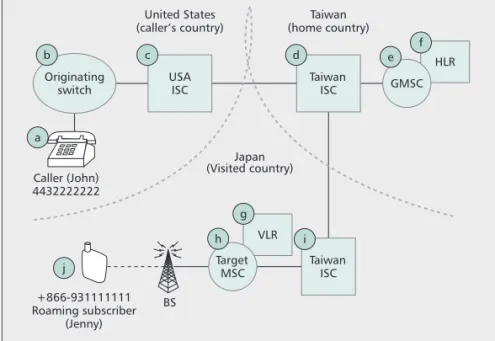
Consider the following scenario where Jenny is a subscriber of a mobile service provider in Taiwan. She travels to Japan, and her friend John in the United States calls her. The standard roaming call setup procedure [4] results in two international trunk connections; as illustrated in Fig. 1. We briefly describe the call setup proce-dure as follows, and the details of signaling pro-tocols can be referred to [5, 6].
Step A1: John dials Jenny’s mobile phone number +886-931111111. The call is set up to Jenny’s gateway mobile switching center (GMSC) in Taiwan through the United States and Taiwan international switching centers (ISCs); see path a → b → c → d → e in Fig. 1.
Step A2: The GMSC queries the home loca-tion Register (HLR, Fig. 1f) to identify the mobile station roaming number (MSRN) of the target mobile switching center (MSC) (Fig. 1h) visited by Jenny’s mobile phone (Fig. 1j). Specif-ically, the HLR communicates with the visitor location register (VLR) of the target MSC (Fig. 1g) to obtain the MSRN. The signaling path is f → d → i → g → i → d → f.
Step A3: According to the MSRN (which indicates the address of the target MSC), the GMSC sets up the call to Jenny through the vis-ited mobile network in Japan; see path e → d → i → h → j. The base station (BS) pages Jenny’s mobile phone. If Jenny’s mobile phone is within the radio coverage of the BS, it sends the page response signal to the BS. Jenny’s mobile phone rings, and the call is connected when Jenny picks up the phone.
After the call is connected, John and Jenny start conversation through path a–b–c–d–e–d–i–h–j. The above procedure results in two international trunk connections. John pays for the international trunk connection between the United States and Taiwan (path a–b–c–d–e), and Jenny pays for the international trunk connection between Taiwan and Japan (path e–d–i–h–j). It is clear that the incoming call to a roaming mobile subscriber is expensive. Note that if John dials Jenny’s mobile phone number through existing VoIP technology, only the international trunk connection between the United States and Taiwan can be avoided. Specifically, based on the dialed number, the VoIP call is set up to Jenny’s GMSC in Taiwan, and then the international trunk connection from the GMSC to Jenny’s mobile phone cannot be avoided.
In [5] a plug-in solution is proposed to replace international calls with local calls when both the calling party and the called party (the roaming mobile subscriber) are in the same visited coun-try. However, the solution did not address the
C
HAI-H
IENG
AN, I
NDUSTRIALT
ECHNOLOGYR
ESEARCHI
NSTITUTEM
ENG-H
SUNT
SAI ANDY
I-B
INGL
IN, N
ATIONALC
HIAOT
UNGU
NIVERSITYA
BSTRACT
Mobile telecommunications operators offer telephone services when the subscribers roam to other countries. However, a call setup to a roam-ing mobile subscriber may result in two expen-sive international trunk connections. In this article we propose a plug-in solution to avoid the international trunk connections. By adding pub-lic switched telephone network gateways, our solution does not need to modify the existing mobile telecommunications systems. In this solu-tion a timer is defined to reduce the call drop probability. A prediction method is proposed to determine the timeout period such that the call drop probability is limited within an acceptable range. Numerical experiments are conducted to indicate the performance of the prediction method. Finally, a prototype implemented at National Chiao Tung University is described.
E
FFICIENT
R
OUTING FOR
I
NTERNATIONAL
M
OBILE
C
ALL
S
ETUP
The authors propose
a plug-in solution
to avoid the
international trunk
connections.
By adding Public
Switched Telephone
Network gateways,
our solution does not
need to modify the
existing mobile
telecommunications
systems.
issues regarding when the calling and called par-ties are in different countries other than the home country of the called mobile subscriber. In the next section we propose a solution called Efficient International Mobile Call Routing (EIMAR), which replaces the two international trunk connections with two local trunk connec-tions connected by the Internet when the calling and called parties are in different countries other than the home country of the called mobile subscriber. Similar to the solution in [5], EIMAR introduces a network node called a public switched telephone network (PSTN) gateway, but does not need to modify the existing mobile telecommunications systems.
EIMAR
In this section we propose the EIMAR solution. The basic network structure of EIMAR is simi-lar to that in [5]. We re-iterate this network structure for the reader’s benefit. In the EIMAR solution, a mobile subscriber is assigned a local phone number (typically a fixed network num-ber) for each of the countries she frequently vis-its. Suppose that the EIMAR solution provider is from Taiwan. A Taiwan subscriber Jenny fre-quently visits Japan and the USA. Therefore, Jenny has the mobile phone number 931111111, a Taiwan phone number, +886-5722222, a U.S. phone number, +1-4433333333, and a Japan phone number, +81-556666666. These local phone numbers are assigned by the solution provider. We note that providing local telephone numbers of multiple countries for a business person is a typical exercise now. For example, Skype provides multiple local tele-phone numbers to subscribers so that SkypeIn can support incoming calls from various coun-tries [1].
The solution provider deploys a PSTN gate-way [6] in each country (Fig. 2c, j, and l). A PSTN gateway can be modified from a Session Initiation Protocol (SIP) and Real-Time Trans-port Protocol (RTP) server [6]. Every PSTN
gateway is connected to the PSTN (links c–h, j–b, and l–e in Fig. 2) and to a telecom-grade IP Network (Fig. 2k). Every PSTN gateway main-tains a table that maps the local phone number (at the country where the PSTN gateway resides) to the mobile phone number of each subscriber. For example, the PSTN gateway in the United States maps Jenny’s U.S. local phone number, +1-4433333333 to her mobile phone number, +886-931111111 (Fig. 2j).
The PSTN gateway also maintains a call record table. When John in the United States (with phone number +1-4432222222) calls Jenny, the PSTN gateways in the United States and the home network (i.e., Taiwan in our exam-ple) create a call record that maps the called mobile phone number to the calling phone num-ber (+886-931111111,+1-4432222222); see Fig. 2j and 2l. Suppose that Jenny travels from Tai-wan to Japan. When she arrives in Japan, she turns on her mobile phone. A small piece of roaming application software in the mobile phone switches the mobile phone to the interna-tional roaming mode, and marks the roaming country as Japan in a memory location called the roaming country buffer. The roaming application software can automatically obtain the roaming country identity (i.e., the country code), to be elaborated in the next section. Therefore, the implementation of the roaming application soft-ware does not need to modify the already built-in telecom software built-in the mobile phone. This software can be automatically downloaded to the mobile phone through over-the-air (OTA) mech-anisms [7, 8]; more details are given in the next section.
When John in the USA calls Jenny, the call setup procedure works as follows.
Step B1: John (with phone number 4432222222) dials Jenny’s U.S. phone number, 4433333333. The originating switch (Fig. 2b) routes the call to the local PSTN gateway (path a → b → j in Fig. 2).
Step B2: The U.S. PSTN gateway uses the number 4433333333 to retrieve Jenny’s mobile phone number +886-931111111 in the mapping table (Fig. 2j). Based on this mobile phone num-ber, the U.S. PSTN gateway sets up the call to Jenny’s GMSC (Fig. 2e) through the VoIP net-work (Fig. 2k) and the home PSTN gateway (i.e., the Taiwan PSTN gateway in Fig. 2l). These steps are the same as those for standard Skype-Out routing [1] (path j → k → l → e in Fig. 2). The call record mapping (+886-931111111, +1-4432222222) is created in both the U.S. PSTN gateway and the Taiwan PSTN gateway (Fig. 2j and 2l).
Step B3: Following the standard mobile call setup procedure (i.e., steps A2 and A3), the GMSC forwards the Signaling System Number 7 (SS7) initial address message (IAM) to set up the call to Jenny’s mobile phone through the visited mobile network (Fig. 2, path e → f → d → g → i → g → d → f → e for retrieving the MSRN, and path e → d → g → h → m for call setup).
Step B4: When Jenny’s mobile phone is paged by the BS of the target MSC, the mobile phone first checks if the international roaming mode is active. If so, steps B4a and B4b are executed. Otherwise, the mobile phone skips these steps
Figure 1. International call setup in existing mobile telecommunications
net-works. Originating switch Caller (John) 4432222222 +866-931111111 Roaming subscriber (Jenny) BS Japan (Visited country) USA ISC b a c Taiwan ISC United States (caller’s country) Taiwan (home country) Taiwan ISC GMSC HLR d i e f Target MSC VLR h g j
and follows the standard mobile call setup pro-cedure:
• Step B4a: Jenny’s mobile phone detects the international roaming mode, and automatical-ly rejects the mobile call setup by sending the SS7 address complete message (ACM) with the parameter call reject [9]. The message is deliv-ered through path m → h → g → d → e in Fig. 2. The GMSC forwards the SS7 ACM(reject) message to inform the Taiwan PSTN gateway that the call is canceled (through path e → l in Fig. 2).
• Step B4b: In parallel with step B4a, Jenny’s mobile phone rings. From the caller ID (i.e.,+1-4432222222) carried by the IAM mes-sage issued at Step B3, if Jenny decides to accept this call, the mobile phone retrieves the address of the visited PSTN gateway (i.e., Japan in our example) recorded in its roaming country buffer. The mobile phone sets up the call directly to the gateway through an IAM message (path m → h → c in Fig. 2).
Step B5: When the Japan PSTN gateway receives the call request from Jenny’s mobile phone, it checks whether there is a call record for Jenny. If so (it means that the calling party resides in Japan), the PSTN gateway bridges the call to the calling party indicated in the call record. Otherwise (i.e., the call record does not exist), from the caller ID, the Japan PSTN gate-way knows that Jenny’s home country is Taiwan, and routes the SIP INVITE message (equivalent to the IAM in SS7) to the Taiwan PSTN gateway (i.e., the home PSTN gateway) through the Internet path c → k → l in Fig. 2. One of the following two cases may occur in the Taiwan PSTN gateway:
• Case 1: The SS7 ACM message issued from the GMSC (step B4a) arrives at the Taiwan PSTN gateway first. The Taiwan PSTN gateway starts a callback timer. One of the following will occur:
–Case 1a: If the SIP INVITE (the callback request) from Jenny’s mobile phone arrives at the Taiwan PSTN gateway before the callback timer expires, the gateway uses the caller ID (i.e., Jenny’s mobile phone number, +886-931111111) to retrieve John’s phone number from the call record table in Fig. 2l. Then the procedure proceeds to step B6.
–Case 1b: If the callback timer expires, then the Taiwan PSTN gateway clears the call record in the table, and rejects John’s call request from the U.S. PSTN gateway. The U.S. PSTN gateway also clears the call record in the table. If the callback request from Jenny (step B4b) arrives after the call-back timer has expired, the Taiwan PSTN gateway rejects Jenny’s callback request. In this case the call is lost, and Jenny may call back again by directly dialing John’s phone number.
• Case 2: Jenny’s callback request (i.e., the SIP INVITE delivered at step B4b arrives at the Taiwan PSTN gateway before the call release issued from the GMSC arrives, (step B4a). The call release from the GMSC (the SS7 ACM message delivered at step B4a is ignored.
Step B6: When the Taiwan PSTN gateway receives the call from Jenny (the SIP INVITE message from the Japan PSTN gateway), it uses the caller ID (i.e., Jenny’s mobile phone num-ber, +886-931111111) to retrieve the calling phone number (i.e., +1-4432222222) from the
Figure 2. International call setup in the EIMAR solution.
HLR Taiwan ISC IP network USA (Caller’s country) Taiwan (Home country) +1-4433333333 +886-931111111 The Mapping Table
+886-931111111 +1-442222222
The Call Record Table +886-931111111 +1-442222222
The Call Record Table USA PSTN Gateway USA PSTN Gateway Originating switch Caller (John) 4432222222 j k l f VLR i a b GMSC Target MSC +866-931111111 Roaming subscriber (Jenny) Japan (Visited country) Japan PSTN gateway e d c Japan ISC g h m BS
Typically, the costs
for local phone calls
and VoIP calls are
much lower than
international phone
calls. Therefore, the
costs are significantly
reduced as compared
with the standard
international mobile
call setup procedure.
call record table in Fig. 2l. The country code of the calling phone number (which is one) indi-cates that the caller is from the United States. Therefore, the call is routed to the US.. PSTN gateway.
Step B7: Based on the call record, the U.S. PSTN gateway bridges call a–b–j and call m–h–c–k–j. Note that the voice path m–h–c–k–j can be different from the signaling path (i.e., m–h–c–k–l–k–j) by directly routing the RTP (voice) streams among the PSTN gateways. Such flexibility is provided by SIP.
In the above procedure, the call from John to Jenny consists of two local phone calls (paths a–b–j and m–h–c) and one VoIP call (path c–k–j). These two local phone calls follow the standard mobile call setup procedures and stan-dard billing processes. On the other hand, the VoIP call is only issued among PSTN gateways, which does not influence the mobile billing pro-cess. Therefore, the PSTN gateways can be deployed by a third party (e.g., a VoIP opera-tor), and the third-party solution provider can charge a reasonable rate for this service. Typical-ly, the costs for local phone calls and VoIP calls are much lower than international phone calls. Therefore, the costs are significantly reduced compared to the standard international mobile call setup procedure (which results in two inter-national connections).
In EIMAR a timer is defined to reduce the call drop probability. In the Appendix, we pro-pose a prediction method to determine a rea-sonably short timeout period such that the call drop probability is limited within an acceptable range. Then we conduct numerical experiments to indicate the performance of the prediction method.
I
MPLEMENTATION OF
EIMAR
An EIMAR prototype is implemented at Nation-al Chiao Tung University (NCTU) [10]. In this prototype the client-side application software (called the EIMAR client) is implemented for mobile phones running on the Windows Mobile operating system. The EIMAR client can be downloaded over the air, and automatically installed through a standard Wireless Applica-tion Protocol (WAP) browser [7]. To download the EIMAR client software, the mobile sub-scriber enters the uniform resource locator (URL) of the download page into the WAP browser (1 in Fig. 3a). The download operation is only performed once at subscription time. On the download page, a hyperlink for the EIMAR client is provided (2 in Fig. 3a). The mobile sub-scriber clicks the hyperlink, and then the EIMAR client software is downloaded and auto-matically installed.The EIMAR client checks the roaming status of the mobile phone and records the visited country code through the lineGetCurrent-Operator function provided in the Windows Mobile Extended Telephony Application Pro-gramming Interface (TAPI) [11]. Alternatively, the roaming status can be obtained through the AT+COPS command of the AT command set [12] provided in a legacy Global System for Mobile Communications (GSM) handset.
To support call release and callback at step B4, the EIMAR client implements a callback function InterceptCall and configures this func-tion into the Windows Mobile Radio Interface Layer (RIL) [13] for intercepting incoming calls (1 in Fig. 3b). This callback function utilizes RIL_Hangup (2 in Fig. 3b) and RIL_Dial (3 in Fig. 3b) to automatically reject and set up mobile calls at step B4.
In our EIMAR prototype the PSTN gateway is implemented in Java based on the BEA WebLogic SIP library [14]. The PSTN gateway implements the processCallSetup function (for call setup at step B2), the processCall-Release function (to release the call at step B5), and the processCallbackRequest function (to handle the callback request in the visited country at step B5 and the home country at step B6).
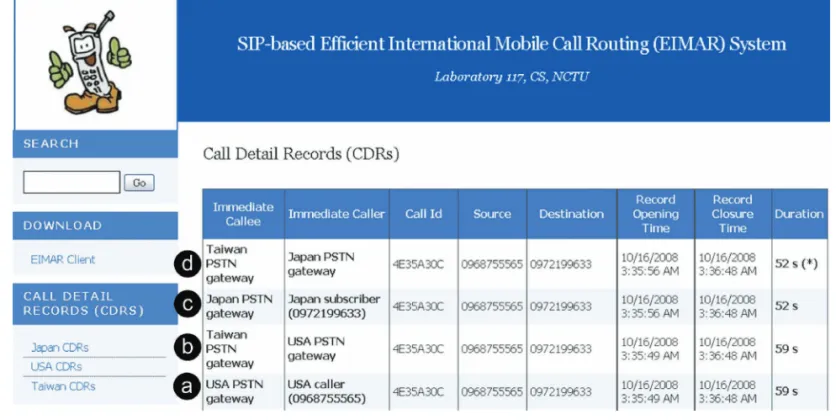
After a call completes, the call detail records (CDRs) of this call in the PSTN gateways are sent to an operation management center (OMC), and are shown on the administration webpage (sorted by the Record Opening Time field in descending order) in Fig. 4. In this figure the Immediate Callee and Immediate Caller fields indicate the immediate call parties of the CDR; the Immediate Callee field also indicates the PSTN gateway that generates the CDR. The Call Id field uniquely identifies a call. Four CDRs (a–d) in this figure are generated for call ID 4E35A30C; this call is set up from phone number 0968755565 (indicated in the Source field) to phone number 0972199633 (indicated in the Destination field). In the scenario described earlier, the signaling paths are partitioned into five segments:
• John dials Jenny’s U.S. phone number at step B1 (Fig. 2, path a → b → j): This segment is
Figure 3. The EIMAR client: a) the download page; b) execution of step B4b.
recorded by the U.S. PSTN gateway as CDR a in Fig. 4. This CDR is opened when the USA PSTN gateway receives the call setup signal from John (with phone number 0968755565, shown in the Immediate Caller field).
• The VoIP call routing between the U.S. and Taiwan PSTN gateways at step B2 (Fig. 2, path j → k → l): This segment is recorded by the Taiwan PSTN gateway as CDR b in Fig. 4. This CDR is opened when the Taiwan PSTN gateway receives the SIP INVITE message from the U.S. PSTN gateway.
• The standard mobile call set up at steps B2 and B3 (Fig. 2, path l → e for call setup to Jenny’s GMSC, path e → f → d → g → i → g → d → f → e for retrieving the MSRN, and path e → d → g → h → m for call setup to Jenny in Japan): Since the immediate callee of this segment is not a PSTN gateway, no CDR is created for this segment in Fig. 4
• The call set up from Jenny to the Japan PSTN gateway at step B4 (Fig. 2, path m → h → c): This segment is recorded by the Japan PSTN gateway as CDR c in Fig. 4. This CDR is opened when the Japan PSTN gateway receives the callback request signal from Jenny’s mobile phone (with phone number 0972199633 shown in the Immediate Caller field).
• The VoIP call routing between the Japan and Taiwan PSTN gateways at step B5 (Fig. 2, path c → k → l): This segment is recorded by the Taiwan PSTN gateway as CDR d in Fig. 4. This CDR is opened when the Taiwan PSTN gateway receives the callback request signal from the Japan PSTN gateway. At this moment, the conversation starts.
When the call completes, these four CDRs are closed. The call holding time is equal to the duration of the last CDR (see * in Fig. 4d; the
call holding time is 52 s). From the CDRs col-lected in the OMC (Fig. 4), John pays for the local call to his mobile operator in the United States (CDR a), and Jenny pays for the local call in Japan to her mobile operator in Taiwan through a global roaming agreement (CDR c). CDRs b and d indicate a VoIP call, which is paid for by Jenny to the solution provider. It is clear that our solution saves money for both John and Jenny.
C
ONCLUSIONS
In this article we propose a plug-in solution, EIMAR, for reducing the costs of incoming calls to an international roaming mobile subscriber. EIMAR replaces two international trunk con-nections with two local trunks and one VoIP connection when the calling and called parties are in countries other than the home country of the called mobile subscriber. The costs of local phone calls and VoIP calls are much lower than those of international phone calls. Therefore, the costs are significantly reduced from those of the standard international mobile call setup pro-cedure. In EIMAR local PSTN gateways are deployed in different countries without modify-ing the existmodify-ing mobile telecommunications sys-tems, so this solution can be deployed by a third party.
In EIMAR a timer is defined to reduce the call drop probability. We proposed a prediction method to determine a reasonably short timeout period so that the call drop probability is limited within an acceptable range. Numerical experi-ments indicate that our prediction method can appropriately predict the call drop probability. Finally, a prototype implemented at NCTU is described.
EIMAR reduces the usage of international
trunk resources, and therefore reduces the network (and social) costs. With this approach, roaming mobile subscribers can be charged much lower rates for incoming international calls, while the tele-com operators can utilize the saved trunk resources to accommodate more real international calls.
A
PPENDIX
: S
ELECTION OF
CALLBACK
T
IMEOUT
P
ERIOD
In this appendix we show how to select a proper value of the callback timer. Let p be the proba-bility that case 1b occurs at step B5 in our approach. A small p means that the call is unlike-ly to be dropped. In Fig. 2, let t1be the delay of the call release for path m → h → g → d → e → l). Let t2be the delay of the callback request for path m → h → c → k → l.
Let constant T be the timeout period of the callback timer in the Taiwan PSTN gateway. Then p is the probability that t2> t1+ T. An important issue in network operation of our approach is to determine a reasonably short timeout period T such that p is limited within an acceptable range. Assume that t1is a Gamma random variable with the shape parameter α and the scale parameter β, and t2has the exponential distribution with mean 1/λ. Note that the Gamma distribution is widely used in modeling telecommunications related delays [15]. Follow-ing the same analytic analysis in [5], we can pre-dict p by using the following formula:
(1)
where p* represents the predicted value of p. During commercial operation, we would like to
select a T value such that the call drop probabili-ty p is roughly equal to p*.
By using Eq. 1, we compute T as follows. The solution provider measures the message delays t1 and t2from the commercial operations, and calcu-lates the α, β, and λ values from the measured data. The solution provider selects a p* value, and substitutes p*, α, β, and λ into Eq. 1 to obtain the estimated T. For example, if λ = β and α = 1, to predict that p ≈ 0.05, we set p* = 0.05 and apply Eq. 1 to yield the estimated T =2.3/λ.
Does Eq. 1 work when t1is not Gamma dis-tributed, or when t2is not exponentially distribut-ed? For demonstration purpose, suppose that t1has the Weibull distribution with variance V1, and t2has the lognormal distribution with variance V2. Figure 5 illustrates the actual p curves where T is calculat-ed by Eq. 1. This figure shows that the p values are roughly the same under all V1values. Similar results are observed when t1and t2have other distribu-tions, which will is presented in this article.
In Fig. 5, when p* = 0.05, p > p* when E[t2]2 < V2< 200E[t2]2. In this V2range, we need to select a smaller p* value for Eq. 1 so that the derived T value ensures that p is within an acceptable range. Let p+be the maximum value of the p curve for a particular V1value in Fig. 5. In this figure, as V2increases, p increases and then decreases; p+occurs in the V
2range (E[t2]2, 200E[t2]2). When p* = 0.05 and V1 = 10,000E[t1]2, we have p ≤ p+= 0.068 in Fig. 5. We observe that p+is a roughly linear function of p*; specifically, we have
p+= 0.695 × p* + 0.033. By re-writing Eq. 1, we have
(2)
To ensure that p ≤ p+, we select T by using Eq. 2. For example, to predict that p ≤ 0.068, we set p+= 0.068 and apply Eq. 2 to yield the T value when E[t2]2< V2< 200E[t2]2. When V2is very large (i.e., V2> 200E[t2]2) or very small (i.e., V2 < E[t2]2), Eq. 1 is used to compute T.
A
CKNOWLEDGMENTThe authors would like to thank W.-S. Cheng, H.-Y. Tseng, and Z.-H. Wu for their efforts in implementing the prototype. Y.-B. Lin’s work was supported in part by NSC 97-2221-E-009-143-MY3, NSC 97-2219-E-009-016, Intel, Chunghwa Telecom, Chung-Hwa Telecom, ITRI, and NCTU joint research center, and MoE ATU plan. M.-H. Tsai’s work was support-ed by the Msupport-ediaTek Fellowship.
R
EFERENCES[1] Skype, “Free Internet Calls and Great Value Calls”; http://www.skype.com/
[2] Truephone, “Cheap Calls Using VoIP with Truphone”; http://www.truphone.com/
[3] Raketu, “Raketu-Rakout with Raketu!”; http://www.rake-tu.com/ [4] 3GPP TS 23.060 v. 7.8.0, “GPRS Service Description: Stage 2,” 2008. T p =⎛ ⎝⎜ ⎞ ⎠⎟
(
−)
(
+)
⎡ ⎣ ⎢ ⎢ ⎢ ⎤ ⎦ ⎥ ⎥ ⎥ ⎧ ⎨ + 1 1 439 0 033 λ β β λ α α ln . . ⎪⎪ ⎩ ⎪ ⎫ ⎬ ⎪ ⎭ ⎪ . T p =⎛ ⎝⎜ ⎞ ⎠⎟(
+)
⎡ ⎣ ⎢ ⎢ ⎢ ⎤ ⎦ ⎥ ⎥ ⎥ ⎧ ⎨ ⎪ ⎩ ⎪ ⎫ ⎬ ⎪ ⎭ ⎪ 1 λ β β λ α α ln * ,Figure 5. Predicting p by using Eq. 1 (E[t1] = E[t2]; t1is Weibull distributed, and t2is Lognormal distributed).
100 0.02 p 0.00 0.04 0.06 0.08 0.10 0.12 10-1 101 V2 (unit: E[t2]2) Solid: p*=0.05, dashed: p*=0.01 102 103 : V1 = E[t1]2 : V1 = 100E[t1]2 : V1 = 10000E[t1]2
[5] Y.-B. Lin, “Eliminating Tromboning Effect of Internation-al Mobile CInternation-all Setup,” to appear, IEEE Trans. Wireless
Commun.
[6] Y.-B. Lin and A.-C. Pang, Wireless and Mobile All-IP
Net-works, Wiley, 2005.
[7] OMA, “Provisioning Architecture Overview,” OMA-WAP-ProvArch-V1_1-20080226-C, candidate v. 1.1, Feb. 26, 2008.
[8] OMA, “Push Over the Air,” OMA-TS-PushOTA-V2_2-20071002-C, candidate v. 2.2, Oct. 2, 2007.
[9 Y.-B. Lin and I. Chlamtac, Wireless and Mobile Network
Architectures, Wiley, 2001.
[10] W.-S. Cheng et al., “SIP-Based Efficient International Mobile Call Routing (EIMAR) System”; http://EIMAR.jrc. nctu.edu.tw/
[11] Microsoft, “Extended TAPI”; http://msdn.microsoft. com/en-us/library/ms879880.aspx
[12] 3GPP TS 27.007 v. 3.13.0, “Group Terminals; AT Com-mand Set for User Equipment (UE),” Mar. 2003. [13] Microsoft, “RIL Application Development”;
http://msdn.microsoft.com/en-us/library/ms894929.aspx [14] Oracle, “BEA Weblogic Platform;” http://www.bea.com/ [15] Y. Fang, “Modeling and Performance Analysis for Wireless Mobile Networks: A New Analytical Approach,”
IEEE/ACM Trans. Net, vol. 13, no. 5, 2005, pp.
989–1002.
B
IOGRAPHIESCHAI-HIENGAN[M‘05] ([email protected]) received his B.S. degree in computer science from Tamkang Universi-ty, Taipei, Taiwanin, in 1994, and both his M.S. and
Ph.D. degrees in computer science and information engi-neering from National Taiwan University, Taipei, Taiwan, in 1996 and 2005, respectively. From March 2005 to July 2007 he was a research assistant professor in Depart-ment of Computer Science, National Chiao Tung Universi-t y { N C T U ) , T a i w a n . S i n c e J u l y 2 0 0 7 h e h a s b e e n a Researcher in the Information and Communications Research Laboratories, Industrial Technology Research Institute (ICL/ITRI), Taiwan. His current research interests include wireless and mobile computing, personal com-munications services, IP multimedia subsystem, and wire-less Internet.
MENG-HSUNTSAI[S‘04] ([email protected]) received B.S. and M.S. degrees from NCTU, Hsinchu in 2002 and 2004, respectively. He is currently working toward a Ph.D. degree at NCTU. His current research interests include design and analysis of personal communications services networks, mobile computing, and performance modeling. YI-BINGLIN[M’95, SM’95, F‘03] ([email protected]) is Chair Professor of Computer Science, National Chiao Tung University. His current research interests include wireless communications and mobile computing. He has published over 220 journal articles and more than 200 conference papers. He is co-author of the books Wireless and Mobile
Network Architecture (with Imrich Chlamtac; Wiley), Wire-less and Mobile All-IP Networks (with Ai-Chun Pang;
Wiley), and Charging for Mobile All-IP Telecommunications (with Sok-Ian Sou; Wiley). He is an ACM Fellow, an AAAS Fellow, and an IET (IEE) Fellow.


![Figure 5. Predicting p by using Eq. 1 (E[t 1 ] = E[t 2 ]; t 1 is Weibull distributed, and t 2 is Lognormal distributed).](https://thumb-ap.123doks.com/thumbv2/9libinfo/7604843.129400/6.985.69.562.61.460/figure-predicting-using-eq-weibull-distributed-lognormal-distributed.webp)
