Studies of nanomechanical properties and fatigue strength of annealed Ni
–Ti shape
memory alloy
Yu-Fen Chen, Po-Hsien Sung, Cheng-Da Wu, Te-Hua Fang
⁎
Department of Mechanical Engineering, National Kaohsiung University of Applied Sciences, Kaohsiung 807, Taiwan
a b s t r a c t
a r t i c l e i n f o
Article history:
Received 28 October 2011 Accepted 6 December 2011 Available online 13 December 2011 Keywords:
Indentation and hardness Fatigue
Shape memory materials Metals and alloys
The nanomechanical properties and fatigue strength of annealed Ni–Ti alloys are studied using cyclic nanoin-dentation. The alloys are annealed for 2 h at 400, 500, 600, and 700 °C, respectively. The experimental results show that the hardness and the elastic recovery ratio increase with increasing number of cyclic indentations. The Young's modulus decreases with increasing annealing temperature. The grain size increases with anneal-ing temperature until 500 °C. At 600 °C, the grain size gradually decreases and hardness increases with in-creasing annealing temperature due to the partial dissolution of Ti3Ni4 precipitates, which prevent
dislocation. The elastic recovery ratio of Ni–Ti alloys increases with increasing hardness. The hardness in-creases with increasing annealing temperature after recrystallization.
© 2011 Elsevier B.V. All rights reserved.
Shape memory alloys (SMAs) have been widely applied in aero-space [1], medicine [2], biomedicine [3–6], micropumps [7,8], and micro-electromechanical systems (MEMS) [9]. Ni–Ti alloys undergo a diffusionless transformation from a CsCl structure (austenite) to a lower-symmetry phase (martensite). Ni–Ti alloys are a popular SMA material due to their excellent biocompatibility and mechanical prop-erties, including high mechanical strength, high work density, low weight, good corrosion resistance, and good resistance to cyclic fa-tigue [9,10]. Ni–Ti alloys with 50–52 at.% Ni content usually have good superelasticity and high damping capacity at room temperature, even in ultra-thin wire form. SMAs can undergo limited plastic defor-mation in a specific temperature range and then quickly revert back to their original shape in their high-temperature state through com-plete stress relaxation, a response called the shape memory effect (SME) or superelasticity (SE) [11]. In present, a significant problem in Ni–Ti alloys is their slow response times due to their larger thermal mass and difficulties controlling the transformation temperature of the material, which may cause an applied limitation on ultra-precision systems.
The mechanical properties and fatigue strength of SMAs affect SE. Many scholars have measured the SE and mechanical properties, such as elastic modulus, hardness, fracture toughness, and fatigue of SMAs using nanoindentation [12–14]. Although annealing can effectively enhance the homogeneity of nanocrystalline structures and relieve internal stress, it sometimes significantly lowers mechanical strength [14–16]. The present study investigates the nanomechanical proper-ties of annealed Ni–Ti alloys, including Young's modulus, hardness,
elastic recovery, and fatigue strength, using nanoindentation experiments.
The experiments were performed on commercial Ni–Ti alloys (cold worked) with a normal composition of 51.35% at Ni and 48.65% at Ti. The alloys were grinded and polished for obtaining good surface roughness. The alloys then were cut into small samples with the size of 8.0 mm × 2.0 mm × 0.5 mm. The samples were annealed in a vacuum furnace (base pressure of 7 × 10− 5Torr) at temperatures of 400, 500, 600, and 700 °C, respectively, for 2 h. After the annealing process, the morphology of the samples was char-acterized usingfield-emission scanning electron microscopy (FESEM, XL-40FEG). The surface roughness of the samples and friction charac-teristics were measured using atomic force microscopy (AFM) and friction force microscopy (FFM), respectively. Topographic measure-ments under a constant normal force with a constant scan frequency of 1.0 Hz were performed over a 5μm×5 μm area. The mechanical properties of the samples, such as hardness, Young's modulus, and fa-tigue strength, were obtained by a nanoindentation system (Tribo-scope, Hysitron, USA) at room temperature. The indenter was a Berkovich three-sided pyramidal diamond tip with a radius of 150 nm. The hardness and Young's modulus were calculated from the load–displacement curve using the Oliver and Pharr method [17]. The surface friction increases with increasing surface roughness. For samples annealed at 400, 500, 600, and 700 °C, the average sur-face roughness (Ra) values are 8.81, 5.43, 8.93, and 10.01 nm, and the average grain sizes are 0.44, 0.61, 0.48, and 0.33μm, respectively. The results indicate that the surface roughness decreases and the grain size increases with increasing annealing temperature until 500 °C. With a further increase in the annealing temperature, the sur-face roughness increases and the grain size gradually decreases for annealing temperatures at or above 600 °C. Annealing occurs via the
Materials Letters 71 (2012) 84–87
⁎ Corresponding author. Tel.: +886 7 3814526 5336; fax: +886 7 3831373. E-mail address:[email protected](T.-H. Fang).
0167-577X/$– see front matter © 2011 Elsevier B.V. All rights reserved. doi:10.1016/j.matlet.2011.12.025
Contents lists available atSciVerse ScienceDirect
Materials Letters
dissolution of Ti3Ni4precipitates, which prevent dislocation and in-crease hardness[16]. The effect of precipitation hardening generally is not obvious for annealing temperatures reaching above 600 °C due to the lost coherency. However,Fig. 3shows that the hardness continuously increases until 700 °C, which may be the influence of TiO2surface layer [18,19] which is formed after annealing. The hard-ness increases with decreasing grain size. The relationship between material strength and grain size can be evaluated using the Hall– Petch formula[20],σY¼ σ0þ K=
ffiffiffi d p
, whereσYis the yield stress,σ0 is a materials constant for the starting stress for displacement move-ment, K is the strengthening coefficient, and d is the average grain di-ameter. InFig. 3, the relationships between hardness and Young's modulus versus annealing temperature are similar to previous exper-imental reports [16,21] for Ni–Ti alloys with about 55% Ni content. The differences in the measurement results by loads of 5000 and 8000μN are due to the effect of TiO2surface layer [18,19].
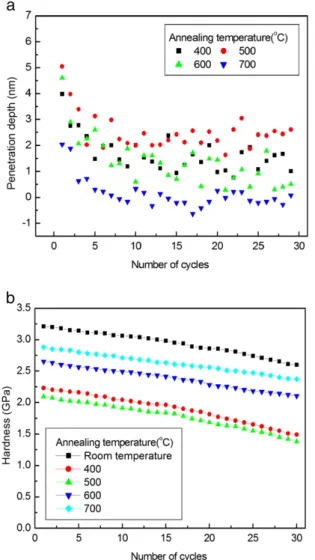
Fig. 4(a) shows the relationship between the penetration depth, number of indentation cycles, and annealing temperature. The aver-age penetration depths after 30 cycles for samples annealed at 400, 500, 600, and 700 °C are 1.68, 2.55, 1.38, and 0.82 nm, respectively. The largest and smallest indentation depths (corresponding to low and high hardness, respectively) were obtained for samples annealed at 500 and 700 °C, respectively.Fig. 4(b) shows the variation of the hardness with the number of cycles for samples annealed at various temperatures. The hardness of the samples increases with the
number of cycles due to a decrease in the penetration depth (occur-rence of strain hardening). The hardness follows the order: samples annealed at 700 > 600 > 400 > 500 °C.
Fig. 5shows the relationship between the ratio of elastic recovery, indentation cycle, and annealing temperature. The elastic recovery is re-lated to the elastic, inelastic[22], and plastic deformations during the indentation process. InFig. 5, the elastic recovery ratio for all curves in-creases with increasing number of cycles. The elastic recovery ratio fol-lows the order: samples annealed at 700 > 600 > 400 > 500 °C, which indicates that the magnitude of the elastic recovery ratio of a material is related to its hardness.
In summary, the nanomechanical properties and fatigue strength of annealed Ni–Ti alloys were studied using cyclic nanoindentation. The hardness of Ni–Ti alloys increases with increasing number of in-dentation cycles. Grain size increases with annealing temperature until 500 °C. At and above 600 °C, the grain size gradually decreases and hardness increases with increasing annealing temperature due to the partial dissolution of Ti3Ni4precipitates, which prevent disloca-tion. The elastic recovery ratio of Ni–Ti alloys increases with increas-ing hardness. The hardness increases with increasincreas-ing annealincreas-ing temperature after crystallization. The elastic recovery ratio of Ni–Ti alloys increases with increasing number of indentation cycles. Acknowledgments
This work was partially supported by the National Science Council of Taiwan under grants NSC 2628-E-151-003-MY3 and NSC 100-2221-E-151-018-MY3.
References
[1] Boller C. In: Friswell M, editor. Adaptive aerospace structures with smart technol-ogies—a retrospective and future view adaptive structures: engineering applica-tions. New York: Wiley; 2007. p. 163–90.
[2] Feninat FE, Laroche G, Fiset M, Mantovani D. Adv Eng Mater 2002;4:91–104. [3] Shabalovskaya SA. Bio-Med Mater Eng 1996;6:267–89.
[4] Dai KR, Chu YY. Bio-Med Mater Eng 1996;6:233–40.
[5] Morgan NB. Mater Sci Eng, A Struct Mater Prop Microstruct Process 2004;378: 16–23.
[6] Petrini L, Migliavacca F, Massarotti P. J Biomech Eng 2005;127:716–25. [7] Benard WL, Kahn H, Heuer AH, Huff MA. J Microelectromech Syst 1998;7:245–51. [8] Makino E, Mitsuya T, Shibata T. Sens Actuators, A 2001;88:256–62.
[9] Krulevitch P, Lee AP, Ramsey PV, Trevino JC, Hamilton J, Northrup MA. J Microelec-tromech Syst 1996;5:270–82.
[10] Otsuka K, Ren X. Intermetallics 1999;7:511–28. [11] Otsuka K, Shimizu K. Int Metals Rev 1986;31:93–114.
[12] Shaw GA, Stone DS, Johnson AD, Ellis AB, Crone WC. Appl Phys Lett 2003;83: 257–9.
[13] Eswar Raju KSS, Bysakh S, Sumesh MA, Kamat SV, Mohan S. Mater Sci Eng A 2008;476:267–73.
[14] Liu KT, Duh JG. Surf CoatTechnol 2008;202:2737–42. Fig. 4. (a) Relationship between penetration depth and number of indentation cycles
for samples annealed at various temperatures. (b) Variation of hardness with the num-ber of cycles for various annealing temperatures.
Fig. 5. Relationship between the ratio of elastic recovery, indentation cycle, and annealing temperature.
[15] Satoh G, Birnbaum AJ, Yao YL. ASME J Manuf Sci Eng 2010;132(051004–1): 051004–9.
[16] Mitwally ME, Farag M. Mater Sci Eng A 2009;519:155–66. [17] Oliver WC, Pharr GM. J Mater Res 1992;7:1564–83.
[18] Neelakantan L, Swaminathan S, Spiegel M, Eggeler G, Hassel AW. Corros Sci 2009;51:635–41.
[19] Poon RWY, Ho JPY, Liu X, Chung CY, Chu PK, Yeung KWK, Lu WW, Cheung KMC. Nucl Instrum Methods B 2005;237:411–6.
[20] Hall EO. Proc Phys Soc B 1951;64:747–53.
[21] Yan XJ, Humbeeck JV. Funct Mater Lett 2009;2:55–60.
[22] Tekaya A, Labdi S, Benameur T, Jellad A. J Mater Sci 2009;44:4930–8.
87 Y.-F. Chen et al. / Materials Letters 71 (2012) 84–87