Fresenius Zeitschrift [fir Fresenius Z Anal Chem (1988) 332:171 -175
9 Springer-Verlag 1988
Synthesis, characterization and complexation properties
of a polystyrene resin containing/ -hydroxydithiocinnamic
acid
Chuen-Ying Liu and Jiin-Jou Lih
Department of Chemistry, National Taiwan University, Taipei, Taiwan, Republic of China
Synthese, Charakterisierung
und Komplexierungseigenschaflen eines
~-Hydroxydithiozimts~iure-haltigen Polystyrolharzes
Summary. A new chelating resin was synthesized from a macroreticular polystyrene-divinylbenzene copolymer in- corporating the /%hydroxydithiocinnamic acid functional group. Some properties, such as the water regain, hydrogen capacity, sulfur content, dissociation constant and the metal capacity of the resin were determined. The formation constants for Cd(II) and Cu(II) resin complex were deter- mined to be 101"1~ and 10
TM,
respectively. The results of the pH-dependence of the adsorption capacity and the trace metal ion uptake showed that the synthesized resin was highly selective for silver(I), mercury(II), gold(III) and platinum(IV) in strongly acidic aqueous solution.Introduction
The lack of selectivity of the conventional ion-exchange resins has led to the discovery and development of a new kind of specific and selective resins. These resins are in fact polymeric complexing and chelating compounds. Despite the increasing utility and application of these resins in separations, preconcentration and recovery of trace metal ions, in catalysis, organic synthesis, nuclear chemistry, water and waste water treatment, pollution control and industrial processes, hydrometallurgy, polymer drug grafts and various miscellaneous applications in analytical chemistry, the development of their coordination chemistry has re- mained rather slow [1]. In view of the above mentioned facts and in continuation of earlier work in the field of preparation of selective ion-exchange resins, a/%hydroxy- dithiocinnamic acid functional group containing resin was synthesized./%Hydroxydithiocinnamic acid, a new chelating agent could form either four-membered chelate rings through two sulfur atoms as very useful analytical reagents (dithiocarbamate [ 2 - 6 ] and xanthate [ 7 - 9 ] ) or form six- membered chelate rings through oxygen and sulfur atoms with metal ions. Based on the above chelating properties, it was expected that a fl-hydroxydithiocinnamic acid group incorporated into a resin would be advantageous. This paper Offprint requests to: Chuen-Ying Liu
describes the synthesis and basic characteristics of such a resin. In addition, some properties and the chelating behaviour of the synthesized new resin are also discussed.
Experimental
Model reactions, fl-Hydroxydithiocinnamic acid (fl- HDTCA) was prepared by the method of Larsson and Lawesson [10] with slight modification. 0.015 mole of acetophenone and 0.025 mole of carbon disulfide in 35 ml benzene were added dropwise to 0.05 mole of t-BuOK in 45 ml benzene. Stirring was continued at 0 ~ for 1 h. Then the mixture was poured into water, the benzene phase re- moved, the aqueous layer acidified with 2.5 tool/1 H2SO4. The precipitate obtained was collected onto a filter, and recrystallized from methanol giving a higher than 70% yield of the acid (m.p. 70 ~
Preparation of ~-hydroxydithiocinnamate resin. The poly- styrene-divinylbenzene, XAD-4 (Rohm and Haas, Phila- delphia, Pa, USA) macroreticular resin was used as starting material. To 10 g of XAD-4 resin 90 g of anhydrous alumin- ium trichloride and 50 ml of petroleum ether were added (100 ~ 1 7 6 Then 50 ml of 1:1 petroleum ether/acetic anhydride were added over a period of 30 rain through an addition funnel, and the resulting mixture was refluxed at 83 ~ for 5 h. This product (I in Scheme 1) was cooled to room temperature and hydrolyzed in 12 tool/1 hydrochloric acid and ice. It was then collected by suction filtration and washed sequently with 15 tool/1 ammonium hydroxide, 12 mol/1 hydrochloric acid, water and acetone. These pro: cedures were repeated to obtain a higher yield. The product was then slurried in 50 ml of petroleum ether to which 20 g of potassium t-butoxide and 40 ml of carbon disulfide were added. The mixture was reacted at 43 ~ for 5 h. The final product was collected by suction filtration and washed sequently with 2.5 mol/1 sulfuric acid, water and acetone. Determination of the dissociation constant of the resin. Various amounts of 0.100 tool/1 sodium hydroxide were added to each 0.2 g resin sample. The ionic strength of 1.0 tool/1 and the 25 ml final volume were adjusted by the addition of a calculated quantity of 2.5 tool/1 sodium chlo- ride and water. The systems were left to equilibrate for 2 days at 25 ~ Then, the p H of the solution phase was measured and some of the other parameters were determined as following:
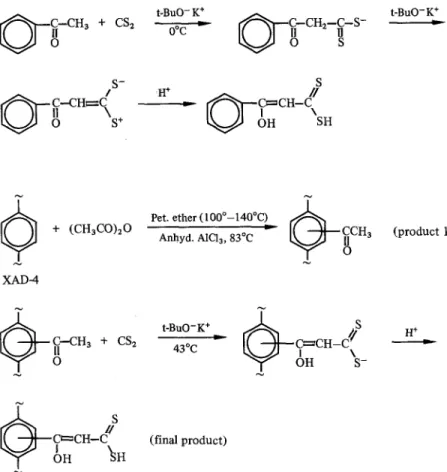
CH3 + CS2 0 ~ = l1 I] 0 S S- S I 'H § C'-CH'-C t ~ A OH SH
Scheme 1
Synthesis of fl-hydroxydithiocinnamic acid
Pet" ether (100~176
~ ~ C
+ (CHaCO)20 Anhyd. AICla, 83~ : Ha
XAD-4
t.BuO-K §
~
S
~i~ OH S-g
~ " - C"'CH--C S (final product) (product 1)H
+
Scheme 2
Synthesis of fl-hydroxydithiocinnamate resin
1. Determination of the amount of counter-ions in the resin phase: The sodium ions were eluted from the resin with 20 ml of 0.1 mol/1 nitric acid collected in a 50 ml volumetric flask. The resin was washed free of chloride with water and the solution made up to the mark. The amount of chemically bound sodium ions was obtained by titration of the acid left in the solution, with 0.1 mol/1 sodium hydroxide and that of the invasive sodium chloride from a Volhard determination. 2. Determination of the hydrogen ion capacity: To obtain the hydrogen ion capacity, the amount of chemically bound counter-ions was plotted against the p H of the resin phase.
Determination of metal ion capacity and trace metal ion uptake, pH-Dependence of metal-ion capacity and trace metal ion uptake of the fl-HDTCA resin were evaluated as previously by a batch equilibration technique [11]. Briefly, metal ion was loaded on 0.3 g of resin. After equilibration, the solid was filtered off and washed with water. The amount of metal ion in the filtrate was determined titrimetrically or spectrophotometrically.
Determination of the complex-decomposition pH. An air-dry sample of the resin was weighed into an ion-exchange column (160 x 5 m m i. d.). The column was conditioned with acetic acid-sodium acetate buffer. Then, 0.2 mmol copper ion or 0.2 mmol cadmium ion was applied on the top of the column. The metal ion sorbed was then eluted with 0.01 or 0.02 mol/1 hydrochloric acid and 4 ml fractions of the effluent were collected. The p H was measured and the metal ion content in each fraction was determined spectro- photometrically.
4000 3000 2000 1600 1200 800 Wevenumber (cm -1}
Fig. 1. Infrared spectra, a XAD-4, polystyrene-divinylbenzene co- polymer; b intermediate product; c fl-hydroxydithiocinnamate resin
0.7 0.6 1....,....-,e'e ~ 9 9
/ "
Ig
o~ 6.6 6.8 7.0 pH7.2 7./, 7.6Fig. 3. Determination of the hydrogen capacity of the fl-hydroxy- dithiocinnamate resin
3800 3000 2200 1400 600 0.6
W o v e n u m b e r (cm -1)
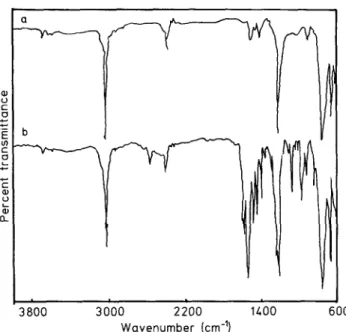
Fig. 2. Infrared spectra, a Chloroform; b monomeric fl-hydroxy-
dithiocinnamic acid 0.5
Results and discussion
Preparation of the fi-hydroxydithiocinnamate resin. It was apt to synthesize fl-hydroxydithiocinnamic acid (model com- pound) (as shown in Scheme 1) and the yield was very high (higher than 70%). Hence, in the preparation of the fl- hydroxydithiocinnamate resin, the procedures were the same as those of the model compound (as shown in Scheme 2).
The characterization of the synthesized resin is of impor- tance in the application of this material to actual analytical samples and for the prediction of resin behaviour in the application. In order to elucidate the structure of the synthe- sized resin, the infrared spectra obtained with KBr pellets were recorded after each step in the syntheses. Figure 1 a is the spectrum of the starting material, XAD-4, polystyrene- divinylbenzene copolymer. Figure I b shows the spectrum of the intermediate substance; the prominent band ( - C = O) appears at 1685 c m - 1 and the intensity of the band in- creased as the repeatability of the reaction increased. Figure 1 c is the spectrum of the final product, fl-hydroxy- dithiocinnamate resin. The absorption spectrum of this resin was in accordance with that of the monomeric fl-hydroxy- dithiocinnamic acid which was obtained from chloroform solution (Fig. 2b) at 1603, 1240, and 1070 c m - 1, except the peak of - S H at 2 571 c m - 1 which was also known to be absent in the solid form of the thiol compound [12].
For evaluation of the dissociation constant of the chelating resin, some parameters, such as ~*, GK, G1, [G], [HI, [H], Q, H a 9 etc. should be established [13], where ~*: the mole fraction of the non-protonated base in the
O K - G , : [G]: [H]: [n]:
Q:
H 2 0 : resin phase,the amount o! chemically bound counter ion, the amount of ions migrated into the resin lattice, the concentration of the counter ions in the resin phase,
the proton activity in the solution phase, the proton activity in the resin phase, the hydrogen capacity of the resin, the water content of the resin.
if-- c~ 0.4 _L" o E E >, 0.3 o o t~ o o 0.2 0.1 0 i 0 6.0
f
of"
/ /
S
//
/
/
g
j 9
i I i i i 1.0 2.0 3.0 4.0 5.0 pH o.24b
A /
c~. 0.11 i ( I//
E ~ 0.1; n O L9 A. /
/
l i i 0 1.0 2.0 3.0 4.0 5.0 6.0 7.0 8.0 pHFig. 4. a Total capacity vs. pH curves for metal ions on the fl-hydroxydithiocinnamate resin: Ag(I) 9 1 4 9 Hg(II) 9 9 Fe(III) A - - A . b Total capacity vs. pH curves for metal ions on the fl-hydroxydithiocinnamate resin: Ni(II)
dithiocinnamate resin pH G-~ G~ [G] pH ~* pK. 80 6.35 0.27 0.06 0.43 6.72 0.45 6.44 ~ 60 6.50 0.36 0.08 0.55 6.76 0.58 6.62 ~- o 6.80 0.40 0.09 0.64 6.99 0.67 6.68 ~ 40, 7.03 0.49 0.10 0.76 7.15 0.81 6.40 o 03
Amount of resin: 0.2 g; volume of solution: 25 ml; ionic strength: 1.0 tool/l; water regain: 0.77 g g- ~ ; temperature: 25 ~
Table 2. Physical and chemical properties of fl-hydroxy- dithiocinnamate resin 20 0 0
{/
. I t I I 1.0 2.0 3.0 4.0 5.0 6.0 7.0 pH Particle size Water regain Sulfur content Hydrogen capacity pK. Cadmium capacity (pH 5.0) Copper capacity (pH 5.0) Iron capacity (pH 4.0) Lead capacity (pH 5.8) Mercury capacity (pH 5.6) Nickel capacity (pH 7.4) Silver capacity (pH 4.4) l o g K f ( C d ( I I ) ) log Kf (Cu(II)) 100- 200 mesh 0.77 g g- 1 1.20 mmol g- ~ 0.60 mmol g- t 6.54 0.02 mmol g- ~ 0.05 mmol g - t 0.60 mmol g-1 0.20 mmol g- ~ 0.59 mmol g- ~ 0.29 mmol g- 0.30 mmol g- ~ 1.10 2.44Table 3. Experimental data and results of determining the stability constants of fl-hydroxydithiocinnamate resin-metal complexes
Cd(II) Cu(II) Initial pH for the complexation 8.0 5.5 Amount of metal ion (mmol) 0.2 0.2 Concentration of eluent (HC1) (mol/1) 0.02 0.01
DpH 5.44 4.10
log/(MR 1.10 2.44
The water regain of the resin determined by the method o f centrifuging [14] was 0.776 g g - 1 . The plot o f ~ vs. p H (Fig. 3) showed that the hydrogen capacity was 0.6 m m o l g - 1. Some other parameters determined are listed in Table 1. F r o m this table, the dissociation constant o f the resin could be calculated [13]. Due to the steric hindrance and the hydrophobicity o f the polymer matrix, the p K , of the syn- thesized resin, 6.54, is rational in comparison with that o f the monomer, 5.44 [15].
Complexation properties of the chelating resin. The metal ion absorption capacities o f the resin at various p H values were determined in the presence of an excess a m o u n t o f metal ion with the results given in Fig. 4 a, b. The m a x i m u m capacities for cadmium(II), copper(II), iron(III), lead(II), mercury(II), nickel(II) and silver(I) are listed in Table 2. This table also shows the other physical and chemical properties of the synthesized resin. F o r mercuric ion, the m a x i m u m capacity was ca. 0.6 m m o l per gram resin (Table 2) which was close to the ligand content, 0.6 m m o l per gram resin (from elemental analysis). Hence, we can say that the synthesized resin seems to f o r m an one to one complex with the mercuric ion.
100 9 80 60 c o 40 o {,,O 20
A~A
A ~
/
ZX E z{ A J[~ | i i i i 10 20 30 40 50 60 70 pHb
A i 8O 100 80 60 o 13. /.0, [.,0 20/
/
&! /
/
[]
| 1.0 2.0 3.0 [ ]/
?
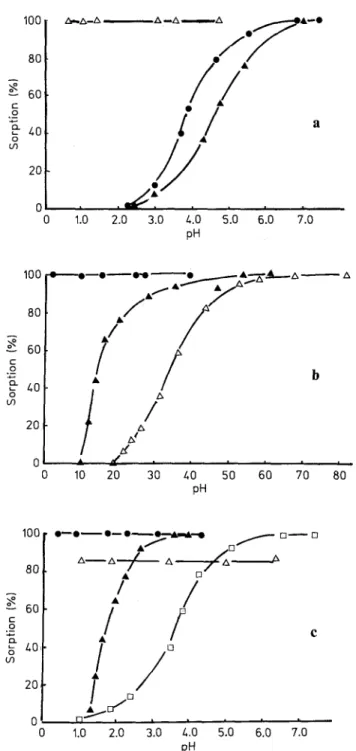
[3 4.0 5 0 6.0 7.0 pHFig. 5. a Metal recovery as a function of pH on the fi-hydroxy- dithiocinnamate resin: Cd(II) 9 0 ; Hg(II) z~ A; Zn(II) 9 9 b Metal recovery as a function of pH on the fl-hydroxydithiocinnamate resin: Au(III) 9 Ni(II) A 2x ; Pb(II) 9 9 e Metal recovery as a function ofpH on the fi-hydroxydithiocinnamate resin: Ag(I) A - - A ; Cu(II) [ ] - - D ; Fe(IIl) 9 9 ; Pt(IV) 0 - 9
To determine the trace metal ion uptake, studies were carried out in which the resin was present in excess o f the metal ion. The uptake of most o f the metal ions tested increased with pH, except that o f silver(I), mercury(II), gold(III) and platinum(IV) (Fig. 5 a - c). The order o f sorp- tion is Pt(IV) ~ A u ( I I I ) -~ Hg(II) > Ag(I) > Pb(II) > Fe(III) > Ni(II) > Cu(II) > Cd(II) > Zn(II). The sorption mechanism is still not completely elucidated. However, the
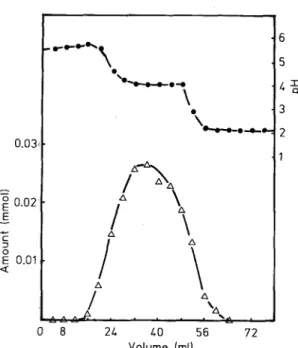
0.06 =o 0.0.4 E o E 0.02 < ,-"q~o " ~ 1 7 6 1 7 6 ~~ o" 8 7 6 5 "1- O- 4 3 2 1
0
8 2.4 .40 56 72 Volume (ml)Fig. 6. Changes in pH and cadmium(II) content of the collected fractions as a function of the volume of the eluent
0.03~ =o 0.02 E E o E 0.01 < 0%o'o.-o.-o- 9 4
\
~ -e-e-/
A/
A/
^ ^ ^~4:~'1, i 8 2.4 A\
A\
A .40 56 Volume {ml) 72 6 5 3 2 1Fig. 7. Changes in pH and copper(II) content of the collected fractions as a function of the volume of the eluent
high capacity for mercury suggests that the synthesized resin shows high affinity and selectivity for soft metal ions.
F o r the calculation o f the stability constant (KMR) o f the metal-chelating resin complexes, the following equation was used [16] :
log KMR = log fl~ -- n - D p H (1) where fi] is the apparent cumulative p r o t o n a t i o n constant o f the ligand and n is the n u m b e r o f protons b o u n d to the ligand. In order to calculate KMR, the p r o t o n a t i o n constant and the DpH-values should be measured. Figures 6 and 7 show the changes in the p H and the metal content o f the collected fractions as a function o f the volume o f the eluent. F r o m this, the DpH-values for Cd(II) and Cu(II) were found to be 5.44 and 4.10, respectively. The experimental data and the apparent stability constants o f the metal-resin complexes calculated by means o f Eq. (1) are given in Table 3. The low formation constants o f the copper-resin complex and the cadmium-resin complex are consistent with the results o f copper and cadmium capacity shown in Table 2.
Conclusion
fi-Hydroxydithiocinnamate resin m a y be expected to be very useful as a chelating resin for the collection and concentra- tion of noble metals f r o m very dilute solutions or the separa- tion o f noble metals from each other or from other metal ions.
Acknowledgement. The financial support of this work by the National Science Council of the Republic of China is gratefully acknowledged.
References
1. Sahni SK, Reedijk J (1984) Coord Chem Rev 59:1 2. Hulanicki A (1967) Talanta 14:1371
3. Halls DJ (1969) Mikrochim Acta 62 4. Magee RJ (1973) Rev Anal Chem 1:333
5. Scharfe RR, Sastri VS, Chakrabarti CL (1973) Anal Chem 45:413
6. Wyttenbach A, Bajo S (1975) Anal Chem 47:2 7. De AK (1968) Sep Sci 3:103
8. Donaldson EM (1976) Talanta 23:417 9. Donaldson EM (1977) Talanta 24:105
10. Larsson FCV, Lawesson SO (1972) Tetrahedron 28:5341 11. Liu CY, Fan JD, Liu CB (1986) Proc Natl Sci Counc ROC(A)
10:352
12. Jensen KA, Buchardt Q, Christophersen C (1967) Acta Chem Scand 21 : 1936
13. Szabadka 0 (1982) Talanta 29:177
14. Liu CY, Sun PJ (1986) Fresenius Z Anal Chem 325:553 15. Lih JJ (1987) Thesis, National Taiwan University, Taipei,
Taiwan
16. Schmidt EM, Incz6dy J, Laki Z, Szabadka I~ (1980) J Chromatogr 201:73