行政院國家科學委員會專題研究計畫 成果報告
球正對圓盤面電泳的理論分析(3/3)
研究成果報告(完整版)
計 畫 類 別 : 個別型
計 畫 編 號 : NSC 96-2221-E-002-079-
執 行 期 間 : 96 年 08 月 01 日至 97 年 07 月 31 日
執 行 單 位 : 國立臺灣大學化學工程學系暨研究所
計 畫 主 持 人 : 徐治平
計畫參與人員: -99:徐治平
此計畫無其他參與人員:
報 告 附 件 : 出席國際會議研究心得報告及發表論文
處 理 方 式 : 本計畫可公開查詢
中 華 民 國 97 年 06 月 27 日
球正對圓盤面電泳的理論分析
(3/3)
Electrophoresis of a Charge-Regulated Sphere Normal to a Large Disk (3/3)
計畫編號: NSC96-2221-E-002-079
執行期限: 96/08/01~97/07/31
主持人: 徐治平 臺灣大學化工系 教授
一、中文摘要
本研究在低表面電位及均勻若電場下探討環形粒子朝向一無窮大圓盤(或平板)的電泳行為
並進行數值模擬。本研究在此系統下成功模擬細菌
DNA、質體 DNA 以及藻類等多種生物膠
體在接近平面時之電泳動行為。所考慮環形粒子的表面荷電性質介於傳統固定電位與固定電
荷密度模式之間,即所謂電荷可調整模式。文中並探討環形粒子之大小、環形粒子與無窮平
板間距離、環形粒子與平板之表面電荷情況以及電雙層厚度等變因對環形粒子電泳動遷移率
之影響。
關鍵詞: 電泳;邊界效應;電荷可調節粒子
二、計畫緣由與目的
For instance, bacterial DNA, plasmid DNA from within eukaryotic cells, and most viral DNA, all can be isolated as a single intact chromosome, is of toroid shape. DNA condensation in vitro has attracted
much attention in gene therapy.1 Within living cells,
DNA is highly condensed in toroidal arrays as com-pared with free DNA in solution, especially in sperm cells and viruses where gene transcription is
inac-tive.2-4 Kong et al.5 determined the structure of the
beta subunit in E. coli and found that it was also a toroid which contained a hole big enough to encircle double-stranded DNA. They proposed that the beta subunit acts as a sliding clamp to hold the poly-merase III. The toroid shape appearing in organ-isms, for example of a condensed DNA, is proposed to be related to the electrostatic charge density and water activity of the immediate microenvironment of
the double-helix in DNA helix.1 Anabaenopsis is
another example of toroidal biocolloids.
The boundary effect on electrophoresis has been studied intensively in the literature. Various types
of geometry have been considered and analytical,6,7
semi-analytical,8 and numerical results reported.9-15
Due to the difficulty involved in solving the govern-ing equations, analytical results are available mainly under drastic assumptions such as simple geometry, low surface potential, and infinitely thin or infinitely thick double layers. As pointed out by Ninham and
Parsegian,16 these are idealized, extreme conditions,
and the actual situation is somewhere between the two. They proposed using a charge-regulate model where the surface of a particle carries ionizable groups and the dissociation/association of them yields fixed charge. Several attempts have been made to simulate the behavior of a system containing
charge-regulated entities. 16-25 In this study, a toroid is
of charge-regulated nature, which mimics bio-colloids such as cells, microorganisms, and DNA, and particles covered by a membrane layer, and the
disk may be charged, that is, the effect of EOF can be significant. We focus on the classic electrophoresis problem, that is, a particle is driven solely by an ap-plied electric field. Other possible driving forces, such as the concentration gradient near electrode sur-face and related gradient of electric field strength arising, for example, from surface reactions or
depo-sition of particles,26 are not within the scope of our
analysis.
三、理論
Let us consider the electrophoresis of a rigid, nonconducting, toroid (doughnut-shaped) of inner radius (b-a) and outer radius (b+a) normal to an infi-nite, conducting disk illustrated in Figure 1. Let h be the center-to-center distance between the toroid and the disk. The cylindrical coordinates (r,θ,z) with its origin located at the center of the disk are adopted. The space between the toroid and the disk is filled with an incompressible Newtonian fluid of constant
physical properties containing electrolytes. A
uni-form electric field E0 of strength
E
0 is applied inr
Eo z
b
2a h
Figure 1. Systematic representation of the problem the z-direction. Because of the axisymmetric nature of the present problem only the (r,z) domain needs be considered. We assume that the toroid moves in a completely symmetric fashion without rotation. For
parti-tioned into the equilibrium potential
Ψ
1 arising from the charge on the toroid and the disk surface,and a perturbed potential
Ψ
2 arising from E0. IfE0 is weak and the surface potential is low, then it
can be shown that
Ψ
1 andΨ
2 satisfy1 2 1 2Ψ =κΨ ∇ (2) 0 2 2 = ∇Ψ (3)
where∇2 is the Laplace operator, κ-1 is the Debye
length, ε is the permittivity, e is the elementary
charge, nj0 is the bulk number concentration of jth
ionic species,
k
is the Boltzmann constant, andT
is the absolute temperature. We assume the follow-ing boundary conditions:
ε σ Ψ =− P ∇ ⋅ 1 n and n⋅ Ψ∇ 2 =0 on surface (4) w
Ψ
1=
ζ
andΨ
2=constant at z=0 (5)0
1=
Ψ
and∇
Ψ
2=
−
E e
0 z asz
→
∞
(6)0
1=
Ψ
∇
⋅
n
andn
⋅
∇
Ψ
2=
0
asr
→
∞
, z>0 (7)Here, σ is the surface charge density of a toroid, P
w
ζ the surface potential of the disk,
n
the unitnormal vector directed into the liquid phase, and
e
zthe unit vector in the z-direction.
Suppose that the surface of a toroid contains both acidic and basic functional groups, and the dis-sociation of them can be expressed by
AH↔A-+H+ (8)
QH+↔Q+H+ (9)
Let Ka and Kb be the dissociation constants of these
reactions. We have S S S
[AH]
]
[H
]
[A
− +=
aK
(10) S S S]
[QH
]
[H
[Q]
+ +=
bK
(11)where subscript S denotes surface property. If we
let Ns and N’s be the total number of the acidic and
the basic functional groups per unit area, then
Ns=[A-]s+[AH]s (12) N’s=[QH-]s+[Q]s (13) We assume [H+] s= 0
exp(
)
kT
e
C
P Hζ
−
+ (14)where
C
H0+ is the bulk concentration of H+.Combining eqns. 11, 13-14 yields
) exp( 1 ) exp( ] [QH 0 0 ' kT e K C kT e K C N P a H P a H S S ζ ζ − + − = + + + (15)
Therefore, the charge density of the associated basic
groups on toroid surface,
σ
P,b=e[QH+]s, is ) exp( 1 ) exp( 0 0 ' , kT e K C kT e K C eN P a H P a H S b P ζ ζ σ − + − = + + (16)
If
ζ
P is low, this expression can beb P,
σ
P b H b H S b H b H S K C kT K C N e K C K C eN ζ 2 0 0 ' 2 0 0 ' ) 1 ( 1 + + + + + − + = (17)It can be shown that the surface charge density of the
dissociated acidic functional groups,
σ
P,a, is 25P a H b H S a H S a P K C kT K C N e K C eN ζ σ 2 0 0 2 0 , ) 1 ( 1 + + + + − + − = (18)
Substituting eqns. 17 and 18 into eqn. 4 yields
1 2 0 0 2 0 1 2 0 0 ' 2 0 0 ' , , 1 ) 1 ( 1 ) 1 ( 1 Ψ ε ε Ψ ε ε ε σ σ Ψ a H a H S a H S b H b H S b H b H S a P b P K C kT K C N e K C eN K C kT K C N e K C K C eN + + + + + + + + + + + + + + − = + − = ∇ ⋅ n (19) or ∗ ∗ ∗ ∗ + + + + + + + − = ∇ ⋅ 1 2 1 2 1 ) 1 ( 1 ) 1 ( ) 1 ( α β Ψ Ψ β β α β Ψ B AB B A B AB B AB n (20) where ∇∗ =a∇ , e /kT 1 1
Ψ
Ψ
∗= , A=
e
2N
Sa
/
ε
kT
, B=
C
Ho+/
K
a ,α
=
N
S/
N
S'and
β
=
K /
aK
b. The scaled charge density ontoroid surface,
σ
*P, can be expressed as∗ ∗ ∗ ∗ ∗ + − + − + − + = + = Pb Pa P P P B AB B A B AB B AB ζ ζ β α β β α β σ σ σ 2 2 , , (1 ) (1 ) 1 (1 ) (21) where
kT
a
e
kT
a
e
P Pb Pa Pσ
ε
σ
σ
ε
σ
∗=
/
=
(
,+
,)
/
andkT
e
P Pζ
/
ζ
∗=
.If we let
η
,u
,p
, and U be respectively theviscosity and the velocity of the fluid, the hydrody-namic pressure, and the speed of the toroid in the
z-direction, then the governing equations and the
associated boundary conditions for the flow field can be described by
0
=
⋅
∇ u
(22)Ψ
p
u
−
∇
=
∇
∇
ρ
η
2 (23) zUe
u
=
on toroid surface (24)0
=
u
at z=0,z
→
∞
, andr
→
∞
(25)
In our case, only the z-components of the relevant forces need be considered. These include the elec-trostatic force and the hydrodynamic force. The
z-component of the former acting on a toroid can be
calculated by integrating the Maxwell stress tensor
I EE (1/2) E2
E =−
ε
−ε
σ over the toroid surface S,
∫∫
⋅
⋅
=
S EdS
F
(
σ
Εn
)
e
z (26) Here, E=−∇Ψ
=n(∂ψ
/∂n)+t(∂ψ
/∂t) is thetotal electric field, I and t are respectively the unit tensor and the unit tangential vector on the toroid surface, n and t are, respectively, the magnitude of n
and t, and E2=E•E. For the present case, it can be
shown that eqn. 26 leads to27,28
∫∫
− ∂∂ ∂∂ ∂ ∂ ∂ ∂ = S Z E n dS t t z n Fε
[(Ψ
1Ψ
2) (Ψ
1Ψ
2) ] (27)The z-component of the hydrodynamic force acting
on a toroid,
F
D, can be evaluated by∫∫
∫∫
+
−
∂
⋅
∂
=
S z S z Dt
dS
pn
dS
n
F
η
(
u
t
)
(28)where
t
zandn
z are the z-component of t and thatof n, respectively. At steady state, the total force acting on a toroid in the z-direction vanishes, that is,
0
=
+
DE
F
F
(29)For convenience, the problem under consideration is decomposed into two sub-problems. In this case, it
experiences a hydrodynamic force
F
D,1=
−
UD
, D(>0) being the drag per unit velocity. In the second
sub-problem, an external electric field is applied, but a toroid is held fixed. In this case, it experiences an
electrostatic force
F
E and an electric body force2 ,
D
F
. BothF
E andF
D,2 are functions ofκ
a
,(b/a), (h/a), A, B,
α
, andβ
;F
D,1 (or D) is afunction of (b/a) and (h/a), but is independent of
a
κ
. SinceF
D=F
D,1+F
D,2, eqn. (29) givesD
F
F
U
=
E+
D,2(30) The electrophoretic mobility of a toroid is evaluated
based on the procedure adopted previously. 29
四、結果與討論
For a more concise presentation, the scaled
elec-trophoretic mobility
ω
=
U
/
U
0 is used in subsequentdiscussions, where
U
0=
ε
(
kT
/
e
)
E
0/
η
is theelec-trophoretic velocity of a particle with a constant surface
potential (
kT /
e
) predicted by the Smoluchowski’stheory when an electric field of strength
E
0 is applied.Also, we define FE FE FD,1,IS *= / , IS D D D F F F* ,2 ,1, 2 , = / , and D* D/(F ,1, /U0) IS D = , where FD,1,IS =6 aU
πμ
0 isthe conventional hydrodynamic force of an isolated sphere moving in an incompressible Newtonian fluid at
steady state. Based on these scaled symbols,
ω
canbe expressed as * * 2 , *
D
F
F
E+
D=
ω
(31)Figure 2 shows the variations of the scaled
electropho-retic mobility
ω
and the scaled forces *E
F , and FD*,2
as a function of
κ
a
at various (b/a)’s for the case whenA=1, B=1,
α
=4,β
=4, and h/a=2.κa 0.1 1 10 ω -0.05 -0.04 -0.03 -0.02 -0.01 b/a=8 1 2 4 κa 0.1 1 10 F*E or F*D,2 -5 -4 -3 -2 -1 0 1 2 3 b/a=8 4 2 1 1 4 2 8 (a) (b)
Figure 2. Variation of scaled electrophoretic mobility ω, (a), and * E
F
and * , D
F 2, (b), as a function of
κ
a
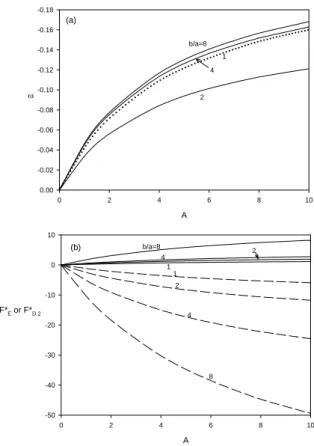
at various (b/a)’s .Under these conditions, the amount of negative charge on the surface of a toroid is larger than that of positive charge, and the direction of its movement is opposite to that of the applied electric field. Figure
3 shows the influence of parameter A (=e2NSa/εkT)
on the scaled electrophoretic mobility
ω
and thescaled forces *
E
F , and FD*,2 at various (b/a)’s for the
case when B=0.3,
α
=2,β
=0.5,κ
a
=1, andh/a=2.
Note that an initially neutral toroid becomes charged as it approaches a charged disk, and an os-motic pressure field is established. These affect ap-preciably the behavior of the toroid. Figure 4 shows the variations of the scaled electrophoretic mobility
ω
and the scaled forces *E
F , and *
, D
F 2 as a function
and h/a=2. A 0 2 4 6 8 10 ω -0.18 -0.16 -0.14 -0.12 -0.10 -0.08 -0.06 -0.04 -0.02 0.00 b/a=8 1 2 4 A 0 2 4 6 8 10 F*E or F*D.2 -50 -40 -30 -20 -10 0 10 b/a=8 4 4 1 2 8 1 2 (a) (b)
Figure 3. Variation of scaled electrophoretic mobility ω, (a), and
* E
F and FD*,2, (b) as a function of A at various (b/a)’s .
κa 0.1 1 10 ω -0.02 -0.01 0.00 0.01 0.02 0.03 b/a=1 8 2 4 κa 0.1 1 10 F*E or F*D,2 -1.0 -0.5 0.0 0.5 1.0 1.5 b/a=8 4 2 1 1 4 2 8 (b) (a)
Figure 7. Variation of scaled electrophoretic mobility ω, (a), and
* E
F and FD*,2, (b), as a function of
κ
a
at various (b/a)’s五、參考文獻
[1] Eickbush, T. H.; Moudrianakis, E. N. Cell 1978, 13, 295-306.
[2] Bloomfield, V. A. Biopolymers 1997, 44, 269-282. [3] Chim, Y. T. A.; Lam, J. K. W.; Ma, Y.; Armes, S. P.;
Lewis, A. L.; Roberts, C. J.; Stolnik, S.; Tendler, S. J. B.; Davies, M. C. Langmuir 2005, 21, 3591-3598. [4] Gosule, L. C.; Schellman, J. A. Nature 1976, 259,
333-335.
[5] Kong, X. P.; Onrust, R.; O'Donnell, M.; Kuriyan, J. Cell 1992, 69, 425-437.
[6] Keh, H. J.; Lien, L. C. J. Fluid Mech. 1991, 224, 305-333.
[7] Zydney, A. L. J. Colloid Interface Sci. 1995, 169, 476-485.
[8] Chiang, C. P.; Lee, E.; He, Y. Y.; Hsu, J. P. J. Phys. Chem. B 2006, 110, 1490-1498.
[9] Lee, E.; Chu, J. W.; Hsu, J. P. Colloid Interface Sci. 1998, 205, 65-76.
[10] Chu, J. W.; Lin, W. H.; Lee, E.; Hsu, J. P. Langmuir 2001, 17, 6289-6297.
[11] Hsu, J. P.; Hung, S. H.; Kao, C. Y. Langmuir 2002, 18, 8897-8910.
[12] Hsu, J. P.; Hung, S. H. Langmuir 2003, 19, 7469- 7473.
[13] Yu, H. Y.; Hsu, J. P.; Hung, S. H. Colloid Polym. Sci. 2004, 283, 10-14.
[14] Hsu, J.P.; Kuo, C.C. J. Phys. Chem. B 2006, 110, 17607-17615.
[15] Chih, M. H.; Lee, E.; Hsu, J. P. J. Colloid Interface Sci. 2002, 248, 383-388.
[16] Ninham, B. W.; Parsegian, V. A. J. Theor. Biol. 1971, 31, 405-428.
[17] Chan, D.; Perram, J. W.; White, L. R.; Healy, Y. W. J. Chem. Soc., Faraday Trans. 1 1975, 71,
1046-1057.
[18] Chan, D.; Healy, Y. W.; White, L. R. J. Chem. Soc., Faraday Trans. 1 1976, 72, 2844-2865.
[19] Krozel, J. W.; Saville, D. A. J. Colloid Interface Sci. 1992, 150, 365-373.
[20] Carnie, S. L.; Chan, D. Y. C. J. Colloid Interface Sci. 1993, 155, 297-312.
[21] Carnie, S. L.; Chan, D. Y. C. J. Colloid Interface Sci. 1993, 161, 260-264.
[22] Carnie, S. L.; Chan, D. Y. C.; Gunning, J. S. Lang-muir 1994, 10, 2993-3009.
[23] Carnie, S. L.; Chan, D. Y. C.; Stankovich, J. J. Col-loid Interface Sci. 1994, 165, 116-128.
[24] Hsu, J. P.; Lee, E.; Yen, F. Y. J. Chem. Phys. 2000, 112, 6404-6410.
[25] Hsu, J. P.; Ku, M. H.; Kuo, C. C. Langmuir 2005, 21, 7588-7597.
[26] Ulberg, Z. R.; Dukhin, A. S. Prog. Org. Coat. 1990, 18, 1-41.
[27] Hsu, J. P.; Yeh, L. H.; Ku, M. H. J. Colloid Inter-face Sci. 2007, 305, 324-329.
[28] Hsu, J. P.; Yeh, L. H. J. Chin. Inst. Chem. Engrs. 2006, 37, 601-607.
[29] Backstrom, G. Fluid Dynamics by Finite Element Analysis, Studentlitteratur, Lund 1999.
表 Y04
行政院國家科學委員會補助國內專家學者出席國際學術會議報告
97 年 6 月 23 日
報告人姓名
徐治平
服務機構
及職稱
台大化工系 教授
時間
會議
地點
97.6.16 至 97.6.19
孔 印 布 拉 ,葡萄牙
本會核定
補助文號
NSC96-2221-E-002-079
會議
名稱
(中文) 第 7 屆國際聚電解質研討會
(英文) 7th International Symposium on Polyelectrolytes (Polyelectrolytes 2008)
發表
論文
題目
(中文) 聚電解在圓柱孔洞內之電泳
(英文) Electrophoresis of a Polyelectrolyte Entity in a Cylindrical Pore
報告內容應包括下列各項:
一、參加會議經過
二、與會心得
三、考察參觀活動(無是項活動者省略)
四、建議
五、攜回資料名稱及內容
六、其他
一 、 參 加 會 議 經 過
國 際 聚 電 解 質 研 討 會 每 二 至 三 年 舉 辦 一 次 , 自 1995 於 德 國 舉 辦 第
一 屆 會 議 後 , 分 別 在 日 本 (1998)、 法 國 (2000)、 瑞 典 (2002)、 與 美 國
(2004)、與 德 國 (2006)舉 辦,為 國 際 間 發 表 聚 電 解 質 相 關 研 究 成 果 的 主
要 學 術 會 議。本 屆 會 議 之 主 題 包 括:Biopolyelectrolytes、Polyelectrolyte
complexes、 Polysaccharides、 Formulations and gels、 Conformation and
counterion binding、 Self-assembly、 Synthesis、 Transport and rheology
等 七 大 項 。
國 際 聚 電 解 質 研 討 會 之 主 旨 在 於 提 供 工 程 師、科 學 家、研 究 人 員 、
技 術 人 員 、 與 學 生 一 個 發 表 最 新 研 究 成 果 、 交 換 意 見 、 交 流 、 建 立 合
作 研 究 管 道 、 與 其 他 學 術 功 能 的 平 台 。 由 於 其 所 牽 涉 到 的 領 域 相 當 廣
泛 , 包 括 物 理 、 化 學 、 生 物 、 醫 學 、 與 工 程 等 , 與 聚 電 解 質 相 關 之 基
礎 與 應 用 已 廣 受 重 視 。 雖 然 此 次 會 議 並 非 大 型 的 研 討 會 , 但 是 多 數 科
技 領 先 國 家 皆 有 代 表 與 會 ; 國 內 與 大 陸 皆 有 數 位 學 者 參 加 。 本 會 提 供
了 一 個 理 想 的 學 術 交 流 機 會 ; 一 方 面 可 以 了 解 國 際 間 關 於 聚 電 解 質 領
域 的 重 要 發 展 與 應 用 , 另 方 面 也 達 到 了 學 術 與 文 化 外 交 的 目 的 。 本 屆
會 議 參 與 者 包 括 全 世 界 共 36 個 國 家 共 約 200 位 的 學 者 專 家,主 要 的 科
技 先 後 國 家 都 有 代 表 與 會 , 是 一 個 規 模 相 當 理 想 的 國 際 學 術 會 議 。 會
附件三
表 Y04
議 期 間 除 了 關 於 聚 電 解 質 的 各 個 主 要 領 域 課 題 之 論 文 發 表 外 , 還 有 專
題 演 講 6 篇、邀 請 演 講 6 篇、口 頭 報 告 論 文 71 篇、與 海 報 論 文 156 篇。
整 體 而 言 , 該 研 討 會 是 一 個 精 心 籌 劃 、 內 容 豐 富 、 與 執 行 成 功 的 中 小
型 國 際 學 術 會 議 。
筆 者 所 發 表 的 論 文 為 『 聚 電 解 在 圓 柱 孔 洞 內 之 電 泳 』
(Electrophoresis of a Polyelectrolyte Entity in a Cylindrical Pore)。 吾 人
以 球 在 圓 柱 孔 洞 內 之 幾 何 架 構 , 探 討 了 邊 界 效 應 對 電 泳 影 響 。 主 要 的
貢 獻 在 於 考 慮 了 因 邊 界 帶 電 所 引 發 的 電 滲 透 流 以 及 電 泳 粒 子 具 多 孔 的
特 質 , 分 析 上 具 有 相 當 的 困 難 度 , 文 獻 中 目 前 尚 少 見 相 關 的 探 討 。 筆
者 於 6 月 14 日 自 台 北 啟 程 , 於 15 日 抵 達 孔 印 布 拉 (Coimbra)市 , 當 日
即 完 成 報 到 註 冊 並 熟 析 環 境 。 會 期 中 全 程 參 與 所 有 的 學 術 及 其 它 相 關
活 動 。 會 議 結 束 後 於 20 日 啟 程 返 國 , 於 6 月 21 日 下 午 抵 達 台 北 。
二 、 與 會 心 得
除 了 前 兩 屆 之 外,國 際 聚 電 解 質 研 討 會 每 二 年 舉 辦 一 次,目 前 已 是
國 際 間 發 表 聚 電 解 質 相 關 研 究 成 果 的 主 要 學 術 會 議 之 一 。 孔 印 布 拉 市
是 一 個 人 口 數 萬 人 的 大 學 城 , 其 中 學 生 即 占 了 約 半 數 。 相 較 於 其 他 國
家 , 國 人 前 往 葡 萄 牙 旅 遊 或 進 行 學 術 或 商 業 活 動 者 相 當 少 , 有 限 的 人
次 中 又 以 前 往 首 都 里 斯 本 者 為 多 , 鮮 有 前 往 孔 印 布 拉 市 者 。 此 次 會 議
雖 由 孔 印 布 拉 大 學 (University of Coimbra)化 學 系 主 辦 , 但 是 孔 印 布 拉
市 政 府 亦 給 予 相 當 程 度 的 支 持 與 配 合 , 例 如 提 供 活 動 場 地 。 化 學 系 內
的 投 入 也 相 當 熱 心 , 包 括 人 力 與 行 政 資 源 的 配 合 。 整 體 而 言 , 從 規 劃
到 執 行,會 議 舉 辦 得 算 是 相 當 成 功,有 許 多 地 方 值 得 我 們 學 習。不 過 ,
也 有 一 些 小 缺 點 , 例 如 孔 印 布 拉 市 與 位 於 里 斯 本 的 國 際 機 場 有 相 當 的
距 離 , 但 是 大 會 對 於 交 通 相 關 資 訊 的 提 供 較 不 理 想 。 另 外 , 活 動 內 容
過 於 緊 湊 , 較 缺 乏 一 些 關 於 孔 印 布 拉 市 的 導 覽 與 介 紹 , 也 有 些 遺 憾 。
孔 印 布 拉 大 學 創 立 於 13 世 紀,是 歐 洲,也 是 全 世 界 歷 史 悠 久 的 大 學 之
一 ; 校 地 雖 然 不 算 大 , 但 是 校 園 建 築 極 具 特 色 , 特 別 是 對 於 老 舊 建 築
的 維 修 別 具 巧 思 。 主 辦 單 位 化 學 系 的 設 備 與 研 究 資 源 比 不 上 國 內 大 學
的 平 均 水 準 , 但 是 以 有 限 的 人 力 與 物 力 可 以 舉 辦 Polyelectrolytes 這 類
國 際 會 議 , 相 當 不 容 易 。
葡 萄 牙 在 科 技 與 工 業 上 雖 然 並 不 突 出,但 是 其 文 化 藝 術 氣 息 濃 厚 ,
與 歐 盟 其 他 歷 史 悠 久 的 國 家 相 較 , 並 不 遜 色 。 特 別 是 自 然 地 呈 現 在 生
活 與 環 境 中 , 值 得 我 們 學 習 。 孔 印 布 拉 市 的 都 市 建 設 及 其 環 境 較 國 際
或 我 國 同 類 型 的 城 市 為 佳 , 建 築 雖 非 極 具 特 色 , 但 是 整 體 感 覺 很 好 ,
不 像 國 內 因 缺 乏 整 體 規 劃 而 顯 得 不 協 調 。 英 語 雖 非 其 國 語 , 但 是 市 民
對 於 其 尚 稱 熟 悉 , 較 我 國 為 優 。 市 民 對 於 觀 光 客 相 當 友 善 , 也 不 吝 於
提 供 協 助 , 市 內 治 安 甚 佳 , 非 我 們 所 能 及 。 孔 印 布 拉 市 對 於 文 化 傳 統
的 維 護 相 當 算 是 用 心 , 對 於 市 民 的 生 活 品 質 亦 十 分 重 視 ; 街 道 與 建 築
表 Y04