Highly efficient yellow and white organic electroluminescent devices doped with 2 , 8
-d i ( t - butyl ) - 5 , 11 - -d i [ 4 - ( t - butyl ) phenyl ] - 6 , 12 --diphenylnaphthacene
Tswen-Hsin Liu, Yao-Shan Wu, Meng-Ting Lee, Hsian-Hung Chen, Chi-Hung Liao, and Chin H. Chen
Citation: Applied Physics Letters 85, 4304 (2004); doi: 10.1063/1.1803911
View online: http://dx.doi.org/10.1063/1.1803911
View Table of Contents: http://scitation.aip.org/content/aip/journal/apl/85/19?ver=pdfcov
Published by the AIP Publishing
Articles you may be interested in
Complete list of Darboux integrable chains of the form t 1 x = t x + d ( t , t 1 )
J. Math. Phys. 50, 102710 (2009); 10.1063/1.3251334
Optical properties of conjugated poly(3-hexylthiophene)/ [ 6 , 6 ] - phenyl C 61 -butyric acid methyl ester composites
J. Appl. Phys. 102, 083104 (2007); 10.1063/1.2799049
The behavior of the I V T characteristics of inhomogeneous ( Ni Au ) – Al 0.3 Ga 0.7 N Al N Ga N heterostructures at high temperatures
J. Appl. Phys. 102, 054510 (2007); 10.1063/1.2777881
Small angle x-ray scattering study of local structure and collapse transition of ( 1 , 3 ) - - D -glucan-chitosan gels
J. Chem. Phys. 125, 054908 (2006); 10.1063/1.2234476
Magnetoelectric effect in magnetostrictive/piezoelectric laminate composite Terfenol- D Li Nb O 3 [ ( z x t w ) 129 ° 30 ° ]
Appl. Phys. Lett. 88, 172903 (2006); 10.1063/1.2198486
This article is copyrighted as indicated in the article. Reuse of AIP content is subject to the terms at: http://scitation.aip.org/termsconditions. Downloaded to IP: 140.113.38.11 On: Thu, 01 May 2014 04:07:05
Highly efficient yellow and white organic electroluminescent devices doped
with 2 , 8-
di
„
t
-butyl
…
-5 , 11-
di
†
4-
„
t
-butyl
…
phenyl
‡
-6 , 12-diphenylnaphthacene
Tswen-Hsin Liu
Institute of Electro-Optical Engineering, National Chiao Tung University, Hsinchu 300, Taiwan, Republic of China and AU Optronics Corporation, Hsinchu 300, Taiwan, Republic of China Yao-Shan Wu, Meng-Ting Lee, Hsian-Hung Chen, and Chi-Hung Liao Department of Applied Chemistry, National Chiao Tung University, Hsinchu 300, Taiwan, Republic of China
Chin H. Chena兲
Display Institute, Microelectronics and Information Systems Research Center, National Chiao Tung University, Hsinchu 300, Taiwan, Republic of China1
共Received 16 April 2004; accepted 16 August 2004兲
We describe the applications of a sterically-hindered yellow dopant, 2 , 8-di
共t-butyl兲-5,11-di关4-共t-butyl兲phenyl兴-6,12-diphenylnaphthacene 共TBRb兲 which, when compared to
5,6,11,12-tetraphenylnaphthacene 共Rb兲 in either tris共8-hydroxyquinolinato兲aluminum or 1,4-bis关N-共1-naphthyl兲-N
⬘
-phenylamino兴−4,4⬘
diamine 共NPB兲 as host emitter, shows a 50%–34% increase in luminance efficiency over that of Rb device without significantly affecting its color. In addition, we have incorporated the TBRb doped yellow NPB emitter into the two-element white organic light-emitting diodes based on p-bis共p-N,N-di-phenyl-aminostyryl兲benzene doped 2-methyl-9 , 10-di共2-naphthyl兲 anthracene sky-blue emitter which improved the luminance efficiency by 44% over that of Rb to 12.8 cd/ A and 4.3 lm/ W at 20 mA/ cm2 with CIEx,y=关0.31,0.38兴. © 2004
American Institute of Physics. 关DOI: 10.1063/1.1803911兴
5,6,11,12-Tetraphenylnaphthacene better known as ru-brene共Rb兲, a highly fluorescent laser dye, has been primarily used as a yellow dopant in organic light-emitting diodes 共OLEDs兲. Doped either in n-type host as in tris共8-hydroxyquinolinato兲 aluminum 共Alq3兲 or p-type host as in 1, 4-bis关N-共1-naphthyl兲-N’-phenylamino兴biphenyl-4,4’ diamine 共NPB兲,1
excellent yellow electroluminescence 共EL兲 can be obtained due to its unique bipolar transport property.2Owing to the vividness and glittering effect of yellow electrolumi-nescence similar to that of the inorganic ZnS: Mn emitter, pixels made from Rb are often combined with their comple-mentary sky-blue color pixels and used in many of the small-sized area-color passive-matrix OLED panels on the market. However, generating a yellow EL is not the only application of Rb in OLEDs. In 1995, Hamada et al. obtained a highly efficient device by doping Rb in aromatic diamine3to make up a p-type yellow emitter. Based on this finding, Sato et al. has added another n-type sky-blue emitter in addition to Ha-mada’s yellow device to fabricate a two-element white OLED.4 In recent years, this white OLED architecture coupled with a red, green, blue 共RGB兲 color filter has be-come increasingly popular as one of the major methodolo-gies to fabricate full color devices.5This is primarily due to cost and mass production consideration in manufacturing as discreet RGB pixelation process can be accomplished with-out using the tedious and troublesome precision shadow mask.
In this letter, the luminance efficiency of the current two-element white OLEDs has been improved by modifying the dopant used in the yellow emitter. The primary objective was
to modify the molecular structure of Rb in achieving better luminance efficiency without affecting its bipolar transport property and color. This is accomplished by introducing four bulky tert-butyl groups into the Rb molecule and thus, hav-ing synthesized 2 , 8-di 共t-butyl兲-5,11-di关4-共t-butyl兲phenyl兴-6 , 12-diphenylnaphthacene, hitherto named as tetra共t-butyl兲 rubrene 共TBRb兲. We doped TBRb into n-type and p-type emitting layers separately and our experimental results showed that TBRb, having greater steric hindrance, can ef-fectively enhance the luminance efficiency of the device by over 50% and 34%, respectively. When the p-type emitter of TBRb is incorporated into the two-element white OLED composition based on p-bis共p-N,N-di-phenyl-aminostyryl兲 benzene共DSA-Ph兲 doped 2-methyl-9,10-di共2-naphthyl兲 an-thracene共MADN兲 sky-blue emitter,6 the total luminance ef-ficiency can be improved by 44% without impacting on its white color Commission Internationale d’Eclairage共CIE兲 co-ordinates which are共0.31, 0.38兲.
Chemical structures of key materials that include TBRb, Rb, DSA-Ph and MADN studied in this report are depicted in Fig. 1. Rb was purchased commercially and purified by train sublimation and TBRb was synthesized in house.7By direct photoionization measurements共Riken AC-2兲, the low-est unoccupied molecular orbital/highlow-est occupied molecular orbital level of TBRb is found to be at around 3.20/ 5.38 eV with a band gap energy共Eg兲 2.18 eV that is essentially iden-tical to that of Rb with 3.31/ 5.4 eV 共Eg⬃2.18 eV兲.
More-over, we adopted three device architectures in this study: Device A is a yellow device with Rb or TBRb doped in
n-type material tris共8-hydroxyquinolinato兲aluminum 共Alq3兲
as the yellow emitter; device B is a yellow device with Rb or TBRb doped in p-type material 1 , 4-bis
关N-共1-naphthyl兲-N
⬘
-phenylamino兴biphenyl-4,4⬘
diamine共NPB兲 as the yellowa兲Author to whom correspondence should be addressed; electronic mail:
[email protected]. edu.tw
APPLIED PHYSICS LETTERS VOLUME 85, NUMBER 19 8 NOVEMBER 2004
0003-6951/2004/85共19兲/4304/3/$22.00 4304 © 2004 American Institute of Physics
This article is copyrighted as indicated in the article. Reuse of AIP content is subject to the terms at: http://scitation.aip.org/termsconditions. Downloaded to IP: 140.113.38.11 On: Thu, 01 May 2014 04:07:05
emitter; device C is a two-element white device in which a sky-blue emitter is combined with a yellow emitter共 Rb or TBRb doped in NPB兲.
In device A, the structure was 关indium tin oxide 共ITO兲 共170 nm兲/copper phthalocyanine 共CuPc, 15 nm兲/NPB 共60nm兲/wt% dopant: Alq3 共37.5 nm兲/LiF
共1 nm兲/Al 共200 nm兲兴, where ITO on glass 共0.7 mm thick兲 has a sheet resistance of⬃10 ⍀/square, CuPc as the hole-injection layer, NPB as the hole transport layer, wt% dopant: Alq3 as the emitter, Alq3 as the electron transport layer and LiF/ Al as the electron-injection layer and cathode. In device B, the Rb or TBRb was doped in NPB共20 nm兲 as a separate emitter where the hole-transport layer NPB was thinned to 40 nm while Alq3 electron transport layer was increased to
75 nm to balance the injected carriers in the device. In de-vice C, the yellow dopant concentration was fixed at 1.2%. MADN and DSA- Ph are the host and dopant of the sky-blue emitter, respectively. The thickness of each organic layer as well as dopant concentration has been adjusted to balance the injected carriers in the white device. The device structure is 关ITO 170 nm/CuPc 共15 nm兲/NPB共50 nm兲/1.2% Rb or
TBRb: NPB 共20 nm兲/3% DSA-Ph: MADN
共40 nm兲/Alq3共15 nm兲/LiF 共1 nm兲/Al 共200 nm兲兴. Details of
device fabrication have been described elsewhere.7
The plots of doping concentration共wt%兲 in Alq3 versus
luminance efficiency共cd/A兲 of TBRb and Rb at 20 mA/cm2 are compared in Fig. 2共a兲. It is found that near saturated yellow color is reached only at over 5% doping where Rb has a CIEx,y=关0.50,0.49兴 and TBRb has a similar CIEx,y
=关0.51,0.48兴. At 5% doping and a drive current density of 20 mA/ cm2and voltage of 8.8 V, the EL efficiency of TBRb
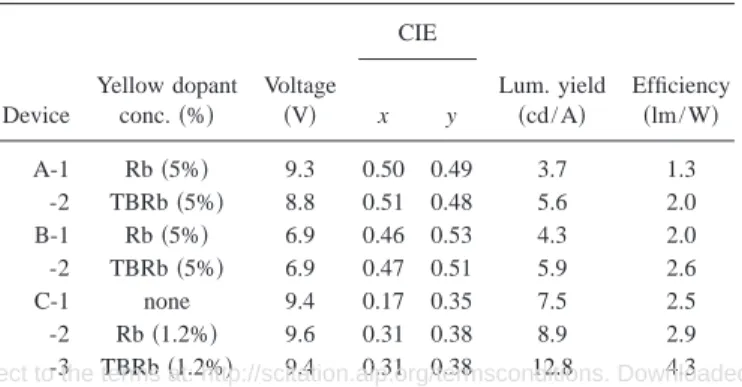
共5.6 cd/A and 2.0 lm/W兲 is more than 50% higher than that of Rb共3.7 cd/A and 1.3 lm/W兲. Detailed device attributes of TBRb and Rb doped 共at 5%兲 emitters are compared in Table I.
In Fig. 2共b兲, we show the plots of doping concentration 共wt%兲 in NPB versus luminance efficiency 共cd/A兲 of TBRb and Rb at 20 mA/ cm2 drive condition in device B. Both
dopants find their luminance efficiencies plateau after 2% and become essentially independent of the doping concentra-tion. From 2% to 14%, TBRb has an efficiency of around 5.9 cd/ A, which is more than 34% more efficient than that of Rb of 4.4 cd/ A. At around 5% doping, Rb has a CIEx,y
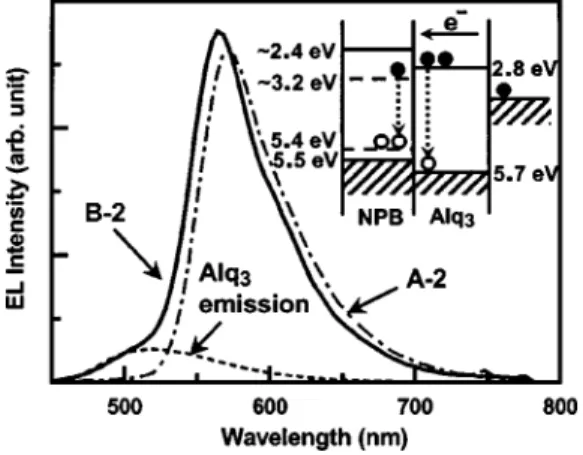
=关0.46,0.53兴 and TBRb has a similar CIEx,y=关0.47,0.51兴 that are quite different from those of device A. The EL spec-tra of 5% TBRb doped devices B has the emission max peak at 564 nm that is 8 nm hypsochromically shifted from that of
device A共max⬃572 nm兲. From the profile of the EL
spec-trum of B共see Fig. 3兲, it is found that the emission of doped NPB device is composed of TBRb and a small amount of Alq3emission atmax520 nm, which is apparently generated
from carriers recombination in the Alq3near the interface of
the emitter.8
Figure 4 is the EL spectra of Device C. Since human eyes are relatively less sensitive to blue light, it is therefore important to increase the blue portion in the white OLED. In order to increase hole/electron recombination in the blue emitter, we have purposely lowered the doping concentration of Rb and TBRb in NPB to 1.2%. In the device structure without yellow dopant in NPB共device C-1兲, a sky-blue color was observed with CIEx,y=关0.17,0.35兴 and the luminance
efficiency of 7.5 cd/ A at 20 mA/ cm2. Furthermore, the op-timal doping concentration of DSA-Ph in achieving the high-est brightness of blue in MADN is 3%. Detailed descriptions pertaining to the development of blue emitter including the synthesis and device structure tuning will be reported elsewhere.9 To better observe the contribution of TBRb in FIG. 1. Chemical structures of materials used in this study.
FIG. 2. EL characteristics of Rb and TBRb doped emitters:共a兲 luminance efficiency vs concentration of device A and共b兲 device B, 共c兲 luminance vs voltage, and共d兲 current density vs voltage.
TABLE I. EL performance of 5% Rb and TBRb doped Alq3共A兲, NPB 共B兲
emitters and white OLEDs共C兲 driven at 20 mA/cm2.
CIE Device Yellow dopant conc.共%兲 Voltage 共V兲 x y Lum. yield 共cd/A兲 Efficiency 共lm/W兲 A-1 Rb共5%兲 9.3 0.50 0.49 3.7 1.3 -2 TBRb共5%兲 8.8 0.51 0.48 5.6 2.0 B-1 Rb共5%兲 6.9 0.46 0.53 4.3 2.0 -2 TBRb共5%兲 6.9 0.47 0.51 5.9 2.6 C-1 none 9.4 0.17 0.35 7.5 2.5 -2 Rb共1.2%兲 9.6 0.31 0.38 8.9 2.9 -3 TBRb共1.2%兲 9.4 0.31 0.38 12.8 4.3
Appl. Phys. Lett., Vol. 85, No. 19, 8 November 2004 Liuet al. 4305
This article is copyrighted as indicated in the article. Reuse of AIP content is subject to the terms at: http://scitation.aip.org/termsconditions. Downloaded to IP: 140.113.38.11 On: Thu, 01 May 2014 04:07:05
the white emission spectrum, the EL spectra in Fig. 4 have been normalized with the blue emission intensity. It is noted from the diagram that the yellow portion of the spectrum has significantly risen when TBRb was added as the yellow dop-ant in the white device. The device luminance efficiency has improved 44% from the original 8.9 cd/ A to 12.8 cd/ A without signiflcantly altering the blue emitter composition. This indicates that the results of the previous p-type yellow devices are applicable to the white device as well. The emis-sion colors of the two white devices are similar with CIEx,y
=关0.31,0.38兴.
In conclusion, we have synthesized a yellow dopant TBRb by introducing four tert-butyl groups into the molecu-lar structure of Rb. The introduction of the passive bulky groups is found to alleviate the concentration-quenching problem by preventing inter-molecular aggregation of dopant molecules. The experimental results have indicated that highly efficient yellow OLED device can be obtained by doping TBRb into either n-type or p-type emitter. In com-parison with the devices doped with Rb, the luminance effi-ciency at 20 mA/ cm2 has improved by 50% and 34% to reach 5.6 cd/ A 共CIEx,y=关0.51,0.48兴兲 and 5.9 cd/A 共CIEx,y
=关0.47,0.51兴兲, respectively. In addition, we have incorpo-rated the TBRb doped yellow NPB emitter into the two-element while OLED based on DSA-Ph doped MADN sky-blue emitter which improved the luminance efficiency by 44% over that of Rb to 12.8 cd/ A at 20 mA/ cm2 with CIEx,y=关0.31,0.38兴. The highly efficient white OLED should
prove beneficial to the development of maskless fabrication process of full-color OLED displays if combined with the color filter technology.
The Ministry of Education of Taiwan, Republic of China, under the grant No. PPUAE共91-E-FAO4-2-4-B兲 and the generous supply of OLED materials provided by e-Ray Optoelectronics Technology Co., Ltd., are gratefully ac-knowledged.
1
Y. Sato, Semicond. Semimetals 64, 209共2000兲.
2
H. Murata, C. D. Merritt, and Z. H. Kafafi, IEEE J. Sel. Top. Quantum Electron. 4, l19共1998兲.
3
Y. Hamada, T. Sano, K. Shibata, and K. Kuroki, Jpn. J. Appl. Phys., Part 2 34, L824共1995兲.
4
Y. Sato, T. Ogata, S. Ichinosawa, and Y. Murata, Synth. Met. 91, 103
共1997兲.
5
K. Mameno, R. Nishikawa, K. Suzuki, S. Matsumoto, T. Yamaguchi, K. Yoneda, Y. Hamada, H. Kanno, Y. Nishio, H. Matsuoka, Y. Saito, S. Oima, N. Mori, G. Rajeswaran, S. Mizukoshi, and T. K. Hatwar, Proceedings of the 9th International Display Workshops, Hiroshima, Japan, 4–6 Decem-ber 2002, p. 235.
6
M. T. Lee, Y S. Wu, H. H. Chen, C. H. Tsai, C. H. Liao, and C. H. Chen, Proceedings of the Society For Information Display, Seattle, Washington, 23–28 May 2004, p. 710.
7
Y. S. Wu, T. H. Liu, C. Y. Iou, and C. H. Chen, Proceedings of the 11th International Workshop on Inorganic and Organic Electroluminescence and 2002 International Conference on the Science and Technology of Emissive Displays and Lighting, Ghent, Belgium, 23–26 September 2002, p. 273.
8
Z. H. Kafai, H. Murata, L. C. Picciolo, H. Mattoussi, C. D. Merritt, Y. lizumi, and J. Kido, Pure Appl. Chem. 71, 11 208共1999兲.
9
M. T Lee, H. H. Chen, C. H. Tsai, C. H. Liao, and C. H. Chen, Appl. Phys. Lett.共to be published兲.
FIG. 3. EL spectra of 5% TBRb doped NPB and Alq3 emitters at
20 mA/ cm2inset is the energy level diagram of B-2 device共in the vicinity
of the emitting layer兲. The dashed line within NPB represents the energy level of TBRb, where共쎲兲 is an electron and 共䊊兲 is a hole.
FIG. 4. EL spectra of device C-1, C-2, and C-3 at 20 mA/ cm2.
4306 Appl. Phys. Lett., Vol. 85, No. 19, 8 November 2004 Liuet al.
This article is copyrighted as indicated in the article. Reuse of AIP content is subject to the terms at: http://scitation.aip.org/termsconditions. Downloaded to IP: 140.113.38.11 On: Thu, 01 May 2014 04:07:05