This content has been downloaded from IOPscience. Please scroll down to see the full text.
Download details:
IP Address: 140.113.38.11
This content was downloaded on 28/04/2014 at 22:07
Please note that terms and conditions apply.
Efficient high-pulse-energy eye-safe laser generated by an intracavity Nd:YLF/KTP optical
parametric oscillator: role of thermally induced polarization switching
View the table of contents for this issue, or go to the journal homepage for more 2012 Laser Phys. Lett. 9 709
(http://iopscience.iop.org/1612-202X/9/10/003)
Abstract: A high-pulse-energy eye-safe laser at 1552 nm is effectually generated by an intracavity Nd:YLF/KTP optical parametric oscillator (OPO) with the help of the thermally in-duced polarization switching. The polarization characteristics of the c-cut Nd:YLF laser at 1053 nm in the continuous-wave (CW) and Q-switched operation are comprehensively investi-gated. We experimentally verify the thermally induced birefrin-gence can lead to a polarization switching between the mutu-ally orthogonal components of the fundamental pulses. Conse-quently, an efficient intracavity nonlinear frequency conversion can be achieved in an optically isotropic laser crystal without any additional polarization control. With this finding, the pulse energy and peak power of the compact Nd:YLF/KTP eye-safe laser under an incident pump power of 12.7 W and a pulse rep-etition rate of 5 kHz are up to 306 µJ and 4 kW, respectively.
Output po w e r a t 1552 n m, W 2.0 2.5 1.0 1.5 0 0.5 14 12 10 8 6 4 2 0
Incident pump power at 806 nm, W
f= 5 kHz f= 8 kHz f=10 kHz f=20 kHz f=40 kHz Intensity , a.u. 0 1.0 0.8 0.6 0.4 0.2 1.2 1530 1540 1550 1560 1570 Wavelength, nm
Output powers at 1552 nm as a function of the incident pump power at 806 nm under a pulse repetition rate of 5, 8, 10, 20 and 40 kHz, respectively. Inset – optical spectrum of the Nd:YLF/KTP eye-safe laser
c
⃝ 2012 by Astro, Ltd.
Efficient high-pulse-energy eye-safe laser generated by an
intracavity Nd:YLF/KTP optical parametric oscillator: role
of thermally induced polarization switching
Y.J. Huang, C.Y. Tang, Y.P. Huang, C.Y. Cho, K.W. Su, and Y.F. Chen∗
Department of Electrophysics, National Chiao Tung University, Hsinchu, Taiwan Received: 19 March 2012, Revised: 22 May 2012, Accepted: 1 June 2012 Published online: 24 August 2012
Key words: Nd:YLF; intracavity OPO; thermal effects; polarization switching
1. Introduction
Among various Nd-doped laser crystals, the negative tem-perature dependence of the refractive index in the Nd:YLF crystal can partly compensate for the positive contribu-tion of the end-face bulging to exhibit a relatively weak thermal-lensing effect [1–3], which is inherently beneficial for designing high-power solid-state lasers. The Nd:YLF crystal is also highly desirable for generating high-energy pulses thanks to its long upper-state lifetime [4–7]. The fluorescence lifetime of 540 µs at 1053 nm in the c-cut
Nd:YLF crystal is expected to be more suitable for con-structing high-pulse-energy lasers as compared with that of 490 µs at 1047 nm in the a-cut counterpart [8]. Unfortu-nately, the transversely isotropic property characterized by the c-cut Nd:YLF crystal leads the polarization state not to be linearly polarized. Note that the Nd:YLF crystal is an uniaxial birefringent crystal that shows distinct emission characteristics between the σ- and π-polarization, where the σ- and π-polarization are defined as the oscillated po-larization of the light to be perpendicular and parallel to the crystallographic c axis, respectively. As a result, ef-∗Corresponding author: e-mail: [email protected]
710
Laser Physics
Letters Y.J. Huang, C.Y. Tang, et al.: Efficient high-pulse-energy eye-safe laser
ficient extracavity nonlinear frequency conversions have been scarcely reported with the c-cut Nd:YLF crystal to date because of its randomly polarized emission property.
Nonlinear frequency conversion provides a useful means for extending the spectral range of available solid-state laser sources when the polarization solid-state and the di-rection of the beam propagation are specifically designed to satisfy the phase matching condition. Linearly polar-ized fundamental beam is usually adopted to perform an efficient extracavity nonlinear frequency conversion with a simple single-pass configuration. Compared with the ex-tracavity method, the inex-tracavity nonlinear frequency con-version takes the advantage of the multi-pass of the fun-damental beam through the nonlinear crystal to effectively reduce the pump threshold and make the resonator more compact. Generally speaking, the multiple round trips can cause the polarization state of the fundamental beam to be changed by the birefringence in the laser cavity. The birefringence-induced polarization switching may be the main mechanism why efficient intracavity nonlinear fre-quency conversions, such as harmonic generations [9–12] and optical parametric oscillations [13–17], can be suc-cessfully realized by using the optically isotropic materials without any active polarization control in the optical res-onator. For example, the output power as high as 36.9 W at 532 nm with the Nd:YAG crystal has been achieved by us-ing an intracavity frequency doublus-ing configuration [12], and the intracavity Nd:YAG/KTA optical parametric oscil-lator (OPO) has efficiently generated the eye-safe radia-tion at 1.54 µm with the output power up to 12.7 W [17]. However, so far the effect of the birefringence-induced po-larization switching in the process of intracavity nonlinear frequency conversion has not been experimentally mani-fested.
In this Letter, we report on an efficient
high-pulse-energy eye-safe radiation in a KTiOPO4 (KTP) based
intracavity optical parametric oscillator (IOPO) pumped by a c-cut Nd:YLF laser with the birefringence-induced polarization switching. We exhaustively explore the in-fluences of the thermal effect and the anisotropic prop-erty of the acousto-optic (AO) Q-switch on the polar-ization characteristics of the c-cut Nd:YLF laser in the continuous-wave (CW) and Q-switched operation, respec-tively. The Q-switched Nd:YLF laser is subsequently uti-lized to intracavity pump a type-II non-critically phase-matched KTP crystal for the generation of the eye-safe radiation at 1552 nm. We properly measure the tempo-ral behaviors of the depleted fundamental pulses to mani-fest that the thermally induced birefringence can lead the mutually orthogonal polarization states of the fundamen-tal pulses to be effectively switched. This successive po-larization switching is experimentally confirmed to be the key mechanism in achieving an efficient IOPO without any additional polarization control. With this finding, this com-pact Nd:YLF/KTP eye-safe laser effectually produces the pulse energy and peak power up to 306 µJ and 4 kW under an incident pump power of 12.7 W and a pulse repetition rate of 5 kHz. To the best of our knowledge, this is the
Laser diode Input mirror
Coupling lens Nd:YLF
AO Q-switch KTP Output coupler L LIOPO
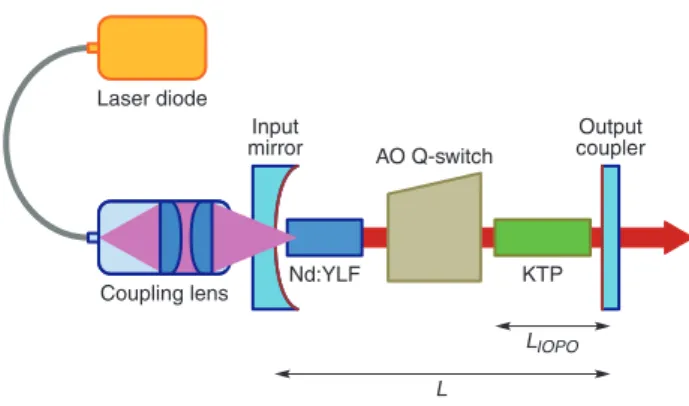
Figure 1 (online color at www.lasphys.com) Schematic of the cavity setup for a KTP-based optical parametric oscillator intra-cavity pumped by an AO Q-switched c-cut Nd:YLF laser
largest pulse energy ever reported among the continuously diode-end-pumped Nd-doped crystal/KTP eye-safe lasers.
2. Experimental setup
The experimental setup for the Nd:YLF/KTP eye-safe laser is schematically shown in Fig. 1. The input mir-ror was a concave mirmir-ror with the radius of curvature of 300 mm. It was antireflection (AR) coated at 806 nm on the entrance face, and was coated at 806 nm for high trans-mission (HT) as well as 1053 nm for high reflection (HR) on the second surface. The gain medium was a 0.8 at.%
c-cut Nd:YLF crystal (CASTECH Inc.) with the diameter
of 4 mm and the length of 15 mm. Both facets of the laser crystal were AR coated at 806 and 1053 nm. Note that al-though it is an uniaxial crystal with the highly anisotropic property, the Nd:YLF crystal effectively exhibits the opti-cally isotropic characteristics in the transverse plane when it is cut along the crystallographic c axis. The orientation of the rod axis of the present c-cut crystal to the crys-tallographic c axis is within 1 degree. The KTP crystal
with dimensions of 5×5×30 mm3 was x-cut at θ = 90◦,
ϕ = 0◦ for the type-II non-critically phase-matched OPO operation, which maximizes the effective nonlinear coef-ficient and eliminates the walk-off effect. The pump face of the KTP crystal was HT coated at 1053 nm as well as HR coated at 1552 nm that acted as the front mirror of the IOPO cavity, while the other face of the KTP crystal was AR coated at 1053 and 1552 nm. Both Nd:YLF and KTP crystals were wrapped with indium foil and mounted
in water-cooled copper heat sinks at 18◦C. A
20-mm-long AO Q-switch (NEOS technologies) was AR coated at 1053 nm on both surfaces. It was placed in the cen-ter of the laser cavity, and was driven at a central fre-quency of 41 MHz with the radio-frefre-quency (RF) power of 25 W. A flat mirror that is HR coated at 1053 nm and partially-reflection coated at 1552 nm with the reflectance
c
⃝ 2012 by Astro, Ltd.
Output po w er at 1053 nm, W 6 5 4 3 2 1 0 102 101 100 14 12 10 8 6 4 2 0
Incident pump power at 806 nm, W (a) CW operation without an intracavity polarizer
CW operation with an intracavity polarizer
14 12 10 8 6 4 2 0
Incident pump power at 806 nm, W (b) AQS operation withoutan intracavity polarizer
P olar izati on r atio Phor iz ontal /Pver tical f = 5 kHz f = 8 kHz f =10 kHz f =20 kHz f =40 kHz
Figure 2 (online color at www.lasphys.com) (a) – output pow-ers at 1053 nm with and without an intracavity polarizer vpow-ersus the incident pump power at 806 nm in the CW operation and (b) – the polarization ratios Phorizontal/Pverticalwith respect
to the incident pump power at a pulse repetition rate of 5, 8, 10, 20, and 40 kHz, where Phorizontal and Pverticalrepresent the
output power with the oscillated polarization to be parallel and perpendicular to the base of the AO Q-switch, respectively
of 80% was utilized as the output coupler during the ex-periment. The pump source was an 806-nm fiber-coupled laser diode with the core diameter of 600 µm and the nu-merical aperture of 0.2, respectively. The polarization state emitted from the fiber-coupled laser diode was measured to be randomly polarized. The pump beam was re-imaged into the laser crystal with a lens set that has the focal length of 25 mm with the magnification of unity and the coupling efficiency of 90%. The lengths of the fundamental laser cavity and the IOPO cavity were set to be L = 115 mm and
LIOP O= 32 mm for the construction of a compact actively
Q-switched (AQS) eye-safe laser. The pulse temporal be-haviors were recorded by a LeCroy digital oscilloscope
Output po w er at 1053 nm, W 4.8 4.6 4.4 4.2 4.0 3.8 200 150 100 50 0 Pul se wi dth a t 105 3 nm, ns 0 5 10 15 20 25 30 35 40 45
Pulse repetition rate, kHz (a) Output power Pulse width Pin=12.7 W Pul se energy an 1053 nm, µ J 900 700 500 300 100 101 100 102 10-1 P eak po w e r a t 105 3 nm, kW 0 5 10 15 20 25 30 35 40 45
Pulse repetition rate, kHz (b)
Pulse energy Peak power
Pin=12.7 W
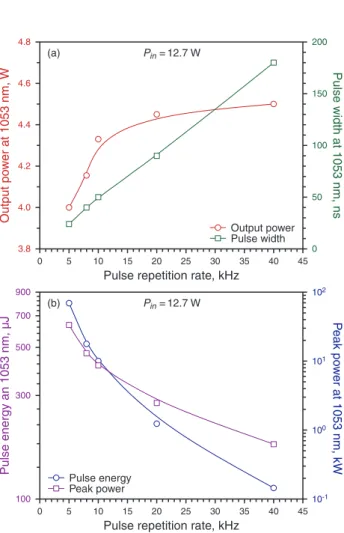
Figure 3 (online color at www.lasphys.com) Dependences of the (a) – output power and pulse width and (b) – pulse energy and peak power at 1053 nm on the pulse repetition rate at an incident pump power of 12.7 W
(Wavepro 7100, 10 G samples/s, 1 GHz bandwidth) with a fast InGaAs photodiode. The spectral information of the laser output was measured by an optical spectrum analyzer (Advantest 8381A) that is constructed with a diffraction monochromator with the resolution of 0.1 nm.
3. Performance of CW and AQS operation at
1053 nm
First of all, the AO Q-switch and the KTP crystal were removed from the laser cavity to investigate the CW per-formance of the c-cut Nd:YLF laser, where the output cou-pler with the reflectance of 80% at 1053 nm was exploited. We utilized an intracavity polarizer to make a compara-tive study of the output characteristics between the lin-early and randomly polarized state, respectively. Fig. 2a illustrates the output powers at 1053 nm with and without an intracavity polarizer versus the incident pump power
712
Laser Physics
Letters Y.J. Huang, C.Y. Tang, et al.: Efficient high-pulse-energy eye-safe laser
(a) f =5 kHz 200 µs/div (b) f =40 kHz 25 µs/div
(c) f =50 kHz 20 µs/div (d) f =100 kHz 10 µs/div
Figure 4 (online color at www.lasphys.com) Pulse trains of the Q-switched Nd:YLF laser at a pulse repetition rate of (a) 5 kHz, (b) 40 kHz, (c) 50 kHz, and (d) 100 kHz. The dashed circle in Fig. 4d indicates the phenomena of the pulse missing
at 806 nm. The maximum output power and slope effi-ciency without an intracavity polarizer are found to be up to 4.7 W and 43.1%, respectively, as depicted by the red curve in Fig. 2a. However, the output power and slope ef-ficiency obtained with an intracavity polarizer are found to be remarkably lower than those obtained without an intra-cavity polarizer, as revealed by the green curve in Fig. 2a. Moreover, the roll-over phenomena in the linearly polar-ized state is experimentally observed at an incident pump power of 10.4 W. In the early researches on the solid-state laser, it was found that the thermally induced birefringence of the optically isotropic material brings in the coupling of the power between the mutually orthogonal polariza-tion components. Consequently, the forbidden polarizapolariza-tion state would be removed with the introduction of a polar-izer inside the laser cavity [18]. This so-called thermal de-polarization loss undoubtedly explains why substantially decreased output power and considerably poorer slope ef-ficiency are obtained in the present linearly polarized c-cut Nd:YLF laser.
We then inserted the AO Q-switch into the laser cav-ity without an intracavcav-ity polarizer to explore the polar-ization characteristics of the c-cut Nd:YLF laser. Figure 2(b) describes the dependences of the polarization ratio
Phorizontal/Pvertical on the incident pump power at a
pulse repetition rate of 5, 8, 10, 20, and 40 kHz, where
Phorizontal and Pvertical stand for the output power with
the oscillated polarization to be parallel and perpendicular to the base of the AO Q-switch, respectively. The polariza-tion ratios for all cases are found to continuously decrease with the increase of the incident pump power. This obser-vation is similar to the works reported in Refs. [19,20]. The diffractive efficiency of the AO Q-switch operated at the compressional mode is polarization dependent, in which the light with the oscillated polarization that is parallel to the propagation of the acoustic wave experiences lower
Output po w er at 1552 nm, W 2.0 2.5 1.0 1.5 0 0.5 14 12 10 8 6 4 2 0
Incident pump power at 806 nm, W f = 5 kHz f = 8 kHz f =10 kHz f =20 kHz f =40 kHz Intensity , a.u. 0 1.0 0.8 0.6 0.4 0.2 1.2 1530 1540 1550 1560 1570 Wavelength, nm
Figure 5 (online color at www.lasphys.com) Output powers at 1552 nm as a function of the incident pump power at 806 nm un-der a pulse repetition rate of 5, 8, 10, 20 and 40 kHz, respectively. Inset – optical spectrum of the Nd:YLF/KTP eye-safe laser
Intensity , a.u. 0 0.8 0.6 0.4 0.2 1.0 1200 1000 800 600 400 200 0 -200 Time, ns Vertically polarized, input fundamental pulses Horizontally polarized, input fundamental pulses
f =5 kHz
Figure 6 (online color at www.lasphys.com) Temporal behav-iors of the originally input fundamental pulses with the mutually orthogonal polarizations at a pulse repetition rate of 5 kHz
diffractive loss. In the meantime, the randomly polarized pump beam leads the gain distribution in the c-cut Nd:YLF crystal to be isotropic; that is, the gain for the mutually or-thogonal polarization components of the laser beam are the same. As a consequence, the lower diffractive loss makes the horizontally polarized laser beam to own the larger net gain as compared with the vertically polarized one, which produces a high degree of the linearly polarized operation at a low incident pump power. However, the polarization ratio is experimentally found to decrease with increasing the incident pump power owing to the reduced difference
c
⃝ 2012 by Astro, Ltd.
Intensity , a.u. 1.0 0.8 0.6 0.4 0.2 0 1200 800 1000 600 400 200 200 0 Time, ns
(a) Vertically polarized, depleted fundamental pulses Horizontally polarized, depleted fundamental pulses
f =5 kHz,Pin=5.9 W Intensity , a.u. 1.0 0.8 0.6 0.4 0.2 0 1200 800 1000 600 400 200 200 0 Time, ns (b) Vertically polarized, depleted fundamental pulses Horizontally polarized, depleted fundamental pulses
f =5 kHz,Pin=7.7W Intensity , a.u. 1.0 0.8 0.6 0.4 0.2 0 1200 800 1000 600 400 200 200 0 Time, ns (c) Vertically polarized, depleted fundamental pulses Horizontally polarized, depleted fundamental pulses
f =5 kHz,Pin=10.4 W Intensity , a.u. 1.0 0.8 0.6 0.4 0.2 0 1200 800 1000 600 400 200 200 0 Time, ns (d) Vertically polarized, depleted fundamental pulses Horizontally polarized, depleted fundamental pulses
f =5 kHz,Pin=12.7W
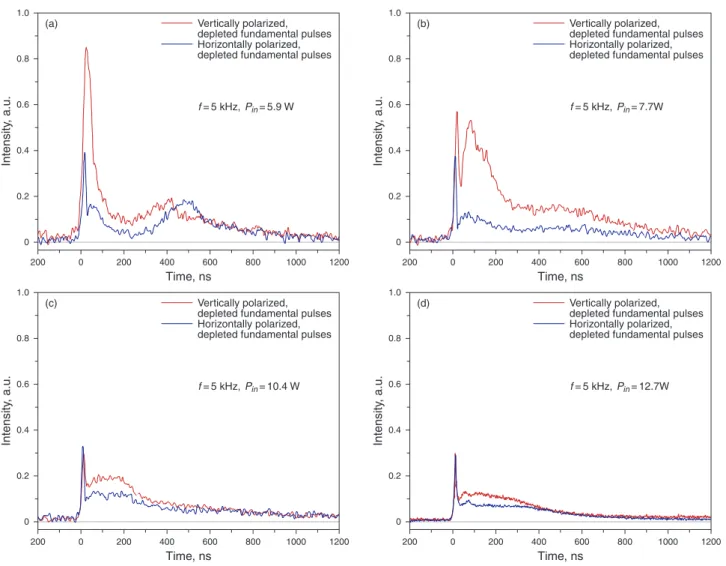
Figure 7 (online color at www.lasphys.com) Temporal behaviors of the mutually orthogonal polarization components of the depleted fundamental pulses at a pulse repetition rate of 5 kHz and an incident pump power of (a) 5.9 W, (b) 7.7 W, (c) 10.4 W, and (d) 12.7 W, respectively
of the net gain between the mutually orthogonal polariza-tion components. Eventually, a nearly random polarizapolariza-tion state was acquired at the maximum incident pump power of 12.7 W. Before examining the IOPO conversion effi-ciency with the KTP crystal, we make a thorough study of the output performance of this AQS Nd:YLF laser.
Fig. 3 depicts the dependences of the output power, pulse width, pulse energy, and peak power on the pulse repetition rate at an incident pump power of 12.7 W. When the pulse repetition rate increases from 5 to 40 kHz, the output power varies from 4.0 to 4.5 W and the pulse width increases linearly from 25 to 180 ns, as shown in Fig. 3a. Consequently, it can be found that the pulse energy changes from 800 to 113 µJ and the peak power decreases from 32 to 0.63 kW with increasing the pulse repetition rate from 5 to 40 kHz, as revealed in Fig. 3b. Fig. 4a – Fig. 4d illustrate the pulse trains of the AQS Nd:YLF laser
at a pulse repetition rate of 5, 40, 50, and 100 kHz, respec-tively. It is experimentally found that the pulse-to-pulse
amplitude stability is better than±8% when the laser
op-erates at 5 – 40 kHz, as exhibited in Fig. 4a and Fig. 4b. Nevertheless, increasing the pulse repetition rate beyond 50 kHz results in an unstable Q-switched operation with the amplitude fluctuation larger than 20%, as revealed in Fig. 4c. Moreover, the phenomena of the pulse missing shown in Fig. 4d is observed at a pulse repetition rate of 100 kHz owing to the lack of the gain for the Q-switched Nd:YLF laser operated at such high pulse repetition rate. Therefore, it is of crucial importance to design an intricate cavity for the stable pulsed operation if the Q-switched Nd:YLF laser with high pulse repetition rate is required [21].
714
Laser Physics
Letters Y.J. Huang, C.Y. Tang, et al.: Efficient high-pulse-energy eye-safe laser
4. Performance of IOPO operation at
1552 nm
When the KTP crystal was inserted into the Q-switched laser cavity and the original IOPO output coupler was em-ployed, the eye-safe pulsed radiation was achieved. The orientation of the y-axis of the KTP crystal is set to be par-allel to the base of the AO Q-switch since the fundamental beam is partially polarized in the horizontal direction. As a result, the oscillated polarization of the present eye-safe laser is horizontally polarized as derived from the type II phase matching condition. Fig. 5 displays the output pow-ers at 1552 nm with respect to the incident pump power at 806 nm at a pulse repetition rate of 5, 8, 10, 20, and 40 kHz, while the inset of Fig. 5 shows the optical spec-trum of the OPO signal pulses with the central wavelength at 1552 nm. If the polarization state of the fundamental beam changes from linear to nearly random status with in-creasing the incident pump power as observed in Fig. 2b, the saturation of the output powers at 1552 nm should be expected. However, it is apparent that the output powers at 1552 nm are almost linearly proportional to the incident pump power at 806 nm in the present situation. For the sake of discovering the interacted mechanism between the fundamental and OPO signal pulses, we used a polariza-tion beam splitter to simultaneously monitor the temporal behaviors of the mutually orthogonal polarization compo-nents of the depleted fundamental pulses. Firstly, figure 6 describes the input fundamental pulses without the IOPO conversion at a pulse repetition rate of 5 kHz. It is obvi-ous that the behaviors of the originally input fundamental pulses with mutually orthogonal polarizations are nearly the same. Fig. 7a – Fig. 7d illustrate the characteristics of the depleted fundamental pulses with mutually orthogonal polarizations at a pulse repetition rate of 5 kHz when the incident pump power is increased. Note that the intensi-ties for each case are normalized with respect to the peak of the originally input fundamental pulses. Initially, the 1552-nm pulses are mainly generated by the horizontally polarized fundamental pulses, which is consistent with the requirement of the type-II phase matching. However, it is experimentally found that the vertically polarized fun-damental pulses can switch to the horizontally polarized state to participate in the IOPO conversion process. Fur-ther increasing the incident pump power, more and more parts of the vertically polarized fundamental pulses are contributed to the generation of the eye-safe radiation, as can be seen clearly in Fig. 7a – Fig. 7d. Although the effect of the optically induced birefringence has been explored in the optically isotropic Nd:Glass and Nd:YAG crystals [22,23], we infer that the thermally induced birefringence is the main mechanism that explains the polarization in-teraction and switching in the present IOPO conversion process. The deduction is based on the degree of the po-larization switching is increased with increasing the inci-dent pump power. It is also worthwhile to mention that the polarization switching is consistent with the roll-over phe-nomena obtained with the linearly polarized c-cut Nd:YLF
Intensity , a.u. 0.8 0.6 0.4 0.2 0 1.0 400 200 0 600 -400 -200 (a) Time, ns f =5 kHz,Pin=12.7W Intensity , a.u. 0.8 0.6 0.4 0.2 0 1.0 500 250 0 750 -750 -500 -250 (b) Time, µs f =5 kHz,Pin=12.7W
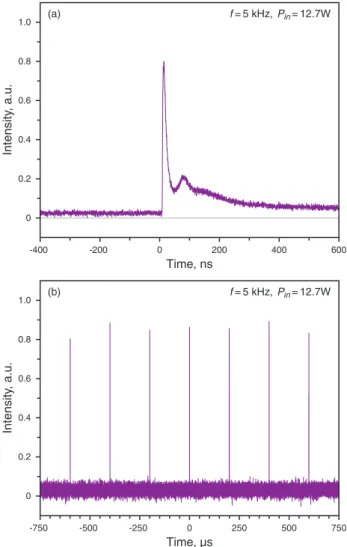
Figure 8 (online color at www.lasphys.com) Typical temporal behaviors of the eye-safe pulses at an incident pump power of 12.7 W and a pulse repetition rate of 5 kHz with: (a) the time span of 1 µs and (b) the time span of 1.5 ms
laser in Sec. 3, both observations are originated from the fact of the polarization state to be significantly influenced by the thermal effect in the laser crystal. To be brief, we first experimentally manifest that the thermally induced polarization switching plays a vital role in accomplishing an efficient intracavity conversion process in an optically isotropic crystal without any active polarization control. We believe that the observed phenomena can provide im-portant insights into the laser physics in an intracavity non-linear frequency conversion process.
Fig. 8a and Fig. 8b demonstrate the typical temporal behaviors of the single pulse shape and pulse trains at 1552 nm under an incident pump power of 12.7 W and a pulse repetition rate of 5 kHz. The relatively long pulse with a remarkable tail depicted in Fig. 8a means that the eye-safe radiation is generated with several round trips in-side the IOPO cavity. Consequently, the time-averaged
ef-c
⃝ 2012 by Astro, Ltd.
fect as a result of this long pulse duration can alleviate the instability probably caused by the polarization switching of the fundamental pulses. The above-mentioned inspec-tion can also be confirmed by referring to Fig. 8b, where the peak-to-peak amplitude fluctuation is experimentally found to be within 10% over an hour-long operation. Ac-cording to Fig. 5, the maximum output power at 1552 nm is up to 1.56 W under an incident pump power of 12.7 W and a pulse repetition rate of 5 kHz, corresponding to the diode-to-signal conversion efficiency of 12.3%. The op-tical conversion efficiency is comparable with those ob-tained with the eye-safe lasers driven by the linearly po-larized fundamental pulses thanks to the assistance of the thermally induced polarization switching [24–27]. On the basis of the Fig. 5 and Fig. 8, the pulse energy can be cal-culated to be as high as 312 µJ and the peak power can be numerically evaluated to be about 4 kW. In compari-son with the reported KTP-based IOPOs pumped by the continuously diode-end-pumped Nd-doped crystal lasers, we have achieved the largest pulse energy of the eye-safe radiation by using the Nd:YLF crystal as a gain medium. This implies that the Nd:YLF crystal is potentially favor-able to be employed for the construction of high-pulse-energy lasers.
5. Conclusion
In summary, we have demonstrated an efficient high-pulse-energy eye-safe radiation in a Nd:YLF/KTP IOPO with the help of thermally induced polarization switching. The polarization characteristics of the c-cut Nd:YLF laser in the CW and AQS operation are comprehensively in-vestigated and discussed. We properly measure the tem-poral behaviors of the depleted fundamental pulses and manifestly find that the thermally induced birefringence can lead the mutually orthogonal polarization states of the fundamental pulses to be effectively switched for accom-plishing an efficient IOPO operation without any extra po-larization control. With this finding, the pulse energy as high as 306 µJ with the optical conversion efficiency up to 12.3% is achieved in our compact Nd:YLF/KTP eye-safe laser under an incident pump power of 12.7 W and a pulse repetition rate of 5 kHz.
Acknowledgements The authors thank the National Science Council for their financial support of this research under Con-tract No. NSC-97-2112-M-009-016-MY3.
References
[1] C. Pfistner, R. Weber, H.P. Weber, S. Merazzi, and R. Gru-ber, IEEE J. Quantum Electron. 30, 1605–1615 (1994). [2] W.A. Clarkson, P.J. Hardman, and D.C. Hanna, Opt. Lett.
23, 1363–1365 (1998).
[3] P.J. Hardman, W.A. Clarkson, G.J. Friel, M. Pollnau, and D.C. Hanna, IEEE Quantum Electron. 35, 647–655 (1999).
[4] S.D. Pan, L. Xue, X.W. Fan, H.T. Huang, and J.L. He, Opt. Commun. 272, 178–181 (2007).
[5] D.J. Li, Z. Ma, R. Haas, A. Schell, P. Zhu, P. Shi, and K.M. Du, Opt. Lett. 33, 1708–1710 (2008).
[6] C. Bollig, C. Jacobs, M.J.D. Esser, E.H. Bernhardi, and H.M. von Bergmann, Opt. Express 18, 13993–14003 (2010).
[7] K. Zhong, J.Q. Yao, Y.Y. Wang, D.G. Xu, and P. Wang, Opt. Laser Technol. 43, 636–641 (2011).
[8] S.D. Pan, K.Z. Han, H.M. Wang, X.W. Fan, and J.L. He, Chin. Opt. Lett. 4, 407–409 (2006).
[9] Y.H. Chen, W. Hou, H.B. Peng, H.L. Zhang, L. Guo, H.B. Zhang, D.F. Cui, and Z.Y. Xu, Opt. Commun. 270, 58–62 (2007).
[10] B.-T. Zhang, J.-F. Yang, J.-L. He, H.-T. Huang, X.-L. Dong, J.-L. Xu, C.-H. Zuo, and K.-J. Yang, Laser Phys. 19, 1389–1394 (2009).
[11] Q. Zheng, Y. Yao, D.P. Qu, K. Zhou, Y. Liu, and L. Zhao, J. Opt. Soc. Am. B 26, 1939–1943 (2009).
[12] B. Ji, X.S. Zheng, Z.P. Cai, H.Y. Xu, and F.Q. Jia, Laser Phys. 22, 406–410 (2012).
[13] A. Dubois, S. Victori, T. L´epine, P. Georges, and A. Brun, Appl. Phys. B 67, 181–183 (1998).
[14] Z. Liu, Q. Wang, X. Zhang, Z. Liu, J. Chang, H. Wang, S. Fan, W. Sun, G. Jin, X. Tao, S. Zhang, and H. Zhang, Appl. Phys. B 92, 37–41 (2008).
[15] B.T. Zhang, X.L. Dong, J.L. He, H.T. Huang, K.J. Yang, C.H. Zuo, J.L. Xu, and S. Zhao, Laser Phys. Lett. 5, 869– 873 (2008).
[16] Z.J. Liu, Q.P. Wang, X.Y. Zhang, Z.J. Liu, J. Chang, H. Wang, S.Z. Fan, S.T. Li, S.S. Huang, W.J. Sun, G.F. Jin, X.T. Tao, S.J. Zhang, and H.J. Zhang, J. Phys. D 41, 135112 (2008).
[17] W.J. Sun, Q.P. Wang, Z.J. Liu, X.Y. Zhang, F. Bai, X.B. Wan, G.F. Jin, X.T. Tao, and Y.X. Sun, Appl. Phys. B 104, 87–91 (2011).
[18] W. Koechner, Solid–State Laser Engineering, 6th ed. (Springer, Berlin, 2005), chap. 7.
[19] C. Lowrie, A. Zygmunt, A. Crout, Y.S. Liu, and J.R. Thompson, Appl. Opt. 34, 4256–4260 (1995).
[20] T. Crawford, C. Lowrie, and J.R. Thompson, Appl. Opt. 35, 5861–5869 (1996).
[21] Y. Sun, H. Zhang, Q. Liu, L. Huang, Y. Wang, and M. Gong, Laser Phys. Lett. 7, 722–725 (2010).
[22] Z. Blaszczak, Proc. SPIE 2202, 469–480 (1995). [23] P. Deb, K.C. Gupta, C.G. Murali, L.J. Dhareshwar, and
B.K. Godwal, J. Opt. A 8, 903–908 (2006).
[24] Y.F. Chen, S.W. Chen, S.W. Tsai, and Y.P. Lan, Appl. Phys. B 76, 263–266 (2003).
[25] W. ˙Zendzian, J.K. Jabczy´nski, P. Wachulak, and J. Kwiatkowski, Appl. Phys. B 80, 329–332 (2005). [26] H.T. Huang, J.L. He, X.L. Dong, C.H. Zuo, B.T. Zhang,
G. Qiu, and Z.K. Liu, Appl. Phys. B 90, 43–45 (2008). [27] H.Y. Zhu, Y.M. Duan, G. Zhang, C.H. Huang, Y. Wei,
W.D. Chen, H.Y. Wang, and G. Qiu, Laser Phys. Lett. 7, 703–706 (2010).