http://crx.sagepub.com
Communication Research
DOI: 10.1177/009365002236193
2002; 29; 503
Communication Research
Chingching Chang
Self-Congruency as a Cue in Different Advertising-Processing Contexts
http://crx.sagepub.com/cgi/content/abstract/29/5/503
The online version of this article can be found at:
Published by:
http://www.sagepublications.com
can be found at: Communication Research
Additional services and information for
http://crx.sagepub.com/cgi/alerts Email Alerts: http://crx.sagepub.com/subscriptions Subscriptions: http://www.sagepub.com/journalsReprints.nav Reprints: http://www.sagepub.com/journalsPermissions.nav Permissions:
CHINGCHING CHANG
Self-Congruency as a Cue in Different
Advertising-Processing Contexts
This study examines how self-congruent advertising messages affect ad and brand evaluations in different contexts. Within the Elaboration Likelihood Model, this study proposes that an ad message’s congruency with subjects’ self-concepts serves as a peripheral cue when subjects do not have the motiva-tion to process informamotiva-tion. Experiment 1 shows that subjects rely on mes-sages’ self-congruency in forming brand and ad attitudes in positive affective states, in which motivation to engage in message elaboration is low, whereas subjects in negative affective states do not. Moreover, in line with past evidence that the lack of motivation to process induced by positive affective states can be overridden by factors enhancing individuals’ motivation, Experiment 2 dem-onstrates that when a product is high involving, as opposed to low involving, attitudes toward the product are less likely to be developed based on the mes-sages’ self-congruency, even when subjects’ affective states encourage a periph-eral mode of processing.
Bombarded with a large quantityand varietyof information everyminute, individuals learn to process incoming information in selective ways. Self-concepts, being well-developed and salient cognitive structures, function readilyas important reference frames when individuals engage in selective information processing (Markus, 1999). However, selective processing based on existing knowledge structures has been shown to be more likelyto occur when an individual’s motivation or abilityto process information is con-strained (Markus & Zajonc, 1985). In a similar vein, selectivitybased on self-knowledge is more likelyto happen when individuals’ motivation to process information is low or when their cognitive capacityis limited. Part of the information load that people carryis directlyrelated to the products avail-able on the market. Therefore, selective processing on the basis of
COMMUNICATION RESEARCH, Vol. 29 No. 5, October 2002 503-536 DOI: 10.1177/009365002236193
self-knowledge also applies to consumers who are exposed to a tremendous variety of product information.
A brand, like a person, can have a personalityor image, which is one important component of brand equity(Biel, 1993). It is well recognized that people consume not onlyfor utilitarian reasons but also for symbolic motiva-tions (e.g., Belk, 1988). Arguing that consumption is one wayto define self-images and fulfill self-completion, consumer researchers have generally demonstrated that to the extent that a product’s image is congruent with an individual’s ideal self-concept, the product is more likelyto be appealing to the individual (Sirgy, 1982).
Advertising is a crucial force in creating brand image; some consumers are attracted to a product simplybecause of the personalitythat the advertise-ment portrays. Based on the consensuallyshared brand personalitythat is developed byadvertising campaigns, consumers are able to decide which products to possess and which products to shun to appropriatelyexpress to others who theyare and what their values or lifestyles are (Batra, Lehmann, & Singh, 1993). Furthermore, an individual’s self-knowledge has been shown to interfere with his or her processing of advertising messages. When an adver-tisement contains a user portrayal that is congruent with the way that a viewer perceives himself or herself to be, it is more likelyto generate more positive affective responses and more favorable product evaluations (e.g., Chang, 2000b; Hong & Zinkhan, 1995).
This studyargues that the congruencyeffect between self-concepts and ad messages is not robust. Drawing on the elaboration likelihood model (ELM), this studysuggests that the extent to which an individual is motivated to pro-cess ad messages will moderate the influence of the self-ad congruencyeffect. In situations in which individuals are motivated to engage in the diligent pro-cessing of product information, theyare less likelyto relymainlyon self-congruencyto evaluate the ad or the product. In contrast, in situations in which individuals are less motivated to process ad messages, a peripheral-route mode of processing is more likelyto occur. Under these conditions, self-congruency, being a readily accessible and salient cue (Fiske & Tay lor, 1991), can render directional influence on individuals’ responses to ads and products.
Two moderators that mayaffect how individuals process ad messages are explored under this research paradigm. The first moderator that is examined in this studyis context-primed affective states. Past studies have shown that an individual’s affective state can affect his or her processing strategies (see Schwarz & Bless, 1991; Schwarz, Bless, & Bohner, 1991). Positive affective states have been found to discourage message elaboration (e.g., see Bless, Bohner, Schwarz, & Strack, 1990) or schema-based processing (Bless, Clore,
et al., 1996; Bless, Schwarz, & Wieland, 1996). Negative affective states, on the other hand, increase individuals’ motivation to process information in analytical ways (e.g., see Bless et al., 1990). Therefore, this study proposes that when individuals are in positive affective states and when motivation to process is low, self-congruencyfunctions as a salient peripheral cue and determines how individuals evaluate the ads and brands. In contrast, when individuals are in negative affective states, their motivation to process product-related information increases, and thus, theydo not simplyrelyon self-congruencyto develop their evaluations of the ads and products. Experi-ment 1 tests the influence of context-primed affective states.
The second moderator concerns product involvement. Products varyin terms of the involvement that consumers are engaged in when formulating product evaluations. When a product is high involving, as opposed to low involving, individuals are more motivated to process product-related infor-mation (Laczniak, Kempf, & Muehling, 1999). For high-involving products, the motivation evoked byproduct involvement mayoverride the lack of moti-vation induced bypositive affective states and encourage individuals to elab-orate on messages and engage in attribute-based information processing. Therefore, this studytheorizes that even in positive affective states, when individuals’ motivation to process is limited, a high-involving product moti-vates individuals to develop a more informed attitude, and as a result, self-congruencyitself does not render significant influence, as it does for a low-involving product. Experiment 2 examines how product involvement may moderate the impact of self-congruencyfor individuals in different affective states.
Self-Congruency Effects in Advertising Research
Continuing attention has been paid to the role that self-concept plays in con-sumer behaviors. It has been suggested that consumption is symbolic and that individuals maintain or enhance their self-concepts through consump-tion (Sentis & Markus, 1986). Therefore, to increase self-satisfacconsump-tion, individ-uals approach products with personalities that are congruent with their ideal self-images and shun products whose perceived personalities are discrepant from what theydesire. It has been well documented that brands with self-congruent images are preferred to brands with self-inself-congruent images (see Sirgy, 1982, for a review).
Self-congruencyeffects are not limited to product perception. The same concept has been applied to understanding how consumers process advertis-ing messages and form their brand evaluations. Indeed, past studies have established that ad attitudes influence brand attitudes (e.g., MacKenzie,
Lutz, & Belch, 1986; Mitchell & Olson, 1981). Extending self-congruency effects to understand how consumers respond to advertising messages is thus reasonable, especiallywhen product image is mainlydeveloped via advertising campaigns. Consistent with the literature exploring the relation-ship between concepts and brand evaluations, studies exploring self-congruencyeffects in ad-processing contexts have shown that consumers’ attitudes toward advertisements are also determined bythe interactions of their self-perceptions and the brand personalitydepicted in ads. To the extent that theyare congruent, consumers’ responses to the ads and the advertised brand are more likely to be positive.
However, concept is not a unidimensional construct; rather, self-concept is said to contain multiple dimensions (Markus & Wurf, 1987). There-fore, testing self-congruencyeffects involves replications across different self-dimensions. Two types of self-concept dimensions have been better explored in advertising literature, namely, personality traits (e.g., Hong & Zinkhan, 1995; LaBarbera, Weingard, & Yorkston, 1998) and values (e.g., Leach & Liu, 1998; Wang & Mowen, 1997).
Regardless of what type of self-concept dimension is explored, consistent support for self-congruencyeffects has been documented. For example, Hong and Zinkhan (1995) have shown that advertising messages that are congru-ent with consumers’ oricongru-entations on the dimension of introversion and extro-version, a personalitytrait, generate more favorable ad attitudes and brand evaluations (see also Chang, 2000b; LaBarbera et al., 1998). Chang (2000a) has indicated that female consumers respond more positivelyto ads depict-ing female users than those depictdepict-ing male users. The matchdepict-ing effects of self-monitoring, also a personalitytrait, and ad appeals on ad and product evaluations have also been explored (e.g., DeBono & Packer, 1991; Snyder & DeBono, 1985).
In terms of values, Wang and Mowen (1997) first determined individuals’ self-ratings on their orientations toward separateness and connectedness and then examined the participants’ responses to ads with either a separate ad appeal or a connected ad appeal. Their findings have demonstrated that self-congruent messages generate more positive ad evaluations. Leach and Liu (1998) have shown that allocentric individuals favor in-group ad appeals, whereas idiocentric individuals prefer out-group ad appeals. Similarly, allocentric individuals have been demonstrated to favor social AIDS health campaign messages to functional AIDS health campaign messages, whereas idiocentric individuals rated functional AIDS health campaign messages more positively than social AIDS health campaign messages (Dutta, 1999). In summary, research has generally supported the conclusion that ad effects varydepending on an ad processor’s self-concepts, and the interaction
holds when different self-dimensions are examined. However, it is important to note that past research appears to assume that the congruencybetween ads and the self exerts influence on ad and brand assessments in all condi-tions. A closer examination shows that possible moderators of self-congru-encyeffects have not been explored. Therefore, it is important to examine fac-tors that may moderate the influence of self-congruency.
Self-Congruency as an Affect-Laden Construct
Individuals’ knowledge structures of the self, or self-concepts, are much more complex than their knowledge structures of other people or other objects (Fiske & Taylor, 1991). In addition, Fiske and Taylor (1991) have theorized that knowledge of the self is affect laden. Higgins (1987) has presented the self-discrepancytheoryto suggest that self-incongruencyhas emotional con-sequences. When discrepancyis experienced, more negative emotions are evoked. Although Higgins’s self-discrepancytheorymainlyconcerns the emotional consequences resulting from the discrepancybetween a real self and an ideal self, Fiske and Taylor as well as Higgins have suggested that processing information that concerns one’s self-concept or activates one’s knowledge of the self tends to have emotional consequences. Indeed, Chang (2000b) has shown that self-congruent ad messages can generate more posi-tive emotional responses than self-incongruent ad messages. In other words, seeing oneself represented in an ad is not onlya cognitive process but also involves emotional responses. To the extent that the congruencyis high, more positive emotional responses will be evoked.
Most important, Fiske and Taylor (1991) have argued, is that generaliza-tions about oneself are different from generalizageneraliza-tions about other people and objects in that theyare more chronicallyaccessible. It is reasonable to propose that when an ad message with user portrayals is processed, ad processors can readilyperceive anydiscrepancybetween the product users and themselves. Therefore, this studysuggests that self-congruency serves as affect-laden information when processing ad messages. How-ever, onlyin situations in which individuals do not have the motivation to adopt an analytical processing mode will self-congruency be a salient cue for developing ad and brand attitudes. Under these conditions, high self-congru-encygenerates more positive evaluations, whereas low self-congruency induces more negative evaluations. In contrast, in situations in which indi-viduals are more involved and motivated to elaborate on information, they are less likelyto relyon peripheral cues to evaluate ads and brands, and thus self-congruency, regardless of its salience and accessibility, will not exert significant influence.
Dual-Mode Processing
Dual-mode processing was introduced in the late 1970s and developed through the early1980s (Chaiken, 1980, 1987; Petty, 1977; Petty& Cacioppo, 1981) and since then has profoundlyinfluenced researchers’ understandings and conceptualizations of how attitudes and social cognition are formed. In general, dual-mode processing suggests that individuals can adopt either an analytical mode of processing or a more limited mode of processing. Among the dual-mode models, the one most widelyapplied in advertising research appears to be the ELM proposed byPettyand Cacioppo (1981). The ELM the-orizes that when motivation is high and cognitive capacityallows, individu-als will be oriented toward employing an analytical processing strategy that is based on the elaboration of a message’s advocated position and argument. However, although individuals are willing to form an informed attitude toward an object, sometimes theyare constrained bytheir cognitive capaci-ties or motivations to do so. As a result, theyrelyon peripheral cues for atti-tude formation, and the importance of argument scrutinythus decreases in contexts within which individuals do not have the capacityor motivation to process information in great detail.
Building on the ELM, this studyargues that one important variable, affec-tive states, influences individuals’ motivation to process information and thus affects the extent to which theywill relyon self-congruencycues for pro-cessing advertising messages. How affective states will affect individuals’ processing motivation and lead individuals to adopt different processing modes is discussed in the next section.
Affective States
1and Processing Strategies
It has long been documented in social psychology literature (and is now gen-erallyaccepted as a given) that how a person feels mayinfluence how he or she thinks (see Schwarz, 1990; Schwarz & Bless, 1991; Schwarz et al., 1991). Feeling good or bad mayeither impair or facilitate a person’s information pro-cessing in regard to attention to detail. It has generallybeen established that when people are in positive2affective states, theyare more likelyto ignore details and relyon heuristics, whereas when theyare in negative affective states, they will engage in detail-oriented and step-by-step analytical pro-cessing (e.g., Bless et al., 1990).
One important explanation has been provided to explain whyindividuals in different affective states process information in different modes. The explanation is motivational in nature, and it suggests that individuals’
affective states signal different information to themselves (see Schwarz, 1990; Schwarz & Bless, 1991; and Schwarz et al., 1991, for discussions). Happyindividuals perceive their environments to be unthreatening and are less likelyto be alert. In addition, to maintain their positive affective states, theyare less likelyto engage in extensive thinking, which mayruin their affective states. Therefore, people in positive affective states will tryto reduce the complexityof information to simplifytheir judgments and decision mak-ing (Isen, Means, Patrick, & Nowicki, 1982). Bycontrast, an individual’s neg-ative affective state sends a message to the individual suggesting that the current situation is distressing and requires close attention. Thus, individu-als in negative affective states are more likelyto engage in causal reasoning and to elaborate on messages (e.g., Bless et al., 1990).
One line of empirical research has adopted the ELM to explore the impacts of different affective states (i.e., positive and negative affective states) on information-processing modes (e.g., Bless et al., 1990; Kuykendall & Keating, 1990). Within the theoretical framework of the ELM, Petty, Gleicher, and Ba-ker (1991) have reasoned that affect can influence the extent of information-processing activity. It has also been empirically demonstrated that positive affect during message exposure decreases systematic processing, whereas negative affect increases systematic processing, and as a result, the impor-tance of argument scrutinyvaries when individuals are in different affective states (Kuykendall & Keating, 1990).
As reviewed earlier, it has been proposed that positive affective states reduce an individual’s motivation to process information, whereas negative affective states increase one’s motivation to systematically process informa-tion. Bless et al. (1990) have examined the influence of affective states on argument scrutinyand have found support for the motivation explanation. Theyhave demonstrated that sad individuals are influenced bypersuasive messages onlyif the arguments delivered are strong, whereas happyindivid-uals are equallyinfluenced bystrong and weak arguments. However, when happyindividuals are instructed to payattention to the content of the mes-sage, the superior effect of strong arguments is also demonstrated, suggest-ing that happyindividuals require motivation to elaborate on messages. Based on what has been documented in past literature, this studyhypothe-sizes that self-congruencyonlyaffects individuals’ responses to ads and brands when theyare in a positive affective state, when the motivation to elaborate on messages is low.
Experiment 1 was conducted to test Hypothesis 1 and Hypothesis 2. As discussed earlier, self-concept is multidimensional (Markus & Wurf, 1987), and users in ads can be depicted with a wide varietyof profiles. Specifically,
this experiment explored one dimension of self-concepts, that is, the individu-alism/collectivism self-values. It was expected that individuals who per-ceived themselves differentlyon this dimension would respond in different ways when ad messages portrayed either individualist or collectivist values. In other words, there would be a significant interaction between ad differ-ences (i.e., ads portraying either individualist or collectivist values) and indi-vidual differences (i.e., indiindi-viduals holding either indiindi-vidualist values or col-lectivist values), with self-congruent ads generating more positive effects than self-incongruent ads.
Hypothesis 1: When individuals are in positive affective states,
self-congruencyaffects their evaluations of ads, whereas when individuals are in negative affective states, self-congruencydoes not affect their evaluations of ads.
Hypothesis 2: When individuals are in positive affective states,
self-congruencyaffects their evaluations of brands, whereas when individ-uals are in negative affective states, self-congruencydoes not affect their evaluations of brands.
Experiment 1 Design
This studywas a three-factor experimental design. The two manipulated fac-tors were ad difference (two ad user profiles: individualist vs. collectivist) and affective states (two levels: positive vs. negative). The third variable was indi-vidual difference along the dimension of indiindi-vidualism/collectivism self-values. Participants were categorized into different groups based on their self-ratings on Yamaguchi’s (1994) Collectivism Scale.
Stimuli
Stimuli ads were created byprofessionals working at the Ogilvyand Mather Ad Agencyin Taipei, Taiwan. Professional copywriters and creative people wrote ad messages to fit different value portrayals and created visuals to fit message descriptions. The product used in this studywas instant coffee. Visuals and layouts were similar for ads with different user portrayals to reduce anypossible confounding effects. Important product attributes that were generated from a pretest were also listed in the ads. All of the ads used in this studywere pretested to ensure that message manipulation would be successful. To improve external validity, the ads were inserted between two real filler ads.
Participants
A total of 214 participants was recruited for this study. Participants were recruited from the campus of a universityin a metropolitan area in Taiwan3 and were paid for their participation. Of the participants, 52% were male. All of the participants were randomlyassigned to one of the four affective states by ad difference conditions.
Procedure
At the beginning of the experiment, participants were told that a professor from the psychologydepartment was collecting happyand sad life events for use in experiments, and the participants were asked to do the professor a favor bywriting down a real-life event that theyhad experienced. This mood-induction procedure4was adopted from Strack, Schwarz, and Gschneidinger (1985).
The second part of the experiment began with the participants’ ratings of their affective states. Then, the second coordinator of the experiment told them that the primarystudywas designed to examine the effects of various ad formats or techniques on consumers’ information processing. This story was designed to discourage them from guessing the purposes of the study. The participants then read a filler ad, which was followed bythe stimuli ad and another filler ad. After reading the ads, the participants rated their per-ceptions of the user images in the ads, after which theyrated their ad atti-tudes and product attiatti-tudes. Finally, they rated themselves on Yamaguchi’s (1994) Collectivism Scale as well as other self-related scales,5 including Snyder’s (1974) Self-Monitoring Scale and Bem’s (1974) Sex Role Inventory. After the participants finished the tasks, the coordinator provided a short debriefing.
Independent Variables
Affective states. As described in the Procedure section, a mood-induction
pro-cedure was adopted from Strack et al. (1985). At the outset of the experimen-tal session, participants were informed that before the studywas conducted, a professor from the psychology department was collecting life stories to develop stimuli for psychology experiments. Participants were asked to help out byproviding their personal stories, and all of the participants complied with the request. Detailed instructions were handed out. In the written instructions, the respondents were informed that each of them had been selected to provide a different type of life event and that he or she happened to
be assigned to provide a happyor sad story. Theywere then presented with a storydescribing a happyor sad event and were instructed to look back and describe a happy or sad life event that they had experienced.
A total of 19 items was selected from the Universityof Wales Institute of Science and Technology(UWIST) Mood Adjective Checklist (Matthews, Jones, & Chamberlain, 1990) to measure the participants’ affective states. Participants rated their agreement with each item on a 19-item, 7-point Likert-type scale. Factor analyses with varimax rotation generated three fac-tors with eigenvalues greater than 1. The first factor comprised 8 items and was labeled Positive Emotions.6 The second factor, Sad Emotions, consisted of 7 items. The third factor, Calmness, contained 2 items. The remaining 2 items with split loading were dropped from further analyses. The scale was treated as if it had three subscales. Positive Emotions contained mainlyitems that represented happiness, whereas Negative Emotions was composed pri-marilyof items depicting sadness. Because this studyexamined onlythe two primaryprototypical affective states—happyversus sad—manipulation checks were conducted onlyon Positive Emotions and Negative Emotions. Cronbach’s reliabilityalphas for Positive Emotions and Negative Emotions were satisfactoryat .92 and .86, respectively. Ratings on items in the two subscales were summed and averaged. An ANOVA indicated that partici-pants in a positive affective state had significantlyhigher ratings on the Posi-tive Emotions subscale, F(1, 143) = 78.37, p < .01, Mpositive= 4.79 (SD = .13),
Mnegative= 3.11 (SD = .14), than did those in a negative affective state. On the other hand, participants in a negative affective state condition generated sig-nificantlyhigher ratings on the Negative Emotions subscale, F(1, 143) = 21.54, p < .01, Mpositive= 3.17 (SD = .11), Mnegative= 3.92 (SD = .12), than did those in a positive affective state. Therefore, the results of the manipulation checks were satisfactory.
Individual difference: Self-ratings on individualism/collectivism.
Partici-pants rated their agreement regarding whether it was ideal to have the char-acteristics listed in Yamaguchi’s (1994) 10-item Collectivism Scale. Factor analyses with varimax rotation generated two factors with eigenvalues greater than 1 (see Appendix A). The first factor, Sacrifice for the Benefit of the Group, comprised 7 items. The second factor consisted of 3 items and was labeled Blind Compliance. The first factor captured the positive side of collec-tivism, and the second factor captured the negative side of collectivism. Due to social desirability, participants might not provide true self-ratings on the negative side of collectivism. Therefore, onlythe subscale pertaining to the positive side of collectivism was employed to categorize participants. Cronbach’s reliability alpha for this subscale was satisfactory at .77.
Subsequently, the respondents were categorized into one of three groups (i.e., individualist, collectivist, or aschematic) byadopting an approach simi-lar to Markus’s (1999) approach. Participants who rated themselves at one extreme of Yamaguchi’s scale were termed collectivists (n = 78) and accounted for 36.4% of the studyparticipants. Participants who rated themselves on the opposite end of the scale were termed individualists (n = 66) and accounted for 30.8% of the studyparticipants. Respondents who rated themselves in the middle range on the scale were termed aschematics (n = 70) and accounted for 32.7% of the studyparticipants. The three groups differed significantlyon how theyrated their self-values on the Collectivism Scale, F(2, 214) = 332.71,
Mindividualist= 4.14 (SD = .08), Maschematic= 4.99 (SD = .08), Mcollectivist= 5.88 (SD = .08). Because aschematics did not stronglyhold individualist or collec-tivist self-views, neither ads portraying individualist users nor those por-traying collectivist users were congruent with their self-images. Therefore, the data for aschematics were not analyzed.
Ad difference: Product user image on individualism/collectivism. One of
the important ways to develop product image is through the depiction of product users (Biel, 1993). Therefore, this studycreated product images through the description of users in the ads. Participants were exposed to ads containing messages delineating ad characters with either individualist or collectivist values. The Collectivism Scale was employed as a manipulation check measure. Participants rated how accuratelytheybelieved each item described the product users on a 7-point basis.
Factor analyses with varimax rotation generated the same two factors as when the scale was used to measure participants’ self-concepts. Therefore, to be consistent, onlythe items for the positive side of collectivism were employed for manipulation checks for ad difference and for categorizing the participants. Cronbach’s reliabilityalpha for this was satisfactoryat .86. An ANOVA indicated that the users portrayed in the collectivist value ad received significantlyhigher ratings on collectivism than did the ad charac-ters depicted in the individualist value ad, F(1, 143) = 9.12, p < .01, Mcollectivist= 5.22 (SD = .09), Mindividualist= 4.85 (SD = .09). Therefore, the result of the manipulation check was satisfactory.
Dependent Measures
Ad attitude. An eight-item, 7-point Likert-type scale was used to measure
participants’ attitudes toward the ads. The following four items were adopted from Madden, Allen, and Twible (1988): “interesting,” “good,” “likable,” and “pleasant.” The other four items were adopted from Beltramini’s (1982)
Advertising BelievabilityScale. Those four items were “believable,” “convinc-ing,” “reasonable,” and “authentic.” Cronbach’s reliabilityalpha for ad atti-tude was deemed satisfactory at .89.
Brand attitude. Brand attitudes were measured with a 7-point
Likert-type scale. The following five items were adopted from Mitchell and Olson (1981) and Holbrook and Batra (1987): “good,” “like,” “pleasant,” “positive,” and “high quality.” Cronbach’s reliabilityalpha was deemed satisfactoryat .90.
Results and Analyses
Because females are more likelyto be collectivists than are males (e.g., Markus & Oyserman, 1988), gender was run as a covariate. ANCOVAs revealed that the three-wayinteractions both on ad attitude, F(1, 143) = 3.93,
p = .05, and brand attitude, F(1, 143) = 6.61, p = .01, were significant. The
sig-nificant interactions qualified further lower level analyses.
Hypothesis 1 proposes that when individuals are in positive affective states, self-congruencyaffects their evaluations of ads, whereas when indi-viduals are in negative affective states, self-congruencydoes not affect their evaluations of ads. When responses of participants in the positive affective state condition were analyzed, a significant two-way interaction between ad difference and individual difference on ad attitude emerged, F(1, 78) = 5.91,
p = .02, with the individualist respondents generating more favorable
responses when exposed to the individualist ad appeal as opposed to the col-lectivist ad appeal (Mindividualist ad= 4.68, SD = .23; Mcollectivist ad= 4.13, SD = .25) (see Figure 1) and collectivist respondents generating less favorable responses when exposed to the individualist ad appeal when compared with the collectivist ad appeal (Mindividualist ad= 4.83, SD = .22; Mcollectivist ad= 5.40,
SD = .19). On the other hand, when responses of the participants in the
nega-tive affecnega-tive mood condition were analyzed, no significant interaction between ad difference and individual difference emerged, F(1, 64) = 0.06, p = .82. This indicates that individuals in negative affective moods did not gener-ate different responses when ad appeals were either congruent or incongru-ent with their self-concepts. Therefore, Hypothesis 1 is fully supported.
Hypothesis 2 suggests that when consumers are in positive affective states, self-congruencyaffects their evaluations of brands, whereas when consumers are in negative affective states, self-congruencydoes not affect their evaluations of brands. When responses of the participants in the posi-tive affecposi-tive state condition were analyzed, a significant two-way interac-tion between ad difference and individual difference on brand attitude
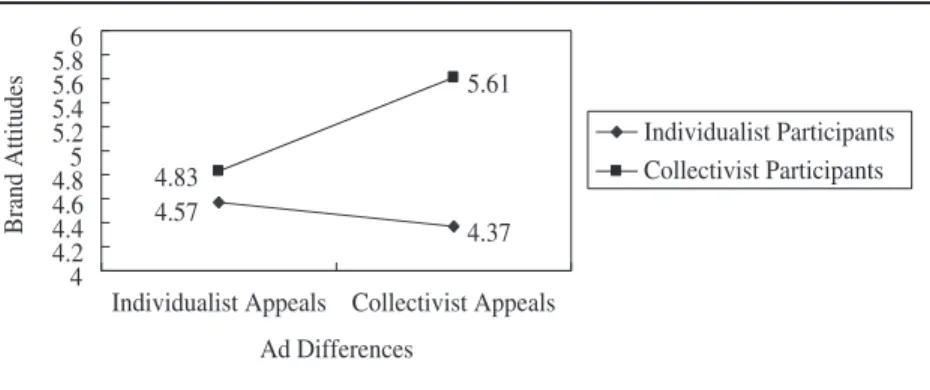
emerged, F(1, 78) = 4.74, p = .03, with the individualist participants generat-ing more favorable brand attitudes when exposed to the individualist ad appeal as opposed to the collectivist ad appeal (Mindividualist ad= 4.57, SD = .23;
Mcollectivist ad= 4.37, SD = .25) (see Figure 2) and the collectivist participants generating less favorable brand attitudes when exposed to the individualist ad appeal in comparison with the collectivist ad appeal (Mindividualist ad= 4.83,
SD = .22; Mcollectivist ad= 5.61, SD = .19). On the other hand, when responses of participants in the negative affective state condition were analyzed, no
4.13 5.4 4.68 4.83 4 4.2 4.4 4.6 4.8 5 5.2 5.4
Individualist Appeals Collectivist Appeals Ad Differences
Ad Attitudes
Individualist Participants Collectivist Participants
Figure 1. The Interaction of Ad Differences (Ads Portraying Individualist Values vs. Collectivist Values) and Individual Differences (Participants Holding Indi-vidualist Values vs. Collectivist Values) on Ad Attitudes
Note. The two-wayinteraction between ad differences and individual differences on ad attitudes
(7-point Likert-type scale with responses ranging from 1 = strongly disagree to 7 = strongly agree) is significant, F(1, 78) = 5.91, p = .02. 4.37 5.61 4.57 4.83 4 4.2 4.4 4.6 4.85 5.2 5.4 5.6 5.86
Individualist Appeals Collectivist Appeals Ad Differences
Brand Attitudes
Individualist Participants Collectivist Participants
Figure 2. The Interaction of Ad Differences (Ads Portraying Individualist Values vs. Collectivist Values) and Individual Differences (Participants Holding Indi-vidualist Values vs. Collectivist Values) on Brand Attitudes
Note. The two-wayinteraction between ad differences and individual differences on brand attitudes
(7-point Likert-type scale with responses ranging from 1 = strongly disagree to 7 = strongly agree) is significant, F(1, 78) = 4.74, p = .03.
significant interaction between ad difference and individual difference was found, F(1, 64) = 2.04, p = .16. Therefore, Hypothesis 2 is fully supported.
Discussion
As expected, the interaction between ad differences and individual differ-ences appeared when participants were in positive affective states but not when participants were in negative affective states. The findings are in line with the assumption in emotion literature that individuals’ processing strat-egies are tuned to their motivation levels in different affective states. Positive affective states are accompanied byan avoidance to elaborate on messages, whereas negative affective states are accompanied bya readiness to process messages in an analytical way. Due to these differences, self-congruency exerted determining effects on ad and brand evaluations in the former con-text, but it did not generate significant influence in the latter context. In sum-mary, affective states appear to be important factors in moderating individu-als’ processing strategies and altering the degree to which individuals relyon self-congruency information for making judgments.
The processes via which ad attitudes can mediate ad perceivers’ brand attitudes have been well established in past literature (MacKenzie et al., 1986). Consistent with this research, similar patterns for participants’ responses to the ads and brands appear in the present study. This study shows that when individuals are in positive affective states, self-congruency functions as a peripheral cue in determining individuals’ ad attitudes and brand evaluations.
It is also interesting to note that the results listed in Table 1 reveal that the collectivist participants, in general, expressed significantlymore positive responses toward the ads and brands than did their counterparts, that is, the individualist participants. There are, of course, manypotential explanations for this difference. For example, it is likelythat collectivist individuals are more sensitive to the demands of researchers and are less likelyto express negative feelings toward either the ads or the brands presented to them. However, there is another, more intriguing possibility, which is that individu-als with different value orientations mayhave different levels of motivation to improve their self-images or that theymayview the environment from dif-ferent perspectives and, as a consequence, respond difdif-ferentlyto ads as well as to brands.
Past studies have pointed out the importance of product involvement in understanding how consumers process advertising messages (e.g., Laczniak et al., 1999). However, Experiment 1 tested onlya single product—instant coffee—that was assumed to be relativelyless involving than other products,
such as computers and CD players. Evidence in persuasion literature has shown that altering the processing goals can override the influence of affec-tive states (Bless et al., 1990). Accordingly, it seems plausible to assume that when a product is more involving, individuals maybe more motivated to elab-orate on advertising messages and that the enhanced motivation mayover-ride the influence of the individuals’ affective states. Therefore, a replication involving products evoking different levels of involvement seemed warranted.
Product Involvement and Processing Strategies
A consumer’s involvement can determine the manner in which he or she pro-cesses and responds to advertising messages (e.g., Laczniak et al., 1999; Petty& Cacioppo, 1983; Petty, Cacioppo, & Schumann, 1983). For example, studies categorizing individuals into high and low advertising message involvement groups have shown that high-involved individuals generate more product cognition, and their product-related cognition plays an influen-tial role when theyformulate their brand attitudes (e.g., Muehling & Laczniak, 1988). On the other hand, low-involved individuals relyprimarily on their ad attitudes for brand attitude formation.
In advertising research specificallytesting the ELM, high-involved con-sumers have been shown to elaborate more on ad messages with strong argu-ments, as opposed to weak arguargu-ments, and to generate more positive thoughts toward ad messages with strong arguments, whereas low-involved consumers do not respond differentlyto ad messages that have different argument qualities (Andrews & Shimp, 1990; Petty& Cacioppo, 1983; Petty
Table 1
Multivariate and Univariate Results for the Effects of Independent Variables on Ad and Brand Attitudes for Experiment 1
Ad Attitude Brand Attitude
Variable F p F p
Gender 3.42 .07 0.17 .69
Affective states (M) 0.04 .84 2.09 .15
Ad difference (A) 0.87 .35 1.92 .17
Individual difference (I) 22.71 .01 19.97 .01
M× A 0.77 .38 0.03 .88
M× I 0.27 .61 0.03 .88
A× I 2.02 .16 0.28 .60
et al., 1983). Low-involved individuals form ad attitudes and brand evalua-tions primarilythrough relying on peripheral cues such as music (Park & Young, 1986), voice characteristics (Gelinas-Chebat & Chebat, 1992), source characteristics (Andrews & Shimp, 1990; Petty& Cacioppo, 1983; Pettyet al., 1983), and argument numbers (Petty & Cacioppo, 1983).
Although most studies that have examined processing strategydiffer-ences manipulate situational factors to induce different levels of advertising message involvement (e.g., Celsi & Olson, 1988; Pettyet al., 1983), Laczniak et al. (1999) have demonstrated that a consumer’s level of advertising mes-sage involvement is not onlycaused bysituational manipulation but also is the result of a consumer’s preexisting product class involvement (see also Muehling & Laczniak, 1992). It is not difficult to understand that high-involving products, generallyhigh-involving more potential risks as opposed to low-involving products, increase individuals’ motivation to process advertis-ing messages. In a similar vein, social psychologists have proposed that selec-tive processing is less likelyto occur when the cost of being wrong is increased (Fiske & Taylor, 1991). Therefore, product involvement appears to be an important variable to consider when examining how individuals respond to advertising messages.
Most important, Bless et al. (1990) have shown that a mood-induced lack of motivation to engage in analytical processing can be overridden by other attempts to motivate individuals to focus on the qualityof the messages. In that study, participants were explicitlyinstructed to attend to the qualityof the arguments. As a result, participants in positive moods, who lack motiva-tion to elaborate on messages unless explicitlyinstructed to do so, are per-suaded to a greater extent bystrong arguments than byweak arguments. Therefore, the current studyargues that product involvement mayoverride the impact of mood states on message elaboration. Specifically, this article hypothesizes that even in positive affective states, when the motivation to engage in analytical processing is limited, individuals are motivated to pro-cess ad messages for high-involving products. Therefore, their attitudes toward high-involving products are not developed simplyon the basis of self-congruency. In contrast, in positive affective states when product involve-ment is low, consumers’ ad and brand evaluations are affected byself-congruency.
Specifically, this experiment explores product involvement levels and affective states as well as one of the other dimensions of self-concepts, that is, introversion and extroversion. When individuals are in positive affective states and the advertised product is low involving, individuals who perceive themselves differentlyon this dimension respond in different ways when ad messages portrayeither introvert or extrovert images. In other words, in this
condition, there is a significant interaction between ad differences (i.e., ads portraying introverts or extroverts) and individual differences (i.e., introvert or extrovert personalitytraits), with self-congruent ads generating more pos-itive effects than self-incongruent ads. In contrast, when individuals are in negative states or when the advertised product is high involving, there is no significant interaction between ad differences and individual differences.
Hypothesis 3: When individuals are in positive affective states and an ad is
for a low-involving product, self-congruencyaffects their evaluations of the ad. However, when individuals are in positive affective states and an ad is for a high-involving product, self-congruencydoes not affect their evaluations of the ad. Bycontrast, when individuals are in nega-tive moods, self-congruencydoes not affect their ad evaluations either when high-involving or low-involving products are advertised.
Hypothesis 4: When individuals are in positive affective states and an ad is
for a low-involving product, self-congruencyaffects their evaluations of the brand. However, when individuals are in positive affective states and an ad is for a high-involving product, self-congruencydoes not affect their evaluations of the brand. Bycontrast, when individuals are in negative moods, self-congruencydoes not affect their brand evalua-tions either when high-involving or low-involving products are advertised.
Experiment 2 Design
This studywas a four-factor mixed experimental design. Three manipulated factors were Ad Difference (two levels: introvert user profile vs. extrovert user profile), Affective State (two levels: positive vs. negative), and Product Involvement, which was a within-subject factor. Given that Experiment 2 explored individual differences along the dimension of introversion/extrover-sion, participants were categorized into different groups based on their self-ratings on Eysenck, Eysenck, and Barrett’s (1985) Introvert/Extrovert Scale.
Stimuli
Stimuli ads were created byprofessionals working at the Ogilvyand Mather Ad Agencyin Taipei, Taiwan. Professional copywriters wrote ad messages to fit different personalityportrayals, and creative people provided visuals to fit message descriptions. Visuals and layouts were similar for ads with introvert user portrayals and ads with extrovert user portrayals to reduce any possible confounding effects. Important product attributes that were generated from
a pretest were also listed in ads for both high-involving and low-involving products. To improve external validity, the stimuli ads were inserted among three real filler ads.
Participants
A total of 396 participants was recruited for this study. Participants were recruited from the campus of a universityin a metropolitan area in Taiwan and were paid for their participation. Theywere randomlyassigned to one of the four conditions.
Procedures
The procedures for Experiment 2 were similar to those used in Experiment 1. The same mood-induction procedure was adopted for this experiment. After the mood-induction procedure, the participants rated themselves on a scale measuring their affective states. Then, the second coordinator told the partic-ipants that the primarystudywas concerned with how ad formats or tech-niques affect consumers’ information processing. The participants then read a stimuli package containing five ads, that is, two stimuli ads dispersed among three filler ads. The order of the two stimuli ads was rotated to coun-terbalance anypossible order effect. After reading the ads, the participants rated their perceptions of the user images in the ads, after which theyrated their ad attitudes and product attitudes. In addition, theyrated themselves on Eysenck et al.’s (1985) Introvert/Extrovert Scale as well as other distracter scales. Because neither the order effect—on ad attitudes, F(1, 260) = 3.00, p = .08, and on brand attitudes, F(1, 260) = 0.84, p = .36—nor the interaction between order and product involvement was significant—on ad attitudes,
F(1, 260) = 2.10, p = .15, and on brand attitudes, F(1, 260) = 0.98, p = .32—
participants’ responses to the two ads with different presentation orders were collapsed for the analyses.
Independent Variables
Product involvement. A pretest was conducted to identifyproducts at
high-and low-involvement levels. Different individuals (N = 20) from the same uni-versitywere asked which product, among those that theyhad purchased before or were planning to purchase in the future, were high involving or low involving. Definitions of high-involving versus low-involving products were provided. Coding of the participants’ open-ended responses indicated that
computers were mentioned most (65%) for the high-involving category, fol-lowed bymobile phones (55%) and stereo systems (35%). On the other hand, drinks were mentioned most (75%) for the low-involving category, followed by pens (50%) and notebooks (30%). Therefore, laptop computers and bottled water were chosen to fulfill the high-involving and low-involving product dif-ference conditions, respectively. The 10 items for product involvement were adopted from Laurent and Kapferer (1985).7A repeated measure ANOVA indicated that the involvement difference for the two products was signifi-cant, F(1, 260) = 8.01, p < .01, Mcomputer= 4.76 (SD = .08), Mwater= 4.51 (SD = .09). Cronbach’s reliabilityalphas were .90 for laptop computers and .89 for bottled water.
Affective states. The same mood-induction procedure as in Experiment 1
was employed in this experiment, and the same 19-item, 7-point Likert-type scale derived from the UWIST Mood Adjective Checklist was applied for manipulation checks. Similarly, factor analy ses with varimax rotation gener-ated three factors with eigenvalues greater than 1, which corresponded well to the three factors generated byExperiment 1. The first factor, Positive Emo-tions, included 9 items.8The second factor, Negative Emotions, consisted of 5 items. The third factor, Calmness, contained 3 items. A total of 3 items with split loading was dropped from further analyses. The scale was treated as if it had three subscales. Similar to Experiment 1, onlythe Positive Emotions and Negative Emotions factors were analyzed for manipulation checks. Cronbach’s reliabilityalphas for Positive Emotions and Negative Emotions were satisfactoryat .88 and .81, respectively. Ratings on items for the two fac-tors were summed and averaged. An ANOVA indicated that participants in the positive affective state condition had significantlyhigher ratings on Posi-tive Emotions, F(1, 261) = 98.18, p < .01, Mpositive= 4.84 (SD = .11), Mnegative= 3.38 (SD = .10), than did the participants in the negative affective state condi-tion. On the other hand, participants in the negative affective state condition generated significantlyhigher ratings on Negative Emotions, F(1, 261) = 40.68, p < .01, Mpositive= 2.74 (SD = .11), Mnegative= 3.73 (SD = .11), than did the participants in the positive affective state condition. Therefore, the results of the manipulation checks were satisfactory.
Ad difference: Product user image on introversion and extroversion.
Partic-ipants were exposed to ads containing messages delineating ad characters with either introvert characteristics or extrovert characteristics. Eysenck et al.’s (1985) Introvert/Extrovert Scale was applied to measure participants’ perceptions of the product users portrayed in the ads, with lower ratings
indicating more of the introversion personalitytrait and higher ratings indi-cating more of the extroversion personalitytrait (see Appendix B). This scale was composed of 12 items. Cronbach’s reliabilityalpha estimates for the scale were satisfactoryat .96 for laptop computers and .98 for bottled water. A repeated measures ANOVA indicated that users portrayed in the introvert ads did generate significantlylower ratings than did product users in the extrovert ads, F(1, 259) = 450.82, p < .01, Mintrovert= 3.13 (SD = .08), Mextrovert= 5.42 (SD = .08). Further analyses indicated that users portrayed in the intro-vert ad for laptop computers had significantlylower ratings on the scale than did users portrayed in the extrovert ad, F(1, 259) = 133.68, p < .01, Mintrovert= 3.43 (SD = .10), Mextrovert= 5.10 (SD = .10). Similarly, users portray ed in the introvert ad for bottled water had significantlylower ratings on the scale than did users portrayed in the extrovert ad, F(1, 259) = 576.72, p < .01,
Mintrovert= 2.82 (SD = .09), Mextrovert= 5.75 (SD = .09).
Individual difference: Self-image on introversion/extroversion. The
par-ticipants rated themselves on Eysenck et al.’s (1985) 12-item, 7-point Likert-type Introvert/Extrovert Scale. Cronbach’s reliability alpha was judged satis-factoryat .82. The participants’ responses to the 12 items were combined and averaged. Those who rated themselves at one extreme of this scale were termed introverts (n = 128) and represented 32.7% of the participants. Those who rated themselves on the opposite end of the scale were termed extroverts (n = 132) and represented 33.7% of the participants. The participants who rated themselves in the middle range of the scale were termed aschematics (n = 132) and represented 33.7% of the participants. The ANOVA analyses showed that the three groups differed significantlyin their self-ratings on the scale, F(2, 392) = 777.15, p = .01, Mintrovert= 3.88 (SD = .04), Maschematic= 4.82 (SD = .03), Mextrovert= 5.82 (SD = .03). Following Markus (1999), however, onlythose participants who rated themselves on the two extremes of the scale were included for subsequent analyses. In total, 262 respondents’ data were analyzed for the hypotheses.
Dependent Measures
Ad attitude. The same scale used in Experiment 1 was employed again.
Cronbach’s reliabilityalphas were deemed satisfactoryat .92 for both bottled water and laptop computers.
Brand attitude. The same scale used in Experiment 1 to measure brand
for this scale were deemed satisfactoryat .93 for both bottled water and lap-top computers.
Results and Analyses
When results of the univariate ANCOVA were examined, theyrevealed that the four-wayinteraction on ad attitude was not significant, F(1, 253) = 1.73,
p = .19 (see Table 2), yet the four-way interaction on brand attitude was
sig-nificant, F(1, 253) = 4.03, p = .05. However, because some researchers argue that simple-level comparison or low-level interactions are acceptable for theory-based hypotheses (e.g., Winer, Brown, & Michels, 1991), further ana-lytical tests were conducted.
Hypothesis 3 proposes that when individuals are in positive affective states and an ad is for a low-involving product, self-congruencyaffects their evaluations of the ad. However, when individuals are in positive affective states and an ad is for a high-involving product, self-congruencydoes not affect their evaluations of the ad. Bycontrast, when individuals are in nega-tive moods, ad congruencydoes not affect their ad evaluations either when
Table 2
Multivariate and Univariate Results for the Effects of Independent Variables on Ad and Brand Attitude for Experiment 2
Ad Attitude Brand Attitude
Variable F p F p
Gender (G) 0.57 .45 0.01 .94
Ad difference (A) 0.35 .55 0.56 .46
Affective states (M) 0.01 .95 0.05 .82
Individual differences (I) 11.89 .01 12.08 .01
A× M 1.00 .32 0.03 .87 A× I 0.11 .74 0.54 .46 M× I 0.49 .49 0.01 .95 A× M × I 0.23 .63 0.11 .74 Within subjects Product (P) 0.11 .74 0.96 .33 P× G 0.48 .49 0.08 .78 P× A 0.32 .57 0.59 .44 P× M 1.32 .25 1.13 .29 P× I 2.86 .09 0.32 .57 P× A × M 0.25 .62 0.68 .41 P× A × I 4.54 .03 0.77 .38 P× M × I 0.48 .49 0.07 .80 P× A × M × I 1.73 .19 4.03 .05
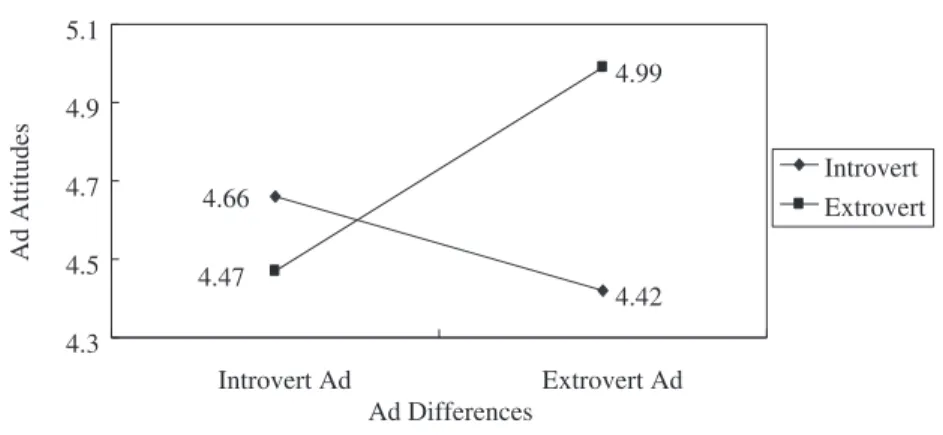
high-involving or low-involving products are advertised. When the responses of participants in the positive affective state condition were analyzed, a sig-nificant three-wayinteraction between ad difference, individual difference, and product involvement on ad attitude emerged, F(1, 118) = 5.52, p = .02. Further analyses of the participants’ responses to the high-involving product indicated that as expected, the interaction between ad difference and individ-ual difference was not significant, F(1, 118) = 1.08, p = .30 (see Table 3 and Figure 3). On the other hand, analyses of the participants’ responses to the low-involving product produced an interaction with a p value of .06, F(1, 118) = 3.64 (see Figure 4), which was not significant if the traditional .05 signifi-cance level was used. However, the mean was in the expected direction.
In contrast, as expected, when responses of participants in the negative affective state condition were analyzed, no significant interaction between ad difference, individual difference, and product involvement emerged, F(1, 132) = 0.37, p = .55. Therefore, Hypothesis 3 is partially supported.
Hypothesis 4 suggests that when consumers are in positive affective states and an ad is for a low-involving product, self-congruencyaffects their evaluations of the brand. However, when consumers are in positive affective states and an ad is for a high-involving product, self-congruencydoes not affect their evaluations of the brand. Bycontrast, when individuals are in negative moods, ad congruencydoes not affect their brand evaluations either when high-involving or low-involving products are advertised.
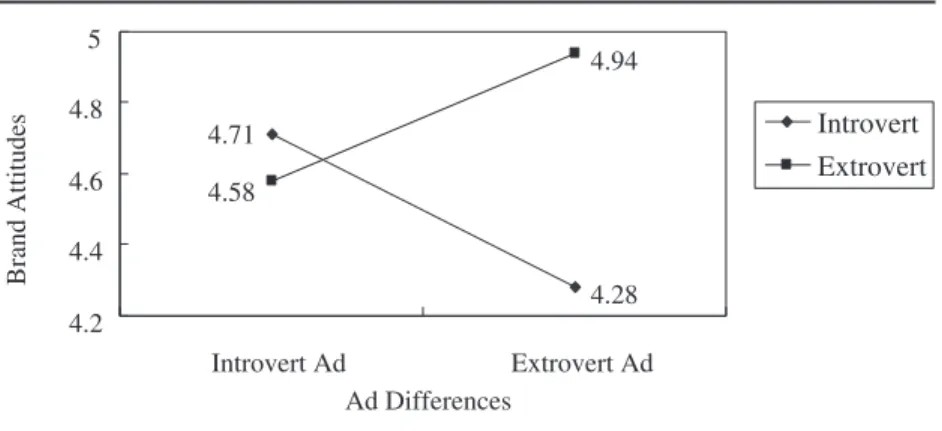
When responses of the participants in the positive affective state condi-tion were analyzed, a significant three-way interaccondi-tion between ad differ-ence, individual differdiffer-ence, and product involvement on brand attitude emerged, F(1, 118) = 4.98, p = .03. Further analyses of participants’ responses to the high-involving product indicated that as expected, the interaction between ad difference and individual difference was not significant, F(1, 118) = 0.44, p = .51 (see Figure 5). In contrast, the interaction between ad difference and individual difference for the low-involving product was significant, F(1, 118) = 3.99, p = .05 (see Figure 6). The means were in the expected directions.
As expected, when responses from the participants in the negative affec-tive state condition were analyzed, no significant interaction among ad dif-ference, individual difdif-ference, and product involvement was found, F(1, 132) = 0.63, p = .43. Therefore, Hypothesis 4 is fully supported.
Discussion
Consistent with expectations, product involvement overrode the influence of affective states and discouraged participants’ reliance on self-congruencyfor making judgments. The interactions between ad differences and product
525
Table 3
Results of Two-Way Interaction on Ad Attitudes and Brand Attitudes for High-Involving and Low-Involving Products When Participants Are in a Positive Affective State Condition for Experiment 2
Positive Affective State Negative Affective State High-Involving Low-Involving High-Involving Low-Involving
Product Product Product Product
Two-Way Interaction Dependent Variable F p F p F p F p
Ad difference× Individual difference Ad attitudes 1.08 .30 3.64 .06 0.23 .63 0.07 .79 Brand attitudes 0.44 .51 3.99 .05 0.41 .52 0.11 .75
at NATIONAL CHENGCHI UNIV LIB on December 11, 2008
differences emerged onlywhen participants were in positive affective states and the product was relativelylow involving. In the same affective states, sig-nificant interactions between ad differences and individual differences were not documented when the product was relatively high involving.
Surprisingly, findings from Experiment 2 also indicated that individuals who rated themselves high on extroversion responded more positivelyto the
4.15 4.35 3.98 4.59 3.8 4 4.2 4.4 4.6 Introvert Ad Extrovert Ad Ad Differences Ad Attitudes Introvert Extrovert
Figure 3. The Interaction of Ad Differences (Introvert Ads vs. Extrovert Ads) and Indi-vidual Differences (Introverts vs. Extroverts) on Ad Attitudes for High-Involving Products in the Positive Affective State Condition
Note. The two-wayinteraction between ad differences and individual differences on ad attitudes
(7-point Likert-type scale with responses ranging from 1 = strongly disagree to 7 = strongly agree) is not significant, F(1, 118) = 1.08, p = .30. 4.42 4.99 4.66 4.47 4.3 4.5 4.7 4.9 5.1 Introvert Ad Extrovert Ad Ad Differences Ad Attitudes Introvert Extrovert
Figure 4. The Interaction of Ad Differences (Introvert Ads vs. Extrovert Ads) and Indi-vidual Differences (Introverts vs. Extroverts) on Ad Attitudes for Low-Involving Products in the Positive Affective State Condition
Note. The two-wayinteraction between ad differences and individual differences on ad attitudes
(7-point Likert-type scale with responses ranging from 1 = strongly disagree to 7 = strongly agree) has a p value of .06, F(1, 78) = 3.64.
ads and brands than their counterparts, that is, introverts. This is parallel to the findings in Experiment 1, showing that the collectivist participants responded significantlymore positivelytoward the ads and brands than did the individualist participants. The evidence seems to argue that individuals who differ from others in terms of certain personalityorientations or values,
4.47 4.94 4.4 5.14 4.3 4.5 4.7 4.9 5.1 5.3 Introvert Ad Extrovert Ad Ad Differences Brand Attitudes Introvert Extrovert
Figure 5. The Interaction of Ad Differences (Introvert Ads vs. Extrovert Ads) and Indi-vidual Differences (Introverts vs. Extroverts) on Brand Attitudes for High-Involving Products in the Positive Affective State Condition
Note. The two-wayinteraction between ad differences and individual differences on brand attitudes
(7-point Likert-type scale with responses ranging from 1 = strongly disagree to 7 = strongly agree) is not significant, F(1, 118) = 0.44, p = .51. 4.28 4.94 4.71 4.58 4.2 4.4 4.6 4.8 5 Introvert Ad Extrovert Ad Ad Differences Brand Attitudes Introvert Extrovert
Figure 6. The Interaction of Ad Differences (Introvert Ads vs. Extrovert Ads) and Indi-vidual Differences (Introverts vs. Extroverts) on Brand Attitudes for Low-Involving Products in the Positive Affective State Condition
Note. The two-wayinteraction between ad differences and individual differences on brand attitudes
(7-point Likert-type scale with responses ranging from 1 = strongly disagree to 7 = strongly agree) is significant, F(1, 118) = 3.99, p = .05.
in addition to self-ad congruency, may respond differently to advertising mes-sages and advertised brands.
General Discussion
Past research exploring self-concepts in consumption behaviors has provided us with a good understanding of how consumers approach products congruent with their self-images and favor advertising messages with self-congruent user portrayals. However, what has been lacking in the research is a discus-sion with respect to whether self-congruencyhas a dominant influence in cer-tain contexts and not in others. This studyspecificallyexplored the contin-gencies under which self-congruencymayplaya dominant role in determining ad and brand evaluations.
Within the ELM framework, this studysuggests that self-congruency, like music, source credibility, or other elements of messages, could function as a peripheral cue when consumers engage in a limited mode of information pro-cessing. Consistent with expectations, findings showed that the selectivityof judgment based on self-knowledge was limited to situations in which individ-uals’ processing loads were heavyand in which theydid not have the motiva-tion to process informamotiva-tion in an analytical way. Findings from Experiment 1 provided empirical evidence for the idea that when consumers are in positive affective states, self-knowledge serves as an important processing frame through which information is evaluated in a biased way. In contrast, when consumers are in negative affective states, when their motivation to process is likelyto be high, message self-congruencydoes not have a significant impact on ad and brand evaluations.
Although this studydid not specificallyexamine the influence of program-induced affective states, given that the affective states in these two experi-ments were induced prior to advertising exposure, as is common in regular viewing situations in which the preceding program or editorial material primes viewers’ or readers’ various affective states, evidence from this study has potential implications for media planners. Although past research has demonstrated how program-induced affective responses influence how con-sumers favor advertising messages (e.g., Goldberg & Gorn, 1987; Pavelchak, Antil, & Munch, 1988; Singh & Hitchon, 1989), little attention has been paid to the influence of program-induced affective states on consumers’ ad-processing strategies. Given that the contextual materials in which an adver-tisement is embedded have alreadybeen shown to induce different affective states (Goldberg & Gorn, 1987), findings regarding how affective states implicate message perceivers’ processing strategies can help advertising pro-fessionals develop more effective media plans. For example, for an image ad
that appeals to the product user’s lifestyle or psychological characteristics, a comedy may be a better placement choice than a news program.
Yet it has been demonstrated that the impacts of affective states can be overridden byfactors that motivate ad perceivers to elaborate on messages (Bless et al., 1990). Therefore, Experiment 2 was conducted to understand whether product involvement overrides the influence of low motivation induced bypositive affective states. The results indicate that when the prod-ucts being considered are more involving, self-congruencyis not as important a determinant of product evaluations as when products are less involving. This is consistent with ELM theorization, namely, that the elements of ad messages serve as peripheral cues and dominate attitude formation when information perceivers have no motivation to process in a systematic, detail-oriented way. Accordingly, research into the interplay of affective states and ad message processing mayprofit from a more thorough examination of other factors that motivate ad perceivers to engage in effortful, detail-oriented pro-cessing strategies.
This studydemonstrates the importance of examining self-concepts to understand how consumers respond to advertising messages. Unfortunately, the role of the self in processing advertising messages has been relativelyless explored in past literature than has the effectiveness of different appeals or message content. The self, being a salient and readilyaccessible concept, deserves more research attention. Consistent with what social psychologists would expect, when individuals’ motivation to process information in details is low, self-ad congruencyprovides sufficient information for individuals to make product judgments. Most important, it is encouraging to note that this evidence suggests that exploring ad effectiveness on the basis of self-concepts may be a fruitful framework for future advertising research.
In addition to support for the interaction of self-concepts and product images, other interesting findings regarding self-concept differences also emerged. Individuals with different self-views on personalitytraits or value orientations appeared to respond to advertising in significantlydifferent ways. Specifically, in contrast with the introvert participants, the extroverts generate more positive evaluations of the ads and brands. In addition, as opposed to the individualists, the collectivists express more favorable responses toward ads and brands. One plausible explanation for these find-ings is that individuals with certain self-concepts, such as collectivist values or an extrovert orientation, mayhave stronger urges to improve their self-images, and this stronger urge mayenhance their readiness to respond to ad messages. The motivation difference mayfurther determine how favorably theyrespond to ad messages. More systematic research seems warranted to
provide a clearer view of this aspect of the interaction between self-concepts and product images.
It has been suggested that developing a product personalityis one impor-tant wayto establish brand equity(Biel, 1993). Nevertheless, findings from this studysuggest two concerns for marketers when employing an ad cam-paign to shape product image. First, this studydemonstrates that each indi-vidual responds to an advertisement with a specific personalityportrayal in a waythat reflects his or her personal preferences. Just as a person can have a set of personalitytraits that he or she desires and another set of personality traits from which he or she disassociates himself or herself, anyspecific prod-uct personalityor value can appeal to some consumers while being perceived as unattractive byothers. Therefore, it is important for marketers to under-stand what kind of product personalitytheir target segments desire. Most important, when appealing to product image, media planning should be orchestrated to enhance the effectiveness of image appeals. Second, in situa-tions in which consumers’ motivation to process is high, even though product image is congruent with consumers’ self-images, this congruencydoes not guarantee that consumers will necessarilyfavor the ad or the product. In these situations, product personalitymaynot be as important and diagnostic as the specific attributes or functions the product offers.
Finally, this study ’s findings must be interpreted within their limitations. First, whether individuals engage in central-route processing when theyare in negative affective states has not been specificallytested. What we can claim from these two experiments is that when individuals have low motiva-tion, theyare more likelyto treat self-congruencyas a peripheral cue for judg-ment making. However, findings do not provide sufficient evidence to claim that when individuals are highlymotivated, theywill engage in analytical processing. Second, whether self-congruencyexerts anyinfluence in high-involving conditions has not been tested. It is likelythat self-congruencymay become an argument when consumers are more motivated to process adver-tising messages, and together with individuals’ assessments of product attributes, it will influence their brand evaluations.
Although this studysuggests that self-ad congruencyis an important variable that influences consumers’ brand and ad evaluations, much regard-ing the correspondence between the self and product image is not well under-stood. For example, it is not clear whether the same dimensions we use to describe self-concepts can be applied to product images. Therefore, one important direction for future studymayinvolve more thorough and system-atic examinations of the correspondence between self-concepts and product images. Another possible approach for those who are interested in the role of self-concepts in processing messages is to explore how and whyindividuals
with different personalitytraits or value orientations respond to advertising messages in different ways.
Appendix A Factor 1
1. I sacrifice self-interest for my group. 2. I act as fellow group members would prefer. 3. I stick with my group through difficulties. 4. I maintain harmony in my group. 5. I respect the majority’s wish. 6. I respect decisions made by my group.
7. I make an effort to avoid disagreements with my group members. Factor 2
1. I support my group whether they are right or wrong.
2. I remain in mygroup if theyneed me, even when I maybe dissatisfied with them.
3. I avoid arguments within mygroup, even when I stronglydisagree with other members.
Appendix B
1. You are a talkative person. 2. You are rather lively.
3. You enjoy meeting new people.
4. You usually let yourself go and enjoy yourself at a lively party. 5. You usually take the initiative in making new friends. 6. You easily get some life into a rather dull party. 7. You tend to keep in the background on social occasions. 8. You like mixing with people.
9. You like plenty of bustle and excitement around you. 10. You are mostly quiet when you are with other people. 11. Other people think of you as being lively.
12. You can get a party going.
Notes
1. In past literature, different terms have been used to refer to perceivers’ affective states. The most commonlyused terms are affect, moods, and emotions. A critical ques-tion concerning emoques-tion research then is how affect, moods, and emoques-tions differ. Past reviews have tried to distinguish between these three concepts. For example, Clore, Schwarz, and Conway(1994) defined affects simplyas “valence—the positive and neg-ative aspect of things” (p. 326). Moods and emotions, according to them, are both affec-tive states; however, moods and emotions differ in terms of “external versus internal concerns, present versus future orientation, and object versus objectless focus” (p. 326). The focus of this studyis on individuals’ affective states, including both moods and