INFORMATION LITERACY AND LIFELONG
LEARNING
Yuhfen Diana Wu
San Jose State University Library, USA E-mailĈ[email protected]
KeywordsĞᙯᔣෟğ:Information Competency; Information Literacy; Lifelong Learning; Faculty-librarian Collaboration; Global Competition; On-line Tutorials; Library Instruction
Ī
摘要ī!
資訊的爆發和全球化所帶來的競爭,對所 有行業帶來極大挑戰,為了求生存並能進一 步在全球化環境中運用自如,現代的學生必 須具有資訊素養;圖書館員和教師能併肩合 作,以幫助學生達此目標。本文探討聖荷西 州立大學(San Jose State University)圖書館 員如何與教師合作,以期培養學生成為終身 學習者,更進一步重點性地敘說部分圖書館 員所設計的工具和學習計畫以加強學生資訊 素養技能。【Abstract】
Information overload and global competition are among the most significant challenges to all professions. Students need to be information literate to survive not just in the workplace but also to excel in the global environment. Librarians can collaborate with teaching faculty to help achieve this goal. This article investigates how librarians at San Jose State University collaborate with teaching faculty in nurturing students for them to become lifelong learners. It also outlines programs and tools developed by librarians to help students enhance their information literacy skills.
INTRODUCTION
At the start of the millennium, the world has become smaller and well-connected because of the wide spread of the Internet. With the power of the Internet, most information is readily available at one’s fingertips. However reliable and useful information may not be freely available on the Internet. Most information seekers cannot differentiate between credible sources and junk sources. Fortunately, users can get help through libraries in most communities, especially in the academic environment. As Bundy said, the library is a place to help people “achieve their full educational and societal potential” (2004, p. 32).
Finding, evaluating, and using information efficiently are among the most significant challenges to all professions. Business management icon Drucker said, “The organization of the future is held together by information … working in such an organization will require literacy to obtain the necessary internal and external information to do our jobs” (2001, p. 16). In this information era, researchers have studied the impact and tried to quantify costs of not finding appropriate information. According to a report from International Data
Corperation (IDC), “the time spent looking for and not finding information costs a company a total of $6 million a year.” IDC is a global technology media, research, and events company. The cost of “reworking information because it hasn’t been found costs that organization a further $12 million a year;” and the success rate in finding the right information at the right time is 50% or less (Feldman, 2004). Another study conducted by OutSell, a leading information industry research and advisory firm, reveals that “the salary cost (in reworking and finding right information) alone to American businesses is $107 billion a year,” and it further states, “this is an $107 billion information literacy problem” (2004).
According to the Association of College and Research Libraries (ACRL), information literacy is a set of abilities requiring individuals to "recognize when information is needed and have the ability to locate, evaluate, and use effectively the needed information" (ACRL, 2000). Three years before the ACRL developed information literacy standards for higher education, the American Association of School Librarians and the Association for Educational Communication and Technology prepared a set of information literacy standards for students learning which consisted of 3 categories, 9 standards, and 29 indicators.[1] They provide a conceptual framework for libraries and librarians to teach, partner and collaborate information literacy efforts within their constituencies for K to 12 students. Therefore, libraries of all kinds offer that powerful bonding from young children to college students.
Libraries have been information providers for centuries. With the arrival of the Internet, the role of libraries and librarians has been dramatically impacted. Libraries need to become a fertile ground for educating patrons in becoming information literate and lifelong learners. The American Library Association declares on its website that “libraries are places for people of all ages and abilities who want to read and learn” and further states that
information Literacy is “the keystone of lifelong learning” (ALA, 2001). [2]
Whether students are properly prepared to be information literate is a concern not only for teaching faculty but also for academic librarians who work with faculty and students.
This article investigates how librarians at San Jose State University collaborate with teaching faculty to help students become lifelong learners. It also covers programs and tools developed by the librarians to help enhance information literacy skills.
San Jose State University (SJSU) is located in the heart of Silicon Valley in northern California. It is 45 miles south of the San Francisco International Airport. In 2003, SJSU library was merged with the main branch of the San Jose Public Library. This joint library is the largest joint venture in the American library history thus far. LITERATURE REVIEW
As early as 1992, the U.S. Labor Department identified five competencies to meet the challenges of today’s workforce (Copple, et.al., 1992). It outlined that today’s workers should have the ability “to manage resources, the ability to work amicably and productively with others, the ability to acquire and use information, the ability to master complex systems, and the ability to work with a variety of technologies.”
The (American) National Forum on Information Literacy (NFIL) (1989) studied the information literacy needs of students, businesses, and citizens in the information age, and produced a report on the necessity of integrating information competence concepts into the curriculum and into workforce training programs. Almost 10 years later NFIL (1998) revised its original study and produced an update that listed recommendations aimed at colleges, librarians and business leaders. These recommendations included collaboration of teaching faculty with librarians/subject specialists; support of educational accrediting
agencies in the area; encouragement of school reform movements to include information literacy skills in the curriculum and the demonstration of the need for these skills to business leaders.
Requiring the use of library resources for assignments is a powerful tool that faculty can use to develop their students’ information literacy skills. Atkinson and Figueroa (1997) reported that when professors in collaboration with librarians included library skills training, the students used better quality resources and significantly improved their research skills. This finding is important in light of a work by Mann that discussed the “Principle of Least Effort” that was originally articulated by G. K. Zipf in 1949. This principle, when applied to students and their research methods, reported, “that most researchers even ‘serious scholars’ will tend to choose easily available information sources, even when they are objectively of low quality … will tend to be satisfied with whatever can be found easily in preference to pursuing higher-quality sources whose use would require a greater expenditure of effort” (Mann, 1993, p. 91). With this principle in mind, professors working with librarians need to consider designing assignments that require high quality information sources. The easy access to the Internet, the explosion of the volume of information, and the predominant use of search engines such as Google make information literacy skills a necessity if students are to find sources of the best quality with least effort. Librarians, in collaboration with the faculty, can help the students critically evaluate all sources.
Students need to be adaptable, flexible, and effective workers. Information literacy skills acquired in college improve a student’s success and lead to lifelong learning ability that can adapt easily to a constantly changing work environment.
Several recent reports and articles have made important connections between information literacy, the classroom, and the
workplace. Breivik (2000) discussed the value of information literacy as a linking tool between the school and the community.
The need for lifelong information literacy skills has been the hallmark of Peter Drucker’s work. Drucker (1995) discussed the changes in business and the need for a company strategy that was based on information from many sources. This information should make executives question assumptions, ask the right questions, and integrate this information into decision-making. Company executives need to understand that information is not only a record of past accomplishments but also a powerful tool for determining future action.
If the quality of the information is not questioned, there can be disastrous effects on the life of a corporation. Several case studies on the impact of the lack of information competence in the workplace were discussed (Cheuk, 2002). INFORMATION LITERACY
PROGRAMS, SERVICES, AND TOOLS TO SUPPORT AND
NURTURE ACADEMIC SUCCESS AND BEYOND
SJSU librarians are allied with the teaching faculty in creating and seizing teachable moments. The following programs and services are provided or developed to teach and enhance information literacy:
Live Information Literacy - Library Research Lecture for SJSU Students from First Year to Graduate Students
At SJSU all students are required to take certain general courses to fulfill the graduation requirements regardless of their majors. These courses include English 1A; English 1B; and 100w, a mandatory junior level writing course by disciplines such as art, business, economics, history, science, and social science, etc.
Librarians work closely with teaching faculty members to develop information literacy/library research lectures as part of the course plan. A campus-wide committee for 100w [3] has developed a handbook that includes links to library research sources and activities that can help teach and support information literacy skills. The intention is to teach our students to become lifelong learners beyond graduation so they will not only survive but also excel in the very competitive workplace.
The majority of information literacy/library research lectures are delivered in the library, where hands-on classrooms are equipped with the latest multi-media tools and classroom management software applications.
Online Tutorials Providing Interactive Tools for Users to Learn Important Issues, such as Plagiarism and Information Literacy Skills
It is mandatory for students who are taking English 1B to take InfoPower, the online tutorial including a diagnostic quiz, prior to coming to the library research lecture taught by librarians. Scores are sent to librarians and instructors. This is to help librarians focus on areas that are missed by the majority of the students.
Since InfoPower is mandatory, there are available statistics showing a steady growth in enrollment: 1401 in Fall 2003 and 1621 in Fall 2005. A total of some 7065 students have taken this tutorial since its inception in fall 2003.
A tutorial [4] on plagiarism is often required for many classes. Students can sign in as a guest before actually taking the quiz with their student ID numbers. This tutorial helps students to understand, learn about, and avoid plagiarism.
Other tutorials designed for SJSU students are: SJSU Library Basics, and 5 Ways to Find Articles and Books. There are three subject
specific tutorials for 100w: computer science, health science, and finding company information; a tutorial to support library science graduate program: LOTSS; and a tutorial for prospective SJSU students: Stairway to Success.
All tutorials are developed either to help diagnose about students’ information literacy skills, or to help enhance and reinforce information literacy skills. They are available 24x7, around the clock anytime anywhere, as long as there are Internet connections. Students can study the tutorials and take the quizzes at their own pace. In addition to the existing diagnostic evaluation, a study to assess the information literacy learning outcomes is underway.
Reference Support: In-Person One-on-One Consultation, Virtual Services such as Email and Online Real-Time Chat
Face-to-face live reference support is available during the hours when the library is open. Reference support is also available via telephone, email, and online real-time chat. Students can make appointments with an academic subject librarian for more in-depth one-on-one consultation. Some librarians also hold office hours throughout the semester. The 24x7 online real-time virtual reference services is a national collaboration available both in English and Spanish.
Current Awareness Matrix
A matrix to help students keep aware of the current development in research and the business world is available at http://www.sjsu.edu/~dwu/CurrentAwareness.h tml. This matrix includes resources that allow users to set up their own profile to receive updated information automatically via email. Resources included in this matrix are databases that the library subscribes or creditable free websites that are provided by government agencies or professional organizations.
100W Library Toolkit
This toolkit provides an one-stop resource page with information on bibliography citation, style manual, grammar and writing tips, primary vs. secondary sources, copyright/plagiarism issues. This toolkit resides in the library’s intranet.
All of these programs, services, and tools are developed by academic librarians in consultation with teaching faculty. A project to assess students’ learning outcomes on information literacy is under way.
“Knowledge is increasing so rapidly that we cannot expect to prepare students by providing them all the facts they will need for their lifetime. Instead, we must develop in them the skills and attitudes of information literacy. To succeed in the information society, they must be learners (Stripling, 1999, 208).” OUTCOME ASSESSMENT
A study conducted at San Jose State University, with the pre- and post-library instruction surveys, showed that there was a 16% decrease in the use of non-library websites after library instruction. Most importantly, although the students may have to spend more time conducting research and evaluating information, they indicated their greater confidence and self-efficacy on strategic analysis (Roldan & Wu, 2004). The result also shows that students are more critical in evaluating the retrieved information. These findings prove the hypothesis that library instruction can provide add-on values to students learning, especially when librarians collaborate with the teaching faculty to develop course plans.
Other evidences of success can be observed in other statistics. Statistics show that there is more than 50% increase in information literacy services and activities in the last four years. In the 2001/2002 academic year 514 group sessions were taught, and that number increased to 784 in 2003/2004 academic year.
These numbers show the demand from the teaching faculty is greater since doing research is more complex in the Internet era.
Statistics [5] also show a dramatic increase in the use of the plagiarism tutorial since it was launched in Fall 2003. In that semester, only 501 students took this tutorial but that number jumped to 1924 in Fall 2005. In the Internet age, it is very easy to “copy” and “paste” when doing research. This big increase demonstrates the commitment of the teaching faculty to help guide students to become lifelong learners. Since SJSU Library made this tutorial open-source in the summer of 2005, seventy-three institutions from around the world have accessed and downloaded this tutorial for their own adaptation and use.
Cumulative statistics show a steady flow of questions coming to the reference desk: 28,457 questions have been answered in 2003/2004, and 26,303 in 2004/2005.
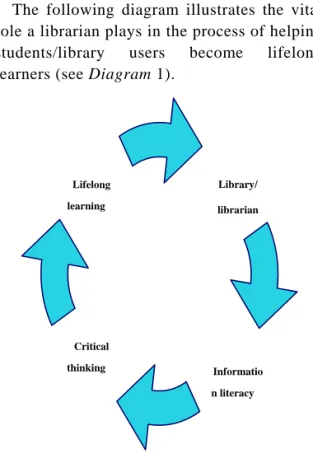
The following diagram illustrates the vital role a librarian plays in the process of helping students/library users become lifelong learners (see Diagram 1).
Diagram 1 Lifelong learning Critical thinking Informatio n literacy Library/ librarian
CONCLUSIONS
Information literacy instruction can be integrated into a course plan to prepare students for lifelong learning beyond graduation. Educational institutions must prepare students for the increasingly more competitive workplace. Librarians and teaching faculty can work collaboratively in developing tools and lecture plans to meet the expectations and to achieve the goals. However, great challenges and opportunities remain. The volume of information being produced and constant changes of access methods require continuous efforts in this collaboration. By working together, librarians and teaching faculty can become strong allies to develop and design a lecture plan that is more focused to meet the lifelong learning objectives.
The research and learning world is becoming very complex because the widely spread use of the Internet. Younger generations are emerging in the highly-wired or wireless fast track. By working together, we can create a virtual space for them to learn and to grow for life.
NOTES
[1] http://www.ala.org/ala/aasl/aaslproftools/ informationpower/InformationLiteracyStandards _final.pdf, retrieved January 29, 2006.
[2] http://www.ala.org/ala/proftools/ 21centurylit/21stcenturyliteracy.htm
[3] http://www2.sjsu.edu/100w/index.htm, retrieved January 20, 2006.
[4] These on-line tutorials reside at http://tutorials.sjlibrary.org/
[5] Tutorials Assessment Report, fall 2003 – fall 2005, unpublished SJSU Library internal report.
REFERENCES
Atkinson, J. D. & Figueroa, M. (1997). Information seeking behavior of business
students: a research study. Reference Librarian, 58, 59-73.
Association of College and Research Libraries ACRL (2000). Information Literacy Competency Standards for Higher Education. Retrieved on June 30, 2004 from:
http://www.ala.org/ala/acrl/acrlstandards/infor mationliteracycompetency.htm
Breivik, P. S. (2000). Information literacy and the engaged campus. AAHE Bulletin. Retrieved on January 5, 2006, from
http://www.aahebulletin.com/public/archive/no v2000_1.asp?pf=1
Bundy, A. (March, 2004). Places of connection: new public and academic library buildings in Australia and New Zealand. Australasian Public Libraries and Information Services, 17(1), 32-47. Retrieved from Wilson Web databases on January 3, 2006.
Cheuk, B. (2002, July). Information Literacy in the Workplace Context: Issues, Best Practices and Challenges. Retrieved on January 10, 2006, from http://www.nclis.gov/libinter/infolitconf&meet /papers/cheuk-fullpaper.pdf
Copple, C. E. [et al.] (1992). The Secretary's Commission on Achieving Necessary Skills: SCANS in the Schools; prepared for Secretary's Commission, U.S. Department of Labor. Washington, D.C.: Pelavin Associates, Inc., 3-4, 22-23.
Drucker, P. (1995). The Information executives truly need. Harvard Business Review. 73(1), 55-62.
Drucker, P. (2001, August). Knowledge management, 4(8), 16.
Feldman, S. (2004, March). The high cost of not finding information. KM world, 13(3), 8-10. Mann, T. (1993). Library Research Models: A
Guide to Classification, Cataloging, and Computers. New York: Oxford University Press.
National Forum on Information Literacy. (1998, March). A Progress Report on Information Literacy: An Update on the American Library Association Presidential Committee on Information Literacy: Final Report. Retrieved at http://www.infolit.org/documents/progress.html on January 4, 2006.
OutSell (2004). There is a $107 Billion Information Literacy Problem. Press release retrieved
http://www.outsellinc.com/outsell/press%20ro om/pr_release/pr20010503_01.htm on January 4, 2006.
Roldan, M. & Wu, Y. D. (2004). Building context-based library instruction. Journal of Education for Business, 79(6), 323-327.
Stripling, B. K., ed. (1999). Learning and Libraries in an Information Age: Principles and Practices. Englewood, Co: Libraries Unlimited, Inc.
Vuotto, F. (2004) Information Competence as a Value Added Product: Applying the Business Model to Academe. Reference Services Review, 32(3), 234-248.
Wu, Y. D. & Kendall, S. L. (2006). Business information literacy from teaching faculty’s perspectives. Reference Services Review, 34(1), 86-96.
Zipf, G. K. (1947). Human Behavior and the Principle of Least Effort: An Introduction to Human Ecology. Cambridge, MA: Addison-Wesley Press.