行政院國家科學委員會專題研究計畫 期末報告
混合式學習上的整合學習經驗模式發展
計 畫 類 別 : 個別型 計 畫 編 號 : NSC 100-2410-H-004-015- 執 行 期 間 : 100 年 08 月 01 日至 101 年 11 月 30 日 執 行 單 位 : 國立政治大學資訊管理學系 計 畫 主 持 人 : 傅豐玲 共 同 主 持 人 : 游聖瑾 報 告 附 件 : 出席國際會議研究心得報告及發表論文 公 開 資 訊 : 本計畫涉及專利或其他智慧財產權,2 年後可公開查詢中 華 民 國 102 年 02 月 25 日
中 文 摘 要 : 因為課堂學習績效和教師、學生、課程內容和學習環境間的 互動有密切的相關;而且在目前線上及混合教室環境在大學 中越來越多被使用的情形;去了解在不同學習環境中,這些 互動會如何發生,及如何利用各種學習環境的優勢,產生有 效的學習互動,引起學者們越來越多的興趣。本研究利用修 正的「討論社群架構」中的教學、社會、認知、及學習呈現 等呈現的概念,利用學習呈現的滿意與不滿意事件,去了解 在「劇場模式」中的各學習元素與學習績效的關係。本研究 發展一個新的架構,命名為「學習劇場架構」。該架構加入 了「平台呈現」這個元素,可以更多解釋造成學習呈現的資 源及提供課程設計改進的指導。本研究用行動研究,分析面 對面、線上、及混合等三種學習環境的滿意與不滿意事件, 來檢視平台的影響。結果指出不同學習環境中所產生的平台 呈現顯著地影響其他四種呈現及強度,也建議有效的使用 「平台呈現」可以中介地增強學習績效。 中文關鍵詞: 劇場模式、學習呈現、學習互動、混合式學習、平台呈現 英 文 摘 要 : Classroom learning performance is thought to be
closely related to the interaction between teacher, students, course content, and learning
environment.With the increased use of online and blended classroom environments in higher education, there is growing interest in understanding the interactions that take place in these alternative learning environments, and how best to take advantage of them to produce effective learning interactions. This study utilizes ideas extended from the Community of Inquiry (teacher, social, cognitive, and learning presence) to understand the relationship between learning elements and learning performance (measured by satisfaction/disatisfaction incitents with the learning presence) in a dramaturgic model. A new framework called the dramaturgy of learning is
developed. The platform presence is added, which can explain more about the learning presence being
created and provide guidelines to improve course design. This study examines the influence of the platform by an action research and by evaluating the incidence of satisfaction and disatisfaction in three types of classroom environments: facto-face, e-learning, and alternative blended environments. The
results indicate that the platform presence created by the different learning environments has a
significant effect on the strength and influence to learning presence. This suggests that effective utlization of the platform presence can moderately improve learning performance.
英文關鍵詞: Dramuturgy model, Learning presence, Learning interaction, Blended learning, Platform presence
行政院國家科學委員會補助專題研究計畫
■成果報告
□期中進度報告
混合式學習上的整合學習經驗模式發展
計畫類別:▓個別型計畫 □整合型計畫
計畫編號:NSC
100-2410-H-004-015-執行期間: 2010 年 08 月 01 日至 2011 年 07 月 31 日
執行機構及系所:政治大學資訊管理系
計畫主持人:傅豐玲
共同主持人 : 游聖瑾
計畫參與人員:丁嘉仁(資管系博士生,兼任助理)
成果報告類型(依經費核定清單規定繳交):▓精簡報告 □完整報告
本計畫除繳交成果報告外,另須繳交以下出國心得報告:
□赴國外出差或研習心得報告
□赴大陸地區出差或研習心得報告
▓出席國際學術會議心得報告
□國際合作研究計畫國外研究報告
處理方式:
除列管計畫及下列情形者外,得立即公開查詢
□涉及專利或其他智慧財產權,□一年□二年後可公開查詢
中 華 民 國 102 年 2 月 26 日
Abstract
Classroom learning performance is thought to be closely related to the interaction between teacher, students, course content, and learning environment.With the increased use of online and blended classroom
environments in higher education, there is growing interest in understanding the interactions that take place in these alternative learning environments, and how best to take advantage of them to produce effective learning interactions. This study utilizes ideas extended from the Community of Inquiry (teacher, social, cognitive, and learning presence) to understand the relationship between learning elements and learning performance
(measured by satisfaction/disatisfaction incitents with the learning presence) in a dramaturgic model. A new framework called the dramaturgy of learning is developed. The platform presence is added, which can explain more about the learning presence being created and provide guidelines to improve course design. This study examines the influence of the platform by an action research and by evaluating the incidence of satisfaction and disatisfaction in three types of classroom environments: face-to-face, e-learning, and alternative blended environments. The results indicate that the platform presence created by the different learning environments has a significant effect on the strength and influence to learning presence. This suggests that effective utlization of the platform presence can moderately improve learning performance.
中文摘要 因為課堂學習績效和教師、學生、課程內容和學習環境間的互動有密切的相關;而且在目前線上及混 合教室環境在大學中越來越多被使用的情形;去了解在不同學習環境中,這些互動會如何發生,及如 何利用各種學習環境的優勢,產生有效的學習互動,引起學者們越來越多的興趣。本研究利用修正的 「討論社群架構」中的教學、社會、認知、及學習呈現等呈現的概念,利用學習呈現的滿意與不滿意 事件,去了解在「劇場模式」中的各學習元素與學習績效的關係。本研究發展一個新的架構,命名為 「學習劇場架構」。該架構加入了「平台呈現」這個元素,可以更多解釋造成學習呈現的資源及提供課 程設計改進的指導。本研究用行動研究,分析面對面、線上、及混合等三種學習環境的滿意與不滿意 事件,來檢視平台的影響。結果指出不同學習環境中所產生的平台呈現顯著地影響其他四種呈現及強 度,也建議有效的使用「平台呈現」可以中介地增強學習績效。 關鍵詞: 劇場模式、學習呈現、學習互動、混合式學習、平台呈現
1 Introduction
For years, e-learning has been on the rise in higher education (Wagner, Hassanein, & Head, 2008), due in part to the advancement of web technologies. Researchers recognized that there exist different advantages for e-learning versus traditional face-to-face (F2F) learning in physical classrooms. Bate (2005), Francescato, Porcelli, Mebane, Cuddetta, Klobas and Renzi (2006), Swan (2004b), and Marjanovice (1999) have produced findings supporting the potential benefits of the asynchronous interactions inherent in e-learning. According to Bate (2005) the constant availability of online materials and the convenience provided by e-learning tools allows students to engage in learning activities at times and places of their own choice. Francescato et al. (2006), Swan (2004b) and Marjanovice (1999) contend that the interactional delays in online communications afford introverted participants the opportunity to collect their thoughts before answering questions, thus reducing embarrassment and pressure, and ultimately facilitating collaborative learning of higher order knowledge. On the other hand, Marjanovice (1999) and Suthers, Hundhausen and Girardeau (2003) challenge these claims, arguing that the verbal and nonverbal communication and interactions experienced in F2F classrooms produce important emotional connections which are difficult to duplicate in the e learning classroom. Currently, the “blended” classroom approach, which applies elements of both F2F and e-learning in a single classroom environment, is popular. With this approach there are more options for instructors to leverage the strengths of both the F2F and e-learning environments (Osguthorpe & Graham, 2003; Garrison & Kanuka, 2004), while minimizing any situational shortcomings.
Accurately understanding how effective learning may take place in a blended learning environment requires an account of learning elements and the interactions that take place between them. The breadth and interrelatedness of the various factors such as students’ background, learning context, pedagogical design, content, instructor’s characteristics, and so on, makes it difficult to understand exactly how a given blended learning environment will encourage or deter effective learning. However, many university teachers tasked with implementing blended e-learning courses are already occupied by their responsibilities and/or unfamiliar with the teaching strategies appropriate to these unique classrooms. There is thus great need for a simple framework to facilitate a clear understanding of the interplay and impact of classroom (platform) to other learning factors in a blended classroom.
Previous literature on dramaturgy theory in service marketing has been proposed a simple framework to illustrate the interactive influences and possible impact from physical facility to service performance. Besides, for analyzing learning performance in on-line conference classrooms, Garrison, Anderson and Archer (2000) developed Community of Inquiry (CoI) framework to explain the interactive relationship among teaching, collaboration and learning. CoI provided a simplified framework, based on the idea of presences. The study tried to combine the ideas of presence with dramaturgy theory to get a new framework, named dramaturgy of learning framework to provide a simple framework for explaining the interactive influences from learning elements and for producing the principles to synergize different platforms in F2F-e learning blended classroom.
studies on e-learning. The platform (physical setting) of the classroom is, however, unaccounted for within the CoI framework, but is addressed by drawing on dramaturgical theory as espoused by the sociologist Goffman.
2.1 The Community of Inquiry framework
For investigative researchers, as well as teaching practitioners, the sheer magnitude of variables identified as influential to learning performance presents a serious challenge to proper analysis of the interactions of learning elements (Freitas and Olive, 2006). Therefore, one aim of the current study is to provide a simple framework, such as the Community of Inquiry (CoI) model, which is capable of rendering the interactions of these variables as an integrated whole. First proposed by Garrison et al. (2000), the CoI framework of online conferences succinctly represents the relationship between the learner’s educational experience and the outcome of increases in knowledge. The relationships are represented by a Venn-diagram with three overlapping components, or CoI ‘presences’: (i) the cognitive presence, indicating the degree to which individuals exhibit “sustained reflection and discourse” to learn (Garrison et al., 2000, 2001; Garrison & Kanuka, 2004); (ii) social presence, signifying the degree to which individuals adopt modes of
communication employed by the larger learning community, to project individual importance and individual roles during the learning process, and (iii) teaching presence, which is the degree in designing/presenting course content, with facilitating learner activities, and in conducting post-activity assessment as perceived by members of the community of inquiry. Teacher is usually the critical person to teaching presence.
Garrison et al. viewed the cognitive presence is the core value in COI, and the other two presences is the catalyst can help cognitive presence (2001). According to Garrison et al., in on-line conference, cognitive presence develops throughout a multi-step, cyclical process, where the social presence and teaching presence joined to establish a Community of Inquiry, which in turn furthers development of the learner’s critical cognitive presence. Following this line of thought, a clear understanding of the process of development of cognitive presence would enable teachers and researchers to improve the learning experience (Garrison and Arbaugh, 2007), leading to improved learning achievement.
Working under the paradigm that links grades to learning achievement, Shea and Bidjerano revised the CoI model to more accurately predict academic performance in online learning (Shea & Bidjerano, 2010; Shea, Hayes, Smith, Vickers, Biderano, Pickett, Gozza-Cohen, Wiide, & Jian, 2012). Compared to the original model’s construct of cognitive presence, Shea et al.’s findings indicate learning presence, a
combination of self-regulation, planning, monitoring, and personal strategizing applied throughout learning to cope with learning requirements and perceived state, to be a superior predictor of learner grades. Based on these findings, Shea et al. suggested adding learning presence as an intermediate variable to the original CoI model. However, despite recent developments in CoI theory the framework lacks an adequate mechanism to account for differences in environmental learning platforms making it particularly problematic to use for F2F-online, blended classrooms (Swan, 2004ab; Cho, Cheng & Lai, 2009).
2.2 The dramaturgical model
In blended classroom, proper usage of “platform” assumed the potential that synergic advantages of the two kind classrooms might be created. The “platform” or learning environment, encompasses specific
physical facilities, technologies, and interfaces that enable students in e-learning/ F2F blended classrooms to interact with teachers, classmates, course content, and learning activities (Swan, 2004a). Goffman’s
dramaturgical model explains the influence of the physical facilities on service interactions, and provides a workable connection for extending CoI for F2F-e learning blended classroom research.
Dramaturgy (Goffman, 1959) is a sociological theory that borrows concepts from the field of drama (e.g. dramatic performance, dramatic content, stage settings, actors, audiences). The dramaturgical model is accessible to layman and researcher alike, and provides an integrated framework that clarifies the cumulative effect of a range of influences on service recipient impression in human service-related experiences. Goffman and other proponents of symbolic interactionism apply the conceptual model of drama to human
service-related experiences, to determine that it is the service recipient’s ‘impression of the performance’, rather than the service-related experience itself, that has big influence the successful outcome of the service provider interactions (Myers & Newman, 2007). Influences ranging from the interplay between performance elements, to past impressions of dramatic performance, to the actual dramatic elements on display, have been identified (Moisio & Arnould, 2005). In dramaturgy, the stage-set performance element is also accounted for. It should be noted that dramaturgy provides a working model of service success that accounts for the
significance of interaction that is lacking in the original CoI framework.
Applied the Dramaturgy theory in higher education, classroom can be considered as a theater stage where the learning activities were conducted there. Teacher is the most important actor to initiate and design learning activities. Most of times, students are audience but sometime they also play as actors to facilitate or initiate some learning activities (Halliday, Davis, Ward, and Lim, 2008).In the world of the theatre, for example, the separation of the front of the stage from back stage can avoid the unprofessional behavior of the actors being seen by the audience (Grove et al., Fisk & Bitner, 1992). According to dramaturgy theory, greater separation of the front of the stage from backstage can prevent cognitive conflict between the dramatic role and the real person of an actor. For example, separating the kitchen from the rest of the restaurant can avoid distracting customers’ enjoyment of the food by viewing the mass preparation process.
Literature indicated that profession is expected to the teacher by their students, therefore unprofessional skill will impede student’s trust to the teacher (Halliday et al., 2008). Internet technology has dramatically changed the theatrical stage of the classroom environment by separating the front of the stage from backstage. In traditional brick-and-mortar classrooms, teachers need to be well prepared in advance to ensure a smooth performance and to avoid making mistakes while lecturing in front of a live audience (the students). The virtual classroom, on the other hand, usually involves the use of pre-recorded video lectures and learning content, allowing the backstage to be easily separated from the front stage. Therefore, problematic behavior such as knowledge-related mistakes or performance slip-ups can be removed during the post-production stages of recording, and the risk of student exposure to these problems is avoided. This is especially beneficial to teachers not fluent in oral communication or junior teachers still unfamiliar with the teaching material. Therefore, separating the front stage from the back stage is one of key benefits of the on-line interface. However, on the other hand, separating the front stage from the back stage may mean the teacher loses the opportunity to display their capability of nonverbal communication.
3 Dramaturgy of Learning Framework
A more holistic framework is proposed that will better explain and predict learning performance produced in blended e-learning/F2F learning environments. On the one hand, literatures indicated that COI confined to analyze the learning performance of interactions only in on-line community. Again, the
dramaturgy theory was not very specific to leaning context. The third, the author considers that a simple framework is better to understand how to synergy the different platforms in blended classroom. The
dramaturgy of learning framework, which reference the concepts from both COI and dramaturgy theory but difference from both of them somewhat, provides a simple framework to analyze the interactive learning performance including platform presence in learning context.
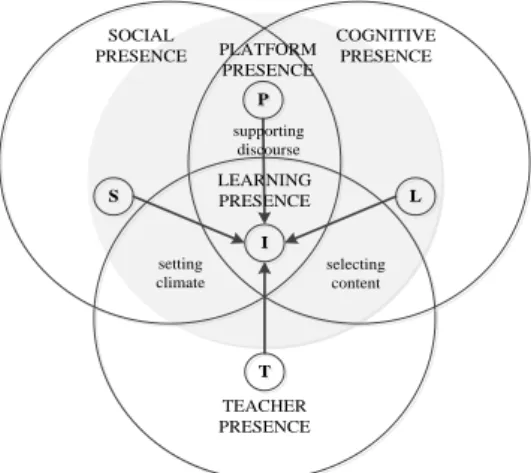
The dramaturgy of learning framework is proposed, as illustrated in Fig. 1. A critical incident of “I” in Figure represents one scenario of Shea et al. learning presence (2012) which is a combination of a student’s self-regulation, planning, monitoring, and personal strategizing applied throughout learning to cope with learning requirements and perceived state. It can be viewed as four overlapping circles including (i) Cognitive Presence, (ii) Teaching Presence, (iii) Social Presence, and (iv) Platform Presence. Each circle represents the influence of that particular kind of presence on learning presence. The cognitive presence, “C” in Figure 1, same defined as in COI indicating the degree to which individuals exhibit “sustained reflection and discourse” to learn (Garrison et al., 2000, 2001; Garrison & Kanuka, 2004). Teaching presence, “T” in Figure 1, is the degree in designing/presenting course content, with facilitating learner activities, and in conducting
post-activity assessment as perceived by learners. Social presence, “S” in Figure 1, signifies the degree to which individuals adopt modes of communication employed by the larger learning community, to project individual importance and individual roles during the learning process. The central, shaded circle portrays how the newly added platform presence impacts the teaching, social, and cognitive presences to produce learning presence. Where the platform presence means platform itself highlights or lower to the other three elements: cognitive, teaching, and social presences. The concept of the platform presence is aimed at describing the learner’s viewpoint towards the physical learning environment.
PLATFORM PRESENCE SOCIAL PRESENCE COGNITIVE PRESENCE TEACHER PRESENCE LEARNING PRESENCE setting climate selecting content P P L L S S T T I I supporting discourse
Figure 1 Framework of learning dramaturgy
The author considered learning presence remains in the core of the dramaturgy of learning framework because learning presence significantly and directly impacted to grade (Shed and Bidjerano, 2010). Therefore a researcher can take advantage of studying the scenarios of learning presence to evaluate the possible grade. Other three presences: cognitive, teaching, and social were proved significant related to learning presence (Shed and Bidjerano, 2010; Shea et al., 2012). Not direct to learning, but dramaturgy theory proposed that physical facility like theater stage would influence on performance of dram. The researcher uses learning presence to be a metaphor of learning grade and collocation of other four elements to be predictor of learning presence in a blended classroom.
learning (Shea et al., 2012). The relationships between student attitude, motivation, and learning performance, have been elucidated in past studies, although only in the traditional classroom. The importance of students’ attitude has been pointed out in the virtual classroom (Swan, 2004a). For example, students who believed that learning results from the exertions of the learner earned better grades than students who believed that learning results from the work of the teacher (Lin, 2002). Furthermore, students who participated in
instructor-supported forum discussions received better grades than the students who just read the discussions (Kashy, Albertelli II, Bauer, Kashy, & Thoennessen, 2003)
But a scenario of learning presence usually combined with some of other four learning elements. For example, learning presence from cognitive presence was surely influenced by design of learning activity and learning content. Challenge and pleasure from learning content or learning activities are the important motivators to student’s involvement (Fu, Su and Yu, 2009; Killi, 2005; Tiger, 2000). Learning presence usually exists when the learning content or activity is cognized to be interesting, practical, effective or
important (Baylor & Ritchie, 2002; Huang, Chang & Chen, 2004). As the students comes with a preconceived set of expectations regarding the teacher’s professional appearance, technique, and attitude (Guiry, 1992; Ottenbreit-Leftwich, Glazewski, Newby, & Ertmer, 2010, Halliday et al, 2008), good or bad teaching
presence in some scenarios will improve or make worse on cognitive and learning presence in same direction. For example, in situations where the teacher’s presentation is effective and attractive, or where the teacher utilizes appropriate learning activities and supplementary material which attracts the students, or the teacher provides timely and useful feedback to minimize interruptions due to problems (Baylor & Ritchie, 2002; Albirini, 2006). On the other hand, bad teaching presence may hinder content absorption are cause a serious barrier to learning in situations where students are bored with the teacher’s presentation, or the teacher does not give timely feedback to the student.
The influence of platform on learning presence may also come from the change of importance in other learning elements. For example, A physical environment with the characteristics of availability, comfort, and convenience may also enhance the interactions between students and teacher, as well as interactions of
students with their classmates (Bulu, 2012). The availability of communication technology, such as e-mail and on-line discussion rooms, provides more opportunities for interaction. The results of previous empirical
studies indicate that a platform that is easy to use and useful is critical to intention to use in the virtual classroom (Sun, Tsai, Finger, Chen & Yeh, 2008). Students need to see that the e-learning system provides quick responses, findable functions, and working links (Fu, Chou & Yu, 2007). Difficult or negative student-platform interactions can hinder learning (Hewitt, 2005).
Even teacher is primary response for teaching presence, but as the character of higher education, students also play the role as actor to facility or initiate learning activity in some situations (Halliday et al., 2008). The proportion of actor role between teacher and student varies lot in virtual classrooms than in face-to-face classrooms. In a traditional classroom, the teacher acts as the knowledge presenter, but in a virtual classroom the teacher takes on the role of facilitator or guide (Moreno & Mayer, 2000; Martens, Gulikers, & Bastiaens, 2004). When comparing face-to-face interactions with online meetings, the
effectiveness of non-verbal messages such as body language, vocal tone and pitch in expressing enthusiasm and emotion decreases. Due to limited network bandwidth, online video often cannot fully capture the teacher’s nonverbal messages. Even a teacher with good skills of expression may have difficulty utilizing such tools to attract students’ attention in the virtual classroom as in the traditional classroom. On the contrary,
students can be more opportunity to play the role of actor to initiate and facilitate their own learning activities in virtual classroom.
In the interactions of platform presence with classroom climate, the atmosphere in a traditional classroom is influenced more by verbal interactions and body language (e.g., listening with close attention versus dozing off) between classmates or between students and teacher (Marjanovice, 1999). In virtual
classrooms, these interactions mainly take place via text, which gives an advantage to certain types of students. For example, introverted students and those who have difficulty expressing themselves verbally strongly prefer communicating via the web to other mediums (Francescato et al., 2006). Compared to face-to-face communication, online discussion may also be more supportive of experimentation, exploration of multiple perspectives, obtaining a comprehensive understanding, and reflection, but less supportive of convergent thinking, instructor-directed inquiry, and scientific thinking (Swan, 2004b). Therefore, “disclosure” is the key to measuring the application of platform presence in the interaction between social presence and learning presence (Bulu, 2012).
4 Research methods
This study probes the tenability of using dramaturgy of learning framework for evaluating the impact of platform presence to a target course. Rather than exclusively applying a grade-based metric, this study used action research method and also takes the dramaturgical approach (scenario-based analyses named Critical Incident Technique) of evaluating service success recipient impressions. Grade assignment in different classrooms is often biased by a myriad of factors, including differences in course content, in the assessment metric, and in student backgrounds, and could also be potentially affected by differences in learning platforms. Thus, this study also systematically analyzes platform presence in various platforms via the dramaturgy of learning approach, based on satisfactory/dissatisfactory learner experience as one means of determining learning effectiveness.
4.1 Project Setting and Evaluation of Action research
The author selected action research method because action research has been described as
“post-positivist social scientific research method, ideally suited to the study of technology in its human
context” (Baskerville and Wood-Harper, 1996, p. 235). Although there are other methods can be used to study technology in its “nature” context , action research distinguish and dedicated to the development of
knowledge useful to both research and practice (Baskerville and Wood-Harper, 1996). The study used the processes of Evered’s cananonial action research method because it is considered as the most widely adoption one in social science (Lindgren, Henfridsson & Schultze, 2004).
The instructor followed the Susman and Evered’s (1978) cyclical action research design to conduct two cycles of action research. The purpose of first cycle was to understand what different performance might be produced by different platforms: face-to-faced vs. traditional classrooms. In first cycle, same instructor taught the targeted classes using same contents and homework by different learning environments for six weeks. Lastly, in second cycle of action research, the blended classroom setting provided completed pedagogic design of a whole semester.
It is important to specify the criteria by which an action research project should be evaluated. The study is valid because it matched the five evaluation criteria of an action research (Davison, Martinson and kock,
2004; Lindgren et al., 2004). (1) The principle of researcher-client agreement was matched because the researcher (also an instructor) was assigned to improve the course by a project of teaching improvement by e learning. (2) The principle of the cyclical process model highlights the importance of all five action research phases was progressed in a sequential and systematic manner. (3) The principle of theory highlights the importance of not only guiding and focusing the research activity, but also relating the finding to the extant literature. (4) The principle of change through action which stipulates the appropriate intervention should be designed and implemented in the action research. (5) The principle of learning through refection which highlights the importance of drawing insights from the research and identifying implication for other situations and research contexts.
4.2 Targeted course and subjects
The target course, “Introduction to Software”, is an information literacy course offering for non-MIS students, traditionally taught as several classes by different instructors. This course was selected based on its compatibility with e-learning enhancement. Instructors are often unwilling to teach this course, because the frequency of content software upgrades prevents familiarization with the material. Learning effectiveness, which would be indicated by at least a C+ grade average and an average student evaluation of 2.75 or more on the 5-point Likerted scale, was also perceived to be inadequate.
Subjects are the students who took the course. 320 students were recruited for interviews with 115 from the face-to-face classroom environment, 110 from the e-learning environment, and 95 from the blended classroom. The participant sample included slightly more females (60%) than males (40%) and was 100% Asian. Participants were all quite young (age 18 to 22) and were also undergraduate students at a Taiwanese university. All were non-MIS undergraduate students, majoring in Social Science fields such as business, law, economics, education, literature, etc.
4.3 Critical incident technique (CIT)
Originally developed by Flanagan (1954) as a form of content analysis, the set of CIT procedures defined for gathering specific observations and important behavioral facts in defined situations has grown in popularity with service-related research over the last three decades, in a large part due to its usefulness in solving practical problems and developing broad psychological principles regarding service encounters (Gremler, 2004). The study used CIT to collect the satisfaction and dissatisfaction learning experiences to validate the advantage and disadvantages of different learning contexts.
However, satisfaction and dissatisfaction operates on more than an exclusive “either-or” model. In Herzberg’s Two-Factor theory, satisfaction and dissatisfaction act independently of each other (2003). In Herzberg’s study, a lack of dissatisfaction did not lead to the long-lasting task motivation that is associated with satisfaction, and likewise, an absence of satisfaction did not invariably induce the effects of
dissatisfaction. Rather, the findings demonstrate that an accurate understanding of satisfaction-motivation relationships requires a proper examination of the motivators supporting satisfaction and dissatisfaction. Critical Incident Technique (CIT), provides a useful way of collecting data on incidents of (dis)satisfaction. The data are analyzed into useful categories to find the root source of (dis)satisfaction.
4.3.1 Procedures of CIT
while sacrificing the least detail and depth possible (Bitner, Booms & Tetreault, 1990). CIT accomplishes this goal through a two stage process -- collection and classification. The first step, collection of behavioral observations, involves accumulation of self-reports from research participants. In the second stage, these collected events, phenomena or occurrences are classified so that they become useful for addressing practical problems (Flanagan, 1954).
Classified respondent data are referred to as “incidents.” Incidents in the present study are comprised of learning experiences involving teaching presence (shown as T in Fig 1), social presence (shown as S in Fig1), and learning presence (shown as L in Fig 1), in combination with platform presence (marked as P in Fig 1). A
critical incident, marked as ‘I’ in Fig. 1, indicates a special incident produced from a combination of teacher
presence, social presence, platform presence, and/or learning presence that creates strong feelings of satisfaction or dissatisfaction in the student towards their assigned course.
Because that there are many classes in learning experiences and the researcher need to classify them to correspond to theory, the four-stage CIT procedures used in the study can be summarized as follows: 1) collect learning incident reports of dissatisfaction and satisfaction in the target classroom; 2) categorize incidents into themes, first at the subcategory level, and then the category level; 3) develop categories based on dramaturgy of learning framework; 4) examine the distribution of categories to determine how incidents of satisfaction versus dissatisfaction vary in different classrooms and with different pedagogical design.
4.3.2 Interview Questions of CIT
The study probed for critical incidents by asking respondents to recollect especially satisfying or dissatisfying experiences related to the version of the target class they participated in, including the time of incident occurrence and what had happened, what the instructor had said or done, and what the outcome was. Most participants reported one incident per interview, but in some cases, two or three incidents were recalled, producing a total of 631 valid incidents from a sample of 320 students, surpassing the 433 incident average obtained in previous CIT studies (Gremler, 2004). Critical incidents of satisfaction in the face-to-face, e-learning, and blended versions of the target course were 100/104/155, respectively, and incidents of dissatisfaction were 101/87/84, respectively, meeting the CIT analysis standard of 50 to 100 incidents for unambiguous activities (Flanagan, 1954).
4.3.3 Reliability of CIT
In CIT studies, the ability of an individual judge, or incident coder, to reliably classify similar incidents into the same categories over time (intrajudge agreement) and demonstration of common consent among judges (interjudge agreement) are necessary for research validity (Gremler, 2004). To code each collected incident, the researcher and two other highly trained coders applied an iterative analytical induction process to sort critical incidents “into groups and categories according to similarities in the reported experiences” (Bitner et al., 1990), based on the learning elements mentioned in the literature review. Holsti’s coefficient for coder agreement of satisfactory and dissatisfactory incident categorizations was calculated according to Smith and Houston’s (1985) methodology. Intrajudge agreement was measured after the first week, producing Holsti’s coefficient values of 0.89/ 0.96 for the F2F class, 0.88 / 0.93 for the e-learning environment, and 0.90 / 0.93 for the blended classroom. Holsti’s coefficient values for interjudge agreement were 0.91/0.89 for the F2F classroom, 0.85/0.80 for the e-learning environment, and 0.89/0.86 for the blended classroom. All coefficient values exceeded the acceptable Holsti’s standard of 0.8 needed to be considered statistically reliable (Smith &
Houston, 1985).
5 First Action Research Cycle
With the intent to identify principles of pedagogic design for blended learning environment, the researcher started the first action research cycle to investigate the advantage and disadvantages of using different
platforms for the targeted course. Each cycle contains the following five phases as suggested by Lindgren et al. (2004).
5.1 Phase One: Diagnosing
The researcher convened an expert meeting to brainstorm the problems of the targeted course. Experts indicated that the most serious challenge of the targeted course was from frequently change of the course content to coordinate the new version of the software appeared on the market rapidly. That situation frustrated the instructors because they perceived not easy to keep familiar with the software or to get financial support from university to upgrade the software. Therefore the experts suggested that the way to improve the
willingness and profession of instructors is to make slow of the change on course content. They suggested that prior learning content of the targeted course focused too much on skill training of software operation. The training program even not quite confirmed to the purpose of higher education to train students with potential to solve problem. Therefore they considered that content of task-oriented training is more appropriate. Even the rapid upgrading on software caused some operating steps of functions or interface become differently, the major functions of a software are not changed. It is just upgraded to own more functions and looks like having different interface. If learning content focuses on how a task can be accomplished by what functions instead of on the operating procedures, the skill of using software will be translated easier from different versions of software. Besides experts also considered that students is better to have self-regulation ability to face with the frequent upgrade of software in the future,
5.2 Phase Two: Action planning
Addressing the problem of learning content, the research developed two principles based on Dramaturgy of learning framework. The first principle is that is better to consider the design of learning content with inducing more learning presence or cognitive presence. For example, to the targeted course, an information literacy course, without good application examples, the learning purposes are hard to be realized and the functions are hard to be remembered by students. The researcher decided to use task-oriented application examples as content to improve the skill of information literacy to students, starting from task introduction, followed by related functions introduction, finally demo of function operations. The second principle of design on learning content is better with finding the proper strategies in utilizing different learning environment: face-to-faced vs. e learning classroom in improving learning presence. For marching the advantages and disadvantages of different platforms, the researcher hypothesized that the presentation of learning style shall be carefully planned.
5.3 Phase Three: Action taking
The two design principles were implemented in four classes for six weeks, two were face-to-faced classroom and the other two were e learning classroom. The face-to-face classroom consisted of several instructor led demo cases designed to showcase different applications of common computer software and student practice operations following each demo. The e-learning variant for this course featured pre-recorded, polished demo content that students could browse online at their own pace, and interactions among classmates and instructor only in discussion board. Considering more difficult to concentration to video lecture, two kinds presentation, lecture by video lecture and illustration by web page of texts and graphs, were prepared for same demo content in e learning system to let student have more choices. The following assignment was to imitate the demos in both classrooms.
5.4 Phase Four: Evaluation
At each classroom, the researcher evaluated the learning performance by analyses of grade, student evaluation to the course and critical incidents of learning experience. Students got litter better performance in grade in face-to-faced classes (B) than in e learning classroom (B- to B). There only existed slight
improvement in students’ evaluation of 2.9 than before. No significant difference of student evaluation existed between two kinds of classrooms. Significant difference existed in critical satisfactory and dissatisfactory incidents between two kinds of classrooms and it was illustrated as follows.
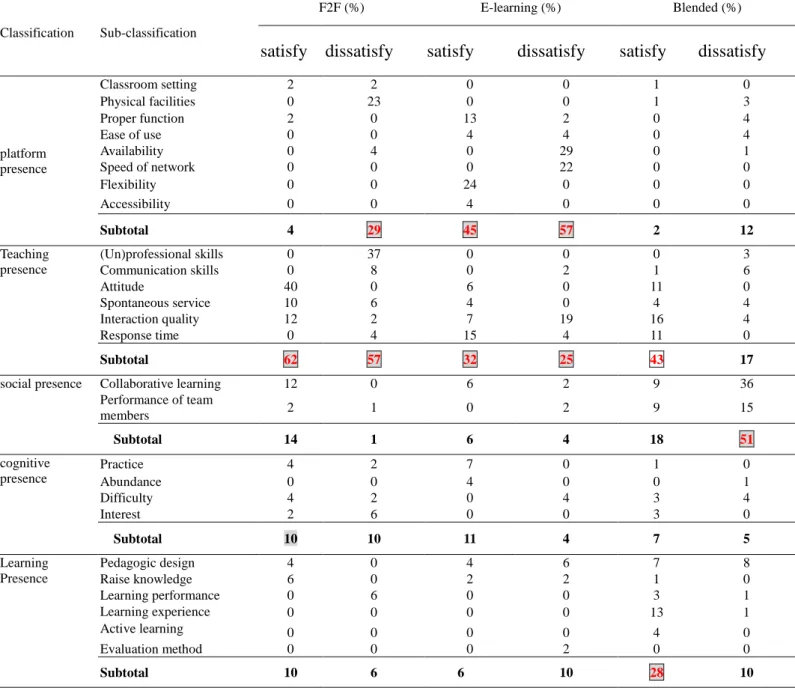
5.4.1 Critical (Dis)satisfactory Incidents in the F2F Version of the Target Course {Table 1 here}
In the face-to-face (F2F) classroom, platform presence spotlighted the role of teacher (actor) in the learning experience. The data in Table 1 show that the major source of incidents of satisfaction in the F2F class derived from teaching presence (62%), while the majority of incidents of dissatisfaction also related to teacher (57%). In other words, lots degree of teaching presence depended on teacher’s profession and had a significant influence in the F2F classroom. Three elements of teaching presence were cited in F2F critical satisfaction incidents - earnest teacher attitude (40%), good student interaction (12%), and spontaneity (10%). Critical dissatisfaction incidents consisted of cases where teacher performance was perceived as being
unprofessional (37%), showed an inability to attract and maintain student attention (8%), or poor handling of unexpected situations (6%), all of which marred the participant’s learning experience.
Examples of incidence of teaching presence include:
‘The instructor is very concerned with students’ learning and developed good examples to help the students understand’ (earnest teacher attitude)
‘When there were not enough computers available in the computer lab for me to use, I felt uncomfortable. But I felt better after learning that the instructor allowed two students to do the same assignment together if they need to share the computer. She was considerate.’ (good student interaction)
‘I felt really great when I received praise from the instructor for ….’ (good student interaction)
quickly and kindly came over to help me.’ (spontaneity)
‘Once when the instructor demoed [a particular program function], she seemed unfamiliar with the operation because she tried and failed several times. I was confused over how to do it and hoped she wished she had been better prepared for class.’(unprofessional)
‘During the midterm exam, I asked for clarification on one of the test questions. I ended up losing points because I didn’t understand the response from the teaching assistant. I thought he should have explained it more clearly.’ (poor handling of unexpected situations)
5.4.2 Critical (Dis)satisfactory Incidents in the E-learning Variant of the Target Course
Reports of critical incidents in our e-learning variant of the target course emphasized critical
dis/satisfaction with the effect of the e-learning platform on learning presence. The greatest contribution to participant reports of critical satisfactory incidents came from platform presence (45%), and most
dissatisfactory incidents (57%) were caused by negative perceptions regarding the platform presence. This was centered on the increased schedule flexibility and physical mobility provided by the online system
(24%), , proper functions (13%) and ease of use (4%). Complaints regarding the e-learning system focused on system performance, such as unavailability of help (29%), and internet transmission speed (22%). Incident data collected for this particular e -learning classroom showed that platform presence played an important role (either positive or negative) in satisfaction and dissatisfaction.
Examples of incidents of platform presence included:
‘I felt very surprised, when I put my question on the discussion board and the teaching assistant called me, and then used the remote login of my computer to figure out my problem. He spent a lot of time resolving my problem.’( the functions of the platform and teacher’s earnest to support effective learning)
‘I was able to ignore the e-learning course and to concentrate on preparing for tests of other courses during the midterm week and then caught up with the course after that week.’ (flexibility)
‘Sometimes the demo was too fast to follow the sample application. In those situations, I paused the video, practiced the content, and continued after I had practiced.’(flexibility)
‘I got up at 11 o’clock, had my breakfast, and was able to browse the e learning content from my dorm. I felt very relaxed because it was Wednesday and I didn’t need go to a classroom like my other roommates.’ (flexibility)
‘Once when I was browsing content in the e learning system, I felt frustrated because when I copied what the instructor was doing, I couldn’t get the same result. I tried several times and then gave
up.’(unavailability of help)
‘I put a question on the discussion board the night before the mid-term. I got the instructor’s response several days later after the mid-term had already passed.’ (unavailability of help)
(unavailability of help)
5.5 Phase Five: Specifying learning
The results of no significant improvement in grade and student evaluation indicated that there may not very benefit to learning performance if only to modify learning content. Under the dramaturgy of learning framework, learning presence is intergrated effect from stimulus of learning content (cognitive presence), teaching presence, social presence, and platform presence. Further studies are needed.
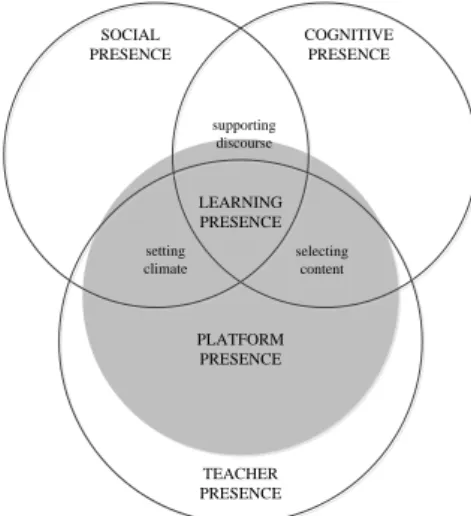
The difference of critical satisfaction or dissatisfaction incidents from two platforms represented learners’ impression on learning presence. Teaching presence has a significant influence on both satisfactory and dissatisfying experience in the F2F variant of the classroom. The teacher is not only responsible for course design and content selection, but a presentation component similar to that of an actor in a drama is also included. In other words, the class instructor has to apply his/her professional and expressional skill to teach content according to professional standards, lest audience members and students feel unsatisfied. The significant overlap between platform and teaching presence that can be seen in Fig. 2 illustrates the critical (dis)satisfaction dynamic within the F2F classroom of the target course.
PLATFORM PRESENCE SOCIAL PRESENCE COGNITIVE PRESENCE TEACHER PRESENCE LEARNING PRESENCE setting climate selecting content supporting discourse
Figure 2 Framework of learning dramaturgy for the F2F classroom
There are two problems in F2F classroom that were solved by the use of the e-learning classroom. First, it is difficult to familiarize oneself with the constantly changing versions of software, meaning the instructor often has to cope with problems marring the smoothness with demos or debugging in face-to-face classrooms. Second, students with different backgrounds in computer literacy might prefer different demo details.
Separating the front stage from the back stage made a difference in the perception of teaching presence, such as teacher's expression (e.g., humor), real-time interactive capabilities, and enthusiasm decreased lot. It was difficult to find unprofessional skills but it was also difficult to debug and to solve student’s learning problem with text. Consistent with previous research on e-learning, students would be happy if their self-learning progressed successfully because they had more flexibility in choosing their own strategy (Sun et al, 2008; Yang and Liu, 2007). However, students might perceive negative platform presence if they find it difficult to solve learning problems due to the lack of on-time support from the teacher and classmates. This could also happen when students were faced with insufficient function or transmission speed in the e-learning systems. With lots of dissatisfy learning experience in e learning system could explain although no more criticism to teacher professions after utilizing the e learning system, the learning performance (grade) and student
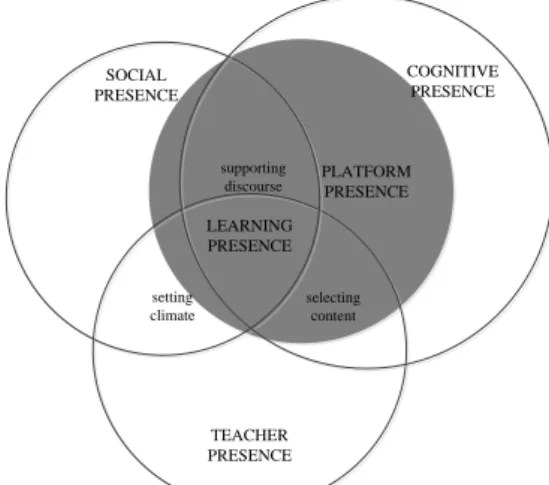
evaluation were still not improved. Incident data collected from the dramaturgy of learning model for this particular e -learning classroom showed that platform presence played an important role (either positive or negative) in satisfaction and dissatisfaction as depicted by the large overlap between platform and learning presence shown in Figure. 3.
PLATFORM PRESENCE SOCIAL PRESENCE COGNITIVE PRESENCE TEACHER PRESENCE LEARNING PRESENCE setting climate selecting content supporting discourse
Figure 3 Framework of learning dramaturgy for the e-learning classroom
6 Second Action Research Cycle
In the second action research, the researcher sought to test the synergy effect of F2F and e learning in a blended classroom.
6.1 Phase One: Diagnosing
Results of the first action research cycle indicated two potentials in blended class. First, it show instructor can synergy both platforms: face-to-faced and e learning classroom to own their own
complementary advantages with each other. Instructor, like an actor in theater stage, was easier to express his/her charm on enthusiasm, expression ability and profession at face-to-faced classroom. Therefore teaching presence is very helpful to learning presence. In e learning classroom, students had more autonomy to make their learning strategies. In other hand, each classroom also had its own disadvantages. Instructor’s
unprofessional performance was not easy to be hided in F2F classroom lest destroyed students’ trust. In e learning classroom, students often not have patience to browse the course content as being designed by teacher. They usually look at homework first and then try to complete homework as quickly as possible. Without basic lecture and guidance, students often had unpredicted problem when they did homework. And students would be frustrated if they couldn’t get help on-time. Secondly, as homework became very important to influence on student’s learning strategy, proper design of homework may create lot learning performance. It is better to refine homework from mimic the demonstration to incentive student’s more reflection.
6.2 Phase Two: Action planning
Guided by the Dramaturgy of Learning Framework, the researcher set out to develop pedagogic design principles for targeted course in blended environment. The researcher relied on the specifying learning from the first cycle that it is important to identify the synergy of learning presences and teaching presence with platform characters. First principle, to classify the lecture either in F2F or e learning classroom was depended on the profession and expression ability of the teacher and the needs of the students. The researcher found there existed two kinds of opportunities to perceived teacher’s facilitation by F2F classroom, either teacher to
share his/her knowledge he/she was quite good at or student perceived needs to be assisted. To the targeted course, instructors usually were more familiar with concept of knowledge than skill of operations. Students often were lack of self-belief in self-regulated learning and needed to be assisted in the beginning to use unfamiliar software. Second principle was it is better to let student had more autonomy in selection their own strategy in advanced knowledge acquisition by using e learning classroom. Third principle was learning presence depended on design of learning activity and assignment (Shed et al., 2012). Therefore face-to-face
demos of content necessary for novice users to understand basic skills, e learning class for reviewing skills and self-regulated learning, followed by a team project for enhancing student engagement and collaboration.
The researcher considered that utilizing team project to creating a product could improve students’ knowledge from low level of understanding to middle level of application (Bloom, 1984), raised the retention rate of knowledge from 5% by lecture to 75% by operation based on learning pyramid ()¸ and increased the needs of interaction with classmates.
6.3 Phase Three: Action taking
Based on action planning, the researcher reorganized the learning content for the targeted course and classified them into two classes: concept of theories and skill of application. The researcher decided that the content was taught either by F2F classroom or by e learning classroom based on the comprehensive
considerations of possible profession of teacher to the content, possible needs for assistant from students, and the possibility of self-regulated learning. Lectures and learning activities in the beginning of the semester were more conducted in the F2F classroom to illustrate the basic concepts and to eliminate the strangeness to the course content, classmates and teacher. Learning activities and contents put in e learning system was to let student had autonomy on self-regulated learning.
The presentation method of learning content included lecture, demo case, and flash game. Lecture and case demo were the teaching method in F2F classroom. The researcher developed some interactive learning content using Flash software to induce student’s interest to browse because browsing rate of the teacher’s lectures in e learning platform was very low. All scripts of demo case were task-oriented. One basic demo case of each software was developed to illustrate the basic functions and would be taught in F2F classroom and one or two extra cases would be put on the e learning platform for self-regulated learning.
To compensate for low self-regulation and student motivation in the e-earning environment and to address the e-learning strategy of first browsing homework, then selectively read on-line content related to homework, the homework was changed to be a team project to develop an application according to learning content. Students could select partners for a team project. Instructors designed several activities to help the students become familiar with each other. Some of these activities were listed as satisfactory incidents, like Bingo game, using a discussion board and a self-introduction quiz. This team project was designed to create more opportunities for collaborative learning and making friends.
6. 4 Phase Four: Evaluation
The average grade was significant improved to B+ or A-. Same significant improvement was happened in student evaluation to the course, 4.35 in 5 Likerted scale. The analyses of critical (dis)satisfactory
incidents in the blended version of the target course was as follows.
classroom, the proportion of critical incidents of satisfaction with learning presence (35%) was higher with the blended approach than with the F2F or e-learning implementations of the target course. Many incidents related to good pedagogic design (7%), good learning experience (13%), and active learning (4%).
Furthermore, the percentage of satisfactory experiences with teaching presence was greater in the blended classroom (43%) than in the e-learning variants.
In the blended classroom, many satisfactory and dissatisfactory incidents concerned matters of social presence: there were 36% such incidents reported good collaborative learning and 15% praised the
performance of their team members. But 9% reported of team members not doing their jobs, and 9% complained about the difficulty of looking for e-learning team members.
Examples of incidents of the overlap of platform and social presence included:
‘It was convenient that members could share data and discuss issues through the Facebook learning community. We finally got a good grade in our team project.’(collaborative learning)
‘ I was team leader, but I found it hard to schedule team meetings. There was even a time when only my account could show up on the meeting invitation.’ (collaborative learning)
‘One member of my team was not very responsible. He often disappeared during meetings and we could not trust him to complete the jobs he promised to do. Unfortunately, he did not do his part well when he turned in his results. But by that time it was almost due and we, the other members, had to cover for his mistakes in a very rushed time.’(performance of team member)
6.5 Phase Five: Specifying learning
In sum, the researcher specified the learning of utilizing platform presence in a blended classroom from the action research cycle two included:
(1) The Dramaturgy of learning framework provided a conceptual framework to focus on learning
performance and learning experience and on collocation of F2F classroom and e learning classroom to get synergy from both two platforms. When the teacher considered how to arrange the course content with platform, he/she was equal to get a stimulus to centralize the learning activities on learning performance. (2) The results on improvement of grade and student evaluation indicated that the proper usage of platforms
was an effective way to improve learning performance. Teacher can hide his/her unprofessional skills and had more sources for teach. Student can get autonomy on selection of learning strategy and method. (3) Combining of learning platforms also let student more flexible in learning schedule arrangement. Several
satisfactory incidents reported they used the normal class time or Facebook community to do the team project.
7 Conclusions
7.1 Summaries of findings
Utilizing two action research cycles to verify the learning performance and the Dramaturgy of learning framework to diagnose the problem and opportunity, the researcher tried to found principles for pedagogic
design of blended classroom. In spite of similar content and instruction by the same instructor, the classification of critical incidents in the e-learning variant of the target course was different from the F2F version. In the F2F classroom, teacher liked aprotagonist of a dram whose performance highly impact on learning presence.All elements, from the teacher’s positive attitude (such as enthusiasm), expressional skills, to professionalism, were critical to satisfaction with the learning presence and needed for an appropriate and considerate response to the students. Unsatisfactory learning could result from poor teaching presence. In the F2F class, some unsatisfactory learning performance was attributed to the teacher, such as the difficulty or understandability of the content. This was usually considered the result of issues with the teacher’s lack of professional ability, problems with the learning activity or problem with assessment designed by the teacher.
Advantages and disadvantages of learning presence created by e learning platform may opposite from those by F2F classroom. Separation of the front stage from back stage can avoid the unprofessional behavior of the teacher being seen by the students in e learning class, it also may mean the teacher loses the opportunity to display their capability of nonverbal communication. Besides, the opportunities for active learning
increased in the e-learning class environment. Students had more autonomy to arrange their study schedule or to browse the online content and do the homework. It became more difficult to let student follow the content arranged by teacher. Most students preferred to complete assignment as spent less time as possible. Therefore, teacher needed to recognize that the importance of teaching presence decreased and the importance of
cognitive presence increase in e learning classroom. Platform presence had a critical impact on the satisfaction or dissatisfaction of the learning presence. Creating benefits such as availability or flexibility by utilizing the e-learning system was the main source of a satisfying learning experience. On the other hand, problems with using the e-learning system such as can’t get help on-time or low transmission dissatisfied students.
The higher score of grade and student evaluation in the blended class indicates opportunity to combine the benefits of the F2F and e-learning classes. For example, in the target course, the lack of teacher’s
professional teaching skill was reduced by using online material. However, the difficulty of self-learning was partially reduced in the F2F classroom. Free choice between two available learning environments in a blended class might also increase student willingness to learn and student autonomy.
The researcher also investigated the influence from change of assignment to social presence and
learning presence based on the dramaturgy of learning framework. Social presence would have a significant impact on learning presence (either positive or negative) in the team project homework. The platform has an important impact on learning presence if students could negotiate and find better and more convenient channels to contact each other. In this situation, the better use of platform helped to avoid negative social presence. Critical incidents reported for the blended version of the target course indicated that the students tended to interact socially with their team members, demonstrating a good fit to higher education goals on collaboration. In other words, the increase in team work and lack of management experience in regulating student participation, combined to make social presence the most important dissatisfactory presence. The results showed that most students are still very reliant on face-to-face and synchronous discussion in team projects. The motivation for course involvement by some students needs to be improved.
7.2 Implications
Analyzing learning performance is often challenging because it is the product of complicated and
parsimonious framework of dramaturgy of learning that can be used for analysis of the above interactions and their impact to learning presence. The researcher used dramaturgy of learning framework to find the possible synergy of platform presence in blended classroom, develop several principles in pedagogic design, and verify the usage of both principles and framework.
The results described in this paper demonstrate the potential usage of this framework for understanding learning satisfaction and dissatisfaction not only in different platforms but also in pedagogic design. With the popularity of e-learning systems and web communication media such as Facebook, teachers have the
opportunity to leverage these emerging platforms to improve learning presence in their classrooms. Utilizing the dramaturgy of learning framework may decrease the complexity of developing the appropriate
pedagogical design for the teachers. Further studies can investigated more pedagogical design in F2F-e learning blended classrooms to guide for more good learning experiences and better performance.
References
Albirini., A. (2006). Teachers’ attitudes toward information and communication technologies: the case of Syrian EFL teachers. Computers & Education, 47, 373-398.
Baskerville, R. L. and Wood-Harper, A. T. (1996). “A Critical Perspective on Action Research as a Method for Information System Research,” 11, 235-246
Bates, A. W. (2005). Technology, e-learning and distance education, RoutledgeFalmer: New York, NY Baylor., A. L., & Ritchie., D. (2002). What factors facilitate teacher skill, teacher morale, and perceived
student learning in technology-using classrooms? Computers & education, 39, 395-414
Bitner, M. J., Booms, B. H., & Tetreault, M. S. (1990). The service encounter: diagnosing favorable and unfavorable incidents. Journal of Marketing, 54(1), 71-84
Bitner, M. J. (1990). Evaluating service encounter: the effects of physical surroundings and employee responses. Journal of Marketing, 54, 69-82.
Bloom, B. S. (1984).Bloom Taxonomy of Educational Objectives, Allyn and Bacon, Boston, MA. Pearson Education.
Bulu, S. T. (2012). Place presence, social presence, co-presence, and satisfaction in virtual worlds. Computers
& education, 58(1), 154-161
Cho, V., Cheng, T. E., Lai, W.J. (2009). The role of perceived user-interface design in continued usage intention of self-paced e-learning tools, Computers & Education, 53 (2),216-227.
Davison, R. M., Martinson, M G., and kock, N. (2004). “Principle of Canonical Action Research,” Information Systems Journal, 14, 65-86.
Flanagan, J. C. (1954). The critical incident technique. Psychological Bulletin, 51( 4), 327-358.
Francescato, D., Porcelli, R., Mebane, M, Cuddetta, M., Klobas, J., & Renzi P. (2006). Evaluation of efficacy of collaborative learning in face-to-face and computer-supported university contexts. Computers in Human
Behavior, 22, 163-176.
Freitas, S. D. & Olive, M. (2006). How can exploratory learning with games and simulations within the curriculum be most effectively evaluated? Computer & Education, 46, 249-264.
Fu, F., Su, R., & S Yu, Y. (2009) “EGameFlow: A scale to measure learners' enjoyment of e-learning games,” Computers & Education, 52(1), 101-112
Fu, F., Chou, H., & Yu, S. (2007). Activate interaction relationships between student’s acceptance behavior and E-learning. Lecture Notes in Computer Science (LNCS), 4505, 600-677.
Garrison, D. R. & Arbaugh, J. B. (2007). Researching the community of inquiry framework: review, issues, and future direction, The Internet and Higher Education, 10, 157-172
Garrison, D. R. & Kanuka, H. (2004). Blended learning: Uncovering its transformative potential in higher education, Internet and Higher Education, 7, 95–105
Garrison, D. R. & Anderson T. (2003). E-learning in the 21st century: a framework for research and practice, RoutledgeFalmer: New York, NY
Garrison, D. R., Anderson T. & Archer W. (2001). Critical thinking, cognitive presence, and computer conferencing in distance education, American Journal of Distance Education, 15(1), 7 – 23
Garrison, D. R., Anderson T. & Archer W. (2000). Critical Inquiry in a Text-Based Environment: Computer Conferencing in Higher Education, 2 (2-3), 87-105
Goffman, E. (1959). The presentation of self in everyday life. Harmondsworth: Penguin
Gremler, D. D. (2004). The critical incident technique in service research. Journal of Service Research, August, 7(1), 65-89
Grove, S. J. & Fisk, R. P. (1983). The dramaturgy of services exchange: an analytical framework for services marketing’, in L. L. Berry, and G. L. Shostack(eds.), Emerging Perspectives on Services Marketing, American Marketing Association, Chicago, IL.
___, ___ , & Bitner M. J. (1992). Dramatizing the service experience: a Managerial approach. Advances in
Services Marketing and Management, 1, 91-121.
Guiry, M. (1992). Consumer and employee roles in service encounters. Advances in Consumer Research, 19, 666-672.
Halliday, S. V., Davis, B. J., Ward, P., & Lim, M. (2008). A dramaturgical analysis of the service encounter in higher education, Journal of Marketing Management, 24.1,2008
Herzberg, F. (2003). One more time: how do you motivate employees? Harvard Business Review, 81(1), 87-96.
Hewitt, J. (2005). Toward an Understanding of How Threads Die in Asynchronous Computer Conferences.
Journal of the Learning Sciences, 14(4), 567 - 589
Hwang., W., Chang., C., & Chen., G. (2004). The relationship of learning traits, motivation and performance-learning response dynamic. Computers & Education, 42(3), 267-287.
Kashy, D. A., Albertelli II, G., Bauer, W., Kashy, E. & Thoennessen, M. (2003). Influencing of non-moderated and moderated discussion sites on student success. JALN, 7(1), 31-36.
Kim, K., Bonk, C. J., & Teng, Y. (2009). The present state and future trends of blended learning in workplace learning setting across five countries. Asia Pacific Educ. Rev., 10, 299-308.
Kim, J., Kwon, Y., & Cho, D. (2011). Investigating factors that influence social presence and learning outcomes in distance higher education. Computers & Education, 57(2), 1512-1520
factors. Adult Education, 24( 2), 130-142.
Lin, C-H. (2002). Effects of computer graphics types and epistemological beliefs on students’ learning of mathematical concepts. Journal of Educational Computing Research, 27( 3), 265-274.
Lindgren, R., Henfridsson, O. & Schultze, U. (2004). Design Principles for Competence Management Systems - A Synthesis of an Action Research Study. MIS Quarterly, 28(3), 435-472.
Marjanovice, O. (1999). Learning and teaching in a synchronous collaborative learning environment. Journal
of Computer Assistance Learning, 15(2), 129-148.
Martens, R.L., Gulikers, J., & Bastiaens, T. (2004). The impact of intrinsic motivation on E-learning in authentic computer tasks, Journal of Computer Assisted Learning, 20(5), 368-376.
Moisio, R. & Arnould, E. J. (2005). Extending the dramaturgical framework in marketing: drama structure, drama interaction and drama content in shopping experience. Journal of Consumer Behaviour, 4(4), 246-256.
Moreno, R., & Mayer, R.E. (2000). Engaging students in active learning: the case for personalized multimedia messages, Journal of Educational Psychology, 92, 724–733.
Myers, M. D. & Newman, M. (2007). The qualitative interview in IS research: Examining the craft.
Information and Organization, 17(1),2-26
Osguthorpe, R. T. & Graham, C. R. (2003). Blended learning environments: definitions and directions.
Quarterly Review of Distance Education, 4 (3), 227-233
Ottenbreit-Leftwich, A., Glazewski, K. D., Newby, T. J., & Ertmer, P. A. (2010). Teacher value beliefs associated with using technology: Addressing professional and student needs. Computers & Education, 55(3), 1321-1335.
Shea, P., Hayes, S., Smith, S. U., Vickers, J., Biderano, T., Pickett, A., Gozza-Cohen, M., Wiide, J., & Jian, S. (2012). Learning presence: additional research on a new conceptual element within the community of inquiry (CoI) framework. Internet and Higher Education, 15(2), 89-95.
Shea, P. & Bidjerano, T. (2010). Learning presence: towards a theory of self-efficacy, self-regulation, and the development of a community of inquiry in online and blended learning environments. Computers &
Education, 55(4), 1721-1731
Smith, R. A. & Houston M. J. (1985). A psychometric assessment of measures of scripts in consumer memory.
Journal of Consumer Research, 12(2), 214-224.
Suthers, D. D., Hundhausen, C. D., & Girardeau, L. E. (2003). Comparing the roles of representations in face-to-face and online computer supported collaborative learning, Computers & Education 41(4), 335-351.
Sun, P., Tsai, R. J., Finger, C., Chen, Y., Yeh, D. (2008). What drives a successful e-Learning? An empirical investigation of the critical factors influencing learner satisfaction, Computers & Education, 50(4), 1183-1202
Susman, G., and Evered, R. (1978). “An Assessment of the Scientific Merits of Action Research,” Administrative Science Quarterly, 23, 582-603.
Swan, K. (2004 a). Relationships between Interactions and Learning in Online Environments. http://www.sloan-c.org/publications/books/interactions.pdf