ELSEVIER Materials Chemistry and Physics 48 (1997) 156-159
MATERIALS
CHEMJ;;KW&ND
The coarsening behavior of duplex A12Q3 /NiA120, composites
W.H. Tuan, M.C. Lin, W.H. Tzing
Instiirrte of Materials Science and Engineering, National Taiwan University, Taipei 10764, Taiwan, ROC
Received 6 October 1995; accepted 4 January 1996
Abstract
In the present study, the grain growth behavior of A1,03/NiA1204 composite is compared with that of A1203 and of NiA1204. Duplex A1203/NiA1203 composite shows strong resistance to coarsening. The activation energy for the grain growth of monolithic A&O, is the same as that of A&O, in composite. However, the activation energy for the grain growth of NiA1204 is changed as NiA120J is surrounded by A1203. The shape of A1203 grains in composite is also different from that of A1203 in monolithic alumina. The coarsening of one phase in the composite is thus constrained by the presence of another phase.
Keywords: Duplex composite; Coarsening; Activation energy
1. Introduction
Ceramics exhibit superior hardness, chemical stability and high temperature strength. However, they suffer from poor toughness at room temperature. The application of ceramics under ambient conditions is therefore limited. Nevertheless, the potential of applying ceramics at high temperature is very
high because of their high melting points and superb oxida- tion resistance. As ceramics are used at elevated temperature, grain growth may take place at the same time. It can seriously degrade the performance of ceramics. Therefore, the micros- tructural stability at high temperature for ceramics is essential for high temperature applications.
The presence of a small amount of second phase slows down the coarsening of matrix grains [ 11. Recent studies have suggested that the coarsening of .50%A1,03/50%Zr02 composite is dramatically slower than that of monolithic ceramics and of composites containing less second phase [ 2,3]. The potential of duplex composites for elevated tem- perature applications is therefore worth noting. The mutual solubility between Al,O, and ZrO, is limited. The coarsening resistance of the duplex A1203/Zr02 composite has been attributed to the physical constraint (due to the space-filling requirement) [ 31, the change of coordination number and of dihedral angle [ 21. The mutual solubility of A1203/NiA1204 system is higher than that of Al,O,/ZrO, system [ 41. For example, the solubility of Al,O, in NiAl,O, increases by lOmol.% from 1000 to 1700°C. In the present study, the grain growth behavior of duplex A1203/NiA1204 composite during sintering is investigated. Furthermore, the process
0254-0584/97/$17.00 0 1997 Elsevier Science S.A. All rights reserved PIISO254-0584(96)01865-2
conditions to prepare dense A1203/NiA1,04 composite are proposed.
2. Experimental
Duplex A1203/NiA1204 composites and monolithic NiAI,O, specimens were prepared by reaction sintering Al,O, and NiO powder mixtures [ 51. Alpha alumina (TM- DR, Taimei Chem. Co. Ltd., Tokyo, Japan, particle size = 0.2 km) and 0,25 and 50 mol.% nickel oxide (John- son Matthey Co., USA, particle size= 16 km) were ball milled in alcohol for 4 h with zirconia balls. The slurry was dried with a rotary evaporator. The dried lumps were crushed and passed through a plastic sieve. Powder compacts were first formed by uniaxial pressing at 18 MPa, then by cold isostatic pressing (CIP) at 250 MPa. Sintering was per- formed in a box furnace at 1500-1700°C in air. Sintering was also performed in a dilatometer (differential dilatometer, Theta Co., USA) that allowed continuous monitoring of the shrinkage kinetics. The heating rate was kept constant as 5°C min-‘.
Phases were identified on fired powder compacts by X-ray diffractometry (XRD) . The final density was determined by the water displacement method. Before the specimens were submerged in water, a wax was applied to the surface to prevent water penetration. The theoretical densities of com- posites were calculated from the theoretical density for alu- mina of 3980 kg rnm3, for nickel oxide of 6800 kg md3, and for nickel aluminate spine1 of 4000 kg rns3. The polished
W.H. Tuan et al. /Materials Chemistry and Physics 48 (1997) 156-159 157
surfaces were prepared by cutting the samples along the axial direction of the discs and polishing with diamond paste to 6 p,rn and silica powder to 0.05 pm. The samples were ther- mally etched at 1550°C for 30 min. The grain size was deter- mined by the linear intercept technique [ 61.
3. Results and discussion
The expansion curves for the powder mixtures of A1,03 and NiO are shown in Fig. 1. Owing to the density difference between A1,03, NiO and NiA1,04, the reaction
A1203 + NiO = NiA1,04 (1)
induces a volume expansion, The expansion curves in Fig. 1 indicate that the reaction starts from 1000°C as the powder mixtures are heated with a heating rate of 5°C min- I. As the holding time at 1OdO’C is prolonged, the amount of NiA1204 can be increased. Fig. 2 shows the XRD pattern for the A1,03/25%Ni0 compact after heating at 1000°C for 50 h. No residual NiO is found within the detection limit of the instrument (about 1%). It suggests that NiO reacted fully with A1203 to form NiA1204. Since there is 75 mol% Al,O,
0 200 400 600 600 1000 1200 1400 1600
temperature I “C
Fig. 1. The expansion curves for the A1203/Ni0 powder mixtures as a function of temperature. The heating rate is 5°C min- ‘.
20 25 30 35 40 45 50 55 60
2 0 /degree
Fig. 2. The XRD pattern for the A1203/25%Ni0 compact after heat treated at 1000°C for 50 h.
in the starting powder, residual Al,O, is indicated in Fig. 2. Therefore, a duplex A1,03/NiA1204 composite resulted-after the heat treatment. According to the phase diagram [ 41, 25 mol.% NiO powder mixture results in 55 mol.% NiA1204, whereas 50 mol.% NiO powder mixture results in only NiA1204 after the heat treatment. To avoid the complexity induced by the expansion of NiA1204 formation, all speci- mens were first heat treated at 1000°C for 50 h.
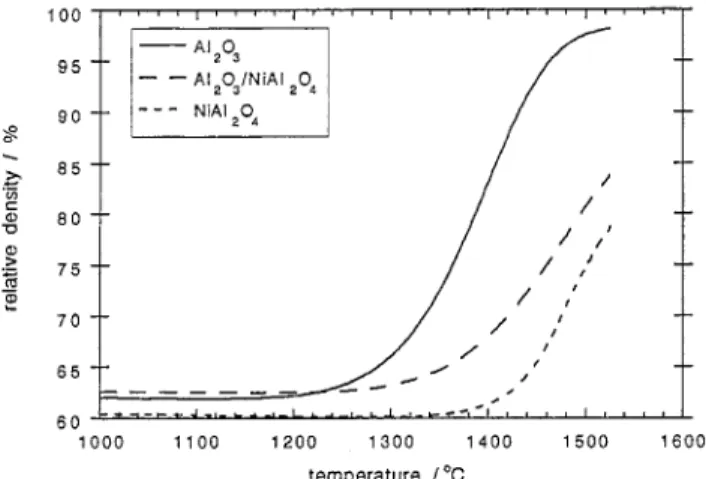
The density for the heat treated powder compacts is shown as a function of temperature in Fig. 3. The sintering is carried out in the dilatometer. Owing to a volume expansion accom- panied by the formation of NiA1204, the particles are pushed apart as the reaction is taken place [7]. A larger pore size thus results. The density of the specimens is decreased with the increase of NiA1,04 content. As the heat-treated compacts are sintered in a box furnace, the relative density is shown as a function of sintering temperature in Fig. 4. The specimens are sintered at the indicated temperatures for 5 h. The fired density is also decreased with the increase of NiA1204 content.
The grain size of the specimens in Fig. 4 is shown as a function of temperature in Fig. 5. The grain size of A1,03/
60
1000 1100 1200 1300 1400
temperature I ‘C
1500 1600
Fig. 3. The densification curves for the A1,03/NiAl,0, powder compacts. The heating rate is 5°C min-‘.
s _ 96
*-
86”“~4~‘~““~~“~“‘~“~’
1450 1500 1550 1600 1650 1700 temperature I%Fig. 4. The relative density of A120j, A1203/NiA1204, NiA1204 specimens as a function of temperature. The specimens are sintered at the indicated temperatures for 5 h.
W.H. Tuan et al. /Materials Chemistry and Physics 48 (1997) 156-159
4 ’ ” * * “+ x I ““““‘1”“”
1450 1500 1550 1600 1650 1700
temperature I%
Fig. 5. The grain size of AlZ03, A1,O,/NiAIPO,, NiAIZ04 specimens as a function of temperature. The specimens are sintered at the indicated tem- peratures for 5 h.
Table 1
The density and grain size of AlZ03, A1,03/NiA1204 and NiA120j specimens after sintering at 1700°C for 1 h
Relative Grain size density of A1203 (%) (pm) Grain size of NiAl?O, (w) ALO, 98.6 15.1 Al,O,/ 96.6 12.8 9.4 NiA1,04 NiAl,O, 97.8 16.8
NiAIPOh composite and of NiA1204 specimen is smaller than that of A1203. The relative density of the Al,O,/NiAl,O, composite is lower than 95%, as the composite sintered at
1675°C for 5 h. A higher sintering temperature, 17OO”C, is used to densify the composite. The density and grain size of the specimens sintered at 1700°C for 1 h are shown in Table 1. The densities of the specimens in Table 1 are very close to one another. However, the grain size of the composite is the smallest. It thus suggests that the composite is resistant to coarsening at high temperature. Typical microstructures of the specimens are shown in Fig. 6.
The grain growth kinetics can be expressed in terms of the relation
G”-G’d=Kt (2)
where G is the grain size at time t, II the grain growth kinetic exponent, G, the grain size in the beginning, and K the grain growth rate constant. When the specimens are sintered at high temperature for 5 h, the grain size G is much greater than G,. Therefore, Eq. (2) can be simplified to
G”=Kt (3)
Grain growth is a thermally activated process. The grain growth rate constant K is thus a function of temperature T as
K= K, exp( - QIRT) (4)
Fig. 6. The microstructures for (a) AIZOJ (b) A1203/NiAlZOJ and (c) NiA1204 specimens. The specimens are sintered at 1700°C for 1 h. The small particles on the surfaces are the contamination from the polishing suspen- sion. In (b), the dark grains are Al,O,, the bright grains NiAlZ04.
where K, is a constant, Q the activation energy, and R the gas constant. The values of n for ceramics have been suggested to vary from 2 to 4 [ 81. The exact value of n is difficult to be determined with limited data points [ 91. A value of n = 3 was thus chosen to provide a basis for comparison of the values of K. The grain growth rate constant is shown as a function of inverse temperature in Fig. 7. The activation energy for the grain growth is shown in Table 2. The activation energy for A1,03 is slightly lower than the reported value for the diffusion of Al ions along grain boundaries [ 101. This may result from the composition difference. The activation energy of A&O, in the composite is the same as that of monolithic Al,O,. However, the activation energy of NiA1204 in the composite is different from that of monolithic NiA1204.
For monolithic ceramics, the mass can be transported along the grain boundaries. However, the grain boundaries in a
W.H. Tuan et al. /Materials Chemistry and Physics48 (1997) 156-159 159
Fig. 7. The grain growth rate constant as a function of temperature.
Table 2
The activation energy for the grain growth of A1,03 and NiAl,O, in AlZ03, AlZ03/NiA1204 and NiA1204 specimens
Specimen
AlZ03
A&O3 in A1203/NiA1,04 NiA1204 in A1,03/NiA1,0J NiA1204
Activation energy (kJ mol-I)
343 342 347 290
monolithic microstructure are replaced by the interphase boundaries in a duplex microstructure. Good lattice matching has been observed in the A1,0,/NiA1,04 interphase bound- ary [ 111. The structure of the interphase boundary may thus be similar to the structure of the grain boundary of monolithic Al,O, and of monolithic NiA1,04. Since the activationenergy of A1,03 in a composite is the same as that of monolithic A1203, the grain growth of the composite is likely to be controlled by the diffusion of Al ions along the interphase boundary. From Fig. 6(a), the aspect ratio of Al,O, grains is slightly higher than unity. However, the Al2O3 grains in the A1,0,/NiA1204 composite are equiaxed instead, Fig. 6(b) . The NiA1,04 grains in NiA1204 or in A1,03/NiA1,04 com- posite are all equiaxed. This suggests that the coarsening of one phase in the composite is constrained by the presence of the other phase and the space filling requirement.
To achieve high density, either the sintering temperature or the sintering time can be increased. The duplex micros- tructure is resistant to coarsening. Therefore, even if a higher temperature or a longer time is used, the sintering-accompa- nied coarsening is limited. This can be demonstrated by sin-
tering the specimens at 17OO”C, Table 1. A relative density of 97% for the composite is achieved. Furthermore, the grain size of duplex A1,03/NiA1204 composite is smaller than that of monolithic Al,O, and NiA1204.
4. Conclusions
The grain growth behavior of Al,O,, A1,03/NiA1204 and NiA1204 is studied. Duplex A1203/NiA1204 composite is resistant to coarsening at high temperature. The grain growth of duplex A1,0,/NiA1204 composite is controlled by the diffusion of Al ion along the interphase boundary. Because of the space filling requirement, the coarsening of each phase in the composite is constrained. Even though dense duplex A1,03/NiA1204 composite can only prepared by sintering at a high temperature, 1700°C. For its coarsening resistance, the microstructure of the composite is still refined. The potential of applying the duplex composite at high temperature is thus high for its microstructural stability.
Acknowledgements
The present study is supported by The National Science Council, ROC, through the contract number of NSC82-0405 E002-63.
References
[ 1] C. Zoner, quoted by C.S. Smith, Trans. Metall. Sot. AIME, 17.5 (1949) 15.
[2] J.D. French, M.P. Harmer, H.M. Ghan and G.A. Miller,J. Am. Ceram. Sot., 73 (1990) 2508.
[ 31 K.B. Alexander, P.F. Becher, S.B. Waters and A. Bleier, J. Am. Ceram. sot., 77 (1994) 939.
[4] F.A. Elrefaie and W.W. Smeltzer, Oxid. Metal, 1.5 (1981) 495. [5] W.H. Tuan and MC. Lin, J. Mater. Sci. Left., 15 ( 1996) 735. [6] J.C. Wurst and J.A. Nelson, J. Am. Gram. Sot., 55 (1972) 109. [7] W-S. Hong, L.C. De Jonghe, X. Yang and M.N. Rahaman, J. Am.
Ceram. Sot., 78 (1995) 3217.
[S] R.J. Brook, in F.F.Y. Wang (ed.), Ceramic Fabrication Processes, Treatise on Materials Science and Technology, Vol. 9,1976, Academic Press, New York, p. 33 1.
[9] W.H. Tuan and J.M. Wu, J. Muter. Sci., 28 (1993) 1409.
[lo] R.M. Cannon, W.H. Rhodes and A.H. Heuer, J. Am. Ceram. Sot., 63 (1980) 46.
[ 1 l] Y.K. Simpson, S. McKeman and C.B. Carter, J. Am. Ceram. Sot., 70 (7) (1987) back cover.