國 立 交 通 大 學
電信工程研究所
博 士 論 文
行動寬頻無線網路之適應性通訊與省電機制
Adaptive Communication and Power-saving Mechanisms
in Mobile Broadband Wireless Networks
研 究 生:徐仲賢
指導教授:方凱田 博士
行動寬頻無線網路之適應性通訊與省電機制
Adaptive Communication and Power-saving Mechanisms
in Mobile Broadband Wireless Networks
研 究 生:徐仲賢
Student: Chung-Hsien Hsu
指導教授:方凱田 博士 Advisor:
Dr.
Kai-Ten
Feng
國立交通大學
電信工程研究所
博士論文
A Dissertation
Submitted to Institute of Communication Engineering
College of Electrical and Computer Engineering
National Chiao Tung University
in Partial Fulfillment of the Requirements
for the Degree of Doctor of Philosophy
in
Communication Engineering
Hsinchu, Taiwan
行動寬頻無線網路之適應性通訊與省電機制
研究生:徐仲賢
指導教授:方凱田 博士
國立交通大學 電信工程研究所
摘 要
近幾年來,隨著移動式網際網路與無線多媒體應用的需求增長,刺激著寬頻無線存取技
術的研究發展。在各式各樣的寬頻無線存取技術發展之際,以 IEEE 802.16 標準為基礎的移
動式全球互通微波存取(Mobile WiMAX)是目前已經開始提供服務的領先技術。此篇論文
論及一些在以 IEEE 802.16 為基礎的移動式寬頻無線網路之問題。更具體地說,四個議題在
此篇論文中被探討:應用於 IEEE 802.16 點對多點(Point-to-multipoint, PMP)網路使用者
(Subscriber Station, SS)間的適應性直接通訊方法;針對每對欲採用直接通訊方式的移動式
使用者(Mobile Station, MS),以預測移動與干擾為基礎的排程演算法;在 IEEE 802.16m 睡
眠模式運作中的傾聽視窗(Listening Window)調整機制;以及在該模式中以統計方式控制睡
眠視窗(Sleep Window)的方法。
在第一個議題中,一個有彈性且免競爭的通訊方式被提出以提供 IEEE 802.16 點對多點
網路使用者間進行直接通訊。基地台(Base Station, BS)控制和安排特定的時段給兩個正在
進行封包傳送的使用者。在所提出的方法中,封包傳送的運作方式將依據基地台和使用者間
的頻道狀態(Channel Condition)主動地在直接與間接通訊間切換。這樣的機制將會增加頻
寬的利用率進而提升使用者生產量(User Throughput)。
以上述所提及之直接通訊為基礎,對於每對預期採用直接通訊的移動式使用者之排程演
算法在第二個議題中被探討。藉由分析與估測每對欲通訊的移動式使用者的干擾範圍
(Interference Region)和可實行範圍(Feasible Region),提出的演算法將適當地把該對移動
式使用者進行直接通訊的時期安排在下載子框架(Downlink Subframe)或上傳子框架(Uplink
Subframe)
,亦或者將其通訊方式轉換成原本的間接通訊方式,即經由基地台傳送。此外,合
併該排程演算法與提出的預測使用者移動之機制,更新移動式使用者位置資訊所帶來的控制
花費(Control Overhead)將被有效率地降低。
另一方面,為了改進移動式使用者在睡眠模式中具有即時性傳輸資料量(Real-time
Traffic)時的能量保存效能,一個有彈性的傾聽視窗調整機制將在第三個探討議題中被提出。
不同於 IEEE 802.16e-2005 標準中所規範的以視窗為基礎之運作方式,在提出的機制中將以週
期為運作之基礎。該機制根據儲存的封包數目、欲重新傳送的封包數目以及可容忍的延遲限
制(Delay Constraint)
,動態地調整每個睡眠周期(Sleep Cycle)中傾聽視窗與睡眠視窗的比
例,以達到節省能量之目的。值得一提的是作者於 IEEE 802.16m 國際標準制訂會議中提出該
機制,其概念順利被採納於目前的 IEEE 802.16m 標準草稿中。
至於改善移動性使用者在睡眠模式中具有非即時性傳輸資料量(Non-real-time Traffic)
時的能量保存效能,一個以 IEEE 802.16m 睡眠模式運作的概念為基礎,利用統計方式控制睡
眠視窗的方法則是在第四個議題中被提出探討。該機制建構一個不連續時間的馬可夫控制的
卜瓦松程序(Discrete-time Markov-modulated Poisson process, dMMPP)以表達非即時性傳輸
資料的狀態。此外,利用部分環境可知馬可夫決策程序(Partially Observable Markov Decision
Process, POMDP)來推測目前傳輸資料量的狀態。藉由該猜測的狀態加上可容忍的延遲限制
和佇列大小(Queue Size)的考量,兩個次佳的策略在此方法中被提出,以達到改善能量保
存之目的。
Adaptive Communication and Power-saving Mechanisms
in Mobile Broadband Wireless Networks
Student:
Chung-Hsien
Hsu
Advisor:
Dr.
Kai-Ten
Feng
Institute of Communication Engineering
National Chiao Tung University
ABSTRACT
The growing demand for mobile Internet and wireless multimedia applications has motivated the
development of broadband wireless-access technologies in recent years. While various broadband
wireless-access technologies are under development at this time, mobile WiMAX based on IEEE
802.16 standards is the leading technology already in service today. This dissertation deals with
some problems regarding IEEE 802.16-based mobile broadband wireless networks. Specifically,
four topics are investigated: an adaptively direct communication approach for subscriber stations
(SSs) in an IEEE 802.16 point-to-multipoint (PMP) network, a predictive motion and
interference-based scheduling algorithm for mobile stations (MSs) with direct communication, a
flexible listening window adjustment approach, and a statistical sleep window control approach for
IEEE 802.16m sleep mode operations.
A flexible and contention-free communication approach is proposed to support direct
communication between SSs in an IEEE 802.16 PMP network. The base station (BS) is
coordinating and arranging specific time periods for the two SSs that are actively involved in
packet transmission. According to the channel conditions among the BS and SSs, the packet
transmission operation is switched between the direct link and indirect links in the proposed
approach, which improves the bandwidth utilization and consequently increases the user
throughput.
Based on the procedures mentioned above, a scheduling algorithm for each pair of MSs that is
expected to conduct direct communication is presented. Both the interference region and feasible
region for the pair of MSs to perform direct communication are studied and calculated. Based on
these two types of information, the algorithm properly arranges the MSs to conduct direct
communication in either downlink subframe or uplink subframe, or to communicate with the
conventional communication manner, i.e., via the BS. Furthermore, by incorporating the motion
prediction mechanism with the scheduling algorithm, the control overheads regarding the updates
of MSs positions can be efficiently reduced.
On the other hand, in order to enhance the efficiency of energy conservation, a flexible
listening window adjustment approach for an MS in the sleep mode with real-time traffic is present.
Instead of window-based operation specified in the IEEE Std. 802.16e-2005, a cycle-based
mechanism is considered in the proposed approach. With the consideration of tolerable delay
constraint, the approach dynamically adjusts the ratio of listening window to sleep window for each
sleep cycle based on the number of both buffered and retransmitted packets. It is worthwhile to
mention that the concept of flexible listening window adjustment approach has been proposed by
the author and is adopted in the IEEE 802.16m standard draft.
For an MS in the sleep mode with non-real-time downlink traffic, a statistical sleep window
control approach is provided based on the concepts of IEEE 802.16m sleep mode operation. The
proposed approach constructs a discrete-time Markov-modulated Poisson process for representing
the states of non-real-time traffic. Furthermore, a partially observable Markov decision process is
exploited to conjecture the present traffic state. Based on the estimated traffic state and the
considerations of tolerable delay and/or queue size, two suboptimal policies for maximizing energy
conservation are proposed within the approach.
Acknowledgements
I would like to express my sincere gratitude to my advisor Professor Kai-Ten Feng for his guidance,
motivation, and support throughout my graduate career at National Chiao Tung University. I have
learned a lot from his scientific thinking methodology, rigorous work attitude, and his personality
of integrity and generosity, which will continue to be good examples in my future research and life.
I would like to thank Professor Chih-Yung Chang, Professor Chung-Ju Chang, Professor
Li-Chun Wang, Professor Ching-Yao Huang, and Professor Ming-Jer Tsai for their invaluable
comments as members of my dissertation committee.
I would like to thank all my colleagues in Professor Feng’s research group, Mobile Intelligent
Network Technology Laboratory, for their patience and sincere friendship.
I would like to dedicate this thesis to all my family members. Without their continuous
encouragement, I would not have completed my graduate study. Finally, I would like to thank my
dearest wife, Candy, my lovely boy, Alvin, and my little girl, Candies, for their love,
encouragement, and sacrifice.
Contents
Chinese Abstract i
English Abstract iii
Acknowledgements v Contents vi List of Tables x List of Figures xi 1 Introduction 1 1.1 Dissertation Overview . . . 3
2 Adaptively Direct Communication Approach for Subscriber Stations in Broadband Wireless Networks 5 2.1 Introduction . . . 5
2.2 Preliminaries . . . 7
2.2.1 IEEE 802.16 OFDM/TDD Frame Structure . . . 7
2.2.2 Packet Transmission Mechanism . . . 9
2.2.3 Problem Statement . . . 11
2.3 Adaptive Point-to-point Communication (APC) Approach . . . 11
2.3.2 Admission Control Scheme . . . 16
2.3.3 Direct Communication Procedures . . . 19
2.4 Numerical Analysis . . . 26
2.4.1 Conventional Mechanism . . . 27
2.4.2 APC Approach . . . 30
2.5 Performance Evaluation . . . 33
2.5.1 Validation of Analytical Results . . . 33
2.5.2 Performance Comparison . . . 34
2.6 Concluding Remarks . . . 39
3 Predictive Motion and Interference-based Scheduling Algorithms for Direct Communication of Mobile Stations 41 3.1 Introduction . . . 41
3.2 Preliminaries . . . 43
3.2.1 Signal Propagation Model . . . 43
3.2.2 Mobility Model . . . 43
3.2.3 Problem Statement . . . 44
3.3 Feasible Region Analysis . . . 45
3.3.1 Feasible Region in DL Subframe . . . 47
3.3.2 Feasible Region in UL Subframe . . . 49
3.4 Predictive Interference-based (PIS) Algorithm . . . 49
3.5 Predictive Motion and Interference-based Scheduling (PMIS) Algorithm . . . . 52
3.5.1 Motion Predication Mechanism . . . 52
3.5.2 PMIS Algorithm . . . 54
3.6 Performance Evaluation . . . 56
3.7 Concluding Remarks . . . 59 4 Adaptive Listening Window Approach for IEEE 802.16m Sleep Mode
4.1 Introduction . . . 61
4.2 Preliminaries . . . 63
4.2.1 System Model . . . 63
4.2.2 IEEE 802.16e Sleep Mode Operations . . . 65
4.2.3 Problem Statement . . . 66
4.3 Adaptive Listening Window (ALW) Approach . . . 68
4.4 Numerical Analysis . . . 71
4.4.1 Analytical Model . . . 72
4.4.2 Energy Consumption . . . 75
4.5 Performance Evaluation . . . 76
4.5.1 Simulation Results for UGS Connection . . . 78
4.5.2 Simulation Results for RT-VR Connection with Poisson Distribution . . 80
4.5.3 Simulation Results for RT-VR Connection with Gamma Distribution . . 83
4.6 Concluding Remarks . . . 85
5 Statistical Sleep Window Control Approach for IEEE 802.16m Sleep Mode Operation 87 5.1 Introduction . . . 87
5.2 Preliminaries . . . 89
5.2.1 IEEE 802.16e Sleep Mode Operation with Non-real-time Traffic . . . 89
5.2.2 Notions of IEEE 802.16m Sleep Mode Operation . . . 91
5.2.3 Problem Statement . . . 92
5.3 Statistical Sleep Window Control (SSWC) Approach . . . 93
5.3.1 Traffic Model Construction (TMC) Procedure . . . 94
5.3.2 Traffic State Estimation (TSE) Procedure . . . 97
5.4 Sleep Window Selection Policy . . . 99
5.4.1 Evaluation Metrics . . . 100
5.4.2 Suboptimal Selection Policies . . . 102
5.5.1 Effect of Delay Constraints . . . 107 5.5.2 Effect of Queue Length Considerations . . . 111 5.6 Concluding Remarks . . . 114
6 Conclusions 116
List of Tables
2.1 OFDM DL-PDL IE format . . . 14
2.2 OFDM UL-PDL IE format . . . 14
2.3 PDL subheader format . . . 15
2.4 Type field encodings for PDL subheader . . . 15
2.5 LT field encodings for requesting/presenting location information . . . 16
2.6 PBPC-REQ/REP message format . . . 16
2.7 OFDM modulation and coding schemes . . . 17
2.8 Simulation parameters for APC approach . . . 35
3.1 Simulation parameters for PMIS algorithm . . . 57
4.1 Notations for Listening Window Adjustment Algorithm . . . 70
4.2 Simulation parameters for ALW approach . . . 77
List of Figures
2.1 Schematic diagram of IEEE 802.16 PMP OFDM frame structure with TDD mode. . . 8 2.2 Example of packet transmission in IEEE 802.16 PMP networks: (a) network
topology and (b) conventional transmission scheme in time sequence. . . 10 2.3 Schematic diagram of IEEE 802.16 PMP OFDM frame structure with APC
approach. . . 12 2.4 Schematic diagram of link request and information collection procedure for
direct communication: (a) SS-initiated procedure and (b) BS-initiated procedure. 20 2.5 Schematic diagram of bandwidth request procedure in APC approach. . . 23 2.6 Flow diagram of APC approach. . . 25 2.7 Validation of analytical results: saturation user throughput versus percentage
of intra-cell traffic flows. . . 34 2.8 Validation of analytical results: overhead versus percentage of intra-cell traffic
flows. . . 35 2.9 Performance comparison of user throughput, overhead, and latency versus
traf-fic load (𝜆). . . 37 2.10 Performance comparison of user throughput, overhead, and latency versus
num-ber of intra-cell traffic flows (with 𝜆 = 2). . . 38 2.11 Performance comparison of user throughput, overhead, and latency versus
3.1 Schematic diagram of transmission scheduling for IEEE 802.16 TDD-based PMP networks. . . 44 3.2 Schematic diagram of feasible region for direct communication pair L2 = {𝑁𝑇2, 𝑁𝑅2}
(i.e, 𝑀 𝑆2 communicates with 𝑀 𝑆3) in DL subframe. . . 47
3.3 Schematic diagram of feasible region for direct communication pair L2 = {𝑁𝑇2, 𝑁𝑅2}
(i.e, 𝑀 𝑆2 communicate with 𝑀 𝑆3) in UL subframe. . . 48
3.4 Flow diagram of PIS Algorithm. . . 50 3.5 Flow diagram of PMIS Algorithm. . . 55 3.6 Performance comparison of user throughput and control overhead versus
num-ber of MSs (with ¯𝑉 = 10). . . 57 3.7 Performance comparison of user throughput and control overhead versus mean
velocity ( ¯𝑉 ). . . 59 4.1 Schematic diagram of packet transmission model in IEEE 802.16 PMP mode
with TDD. . . 64 4.2 Schematic diagram of PSCs in IEEE 802.16 system: (a) PSC I, (b) PSC II,
and (c) PSC III. . . 65 4.3 Schematic diagram of PSC II with proposed ALW approach for RT-VR
con-nection with 𝑇𝐿= 2 frames and 𝐷 = 4 frames. . . 69
4.4 State transition model of the proposed ALW approach. . . 72 4.5 Validation of analytical results: energy consumption versus packet arrival rate. 77 4.6 Performance comparison of energy consumption and packet loss rate versus
packet arrival rate (𝜆) of UGS connection (with 𝑝 = 0.05 and 𝛿 = 3). . . 78 4.7 Performance comparison of energy consumption and packet loss rate versus
packet error probability (𝑝) of UGS connection (with 𝜆 = 0.3 and 𝛿 = 3). . . . 79 4.8 Performance comparison of energy consumption and packet loss rate versus
packet service rate (𝛿) of UGS connection (with 𝜆 = 0.3 and 𝑝 = 0.05). . . 80 4.9 Performance comparison of energy consumption and packet loss rate versus
4.10 Performance comparison of energy consumption and packet loss rate versus packet error probability (𝑝) of RT-VR connection (with 𝜆 = 0.3 and 𝛿 = 3). . . 81 4.11 Performance comparison of energy consumption and packet loss rate versus
packet service rate (𝛿) of RT-VR connection (with 𝜆 = 0.3 and 𝑝 = 0.05). . . . 82 4.12 Performance comparison of energy consumption and packet loss rate versus
packet arrival rate (𝜆) of RT-VR connection (with 𝛼 = 0.5, 𝑝 = 0.05, and 𝛿 = 3). 83 4.13 Performance comparison of energy consumption and packet loss rate versus
packet error probability (𝑝) of RT-VR connection (with 𝛼 = 0.5, 𝜆 = 0.3, and 𝛿 = 3). . . 84 4.14 Performance comparison of energy consumption and packet loss rate versus
shape parameter (𝛼) of RT-VR connection (with 𝜆 = 0.3, 𝑝 = 0.05, and 𝛿 = 3). 84 5.1 Schematic diagram of sleep mode operation in IEEE 802.16 systems: (a) PSC
I in IEEE 802.16e system and (b) evolutional PSC I in IEEE 802.16m system. . 89 5.2 Schematic diagram of ideal sleep mode operation for an MS with non-real-time
downlink traffic. . . 93 5.3 Flow diagram of TMC procedure. . . 94 5.4 Schematic diagram of POMDP model for SSWC approach. . . 98 5.5 An exemplified sleep mode operation among IEEE 802.16e, IEEE 802.16m,
SSWC-SR, and SSWC-EC approaches under traffic state of 𝜆 = 0.1. . . 106 5.6 Performance comparison of average packet delay between the two proposed
SSWC approaches (i.e., EC and SR) with different delay constraints (𝛿). . . 107 5.7 Performance comparison of average energy consumption between the two
pro-posed SSWC approaches (i.e., EC and SR) with different delay constraints (𝛿). 109 5.8 Performance comparison among IEEE 802.16e, IEEE 802.16m, and SSWC-EC
approaches with different delay constraints (𝛿). . . 110 5.9 Performance comparison of average packet delay between the two proposed
5.10 Performance comparison of average energy consumption between the two pro-posed SSWC approaches (i.e., EC and SR) with different queue size consider-ations (𝑄). . . 112 5.11 Performance comparison of packet overflow among IEEE 802.16e, IEEE 802.16m,
SSWC-SR, and SSWC-EC approaches under various queue size considerations (𝑄). . . 113 5.12 Performance comparison among IEEE 802.16e, IEEE 802.16m, and SSWC-EC
Chapter 1
Introduction
The growing demand for mobile Internet and wireless multimedia applications has motivated the development of broadband wireless-access technologies in recent years. While various broadband wireless-access technologies are under development at this time, mobile WiMAX based on IEEE 802.16 standards is the leading technology already in service today. The mobile WiMAX is being deployed via 475 service providers in 140 countries worldwide, including the United States, Japan, Korea, Taiwan, Europe, Australia, Mideast, etc [1]. With the characteristics of providing high data rate and enabling various usage models, the mobile WiMAX is considered as a candidate for the next generation mobile broadband wireless networks (MBWNs) as well as the first generation of mobile Internet technology [2].
The IEEE 802.16 Working Group established by the IEEE Standards Board in 1999 has developed and published several versions of air interface standards for wireless metropolitan area networks (WMANs) [3]. The IEEE 802.16 standards define the structure of the physical (PHY) and medium access control (MAC) operations that occur between base station (BS) and subscriber stations (SSs). The IEEE Std. 802.16-2001 [4] is the initial solution to provide a fixed broadband wireless-access technology. The standard described an orthogonal frequency-division multiplexing (OFDM)-based point-to-multipoint (PMP) solution, wherein all the communication between the BS and SSs were controlled by the BS. The IEEE Std. 802.16a-2003 amendment [5] added the specifications of Mesh mode and lower-frequency operations
to the original standard. In the Mesh mode, communication can occur directly between SSs with potential packet forwarding via other SSs. Both of the standards were revised and consolidated as the IEEE Std. 802.16-2004 [6] published in 2004 for fixed broadband wireless networks (FBWNs). The issues of mobility management and energy conservation were addressed in the IEEE Std. 802.16e-2005 amendment [7], which was utilized as the basic document to standardize the current mobile WiMAX system.
The IEEE 802.16 Maintenance Task Group is chartered to maintain IEEE 802.16 standards through ongoing maintenance activities. The latest revision is the IEEE Std. 802.16-2009 [8] published on May 2009. This revision supersedes and makes obsolete IEEE Std. 802.16-2004 and all of its subsequent amendments and corrigenda. In this standard, one of the major modifications is the removal of the Mesh mode, which results in that the PMP mode becomes the only solution in IEEE 802.16 networks. However, the inefficiency within the PMP mode occurs while two SSs are intended to conduct communication. It is required for the data packets between the SSs to be forwarded by the BS even though the SSs are adjacent with each others. Due to the packet rerouting process, communication bandwidth is wasted which consequently increases control overhead and packet-rerouting delay.
On the other hand, since January 2007, the IEEE 802.16 Working Group has embarked on the development of a new amendment of the IEEE 802.16 standard in the Task Group m. The new standard is focusing on the specification of an advanced air interface and system architecture to meet the requirements of the International Telecommunication Union -Radiocommunication/International Mobile Telecommunications (ITU-R/IMT)-advanced for fourth-generation (4G) systems. In other words, advanced services with characteristics of higher data rate and higher mobility are expected to be supported by the next-generation mobile WiMAX based on the new IEEE 802.16m standard. Since mobility is considered a key feature in MBWNs, how to prolong the battery lifetime of mobile stations (MSs) has been recognized as one of the critical issues. There are existing power-saving mechanisms specified in the IEEE Std. 802.16e-2005; while improved operations for energy conservation are also considered desirable for the IEEE 802.16m system.
Therefore, in this dissertation, the following two issues for IEEE 802.16-based MBWNs are studied and addressed. How to enhance the bandwidth utilization as well as user throughput in the PMP networks? And how to improve the energy conservation for MSs?
1.1
Dissertation Overview
Major contributions of this dissertation are listed as follows:
∙ An adaptively direct communication approach for SSs in an IEEE 802.16 OFDM/TDD-based PMP network (Chapter 2)
∙ A predictive motion and interference-based scheduling algorithm for MSs with direct communication (Chapter 3)
∙ A flexible listening window adjustment approach for IEEE 802.16m sleep mode operation (Chapter 4)
∙ A statistical sleep window control approach for IEEE 802.16m sleep mode operation (Chapter 5)
A brief overview of each chapter are given in subsequent paragraphs.
Chapter 2 provides a flexible and contention-free approach to support direct commu-nication between SSs in an IEEE 802.16 OFDM/TDD-based PMP network. The BS is co-ordinating and arranging specific time periods for the two SSs that are actively involved in packet transmission. According to the channel conditions among the BS and SSs, the packet transmission operation is switched between the direct link and indirect links in the proposed approach, which improves the bandwidth utilization and consequently increases the user throughput. A comprehensive architecture design associated with the extended frame structures for the proposed approach are described. Moreover, an analytical model is also conducted to justify the correctness and effectiveness of the proposed scheme.
In Chapter 3, a scheduling algorithm for each pair of MSs that is expected to conduct direct communication is presented. Both the interference region and feasible region for the pair
of MSs to perform direct communication are studied and calculated. Based on these two types of information, the algorithm properly arranges the MSs to conduct direct communication in either DL subframe or UL subframe, or to communicate with the conventional communication manner, i.e., via the BS. Furthermore, since MSs may move around, a motion prediction mechanism is proposed and is considered within the scheduling algorithm, which effectively reduces the control overheads regarding the updates of MSs positions.
A flexible listening window adjustment approach for an MS in the sleep mode with real-time traffic is proposed in Chapter 4. Instead of window-based operation specified in the IEEE Std. 802.16e-2005, a cycle-based mechanism is considered in the proposed approach. With the consideration of tolerable delay constraint, the approach dynamically adjusts the ratio of listening window to sleep window for each sleep cycle based on the number of both buffered and retransmitted packets. Therefore, the performance of both energy efficiency and packet loss rate are improved in the proposed scheme. It is worthwhile to mention that the concept of flexible listening window adjustment approach has been proposed by the authors and is adopted in the IEEE 802.16m standard draft.
For an MS in the sleep mode with non-real-time downlink traffic, a statistical sleep window control approach, based on the concepts of IEEE 802.16m sleep mode operation, is provided in Chapter 5. The proposed approach constructs a discrete-time Markov-modulated Poisson process (dMMPP) for representing the states of non-real-time traffic. Furthermore, a partially observable Markov decision process (POMDP) is exploited to conjecture the present traffic state. Based on the estimated traffic state and the considerations of tolerable delay and/or queue size, two suboptimal policies for maximizing energy conservation are proposed within the approach.
Each of the following four chapters are began with an introduction and some preliminaries to describe the subject problem. The proposed approach, analytical model, and performance evaluation are presented in the subsequent sections. Finally, the concluding remarks are given in the end of each chapter.
Chapter 2
Adaptively Direct Communication
Approach for Subscriber Stations in
Broadband Wireless Networks
2.1
Introduction
The IEEE 802.16 standards for wireless metropolitan area networks (WMANs) are designed to satisfy various demands for high capacity, high data rate, and advanced multimedia services [9]. The medium access control (MAC) layer of IEEE 802.16 networks supports both point-to-multipoint (PMP) and mesh modes for packet transmission [6]. Based on application requirements, it is suggested in the standard that only one of the modes can be exploited by the network components within the considered time period, and the PMP mode is considered the well-adopted one. In the PMP mode, packet transmission is coordinated by the base station (BS), which is responsible for controlling the communication with multiple subscriber stations (SSs) in both downlink (DL) and uplink (UL) directions. All the traffic within an IEEE 802.16 PMP network can be categorized into two types, including inter-cell traffic and intra-cell traffic. For the inter-cell traffic, the source/destination pair of each traffic flow are located in different cells. On the other hand, the intra-cell traffic is defined if they are
situated within the same cell. The inefficiency within the PMP mode occurs while two SSs are intended to conduct packet transmission, i.e., the intra-cell traffic between the SSs. It is required for data packets between the SSs to be forwarded by the BS even though the SSs are adjacent with each others. Due to the packet rerouting process, the communication bandwidth is wasted which consequently increases the packet-rerouting delay.
In order to alleviate the drawbacks resulted from the indirect transmission, a directly communicable mechanism between SSs should be considered in IEEE 802.16 networks. Several direct communication approaches have been proposed for different types of networks. The direct-link setup (DLS) protocol is standardized in the IEEE 802.11z draft standard to support direct communication between two SSs in wireless local networks [10]. However, the DSL protocol is designed as a contention-based mechanism, which does not guarantee the access of direct link setup and data exchanges between two SSs. The dynamic slot assignment (DSA) scheme for Bluetooth networks is proposed in [11, 12], which is primarily implemented based on the characteristics of the Bluetooth standard [13]. Since the frame structures and the medium access mechanisms are different among these wireless communication technologies, both the DLS protocol and DSA scheme cannot be directly applied to IEEE 802.16 networks. For the IEEE 802.16 PMP networks, the virtual direct link access (VDLA) mechanism is proposed in [14], which partially overlaps the DL and UL subframes within a single frame. The source SS and destination SS are scheduled in the overlapped time intervals in order to accomplish the direct transmission. However, since the channel conditions among the BS and the two SSs can be different, it will not always attainable to assume that both the source and destination SSs process the common burst profile in the VDLA scheme.
In this work, an adaptive point-to-point communication (APC) approach is proposed to support direct communication for SSs. The APC approach is designed as a flexible and contention-free scheme especially for the time division duplexing-based IEEE 802.16 PMP networks. The complete data structures and procedures for implementing direct communi-cation are proposed. According to the relative locommuni-cations and channel conditions among the BS and SSs, the packet transmission operation is switched between the direct link and
in-direct links in the APC approach, which results in enhanced network throughput. While the direct link approach is selected, the required bandwidth, communication overhead, and packet latency can be greatly reduced. The effectiveness of the APC approach is evaluated and validated via both the numerical analysis and extensive simulation studies. It can be shown that the proposed APC approach outperforms the conventional IEEE 802.16 transmis-sion mechanism in terms of user throughput, communication overhead, and packet latency. In summary, the contributions of this work are listed as follows: (a) the proposal of a com-prehensive architectural design associated with the extended frame structures for conducting direct communication; (b) an adaptive communication approach that can dynamically select the most efficient packet transmission scheme between the direct communication and indirect communication; (c) an approach that is fully compatible and can be directly integrated with the existing protocols defined in the IEEE 802.16 standard; and (d) numerical analysis and extensive simulations to justify the effectiveness of the proposed scheme.
The remainder of this chapter is organized as follows. Section 2.2 briefly reviews the MAC frame structure and packet transmission mechanism in IEEE 802.16 PMP networks. The proposed APC approach, consisting of management structures, admission control scheme, and direct communication procedures, is described in Section 2.3; while the numerical analysis is carried in Section 2.4. Both the performance evaluation and validation of the APC approach are conducted in Section 2.5. Section 2.6 draws the concluding remarks.
2.2
Preliminaries
2.2.1 IEEE 802.16 OFDM/TDD Frame Structure
The PMP mode is considered the well-adopted network configuration in IEEE 802.16 net-works wherein the BS is responsible for controlling all the communication among SSs. Two duplexing techniques are supported for the SSs to share common channels, i.e., time divi-sion duplexing (TDD) and frequency dividivi-sion duplexing. The MAC protocol is structured to support multiple physical (PHY) layer specifications in the IEEE 802.16 standard. In this
DL PHY PDU DL Subframe UL Subframe R T G T T G Pre-amble UL burst DLFP DL-MAP UL-MAP DCD UCD MAC PDUs MAC PDUs MAC PDUs
Frame n-1 Frame n Frame n+1 Frame n+2 time DL Subframe UL Subframe IE IE IE IE IE IE IE IE IE IE IE IE IE DLFP IE IE DL-MAP IE IE UL-MAP IE Initial ranging Bandwidth request UL PHY PDU #1 UL PHY PDU #k-1 UL PHY PDU #k UL PHY PDU #k-j UL PHY PDU #k-j+1 Pre-amble FCH DL burst #1 DL burst #5 DL burst #m DL burst #m-1 DL burst #m-i DL burst #m-i+1 UL PHY PDU #k-1 UL PHY PDU #k Pre-amble FCH DL burst #1 DL burst #5 DL burst #m DL burst #m-1 DL burst #m-i DL burst #m-i+1 Initial ranging Bandwidth request UL PHY PDU #1 IE IE IE IE UL PHY PDU #k-j UL PHY PDU #k-j+1
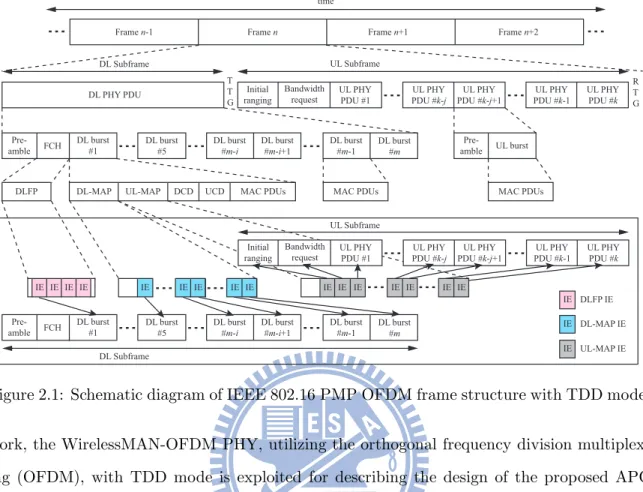
Figure 2.1: Schematic diagram of IEEE 802.16 PMP OFDM frame structure with TDD mode. work, the WirelessMAN-OFDM PHY, utilizing the orthogonal frequency division multiplex-ing (OFDM), with TDD mode is exploited for describmultiplex-ing the design of the proposed APC approach.
Fig. 2.1 illustrates the schematic diagram of the IEEE 802.16 PMP OFDM frame structure with TDD mode. It can be observed that each frame consists of a DL subframe and a UL subframe. The DL subframe contains only one DL PHY protocol data unit (PDU), which starts with a long preamble for PHY synchronization. The preamble is followed by a frame control header (FCH) burst and several DL bursts. A DL frame prefix (DLFP), which is contained in the FCH, specifies the burst profile and length for the first DL burst (at most four) via the information element (IE). It is noted that each DL burst may contain an optional preamble and more than one MAC PDUs that are destined for the same or different SSs. The first MAC PDU followed by the FCH is the DL-MAP message, which employs DL-MAP IEs to describe the remaining DL bursts. The DL-MAP message can be excluded in the case that the DL subframe consists of less than five bursts; nevertheless, it must still be sent out periodically to maintain synchronization. A UL-MAP message immediately following
the DL-MAP message denotes the usage of UL bursts via UL-MAP IEs. An interval usage code, corresponding to a burst profile, describes a set of transmission parameters, e.g., the modulation and coding type, and the forward error correction type. The DL interval usage code (DIUC) and UL interval usage code (UIUC) are specified in the DL channel descriptor (DCD) and UL channel descriptor (UCD) messages respectively. The BS broadcasts both the DCD and UCD messages periodically to define the characteristics of the DL and UL physical channels respectively.
On the other hand, as can be seen from Fig. 2.1, the UL subframe starts with the con-tention intervals that are specified for both initial ranging and bandwidth request. It is noted that more than one UL PHY PDU can be transmitted after the contention intervals. Each UL PHY PDU consists of a short preamble and a UL burst, where the UL burst transports the MAC PDUs for each specific SS. Moreover, the transmit/receive transition gap (TTG) and the receive/transmit transition gap (RTG) are inserted in between the DL and the UL subframes and at the end of each frame respectively. These two gaps provide the required time for the BS to switch from the transmit to receive mode and vice versa.
2.2.2 Packet Transmission Mechanism
A connection in IEEE 802.16 PMP networks is defined as a unidirectional mapping between the BS and an MS, which is identified by a 16-bit connection identifier (CID). Two kinds of connections, including management connections and transport connections, are defined in the IEEE 802.16 standard. The management connections are utilized for delivering MAC management messages; while the transport connections are employed to transmit user data. During the initial ranging of a SS, a pair of UL/DL basic connections are established, which belong to a type of the management connections. It is noted that a single Basic CID is assigned to a pair of UL/DL basic connections, which is served as the identification number for the corresponding SS. Thus the SS uses the individual transport CID to request bandwidth for each transport connection while the BS arranges the accumulated transmission opportunity by addressing the Basic CID of the SS.
SS1
SS2
BS
Internet (or other networks) Intra-cell traffic Inter-cell traffic Wired connection Wirelses connection (a) DL subframe UL subframe Frame n DL subframe UL subframe Frame n+1 The jth packet: from SS1 to BS The jth packet: from BS to SS2 Packet-rerouting delay
Other data packets Target intra-cell data packet
(b)
Figure 2.2: Example of packet transmission in IEEE 802.16 PMP networks: (a) network topology and (b) conventional transmission scheme in time sequence.
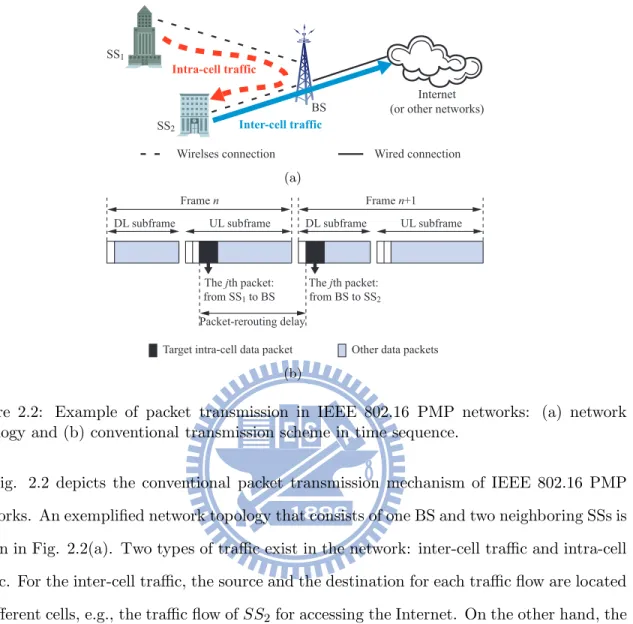
Fig. 2.2 depicts the conventional packet transmission mechanism of IEEE 802.16 PMP networks. An exemplified network topology that consists of one BS and two neighboring SSs is shown in Fig. 2.2(a). Two types of traffic exist in the network: inter-cell traffic and intra-cell traffic. For the inter-cell traffic, the source and the destination for each traffic flow are located in different cells, e.g., the traffic flow of 𝑆𝑆2 for accessing the Internet. On the other hand, the
intra-cell traffic is defined while the source and destination are situated within the same cell network, such as the traffic flow between 𝑆𝑆1and 𝑆𝑆2in Fig. 2.2(a). Considering the scenario
that 𝑆𝑆1 intends to communicate with its neighboring station 𝑆𝑆2, two transport connections
are required to be established via the service flow management mechanism for the intra-cell traffic, i.e., the UL transport connection from 𝑆𝑆1 to the BS and the DL transport connection
from the BS to 𝑆𝑆2. Fig. 2.2(b) illustrates the conventional transmission mechanism of IEEE
802.16 PMP networks in time sequence. In the most ideal case, the 𝑗th intra-cell packet, transmitted from 𝑆𝑆1 to the BS in the 𝑛th frame, will be forwarded to 𝑆𝑆2 in the (𝑛+1)th
for achieving the intra-cell packet transmission, which consequently increases communication overhead resulted from the duplication of data packets. Moreover, the delay time for packet-rerouting can be more than one half of a frame duration while the packet transmission from the BS to 𝑆𝑆2 is postponed to a latter DL subframe.
2.2.3 Problem Statement
Based on the aforementioned drawbacks of the conventional transmission mechanism in IEEE 802.16 PMP networks, the object problem of this work is described as follows:
Problem 1 (Direct Communication Problem). Given a pair of SSs that are actively in-volved in packet transmission, how to conduct efficient communication for the pair in order to increase the user throughput as well as to reduce the communication bandwidth and control overheads?
2.3
Adaptive Point-to-point Communication (APC) Approach
In this section, the proposed APC approach is presented for IEEE 802.16 PMP networks. The concept of the proposed scheme is to design a point-to-point directly communicable mechanism for SSs. Based on the channel conditions among the BS and SSs, the packet transmission operation is switched automatically between the conventional indirect-link scheme and the proposed direct-link mechanism. Therefore, the following three conditions are designed to be satisfied in the proposed APC approach:
∙ Flexible Condition. This condition states that the APC approach is dynamically imple-mented. In other words, the direct communication between two SSs can be initiated, reactivated, and terminated by either the BS or the SS at any frame.
∙ Contention-free Condition. The inquiry for direct communication between two SSs may be requested by different pairs of SSs simultaneously. This condition indicates that the proposed APC approach should hold the contention-free processes, which include request, proceeding, and termination among those directly communicable pairs.
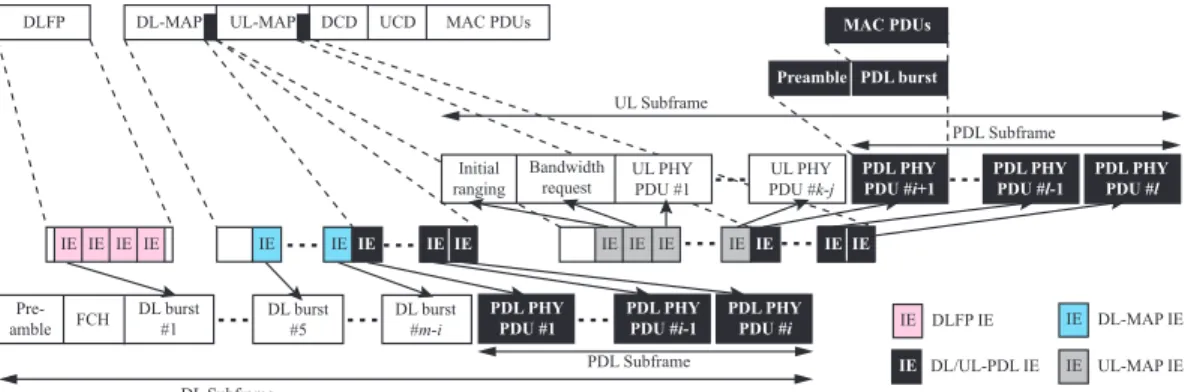
DLFP DL-MAP UL-MAP DCD UCD MAC PDUs DL Subframe UL Subframe IE IE IE IE IE IE IE IE IE IE IE DLFP IE IE DL-MAP IE IE UL-MAP IE Pre-amble FCH DL burst #1 DL burst #5 DL burst #m-i Initial ranging Bandwidth request UL PHY PDU #1 Preamble PDL burst MAC PDUs UL PHY PDU #k-j PDL PHY PDU #i+1 PDL PHY PDU #l-1 PDL PHY PDU #l PDL PHY PDU #1 PDL PHY PDU #i-1 PDL PHY PDU #i IE IE IE IE IE IE DL/UL-PDL IE IE PDL Subframe PDL Subframe
Figure 2.3: Schematic diagram of IEEE 802.16 PMP OFDM frame structure with APC approach.
∙ Backward-compatible Condition. This condition indicates that the proposed APC ap-proach is compatible and can be directly integrated with the existing protocols that are defined in the IEEE 802.16 standard.
It can be expected that the APC approach reduces both the required communication band-width and the control overhead for intra-cell traffic and also eliminates the packet-rerouting delay time. Furthermore, the network throughput is enhanced due to the automatic selection of efficient transmission manner between two schemes.
2.3.1 Architecture and Management Structure
Comparing with the original IEEE 802.16 PMP frame structure, the following two modifica-tions are exploited by the proposed APC approach: (𝑖) one or more point-to-point direct link (PDL) PHY PDUs are appended after the original DL PHY PDU in DL subframe; and (𝑖𝑖) a specific number of UL PHY PDUs are replaced by the PDL PHY PDUs in UL subframe. The schematic diagram of the IEEE 802.16 PMP frame structure with APC approach is illustrated in Fig. 2.3, where the adjustments are depicted by the block rectangles. It can be observed that the proposed PDL subframe is designed to be a subset of a DL subframe and/or a UL subframe. A PDL subframe consists of one or more PDL PHY PDUs, which start with a short preamble followed by a PDL burst. Each PDL burst is designed to transport the MAC PDUs for each specific SS. Moreover, the DL-PDL IE and UL-PDL IE are designed to be included
in the DL-MAP and UL-MAP messages respectively, which are utilized to specify the burst profiles and lengths for the corresponding PDL bursts. In order to fully compatible with the existing IEEE 802.16 standard, three categories of management structures,including the DL-PDL IE and UL-PDL IE, the PDL subheader, and the PDL burst profile change request (PBPC-REQ) and response (PBPC-REP) messages, are proposed in the APC approach. The functionalities and formats of these structures are detailed as follows.
DL-PDL IE and UL-PDL IE
As shown in Fig. 2.3, the DL-MAP message defines the access to the DL channel; while the UL-MAP message characterizes and schedules the UL subframe. In other words, both the DL-MAP and UL-MAP messages adopt the IEs along with DIUC and UIUC to describe the burst profiles and lengths of the corresponding DL and UL bursts respectively. The proposed DL-PDL IE and UL-PDL IE are designed to depict burst profiles and lengths of their corresponding PDLs in the DL and UL subframes respectively. The format of the DL-PDL IE is defined as in Table 2.1, which is considered as a new type of the extended DIUC dependent IE within the OFDM DL-MAP IE. The extended DIUC field identifies the IE type; while the size of IE is indicated in the length field. The duration field specifies the length of the corresponding PDL burst in the OFDM symbols. On the other hand, the proposed UL-PDL IE (as defined in Table 2.2) is designed to be a new type of the UL extended IE that is contained in the OFDM UL-MAP IE. It is noticed that both the proposed DL-PDL IE and UL-PDL IE are designed to conform to the formats of the DL-MAP dummy IE and UL-MAP dummy IE, respectively, which are defined in the IEEE 802.16 standard for supporting newly developed IEs.
PDL Subheader
In the original IEEE 802.16 standard, six types of subheaders have been specified immediately followed by the generic MAC header. The proposed PDL subheader is designed to be a new type of per-PDU subheader that can be transmitted in both the DL and UL directions. It
Table 2.1: OFDM DL-PDL IE format
Syntax Size (bit)
DL PDL IE() { -Extended DIUC 4 Length 4 DIUC 4 Duration 12 }
-Table 2.2: OFDM UL-PDL IE format
Syntax Size (bit)
UL PDL IE() {
-Extended UIUC 4
Length 4
UIUC 4
Padding nibble, if needed 4
}
-is utilized to implement the request, response, announcement, and termination of the APC approach. The presence of the PDL subheader is indicated by a reserved bit in the generic MAC header. Table 2.3 illustrates the format of the PDL subheader; while its encoded type field is shown in Table 2.4. The location type (LT) field (as shown in Table 2.5) within the PDL subheader is adopted to either request or present the location information (LI) IE which includes the latitude, longitude, and altitude information [15]. The usages of the location information will further be explained in Subsection 2.3.2.
PBPC-REQ and PBPC-REP messages
In the IEEE 802.16 standard, the adaptive modulation and coding (AMC) mechanism is exploited as the link adaption technique to improve network performance on time-varying channels. The BS selects an adequate modulation and coding scheme (MCS) for a SS based on the reported signal-to-interference and noise ratio (SINR) value. The selected MCS is specified in the burst profile and is represented by the DIUC and UIUC value for the DL and UL directions respectively. Moreover, the BS permits the changes in the DIUC value that are suggested by the SS via the burst profile change request message. Similarly, both the
Table 2.3: PDL subheader format
Syntax Size (bit)
PDL Subheader() { -Type 3 Location Type (LT) 2 if (Type == 000) { -SSID 48 LI IE() 64 } -if (Type == 001) -CID 16 if (Type == 010) { -if (LT == 01) -LI IE() 64 } -if (Type == 011) { -SINR 8 if (LT == 10) -LI IE() 64 } -if (Type == 1xx) { -CID 16 CID 16 for (𝑖 = 1; 𝑖 <= 𝑛; 𝑖++) -CID 16 } -Reserved 3 }
-Table 2.4: Type field encodings for PDL subheader
Type PDL subheader type
000 PDL request from source SS to BS.
001 PDL request from BS to destination SS.
010 PDL response from source SS to BS.
011 PDL response from destination SS to BS.
100 PDL termination request from SS.
101 PDL announcement for termination.
110 PDL announcement for confirming the request.
Table 2.5: LT field encodings for requesting/presenting location information
LT DL/UL
00 Not request/present.
01 Request/present source SS’s location information. 10 Request/present destination SS’s location information. 11 Request both SSs’ location
information./-Table 2.6: PBPC-REQ/REP message format
Syntax Size (bit)
PBPC-REQ/REP Message Format(){
-Management Message Type 8
Reserved 4
CID 16
PIUC 4
Configuration Change Count 8
}
-proposed PBPC-REQ and PBPC-REP messages are designed to change the MCS for PDLs, where the format of both messages are shown in Table 2.6. The PBPC-REQ message is utilized to request the adjustment of the PDL interval usage code (PIUC) value for the PDL burst. The BS will respond with the proposed PBPC-REP message for either confirming or denying the alteration in the PIUC value. It is noticed that the PIUC value represents either the DIUC in DL direction or the UIUC in UL direction. The operation of the PBPC-REQ and PBPC-REP messages will be shown in the following subsection.
2.3.2 Admission Control Scheme
In the APC approach, some criteria should be exploited to determine the execution of direct communication between two SSs. A two-tiered admission control scheme for a BS and two attached SSs is presented in this subsection. In wireless communication system, the data transmission range for each station is proportional to its corresponding transmission power. In order to avoid additional power consumption resulted from the APC approach, the distance factor is considered as the first-tiered constraint, energy-oriented (EO) constraint, which is
Table 2.7: OFDM modulation and coding schemes
MCS index Modulation Coding rate Coded block size (byte) Receiver SNR (dB)
0 BPSK 1/2 24 3.0 1 QPSK 1/2 48 6.0 2 QPSK 3/4 48 8.5 3 16-QAM 1/2 96 11.5 4 16-QAM 3/4 96 15.0 5 64-QAM 2/3 144 19.0 6 64-QAM 3/4 144 21.0 defined as 𝒞1: 𝐷(𝑆𝑆𝑠, 𝑆𝑆𝑑) ≤ 𝐷(𝑆𝑆𝑠, 𝐵𝑆),
where 𝐷(𝑥, 𝑦) denotes the relative distance between 𝑥 and 𝑦; while the source SS and desti-nation SS of an intra-cell traffic is represented as 𝑆𝑆𝑠 and 𝑆𝑆𝑑 respectively. In other words,
the transmission power utilized by 𝑆𝑆𝑠 for achieving direct communication is adjusted to be
equal to or less than that as specified in the conventional IEEE 802.16 mechanism.
On the other hand, for the purpose of enhancing the efficiency for data transmission, channel conditions among the BS, 𝑆𝑆𝑠, and 𝑆𝑆𝑑 should be taken into account. Different
MCSs associated with various number of data bits are adopted for data transmission under different channel conditions. Based on the channel states and the corresponding MCS, the second-tiered constraint, throughput-oriented (TO) constraint, is defined as
𝒞2 : 𝑇𝑃 𝐷𝐶(𝑆𝑆𝑠, 𝑆𝑆𝑑) ≥ 𝑇𝐶𝑜𝑛𝑣(𝑆𝑆𝑠, 𝑆𝑆𝑑),
where 𝑇 (𝑆𝑆𝑠, 𝑆𝑆𝑦) represents the raw user throughput defined as ”number of bits per second
that is received by the destination 𝑆𝑆𝑑 while the source is 𝑆𝑆𝑠”. In other words, the raw user
throughput resulted from the PDC approach (𝑇𝑃 𝐷𝐶) should be at least equal to or higher
than that from the conventional IEEE 802.16 mechanism (𝑇𝐶𝑜𝑛𝑣). The values of both 𝑇𝑃 𝐷𝐶
and 𝑇𝐶𝑜𝑛𝑣 are derived as the description in the following paragraph.
the considered OFDM system, the raw data rate 𝑅𝑑 of the MCS with index 𝜉 is represented as 𝑅𝑑[𝜉] = 𝐵𝑢[𝜉] 𝑇𝑠 , (2.3)
where 𝑇𝑠 is the OFDM symbol duration. The notation 𝐵𝑢[𝜉] indicates the number of uncoded
bits per OFDM symbol of the MCS with index 𝜉, which is obtained as
𝐵𝑢[𝜉] = 𝑁𝑑⋅ log2𝑀 ⋅ 𝑅𝑐[𝜉], (2.4)
where 𝑁𝑑 denotes the number of data subcarriers and 𝑅𝑐[𝜉] is the coding rate of the MCS
with index 𝜉. The value of the parameter 𝑀 depends on the adopted MCS, i.e., 𝑀 = 2 for BPSK, 𝑀 = 4 for QPSK, 𝑀 = 16 for 16-QAM, and 𝑀 = 64 for 64-QAM. Moreover, the OFDM symbol duration 𝑇𝑠 can be acquired as
𝑇𝑠= 𝑇𝑏+ 𝑇𝑔= 𝑇𝑏+ 𝐺 ⋅ 𝑇𝑏=
1 + 𝐺
△𝑓 , (2.5)
where 𝑇𝑏 and 𝑇𝑔 represent the useful symbol time and the cyclic prefix (CP) time respectively.
The notation 𝐺 denotes the ratio of 𝑇𝑔 to 𝑇𝑏. The subcarrier spacing △𝑓 is obtained as
△𝑓 = 𝐹𝑠 𝑁𝑠 = 8000 𝑁𝑠 ⋅⌊ 𝑛 ⋅ 𝐵𝑊 8000 ⌋ , (2.6)
where 𝑁𝑠indicates the number of total subcarriers. The notation 𝐹𝑠 represents the sampling
frequency with its value specified by the IEEE 802.16 standard as in (2.6), where 𝑛 is the sampling factor and 𝐵𝑊 is the channel bandwidth. By substituting (2.6) into (2.5), the OFDM symbol time can be approximated as
𝑇𝑠= 𝑁𝑠
𝐹𝑠
⋅ (1 + 𝐺) ≈ 𝑁𝑠
With (2.4) and (2.7), the raw data rate 𝑅𝑑 of the MCS with index 𝜉 in (2.3) becomes
𝑅𝑑[𝜉] ≈
𝑁𝑑⋅ log2𝑀 ⋅ 𝑅𝑐[𝜉] ⋅ 𝑛 ⋅ 𝐵𝑊
𝑁𝑠⋅ (1 + 𝐺)
. (2.8)
Based on (2.8), the raw user throughput by adopting the PDC approach is acquired as 𝑇𝑃 𝐷𝐶(𝑆𝑆𝑠, 𝑆𝑆𝑑) = 𝑅𝑑[𝜉(𝑠,𝑑)], (2.9)
where 𝜉(𝑠,𝑑) represents the index of the MCS that will be assigned to the direct link between
𝑆𝑆𝑠 and 𝑆𝑆𝑑. On the other hand, the raw user throughput in the conventional IEEE 802.16
mechanism is constrained by the two-hop transmission, i.e., from 𝑆𝑆𝑠 to BS and from BS to
𝑆𝑆𝑑. Thus the 𝑇𝐶𝑜𝑛𝑣 can be obtained as
𝑇𝐶𝑜𝑛𝑣(𝑆𝑆𝑠, 𝑆𝑆𝑑) =
1
2𝑅𝑑[𝜙(𝑠,𝑑)], (2.10)
where
𝜙(𝑠,𝑑)= min[𝜉(𝑠,𝐵𝑆), 𝜉(𝐵𝑆,𝑑)] . (2.11)
The notation 𝜉(𝑠,𝐵𝑆) denotes the index of the MSC utilized in the link between 𝑆𝑆𝑠 and the
BS; while that is assigned to the link between the BS and 𝑆𝑆𝑑 is represented as 𝜉(𝐵𝑆,𝑑).
2.3.3 Direct Communication Procedures
Based on the aforementioned management structures and admission control scheme, the direct communication procedures of the APC approach are explained in this subsection.
Considering a basic IEEE 802.16 PMP network that consists of a BS and two SSs, an intra-cell traffic flow is existed between the source 𝑆𝑆𝑠 and destination 𝑆𝑆𝑑. Two transport
connections are established for packet transmission, i.e., the UL transport connection (with CID = 𝐾1) from 𝑆𝑆𝑠 to the BS and the DL transport connection (with CID = 𝐾2) from the
BS to 𝑆𝑆𝑑. It is noted that 𝐾1 and 𝐾2 are denoted as specific CID values.
Data packet on transport connection (CID = K1)
SSs BS SSd
Data + PDL subheader (Type = 000)
DL/UL-MAPs (excludes PDL_IEs)
Data + PDL subheader (Type = 001) SINR detection message
PDL subheader (Type = 011) Data packet
on transport connection (CID = K2)
DL/UL-MAPs (excludes PDL_IEs)
(a)
SSs BS SSd
SINR detection message
PDL subheader (Type = 111)
PDL subheader (Type = 011) Data + PDL subheader (Type = 010)
Data packet
on transport connection (CID = K1)
Data packet on transport connection (CID = K2)
DL/UL-MAPs (excludes PDL_IEs)
(b)
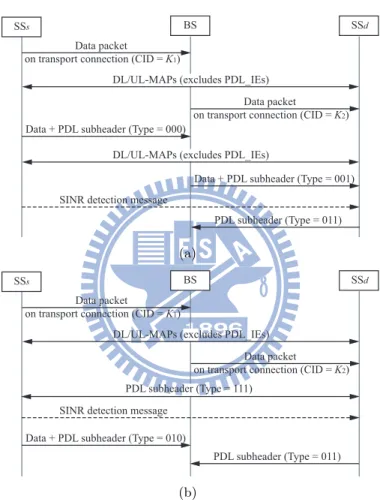
Figure 2.4: Schematic diagram of link request and information collection procedure for direct communication: (a) SS-initiated procedure and (b) BS-initiated procedure.
request and information collection. The pair of 𝑆𝑆𝑠 and 𝑆𝑆𝑑 that anticipates to establish
a direct link are required to provide their location information and channel conditions to the BS. It is assumed that the SSs can acquire their location information by either using the GPS or performing network-based location estimation techniques [16, 17]. The collected information is utilized in the admission control scheme mentioned above. Fig. 2.4 illustrates an exemplified message flows for the initialization procedure of direct communication.
In the case that 𝑆𝑆𝑠 intends to conduct direct communication with 𝑆𝑆𝑑, as shown in Fig.
2.4(a), it attaches a PDL subheader to a data packet that will be delivered to the BS. The PDL subheader is utilized to request a direct link establishment with 𝑆𝑆𝑑, where the Type
field in the subheader is denoted as 000 and the 48-bit MAC address of 𝑆𝑆𝑑 is filled in the
SSID field (as shown in Tables 2.3 and 2.4). The LT field is assigned as 01 and the location information of 𝑆𝑆𝑠 will be filled into the corresponding LI IE. As the BS receives the request
PDL subheader from 𝑆𝑆𝑠, the BS will attach a PDL subheader (with Type field = 001) to
the data packet and conduct the transmission to 𝑆𝑆𝑑. The transport CID 𝐾1 will be carried
in the subheader for indicating that 𝑆𝑆𝑠is the source of the direct communication, and it will
send an SINR detection message via that connection. If the BS does not possess the location information of 𝑆𝑆𝑑, it will set the LT field as 10 for requesting the location information of
𝑆𝑆𝑑.
Furthermore, the BS will arrange a DL burst for 𝑆𝑆𝑠 with the assignment in the
cor-responding DL-MAP message. The CID of the UL transport connection (i.e., CID = 𝐾1)
will be recorded in the CID field of the DL-MAP IE; while the DIUC field is set with the value that corresponds to the BPSK 1/2 MCS. Specifically, the DL burst for the connection with CID 𝐾1 is prepared for 𝑆𝑆𝑠 to transmit an SINR detection message to 𝑆𝑆𝑑 by using
the BPSK 1/2 MCS. It is noticed that the UL transport CID will be assigned in the DL subframe, which will not happen by adopting the conventional mechanism. Therefore, the 𝑆𝑆𝑠 is aware that the DL burst for the UL transport CID is utilized to transmit the SINR
detection message. After receiving the PDL subheader and SINR detection message from the BS and 𝑆𝑆𝑠 respectively, 𝑆𝑆𝑑 will transmit a response PDL subheader with Type 011. The
average SINR value calculated from the SINR detection message will also be recorded in the response PDL subheader. It is noted that the location information of 𝑆𝑆𝑑 is carried in the
response PDL subheader if it is required by the BS.
On the other hand, the BS-initiated direct communication procedure is shown in Fig. 2.4(b). Contrary to the SS-initiated procedure, the BS actively announces the link request along with the PDL subheader (with Type field = 111) to the specific SSs, i.e, 𝑆𝑆𝑠 and
𝑆𝑆𝑑. The Basic CIDs for both 𝑆𝑆𝑠 and 𝑆𝑆𝑑 are specified within the first two CID fields of
the PDL subheader as shown in Table 2.3; while the corresponding UL transport CID 𝐾1 is
written in the third CID field. As the 𝑆𝑆𝑠 receives the requesting PDL subheader with LT
= 01 or 11 from the BS, the 𝑆𝑆𝑠 will attach a PDL subheader (with Type field = 010) to a
data packet that will be delivered to the BS. Correspondingly, the 𝑆𝑆𝑠will utilize the replying
PDL subheader to provide its location information that is requested by the BS. The remaining procedures of the BS-initiated APC approach are similar to that of the SS-initiated case, such as the SINR detection procedure between 𝑆𝑆𝑠 and 𝑆𝑆𝑑, and the response PDL subheader
from 𝑆𝑆𝑑.
The BS executes the admission control procedure after it received the response PDL subheader transmitted from 𝑆𝑆𝑑. Based on the collected information, the aforementioned
two-tiered control scheme is exploited by the BS to either confirm or deny the direct communication request between 𝑆𝑆𝑠 and 𝑆𝑆𝑑. It is noted that the constraints 𝒞1 and 𝒞2 can be exploited
either jointly or separately. The performance of the separately implemented mechanisms, i.e., the APC-TO and the APC-EO approaches, will be evaluated via the simulation results in Subsection 2.5.2. The confirming results will be broadcasted along with the PDL subheader (with Type field = 110) by the BS. The Basic CIDs for both 𝑆𝑆𝑠 and 𝑆𝑆𝑑 are written
within the the first two CID fields of the PDL subheader as shown in Table 2.3; while the corresponding confirmed connections are recorded in the remaining CID fields. In the case that all the connections belonging to the indirect transmission from 𝑆𝑆𝑠to 𝑆𝑆𝑑are confirmed
by the BS, the individual CIDs will be replaced by the Basic CID of 𝑆𝑆𝑠. In other words, the
SSs BS SSd
DL/UL-MAPs (includes PDL_IEs)
(provides bandwidth request opportunity for polling-based service)
Bandwidth request (polling-based service)
DL/UL-MAPs (includes PDL_IEs) Data packet (non-polling-based service) Data packet (non-polling-based service) Data packet (polling-based service)
Figure 2.5: Schematic diagram of bandwidth request procedure in APC approach. overhead caused by the individually confirmed CIDs. Consequently, the BS will arrange the corresponding PDL bursts for conducting direct communication in subsequent frames.
After receiving the confirmation announcement, the considered SSs will activate the pro-cedure of direct communication. According to the received MAPs associated with the PDL IEs, 𝑆𝑆𝑠 will conduct packet transmission directly to 𝑆𝑆𝑑 within the PDL bursts. Moreover,
𝑆𝑆𝑑 will continuously observe and evaluate the cannel condition for the direct link with the
adaptation to an appropriate MCS. The calculated SINR is compared with the receiver SNR range of the current MCS (as listed in Table 2.7) by 𝑆𝑆𝑑. If the existing MCS is observed
to be improper for the current channel condition, 𝑆𝑆𝑑 will initiate a PBPC-REQ message to
the BS for suggesting an appropriate MCS via the PIUC value. Consequently, the BS will respond with a PBPC-REP message with a recommended PIUC value. If the PIUC values from both the PDPB-REQ and the PBPC-REP messages are perceived to be the same, the request for the change of MCS will be accepted. If the condition is not satisfied, the PIUC value will remain unaltered.
It is worthwhile to mention that the bandwidth requests are conducted by an SS based on individual transport connection. On the other hand, the bandwidth grant from the BS is executed according to the accumulated requests from the SS. In other words, the bandwidth grant is addressed to the Basic CID of the corresponding SS, not to the individual transport CIDs. As a result, the CID specified for the PDL burst becomes the Basic CID of 𝑆𝑆𝑠.
bandwidth request and allocation as specified in the IEEE 802.16 standard are implemented within the proposed APC approach. Fig. 2.5 illustrates the bandwidth request procedure while the APC approach is adopted. It can be observed that the BS preserves PDL bursts for non-polling based service periodically. Furthermore, the BS will continue to provide unicast bandwidth request opportunity for polling-based service based on the original transport CIDs of 𝑆𝑆𝑠. The unicast bandwidth grant of the polling-based service will consequently be assigned
to PDL bursts based on the Basic CID of 𝑆𝑆𝑠.
The procedure for the link termination occurs as one of the following two conditions is satisfied: (a) the channel condition of the direct link is becoming worse than that from the indirect channels (i.e., via the BS); (b) the direct communication is determined to be ceased. It is noted that the link termination can be initiate by either the BS or the SSs. In the SS-initiated termination procedure, the SS will transmit a termination PDL subheader (with Type field = 100). As the message is received by the BS, it will broadcast an announce-ment along with a PDL subheader (with Type field = 101) to both 𝑆𝑆𝑠 and 𝑆𝑆𝑑 regarding
the termination of the direct communication link. On the other hand, for the BS-initiated termination procedure, the termination information is actively announced by the BS. As a result, the BS and the associated SSs will return to adopt the original packet transmission mechanism as defined in the IEEE 802.16 standard.
Fig. 2.6 depicts the flowchart of switching process for packet transmission in the proposed APC approach. The entire process is constructed by the aforementioned procedures. It can be observed that the communication operation switched between direct and indirection manners is dominated by the constraint 𝒞2. In other words, the APC approach always selects the most
efficient transmission manner for intra-cell traffic based on the channel conditions among the BS and SSs. It is noted that the channel conditions can be obtained via calculating the SINR value periodically. Consequently, it can be expected that the network throughput is enhanced while the proposed APC approach is exploited.
Begin of APC approach The 1st time to execute APC approach Information collection: Location of SSs Information collection: SINR of direct link
Admission control: satisfy C1 and/or C2 constraint Indirect communication (IEEE 802.16) MCS change for the direct link Direct communication
(proposed) Satisfy C2 constraint
Terminate APC approach No Yes No Yes Yes Yes No No No End of APC approach Yes
2.4
Numerical Analysis
In this section, an analytical study of the IEEE 802.16 PMP OFDM frame structure with TDD mode is conducted. This study aims at analyzing the saturation user throughput as well as the corresponding overhead that can be achieved in IEEE 802.16 PMP networks. The user throughput is defined as the data bits per second which are received by the destination station in the considered network. Both the conventional packet transmission mechanism and the proposed APC approach are analyzed while taking into account both the MAC and PHY overheads. Since the saturation user throughput of the IEEE 802.16 network is the primary concern in this study, only one BS and two SSs are considered as shown in Fig. 2.2(a). It is assumed that both inter-cell traffic and intra-cell traffic flows exist in the considered network. Each inter-cell traffic flow is attached to either a UL or a DL connection; while the intra-cell traffic flow is resulted from the combination of both a UL and a DL connections. Therefore the number of inter-cell connections for a specific 𝑆𝑆𝑘 can be represented as
𝑛𝑘= 𝑛𝑑𝑘+ 𝑛𝑢𝑘, (2.12)
where 𝑛𝑑
𝑘 and 𝑛𝑢𝑘 are the numbers of inter-cell connections for 𝑆𝑆𝑘 in the DL and UL
direc-tions respectively. On the other hand, the number of intra-cell connecdirec-tions for 𝑆𝑆𝑘 can be
represented as
𝑚𝑘= 𝑚𝑑𝑘+ 𝑚𝑢𝑘+ 𝑚𝑑𝑘+ 𝑚𝑢𝑘, (2.13)
where 𝑚𝑑
𝑘 and 𝑚𝑢𝑘 denote the numbers of one-hop intra-cell connections in the DL and UL
directions for 𝑆𝑆𝑘 respectively. The term one-hop indicates that BS is assigned as either the
source or the destination station for the intra-cell connection. On the other hand, the numbers of two-hop intra-cell connections in the DL and UL directions for 𝑆𝑆𝑘 are represented as 𝑚𝑑𝑘
and 𝑚𝑢𝑘. In other words, both the source and destination stations are designated to SSs; while 𝑆𝑆𝑘 belongs to one of these two SSs.
2.4.1 Conventional Mechanism
In this subsection, both the saturation user throughput and the corresponding overhead for the conventional mechanism of the IEEE 802.16 network will be derived. Considering that 𝑆𝑓
represents one frame duration in the unit of OFDM symbols, the total number of available OFDM symbols 𝑆𝑎𝑣 within a frame can be obtained as
𝑆𝑎𝑣= 𝑆𝑓 − 𝑆𝑡𝑡𝑔− 𝑆𝑟𝑡𝑔, (2.14)
where 𝑆𝑡𝑡𝑔 and 𝑆𝑟𝑡𝑔 denote the durations of TTG and RTG in OFDM symbols respectively.
Without loss of generality, it is assumed that a frame duration is evenly partitioned by the DL and UL subframes for analytical convenience. Different durations of DL and UL subframes can also be analyzed in similar manner. However, the ratio of DL subframe to UL subframe should be a constant value for all the BSs in an IEEE 802.16 network. If the ratio is different for each BS, significant inter-cell interference will appear in the entire network. Therefore, the durations of both the DL subframe (𝑆𝑓𝑑) and the UL subframe (𝑆𝑓𝑢) in OFDM symbols can be represented as 𝑆𝑓𝑑=⌊ 𝑆𝑎𝑣 2 ⌋ , (2.15) 𝑆𝑓𝑢 = 𝑆𝑎𝑣− 𝑆𝑓𝑑. (2.16)
In order to obtain the user throughput, both the MAC and PHY overheads should be removed from the available raw bandwidth. According to the assumptions as mentioned above, the MAC and PHY overheads for a DL subframe in the conventional mechanism can be computed as 𝑆𝑜ℎ𝑑 = 𝑆𝑙𝑝+ 𝑆𝑓 𝑐ℎ+ ⌈ 2𝐵𝑔𝑚ℎ+ 2𝐵𝑐𝑟𝑐+ 𝐵𝑚𝑎𝑝𝑑 + 𝐵𝑖𝑒𝑑 + 𝐵𝑚𝑎𝑝𝑢 + 5𝐵𝑖𝑒𝑢 𝐶𝑚𝑎𝑝 ⌉ , (2.17) where 𝑆𝑙𝑝 and 𝑆𝑓 𝑐ℎ are the durations of long preamble and FCH in OFDM symbols, which
MAC header and CRC in bytes; while 𝐵𝑚𝑎𝑝𝑑 , 𝐵𝑚𝑎𝑝𝑢 , 𝐵𝑖𝑒𝑑, and 𝐵𝑖𝑒𝑢 are the size of DL-MAP, UL-MAP, DL-MAP IE, and UL-MAP IE in bytes respectively. It is noted that all these parameters are designated as the MAC overhead. Moreover, the bytes per OFDM symbol for transmitting these MAP messages is denoted as 𝐶𝑚𝑎𝑝, whose value depends on the selection
of the MCS. Since only two SSs are considered in the analytical model, three DL bursts are described in the FCH, i.e., for broadcasting MAP messages and transmitting data packets to 𝑆𝑆1 and 𝑆𝑆2 individually. The DL-MAP message contains only an end of map IE; while
the UL-MAP message associated with UL-MAP IEs describe five bursts, including initial ranging, bandwidth request, two data grants for 𝑆𝑆1 an 𝑆𝑆2 individually, and end of map
IE. Furthermore, both the DL-MAP and UL-MAP messages are individually attached with a generic MAC header and a CRC as denoted in (2.17). On the other hand, the MAC and PHY overhead for a UL subframe consists of two contention intervals (i.e., the initial ranging and the bandwidth request) and the short preambles. Since there are two SSs in considered, two short preambles will be transmitted in total by both 𝑆𝑆1 and 𝑆𝑆2. Therefore, the overhead
for a UL subframe can be obtained as
𝑆𝑜ℎ𝑢 = 𝑆𝑐𝑖+ 2𝑆𝑠𝑝, (2.18)
where 𝑆𝑐𝑖 and 𝑆𝑠𝑝 are the durations of contention intervals and a single short preamble in
OFDM symbols respectively.
Recall that the main objective of this study is to determine the saturation user throughput and the corresponding overhead of IEEE 802.16 PMP networks. The focus is to compute the maximum number of MAC PDUs that can be transmitted and received by a station within a frame respectively. It is assumed that there is always a packet to be transmitted in each the connection for any of the SS. Moreover, based on connection-oriented feature of the IEEE 802.16 MAC protocol, the resource scheduling within the BS is implemented on a per connection basis. Therefore, each connection is designed to receive a fair share of service. In other words, the available bandwidth for an SS in a frame depends on the number of connections it possesses. Based on (2.12), (2.13), (2.15) and (2.17), the maximum number of